Works › Posterior Analytics, Books I–II
Volume 2 · pp. 118–120
Treatise IV, Chapter XIII. That The Principles Of Demonstration Stand Is Proved Analytically
A marker with ≈ is an approximate page boundary, placed by measure of the text; the page photographs remain the authority. In the paired views, clicking a page marker brings that page into view.
Caput XIII.
Quod stant principia demonstrationis analytice probatur.
Analytice autem proprie procedendo per resolutionem demonstratae conclusionis in sua principia, probatur quod finita sunt et stant demonstrationis principia: et hoc velocius et brevius quam fieri possit in logicis ostensionibus: quia talis analytica ostensio non colligit nisi demonstrationi propria quae pauca sunt. Logica autem considerat communia quae sunt valde multa. Analytice igitur ostenditur, quod nec in sursum accipiendo super praedicatum, neque in deorsum accipiendo sub subjecto praedicantia media scilicet quae de inferioribus praedicantur, infinita contingit esse in demonstrativis scientiis, de quibus in hoc opere nobis intentio est. Est autem in hac ostensione praemittendum, quod demonstratio est ex talibus et de talibus quae ipsa (secundum quod ipsa sunt) insunt, et secundum seipsa sive per se insunt rebus. Secundum seipsa autem sive per seipsa insunt dupliciter, ut scilicet in primo modo dicendi per se, vel in secundo. Quartus enim modus non pertinet ad propositiones, sed ad consequentiam: et tertius modus est subjecti ad praedicatum non comparati. Unde primus et secundus sunt propositionis: primus quidem est praedicati comparati ad subjectum, secundus autem subjecti comparati ad praedicatum 1.
Duo autem modi sunt: primus quidem eorum praedicatorum quae in illis subjectis sunt in eo quod quid est per diffinitionem: et secundus modus est in quibus praedicatis ipsa subjecta insunt ipsis praedicatis in eo quod quid est in diffinitiva ratione. Et hujus secundi modi est exemplum sicut in numero est impar: quia numerus cadit in diffinitione imparis: est enim impar numerus in cujus divisione per aequalia intercidit unitas, ut dicit Pythagoras: et quod est impar, inest in numero sicut passio in subjecto: numerus autem ut subjectum inest in ratione diffinitiva ipsius imparis. Et iterum ut exemplum ponamus de primo modo dicendi per se, multitudo, aut divisibile, quae sunt essentialia praedicata de numero, insunt in ratione diffinitiva numeri, sicut praedicatum est in ratione diffinitiva subjecti. Est enim numerus multitudo aggregata per unum, vel numerus est divisibile sive divisum ad unum.
Haec autem, quae sic cadunt in modis dicendi per se primo vel secundo, neutra contingit esse infinita: nec enim contingit abire in infinitum, sicut imperfectum vel impar est numeri, ut passio, ita scilicet, quod super passionem quae est praedicatum accipiatur alia passio, cui insit prima passio: sicut si dicam inesse impari esse impariter imparem, et illi dicam inesse aliam ulterius passionem in infinitum, cui passioni inerat prior passio existenti in subjecto. Hoc autem subjectum, cui existenti statim inest passio sicut primum subjectum quod secundum seipsum subjectum passionis est, si dicatur esse numerus, inerit his omnibus passionibus, quae insunt ipsi subjecto, in ratione diffinitiva: quia quidquid est in ratione diffinientis, est in ratione diffiniti: secunda autem passio diffinitur per primam, et tertia per secundam, et sic deinceps, et subjectum est in ratione primae passionis: igitur erit in ratione omnium aliarum. Si igitur, a destructione consequentis, non contingit infinita hujusmodi esse in numero, hoc est, infinitas passiones, sequitur quod praedicata, in quorum ratione sunt substantia, quae in sursum accipiuntur supra praedicatum conclusionis, quod est passio, non erunt infinita in sursum accepta: stant ergo finita in sursum.
Chapter XIII.
That the principles of demonstration stand is proved analytically.
But by proceeding properly analytically, through the resolution of a demonstrated conclusion into its principles, it is proved that the principles of demonstration are finite and stand; and this is done more quickly and more briefly than can be done in logical showings, because such an analytical showing gathers only things proper to demonstration, which are few. But logic considers common things, which are very many. Therefore it is shown analytically that neither in accepting upward above the predicate, nor in accepting downward under the subject, does it happen in demonstrative sciences, about which our intention is in this work, that the predicating middles, namely those which are predicated of inferiors, are infinite. But in this showing it must be premised that demonstration is from such things and concerning such things which themselves, according as they themselves are, are present, and are present to things according to themselves or per se. But they are present according to themselves or through themselves in two ways, namely in the first mode of speaking per se or in the second. For the fourth mode does not pertain to propositions but to consequence, and the third mode belongs to a subject not compared to a predicate. Whence the first and second belong to a proposition: the first indeed is of a predicate compared to a subject, but the second is of a subject compared to a predicate 1.
But there are two modes: the first indeed is of those predicates which are in those subjects in what-it-is through definition, and the second mode is in those predicates in which the subjects themselves are present to those predicates in what-it-is, in the definitive account. And an example of this second mode is as odd is in number, because number falls in the definition of odd. For the odd is a number in whose division by equals a unit intervenes, as Pythagoras says; and what is odd is present in number as a property in a subject, but number as subject is present in the definitive account of odd itself. And again, so that we may put an example of the first mode of speaking per se, multitude or divisible, which are essential predicates of number, are present in the definitive account of number, just as the predicate is in the definitive account of the subject. For number is a multitude aggregated through one, or number is divisible or divided to one.
But neither of these things, which in this way fall in the modes of speaking per se, the first or the second, can happen to be infinite. For neither does it happen to go away into infinity, as imperfect or odd belongs to number as a property, namely so that above the property which is the predicate another property is accepted, to which the first property is present, as if I should say that being unevenly odd is present to odd, and that another property further into infinity is present to that, to which property the prior property existing in the subject was present. But this subject, to which, as existing, the property is immediately present as to the first subject which according to itself is the subject of the property, if it is said to be number, will be present to all these properties which are present to the subject itself in the definitive account, because whatever is in the account of the one defining is in the account of the thing defined. But the second property is defined through the first, and the third through the second, and so thereafter, and the subject is in the account of the first property; therefore it will be in the account of all the others. Therefore if, by destruction of the consequent, it does not happen that infinite things of this sort are in number, that is, infinite properties, it follows that predicates, in whose account substance is, which are accepted upward above the predicate of the conclusion, which is a property, will not be infinite as accepted upward. Therefore finite things stand upward.
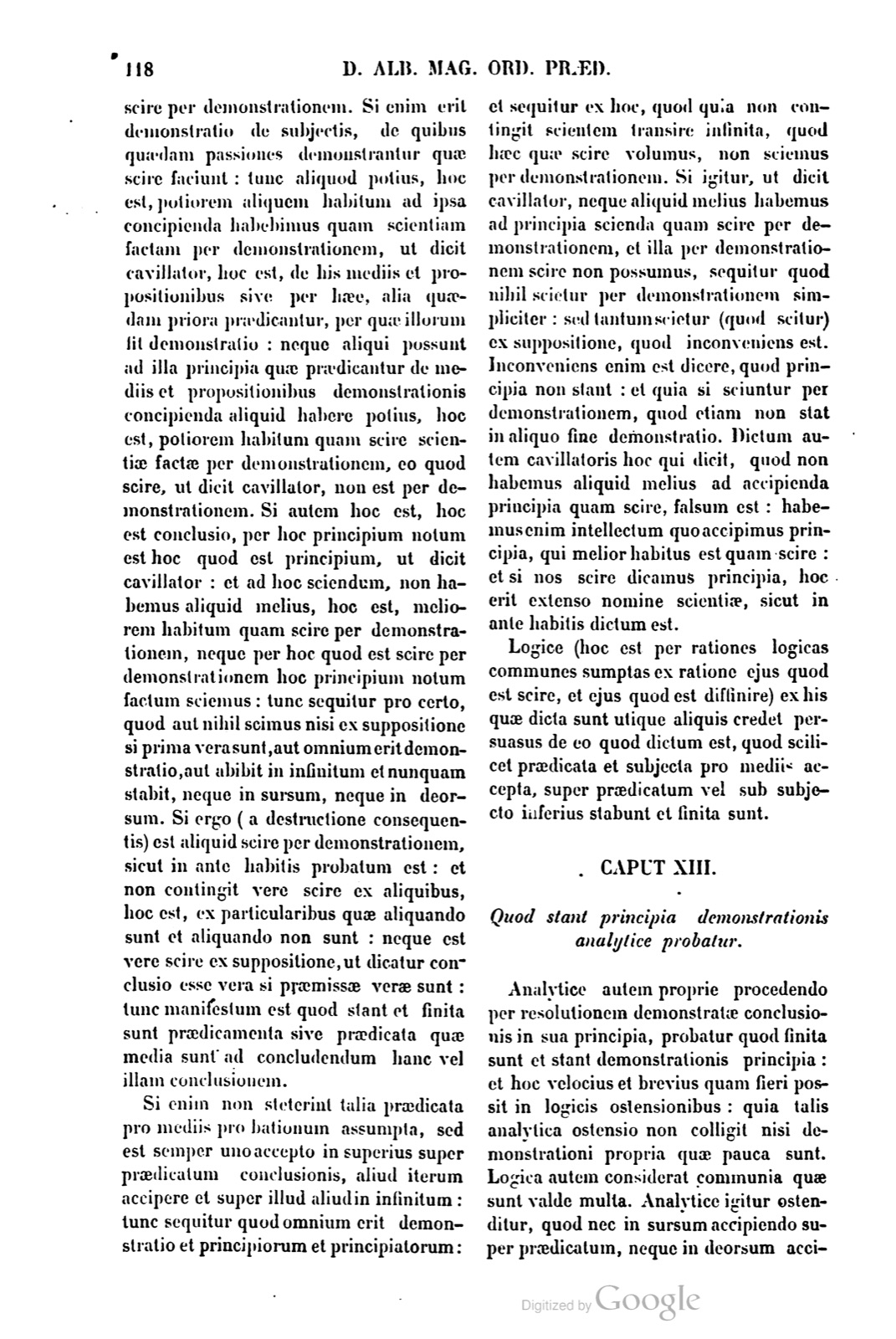
At vero quaecumque talia sint passiones subjecti, necesse omnia illa inesse primo subjecto, quod subjectum est primae passionis, ut numero quod est primum subjectum imparis, et impariter imparis, et divisibilis in aequa, et hujus modi: propter quod sequitur quod omnia talia praedicata sic accepta erunt convertibilia, et inter se, et cum subjecto: quia quarta convertitur cum tertia, et tertia cum secunda, et secunda cum prima, et prima cum subjecto: et quaecumque convertuntur cum convertibili, convertuntur etiam cum eo quod convertitur cum illo: sicut quidquid convertitur cum risibili, convertitur cum homine, sicut animal admirativum esse convertitur cum risibili et cum homine. Si autem sunt convertibilia, tunc nullum eorum excedit reliquum: igitur ad se revertuntur sibi invicem subjecta et de se invicem praedicata: non ergo abeunt semper in sursum accipiendo. Patet igitur quod in secundo modo dicendi per se non contingit abire in infinitum: et in primo modo etiam dicendi per se hoc non contingit, quum illa stent quae in secundo sunt dicta per se.
Non autem propter hoc quaecumque sunt in eo quod quid est in diffinitiva ratione subjecti, infinita sunt: quia non sunt infinita quae sunt in secundo modo dicendi per se. Si enim infinita essent illa, sequeretur quod non contingeret diffinire. Propter quod si talia praedicantia non praedicant id quod est in definita ratione subjecti, omnia dicentur esse per se praedicata: haec autem infinita non sunt neque esse possunt: stabunt utique haec in sursum accepta, ita quod unum super aliud continue accipiatur usque ad primum, quod ideo summum est, quia ipsum in nullo est superiori. Propter quod sequitur, quod stabunt etiam in deorsum ad infimum: quia per eadem descenditur per quae ascenditur: et si ascensus ab infimo ad superius est finitus, erit etiam descensus a summo ad infimum finitus. Si autem sic est, quod termini ascensus et descensus sunt finiti, tunc non distabunt termini per infinita media.
But whatever such things may be properties of the subject, all those must be present to the first subject, which is the subject of the first property, as to number, which is the first subject of odd, and of unevenly odd, and of divisible into equals, and of this sort. On account of this it follows that all such predicates accepted in this way will be convertible both among themselves and with the subject, because the fourth is converted with the third, and the third with the second, and the second with the first, and the first with the subject; and whatever things are converted with a convertible are also converted with that which is converted with it, just as whatever is converted with risible is converted with man, as being an admiring animal is converted with risible and with man. But if they are convertible, then none of them exceeds the remaining one. Therefore subjects and things predicated of one another return to themselves in relation to one another; therefore they do not always go away by accepting upward. Therefore it is clear that in the second mode of speaking per se it does not happen to go away into infinity; and also in the first mode of speaking per se this does not happen, since those things stand which in the second mode are said per se.
But on account of this, not whatever things are in what-it-is in the definitive account of the subject are infinite, because those things which are in the second mode of speaking per se are not infinite. For if they were infinite, it would follow that it would not happen to define. On account of this, if such predicating things do not predicate that which is in the defined account of the subject, all will be said to be per se predicates. But these are not infinite and cannot be; they indeed will stand as accepted upward, so that one is continuously accepted above another up to the first, which is therefore highest because it itself is in no superior. On account of this it follows that they will also stand downward at the lowest, because one descends through the same things through which one ascends; and if the ascent from the lowest to the higher is finite, the descent from the highest to the lowest will also be finite. But if it is so, that the terms of ascent and descent are finite, then the terms will not stand apart through infinite middles.
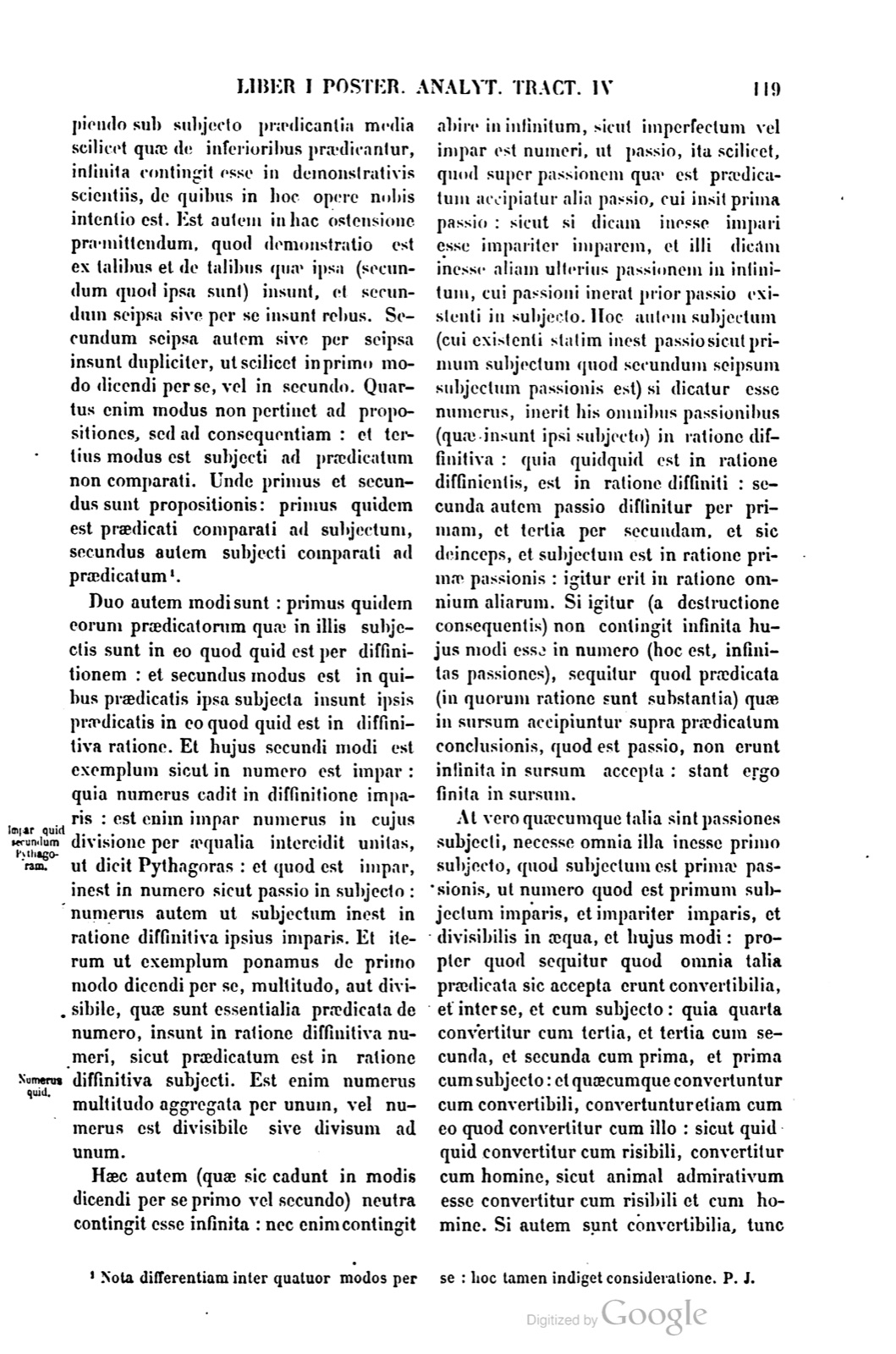
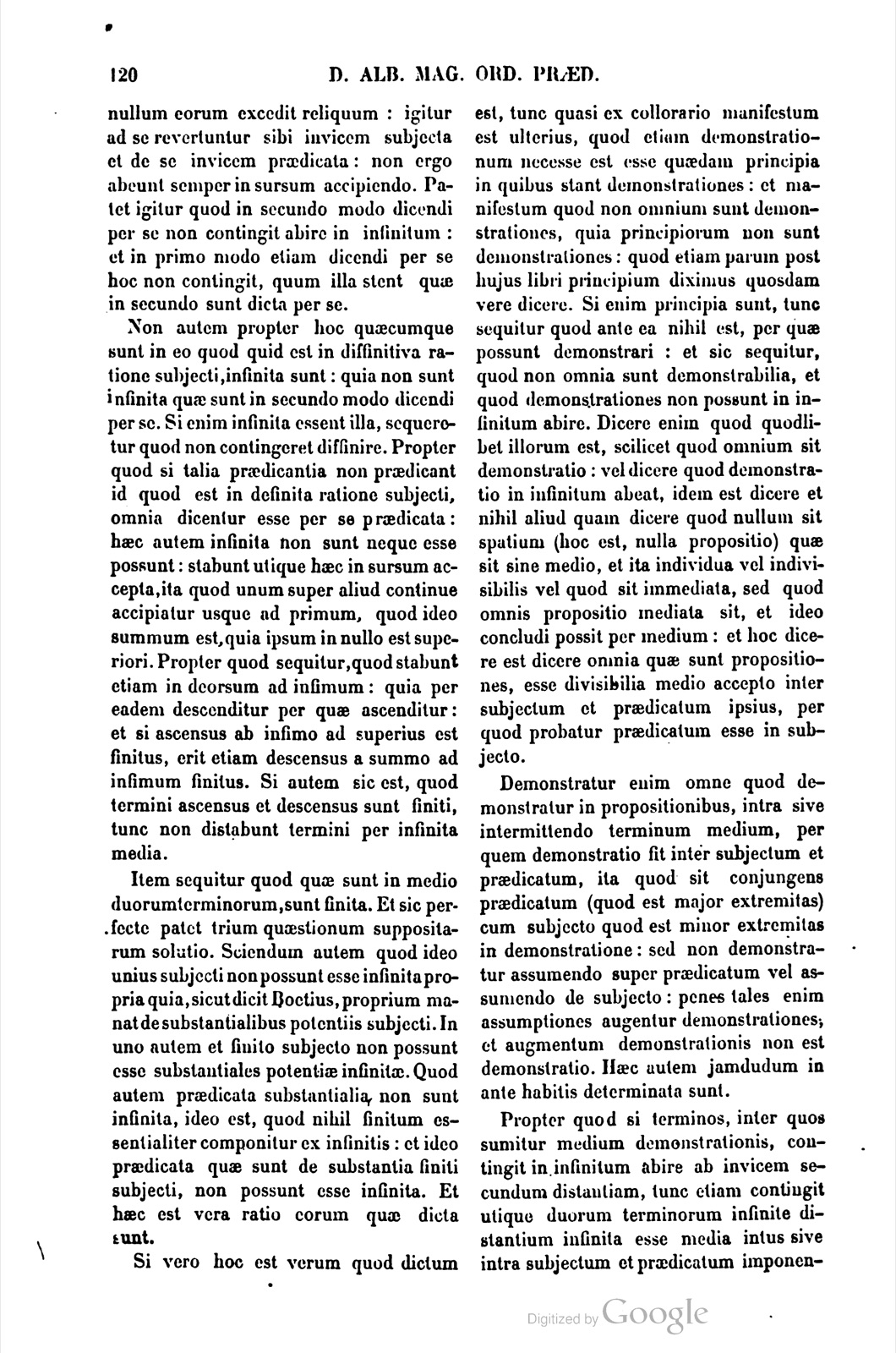
Item sequitur quod quae sunt in medio duorum terminorum, sunt finita. Et sic perfecte patet trium quaestionum suppositarum solutio. Sciendum autem quod ideo unius subjecti non possunt esse infinita propria quia, sicut dicit Boetius, proprium manat de substantialibus potentiis subjecti. In uno autem et finito subjecto non possunt esse substantiales potentiae infinitae. Quod autem praedicata substantialia non sunt infinita, ideo est, quod nihil finitum essentialiter componitur ex infinitis: et ideo praedicata quae sunt de substantia finiti subjecti, non possunt esse infinita. Et haec est vera ratio eorum quae dicta sunt.
Si vero hoc est verum quod dictum est, tunc quasi ex collorario manifestum est ulterius, quod etiam demonstrationum necesse est esse quaedam principia in quibus stant demonstrationes: et manifestum quod non omnium sunt demonstrationes, quia principiorum non sunt demonstrationes: quod etiam parum post hujus libri principium diximus quosdam vere dicere. Si enim principia sunt, tunc sequitur quod ante ea nihil est, per quae possunt demonstrari: et sic sequitur, quod non omnia sunt demonstrabilia, et quod demonstrationes non possunt in infinitum abire. Dicere enim quod quodlibet illorum est, scilicet quod omnium sit demonstratio: vel dicere quod demonstratio in infinitum abeat, idem est dicere et nihil aliud quam dicere quod nullum sit spatium, hoc est, nulla propositio, quae sit sine medio, et ita individua vel indivisibilis vel quod sit immediata, sed quod omnis propositio mediata sit, et ideo concludi possit per medium: et hoc dicere est dicere omnia quae sunt propositiones, esse divisibilia medio accepto inter subjectum et praedicatum ipsius, per quod probatur praedicatum esse in subjecto.
Demonstratur enim omne quod demonstratur in propositionibus, intra sive intermittendo terminum medium, per quem demonstratio fit inter subjectum et praedicatum, ita quod sit conjungens praedicatum (quod est major extremitas) cum subjecto quod est minor extremitas in demonstratione: sed non demonstratur assumendo super praedicatum vel assumendo de subjecto: penes tales enim assumptiones augentur demonstrationes, et augmentum demonstrationis non est demonstratio. Haec autem jamdudum in ante habitis determinata sunt.
Propter quod si terminos, inter quos sumitur medium demonstrationis, contingit in infinitum abire ab invicem secundum distantiam, tunc etiam contingit utique duorum terminorum infinite distantium infinita esse media intus sive intra subjectum et praedicatum imponenda.
Likewise it follows that the things which are in the middle of two terms are finite. And thus the solution of the three supposed questions is perfectly clear. But it must be known that there cannot be infinite proper properties of one subject for this reason, that, as Boethius says, a proper property flows from the substantial powers of the subject. But in one and finite subject there cannot be infinite substantial powers. But the reason why substantial predicates are not infinite is that nothing finite is composed essentially from infinite things; and therefore predicates which belong to the substance of a finite subject cannot be infinite. And this is the true reason of the things that have been said.
But if this which has been stated is true, then further, as if from a corollary, it is manifest that there must also be certain principles of demonstrations in which demonstrations stand; and it is manifest that there are not demonstrations of all things, because there are not demonstrations of principles. This also a little after the beginning of this book we said that certain people truly say. For if there are principles, then it follows that before them there is nothing through which they can be demonstrated; and thus it follows that not all things are demonstrable, and that demonstrations cannot go away into infinity. For to say that any one of these is the case, namely that there is demonstration of all things, or to say that demonstration goes away into infinity, is to say the same thing and nothing other than to say that there is no space, that is, no proposition, which is without a middle, and thus individual or indivisible or immediate, but that every proposition is mediate and therefore can be concluded through a middle. And to say this is to say that all things which are propositions are divisible by a middle accepted between their subject and predicate, through which the predicate is proved to be in the subject.
For everything that is demonstrated is demonstrated in propositions, within or by inserting a middle term, through which the demonstration is made between the subject and the predicate, so that it is joining the predicate, which is the major extreme, with the subject which is the minor extreme in demonstration. But it is not demonstrated by assuming above the predicate or by assuming from the subject; for according to such assumptions demonstrations are increased, and an increase of demonstration is not demonstration. But these things were already long ago determined in the things had before.
On account of this, if the terms between which the middle of demonstration is taken happen to go away from one another into infinity according to distance, then it will also indeed happen that of two infinitely distant terms there are infinite middles inside or within the subject and predicate to be posited.
Notes
- Note the difference among the four modes per se: nevertheless this needs consideration. P. J. (Nota differentiam inter quatuor modos per se: hoc tamen indiget consideratione. P. J.) ↩
If a page does not appear, its photograph has not been uploaded yet.