Works › Posterior Analytics, Books I–II
Volume 2 · pp. 106–107
Treatise IV, Chapter VIII. On The Two Suppositions
A marker with ≈ is an approximate page boundary, placed by measure of the text; the page photographs remain the authority. In the paired views, clicking a page marker brings that page into view.
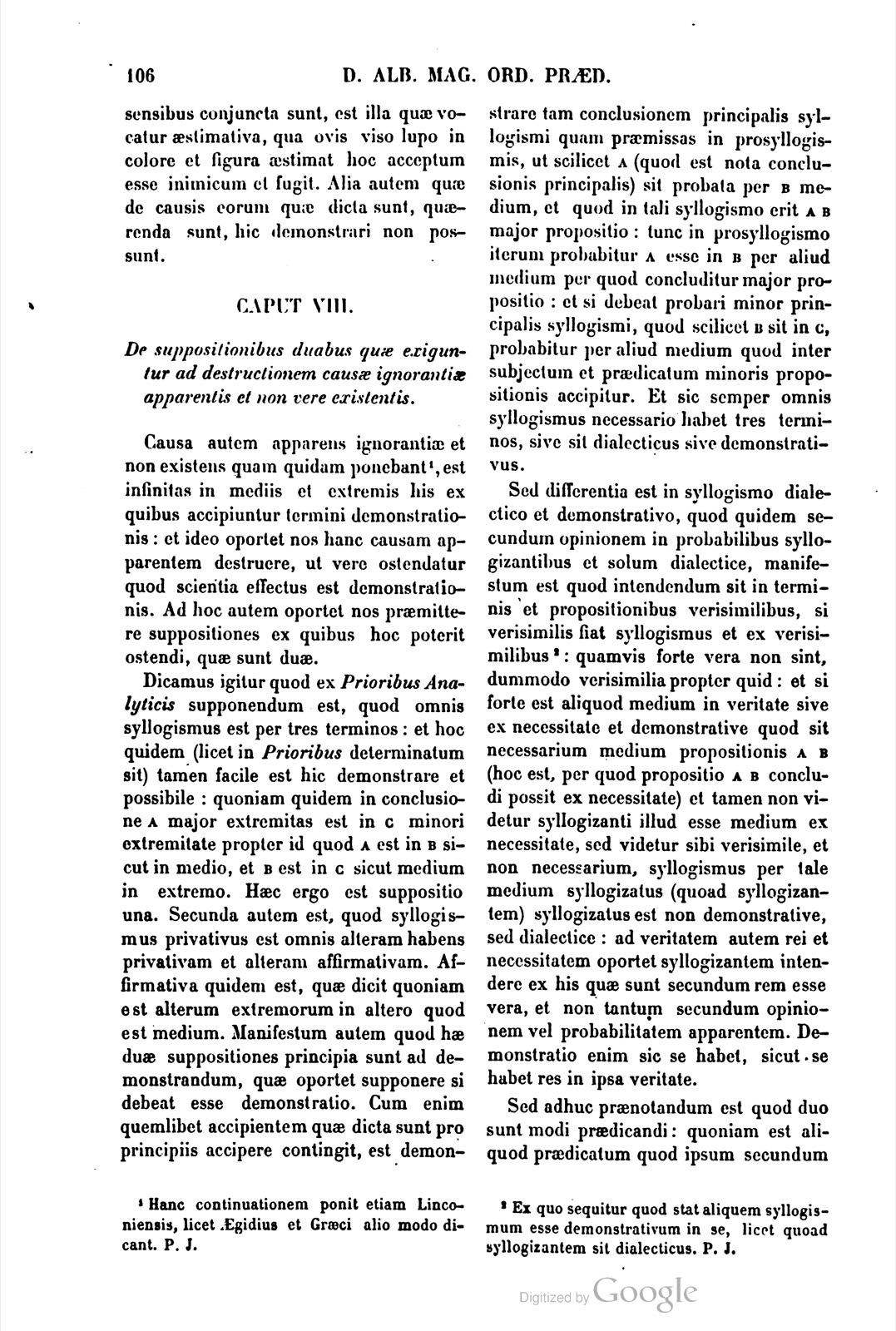
Caput VIII.
De suppositionibus duabus quae exiguntur ad destructionem causae ignorantiae apparentis et non vere existentis.
Causa autem apparens ignorantiae et non existens quam quidam ponebant 1, est infinitas in mediis et extremis his ex quibus accipiuntur termini demonstrationis: et ideo oportet nos hanc causam apparentem destruere, ut vere ostendatur quod scientia effectus est demonstrationis. Ad hoc autem oportet nos praemittere suppositiones ex quibus hoc poterit ostendi, quae sunt duae.
Dicamus igitur quod ex Prioribus Analyticis supponendum est, quod omnis syllogismus est per tres terminos: et hoc quidem (licet in Prioribus determinatum sit) tamen facile est hic demonstrare et possibile: quoniam quidem in conclusione A major extremitas est in C minori extremitate propter id quod A est in B sicut in medio, et B est in C sicut medium in extremo. Haec ergo est suppositio una. Secunda autem est, quod syllogismus privativus est omnis alteram habens privativam et alteram affirmativam. Affirmativa quidem est, quae dicit quoniam est alterum extremorum in altero quod est medium. Manifestum autem quod hae duae suppositiones principia sunt ad demonstrandum, quae oportet supponere si debeat esse demonstratio. Cum enim quemlibet accipientem quae dicta sunt pro principiis accipere contingit, est demonstrare tam conclusionem principalis syllogismi quam praemissas in prosyllogismis, ut scilicet A (quod est nota conclusionis principalis) sit probata per B medium, et quod in tali syllogismo erit A B major propositio: tunc in prosyllogismo iterum probabitur A esse in B per aliud medium per quod concluditur major propositio: et si debeat probari minor principalis syllogismi, quod scilicet B sit in C, probabitur per aliud medium quod inter subjectum et praedicatum minoris propositionis accipitur. Et sic semper omnis syllogismus necessario habet tres terminos, sive sit dialecticus sive demonstrativus.
Sed differentia est in syllogismo dialectico et demonstrativo, quod quidem secundum opinionem in probabilibus syllogizantibus et solum dialectice, manifestum est quod intendendum sit in terminis et propositionibus verisimilibus, si verisimilis fiat syllogismus et ex verisimilibus 2: quamvis forte vera non sint, dummodo verisimilia propter quid: et si forte est aliquod medium in veritate sive ex necessitate et demonstrative quod sit necessarium medium propositionis A B (hoc est, per quod propositio A B concludi possit ex necessitate) et tamen non videtur syllogizanti illud esse medium ex necessitate, sed videtur sibi verisimile, et non necessarium, syllogismus per tale medium syllogizatus (quoad syllogizantem) syllogizatus est non demonstrative, sed dialectice: ad veritatem autem rei et necessitatem oportet syllogizantem intendere ex his quae sunt secundum rem esse vera, et non tantum secundum opinionem vel probabilitatem apparentem. Demonstratio enim sic se habet, sicut se habet res in ipsa veritate.
Chapter VIII.
On the two suppositions which are required for the destruction of the apparent and not truly existing cause of ignorance.
But the apparent cause of ignorance, and not an existing cause, which certain persons posited 1, is infinity in the middles and extremes from which the terms of demonstration are accepted. And therefore it is necessary for us to destroy this apparent cause, so that it may truly be shown that science is the effect of demonstration. But for this it is necessary for us to premise the suppositions from which this can be shown, and these are two.
Therefore let us say that from the Prior Analytics it must be supposed that every syllogism is through three terms. And although this has been determined in the Priors, nevertheless it is easy and possible to demonstrate it here, because in the conclusion A the major extreme is in C the minor extreme on account of the fact that A is in B as in the middle, and B is in C as the middle in the extreme. Therefore this is one supposition. But the second is that every privative syllogism has one premise privative and the other affirmative. The affirmative indeed is the one which says that one of the extremes is in the other, which is the middle. But it is manifest that these two suppositions are principles for demonstrating, which must be supposed if there ought to be demonstration. For since anyone receiving the things which have been said as principles can receive them, it is possible to demonstrate both the conclusion of the principal syllogism and the premises in prosyllogisms, namely so that A, which is the mark of the principal conclusion, is proved through B the middle, and so that in such a syllogism A B will be the major proposition. Then in a prosyllogism it will again be proved that A is in B through another middle through which the major proposition is concluded. And if the minor of the principal syllogism ought to be proved, namely that B is in C, it will be proved through another middle which is accepted between the subject and predicate of the minor proposition. And thus every syllogism always necessarily has three terms, whether it is dialectical or demonstrative.
But there is a difference in the dialectical and demonstrative syllogism. For as to those syllogizing according to opinion in probable things and only dialectically, it is manifest that one must attend to plausible terms and propositions, if a plausible syllogism is made and made from plausible things 2, although perhaps they are not true, provided that they are plausible on account of why. And if perhaps there is some middle in truth, or from necessity and demonstratively, which is the necessary middle of the A B proposition, that is, through which the A B proposition can be concluded from necessity, and nevertheless it does not seem to the one syllogizing that this is a middle from necessity, but seems to him plausible and not necessary, then the syllogism syllogized through such a middle, with respect to the one syllogizing, has been syllogized not demonstratively but dialectically. But for the truth of the thing and necessity, it is necessary for the one syllogizing to attend from those things which are true according to the thing, and not only according to opinion or apparent probability. For demonstration stands in such a way as the thing stands in the truth itself.
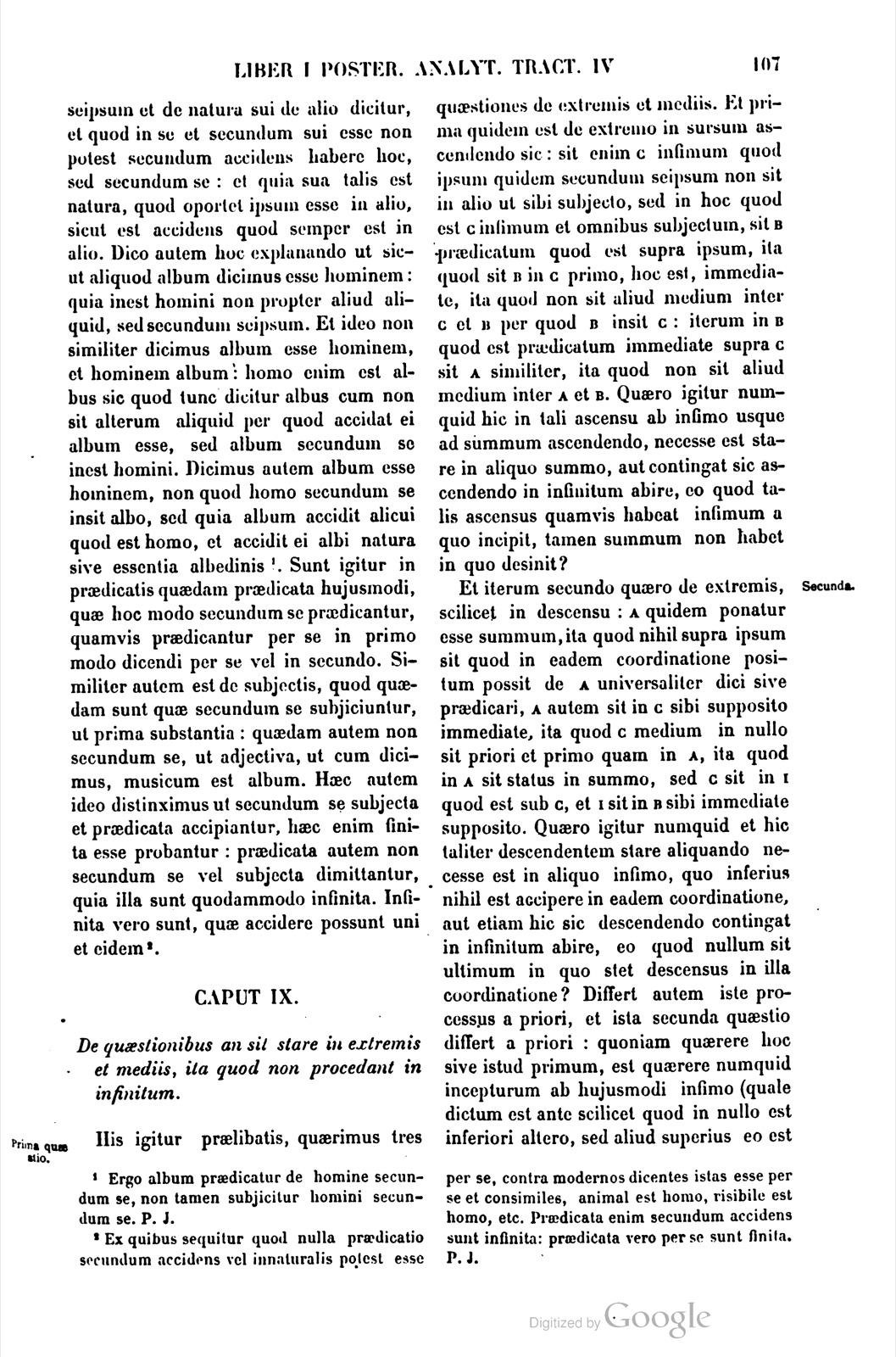
Sed adhuc praenotandum est quod duo sunt modi praedicandi: quoniam est aliquid praedicatum quod ipsum secundum seipsum et de natura sui de alio dicitur, et quod in se et secundum sui esse non potest secundum accidens habere hoc, sed secundum se: et quia sua talis est natura, quod oportet ipsum esse in alio, sicut est accidens quod semper est in alio. Dico autem hoc explanando ut sicut aliquod album dicimus esse hominem: quia inest homini non propter aliud aliquid, sed secundum seipsum. Et ideo non similiter dicimus album esse hominem, et hominem album: homo enim est albus sic quod tunc dicitur albus cum non sit alterum aliquid per quod accidat ei album esse, sed album secundum se inest homini. Dicimus autem album esse hominem, non quod homo secundum se insit albo, sed quia album accidit alicui quod est homo, et accidit ei albi natura sive essentia albedinis 3. Sunt igitur in praedicatis quaedam praedicata hujusmodi, quae hoc modo secundum se praedicantur, quamvis praedicantur per se in primo modo dicendi per se vel in secundo. Similiter autem est de subjectis, quod quaedam sunt quae secundum se subjiciuntur, ut prima substantia: quaedam autem non secundum se, ut adjectiva, ut cum dicimus, musicum est album. Haec autem ideo distinximus ut secundum se subjecta et praedicata accipiantur, haec enim finita esse probantur: praedicata autem non secundum se vel subjecta dimittantur, quia illa sunt quodammodo infinita. Infinita vero sunt, quae accidere possunt uni et eidem 4.
But still it must be fore-noted that there are two modes of predicating, because there is some predicate which is said of another by itself and from its own nature, and which in itself and according to its being cannot have this according to accident, but according to itself; and because its nature is such that it must be in another, just as an accident always is in another. But I say this by explaining it as follows: we say that some white thing is a man because it is present in man not on account of something else, but according to itself. And therefore we do not similarly say that a white thing is a man and that a man is white. For man is white in such a way that then he is called white when there is not some other thing through which it happens to him to be white, but white according to itself is present in man. But we say that a white thing is a man, not because man according to himself is present in the white, but because white occurs to something which is man, and the nature of white or the essence of whiteness occurs to it 3. Therefore among predicates there are certain predicates of this sort, which are predicated according to themselves in this way, although they are predicated per se in the first mode of speaking per se or in the second. Similarly, however, it is so concerning subjects, because there are certain things which are subjected according to themselves, as first substance; but certain things are not subjected according to themselves, as adjectival things, as when we say, a musical thing is white. But we have distinguished these things for this reason, so that subjects and predicates according to themselves may be accepted, for these are proved to be finite. But predicates not according to themselves, or subjects not according to themselves, are to be set aside, because those are in a certain way infinite. But infinite things are those which can happen to one and the same thing 4.
Notes
- Lincolniensis also posits this continuation, although Giles and the Greeks speak in another way. P. J. (Hanc continuationem ponit etiam Linconiensis, licet Egidius et Graeci alio modo dicant. P. J.) ↩
- From this it follows that some syllogism can stand as demonstrative in itself, although with respect to the one syllogizing it is dialectical. P. J. (Ex quo sequitur quod stat aliquem syllogismum esse demonstrativum in se, licet quoad syllogizantem sit dialecticus. P. J.) ↩
- Therefore white is predicated of man according to itself, yet it is not subjected to man according to itself. P. J. (Ergo album praedicatur de homine secundum se, non tamen subjicitur homini secundum se. P. J.) ↩
- From these things it follows that no predication according to accident or unnatural predication can be per se, against the moderns saying that these and similar ones are per se: animal is man, risible is man, etc. For predicates according to accident are infinite, but predicates per se are finite. P. J. (Ex quibus sequitur quod nulla praedicatio secundum accidens vel innaturalis potest esse per se, contra modernos dicentes istas esse per se et consimiles, animal est homo, risibile est homo, etc. Praedicata enim secundum accidens sunt infinita: praedicata vero per se sunt finita. P. J.) ↩
If a page does not appear, its photograph has not been uploaded yet.