Works › Posterior Analytics, Books I–II
Volume 2 · pp. 104–106
Treatise IV, Chapter VII. On The Causes Of Ignorance Said According To Negation
A marker with ≈ is an approximate page boundary, placed by measure of the text; the page photographs remain the authority. In the paired views, clicking a page marker brings that page into view.
Caput VII.
De causis ignorantiae secundum negationem dictae.
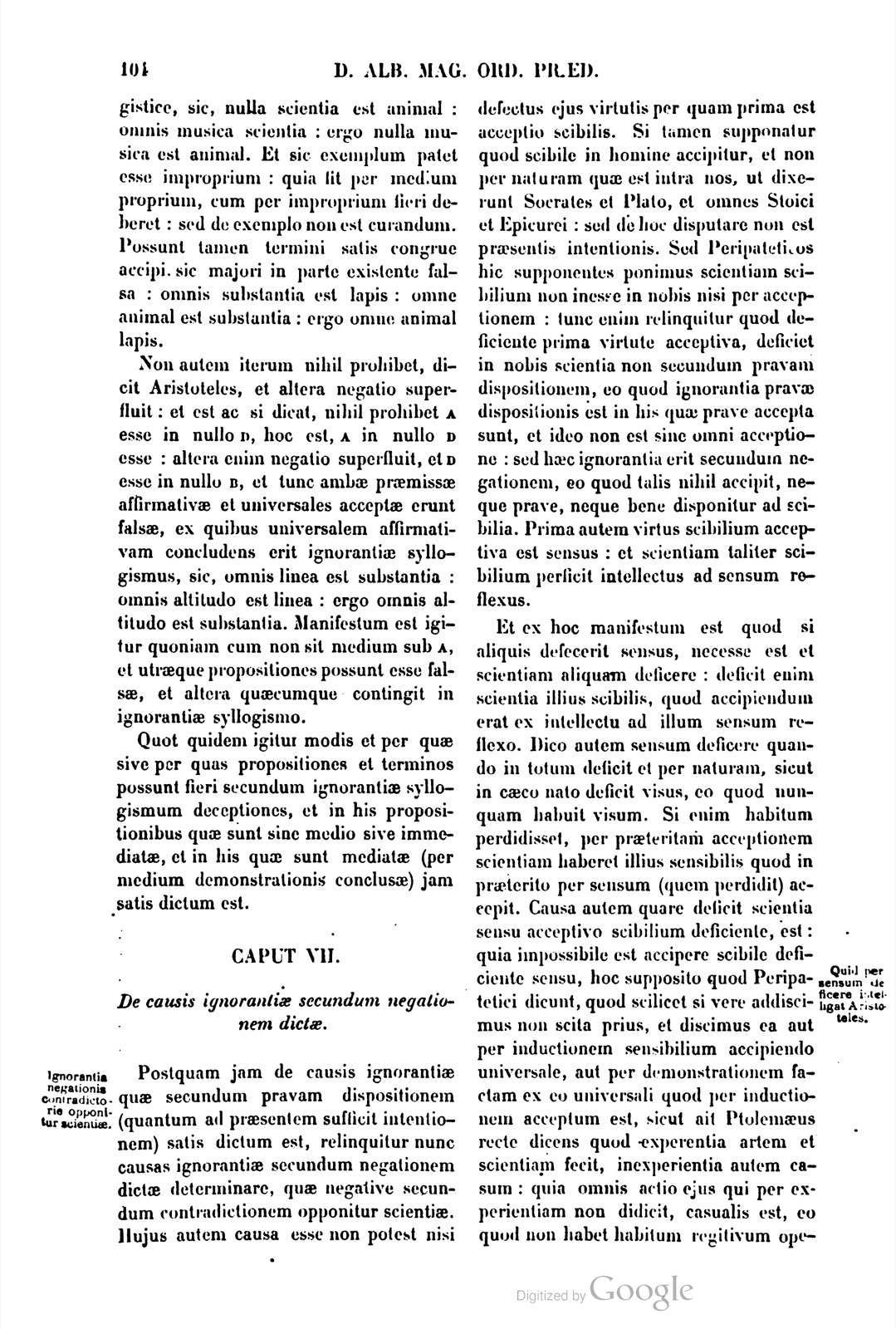
Postquam jam de causis ignorantiae quae secundum pravam dispositionem (quantum ad praesentem sufficit intentionem) satis dictum est, relinquitur nunc causas ignorantiae secundum negationem dictae determinare, quae negative secundum contradictionem opponitur scientiae. Hujus autem causa esse non potest nisi defectus ejus virtutis per quam prima est acceptio scibilis. Si tamen supponatur quod scibile in homine accipitur, et non per naturam quae est intra nos, ut dixerunt Socrates et Plato, et omnes Stoici et Epicurei: sed de hoc disputare non est praesentis intentionis. Sed Peripateticos hic supponentes ponimus scientiam scibilium non inesse in nobis nisi per acceptionem: tunc enim relinquitur quod deficiente prima virtute acceptiva, deficiet in nobis scientia non secundum pravam dispositionem, eo quod ignorantia pravae dispositionis est in his quae prave accepta sunt, et ideo non est sine omni acceptione: sed haec ignorantia erit secundum negationem, eo quod talis nihil accipit, neque prave, neque bene disponitur ad scibilia. Prima autem virtus scibilium acceptiva est sensus: et scientiam taliter scibilium perficit intellectus ad sensum reflexus.
Et ex hoc manifestum est quod si aliquis defecerit sensus, necesse est et scientiam aliquam deficere: deficit enim scientia illius scibilis, quod accipiendum erat ex intellectu ad illum sensum reflexo. Dico autem sensum deficere quando in totum deficit et per naturam, sicut in caeco nato deficit visus, eo quod nunquam habuit visum. Si enim habitum perdidisset, per praeteritam acceptionem scientiam haberet illius sensibilis quod in praeterito per sensum (quem perdidit) accepit. Causa autem quare deficit scientia sensu acceptivo scibilium deficiente, est: quia impossibile est accipere scibile deficiente sensu, hoc supposito quod Peripatetici dicunt, quod scilicet si vere addiscimus non scita prius, et discimus ea aut per inductionem sensibilium accipiendo universale, aut per demonstrationem factam ex eo universali quod per inductionem acceptum est, sicut ait Ptolemaeus recte dicens quod experientia artem et scientiam fecit, inexperientia autem casum: quia omnis actio ejus qui per experientiam non didicit, casualis est, eo quod non habet habitum regitivum operationum. Inductio enim est ex his quae sunt secundum partem, hoc est, particularia et singularia. Impossibile est autem universalia speculari ex quibus est ars et scientia, et non per inductionem.
Chapter VII.
On the causes of ignorance said according to negation.
After enough has now been said about the causes of ignorance which is according to a bad disposition, as much as suffices for the present intention, it remains now to determine the causes of ignorance said according to negation, which is negatively opposed to science according to contradiction. But the cause of this cannot be anything except the defect of that power through which the first reception of the knowable is made. This is so, however, if it is supposed that the knowable is received in man, and not through the nature which is within us, as Socrates and Plato and all the Stoics and Epicureans said; but to dispute about this is not of the present intention. But supposing the Peripatetics here, we posit that the science of knowable things is not present in us except through reception. For then it remains that, when the first receptive power fails, science will fail in us, not according to a bad disposition, because ignorance of bad disposition is in those things which have been badly received, and therefore it is not without every reception. But this ignorance will be according to negation, because such a one receives nothing, and is disposed toward knowable things neither badly nor well. But the first power receptive of knowable things is sense, and the intellect, reflected back to sense, perfects the science of knowable things in this way.
And from this it is manifest that if any sense has failed someone, some science too must fail. For the science of that knowable thing fails, which had to be received from the intellect reflected back to that sense. But I say that a sense fails when it fails wholly and by nature, as sight fails in one born blind, because he never had sight. For if he had lost the habit, through past reception he would have the science of that sensible thing which in the past he received through the sense which he lost. But the cause why science fails when the receptive sense of knowable things fails is this: that it is impossible to receive the knowable when sense is failing, with this supposed which the Peripatetics say, namely that if we truly learn things not previously known, we learn them either through induction of sensible things by receiving the universal, or through demonstration made from that universal which has been received through induction, as Ptolemy says, rightly saying that experience made art and science, but inexperience made chance; because every action of one who has not learned through experience is casual, because he does not have a habit regulative of operations. For induction is from those things which are according to part, that is, particulars and singulars. But it is impossible to consider the universals from which art and science come, and not through induction.
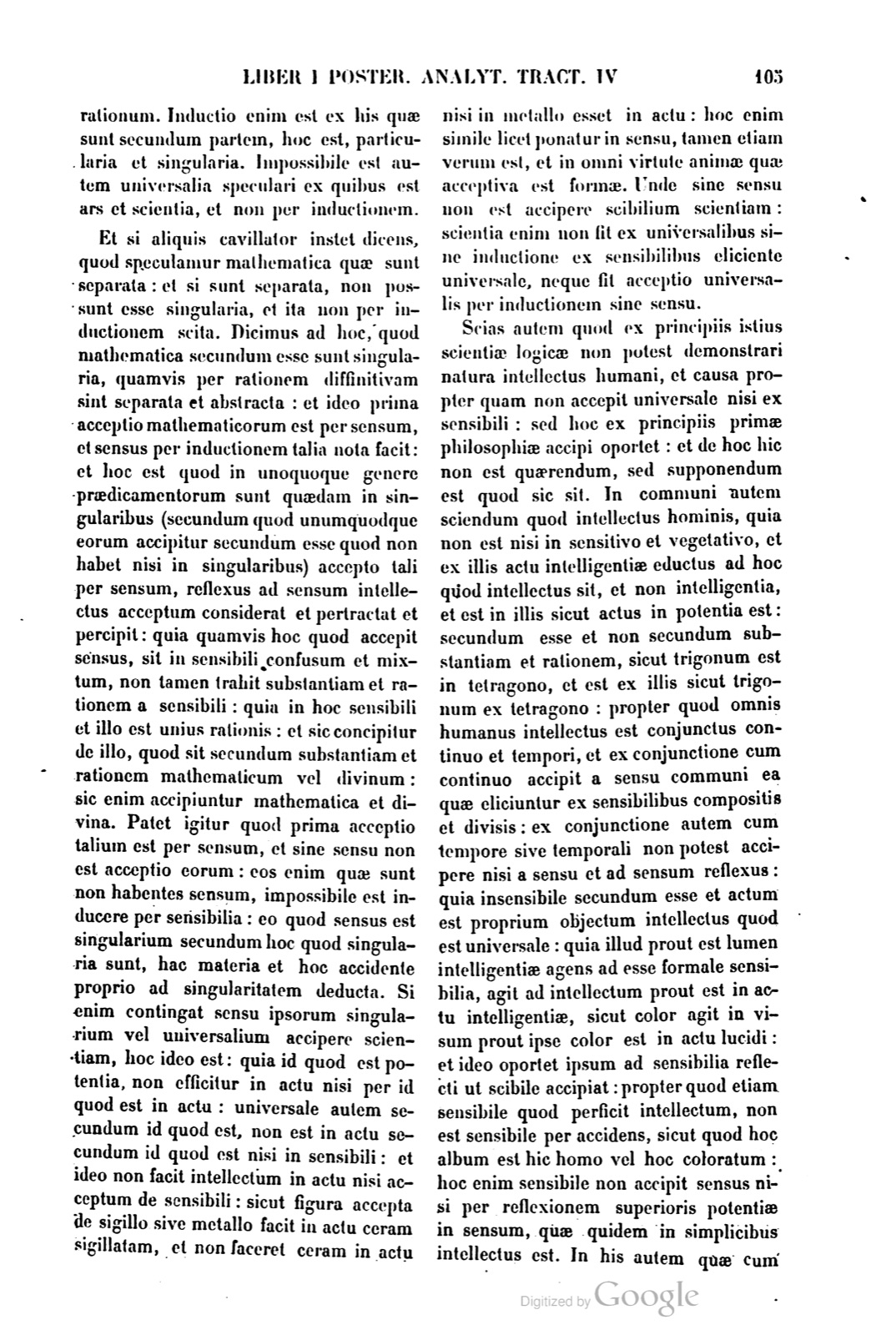
Et si aliquis cavillator instet dicens, quod speculamur mathematica quae sunt separata: et si sunt separata, non possunt esse singularia, et ita non per inductionem scita. Dicimus ad hoc, quod mathematica secundum esse sunt singularia, quamvis per rationem diffinitivam sint separata et abstracta: et ideo prima acceptio mathematicorum est per sensum, et sensus per inductionem talia nota facit: et hoc est quod in unoquoque genere praedicamentorum sunt quaedam in singularibus (secundum quod unumquodque eorum accipitur secundum esse quod non habet nisi in singularibus) accepto tali per sensum, reflexus ad sensum intellectus acceptum considerat et pertractat et percipit: quia quamvis hoc quod accepit sensus, sit in sensibili confusum et mixtum, non tamen trahit substantiam et rationem a sensibili: quia in hoc sensibili et illo est unius rationis: et sic concipitur de illo, quod sit secundum substantiam et rationem mathematicum vel divinum: sic enim accipiuntur mathematica et divina. Patet igitur quod prima acceptio talium est per sensum, et sine sensu non est acceptio eorum: eos enim quae sunt non habentes sensum, impossibile est inducere per sensibilia: eo quod sensus est singularium secundum hoc quod singularia sunt, hac materia et hoc accidente proprio ad singularitatem deducta. Si enim contingat sensu ipsorum singularium vel universalium accipere scientiam, hoc ideo est: quia id quod est potentia, non efficitur in actu nisi per id quod est in actu: universale autem secundum id quod est, non est in actu secundum id quod est nisi in sensibili: et ideo non facit intellectum in actu nisi acceptum de sensibili: sicut figura accepta de sigillo sive metallo facit in actu ceram sigillatam, et non faceret ceram in actu nisi in metallo esset in actu: hoc enim simile licet ponatur in sensu, tamen etiam verum est, et in omni virtute animae quae acceptiva est formae. Unde sine sensu non est accipere scibilium scientiam: scientia enim non fit ex universalibus sine inductione ex sensibilibus eliciente universale, neque fit acceptio universalis per inductionem sine sensu.
And if some caviller objects, saying that we consider mathematical things which are separate, and if they are separate they cannot be singulars and so are not known through induction, we say to this that mathematical things according to being are singulars, although through their definitive account they are separate and abstract. And therefore the first reception of mathematical things is through sense, and sense through induction makes such things known. And this is the fact that in each genus of predicaments there are certain things in singulars, according as each of them is received according to the being which it has only in singulars; when such a thing has been received through sense, the intellect, reflected back to sense, considers and treats throughout and perceives what has been received, because although what sense received is confused and mixed in the sensible thing, nevertheless it does not draw its substance and account from the sensible, because in this sensible and in that sensible it is of one account. And thus it is conceived concerning it that it is mathematical or divine according to substance and account; for in this way mathematical and divine things are received. Therefore it is clear that the first reception of such things is through sense, and without sense there is no reception of them. For it is impossible to induce through sensible things those who are not having sense, because sense belongs to singulars according to the fact that they are singulars, reduced to singularity by this matter and this proper accident. For if it happens to receive science by sense concerning those singulars or universals, this is therefore because what is in potency is not made in act except through that which is in act. But the universal according to that which it is is not in act according to that which it is except in a sensible thing, and therefore it does not make the intellect in act unless it is received from a sensible thing, just as a figure received from a seal or metal makes wax actually sealed, and would not make wax in act unless it were in act in the metal. For although this likeness is posited in sense, nevertheless it is also true in every power of the soul which is receptive of form. Hence without sense there is no receiving the science of knowable things, for science is not made from universals without induction drawing out the universal from sensible things, nor is universal reception made through induction without sense.
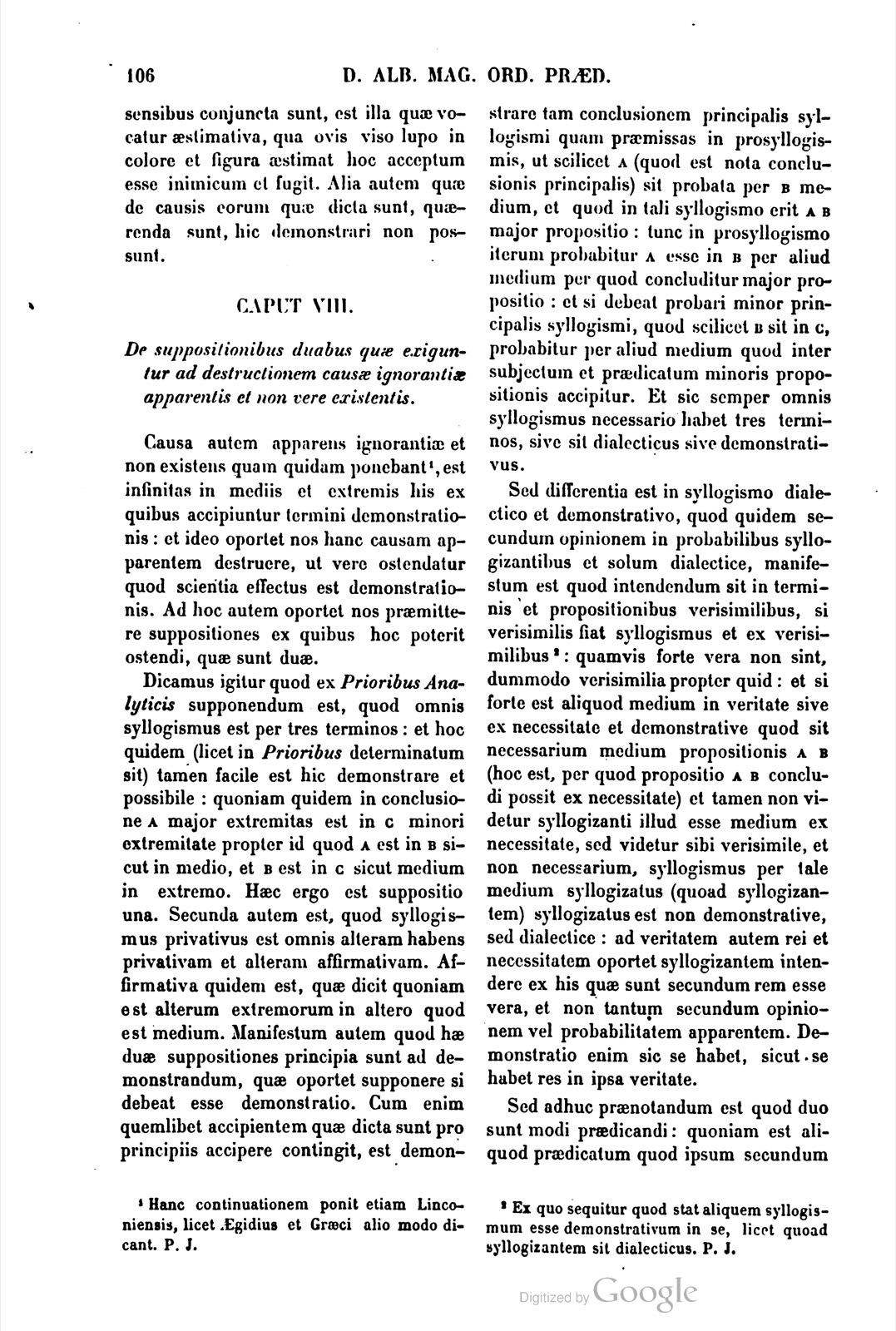
Scias autem quod ex principiis istius scientiae logicae non potest demonstrari natura intellectus humani, et causa propter quam non accepit universale nisi ex sensibili: sed hoc ex principiis primae philosophiae accipi oportet: et de hoc hic non est quaerendum, sed supponendum est quod sic sit. In communi autem sciendum quod intellectus hominis, quia non est nisi in sensitivo et vegetativo, et ex illis actu intelligentiae eductus ad hoc quod intellectus sit, et non intelligentia, et est in illis sicut actus in potentia est: secundum esse et non secundum substantiam et rationem, sicut trigonum est in tetragono, et est ex illis sicut trigonum ex tetragono: propter quod omnis humanus intellectus est conjunctus continuo et tempori, et ex conjunctione cum continuo accipit a sensu communi ea quae eliciuntur ex sensibilibus compositis et divisis: ex conjunctione autem cum tempore sive temporali non potest accipere nisi a sensu et ad sensum reflexus: quia insensibile secundum esse et actum est proprium objectum intellectus quod est universale: quia illud prout est lumen intelligentiae agens ad esse formale sensibilia, agit ad intellectum prout est in actu intelligentiae, sicut color agit in visum prout ipse color est in actu lucidi: et ideo oportet ipsum ad sensibilia reflecti ut scibile accipiat: propter quod etiam sensibile quod perficit intellectum, non est sensibile per accidens, sicut quod hoc album est hic homo vel hoc coloratum: hoc enim sensibile non accipit sensus nisi per reflexionem superioris potentiae in sensum, quae quidem in simplicibus intellectus est. In his autem quae cum sensibus conjuncta sunt, est illa quae vocatur aestimativa, qua ovis viso lupo in colore et figura aestimat hoc acceptum esse inimicum et fugit. Alia autem quae de causis eorum quae dicta sunt, quaerenda sunt, hic demonstrari non possunt.
But you should know that from the principles of this science of logic the nature of the human intellect cannot be demonstrated, nor the cause on account of which it has not received the universal except from the sensible; but this must be received from the principles of first philosophy. And this is not to be inquired about here, but it must be supposed that it is so. But in common it must be known that the intellect of man, because it is only in the sensitive and vegetative, and from them is brought forth by the act of intelligence to this, that it is intellect and not intelligence, and because it is in them as act is in potency, according to being and not according to substance and account, as a triangle is in a quadrangle and is from them as a triangle from a quadrangle, on account of this every human intellect is joined to the continuous and to time. And from conjunction with the continuous it receives from common sense those things which are elicited from sensible things composed and divided; but from conjunction with time or the temporal it cannot receive except from sense and as reflected back to sense. For the insensible according to being and act is the proper object of intellect, which is the universal, because that, insofar as it is the light of intelligence acting toward the formal being of sensible things, acts upon the intellect insofar as it is in the act of intelligence, just as color acts upon sight insofar as that color itself is in the act of the luminous. And therefore the intellect must be reflected back to sensible things so that it may receive the knowable. On account of this also the sensible which perfects the intellect is not the sensible by accident, as that this white thing is this man or this colored thing. For sense does not receive this sensible except through the reflection of a superior power into sense, which indeed in simple things is intellect. But in those things which are joined with senses there is that power which is called estimative, by which a sheep, having seen a wolf in color and figure, judges this received thing to be an enemy and flees. But the other things which should be asked about the causes of those things which have been said cannot be demonstrated here.
If a page does not appear, its photograph has not been uploaded yet.