Works › Posterior Analytics, Books I–II
Volume 2 · pp. 107–108
Treatise IV, Chapter IX. On The Questions Whether There Is A Stand In Extremes And Middles
A marker with ≈ is an approximate page boundary, placed by measure of the text; the page photographs remain the authority. In the paired views, clicking a page marker brings that page into view.
Caput IX.
De quaestionibus an sit stare in extremis et mediis, ita quod non procedant in infinitum.
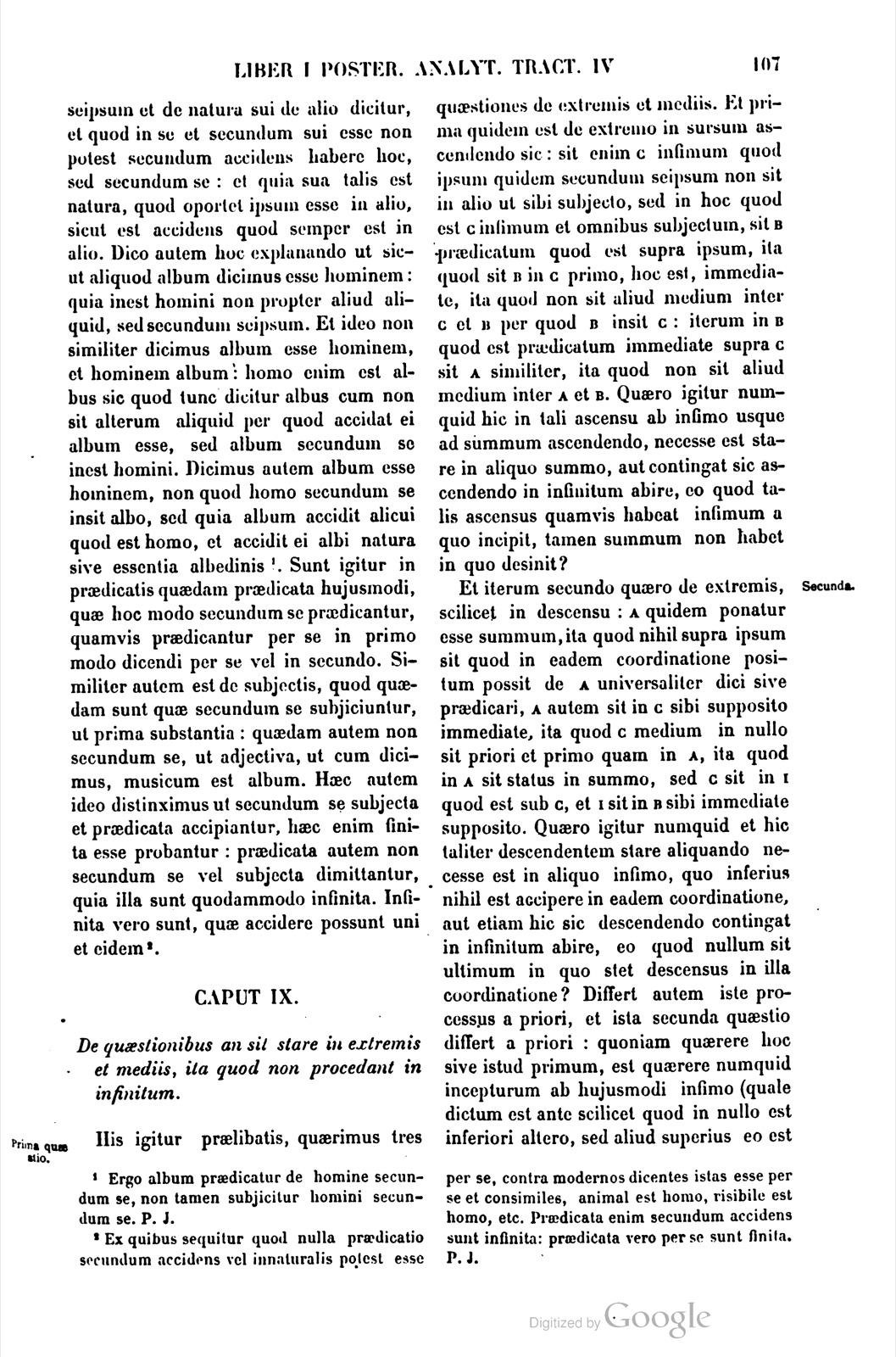
His igitur praelibatis, quaerimus tres quaestiones de extremis et mediis. Et prima quidem est de extremo in sursum ascendendo sic: sit enim C infimum quod ipsum quidem secundum seipsum non sit in alio ut sibi subjecto, sed in hoc quod est C infimum et omnibus subjectum, sit B praedicatum quod est supra ipsum, ita quod sit B in C primo, hoc est, immediate, ita quod non sit aliud medium inter C et B per quod B insit C: iterum in B quod est praedicatum immediate supra C sit A similiter, ita quod non sit aliud medium inter A et B. Quaero igitur numquid hic in tali ascensu ab infimo usque ad summum ascendendo, necesse est stare in aliquo summo, aut contingat sic ascendendo in infinitum abire, eo quod talis ascensus quamvis habeat infimum a quo incipit, tamen summum non habet in quo desinit?
Et iterum secundo quaero de extremis, scilicet in descensu: A quidem ponatur esse summum, ita quod nihil supra ipsum sit quod in eadem coordinatione positum possit de A universaliter dici sive praedicari, A autem sit in C sibi supposito immediate, ita quod C medium in nullo sit priori et primo quam in A, ita quod in A sit status in summo, sed C sit in I quod est sub C, et I sit in B sibi immediate supposito. Quaero igitur numquid et hic taliter descendentem stare aliquando necesse est in aliquo infimo, quo inferius nihil est accipere in eadem coordinatione, aut etiam hic sic descendendo contingat in infinitum abire, eo quod nullum sit ultimum in quo stet descensus in illa coordinatione? Differt autem iste processus a priori, et ista secunda quaestio differt a priori: quoniam quaerere hoc sive istud primum, est quaerere numquid incepturum ab hujusmodi infimo (quale dictum est ante scilicet quod in nullo est inferiori altero, sed aliud superius eo est in illo sicut praedicatum in subjecto) in sursum ascendendo in infinitum contingat abire sic ascendendo? Alterum autem sive secundum quod quaeritur, est utrum aliquem incepturum ab hujusmodi summo quod ipsum quidem praedicatur de alio, sed de illo nihil praedicatur in eadem coordinatione praedicabilium (eo quod summum est in illa coordinatione) sit in deorsum intendere descendendo status, vel si contingit sic descendendo in infinitum abire?
Amplius autem tertio quaero, cum inter summum et infimum sint multa media, si (determinatis et definitis terminis in sursum et deorsum) contingit media quae sunt inter haec infinitare, hoc est, infinita esse. Dico autem hoc explanando, ut si A summum sit in C infimo per medium quod inter ea est, et sit illud medium B, et sit iterum aliud medium ab A et B per quod B insit C, et horum duorum mediorum sint sic altera et altera. Quaero igitur numquid et hic accipiendo semper altera et altera contingit in infinitum abire, aut est hoc impossibile si contingit stare in mediis finitis?
Chapter IX.
On the questions whether there is a stand in extremes and middles, so that they do not proceed to infinity.
Therefore, with these things stated beforehand, we ask three questions about extremes and middles. And the first is about the extreme in ascending upward in this way: let C be the lowest thing, which indeed according to itself is not in another as in its subject, but in this C, which is lowest and subject to all, let there be B, the predicate which is above it, so that B is in C first, that is, immediately, so that there is not another middle between C and B through which B is present in C. Again, in B, which is the predicate immediately above C, let A be similarly, so that there is not another middle between A and B. Therefore I ask whether here, in such an ascent from the lowest up to the highest by ascending, it is necessary to stand in some highest thing, or whether it happens by ascending in this way to go away into infinity, because such an ascent, although it has a lowest thing from which it begins, nevertheless does not have a highest thing in which it ends.
And again, secondly, I ask about extremes, namely in descent. Let A indeed be posited as the highest, so that there is nothing above it which, posited in the same coordination, can be said or predicated universally of A; but let A be in C, which is supposed beneath it, immediately, so that C the middle is in nothing prior and first than in A, so that in A there is a stand in the highest, but C is in I, which is under C, and I is in B, immediately supposed beneath it. Therefore I ask whether here also it is necessary for one descending in such a way to stand sometime in some lowest thing, than which nothing lower is to be accepted in the same coordination, or whether here also by descending in this way it happens to go away into infinity, because there is no ultimate thing in which the descent may stand in that coordination. But this process differs from the prior one, and this second question differs from the prior question, because to ask this or that first question is to ask whether one beginning from a lowest thing of this sort, such as was stated before, namely that it is in no other inferior thing, but another superior to it is in it as predicate in subject, happens, in ascending upward, to go away to infinity by ascending in this way. But the other or second thing which is asked is whether, for someone beginning from a highest of this sort, which indeed is predicated of another, but of which nothing is predicated in the same coordination of predicables, because it is the highest in that coordination, there is a stand in directing oneself downward by descending, or whether it happens by descending in this way to go away into infinity.
Moreover, thirdly, I ask, since between the highest and the lowest there are many middles, whether, with the terms upward and downward determined and defined, it happens that the middles which are between these are infinitized, that is, are infinite. But I say this by explaining it, as if A the highest is in C the lowest through a middle which is between them, and that middle is B, and again there is another middle from A and B through which B is present in C, and of these two middles there are in this way others and others. Therefore I ask whether here also, by always accepting others and others, it happens to go away into infinity, or whether this is impossible if it happens to stand in finite middles.
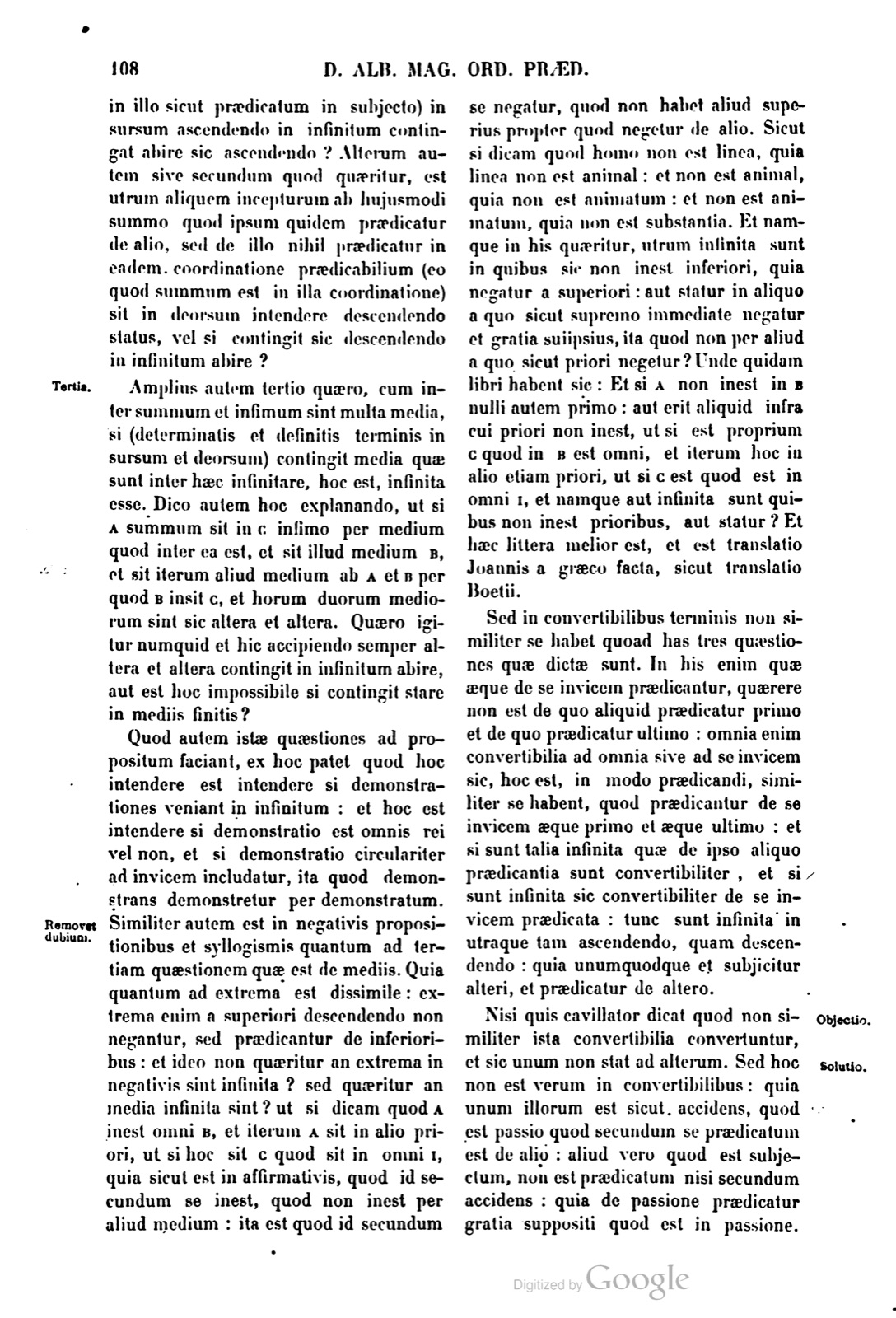
Quod autem istae quaestiones ad propositum faciant, ex hoc patet quod hoc intendere est intendere si demonstrationes veniant in infinitum: et hoc est intendere si demonstratio est omnis rei vel non, et si demonstratio circulariter ad invicem includatur, ita quod demonstrans demonstretur per demonstratum. Similiter autem est in negativis propositionibus et syllogismis quantum ad tertiam quaestionem quae est de mediis. Quia quantum ad extrema est dissimile: extrema enim a superiori descendendo non negantur, sed praedicantur de inferioribus: et ideo non quaeritur an extrema in negativis sint infinita? sed quaeritur an media infinita sint? ut si dicam quod A inest omni B, et iterum A sit in alio priori, ut si hoc sit C quod sit in omni I, quia sicut est in affirmativis, quod id secundum se inest, quod non inest per aliud medium: ita est quod id secundum se negatur, quod non habet aliud superius propter quod negetur de alio. Sicut si dicam quod homo non est linea, quia linea non est animal: et non est animal, quia non est animatum: et non est animatum, quia non est substantia. Et namque in his quaeritur, utrum infinita sunt in quibus sic non inest inferiori, quia negatur a superiori: aut statur in aliquo a quo sicut supremo immediate negatur et gratia suiipsius, ita quod non per aliud a quo sicut priori negetur? Unde quidam libri habent sic: Et si A non inest in B nulli autem primo: aut erit aliquid infra cui priori non inest, ut si est proprium C quod in B est omni, et iterum hoc in alio etiam priori, ut si C est quod est in omni I, et namque aut infinita sunt quibus non inest prioribus, aut statur? Et haec littera melior est, et est translatio Joannis a Graeco facta, sicut translatio Boetii.
Sed in convertibilibus terminis non similiter se habet quoad has tres quaestiones quae dictae sunt. In his enim quae aeque de se invicem praedicantur, quaerere non est de quo aliquid praedicatur primo et de quo praedicatur ultimo: omnia enim convertibilia ad omnia sive ad se invicem sic, hoc est, in modo praedicandi, similiter se habent, quod praedicantur de se invicem aeque primo et aeque ultimo: et si sunt talia infinita quae de ipso aliquo praedicantia sunt convertibiliter, et si sunt infinita sic convertibiliter de se invicem praedicata: tunc sunt infinita in utraque tam ascendendo, quam descendendo: quia unumquodque et subjicitur alteri, et praedicatur de altero.
Nisi quis cavillator dicat quod non similiter ista convertibilia convertuntur, et sic unum non stat ad alterum. Sed hoc non est verum in convertibilibus: quia unum illorum est sicut accidens, quod est passio quod secundum se praedicatum est de alio: aliud vero quod est subjectum, non est praedicatum nisi secundum accidens: quia de passione praedicatur gratia suppositi quod est in passione.
But that these questions are relevant to the proposed matter is clear from this, that to intend this is to intend whether demonstrations come into infinity; and this is to intend whether there is demonstration of every thing or not, and whether demonstration is circularly included in relation to itself, so that the one demonstrating is demonstrated through what has been demonstrated. It is similar in negative propositions and syllogisms with respect to the third question, which concerns middles. For with respect to the extremes it is dissimilar: for the extremes are not denied by descending from the superior, but are predicated of inferiors. And therefore one does not ask whether the extremes in negatives are infinite, but one asks whether the middles are infinite. For instance, if I say that A is present to every B, and again A is in another prior thing, as if this is C, which is in every I, because just as it is in affirmatives that that is present according to itself which is not present through another middle, so that is denied according to itself which does not have another superior on account of which it is denied of another. For example, if I say that man is not line because line is not animal, and line is not animal because it is not animated, and it is not animated because it is not substance. And indeed in these matters one asks whether the things are infinite in which it is not present to the inferior in this way because it is denied by a superior, or whether a stand is made in something from which, as from a highest, it is denied immediately and for its own sake, so that it is not denied through another from which it would be denied as from a prior thing. Hence certain books have it thus: "And if A is not present in B, but in none first: either there will be something below to which it is not present as to a prior thing, as if C is proper which is in every B, and again this is in another also prior thing, as if C is what is in every I; and indeed either the things to which it is not present as to priors are infinite, or a stand is made." And this reading is better, and it is the translation of John made from the Greek, as is the translation of Boethius.
But in convertible terms it is not similarly the case with respect to these three questions which have been stated. For in those things which are predicated equally of one another, there is no asking of what something is predicated first and of what it is predicated last. For all convertibles in relation to all, or to one another in this way, that is, in the mode of predicating, are similarly related, because they are predicated of one another equally first and equally last. And if there are such infinite things which are predicating convertibly of that very thing, and if they are infinite in such a way as predicated convertibly of one another, then they are infinite in both directions, both by ascending and by descending, because each one is both subjected to another and predicated of another.
Unless some caviller says that these convertibles are not converted in a similar way, and so one does not stand in relation to the other. But this is not true in convertibles, because one of them is as an accident, which is a property that is predicated according to itself of another; but the other, which is the subject, is not predicated except according to accident, because it is predicated of the property for the sake of the supposit which is in the property.
If a page does not appear, its photograph has not been uploaded yet.