Works › Posterior Analytics, Books I–II
Volume 2 · pp. 102–104
Treatise IV, Chapter VI. How A Syllogism Of Ignorance Is Made In The First Figure Concluding A Mediate Affirmative
A marker with ≈ is an approximate page boundary, placed by measure of the text; the page photographs remain the authority. In the paired views, clicking a page marker brings that page into view.
Caput VI.
Qualiter fit ignorantiae syllogismus in prima figura concludens affirmativam mediatam.
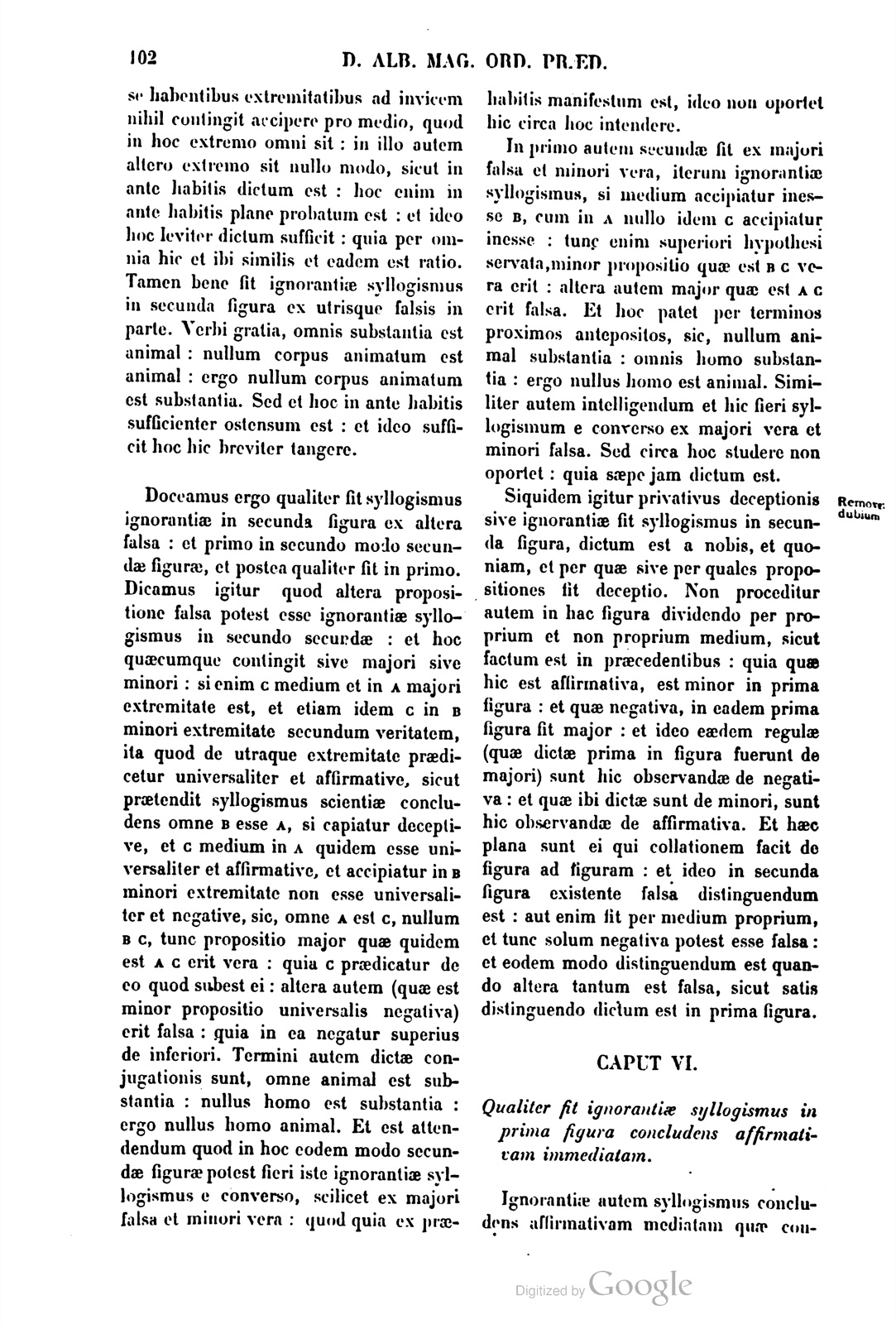
Ignorantiae autem syllogismus concludens affirmativam mediatam quae contraria est negativae conclusae in scientiae syllogismo fit quidem in prima figura per medium proprium, et per medium non proprium: et quando fit per medium proprium, dupliciter fit, scilicet per medium proprium ejusdem coordinationis, et fit per medium proprium non ejusdem coordinationis.
Quando igitur fit per medium ejusdem coordinationis: tunc impossibile est utrasque praemissas esse falsas: sed major tantum in syllogismo ignorantiae erit falsa: quia illa potest mutari secundum oppositas qualitates: sed minorem propositionem quae est B C necesse est manere in eadem qualitate: quia minor in prima figura semper est affirmativa siquidem fiat a prima figura, sicut dictum est in praehabitis: propter quae necesse majorem propositionem quae est A C semper esse falsam: haec enim sola in prima figura conversa est ad oppositam qualitatem: major enim syllogismi demonstrativi quae est negativa et vera in syllogismo scientiae, transmutatur in contrariam in syllogismo ignorantiae. Cujus exemplum est, quod syllogismus scientiae demonstrativus fit sic, nullum sensibile est incorporeum: omne rationale mortale est sensibile: ergo nullum rationale mortale est incorporeum. Syllogismus autem deceptionis formatur sic: omne sensibile est incorporeum: omne rationale mortale est sensibile: omne ergo rationale mortale est incorporeum.
Similiter autem est deceptio eodem modo si ex alia coordinatione accipiatur medium proprium, sicut dictum est in illa quae est privativa deceptio. Cujus exemplum est: omnis color est albus: omnis albedo color: ergo omnis albedo est alba. Si enim istae propositiones in contrarias transmutantur, erit syllogismus scientiae: semper enim necesse est manere propositionem minorem quae est B D, sive sit medium proprium in eadem coordinatione, sive sit ex alia: propositionem autem majorem (in medio proprio quod ex alia coordinatione assumptum est quae est A D) necesse converti secundum oppositas qualitates in ignorantiae syllogismo: unde haec deceptio eadem et syllogismus est priori.
Chapter VI.
In what manner a syllogism of ignorance is made in the first figure, concluding a mediate affirmative.
But a syllogism of ignorance concluding a mediate affirmative, which is contrary to the negative concluded in the syllogism of science, is indeed made in the first figure through a proper middle and through a non-proper middle. And when it is made through a proper middle, it is made in two ways, namely through a proper middle of the same coordination, and it is made through a proper middle which is not of the same coordination.
Therefore, when it is made through a middle of the same coordination, then it is impossible for both premises to be false; but only the major in the syllogism of ignorance will be false, because that proposition can be changed according to opposite qualities. But the minor proposition which is B C must remain in the same quality, because the minor in the first figure is always affirmative, if indeed it is made from the first figure, as was said in the things previously had. On account of these things it is necessary that the major proposition which is A C always be false, for this one alone in the first figure is converted to the opposite quality. For the major of the demonstrative syllogism, which is negative and true in the syllogism of science, is transmuted into the contrary in the syllogism of ignorance. An example of this is that the demonstrative syllogism of science is made thus: no sensible thing is incorporeal; every mortal rational thing is sensible; therefore no mortal rational thing is incorporeal. But the syllogism of deception is formed thus: every sensible thing is incorporeal; every mortal rational thing is sensible; every mortal rational thing, therefore, is incorporeal.
Similarly, however, deception exists in the same mode if the proper middle is accepted from another coordination, as was said in that deception which is privative. An example of this is: every color is white; every whiteness is color; therefore every whiteness is white. For if these propositions are transmuted into their contraries, there will be a syllogism of science. For it is always necessary that the minor proposition, which is B D, remain, whether the proper middle is in the same coordination or is from another. But the major proposition, in the proper middle which is assumed from another coordination, which is A D, must be converted according to opposite qualities in the syllogism of ignorance. Whence this deception and this syllogism are the same as the prior one.
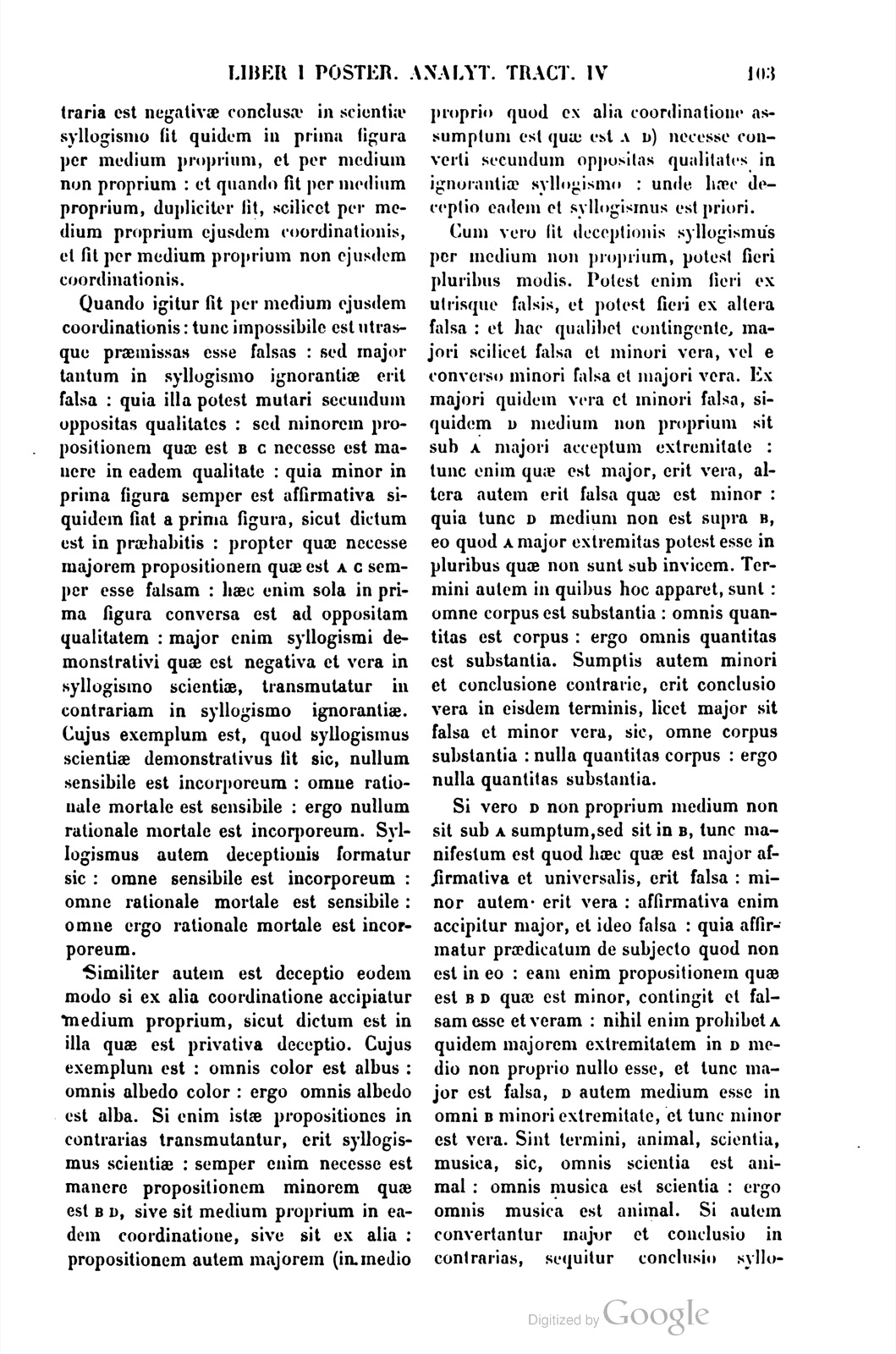
Cum vero fit deceptionis syllogismus per medium non proprium, potest fieri pluribus modis. Potest enim fieri ex utrisque falsis, et potest fieri ex altera falsa: et hac qualibet contingente, majori scilicet falsa et minori vera, vel e converso minori falsa et majori vera. Ex majori quidem vera et minori falsa, siquidem D medium non proprium sit sub A majori acceptum extremitate: tunc enim quae est major, erit vera, altera autem erit falsa quae est minor: quia tunc D medium non est supra B, eo quod A major extremitas potest esse in pluribus quae non sunt sub invicem. Termini autem in quibus hoc apparet, sunt: omne corpus est substantia: omnis quantitas est corpus: ergo omnis quantitas est substantia. Sumptis autem minori et conclusione contrarie, erit conclusio vera in eisdem terminis, licet major sit falsa et minor vera, sic, omne corpus substantia: nulla quantitas corpus: ergo nulla quantitas substantia.
Si vero D non proprium medium non sit sub A sumptum, sed sit in B, tunc manifestum est quod haec quae est major affirmativa et universalis, erit falsa: minor autem erit vera: affirmativa enim accipitur major, et ideo falsa: quia affirmatur praedicatum de subjecto quod non est in eo: eam enim propositionem quae est B D quae est minor, contingit et falsam esse et veram: nihil enim prohibet A quidem majorem extremitatem in D medio non proprio nullo esse, et tunc major est falsa, D autem medium esse in omni B minori extremitate, et tunc minor est vera. Sint termini, animal, scientia, musica, sic, omnis scientia est animal: omnis musica est scientia: ergo omnis musica est animal. Si autem convertantur major et conclusio in contrarias, sequitur conclusio syllogistice, sic, nulla scientia est animal: omnis musica scientia: ergo nulla musica est animal. Et sic exemplum patet esse improprium: quia fit per medium proprium, cum per improprium fieri deberet: sed de exemplo non est curandum. Possunt tamen termini satis congrue accipi, sic majori in parte existente falsa: omnis substantia est lapis: omne animal est substantia: ergo omne animal lapis.
But when the syllogism of deception is made through a non-proper middle, it can be made in several ways. For it can be made from both premises false, and it can be made from one false premise; and with either of these cases happening, namely with the major false and the minor true, or conversely with the minor false and the major true. From a true major and a false minor indeed it is made if D the non-proper middle is accepted under A the major extreme; for then that proposition which is the major will be true, but the other will be false, namely the one which is the minor, because then D the middle is not above B, by the fact that A the major extreme can be in many things which are not under one another. But the terms in which this appears are these: every body is substance; every quantity is body; therefore every quantity is substance. But when the minor and the conclusion have been taken contrariwise, the conclusion will be true in the same terms, although the major is false and the minor true, thus: every body is substance; no quantity is body; therefore no quantity is substance.
But if D, the non-proper middle, is not taken under A, but is in B, then it is manifest that this proposition which is the major, affirmative and universal, will be false, but the minor will be true. For the major is accepted as affirmative, and therefore as false, because the predicate is affirmed of a subject when it is not in that subject. For the proposition which is B D, which is the minor, can happen to be both false and true. For nothing prevents A indeed, the major extreme, from being in no D, the non-proper middle, and then the major is false, while D the middle is in every B the minor extreme, and then the minor is true. Let the terms be animal, science, music, thus: every science is animal; every music is science; therefore every music is animal. But if the major and the conclusion are converted into contraries, the conclusion follows syllogistically thus: no science is animal; every music is science; therefore no music is animal. And so the example is clear to be improper, because it is made through a proper middle, when it ought to be made through an improper one; but one must not be concerned about the example. Nevertheless the terms can be accepted rather congruently, thus with the major existing as false in part: every substance is stone; every animal is substance; therefore every animal is stone.
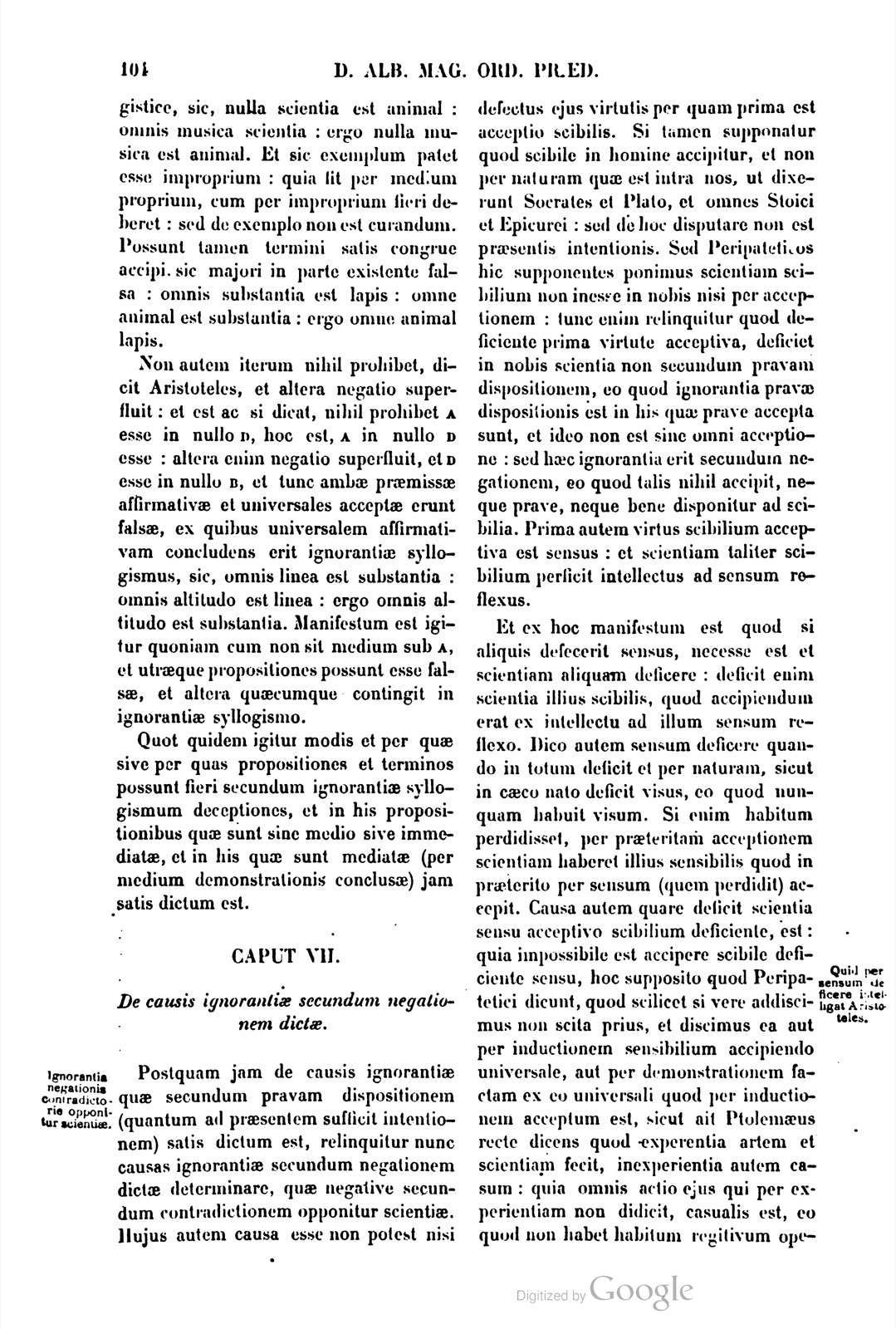
Non autem iterum nihil prohibet, dicit Aristoteles, et altera negatio superfluit: et est ac si dicat, nihil prohibet A esse in nullo D, hoc est, A in nullo D esse: altera enim negatio superfluit, et D esse in nullo B, et tunc ambae praemissae affirmativae et universales acceptae erunt falsae, ex quibus universalem affirmativam concludens erit ignorantiae syllogismus, sic, omnis linea est substantia: omnis altitudo est linea: ergo omnis altitudo est substantia. Manifestum est igitur quoniam cum non sit medium sub A, et utraeque propositiones possunt esse falsae, et altera quaecumque contingit in ignorantiae syllogismo.
Quot quidem igitur modis et per quae sive per quas propositiones et terminos possunt fieri secundum ignorantiae syllogismum deceptiones, et in his propositionibus quae sunt sine medio sive immediatae, et in his quae sunt mediatae (per medium demonstrationis conclusae) jam satis dictum est.
But "not nothing prevents again," Aristotle says, and the other negation is superfluous. And it is as if he were saying: nothing prevents A from being in no D, that is, A from being in no D, for the other negation is superfluous, and D from being in no B; and then both premises, accepted as affirmative and universal, will be false, from which there will be a syllogism of ignorance concluding a universal affirmative, thus: every line is substance; every height is line; therefore every height is substance. Therefore it is manifest that, since the middle is not under A, both propositions can be false, and either one, whichever it may be, happens in a syllogism of ignorance.
Therefore it has now been sufficiently said in how many modes, and through what things, or through what propositions and terms, deceptions can be made according to the syllogism of ignorance, both in those propositions which are without a middle or immediate, and in those which are mediate, that is, concluded through the middle of demonstration.
If a page does not appear, its photograph has not been uploaded yet.