Works › Posterior Analytics, Books I–II
Volume 2 · pp. 101–102
Treatise IV, Chapter V. How A Syllogism Of Ignorance Is Made In The Second Figure Against A Universal Affirmative
A marker with ≈ is an approximate page boundary, placed by measure of the text; the page photographs remain the authority. In the paired views, clicking a page marker brings that page into view.
Caput V.
Qualiter fit syllogismus ignorantiae in secunda figura contra universalem affirmativam.
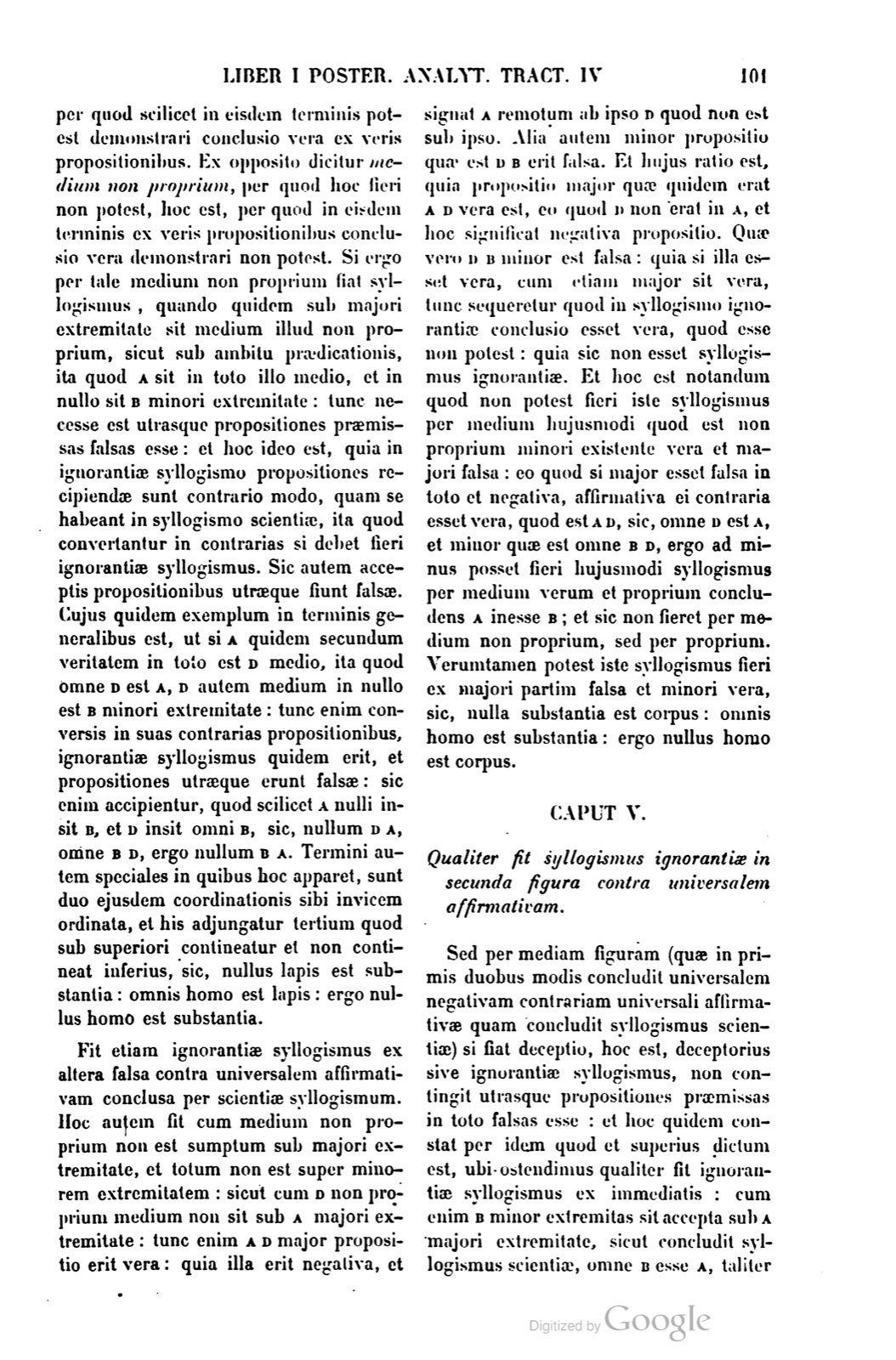
Sed per mediam figuram (quae in primis duobus modis concludit universalem negativam contrariam universali affirmativae quam concludit syllogismus scientiae) si fiat deceptio, hoc est, deceptorius sive ignorantiae syllogismus, non contingit utrasque propositiones praemissas in toto falsas esse: et hoc quidem constat per idem quod et superius dictum est, ubi ostendimus qualiter fit ignorantiae syllogismus ex immediatis: cum enim B minor extremitas sit accepta sub A majori extremitate, sicut concludit syllogismus scientiae, omne B esse A, taliter se habentibus extremitatibus ad invicem nihil contingit accipere pro medio, quod in hoc extremo omni sit: in illo autem altero extremo sit nullo modo, sicut in ante habitis dictum est: hoc enim in ante habitis plane probatum est: et ideo hoc leviter dictum sufficit: quia per omnia hic et ibi similis et eadem est ratio. Tamen bene fit ignorantiae syllogismus in secunda figura ex utrisque falsis in parte. Verbi gratia, omnis substantia est animal: nullum corpus animatum est animal: ergo nullum corpus animatum est substantia. Sed et hoc in ante habitis sufficienter ostensum est: et ideo sufficit hoc hic breviter tangere.
Doceamus ergo qualiter fit syllogismus ignorantiae in secunda figura ex altera falsa: et primo in secundo modo secundae figurae, et postea qualiter fit in primo. Dicamus igitur quod altera propositione falsa potest esse ignorantiae syllogismus in secundo secundae: et hoc quaecumque contingit sive majori sive minori: si enim C medium et in A majori extremitate est, et etiam idem C in B minori extremitate secundum veritatem, ita quod de utraque extremitate praedicetur universaliter et affirmative, sicut praetendit syllogismus scientiae concludens omne B esse A, si capiatur deceptive, et C medium in A quidem esse universaliter et affirmative, et accipiatur in B minori extremitate non esse universaliter et negative, sic, omne A est C, nullum B C, tunc propositio major quae quidem est A C erit vera: quia C praedicatur de eo quod subest ei: altera autem (quae est minor propositio universalis negativa) erit falsa: quia in ea negatur superius de inferiori. Termini autem dictae conjugationis sunt, omne animal est substantia: nullus homo est substantia: ergo nullus homo animal. Et est attendendum quod in hoc eodem modo secundae figurae potest fieri iste ignorantiae syllogismus e converso, scilicet ex majori falsa et minori vera: quod quia ex praehabitis manifestum est, ideo non oportet hic circa hoc intendere.
Chapter V.
How a syllogism of ignorance is made in the second figure against a universal affirmative.
But through the middle figure, which in its first two modes concludes a universal negative contrary to the universal affirmative which the syllogism of science concludes, if deception is made, that is, a deceptive syllogism or a syllogism of ignorance, it does not happen that both premise propositions are wholly false. And this indeed is established through the same thing that was said above, where we showed how a syllogism of ignorance is made from immediates. For since B the minor extreme is accepted under A the major extreme, just as the syllogism of science concludes every B to be A, when the extremes are related to one another in this way, nothing can be accepted as a middle which is in this whole extreme, but is in no way in that other extreme, as was said in the preceding matters. For this was plainly proved in the preceding matters. And therefore this, lightly stated, suffices, because here and there the account is similar and the same through all things. Nevertheless a syllogism of ignorance is indeed made in the second figure from both premises false in part. For example: every substance is animal; no animated body is animal; therefore no animated body is substance. But this also has been sufficiently shown in the preceding matters; and therefore it suffices to touch on this briefly here.
Therefore let us teach how a syllogism of ignorance is made in the second figure from one false premise: and first in the second mode of the second figure, and afterward how it is made in the first. Therefore let us say that with one proposition false there can be a syllogism of ignorance in the second mode of the second figure; and this whichever proposition happens to be false, whether the major or the minor. For if C the middle is both in A the major extreme, and also the same C is in B the minor extreme according to truth, so that it is predicated universally and affirmatively of each extreme, just as the syllogism of science holding forth concludes every B to be A, if it is taken deceptively, and C the middle is indeed accepted as being in A universally and affirmatively, and is accepted as not being in B the minor extreme universally and negatively, thus: every A is C, no B is C, then the major proposition, which indeed is A C, will be true, because C is predicated of that which is under it; but the other, which is the universal negative minor proposition, will be false, because in it the superior is denied of the inferior. But the terms of the stated conjugation are: every animal is substance; no man is substance; therefore no man is animal. And it must be attended to that in this same mode of the second figure this syllogism of ignorance can be made conversely, namely from a false major and a true minor; but because this is manifest from the preceding matters, one need not attend to this here.
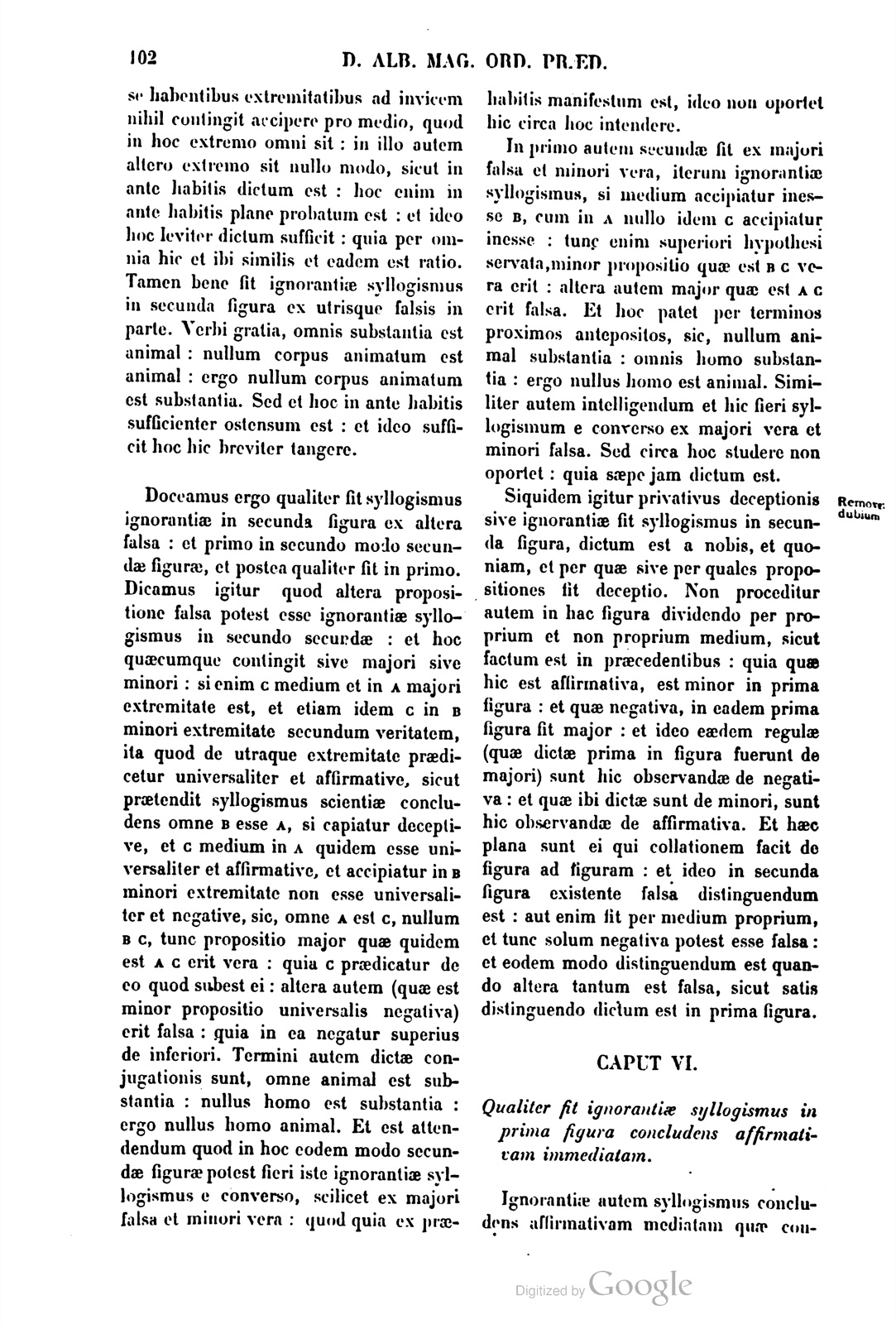
In primo autem secundae fit ex majori falsa et minori vera, iterum ignorantiae syllogismus, si medium accipiatur inesse B, cum in A nullo idem C accipiatur inesse: tunc enim superiori hypothesi servata, minor propositio quae est B C vera erit: altera autem major quae est A C erit falsa. Et hoc patet per terminos proximos antepositos, sic, nullum animal substantia: omnis homo substantia: ergo nullus homo est animal. Similiter autem intelligendum et hic fieri syllogismum e converso ex majori vera et minori falsa. Sed circa hoc studere non oportet: quia saepe jam dictum est.
Siquidem igitur privativus deceptionis sive ignorantiae fit syllogismus in secunda figura, dictum est a nobis, et quoniam, et per quae sive per quales propositiones fit deceptio. Non proceditur autem in hac figura dividendo per proprium et non proprium medium, sicut factum est in praecedentibus: quia quae hic est affirmativa, est minor in prima figura: et quae negativa, in eadem prima figura fit major: et ideo eaedem regulae (quae dictae prima in figura fuerunt de majori) sunt hic observandae de negativa: et quae ibi dictae sunt de minori, sunt hic observandae de affirmativa. Et haec plana sunt ei qui collationem facit de figura ad figuram: et ideo in secunda figura existente falsa distinguendum est: aut enim fit per medium proprium, et tunc solum negativa potest esse falsa: et eodem modo distinguendum est quando altera tantum est falsa, sicut satis distinguendo dictum est in prima figura.
But in the first mode of the second figure a syllogism of ignorance is again made from a false major and a true minor, if the middle is accepted as being present to B, while the same C is accepted as being present in no A. For then, with the higher hypothesis preserved, the minor proposition which is B C will be true; but the other, the major which is A C, will be false. And this is clear through the terms placed immediately before, thus: no animal is substance; every man is substance; therefore no man is animal. Similarly, however, it must also be understood here that the syllogism is made conversely from a true major and a false minor. But one need not study about this, because it has already often been said.
Therefore, since it has been said by us both that a privative syllogism of deception or ignorance is made in the second figure, and through what things or through what sort of propositions deception is made, one does not proceed in this figure by dividing through a proper and a non-proper middle, as was done in the preceding matters. For what is affirmative here is the minor in the first figure; and what is negative here becomes the major in the same first figure. And therefore the same rules which were stated in the first figure about the major are to be observed here about the negative; and the things which were said there about the minor are to be observed here about the affirmative. And these things are plain to one who makes a comparison of figure to figure. And therefore, when there is falsity in the second figure, one must distinguish: for either it is made through a proper middle, and then only the negative can be false; and in the same way one must distinguish when only one premise is false, as was said with sufficient distinction in the first figure.
If a page does not appear, its photograph has not been uploaded yet.