Works › Posterior Analytics, Books I–II
Volume 2 · pp. 99–101
Treatise IV, Chapter IV. How A Syllogism Of Ignorance Is Made In Mediate Propositions
A marker with ≈ is an approximate page boundary, placed by measure of the text; the page photographs remain the authority. In the paired views, clicking a page marker brings that page into view.
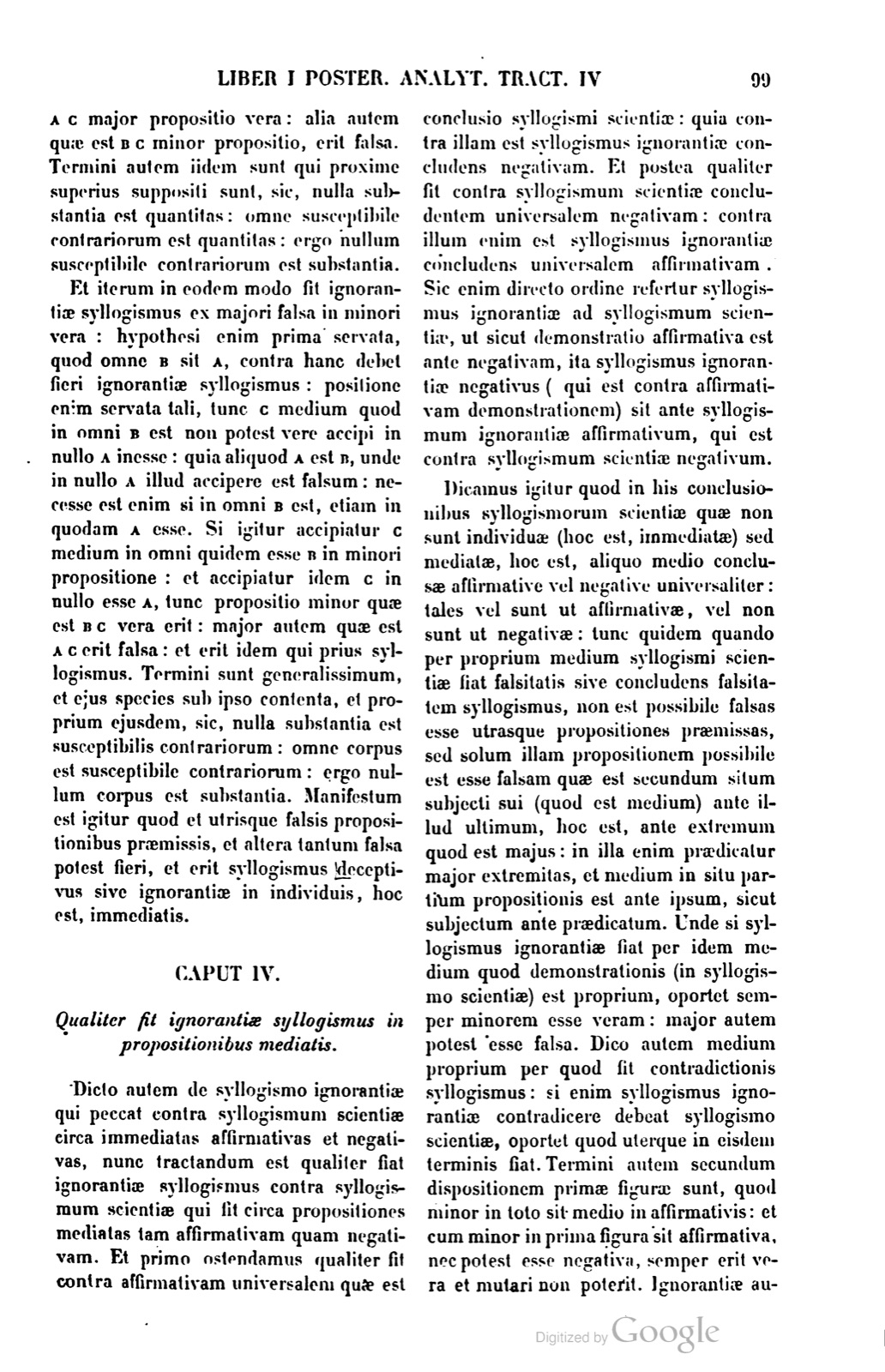
Caput IV.
Qualiter fit ignorantiae syllogismus in propositionibus mediatis.
Dicto autem de syllogismo ignorantiae qui peccat contra syllogismum scientiae circa immediatas affirmativas et negativas, nunc tractandum est qualiter fiat ignorantiae syllogismus contra syllogismum scientiae qui fit circa propositiones mediatas tam affirmativam quam negativam. Et primo ostendamus qualiter fit contra affirmativam universalem quae est conclusio syllogismi scientiae: quia contra illam est syllogismus ignorantiae concludens negativam. Et postea qualiter fit contra syllogismum scientiae concludentem universalem negativam: contra illum enim est syllogismus ignorantiae concludens universalem affirmativam. Sic enim directo ordine refertur syllogismus ignorantiae ad syllogismum scientiae, ut sicut demonstratio affirmativa est ante negativam, ita syllogismus ignorantiae negativus (qui est contra affirmativam demonstrationem) sit ante syllogismum ignorantiae affirmativum, qui est contra syllogismum scientiae negativum.
Dicamus igitur quod in his conclusionibus syllogismorum scientiae quae non sunt individuae (hoc est, immediatae) sed mediatae, hoc est, aliquo medio conclusae affirmative vel negative universaliter: tales vel sunt ut affirmativae, vel non sunt ut negativae: tunc quidem quando per proprium medium syllogismi scientiae fiat falsitatis sive concludens falsitatem syllogismus, non est possibile falsas esse utrasque propositiones praemissas, sed solum illam propositionem possibile est esse falsam quae est secundum situm subjecti sui (quod est medium) ante illud ultimum, hoc est, ante extremum quod est majus: in illa enim praedicatur major extremitas, et medium in situ partium propositionis est ante ipsum, sicut subjectum ante praedicatum. Unde si syllogismus ignorantiae fiat per idem medium quod demonstrationis (in syllogismo scientiae) est proprium, oportet semper minorem esse veram: major autem potest esse falsa. Dico autem medium proprium per quod fit contradictionis syllogismus: si enim syllogismus ignorantiae contradicere debeat syllogismo scientiae, oportet quod uterque in eisdem terminis fiat. Termini autem secundum dispositionem primae figurae sunt, quod minor in toto sit medio in affirmativis: et cum minor in prima figura sit affirmativa, nec potest esse negativa, semper erit vera et mutari non poterit. Ignorantiae autem syllogismus concludit falsum: et hoc non sequitur nisi ex falso. Oportet ergo in tali dispositione majorem esse falsam.
Hujus autem exemplum in terminis generalibus est, quod ponatur conclusio demonstrativa per syllogismum scientiae esse universalis affirmativa, scilicet omne B A, ita quod A sit in B in toto, et sit conclusa per C medium: si enim A erit in B per medium C, quoniam in prima figura necesse est propositionem minorem quae est B C esse affirmativam, eo quod aliter non valet consequentia syllogismi, oportet quod in syllogismo ignorantiae maneat minor affirmativa, quae eadem minor fuit in syllogismo scientiae: manifestum est ergo quod haec minor semper erit vera in syllogismo ignorantiae, sicut fuit in syllogismo scientiae: semper enim vera propositio est in qua totum universale de parte sua subjectiva praedicatur: haec enim minor propositio non convertitur in contrariam in syllogismo ignorantiae, sed accipitur semper affirmativa, sicut fuit in syllogismo scientiae: sed illa major propositio quae est A C potest esse falsa in syllogismo ignorantiae: eo quod hac conversa in contrarium, contrario (hoc est, ad contrarium conclusionis syllogismi scientiae) fiet ignorantiae syllogismus: sic enim syllogizabitur in syllogismo scientiae: omne C est A, omne B C, ergo omne B A. Termini autem in materia speciali in quibus hoc apparet, sunt continue ordinati ad invicem in aliquo genere sic in syllogismo scientiae: omne corpus est substantia: omne animatum est corpus: ergo omne animatum est substantia. In syllogismo ignorantiae sic: nullum corpus est substantia: omne animatum est corpus: ergo nullum animatum est substantia. Sic ergo fit syllogismus ignorantiae per proprium medium quod quidem proprium medium est demonstrativum: quia aliter non esset proprium nisi esset ejusdem coordinationis cum extremis quae demonstrantur sibi inesse, ita quod major probetur inesse minori.
Chapter IV.
How a syllogism of ignorance is made in mediate propositions.
But having spoken about the syllogism of ignorance which sins against the syllogism of science concerning immediate affirmatives and negatives, now it must be treated how a syllogism of ignorance is made against the syllogism of science which is made concerning mediate propositions, both affirmative and negative. And first let us show how it is made against the universal affirmative which is the conclusion of the syllogism of science, because against that there is a syllogism of ignorance concluding a negative. And afterward let us show how it is made against the syllogism of science concluding a universal negative, for against that there is a syllogism of ignorance concluding a universal affirmative. For in this direct order the syllogism of ignorance is referred to the syllogism of science, so that, just as affirmative demonstration is before negative demonstration, so the negative syllogism of ignorance, which is against affirmative demonstration, is before the affirmative syllogism of ignorance, which is against the negative syllogism of science.
Therefore let us say that, in those conclusions of syllogisms of science which are not individual, that is, immediate, but mediate, that is, concluded universally, either affirmatively or negatively, by some middle, such conclusions either are as affirmatives or are not as negatives. Then, when through the proper middle of the syllogism of science there is made a syllogism of falsity or one concluding falsity, it is not possible for both premise propositions to be false; but only that proposition can be false which, according to the position of its subject, which is the middle, is before that ultimate thing, that is, before the extreme which is greater. For in that proposition the major extreme is predicated, and the middle, in the position of the parts of the proposition, is before it, as subject before predicate. Whence, if the syllogism of ignorance is made through the same middle which is proper to the demonstration in the syllogism of science, the minor must always be true, but the major can be false. But I call that the proper middle through which a syllogism of contradiction is made; for if a syllogism of ignorance ought to contradict the syllogism of science, each must be made in the same terms. But the terms according to the disposition of the first figure are such that the minor is in the whole middle in affirmatives; and since the minor in the first figure is affirmative and cannot be negative, it will always be true and will not be able to be changed. But the syllogism of ignorance concludes the false, and this does not follow except from the false. Therefore in such a disposition the major must be false.
But an example of this in general terms is that the demonstrative conclusion through the syllogism of science is posited to be a universal affirmative, namely every B is A, so that A is in B as in a whole, and is concluded through C the middle. For if A will be in B through the middle C, since in the first figure it is necessary that the minor proposition, which is B C, be affirmative, because otherwise the consequence of the syllogism is not valid, it is necessary that in the syllogism of ignorance the affirmative minor remain, which was the same minor in the syllogism of science. Therefore it is manifest that this minor will always be true in the syllogism of ignorance, just as it was true in the syllogism of science. For a proposition is always true in which the universal whole is predicated of its subjective part. For this minor proposition is not converted into the contrary in the syllogism of ignorance, but is always accepted as affirmative, just as it was in the syllogism of science. But that major proposition which is A C can be false in the syllogism of ignorance, because, when this has been converted into the contrary, the syllogism of ignorance will be made contrary to, that is, toward the contrary of, the conclusion of the syllogism of science. For in the syllogism of science it will be syllogized thus: every C is A; every B is C; therefore every B is A. But the terms in special matter in which this appears are continuously ordered to one another in some genus thus in the syllogism of science: every body is substance; every animated thing is body; therefore every animated thing is substance. In the syllogism of ignorance thus: no body is substance; every animated thing is body; therefore no animated thing is substance. Thus therefore the syllogism of ignorance is made through a proper middle, which indeed is a demonstrative proper middle, because otherwise it would not be proper unless it were of the same coordination with the extremes which are demonstrated to be present to one another, so that the major is proved to be present to the minor.
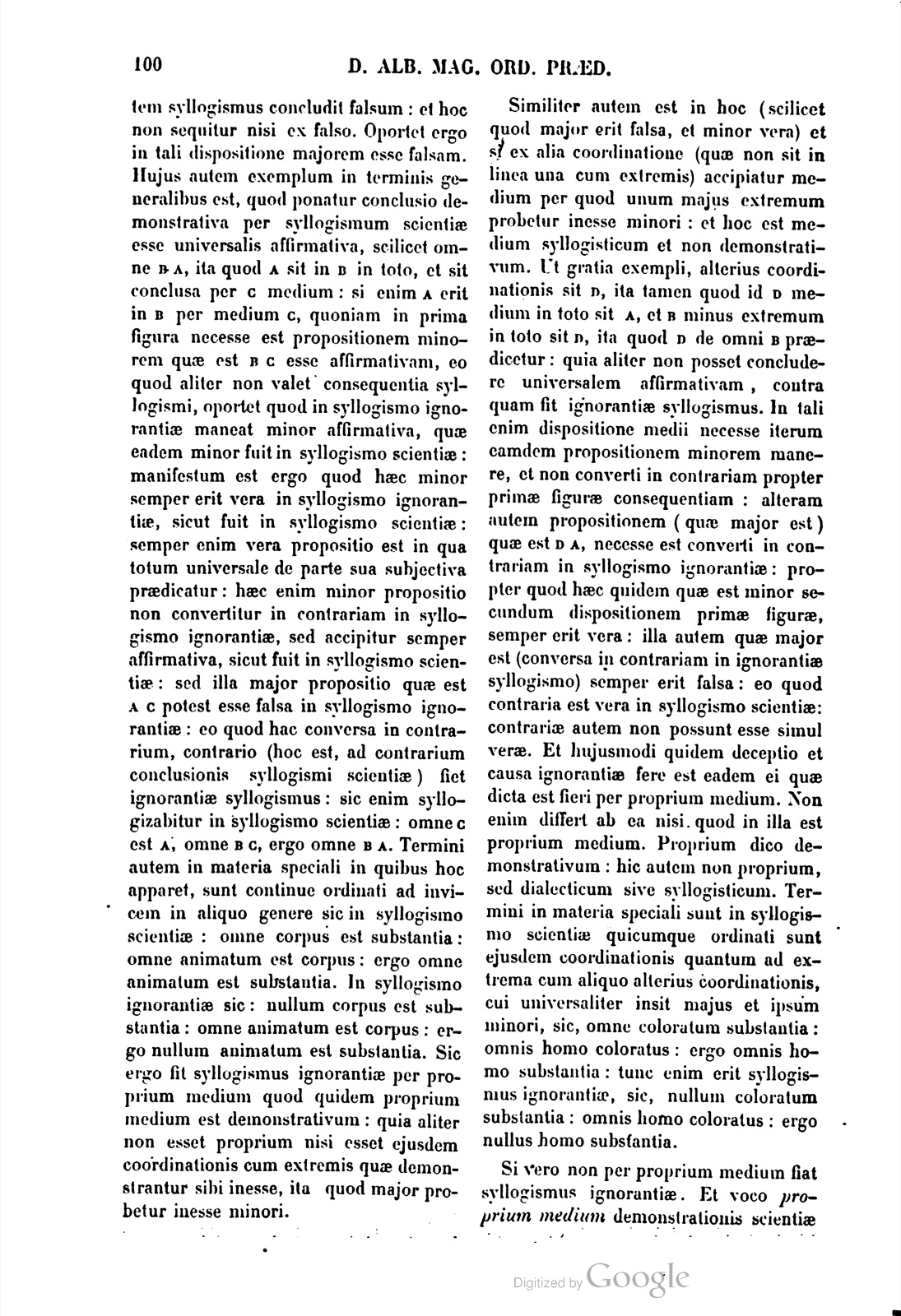
Similiter autem est in hoc (scilicet quod major erit falsa, et minor vera) et si ex alia coordinatione (quae non sit in linea una cum extremis) accipiatur medium per quod unum majus extremum probetur inesse minori: et hoc est medium syllogisticum et non demonstrativum. Ut gratia exempli, alterius coordinationis sit D, ita tamen quod id D medium in toto sit A, et B minus extremum in toto sit D, ita quod D de omni B praedicetur: quia aliter non posset concludere universalem affirmativam, contra quam fit ignorantiae syllogismus. In tali enim dispositione medii necesse iterum eamdem propositionem minorem manere, et non converti in contrariam propter primae figurae consequentiam: alteram autem propositionem (quae major est) quae est D A, necesse est converti in contrariam in syllogismo ignorantiae: propter quod haec quidem quae est minor secundum dispositionem primae figurae, semper erit vera: illa autem quae major est (conversa in contrariam in ignorantiae syllogismo) semper erit falsa: eo quod contraria est vera in syllogismo scientiae: contrariae autem non possunt esse simul verae. Et hujusmodi quidem deceptio et causa ignorantiae fere est eadem ei quae dicta est fieri per proprium medium. Non enim differt ab ea nisi quod in illa est proprium medium. Proprium dico demonstrativum: hic autem non proprium, sed dialecticum sive syllogisticum. Termini in materia speciali sunt in syllogismo scientiae quicumque ordinati sunt ejusdem coordinationis quantum ad extrema cum aliquo alterius coordinationis, cui universaliter insit majus et ipsum minori, sic, omne coloratum substantia: omnis homo coloratus: ergo omnis homo substantia: tunc enim erit syllogismus ignorantiae, sic, nullum coloratum substantia: omnis homo coloratus: ergo nullus homo substantia.
Si vero non per proprium medium fiat syllogismus ignorantiae. Et voco proprium medium demonstrationis scientiae per quod scilicet in eisdem terminis potest demonstrari conclusio vera ex veris propositionibus. Ex opposito dicitur medium non proprium, per quod hoc fieri non potest, hoc est, per quod in eisdem terminis ex veris propositionibus conclusio vera demonstrari non potest. Si ergo per tale medium non proprium fiat syllogismus, quando quidem sub majori extremitate sit medium illud non proprium, sicut sub ambitu praedicationis, ita quod A sit in toto illo medio, et in nullo sit B minori extremitate: tunc necesse est utrasque propositiones praemissas falsas esse: et hoc ideo est, quia in ignorantiae syllogismo propositiones recipiendae sunt contrario modo, quam se habeant in syllogismo scientiae, ita quod convertantur in contrarias si debet fieri ignorantiae syllogismus. Sic autem acceptis propositionibus utraeque fiunt falsae. Cujus quidem exemplum in terminis generalibus est, ut si A quidem secundum veritatem in toto est D medio, ita quod omne D est A, D autem medium in nullo est B minori extremitate: tunc enim conversis in suas contrarias propositionibus, ignorantiae syllogismus quidem erit, et propositiones utraeque erunt falsae: sic enim accipientur, quod scilicet A nulli insit B, et D insit omni B, sic, nullum D A, omne B D, ergo nullum B A. Termini autem speciales in quibus hoc apparet, sunt duo ejusdem coordinationis sibi invicem ordinata, et his adjungatur tertium quod sub superiori contineatur et non contineat inferius, sic, nullus lapis est substantia: omnis homo est lapis: ergo nullus homo est substantia.
Similarly it is so in this, namely that the major will be false and the minor true, even if from another coordination, which is not in one line with the extremes, a middle is accepted through which one greater extreme is proved to be present to the minor; and this is a syllogistic middle and not a demonstrative one. By way of example, let D be of another coordination, yet in such a way that this middle D is in the whole A, and B the lesser extreme is in the whole D, so that D is predicated of every B, because otherwise it could not conclude a universal affirmative against which the syllogism of ignorance is made. For in such a disposition of the middle it is again necessary that the same minor proposition remain, and not be converted into the contrary because of the consequence of the first figure; but the other proposition, which is the major, which is D A, must be converted into the contrary in the syllogism of ignorance. On account of this, this one, which is the minor according to the disposition of the first figure, will always be true, but that one which is the major, when converted into the contrary in the syllogism of ignorance, will always be false, because its contrary is true in the syllogism of science; but contraries cannot be true at the same time. And this kind of deception and cause of ignorance is almost the same as that which was said to be made through a proper middle. For it differs from it only because in that one there is a proper middle. I mean a demonstrative proper middle; but here it is not proper, but dialectical or syllogistic. The terms in special matter are, in the syllogism of science, any terms ordered in the same coordination with respect to the extremes with something of another coordination, to which the greater is universally present and which itself is present to the minor, thus: every colored thing is substance; every man is colored; therefore every man is substance. Then there will be a syllogism of ignorance thus: no colored thing is substance; every man is colored; therefore no man is substance.
But if the syllogism of ignorance is not made through a proper middle. And I call the proper middle of demonstration of science that through which, namely in the same terms, a true conclusion can be demonstrated from true propositions. By opposition the middle is called non-proper through which this cannot be done, that is, through which, in the same terms, a true conclusion cannot be demonstrated from true propositions. Therefore if a syllogism is made through such a non-proper middle, when that non-proper middle is indeed under the major extreme as under the ambit of predication, so that A is in that whole middle and is in no B the minor extreme, then it is necessary that both premise propositions be false. And this is so because in the syllogism of ignorance the propositions must be received in a contrary way from the way they stand in the syllogism of science, so that they are converted into contraries if a syllogism of ignorance ought to be made. But when the propositions are accepted in this way, both become false. The example of this in general terms is, as if A indeed according to truth is in the whole D the middle, so that every D is A, but D the middle is in no B the minor extreme. For then, when the propositions have been converted into their contraries, there will indeed be a syllogism of ignorance, and both propositions will be false. For they will be accepted thus, namely that A is present to no B, and that D is present to every B, in this way: no D is A; every B is D; therefore no B is A. But the special terms in which this appears are two terms of the same coordination ordered to one another, and to these let a third be joined which is contained under the superior and does not contain the inferior, thus: no stone is substance; every man is stone; therefore no man is substance.
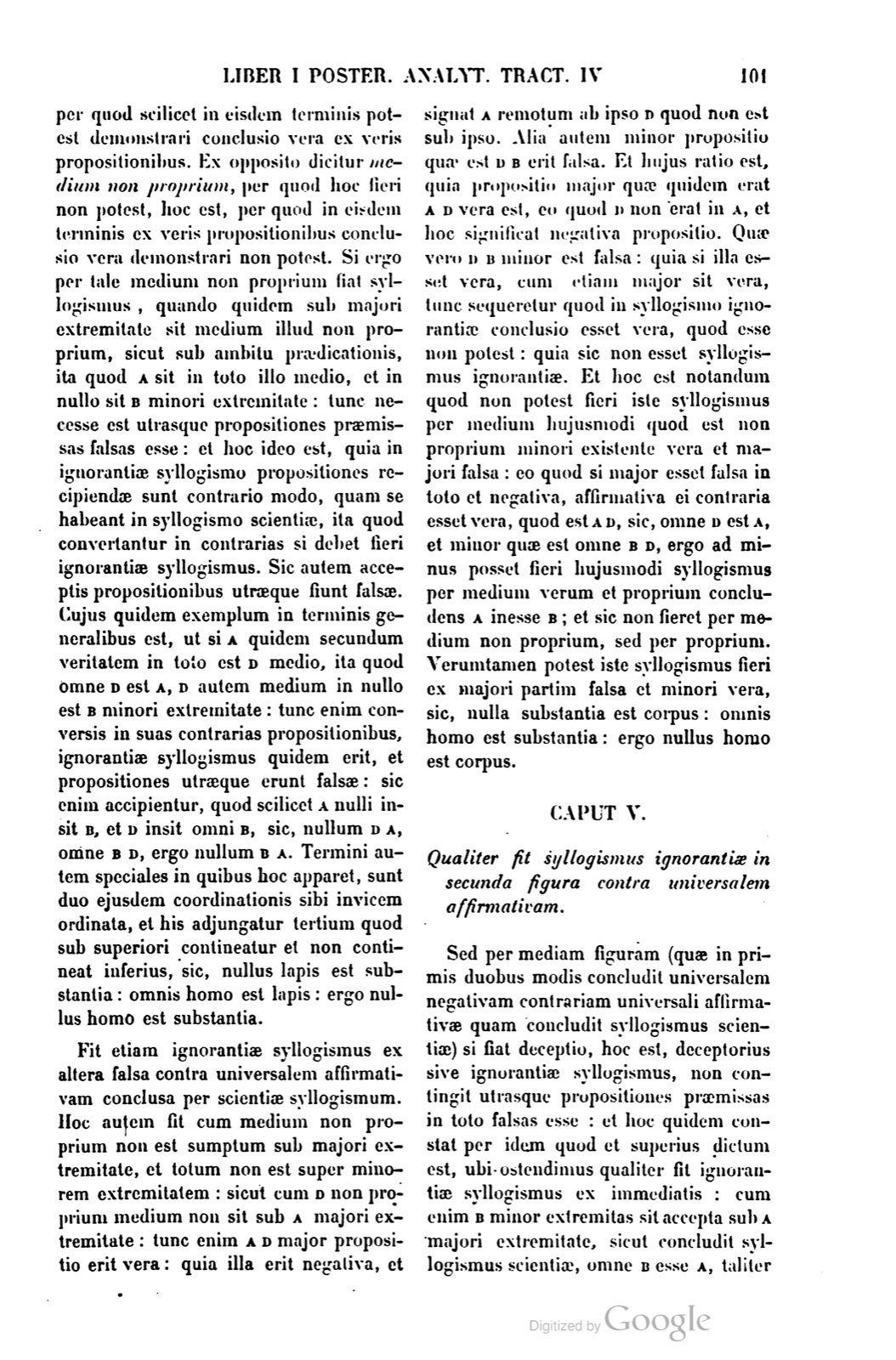
Fit etiam ignorantiae syllogismus ex altera falsa contra universalem affirmativam conclusam per scientiae syllogismum. Hoc autem fit cum medium non proprium non est sumptum sub majori extremitate, et totum non est super minorem extremitatem: sicut cum D non proprium medium non sit sub A majori extremitate: tunc enim A D major propositio erit vera: quia illa erit negativa, et signat A remotum ab ipso D quod non est sub ipso. Alia autem minor propositio quae est D B erit falsa. Et hujus ratio est, quia propositio major quae quidem erat A D vera est, eo quod D non erat in A, et hoc significat negativa propositio. Quae vero D B minor est falsa: quia si illa esset vera, cum etiam major sit vera, tunc sequeretur quod in syllogismo ignorantiae conclusio esset vera, quod esse non potest: quia sic non esset syllogismus ignorantiae. Et hoc est notandum quod non potest fieri iste syllogismus per medium hujusmodi quod est non proprium minori existente vera et majori falsa: eo quod si major esset falsa in toto et negativa, affirmativa ei contraria esset vera, quod est A D, sic, omne D est A, et minor quae est omne B D, ergo ad minus posset fieri hujusmodi syllogismus per medium verum et proprium concludens A inesse B; et sic non fieret per medium non proprium, sed per proprium. Verumtamen potest iste syllogismus fieri ex majori partim falsa et minori vera, sic, nulla substantia est corpus: omnis homo est substantia: ergo nullus homo est corpus.
A syllogism of ignorance is also made from one false premise against a universal affirmative concluded through a syllogism of science. But this happens when the non-proper middle is not taken under the major extreme, and the whole is not above the minor extreme. For example, when D, the non-proper middle, is not under A the major extreme. Then the A D major proposition will be true, because that proposition will be negative and signifies A as removed from D itself, which is not under it. But the other proposition, the minor, which is D B, will be false. And the reason for this is that the major proposition, which indeed was A D, is true, because D was not in A, and this is what the negative proposition signifies. But the minor which is D B is false, because if that were true, since the major also is true, then it would follow that in the syllogism of ignorance the conclusion would be true, which cannot be, because thus it would not be a syllogism of ignorance. And it must be noted that this syllogism cannot be made through a middle of this sort which is not proper while the minor is true and the major false, because if the major were wholly false and negative, the affirmative contrary to it would be true, which is A D, thus: every D is A; and the minor, which is every B is D, therefore at least such a syllogism could be made through a true and proper middle concluding A to be present in B, and so it would not be made through a non-proper middle, but through a proper one. Nevertheless this syllogism can be made from a major partly false and a true minor, thus: no substance is body; every man is substance; therefore no man is body.
If a page does not appear, its photograph has not been uploaded yet.