Works › Posterior Analytics, Books I–II
Volume 2 · pp. 93–95
Treatise IV, Chapter II. On Ignorance Of Bad Disposition
A marker with ≈ is an approximate page boundary, placed by measure of the text; the page photographs remain the authority. In the paired views, clicking a page marker brings that page into view.
Caput II.
De ignorantia malae dispositionis, quid sit et quae causae ipsius, et primo circa affirmativas et negativas.
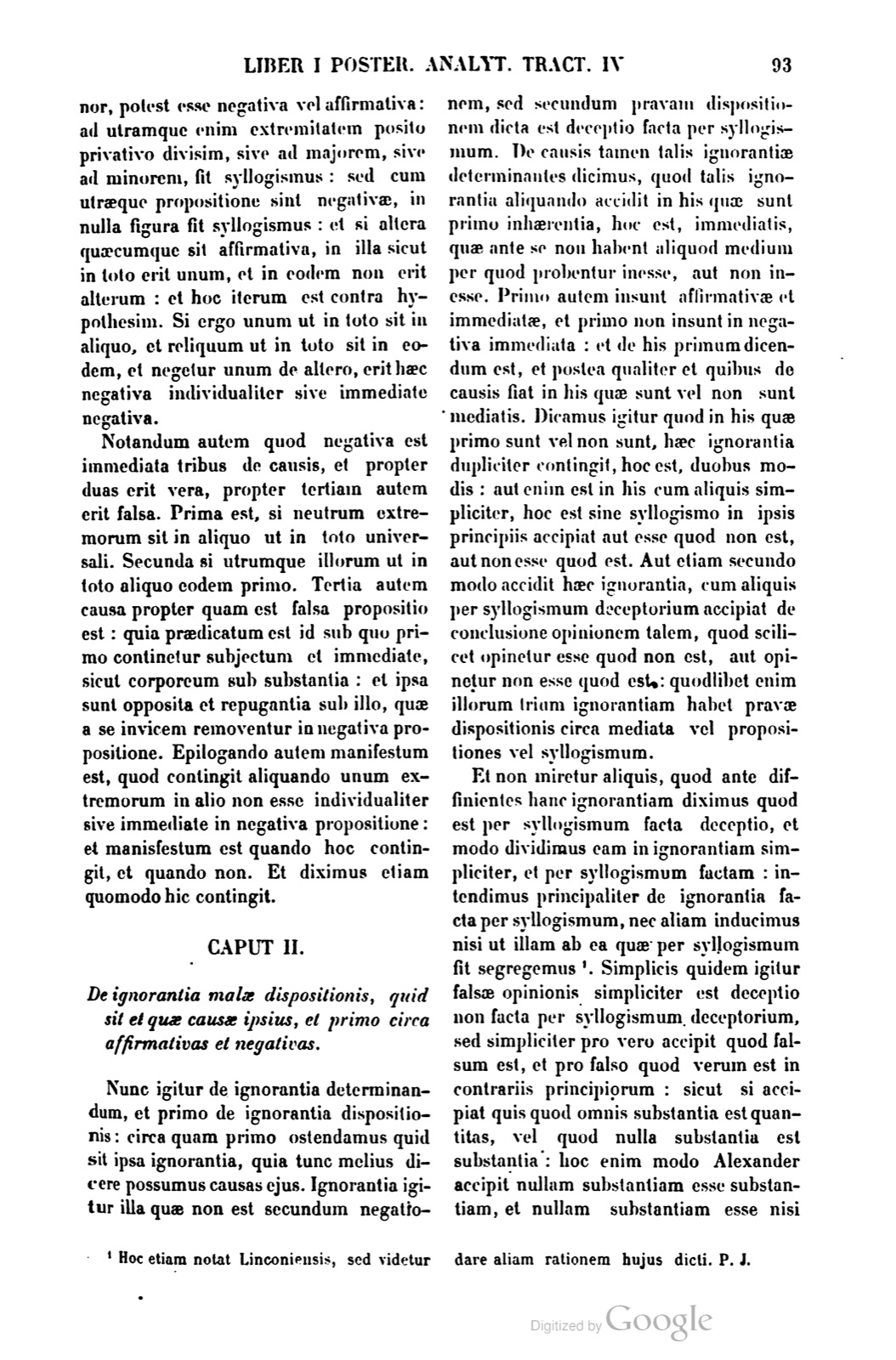
Nunc igitur de ignorantia determinandum, et primo de ignorantia dispositionis: circa quam primo ostendamus quid sit ipsa ignorantia, quia tunc melius dicere possumus causas ejus. Ignorantia igitur illa quae non est secundum negationem, sed secundum pravam dispositionem dicta est deceptio facta per syllogismum. De causis tamen talis ignorantiae determinantes dicimus, quod talis ignorantia aliquando accidit in his quae sunt primo inhaerentia, hoc est, immediatis, quae ante se non habent aliquod medium per quod probentur inesse, aut non inesse. Primo autem insunt affirmativae et immediatae, et primo non insunt in negativa immediata: et de his primum dicendum est, et postea qualiter et quibus de causis fiat in his quae sunt vel non sunt mediatis. Dicamus igitur quod in his quae primo sunt vel non sunt, haec ignorantia dupliciter contingit, hoc est, duobus modis: aut enim est in his cum aliquis simpliciter, hoc est sine syllogismo in ipsis principiis accipiat aut esse quod non est, aut non esse quod est. Aut etiam secundo modo accidit haec ignorantia, cum aliquis per syllogismum deceptorium accipiat de conclusione opinionem talem, quod scilicet opinetur esse quod non est, aut opinetur non esse quod est: quodlibet enim illorum trium ignorantiam habet pravae dispositionis circa mediata vel propositiones vel syllogismum.
Et non miretur aliquis, quod ante diffinientes hanc ignorantiam diximus quod est per syllogismum facta deceptio, et modo dividimus eam in ignorantiam simpliciter, et per syllogismum factam: intendimus principaliter de ignorantia facta per syllogismum, nec aliam inducimus nisi ut illam ab ea quae per syllogismum fit segregemus 1. Simplicis quidem igitur falsae opinionis simpliciter est deceptio non facta per syllogismum deceptorium, sed simpliciter pro vero accipit quod falsum est, et pro falso quod verum est in contrariis principiorum: sicut si accipiat quis quod omnis substantia est quantitas, vel quod nulla substantia est substantia: hoc enim modo Alexander accipit nullam substantiam esse substantiam, et nullam substantiam esse nisi materiam, et substantiam formatam esse actum materiae, sicut apparet in libro de Atomis, quem scripsit Alexander primus.
Sed illa quae est per syllogismum ignorantia conclusionis, plures sunt causae facientes eam, et talis est plures secundum modos et causas. Ponamus enim in terminis generalibus, quod A non sit in nullo B, hoc est, quod A removeatur a B, universaliter sic dicendo: nullum B est A, et nullum A B, ita quod non insit unum alteri individualiter, hoc est, immediate, hoc est, quod haec negativa sit immediata, nullum B est A: si ergo aliquis syllogizet sive per syllogismum concludat, quod sit in medium accipiens C per quod concludat A de B, deceptus erit per syllogismum: deceptus quidem, quia accipit esse quod non est, et deceptus quia accipit mediatum quod immediatum est. Et haec deceptio per syllogismum concludentem facta simpliciter, dupliciter potest accidere, scilicet ex utrisque praemissis falsis, et ex altera falsa et altera vera: contingit enim in tali syllogismo deceptorio utrasque propositiones esse falsas, et contingit aliquando alteram tantum esse falsam. Si enim dicatur, quod neque A major extremitas in nullo C erit medio in majori propositione, ita quod haec sit vera et immediata, nullum C est A, et similiter C medium sit in nullo B in minori propositione, ita quod haec sit vera, nullum B est C, et utraque istarum propositionum sit e contrario accepta, ita quod contrariae istarum accipiantur per oppositas qualitates, ut omne C est A, et omne B C: utraeque propositiones erunt falsae.
Chapter II.
On ignorance of bad disposition, what it is and what its causes are, and first concerning affirmatives and negatives.
Now, therefore, ignorance must be determined, and first ignorance of disposition. Concerning this ignorance we should first show what this ignorance itself is, because then we can speak better of its causes. Therefore that ignorance which is not according to negation, but according to a bad disposition, is called deception made through a syllogism. Yet in determining the causes of such ignorance we say that such ignorance sometimes occurs in those things which are first inhering, that is, in immediate things, which do not have before themselves some middle through which they are proved to be present, or proved not to be present. But affirmatives and immediate things are first present, and they are first not present in an immediate negative; and about these one must speak first, and afterward how and from what causes it occurs in those things which are, or are not, mediate. Therefore let us say that in those things which first are or first are not, this ignorance happens in two ways, that is, in two modes. For either it is in these things when someone simply, that is, without a syllogism, in the principles themselves accepts either that what is not is, or that what is is not. Or also, in a second mode, this ignorance occurs when someone through a deceptive syllogism receives concerning the conclusion such an opinion, namely that he opines that what is not is, or opines that what is is not. For any one of those three things has ignorance of bad disposition concerning mediate things, whether concerning propositions or concerning a syllogism.
And let no one wonder that before, when defining this ignorance, we said that it is deception made through a syllogism, and now we divide it into ignorance simply and ignorance made through a syllogism. For we principally intend to speak about ignorance made through a syllogism, and we introduce the other ignorance only so that we may separate that ignorance from the one which is made through a syllogism 1. Therefore deception of simple false opinion is simply not made through a deceptive syllogism, but simply accepts as true what is false, and as false what is true, in the contraries of principles. For example, if someone accepts that every substance is quantity, or that no substance is substance. For in this way Alexander accepts that no substance is substance, and that no substance is anything except matter, and that formed substance is the act of matter, as appears in the book On Atoms, which Alexander the First wrote.
But as for that ignorance of a conclusion which occurs through a syllogism, there are several causes making it, and such ignorance is manifold according to its modes and according to its causes. For let us posit in general terms that A is in no B, that is, that A is removed from B, by saying universally in this way: no B is A, and no A is B, so that one is not in the other individually, that is, immediately, that is, so that this negative is immediate: no B is A. Therefore if someone syllogizes or concludes through a syllogism that A is in B, by accepting C as a middle through which he concludes A of B, he will be deceived through a syllogism: deceived indeed because he accepts being where there is not being, and deceived because he accepts as mediate that which is immediate. And this deception, made simply through a syllogism that concludes, can occur in two ways, namely from both premises being false, and from one premise being false and the other true. For in such a deceptive syllogism it happens that both propositions are false, and sometimes it happens that only one proposition is false. For if it is said that A, the major extreme, will be in no C the middle in the major proposition, so that this proposition is true and immediate, "no C is A," and similarly that C the middle is in no B in the minor proposition, so that this proposition is true, "no B is C," and each of these propositions is taken contrariwise, so that the contrary propositions of these are accepted through opposite qualities, as "every C is A" and "every B is C," then both propositions will be false.
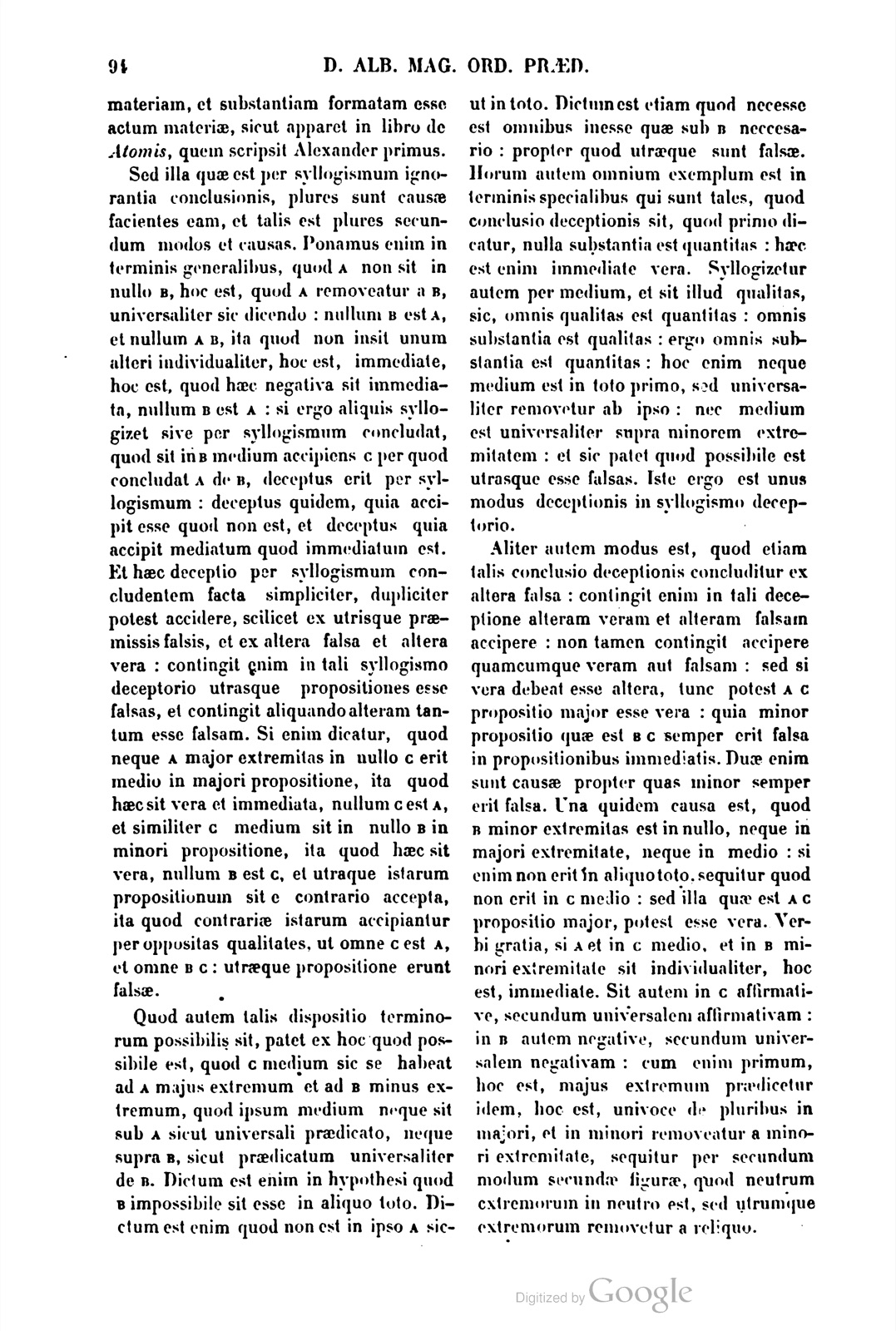
Quod autem talis dispositio terminorum possibilis sit, patet ex hoc quod possibile est, quod C medium sic se habeat ad A majus extremum et ad B minus extremum, quod ipsum medium neque sit sub A sicut universali praedicato, neque supra B, sicut praedicatum universaliter de B. Dictum est enim in hypothesi quod B impossibile sit esse in aliquo toto. Dictum est etiam quod necesse est omnibus inesse quae sub B necessario: propter quod utraeque sunt falsae. Horum autem omnium exemplum est in terminis specialibus qui sunt tales, quod conclusio deceptionis sit, quod primo dicatur, nulla substantia est quantitas: haec est enim immediate vera. Syllogizetur autem per medium, et sit illud qualitas, sic, omnis qualitas est quantitas: omnis substantia est qualitas: ergo omnis substantia est quantitas: hoc enim neque medium est in toto primo, sed universaliter removetur ab ipso: nec medium est universaliter supra minorem extremitatem: et sic patet quod possibile est utrasque esse falsas. Iste ergo est unus modus deceptionis in syllogismo deceptorio.
Aliter autem modus est, quod etiam talis conclusio deceptionis concluditur ex altera falsa: contingit enim in tali deceptione alteram veram et alteram falsam accipere: non tamen contingit accipere quamcumque veram aut falsam: sed si vera debeat esse altera, tunc potest A C propositio major esse vera: quia minor propositio quae est B C semper erit falsa in propositionibus immediatis. Duae enim sunt causae propter quas minor semper erit falsa. Una quidem causa est, quod B minor extremitas est in nullo, neque in majori extremitate, neque in medio: si enim non erit in aliquo toto, sequitur quod non erit in C medio: sed illa quae est A C propositio major, potest esse vera. Verbi gratia, si A et in C medio, et in B minori extremitate sit individualiter, hoc est, immediate. Sit autem in C affirmative, secundum universalem affirmativam: in B autem negative, secundum universalem negativam: cum enim primum, hoc est, majus extremum praedicetur idem, hoc est, univoce de pluribus in majori, et in minori removeatur a minori extremitate, sequitur per secundum modum secundae figurae, quod neutrum extremorum in neutro est, sed utrumque extremorum removetur a reliquo.
But that such a disposition of terms is possible is clear from the fact that it is possible that C the middle is so related to A the greater extreme and to B the lesser extreme that this middle itself is neither under A as under a universal predicate, nor above B as a predicate universally said of B. For it has been said in the hypothesis that it is impossible for B to be in some whole. It has also been said that it is necessary that all things which are under B be present necessarily to all. On account of this both propositions are false. But the example of all these things is in special terms which are such that the conclusion of deception is that first it is said: no substance is quantity; for this proposition is immediately true. But let it be syllogized through a middle, and let that middle be quality, thus: every quality is quantity; every substance is quality; therefore every substance is quantity. For this middle is neither in the first whole, but rather is universally removed from that first whole, nor is the middle universally above the minor extreme. And thus it is clear that it is possible for both premises to be false. Therefore this is one mode of deception in a deceptive syllogism.
But another mode is that such a conclusion of deception is also concluded from one false premise. For in such deception it happens to accept one premise as true and the other premise as false; nevertheless it does not happen to accept any true premise whatever or any false premise whatever. But if one premise ought to be true, then the A C proposition, which is the major proposition, can be true, because the minor proposition which is B C will always be false in immediate propositions. For there are two causes on account of which the minor proposition itself will always be false. One cause indeed is that B the minor extreme is in nothing, neither in the major extreme nor in the middle. For if it will not be in some whole, it follows that it will not be in C the middle. But that proposition which is A C, the major proposition, can be true. For example, if A is both in C the middle and in B the minor extreme individually, that is, immediately. But let it be in C affirmatively, according to a universal affirmative proposition, and in B negatively, according to a universal negative proposition. For since the first, that is, the greater extreme, is predicated as the same, that is, univocally, of many things in the major, and in the minor is removed from the minor extreme, it follows through the second mode of the second figure that neither of the extremes is in the other, but each of the extremes is removed from the remaining one.
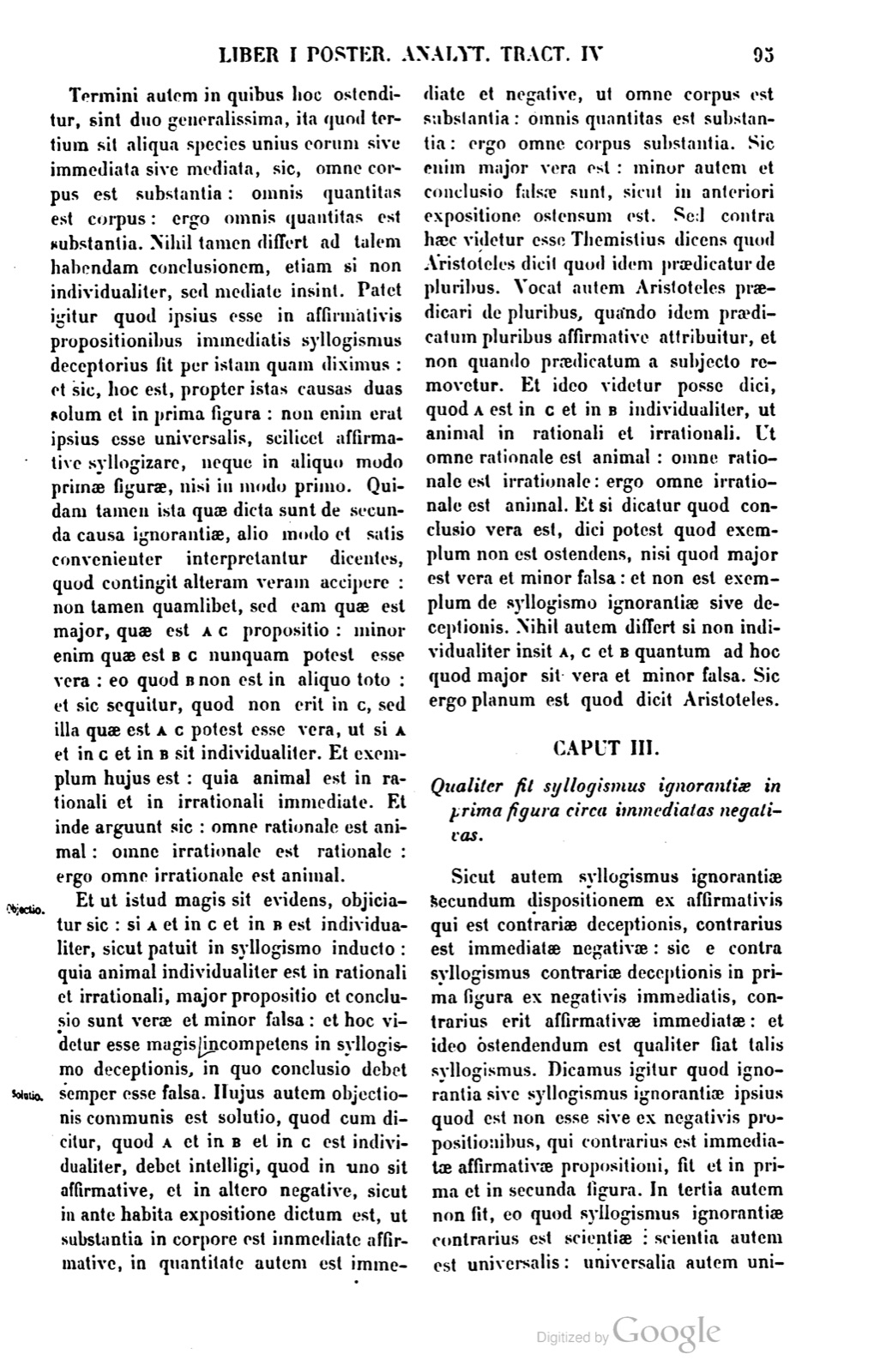
Termini autem in quibus hoc ostenditur, sint duo generalissima, ita quod tertium sit aliqua species unius eorum sive immediata sive mediata, sic, omne corpus est substantia: omnis quantitas est corpus: ergo omnis quantitas est substantia. Nihil tamen differt ad talem habendam conclusionem, etiam si non individualiter, sed mediate insint. Patet igitur quod ipsius esse in affirmativis propositionibus immediatis syllogismus deceptorius fit per istam quam diximus: et sic, hoc est, propter istas causas duas solum et in prima figura: non enim erat ipsius esse universalis, scilicet affirmative syllogizare, neque in aliquo modo primae figurae, nisi in modo primo. Quidam tamen ista quae dicta sunt de secunda causa ignorantiae, alio modo et satis convenienter interpretantur dicentes, quod contingit alteram veram accipere: non tamen quamlibet, sed eam quae est major, quae est A C propositio: minor enim quae est B C nunquam potest esse vera: eo quod B non est in aliquo toto: et sic sequitur, quod non erit in C, sed illa quae est A C potest esse vera, ut si A et in C et in B sit individualiter. Et exemplum hujus est: quia animal est in rationali et in irrationali immediate. Et inde arguunt sic: omne rationale est animal: omne irrationale est rationale: ergo omne irrationale est animal.
Et ut istud magis sit evidens, objiciatur sic: si A et in C et in B est individualiter, sicut patuit in syllogismo inducto: quia animal individualiter est in rationali et irrationali, major propositio et conclusio sunt verae et minor falsa: et hoc videtur esse magis incompetens in syllogismo deceptionis, in quo conclusio debet semper esse falsa. Hujus autem objectionis communis est solutio, quod cum dicitur, quod A et in B et in C est individualiter, debet intelligi, quod in uno sit affirmative, et in altero negative, sicut in ante habita expositione dictum est, ut substantia in corpore est immediate affirmative, in quantitate autem est immediate et negative, ut omne corpus est substantia: omnis quantitas est substantia: ergo omne corpus substantia. Sic enim major vera est: minor autem et conclusio falsae sunt, sicut in anteriori expositione ostensum est. Sed contra haec videtur esse Themistius dicens quod Aristoteles dicit quod idem praedicatur de pluribus. Vocat autem Aristoteles praedicari de pluribus, quando idem praedicatum pluribus affirmative attribuitur, et non quando praedicatum a subjecto removetur. Et ideo videtur posse dici, quod A est in C et in B individualiter, ut animal in rationali et irrationali. Ut omne rationale est animal: omne rationale est irrationale: ergo omne irrationale est animal. Et si dicatur quod conclusio vera est, dici potest quod exemplum non est ostendens, nisi quod major est vera et minor falsa: et non est exemplum de syllogismo ignorantiae sive deceptionis. Nihil autem differt si non individualiter insit A, C et B quantum ad hoc quod major sit vera et minor falsa. Sic ergo planum est quod dicit Aristoteles.
But the terms in which this is shown should be two most general things, in such a way that the third is some species of one of them, whether immediate or mediate, thus: every body is substance; every quantity is body; therefore every quantity is substance. Yet it differs in nothing for having such a conclusion, even if they are present not individually but mediately. Therefore it is clear that a deceptive syllogism of the being itself in immediate affirmative propositions is made through this one which we have described; and so, that is, on account of those two causes only and in the first figure. For it did not belong to universal being itself, namely to syllogize affirmatively, in any mode of the first figure except in the first mode. Yet certain persons interpret, in another way and quite fittingly, those things which have been said about the second cause of ignorance, saying that it happens to accept one premise as true, not however just any premise whatever, but that one which is the major, which is the A C proposition. For the minor, which is B C, can never be true, because B is not in some whole; and thus it follows that it will not be in C. But that which is A C can be true, as if A is individually in both C and B. And the example of this is this: because animal is immediately in rational and in irrational. And from this they argue thus: every rational thing is animal; every irrational thing is rational; therefore every irrational thing is animal.
And so that this may be more evident, let an objection be made thus: if A is individually in both C and B, as appeared in the syllogism introduced, because animal is individually in rational and irrational, the major proposition and the conclusion are true and the minor is false; and this seems to be more unfitting in a syllogism of deception, in which the conclusion ought always to be false. But the common solution of this objection is that when it is said that A is individually in B and in C, it must be understood that it is in one affirmatively and in the other negatively, just as was said in the exposition had before, as substance is in body immediately and affirmatively, but in quantity immediately and negatively, as: every body is substance; every quantity is substance; therefore every body is substance. For in this way the major is true, but the minor and the conclusion are false, as was shown in the preceding exposition. But against these things Themistius seems to be, saying that Aristotle says that the same thing is predicated of many. But Aristotle calls something predicated of many when the same predicate is attributed affirmatively to many things, and not when the predicate is removed from the subject. And therefore it seems possible to say that A is in C and in B individually, as animal is in rational and irrational, as: every rational thing is animal; every rational thing is irrational; therefore every irrational thing is animal. And if it is said that the conclusion is true, it can be said that the example is not showing anything except that the major is true and the minor false, and it is not an example of a syllogism of ignorance or deception. But it makes no difference if A is not individually present in C and B with respect to this, that the major is true and the minor false. Thus therefore what Aristotle says is plain.
Notes
- Lincolniensis also notes this, but he seems to give another account of this saying. P. J. (Hoc etiam notat Linconiensis, sed videtur dare aliam rationem hujus dicti. P. J.) ↩
If a page does not appear, its photograph has not been uploaded yet.