Works › Posterior Analytics, Books I–II
Volume 2 · pp. 91–93
Treatise IV, Chapter I. On The Things Which Are Preliminary To The Treatise On The Necessary Proposition
A marker with ≈ is an approximate page boundary, placed by measure of the text; the page photographs remain the authority. In the paired views, clicking a page marker brings that page into view.
Tractatus IV.
De oppositis principiorum demonstrationis quae faciunt ignorantiam.
Caput I.
De his quae praeambula sunt ad tractatum de propositione necessaria.
Jam autem determinatis omnibus principiis verae demonstrationis quae facit veram scientiam, determinandum est de oppositis principiorum quae faciunt ignorantiam, ex quibus fit syllogismus contrariae deceptionis. Dictum est enim quod nihil demonstratori oportet esse notius oppositis principiorum in falsitate. Determinabimus ergo primo causas veras ignorantiae, et consequenter causas ignorantiae secundum dispositionem: eo quod illa contraria est scientiae: et postea causas tangemus ignorantiae secundum negationem. Adhuc autem volentes determinare causas ignorantiae secundum dispositionem, ostendemus primum quaedam praeambula quibus nos uti oportet ad ostensionem illarum.
Dicamus igitur, quod sicut in affirmativis propositionibus contingit praedicatum quod est A, esse in subjecto quod est B individualiter, hoc est, immediate in affirmativa propositione: sic etiam in negativa propositione conceditur individualiter, hoc est, immediate non esse in eodem, ut haec immediata sit negativa, B non est A, sicut affirmativa immediata est, B est A. Dico autem individualiter esse affirmative, aut non esse negative. Hoc autem verificatur quidem uno modo. Videamus igitur primo qualiter contingat negativam non esse immediatam: tunc enim ex opposito videre possumus quomodo fiat immediata: hoc enim est esse immediatum, quando non est medium aliquod inter extrema, per quod unum extremum syllogizetur de alio. Dico ergo, quod cum A praedicatum in toto aliquo sit, in quo non sit B subjectum, in toto autem dico universale: aut e converso B subjectum in toto aliquo sit universali in quo non sit A, vel utrumque divisim sit in toto aliquo in quo non sit reliquum: non erit propositio immediata negativa quae dicit, quoniam nullum B est A. Haec autem sic verificatur: ponamus enim primo, quod A praedicatum sit in toto C, B subjectum non sit in eodem toto C (et hoc enim fieri potest, quod A quidem sit in quodam toto, et quod B non sit in illo ut in toto) tunc necessario erit aliquod medium per quod fit syllogismus, per quod medium concluditur quod A non sit in B, et sic propositio erit mediata quae dicit nullum B esse A. Termini autem in quibus hoc evidenter apparet, sunt, ut A sit linea, C autem totum simile vel idem cum linea sit quantitas, B autem sit substantia: tunc syllogizatur in secundo secundae figurae sic: omnis linea est quantitas: nulla substantia est quantitas: ergo nulla substantia est linea. Si enim A quidem omni est C, quia omnis linea est quantitas: in B autem nullo est, quia nulla substantia est quantitas: sequitur quod in nullo B est A, quia nulla substantia linea.
Treatise IV.
On the opposites of the principles of demonstration, which make ignorance.
Chapter I.
On those things which are preliminary to the treatise on the necessary proposition.
But now, once all the principles of true demonstration which makes true science have been determined, it must be determined concerning the opposites of the principles which make ignorance, from which there is made a syllogism of contrary deception. For it has been said that nothing ought to be more known to the demonstrator than the opposites of the principles in falsity. Therefore we shall first determine the true causes of ignorance, and consequently the causes of ignorance according to disposition, because that ignorance is contrary to science; and afterward we shall touch upon the causes of ignorance according to negation. But further, wishing to determine the causes of ignorance according to disposition, we shall first show certain preliminary things which it is necessary for us to use for the showing of those causes.
Therefore let us say that, just as in affirmative propositions it happens that the predicate which is A is in the subject which is B individually, that is, immediately in an affirmative proposition, so also in a negative proposition it is conceded that it individually, that is, immediately, is not in the same, so that this negative proposition is immediate: B is not A, just as the affirmative immediate proposition is: B is A. But I call "individually" being affirmatively, or not being negatively. This, however, is verified in one way. Therefore let us first see in what way it happens that a negative is not immediate; for then from the opposite we can see how it becomes immediate. For this is to be immediate: when there is no middle between the extremes through which one extreme is syllogized of the other. Therefore I say that, when A the predicate is in some whole in which B the subject is not, and by whole I mean a universal; or conversely B the subject is in some universal whole in which A is not, or each separately is in some whole in which the remaining one is not, then the negative immediate proposition which says that no B is A will not be immediate. But this is verified thus. For let us first posit that A the predicate is in the whole C, while B the subject is not in that same whole C. For this can be, that A is indeed in a certain whole, and that B is not in it as in a whole. Then necessarily there will be some middle through which the syllogism is made, through which middle it is concluded that A is not in B, and so the proposition which says that no B is A will be mediate. But the terms in which this appears evidently are these: let A be line; but let C, the whole similar or the same with line, be quantity; and let B be substance. Then it is syllogized in the second mode of the second figure thus: every line is quantity; no substance is quantity; therefore no substance is line. For if A indeed is in every C, because every line is quantity, but is in no B, because no substance is quantity, it follows that A is in no B, because no substance is line.
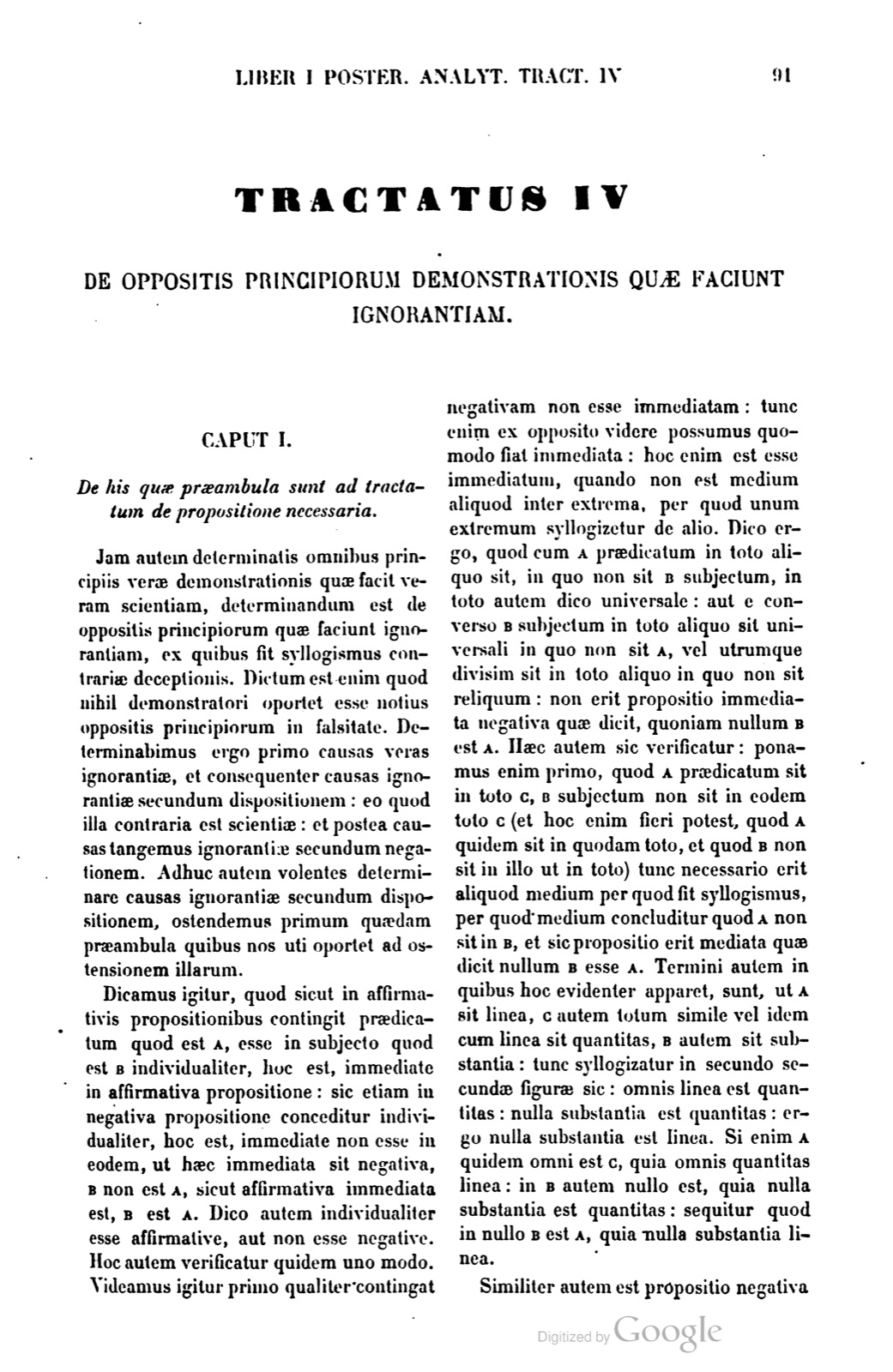
Similiter autem est propositio negativa non immediata si dicatur, quod B subjectum sit in aliquo ut in toto universali, et sit hoc D in quo non sit A praedicatum primum: erit verum medium ad syllogizandum, quoniam nullum B sit A: sit enim B animal cujus totum universale quod est, D sit substantia, A autem sit quantitas: et erit syllogismus in secundo primae sic: nulla substantia est quantitas: omne animal substantia: ergo nullum animal est quantitas. Quod enim in omni B est D, A autem in nullo B, sicut dictum est, erit syllogismus negativae et mediatae propositionis.
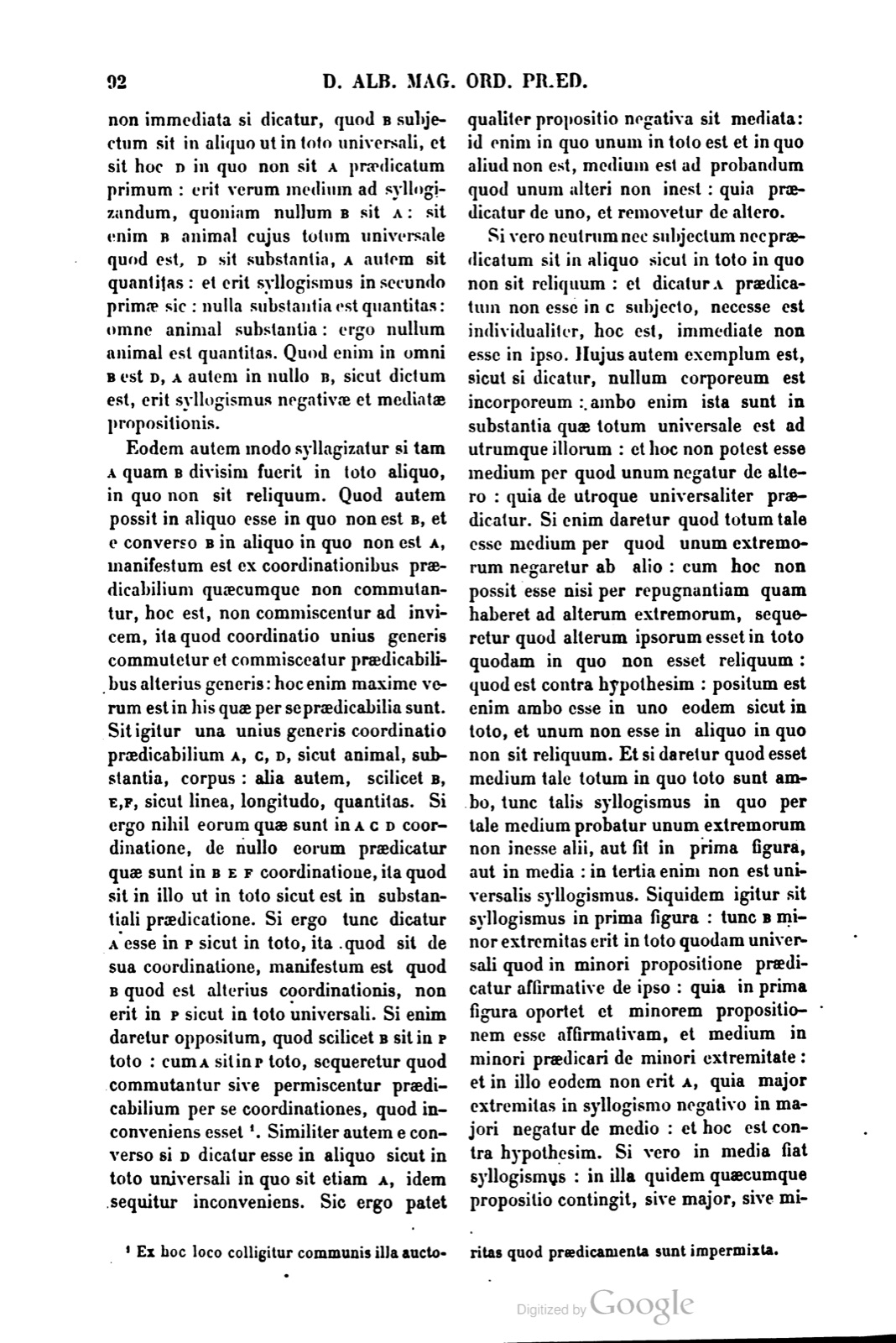
Eodem autem modo syllogizatur si tam A quam B divisim fuerit in toto aliquo, in quo non sit reliquum. Quod autem A possit in aliquo esse in quo non est B, et e converso B in aliquo in quo non est A, manifestum est ex coordinationibus praedicabilium quaecumque non commutantur, hoc est, non commiscentur ad invicem, ita quod coordinatio unius generis commutetur et commisceatur praedicabilibus alterius generis: hoc enim maxime verum est in his quae per se praedicabilia sunt. Sit igitur una unius generis coordinatio praedicabilium A, C, D, sicut animal, substantia, corpus: alia autem, scilicet B, E, F, sicut linea, longitudo, quantitas. Si ergo nihil eorum quae sunt in A C D coordinatione, de nullo eorum praedicatur quae sunt in B E F coordinatione, ita quod sit in illo ut in toto sicut est in substantiali praedicatione. Si ergo tunc dicatur A esse in C sicut in toto, ita quod sit de sua coordinatione, manifestum est quod B quod est alterius coordinationis, non erit in C sicut in toto universali. Si enim daretur oppositum, quod scilicet B sit in C toto: cum A sit in C toto, sequeretur quod commutantur sive permiscentur praedicabilium per se coordinationes, quod inconveniens esset 1. Similiter autem e converso si D dicatur esse in aliquo sicut in toto universali in quo sit etiam A, idem sequitur inconveniens. Sic ergo patet qualiter propositio negativa sit mediata: id enim in quo unum in toto est et in quo aliud non est, medium est ad probandum quod unum alteri non inest: quia praedicatur de uno, et removetur de altero.
Si vero neutrum nec subjectum nec praedicatum sit in aliquo sicut in toto in quo non sit reliquum: et dicatur A praedicatum non esse in C subjecto, necesse est individualiter, hoc est, immediate non esse in ipso. Hujus autem exemplum est, sicut si dicatur, nullum corporeum est incorporeum: ambo enim ista sunt in substantia quae totum universale est ad utrumque illorum: et hoc non potest esse medium per quod unum negatur de altero: quia de utroque universaliter praedicatur. Si enim daretur quod totum tale esse medium per quod unum extremorum negaretur ab alio: cum hoc non possit esse nisi per repugnantiam quam haberet ad alterum extremorum, sequeretur quod alterum ipsorum esset in toto quodam in quo non esset reliquum: quod est contra hypothesim: positum est enim ambo esse in uno eodem sicut in toto, et unum non esse in aliquo in quo non sit reliquum. Et si daretur quod esset medium tale totum in quo toto sunt ambo, tunc talis syllogismus in quo per tale medium probatur unum extremorum non inesse alii, aut fit in prima figura, aut in media: in tertia enim non est universalis syllogismus. Siquidem igitur sit syllogismus in prima figura: tunc B minor extremitas erit in toto quodam universali quod in minori propositione praedicatur affirmative de ipso: quia in prima figura oportet et minorem propositionem esse affirmativam, et medium in minori praedicari de minori extremitate: et in illo eodem non erit A, quia major extremitas in syllogismo negativo in majori negatur de medio: et hoc est contra hypothesim. Si vero in media fiat syllogismus: in illa quidem quaecumque propositio contingit, sive major, sive minor, potest esse negativa vel affirmativa: ad utramque enim extremitatem posito privativo divisim, sive ad majorem, sive ad minorem, fit syllogismus: sed cum utraeque propositione sint negativae, in nulla figura fit syllogismus: et si altera quaecumque sit affirmativa, in illa sicut in toto erit unum, et in eodem non erit alterum: et hoc iterum est contra hypothesim. Si ergo unum ut in toto sit in aliquo, et reliquum ut in toto sit in eodem, et negetur unum de altero, erit haec negativa individualiter sive immediate negativa.
Similarly also the negative proposition is not immediate if it is said that B the subject is in something as in a universal whole, and let this be D, in which A the first predicate is not. There will be a true middle for syllogizing that no B is A. For let B be animal, whose universal whole which is D is substance, but let A be quantity. And there will be a syllogism in the second mode of the first figure thus: no substance is quantity; every animal is substance; therefore no animal is quantity. For because D is in every B, but A is in no B, as was said, there will be a syllogism of a negative and mediate proposition.
In the same way it is syllogized if both A and B separately were in some whole in which the remaining one is not. But that A can be in something in which B is not, and conversely B in something in which A is not, is manifest from coordinations of predicables, whenever they are not exchanged, that is, not mixed with one another, so that the coordination of one genus is exchanged and mixed with the predicables of another genus. For this is especially true in those things which are predicable per se. Therefore let there be one coordination of predicables of one genus, A, C, D, as animal, substance, body; but another, namely B, E, F, as line, length, quantity. Therefore if nothing of those things which are in the A C D coordination is predicated of any of those things which are in the B E F coordination, so that it would be in it as in a whole, as happens in substantial predication. Therefore if A is then said to be in C as in a whole, so that it is of its own coordination, it is manifest that B, which belongs to the other coordination, will not be in C as in a universal whole. For if the opposite were granted, namely that B is in the whole C, then since A is in the whole C, it would follow that the coordinations of things predicable per se are exchanged or mixed, which would be unfitting 1. Similarly, conversely, if D is said to be in something as in a universal whole in which A also is, the same unfitting result follows. Thus therefore it is clear how a negative proposition is mediate. For that in which one thing is in the whole and in which another thing is not is the middle for proving that one is not in the other, because it is predicated of one and removed from the other.
But if neither the subject nor the predicate is in something as in a whole in which the remaining one is not, and A the predicate is said not to be in C the subject, it is necessary that it individually, that is, immediately, is not in it. But an example of this is as if it is said: no corporeal thing is incorporeal. For both of these are in substance, which is the universal whole with respect to each of them; and this cannot be a middle through which one is denied of the other, because it is predicated universally of each. For if it were granted that such a whole is the middle through which one of the extremes is denied of the other, since this could be only through the repugnance which it would have toward one of the extremes, it would follow that one of them would be in some whole in which the remaining one was not. This is contrary to the hypothesis, for it has been posited that both are in one and the same thing as in a whole, and that one is not in something in which the remaining one is not. And if it were granted that there was such a middle, a whole in the whole of which both are, then such a syllogism in which, through such a middle, one of the extremes is proved not to be in the other is made either in the first figure or in the middle figure. For in the third there is no universal syllogism. Therefore if it is a syllogism in the first figure, then B the minor extreme will be in some universal whole which in the minor proposition is predicated affirmatively of it, because in the first figure it is necessary both that the minor proposition be affirmative and that the middle in the minor be predicated of the minor extreme; and in that same whole A will not be, because the major extreme in a negative syllogism is denied of the middle in the major. And this is contrary to the hypothesis. But if the syllogism is made in the middle figure, in that figure any proposition whatever can be negative or affirmative, whether major or minor. For with a privative posited separately toward either extreme, either toward the major or toward the minor, a syllogism is made. But when both propositions are negative, in no figure is a syllogism made. And if either one whatever is affirmative, in that one as in a whole one thing will be, and in the same the other will not be; and this again is contrary to the hypothesis. Therefore if one thing as in a whole is in something, and the remaining thing as in a whole is in the same thing, and one is denied of the other, this negative will be individual, or immediately negative.
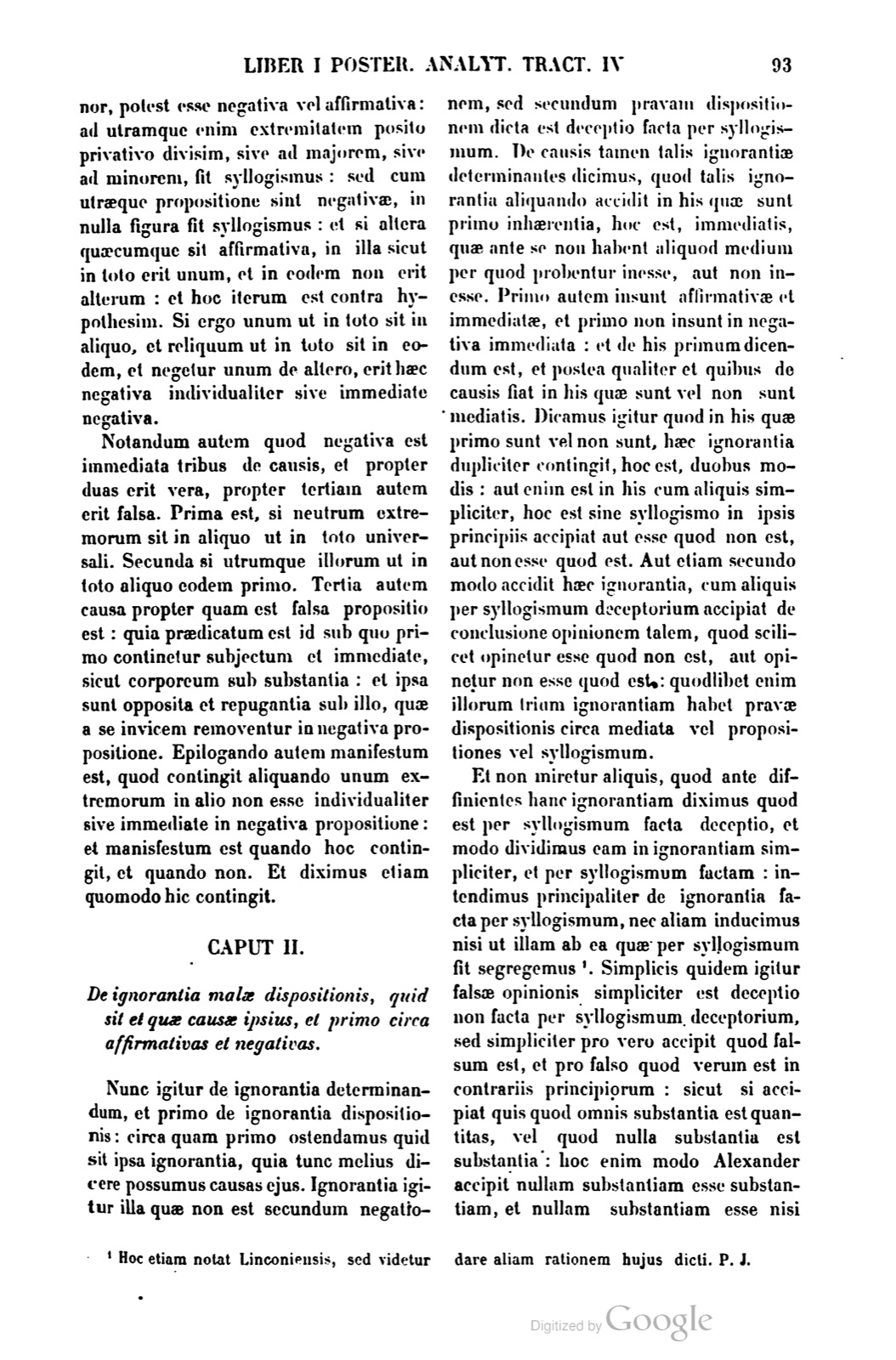
Notandum autem quod negativa est immediata tribus de causis, et propter duas erit vera, propter tertiam autem erit falsa. Prima est, si neutrum extremorum sit in aliquo ut in toto universali. Secunda si utrumque illorum ut in toto aliquo eodem primo. Tertia autem causa propter quam est falsa propositio est: quia praedicatum est id sub quo primo continetur subjectum et immediate, sicut corporeum sub substantia: et ipsa sunt opposita et repugnantia sub illo, quae a se invicem removentur in negativa propositione. Epilogando autem manifestum est, quod contingit aliquando unum extremorum in alio non esse individualiter sive immediate in negativa propositione: et manifestum est quando hoc contingit, et quando non. Et diximus etiam quomodo hic contingit.
But it must be noted that a negative is immediate for three causes, and for two of them it will be true, but for the third it will be false. The first is if neither of the extremes is in something as in a universal whole. The second is if each of them is as in some same first whole. But the third cause on account of which the proposition is false is that the predicate is that under which the subject is first and immediately contained, as corporeal under substance; and they are opposite and repugnant under it, and are removed from one another in a negative proposition. But by epiloguing it is manifest that sometimes one of the extremes happens not to be in the other individually or immediately in a negative proposition, and it is manifest when this happens and when it does not. And we have also said how this happens here.
Notes
- From this place that common authority is gathered, that the predicaments are unmixed. (Ex hoc loco colligitur communis illa auctoritas quod praedicamenta sunt impermixta.) ↩
If a page does not appear, its photograph has not been uploaded yet.