Works › Posterior Analytics, Books I–II
Volume 2 · pp. 95–96
Treatise IV, Chapter III. How A Syllogism Of Ignorance Is Made In The First Figure Concerning Immediate Negatives
A marker with ≈ is an approximate page boundary, placed by measure of the text; the page photographs remain the authority. In the paired views, clicking a page marker brings that page into view.
Caput III.
Qualiter fit syllogismus ignorantiae in prima figura circa immediatas negativas.
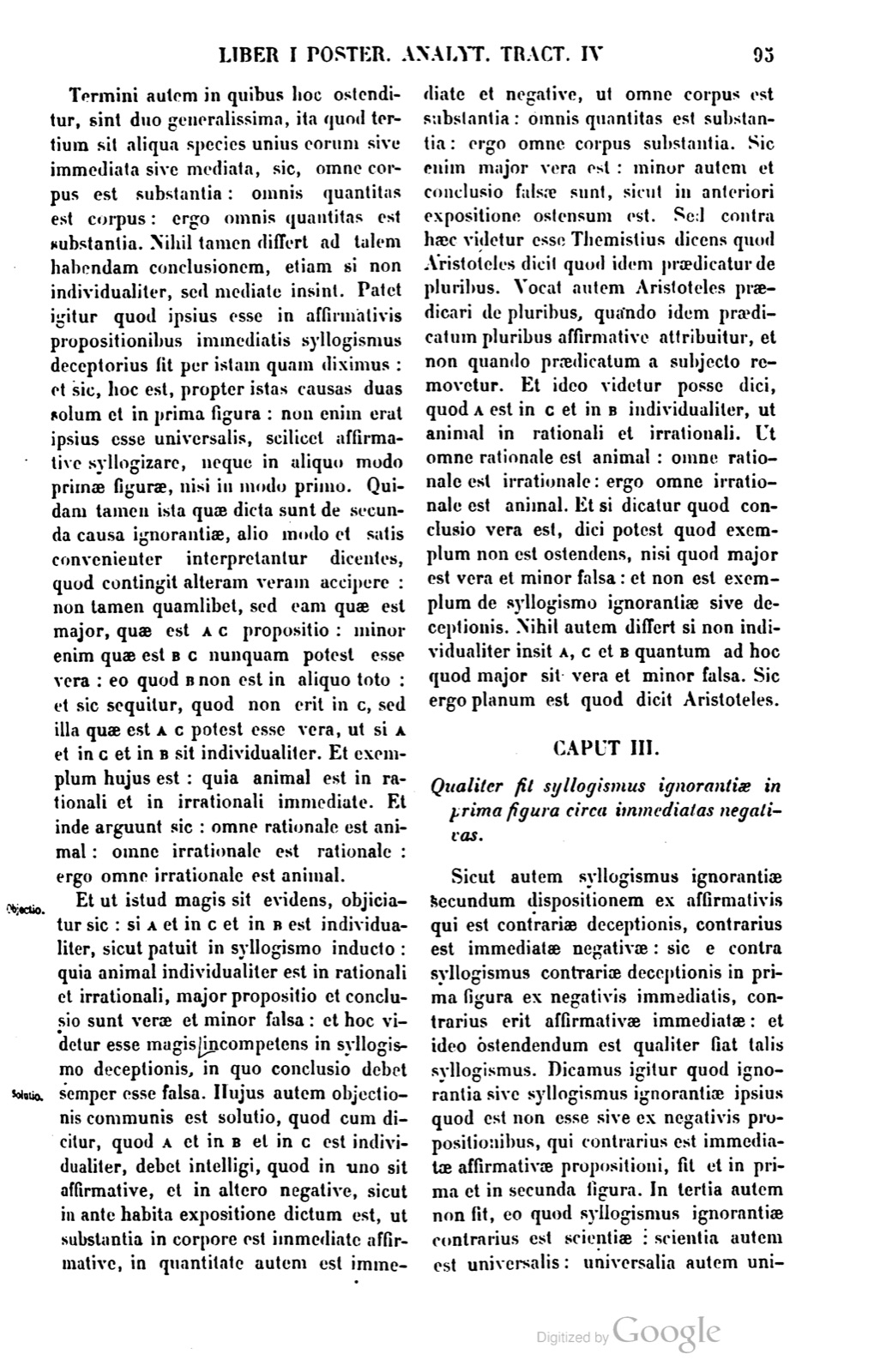
Sicut autem syllogismus ignorantiae secundum dispositionem ex affirmativis qui est contrariae deceptionis, contrarius est immediatae negativae: sic e contra syllogismus contrariae deceptionis in prima figura ex negativis immediatis, contrarius erit affirmativae immediatae: et ideo ostendendum est qualiter fiat talis syllogismus. Dicamus igitur quod ignorantia sive syllogismus ignorantiae ipsius quod est non esse sive ex negativis propositionibus, qui contrarius est immediatae affirmativae propositioni, fit et in prima et in secunda figura. In tertia autem non fit, eo quod syllogismus ignorantiae contrarius est scientiae: scientia autem est universalis: universalia autem universaliter non concluduntur, nisi in prima et in secunda figura, et non in tertia. Propter quod syllogismus ignorantiae non fit in tertia figura, sed in prima et in media. Dicamus igitur primum quot modis fit in prima figura, et quomodo in veritate et falsitate se habentibus propositionibus.
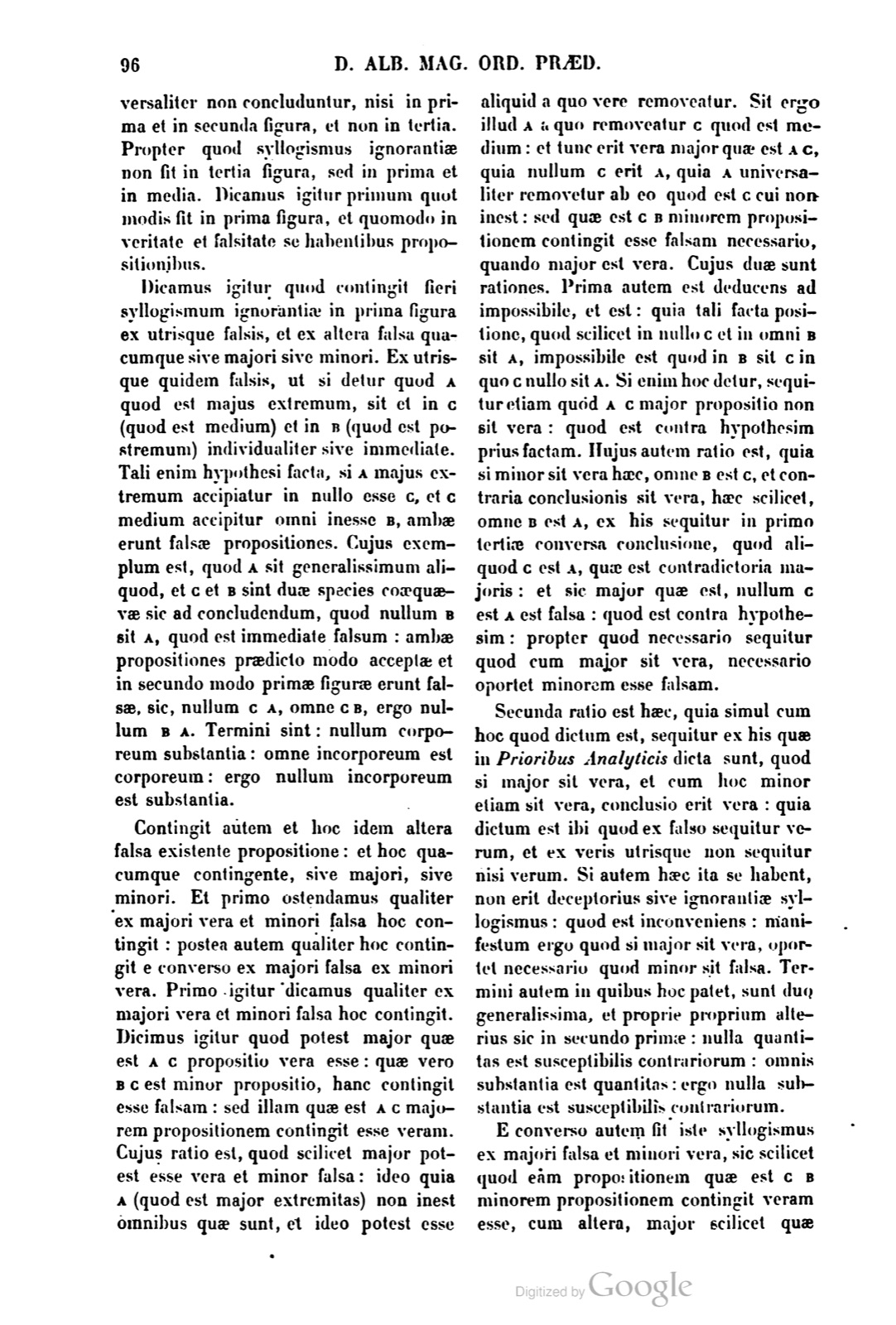
Dicamus igitur quod contingit fieri syllogismum ignorantiae in prima figura ex utrisque falsis, et ex altera falsa quacumque sive majori sive minori. Ex utrisque quidem falsis, ut si detur quod A quod est majus extremum, sit et in C (quod est medium) et in B (quod est postremum) individualiter sive immediate. Tali enim hypothesi facta, si A majus extremum accipiatur in nullo esse C, et C medium accipitur omni inesse B, ambae erunt falsae propositiones. Cujus exemplum est, quod A sit generalissimum aliquod, et C et B sint duae species coaequae sic ad concludendum, quod nullum B sit A, quod est immediate falsum: ambae propositiones praedicto modo acceptae et in secundo modo primae figurae erunt falsae, sic, nullum C A, omne C B, ergo nullum B A. Termini sint: nullum corporeum substantia: omne incorporeum est corporeum: ergo nullum incorporeum est substantia.
Contingit autem et hoc idem altera falsa existente propositione: et hoc quacumque contingente, sive majori, sive minori. Et primo ostendamus qualiter ex majori vera et minori falsa hoc contingit: postea autem qualiter hoc contingit e converso ex majori falsa ex minori vera. Primo igitur dicamus qualiter ex majori vera et minori falsa hoc contingit. Dicimus igitur quod potest major quae est A C propositio vera esse: quae vero B C est minor propositio, hanc contingit esse falsam: sed illam quae est A C majorem propositionem contingit esse veram. Cujus ratio est, quod scilicet major potest esse vera et minor falsa: ideo quia A (quod est major extremitas) non inest omnibus quae sunt, et ideo potest esse aliquid a quo vere removeatur. Sit ergo illud A a quo removeatur C quod est medium: et tunc erit vera major quae est A C, quia nullum C erit A, quia A universaliter removetur ab eo quod est C cui non inest: sed quae est C B minorem propositionem contingit esse falsam necessario, quando major est vera. Cujus duae sunt rationes. Prima autem est deducens ad impossibile, et est: quia tali facta positione, quod scilicet in nullo C et in omni B sit A, impossibile est quod in B sit C in quo C nullo sit A. Si enim hoc detur, sequitur etiam quod A C major propositio non sit vera: quod est contra hypothesim prius factam. Hujus autem ratio est, quia si minor sit vera haec, omne B est C, et contraria conclusionis sit vera, haec scilicet, omne B est A, ex his sequitur in primo tertiae conversa conclusione, quod aliquod C est A, quae est contradictoria majoris: et sic major quae est, nullum C est A est falsa: quod est contra hypothesim: propter quod necessario sequitur quod cum major sit vera, necessario oportet minorem esse falsam.
Chapter III.
How a syllogism of ignorance is made in the first figure concerning immediate negatives.
But just as a syllogism of ignorance according to disposition from affirmatives, which belongs to contrary deception, is contrary to an immediate negative, so conversely a syllogism of contrary deception in the first figure from immediate negatives will be contrary to an immediate affirmative. And therefore it must be shown how such a syllogism is made. Therefore let us say that ignorance, or a syllogism of ignorance of that which is not-being or from negative propositions, which is contrary to an immediate affirmative proposition, is made both in the first and in the second figure. But it is not made in the third, because a syllogism of ignorance is contrary to science; but science is universal; and universals are not concluded universally except in the first and in the second figure, and not in the third. On account of this a syllogism of ignorance is not made in the third figure, but in the first and in the middle. Therefore let us first say in how many modes it is made in the first figure, and how it is with propositions as they stand in truth and falsity.
Therefore let us say that it happens that a syllogism of ignorance is made in the first figure from both premises being false, and from one premise being false, whichever it is, whether major or minor. From both being false indeed, as if it is granted that A, which is the greater extreme, is both in C, which is the middle, and in B, which is the last, individually or immediately. For when such a hypothesis has been made, if A the greater extreme is accepted as being in no C, and C the middle is accepted as being present to every B, both propositions will be false. An example of this is that A is some most general thing, and C and B are two coequal species, in order thus to conclude that no B is A, which is immediately false. Both propositions accepted in the aforesaid way and in the second mode of the first figure will be false, thus: no C is A; every C is B; therefore no B is A. Let the terms be: no corporeal thing is substance; every incorporeal thing is corporeal; therefore no incorporeal thing is substance.
But this same thing also happens when one proposition is false, and this whichever proposition happens to be false, whether the major or the minor. And first let us show how this happens from a true major and a false minor; but afterward how this happens conversely from a false major and from a true minor. Therefore first let us say how this happens from a true major and a false minor. Therefore we say that the major which is the A C proposition can be true; but the one which is B C, the minor proposition, can be false. But that one which is the A C major proposition can be true. The reason for this is, namely, that the major can be true and the minor false, because A, which is the major extreme, is not present in all things which are, and therefore there can be something from which it is truly removed. Therefore let that be A from which C, which is the middle, is removed; and then the major which is A C will be true, because no C will be A, because A is universally removed from that which is C, to which it is not present. But as for that which is C B, the minor proposition, this must necessarily be able to be false when the major is true. There are two reasons for this. The first is one leading to the impossible, and it is this: because, with such a position made, namely that A is in no C and in every B, it is impossible that C should be in B, in which C A is in no way. For if this is granted, it also follows that the A C major proposition is not true, which is contrary to the hypothesis made before. But the reason for this is that, if the minor is true, namely this one, every B is C, and the contrary of the conclusion is true, namely this one, every B is A, from these there follows in the first mode of the third figure, with the conclusion converted, that some C is A, which is the contradictory of the major. And thus the major which is "no C is A" is false, which is contrary to the hypothesis. On account of this it necessarily follows that, when the major is true, it is necessary that the minor be false.
Secunda ratio est haec, quia simul cum hoc quod dictum est, sequitur ex his quae in Prioribus Analyticis dicta sunt, quod si major sit vera, et cum hoc minor etiam sit vera, conclusio erit vera: quia dictum est ibi quod ex falso sequitur verum, et ex veris utrisque non sequitur nisi verum. Si autem haec ita se habent, non erit deceptorius sive ignorantiae syllogismus: quod est inconveniens: manifestum ergo quod si major sit vera, oportet necessario quod minor sit falsa. Termini autem in quibus hoc patet, sunt duo generalissima, et proprie proprium alterius sic in secundo primae: nulla quantitas est susceptibilis contrariorum: omnis substantia est quantitas: ergo nulla substantia est susceptibilis contrariorum.
E converso autem fit iste syllogismus ex majori falsa et minori vera, sic scilicet quod eam propositionem quae est C B minorem propositionem contingit veram esse, cum altera, major scilicet quae
The second reason is this: because together with what has been said, it follows from those things which were said in the Prior Analytics that, if the major is true and along with this the minor also is true, the conclusion will be true, because it was said there that from the false the true follows, and from both true premises nothing follows except the true. But if these things are so, it will not be a deceptive syllogism or a syllogism of ignorance, which is unfitting. Therefore it is manifest that if the major is true, it is necessary that the minor necessarily be false. But the terms in which this is clear are two most general things and the proper property of one of them, thus in the second mode of the first figure: no quantity is susceptible of contraries; every substance is quantity; therefore no substance is susceptible of contraries.
Conversely, however, this syllogism is made from a false major and a true minor, namely in such a way that the proposition which is C B, the minor proposition, can be true, together with the other, namely the major, which
If a page does not appear, its photograph has not been uploaded yet.