Works › Posterior Analytics, Books I–II
Volume 2 · pp. 88–90
Treatise III, Chapter VIII. On Syllogisms, And First In What Form Syllogisms Are Made Most Especially
A marker with ≈ is an approximate page boundary, placed by measure of the text; the page photographs remain the authority. In the paired views, clicking a page marker brings that page into view.
Caput VIII.
De syllogismis, et primo in qua forma syllogismi potissime fiant.
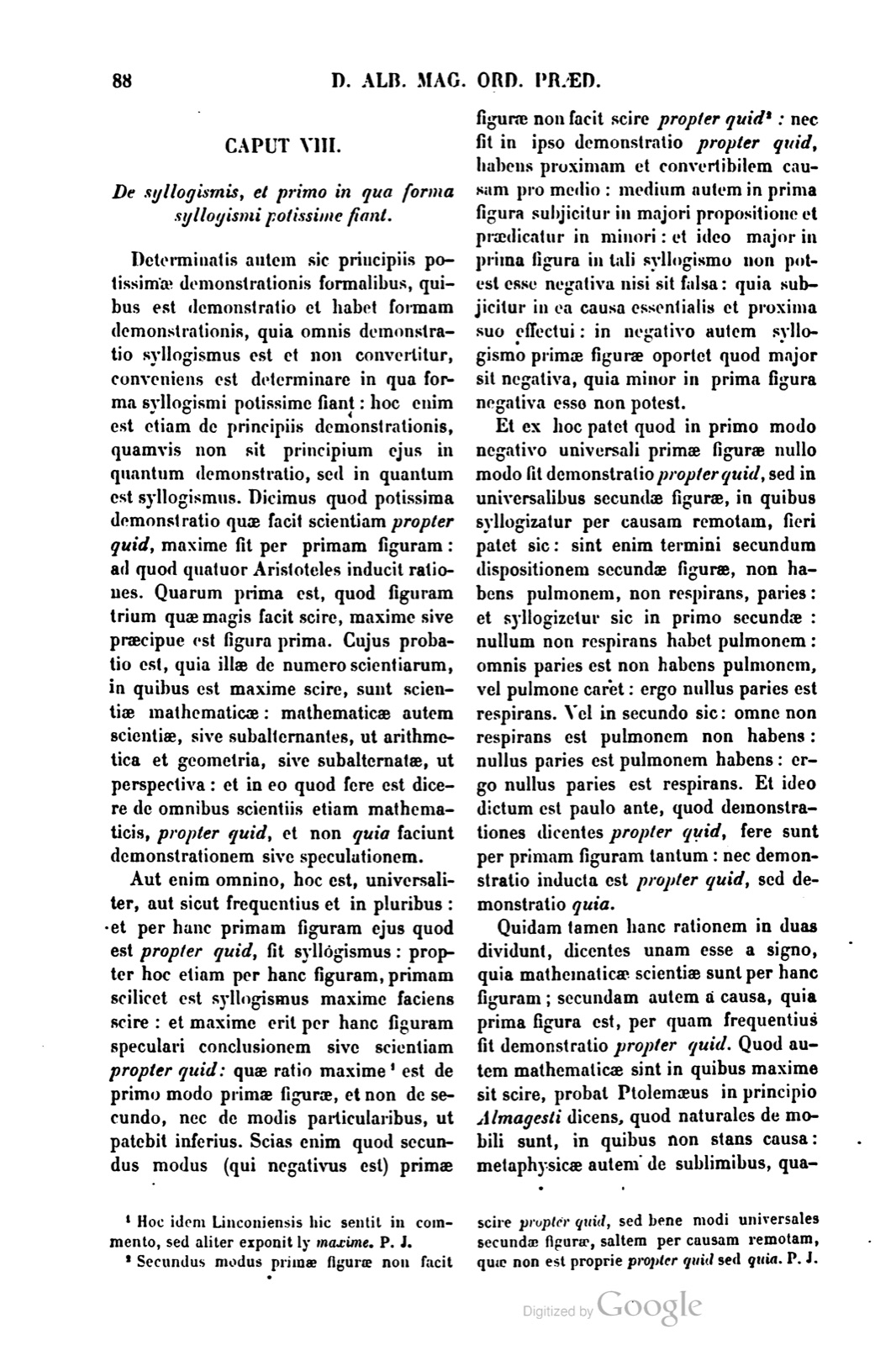
Determinatis autem sic principiis potissimae demonstrationis formalibus, quibus est demonstratio et habet formam demonstrationis, quia omnis demonstratio syllogismus est et non convertitur, conveniens est determinare in qua forma syllogismi potissime fiant: hoc enim est etiam de principiis demonstrationis, quamvis non sit principium ejus in quantum demonstratio, sed in quantum est syllogismus. Dicimus quod potissima demonstratio quae facit scientiam propter quid, maxime fit per primam figuram: ad quod quatuor Aristoteles inducit rationes. Quarum prima est, quod figuram trium quae magis facit scire, maxime sive praecipue est figura prima. Cujus probatio est, quia illae de numero scientiarum, in quibus est maxime scire, sunt scientiae mathematicae: mathematicae autem scientiae, sive subalternantes, ut arithmetica et geometria, sive subalternatae, ut perspectiva: et in eo quod fere est dicere de omnibus scientiis etiam mathematicis, propter quid, et non quia faciunt demonstrationem sive speculationem.
Aut enim omnino, hoc est, universaliter, aut sicut frequentius et in pluribus: et per hanc primam figuram ejus quod est propter quid, fit syllogismus: propter hoc etiam per hanc figuram, primam scilicet, est syllogismus maxime faciens scire: et maxime erit per hanc figuram speculari conclusionem sive scientiam propter quid: quae ratio maxime 1 est de primo modo primae figurae, et non de secundo, nec de modis particularibus, ut patebit inferius. Scias enim quod secundus modus (qui negativus est) primae figurae non facit scire propter quid 2: nec fit in ipso demonstratio propter quid, habens proximam et convertibilem causam pro medio: medium autem in prima figura subjicitur in majori propositione et praedicatur in minori: et ideo major in prima figura in tali syllogismo non potest esse negativa nisi sit falsa: quia subjicitur in ea causa essentialis et proxima suo effectui: in negativo autem syllogismo primae figurae oportet quod major sit negativa, quia minor in prima figura negativa esse non potest.
Et ex hoc patet quod in primo modo negativo universali primae figurae nullo modo fit demonstratio propter quid, sed in universalibus secundae figurae, in quibus syllogizatur per causam remotam, fieri patet sic: sint enim termini secundum dispositionem secundae figurae, non habens pulmonem, non respirans, paries: et syllogizetur sic in primo secundae: nullum non respirans habet pulmonem: omnis paries est non habens pulmonem, vel pulmone caret: ergo nullus paries est respirans. Vel in secundo sic: omne non respirans est pulmonem non habens: nullus paries est pulmonem habens: ergo nullus paries est respirans. Et ideo dictum est paulo ante, quod demonstrationes dicentes propter quid, fere sunt per primam figuram tantum: nec demonstratio inducta est propter quid, sed demonstratio quia.
Quidam tamen hanc rationem in duas dividunt, dicentes unam esse a signo, quia mathematicae scientiae sunt per hanc figuram; secundam autem a causa, quia prima figura est, per quam frequentius fit demonstratio propter quid. Quod autem mathematicae sint in quibus maxime sit scire, probat Ptolemaeus in principio Almagesti dicens, quod naturales de mobili sunt, in quibus non stans causa: metaphysicae autem de sublimibus, quarum causa in quibusdam non attingitur: et ideo per veram causam non potest esse scientia. Restat ergo quod in mediis sit, quae et causam stantem habent, et quorum causa attingitur: et sic in mathematicis quae mediae sunt inter physicas et metaphysicas causas, habentur verae et incorruptibiles scientiae.
Chapter VIII.
On syllogisms, and first in what form syllogisms are made most especially.
But when the formal principles of the most powerful demonstration have thus been determined, through which demonstration exists and has the form of demonstration, because every demonstration is a syllogism and it is not converted, it is fitting to determine in what form syllogisms are made most especially. For this also belongs to the principles of demonstration, although it is not a principle of it insofar as it is demonstration, but insofar as it is syllogism. We say that the most powerful demonstration, which makes science why, is made especially through the first figure. To this Aristotle introduces four reasons. The first of these is that, of the three figures, the figure which more makes one know, especially or principally, is the first figure. The proof of this is that those sciences from the number of sciences in which there is knowing most especially are the mathematical sciences. But mathematical sciences, whether subalternating, as arithmetic and geometry, or subalternated, as perspective, and in what is almost to be said of all sciences, even mathematical ones, make demonstration or speculation why and not that.
For either altogether, that is, universally, or as more frequently and in more cases, the syllogism of that which is why is made through this first figure. On account of this also, through this figure, namely the first, the syllogism is most especially making one know, and through this figure it will most especially belong to one to consider the conclusion or science why. This reason especially 1 concerns the first mode of the first figure, and not the second, nor the particular modes, as will be clear below. For you should know that the second mode, which is negative, of the first figure does not make one know why 2; nor is demonstration why made in it, having the proximate and convertible cause for the middle. But the middle in the first figure is subjected in the major proposition and predicated in the minor; and therefore the major proposition in the first figure, in such a syllogism, cannot be negative unless it is false, because in it the essential and proximate cause is subjected to its effect. But in a negative syllogism of the first figure it is necessary that the major be negative, because the minor in the first figure cannot be negative.
And from this it is clear that in the first universal negative mode of the first figure demonstration why is in no way made; but that it is made in the universal modes of the second figure, in which one syllogizes through a remote cause, is clear thus: let the terms be according to the disposition of the second figure: not having a lung, not breathing, wall. And let it be syllogized thus in the first mode of the second figure: no non-breathing thing has a lung; every wall is not having a lung, or lacks a lung; therefore no wall is breathing. Or in the second mode thus: every non-breathing thing is not having a lung; no wall is having a lung; therefore no wall is breathing. And therefore it was said a little before that demonstrations stating why are almost only through the first figure; and the demonstration introduced is not why, but demonstration that.
Yet certain persons divide this reason into two, saying that one is from a sign, because the mathematical sciences are through this figure, and the second is from the cause, because the first figure is that through which demonstration why is made more frequently. But that the mathematical sciences are those in which there is knowing most especially Ptolemy proves at the beginning of the Almagest, saying that natural things are about the mobile, in which there is not a standing cause; but metaphysical things are about sublime things, whose cause in certain cases is not reached. And therefore science cannot exist through the true cause. Therefore it remains that it is in the middle things, which both have a standing cause and whose cause is reached. And thus in mathematical things, which are middle between physical and metaphysical causes, true and incorruptible sciences are had.
Postea tertia ratio est, quia non est possibile venari scientiam sive venerabilem prae aliis scientiis (quae est scientia quid et propter quid) accipere, nisi per primam figuram: quod sic probatur, quia in media figura non fit syllogismus categoricus sive affirmativus syllogismus: sed scientia quae est ipsius quod quid et propter quid, est scientia affirmationis sive affirmativae conclusionis. In ultima autem sive in tertia figura fit quidem affirmativus syllogismus, sed non fit syllogismus universaliter concludens, sed scientia per id quod quid est de numero universalium: diffinitio enim subjecta majori extremitati universaliter et affirmative recipit praedicationem ipsius, et in minori praedicatur diffinitio de hoc quod continetur sub medio substantialiter et per se, de illo etiam praedicabitur universaliter et affirmative. Duabus autem praemissis universalibus et affirmativis secundum primae figurae dispositionem necesse est concludi conclusionem universalem et affirmativam quae est scientia quid et propter quid. Et sic est planum quod non nisi in prima figura, et in primo modo, et non aliis modis, nec etiam in aliis figuris concluditur scientia propter quid. Hoc autem manifestatur per exemplum: sit enim hominis diffinitio, animal bipes: patet quod non in quodam particulari modo quodam de subjecto per accidens dicto qui negari possit, est homo animal bipes, sed simpliciter et universaliter.
Forte autem aliquis dubitat, utrum hoc verum sit, quod in negativo syllogismo non possit concludi diffinitio quae facit scientiam propter quid: potest enim esse diffinitio medium in negativa demonstratione, et negari ab una extremitate, et affirmari de alia: et sic in negativa propositione et demonstratione potest fieri scientia propter quid, ut videtur: quia quamvis non concluditur in tali demonstratione diffinitio, tamen demonstratio elici potest ex tali syllogismo. Dicitur autem ad hoc communiter, quod revera diffinitio majoris extremitatis nunquam potest elici ex syllogismo negativo in prima: quia si sit syllogismus negativus in prima figura, major erit negativa: et erit tunc major propositio falsa, ut paulo ante dictum est: sed diffinitio minoris extremitatis poterit esse medium in syllogismo negativo, eo quod minor in prima figura est affirmativa, et praedicari potest diffinitio minoris extremitatis de ipsa minori extremitate. Et cum dicitur quod diffinitio non potest concludi in negativo syllogismo: hoc quidem generaliter verum est pro generibus singulorum: nec enim concluditur diffinitio quae est conclusio demonstrationis, nec diffinitio quae est demonstratio positione differens, sed solum illa quae est ut principium demonstrationis, contingit ex negativa demonstratione cognoscere: ex affirmativis autem contingit omnes diffinitiones demonstrare. Sed in secunda figura est aliquando dicere diffinitionem majoris extremitatis quando major est affirmativa, ut in ante habitis dictum est.
Afterward the third reason is that it is not possible to hunt down science, or the science venerable before the other sciences, which is the science of what and why, and to receive it except through the first figure. This is proved thus, because in the middle figure a categorical syllogism, or affirmative syllogism, is not made. But the science which is of what and why is the science of affirmation or of an affirmative conclusion. In the last, or in the third figure, an affirmative syllogism is indeed made, but a syllogism concluding universally is not made, whereas science through that which is what belongs to the number of universals. For a definition, when subjected to the major extreme, receives the predication of that major extreme universally and affirmatively, and in the minor the definition is predicated of that which is contained under the middle substantially and per se; therefore of that also it will be predicated universally and affirmatively. But from two universal and affirmative premises according to the disposition of the first figure it is necessary that a universal and affirmative conclusion be concluded, which is the science of what and why. And thus it is plain that science why is concluded only in the first figure, and in the first mode, and not in other modes, nor even in other figures. This is manifested by an example: let the definition of man be "two-footed animal." It is clear that man is not two-footed animal in some particular mode, said of the subject by accident in such a way that it could be denied, but simply and universally.
Perhaps, however, someone doubts whether this is true, that in a negative syllogism a definition which makes science why cannot be concluded; for a definition can be the middle in a negative demonstration, and be denied of one extreme and affirmed of the other, and so in a negative proposition and demonstration science why can be made, as it seems, because although the definition is not concluded in such a demonstration, nevertheless demonstration can be drawn out from such a syllogism. But it is commonly said to this that in truth the definition of the major extreme can never be drawn out from a negative syllogism in the first figure, because if there is a negative syllogism in the first figure, the major will be negative, and then the major proposition will be false, as was said a little before. But the definition of the minor extreme will be able to be the middle in a negative syllogism, because the minor in the first figure is affirmative, and the definition of the minor extreme can be predicated of that minor extreme itself. And when it is said that a definition cannot be concluded in a negative syllogism, this indeed is generally true for the genera of singular things. For neither is the definition concluded which is the conclusion of the demonstration, nor the definition which is a demonstration differing in position, but only that definition which is as a principle of demonstration can happen to be known from a negative demonstration. But from affirmatives it happens that all definitions are demonstrated. Yet in the second figure one must sometimes speak of the definition of the major extreme when the major is affirmative, as was said in the things had before.
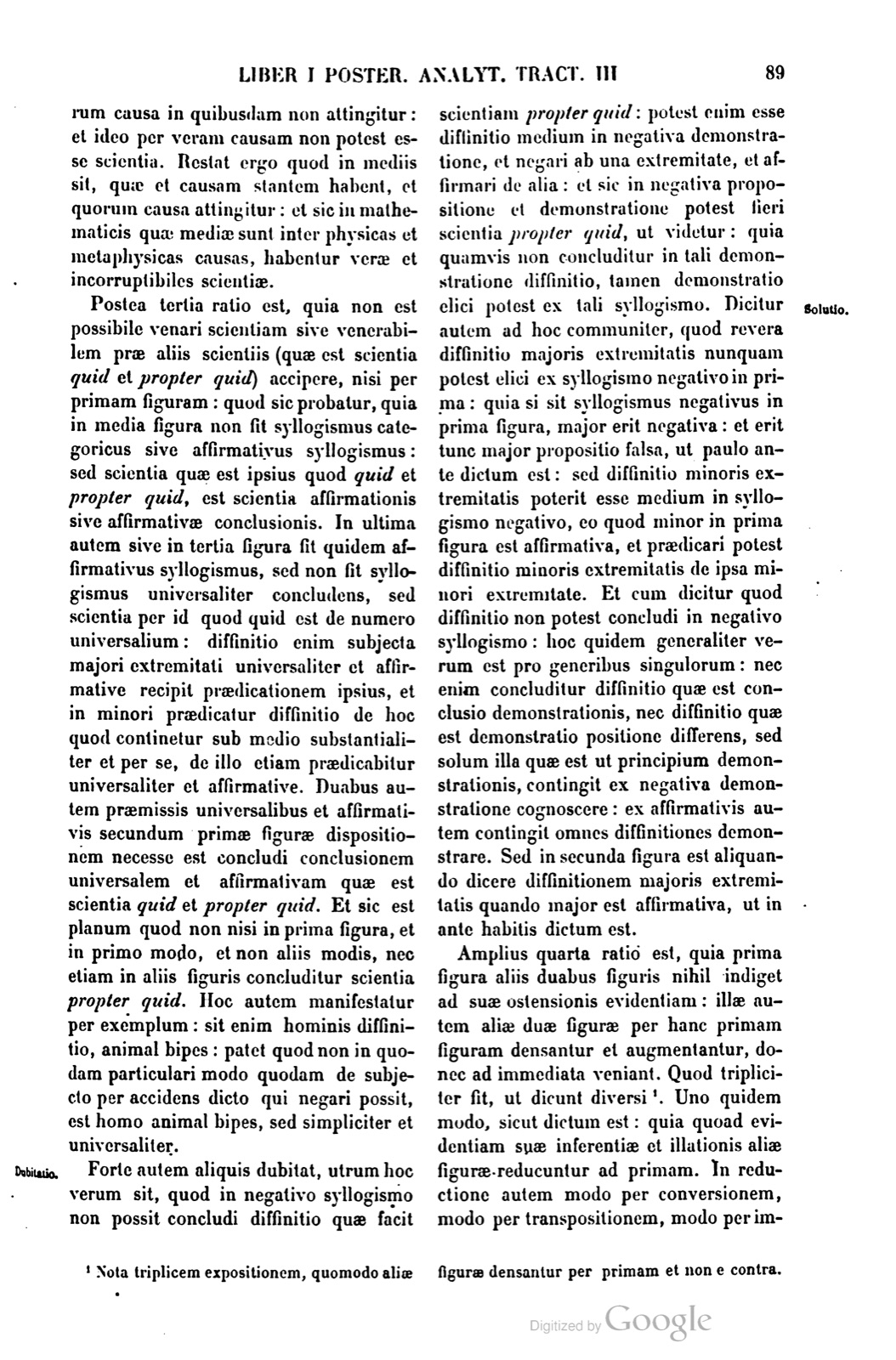
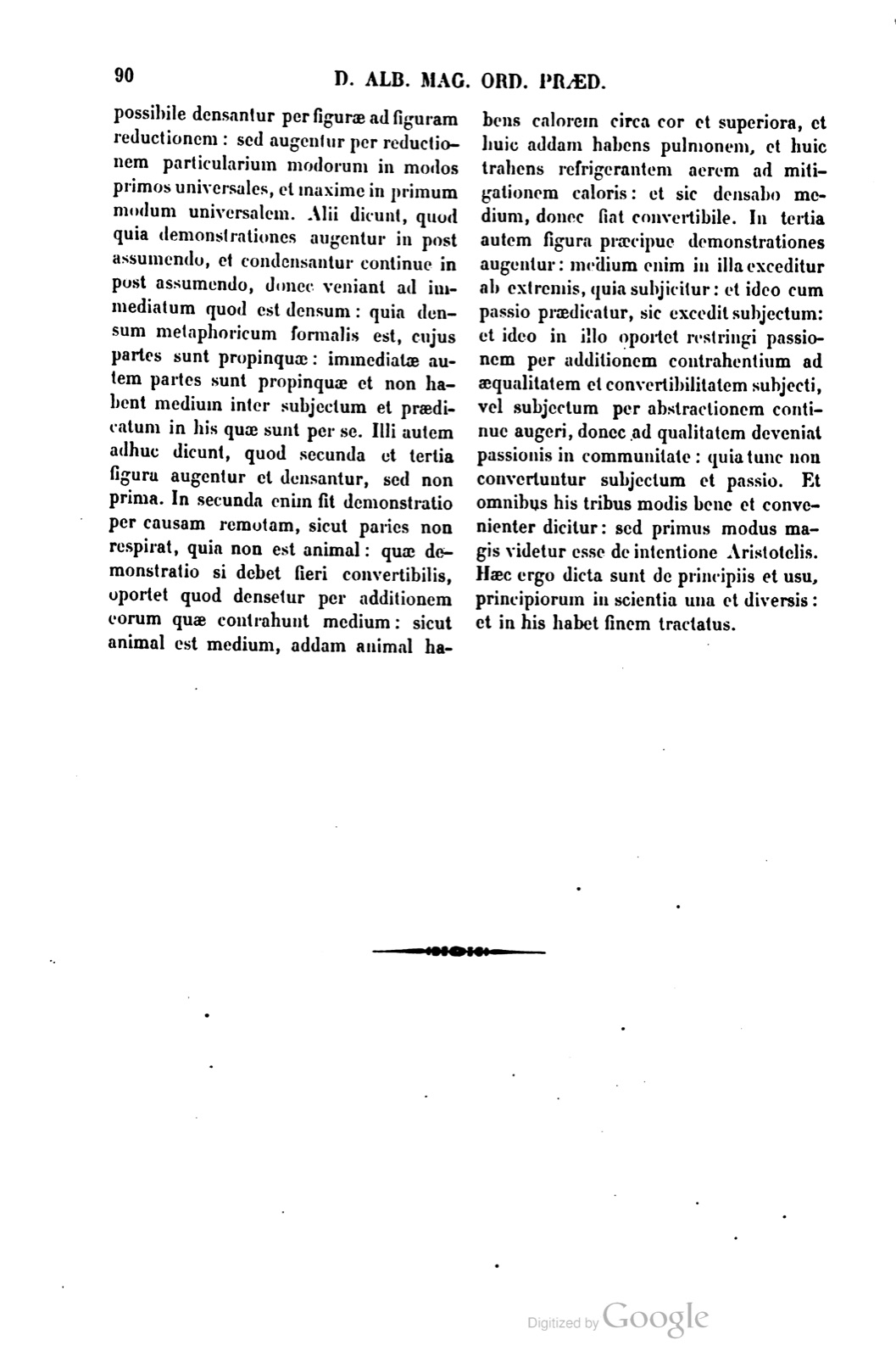
Amplius quarta ratio est, quia prima figura aliis duabus figuris nihil indiget ad suae ostensionis evidentiam: illae autem aliae duae figurae per hanc primam figuram densantur et augmentantur, donec ad immediata veniant. Quod tripliciter fit, ut dicunt diversi 3. Uno quidem modo, sicut dictum est: quia quoad evidentiam suae inferentiae et illationis aliae figurae reducuntur ad primam. In reductione autem modo per conversionem, modo per transpositionem, modo per impossibile densantur per figurae ad figuram reductionem: sed augentur per reductionem particularium modorum in modos primos universales, et maxime in primum modum universalem. Alii dicunt, quod quia demonstrationes augentur in post assumendo, et condensantur continue in post assumendo, donec veniant ad immediatum quod est densum: quia densum metaphoricum formalis est, cujus partes sunt propinquae: immediatae autem partes sunt propinquae et non habent medium inter subjectum et praedicatum in his quae sunt per se. Illi autem adhuc dicunt, quod secunda et tertia figura augentur et densantur, sed non prima. In secunda enim fit demonstratio per causam remotam, sicut paries non respirat, quia non est animal: quae demonstratio si debet fieri convertibilis, oportet quod densetur per additionem eorum quae contrahunt medium: sicut animal est medium, addam animal habens calorem circa cor et superiora, et huic addam habens pulmonem, et huic trahens refrigerantem aerem ad mitigationem caloris: et sic densabo medium, donec fiat convertibile. In tertia autem figura praecipue demonstrationes augentur: medium enim in illa exceditur ab extremis, quia subjicitur: et ideo cum passio praedicatur, sic excedit subjectum: et ideo in illo oportet restringi passionem per additionem contrahentium ad aequalitatem et convertibilitatem subjecti, vel subjectum per abstractionem continue augeri, donec ad qualitatem deveniat passionis in communitate: quia tunc non convertuntur subjectum et passio. Et omnibus his tribus modis bene et convenienter dicitur: sed primus modus magis videtur esse de intentione Aristotelis. Haec ergo dicta sunt de principiis et usu principiorum in scientia una et diversis: et in his habet finem tractatus.
Further, the fourth reason is that the first figure needs nothing from the other two figures for the evidentness of its showing. But those other two figures are densified and augmented through this first figure until they come to immediate things. This happens in three ways, as different persons say 3. In one way, as has been said, because with respect to the evidentness of their inference and illation the other figures are reduced to the first. But in reduction, now through conversion, now through transposition, now through the impossible, they are densified through the reduction of figure to figure; but they are augmented through the reduction of particular modes into first universal modes, and especially into the first universal mode. Others say that, because demonstrations are augmented by assuming what is posterior, and are continually condensed by assuming what is posterior, until they come to the immediate, which is dense, because the metaphorical dense belongs to the formal whose parts are near; but immediate parts are near and do not have a middle between subject and predicate in those things which are per se. Still others say that the second and third figure are augmented and densified, but not the first. For in the second figure demonstration is made through a remote cause, as "the wall does not breathe because it is not an animal." If this demonstration ought to become convertible, it must be densified through the addition of those things which contract the middle. Thus animal is the middle; I shall add animal having heat around the heart and upper parts, and to this I shall add having a lung, and to this drawing in cooling air for the mitigation of heat. And in this way I shall densify the middle until it becomes convertible. But in the third figure demonstrations are especially augmented. For the middle in that figure is exceeded by the extremes, because it is subjected; and therefore when the property is predicated, in this way it exceeds the subject. And therefore in that figure it is necessary to restrict the property through the addition of things contracting it to equality and convertibility with the subject, or to augment the subject continually through abstraction until it arrives at the quality of the property in commonness, because then the subject and the property are not converted. And in all these three ways it is said well and fittingly; but the first mode seems more to be of the intention of Aristotle. Therefore these things have been said about the principles and the use of principles in one science and in diverse sciences; and in these things the treatise has its end.
Notes
- Lincolniensis thinks this same thing here in the commentary, but he explains the expression `especially` differently. P. J. (Hoc idem Linconiensis hic sentit in commento, sed aliter exponit ly maxime. P. J.) ↩
- The second mode of the first figure does not make one know why; but the universal modes of the second figure do so well, at least through a remote cause, which is not properly why but that. P. J. (Secundus modus primae figurae non facit scire propter quid, sed bene modi universales secundae figurae, saltem per causam remotam, quae non est proprie propter quid sed quia. P. J.) ↩
- Note the threefold exposition of how the other figures are densified through the first and not conversely. (Nota triplicem expositionem, quomodo aliae figurae densantur per primam et non e contra.) ↩
If a page does not appear, its photograph has not been uploaded yet.