Works › Posterior Analytics, Books I–II
Volume 2 · pp. 13–24
Chapter IV. That Knowing Beforehand Is Twofold, Especially in Demonstrative Science
A marker with ≈ is an approximate page boundary, placed by measure of the text; the page photographs remain the authority. In the paired views, clicking a page marker brings that page into view.
et diffinitio proprie est incomplexorum, sicut saepius in hac scientia ostendimus, et maxime in libro diffinitionum, et non refertur scientia quid est, ad complexa nisi per consequens: ideo dicit Aristoteles quod oportet praecognoscere de dignitate quia est, et tacet de praecognitione quid est. Et hoc est quod multi dicunt. Veritas autem secundum intellectum Aristotelis est, quod demonstrator in demonstratione non praeutitur scientia quid est de dignitate, sed scientia quia est tantum, quod scilicet verum sit quod dicit dignitas: et ideo demonstrator in demonstratione non cognoscit quid est de dignitate, quamvis putatur in praecognitione dignitatis, quid est quod dicitur per nomen: quia dignitatem scire non potest nisi sciat quid est quod dicitur per nomina posita in dignitate. Et hic est intellectus Aristotelis.
Adhuc autem notandum quod praecognitio quia est, non primo inest incomplexis et per ea complexis per consequens, sed utrisque inest aeque primo, secundum quod verum et esse convertitur cum omni ente: unde de asino est praecognoscere quia est, et de homine, et sic de aliis. Sed non oportet praecognoscere quid est ipsa complexio complexi principii quod est dignitas, per diffinitionem: et ideo non oportet praecognoscere quid est de dignitate: et hoc quidem planum est omni homini etiam parum de hoc cogitanti et consideranti.
Adhuc autem notandum quod quamvis in dignitate praedicitur aliqua passio de aliquo subjecto, non tamen gratia illius passionis oportet praecognoscere et praesupponere quid est in dignitate, et gratia subjecti, quia est et quid est: ita quod propter duo quae sunt in dignitate, oporteat praecognoscere de dignitate et quid est et quia est: quia proprietas inhaerens subjecto dignitatis, non est passio probata et conclusa de subjecto dignitatis per scientiam demonstrativam: et ideo de dignitate praecognoscitur quia est et non quid, ut dictum est.
Adhuc autem principia demonstrationis non sunt tantum dignitates, sed etiam suppositiones et petitiones, sicut patet in principio Euclidis, quae omnia oportet praecognoscere: et ideo talia omnia supponuntur hic in nomine dignitatum large sumendo dignitatem.
Adhuc autem quamvis medium sit necessarium in demonstratione, tamen non dicitur quod de ipso oportet praecognoscere vel quid est vel quia est: quia medium investigandum est, ut dicit Aristoteles in primo Priorum, et ideo de ipso praecognoscere non oportet. Forte tamen quid sit oportet in medio praecognoscere ante demonstrationem: sed hoc postquam investigatum est medium: cum enim in omni doctrina et disciplina addiscendae sint res super quas fundatur illa scientia per propria et instituta illius scientiae vocabula sive nomina: cum nihil contingat secundum veritatem vel addiscere vel cognoscere, nisi per significationem nominum, ut dicit Aristoteles in quarto primae philosophiae 1: necesse est de omnibus praecognoscere quid est quod dicitur per nomen: quia aliter doctrina fieri non potest.
Omnium autem horum ratio et causa haec est, quod res significatae in scientia, aut sunt principia, aut sunt principiata. Et siquidem sunt principiata, esse suum quia sunt, habent ab aliis: et ideo non potest hic quia sunt supponi de ipsis, sed debet probari per principia. De principiis autem quia esse suum non habent ab aliis, in ipsa scientia oportet relinqui quia sunt, nec potest probari de ipsis. Principiata autem sunt, passiones quae causantur a subjectis, et ideo probantur de ipsis.
and definition properly belongs to incomplex things, as we have shown rather often in this science, and especially in the book of definitions; and the science of what it is is not referred to complexes except consequently. Therefore Aristotle says that it is necessary to know beforehand, concerning a dignity, that it is, and he is silent about the forecognition of what it is. And this is what many say. But the truth according to the understanding of Aristotle is that the demonstrator in demonstration does not use beforehand the science of what a dignity is, but only the science that it is, namely that what the dignity says is true. And therefore the demonstrator in demonstration does not cognize what a dignity is, although in the forecognition of a dignity it is thought that what is said through the name is known, because he cannot know a dignity unless he knows what is said through the names placed in the dignity. And this is the understanding of Aristotle.
Furthermore it must be noted that the forecognition that it is does not first belong to incomplex things and through them consequently to complex things, but belongs to both equally first, according as true and being are converted with every being. Hence concerning an ass it is a matter of knowing beforehand that it is, and concerning a man, and so concerning others. But it is not necessary to know beforehand, through definition, what the very composition of the complex principle is which is a dignity; and therefore it is not necessary to know beforehand what a dignity is. And this is plainly clear to every man, even one thinking and considering only a little about this.
Furthermore it must be noted that although in a dignity some property is predicated of some subject, nevertheless it is not for the sake of that property that it is necessary to know beforehand and presuppose what is in the dignity, and for the sake of the subject that it is and what it is, so that on account of the two things which are in the dignity it would be necessary to know beforehand concerning the dignity both what it is and that it is. For the property inhering in the subject of the dignity is not a property proved and concluded of the subject of the dignity through demonstrative science; and therefore concerning a dignity it is known beforehand that it is and not what it is, as has been said.
Furthermore the principles of demonstration are not only dignities, but also suppositions and petitions, as is evident at the beginning of Euclid, all of which must be known beforehand. Therefore all such things are supposed here under the name of dignities, taking dignity broadly.
Furthermore, although the middle is necessary in demonstration, nevertheless it is not said that concerning it one must know beforehand either what it is or that it is, because the middle must be investigated, as Aristotle says in the first book of the Priors, and therefore concerning it it is not necessary to know beforehand. Yet perhaps what it is must be known beforehand in the middle before demonstration; but this is after the middle has been investigated. For since in every teaching and discipline the things on which that science is founded must be learned through the proper and established vocables or names of that science, and since nothing can happen according to truth either to be learned or to be cognized except through the signification of names, as Aristotle says in the fourth book of first philosophy 1, it is necessary concerning all things to know beforehand what is said through the name, because otherwise teaching cannot take place.
But the reason and cause of all these things is this, that the things signified in a science are either principles or things principiated. And if indeed they are things principiated, they have their being, namely that they are, from others; and therefore here that they are cannot be supposed concerning them, but must be proved through principles. But concerning principles, because they do not have their being from others, it is necessary in the science itself to leave that they are, nor can this be proved concerning them. But things principiated are properties which are caused by subjects, and therefore are proved of them.
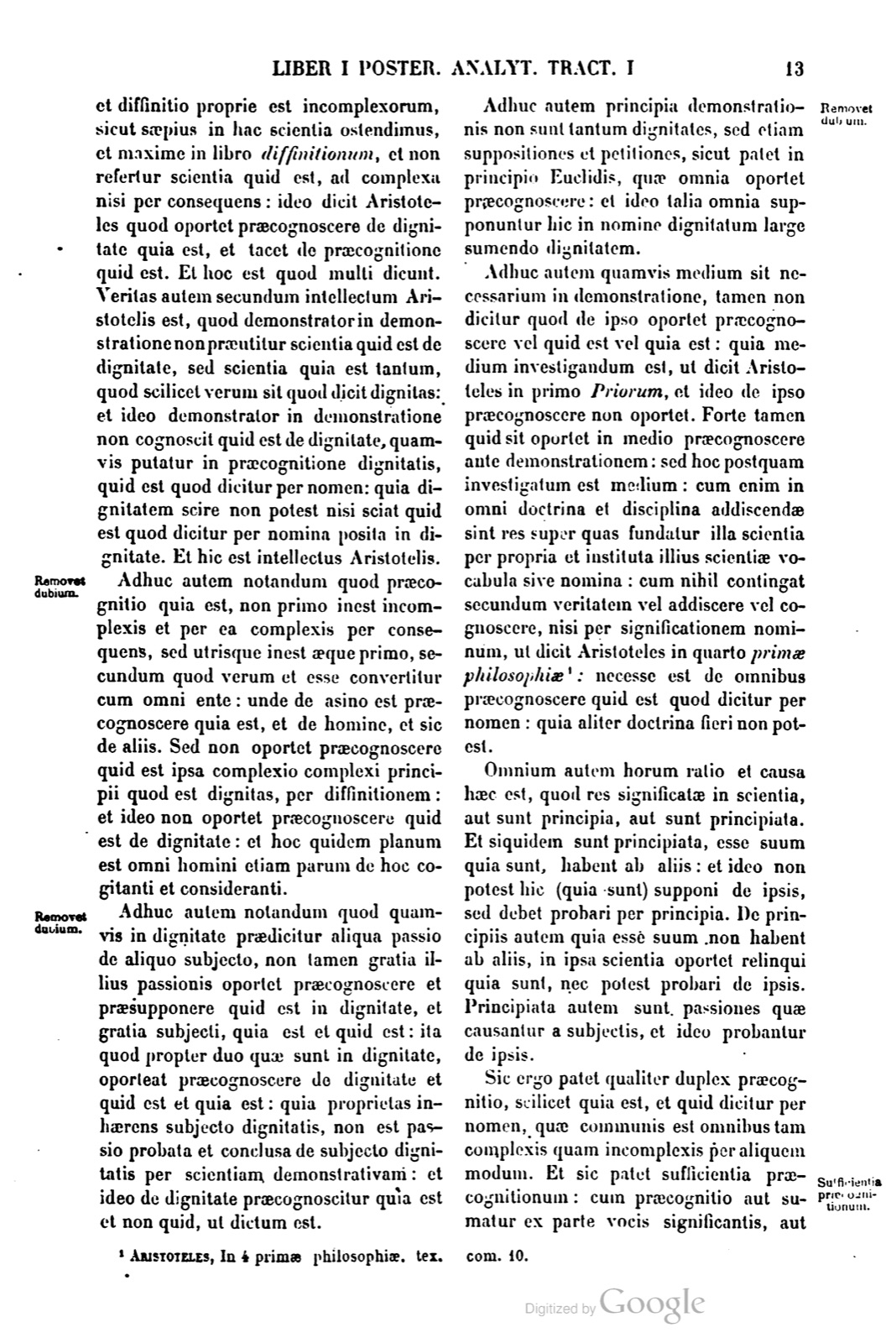
Sic ergo patet qualiter duplex praecognitio, scilicet quia est, et quid dicitur per nomen, quae communis est omnibus tam complexis quam incomplexis per aliquem modum. Et sic patet sufficientia praecognitionum: cum praecognitio aut sumatur ex parte vocis significantis, aut ex parte rei: et praecognitio ex parte rei sit praecognitio quia est, ex parte autem nominis significantis rem sit praecognitio quae est quod dicitur per nomen. Quamvis autem duae sunt praecognitiones tantum, tamen tripartita est praecognitio: quia in quibusdam duae praecognitiones conjunguntur et faciunt unum praecognoscendi modum, in aliis autem divisae faciunt duos: et sic sunt tres modi praecognoscendi 2.
Sciendum etiam quod esse de subjecto, sive quia est, simpliciter et per essentiam non potest sciri, nisi praecognoscatur quid est subjectum. Quaestio enim quae est si est, sciri non potest per se et per essentialia, nisi sciatur et cognoscatur quaestio quid est: potest tamen sciri per accidentalia si est subjectum etiam non cognito quid est. Et similiter de passione, quod non scitur quia est, nisi sciatur quid est, si per essentialia debet sciri quia est: sed per medium accidentale sciri potest quia est, non praecognito quid est per essentialia. Haec sunt quae a Commentatoribus hic dici consueverunt 3.
Dictum autem Porphyrii in commento est, quod in demonstratione tria sunt, scilicet id quod est causa consequentiae, et hoc est principium: et passio quae probatur inesse subjecto, et subjectum cui per se et non per alterum inest passio. De principio igitur oportet supponi et praesciri quia est, et quia verum est: quia esse et esse verum convertuntur: quia nisi hoc praesciatur, nulla erit consequentia demonstrationis, cum principium per hoc quod est, et per hoc quod de necessitate est verum, sit causa consequentiae. De passione autem praescitur quid est: quia per suum quid est, hoc est, per diffinitionem, multoties probatur inesse subjecto. De subjecto autem et quid est et quia est: quia per quid est, quod est ejus diffinitio, scitur esse subjectum per se passionis: eo quod passio manat de substantialibus subjecti: nec potest sciri, quod proprium subjectum sit passionis, nisi per quidditatem essentialium subjecti. Oportet etiam praecognoscere quia est: aliter passioni non substaret. Et quia subjectum sic dupliciter se habet ad passionem, ut causa scilicet, et subjectum: et ideo de ipso in quantum est causa, oportet praecognoscere quid est: et de eodem in quantum immediate substat passioni, oportet praecognoscere quia est. Et iste procul dubio est intellectus Aristotelis.
Quod autem unitas dicitur subjectum, in arithmeticis et in septimo Euclidis satis patet: quia multa probantur de ipsa, quod scilicet sit indivisibile, quod non habeat positionem, quod sit substantia numeri, et multa alia. Haec igitur de praecognitione principiorum dicta sunt: quae enim quaeri possunt, facile patent ex dictis.
Thus therefore it is evident how there is a twofold forecognition, namely that it is and what is said through the name, which is common in some mode to all things, both complex and incomplex. And thus the sufficiency of forecognitions is evident, since forecognition is taken either on the part of the signifying word or on the part of the thing: forecognition on the part of the thing is forecognition that it is, but on the part of the name signifying the thing it is the forecognition which is what is said through the name. But although there are only two forecognitions, nevertheless forecognition is tripartite, because in some things two forecognitions are joined and make one mode of knowing beforehand, but in others, when divided, they make two; and thus there are three modes of knowing beforehand 2.
It must also be known that being concerning the subject, or that it is, simply and through essence cannot be known unless what the subject is is known beforehand. For the question which is whether it is cannot be known through itself and through essentials unless the question what it is is known and cognized; yet whether the subject is can be known through accidentals even when what it is is not known. And similarly concerning a property, that it is is not known unless what it is is known, if it ought to be known through essentials that it is; but through an accidental middle it can be known that it is, while what it is through essentials has not been known beforehand. These are the things which the Commentators have customarily said here 3.
But the saying of Porphyry in the commentary is that in demonstration there are three things, namely that which is the cause of the consequence, and this is the principle; and the property which is proved to belong to the subject; and the subject to which the property belongs through itself and not through another. Concerning the principle, therefore, it is necessary to suppose and know beforehand that it is and that it is true, because being and being true are converted; for unless this is known beforehand, there will be no consequence of the demonstration, since the principle, through the fact that it is and through the fact that it is of necessity true, is the cause of the consequence. But concerning the property, what it is is known beforehand, because through its what-it-is, that is, through its definition, it is often proved to belong to the subject. But concerning the subject, both what it is and that it is are known beforehand, because through what it is, which is its definition, it is known to be the per se subject of the property, because the property flows from the substantial things of the subject. Nor can it be known that the proper subject is the subject of the property except through the quiddity of the essentials of the subject. It is also necessary to know beforehand that it is; otherwise it would not stand under the property. And because the subject is related in this twofold way to the property, namely as cause and as subject, therefore concerning it insofar as it is cause, it is necessary to know beforehand what it is; and concerning the same thing insofar as it immediately stands under the property, it is necessary to know beforehand that it is. And this without doubt is the understanding of Aristotle.
But that unity is called a subject is sufficiently evident in arithmetic and in the seventh book of Euclid, because many things are proved of it, namely that it is indivisible, that it does not have position, that it is the substance of number, and many other things. Therefore these things have been said about forecognition of principles; for the things which can be asked are easily evident from what has been said.
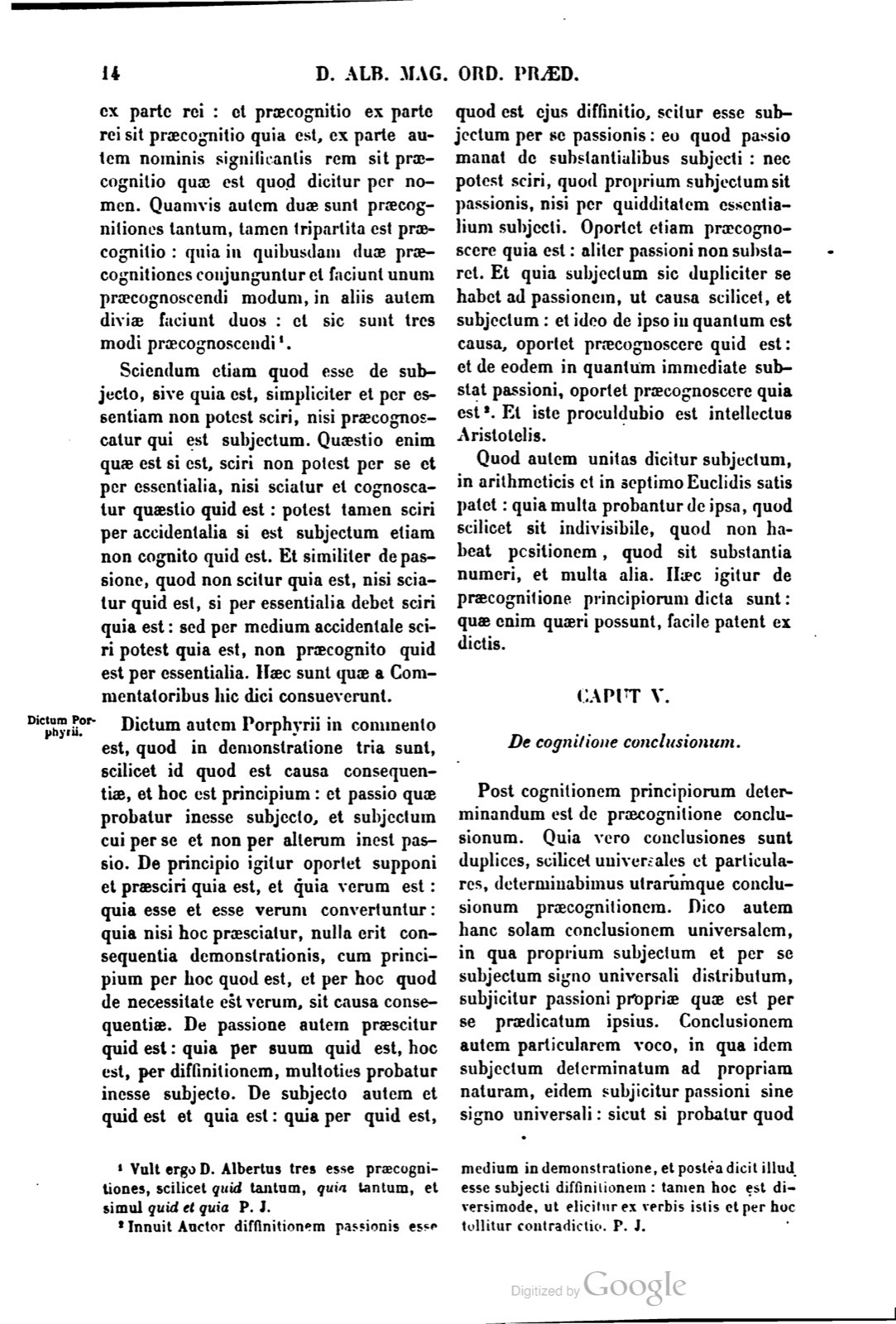
Caput V. De cognitione conclusionum.
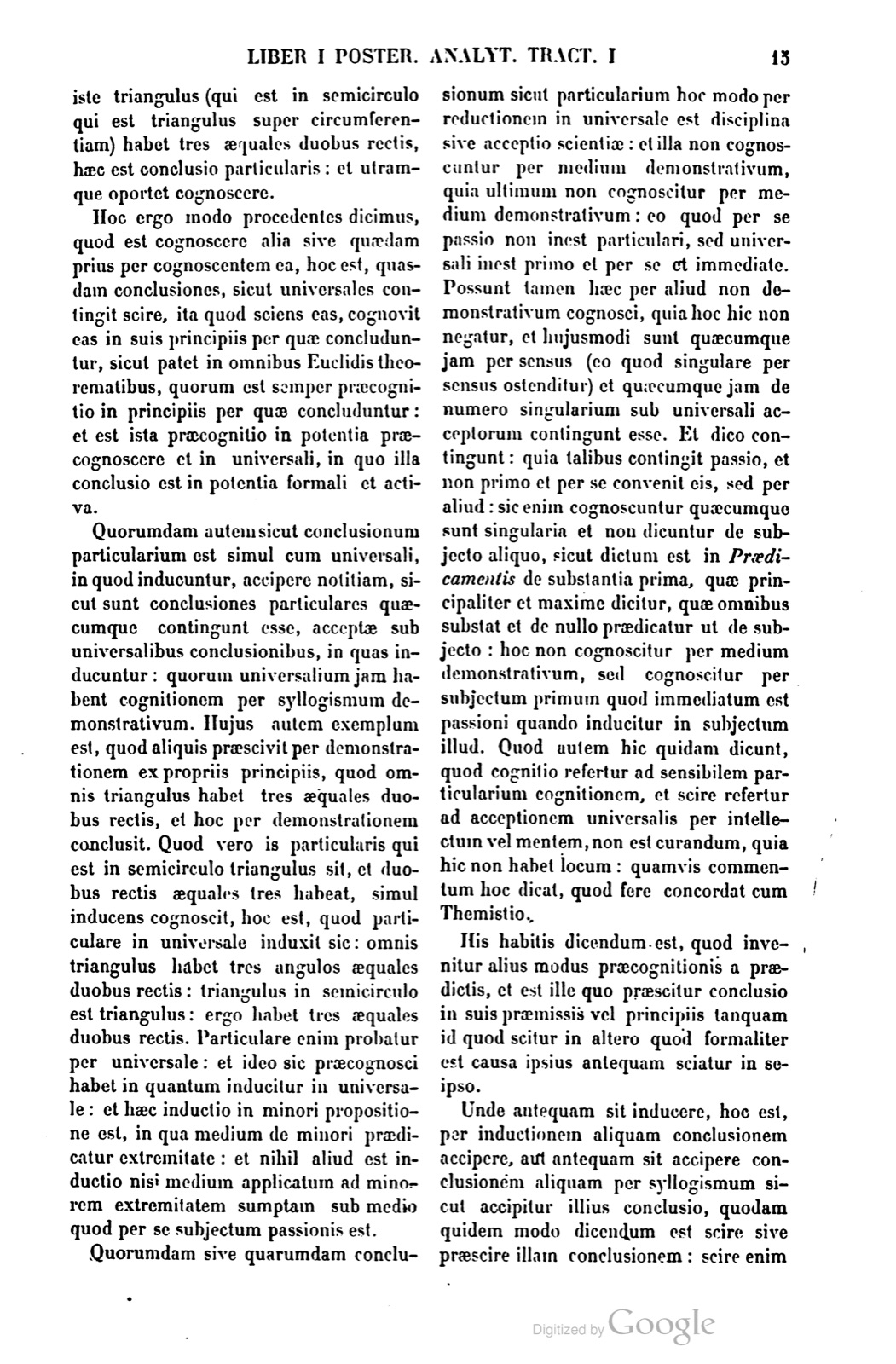
Post cognitionem principiorum determinandum est de praecognitione conclusionum. Quia vero conclusiones sunt duplices, scilicet universales et particulares, determinabimus utrarumque conclusionum praecognitionem. Dico autem hanc solam conclusionem universalem, in qua proprium subjectum et per se subjectum signo universali distributum, subjicitur passioni propriae quae est per se praedicatum ipsius. Conclusionem autem particularem voco, in qua idem subjectum determinatum ad propriam naturam, eidem subjicitur passioni sine signo universali: sicut si probatur quod iste triangulus, qui est in semicirculo qui est triangulus super circumferentiam, habet tres aequales duobus rectis, haec est conclusio particularis: et utramque oportet cognoscere.
Hoc ergo modo procedentes dicimus, quod est cognoscere alia sive quaedam prius per cognoscentem ea, hoc est, quasdam conclusiones, sicut universales contingit scire, ita quod sciens eas, cognovit eas in suis principiis per quae concluduntur, sicut patet in omnibus Euclidis theorematicis, quorum est semper praecognitio in principiis per quae concluduntur: et est ista praecognitio in potentia praecognoscere et in universali, in quo illa conclusio est in potentia formali et activa.
Quorumdam autem sicut conclusionum particularium est simul cum universali, in quod inducuntur, accipere notitiam, sicut sunt conclusiones particulares quaecumque contingunt esse, acceptae sub universalibus conclusionibus, in quas inducuntur: quorum universalium jam habent cognitionem per syllogismum demonstrativum. Hujus autem exemplum est, quod aliquis praescivit per demonstrationem ex propriis principiis, quod omnis triangulus habet tres aequales duobus rectis, et hoc per demonstrationem conclusit. Quod vero is particularis qui est in semicirculo triangulus sit, et duobus rectis aequales tres habeat, simul inducens cognoscit, hoc est, quod particulare in universale induxit sic: omnis triangulus habet tres angulos aequales duobus rectis: triangulus in semicirculo est triangulus: ergo habet tres aequales duobus rectis. Particulare enim probatur per universale: et ideo sic praecognosci habet in quantum inducitur in universale: et haec inductio in minori propositione est, in qua medium de minori praedicatur extremitate: et nihil aliud est inductio nisi medium applicatum ad minorem extremitatem sumpta in sub medio quod per se subjectum passionis est.
Quorumdam sive quarumdam conclusionum sicut particularium hoc modo per reductionem in universale est disciplina sive acceptio scientiae: et illa non cognoscuntur per medium demonstrativum, quia ultimum non cognoscitur per medium demonstrativum: eo quod per se passio non inest particulari, sed universali inest primo et per se et immediate. Possunt tamen haec per aliud non demonstrativum cognosci, quia hoc hic non negatur, et hujusmodi sunt quaecumque jam per sensus, eo quod singulare per sensus ostenditur, et quaecumque jam de numero singularium sub universali acceptorum contingunt esse. Et dico contingunt: quia talibus contingit passio, et non primo et per se convenit eis, sed per aliud: sic enim cognoscuntur quaecumque sunt singularia et non dicuntur de subjecto aliquo, sicut dictum est in Praedicamentis de substantia prima, quae principaliter et maxime dicitur, quae omnibus substat et de nullo praedicatur ut de subjecto: hoc non cognoscitur per medium demonstrativum, sed cognoscitur per subjectum primum quod immediatum est passioni quando inducitur in subjectum illud. Quod autem hic quidam dicunt, quod cognitio refertur ad sensibilem particularium cognitionem, et scire refertur ad acceptionem universalis per intellectum vel mentem, non est curandum, quia hic non habet locum: quamvis commentum hoc dicat, quod fere concordat cum Themistio.
Chapter V. On the cognition of conclusions.
After the cognition of principles, we must determine concerning the forecognition of conclusions. But because conclusions are twofold, namely universal and particular, we shall determine the forecognition of each kind of conclusion. I call that conclusion alone universal in which the proper subject and the per se subject, distributed by a universal sign, is subjected to its proper property, which is its per se predicate. But I call that conclusion particular in which the same subject, determined to its proper nature, is subjected to the same property without a universal sign; as if it is proved that this triangle, which is in a semicircle and which is a triangle upon the circumference, has three angles equal to two right angles, this is a particular conclusion. And it is necessary to cognize each kind.
Proceeding in this way, therefore, we say that there is a knowing of other or certain things before by the one cognizing them, that is, of certain conclusions, just as it happens that universal conclusions are known, so that the one knowing them has cognized them in their principles through which they are concluded, as is evident in all the theorems of Euclid, of which there is always forecognition in the principles through which they are concluded. And this forecognition is to know beforehand in potency and in the universal, in which that conclusion is in formal and active potency.
But of some things, such as particular conclusions, it belongs to receive knowledge together with the universal into which they are induced, as are whatever particular conclusions happen to be, accepted under universal conclusions into which they are induced; of these universals they already have cognition through demonstrative syllogism. An example of this is that someone knew beforehand through demonstration from proper principles that every triangle has three angles equal to two right angles, and concluded this through demonstration. But that this particular figure which is in a semicircle is a triangle, and that it has three angles equal to two right angles, he cognizes at the same time by inducing, that is, because he induced the particular into the universal in this way: every triangle has three angles equal to two right angles; the triangle in the semicircle is a triangle; therefore it has three equal to two right angles. For the particular is proved through the universal, and therefore in this way it has to be known beforehand insofar as it is induced into the universal. And this induction is in the minor proposition, in which the middle is predicated of the minor extreme; and induction is nothing other than the middle applied to the minor extreme taken under the middle, which is the per se subject of the property.
Of some things, or of some conclusions, as of particulars, in this mode through reduction into the universal, there is discipline or reception of science. And those are not cognized through a demonstrative middle, because the ultimate is not cognized through a demonstrative middle, since a per se property does not belong to the particular, but belongs first, per se, and immediately to the universal. Yet these can be cognized through something else non-demonstrative, because this is not denied here; and of this kind are whatever things are already through the senses, because the singular is shown through the senses, and whatever things already happen to be from the number of singulars accepted under a universal. And I say happen because the property happens to such things, and does not agree with them first and per se, but through another. For in this way are cognized whatever things are singular and are not said of any subject, as was said in the Predicaments concerning first substance, which is said principally and most of all, which stands under all things and is predicated of nothing as of a subject. This is not cognized through a demonstrative middle, but it is cognized through the first subject which is immediate to the property when it is induced into that subject. But what certain persons say here, that cognition is referred to sensible cognition of particulars, and knowing is referred to reception of the universal through intellect or mind, is not to be cared for, because it has no place here, although the commentary says this, which nearly agrees with Themistius.
His habitis dicendum est, quod invenitur alius modus praecognitionis a praedictis, et est ille quo praescitur conclusio in suis praemissis vel principiis tanquam id quod scitur in altero quod formaliter est causa ipsius antequam sciatur in seipso.
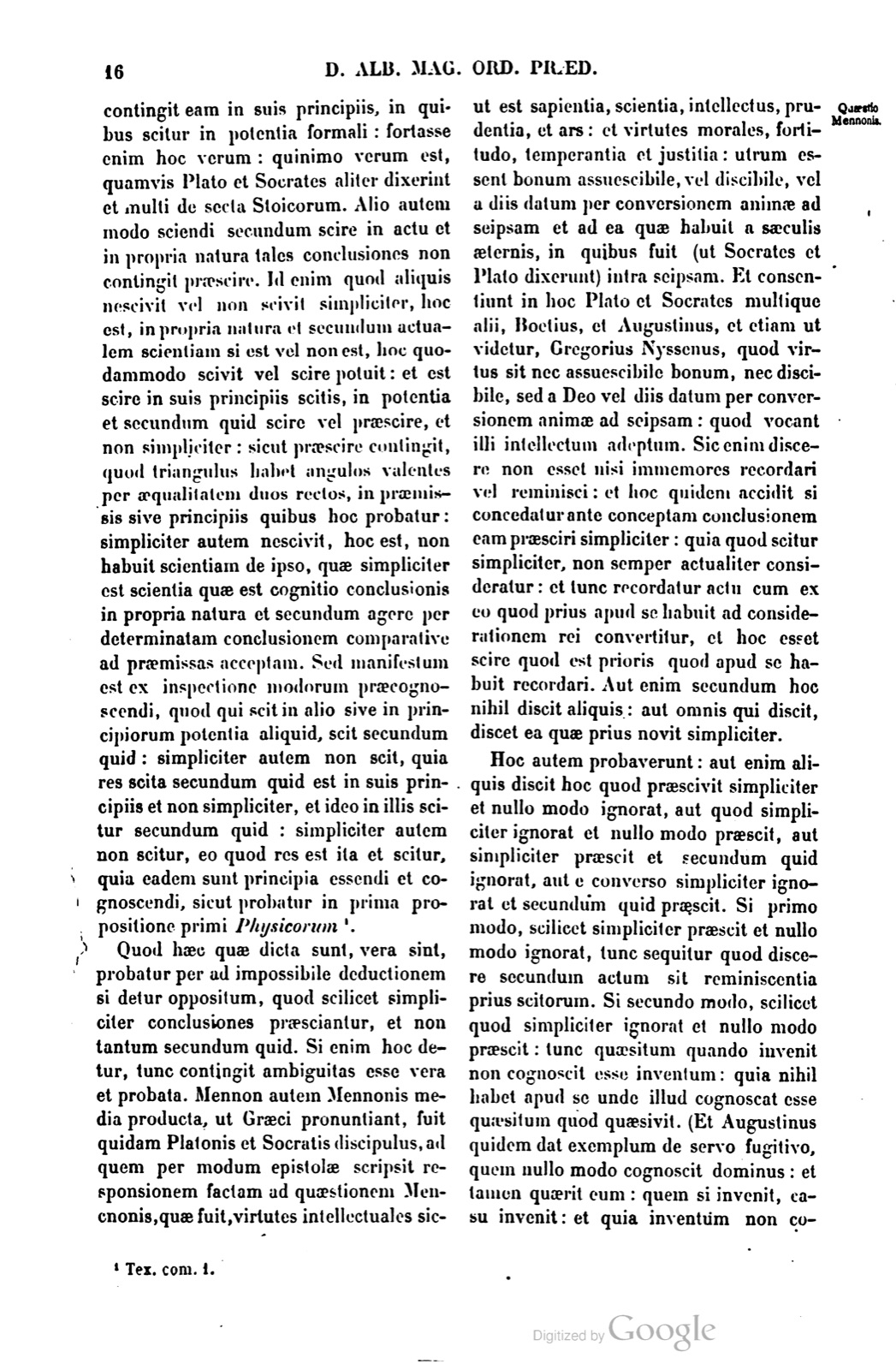
Unde antequam sit inducere, hoc est, per inductionem aliquam conclusionem accipere, aut antequam sit accipere conclusionem aliquam per syllogismum sicut accipitur illius conclusio, quodam quidem modo dicendum est scire sive praescire illam conclusionem: scire enim contingit eam in suis principiis, in quibus scitur in potentia formali: fortasse enim hoc verum: quinimo verum est, quamvis Plato et Socrates aliter dixerint et multi de secta Stoicorum. Alio autem modo sciendi secundum scire in actu et in propria natura tales conclusiones non contingit praescire. Id enim quod aliquis nescivit vel non scivit simpliciter, hoc est, in propria natura et secundum actualem scientiam si est vel non est, hoc quodammodo scivit vel scire potuit: et est scire in suis principiis scitis, in potentia et secundum quid scire vel praescire, et non simpliciter: sicut praescire contingit, quod triangulus habet angulos valentes per aequalitatem duos rectos, in praemissis sive principiis quibus hoc probatur: simpliciter autem nescivit, hoc est, non habuit scientiam de ipso, quae simpliciter est scientia quae est cognitio conclusionis in propria natura et secundum agere per determinatam conclusionem comparative ad praemissas acceptam. Sed manifestum est ex inspectione modorum praecognoscendi, quod qui scit in alio sive in principiorum potentia aliquid, scit secundum quid: simpliciter autem non scit, quia res scita secundum quid est in suis principiis et non simpliciter, et ideo in illis scitur secundum quid: simpliciter autem non scitur, eo quod res est ita et scitur, quia eadem sunt principia essendi et cognoscendi, sicut probatur in prima propositione primi Physicorum 4.
With these things had, it must be said that another mode of forecognition is found besides those mentioned before; and it is that by which the conclusion is foreknown in its premises or principles, as that which is known in another which formally is the cause of it before it is known in itself.
Hence, before there is inducing, that is, receiving some conclusion through induction, or before there is receiving some conclusion through syllogism as the conclusion of that is received, it must indeed be said in some mode that one knows or knows beforehand that conclusion. For it happens that one knows it in its principles, in which it is known in formal potency. Perhaps this is true; indeed it is true, although Plato and Socrates and many of the sect of the Stoics said otherwise. But in another mode of knowing, according to knowing in act and in its proper nature, such conclusions cannot be known beforehand. For that which someone did not know, or did not know simply, that is, in its proper nature and according to actual science whether it is or is not, he in some mode knew or could know. And this is to know in its known principles, to know or know beforehand in potency and in a qualified respect, and not simply; as it happens to know beforehand that a triangle has angles equal by equality to two right angles, in the premises or principles by which this is proved. But simply he did not know it, that is, he did not have science of it, which simply is science that is cognition of the conclusion in its proper nature and according to acting, received through a determinate conclusion comparatively to the premises. But it is manifest from inspection of the modes of knowing beforehand that one who knows something in another or in the potency of principles knows in a qualified respect; but simply he does not know, because the thing known in a qualified respect is in its principles and not simply, and therefore in them it is known in a qualified respect. But simply it is not known, because the thing is so and is known, since the principles of being and of cognizing are the same, as is proved in the first proposition of the first book of the Physics 4.
Quod haec quae dicta sunt, vera sint, probatur per ad impossibile deductionem si detur oppositum, quod scilicet simpliciter conclusiones praesciantur, et non tantum secundum quid. Si enim hoc detur, tunc contingit ambiguitas esse vera et probata. Mennon autem Mennonis media producta, ut Graeci pronuntiant, fuit quidam Platonis et Socratis discipulus, ad quem per modum epistolae scripsit responsionem factam ad quaestionem Mennonis, quae fuit, virtutes intellectuales sicut est sapientia, scientia, intellectus, prudentia, et ars: et virtutes morales, fortitudo, temperantia et justitia: utrum essent bonum assuescibile, vel discibile, vel a diis datum per conversionem animae ad seipsam et ad ea quae habuit a saeculis aeternis, in quibus fuit, ut Socrates et Plato dixerunt, intra seipsam. Et consentiunt in hoc Plato et Socrates multique alii, Boetius, et Augustinus, et etiam ut videtur, Gregorius Nyssenus, quod virtus sit nec assuescibile bonum, nec discibile, sed a Deo vel diis datum per conversionem animae ad seipsam: quod vocant illi intellectum adeptum. Sic enim discere non esset nisi immemores recordari vel reminisci: et hoc quidem accidit si concedatur ante conceptam conclusionem eam praesciri simpliciter: quia quod scitur simpliciter, non semper actualiter consideratur: et tunc recordatur actu cum ex eo quod prius apud se habuit ad considerationem rei convertitur, et hoc esset scire quod est prioris quod apud se habuit recordari. Aut enim secundum hoc nihil discit aliquis: aut omnis qui discit, discet ea quae prius novit simpliciter.
Hoc autem probaverunt: aut enim aliquis discit hoc quod praescivit simpliciter et nullo modo ignorat, aut quod simpliciter ignorat et nullo modo praescit, aut simpliciter praescit et secundum quid ignorat, aut e converso simpliciter ignorat et secundum quid praescit. Si primo modo, scilicet simpliciter praescit et nullo modo ignorat, tunc sequitur quod discere secundum actum sit reminiscentia prius scitorum. Si secundo modo, scilicet quod simpliciter ignorat et nullo modo praescit: tunc quaesitum quando invenit non cognoscit esse inventum: quia nihil habet apud se unde illud cognoscat esse quaesitum quod quaesivit. Et Augustinus quidem dat exemplum de servo fugitivo, quem nullo modo cognoscit dominus: et tamen quaerit eum: quem si invenit, casu invenit: et quia inventum non cognoscit vel praecognoscit, ideo nescit se invenisse eum quando invenit. Et si hoc: tunc non contingit aliquid discere: quia discitur quod invenitur et cognoscitur postea: hoc autem postquam inventum est non scitur et non cognoscitur. Si vero simpliciter praescit et secundum quid ignorat: tunc quod discitur, non discitur nisi secundum quod ignoratur, ad reminiscentiam reducitur: et haec est reminiscentia quae secundum Aristotelem in libro de Reminiscentia est super partem obliti. Tribus ergo membris inductae divisionis falsis existentibus, relinquitur quartum membrum esse verum, quod ea scilicet quae syllogismo vel inductione docentur vel addiscuntur, simpliciter quidem praeignorantur et secundum quid praesciuntur, ut supra dictum est. Nos autem in sequentibus ut perfectior sit doctrina, istam determinabimus quaestionem. Patet igitur quod si oppositum detur, quod alterum duorum sequitur: aut quod nihil discet, quod sequitur ex secundo membro divisionis: aut quod discit quod prius simpliciter cognovit, quod sequitur ex primo membro divisionis et ex tertio.
That these things which have been said are true is proved by deduction to the impossible if the opposite is granted, namely that conclusions are known beforehand simply and not only in a qualified respect. For if this is granted, then the ambiguity can be true and proved. But Meno, with the middle of Meno prolonged, as the Greeks pronounce it, was a certain disciple of Plato and Socrates, to whom he wrote in the manner of a letter a response made to Meno's question. That question was about intellectual virtues, such as wisdom, science, intellect, prudence, and art, and moral virtues, fortitude, temperance, and justice: whether they were an habituable good, or teachable, or given by the gods through the conversion of the soul to itself and to those things which it had from eternal ages, in which it was, as Socrates and Plato said, within itself. And Plato and Socrates and many others agree in this, Boethius and Augustine, and also, as it seems, Gregory of Nyssa, that virtue is neither an habituable good nor teachable, but is given by God or by the gods through the conversion of the soul to itself, which they call the acquired intellect. For thus to learn would be nothing other than for those who are forgetful to recall or remember. And this indeed happens if it is granted that before the conclusion has been conceived it is known beforehand simply, because what is known simply is not always actually considered; and then it is recalled in act when, from that which one previously had within oneself, one is converted to the consideration of the thing, and this would be to know, namely to remember what belongs to the prior thing which one had within oneself. For according to this either someone learns nothing, or everyone who learns will learn the things which he previously knew simply.
But they proved this as follows: either someone learns what he knew beforehand simply and in no way ignores, or what he ignores simply and in no way knows beforehand, or he simply knows beforehand and ignores in a qualified respect, or conversely he simply ignores and knows beforehand in a qualified respect. If in the first mode, namely he simply knows beforehand and in no way ignores, then it follows that to learn according to act is reminiscence of things previously known. If in the second mode, namely that he simply ignores and in no way knows beforehand, then when he finds what was sought he does not cognize it to have been found, because he has nothing within himself from which he may cognize that what he sought is the thing sought. And Augustine indeed gives the example of a runaway slave, whom the master knows in no way, and yet seeks him; if he finds him, he finds him by chance; and because he does not cognize or forecognize the one found, therefore he does not know that he has found him when he finds him. And if this is so, then it does not happen that anything is learned, because what is found and afterward cognized is learned; but after this has been found, it is not known and is not cognized. But if he simply knows beforehand and ignores in a qualified respect, then what is learned is learned only according as it is ignored, and it is reduced to reminiscence; and this is the reminiscence which, according to Aristotle in the book On Reminiscence, concerns a part of what has been forgotten. Therefore, with the three members of the introduced division being false, it remains that the fourth member is true, namely that the things which are taught or learned by syllogism or induction are indeed pre-ignored simply and are known beforehand in a qualified respect, as was said above. But in what follows, so that the teaching may be more perfect, we shall determine this question. Therefore it is evident that if the opposite is granted, one of two things follows: either that he will learn nothing, which follows from the second member of the division, or that he learns what he previously cognized simply, which follows from the first member of the division and from the third.
Et hanc quidem Mennonis ambiguitatem quidam solvere conati sunt, quamvis non solvant. Non enim dicendum est solvere hanc ambiguitatem sicut quidam argumentantur, hoc est, ratione sophistica probant eam solvere. Cum enim quaeritur ab aliquo a respondente et dicente post factam demonstrationem, numquid scivisti per demonstrationem universalem quae probat quod dualitas est par numerus per hoc quod dividitur in duo aequalia, omnem universaliter dualitatem esse parem, vel non? Dicente autem respondente, quod scit sic per demonstrationem factam, hoc est, quod omnis dualitas est par, instant: attulerunt enim proferendo in publicum quamdam particularem dualitatem forte lapidum quam in sinu vel manu absconderant, quam respondens in particulari non opinatus est esse, hoc est, de qua utrum esset vel non esset, nullam habuit opinionem: et dixerunt, de hac dualitate nescivisti, utrum esset vel non esset par: ergo non omnem dualitatem scivisti esse parem. Hoc enim quidam male solvunt dicentes, quod cum dicit respondens per demonstrationem factam se scire omnem dualitatem esse parem, intelligitur de omni quam scivit esse dualitatem sive quod dualitas sit.
Haec enim solutio nulla est, quia in se continet opposita per contradictionem: quia quamvis alia sint scita, tamen omnes discentes et accipientes doctrinam, si accipientes sciunt simpliciter illud cujus veram habent demonstrationem, cum ille sit verissimus sciendi modus, et sciunt illam conclusionem cujus acceperunt demonstrationem simpliciter: acceperunt autem demonstrationem non de omni de quo sciunt, quia hoc demonstrationis non potest esse subjectum, cum nec per se nec de omni conveniat ei passio: quia haec propositio, omnis dualitas quam scio dualitatem esse, est par, nec simpliciter universalis est, nec per se convenit ei praedicatum: unde demonstratio non concludit de dualitate quam sciunt, sed simpliciter de omni: et similiter demonstratio concludens quod triangulus habet tres aequales duobus rectis, non concludit de omni quem sciunt, sed concludit simpliciter de omni numero dualitatis et de omni figura triangula trilatera et rectilinea: quia de alia figura quae componitur ex lineis curvis, non est verum: haec enim aliquando habet tres angulos majores tribus rectis. Cujus ratio est: quia neque una, hoc est, nulla propositio in demonstrativis ita accipitur: quia propositiones demonstrativae simpliciter sunt universales et per se: unde nulla harum sic accipitur de eo quem tu nosti numerum, aut quam nosti rectam lineam: sed propositio demonstrativa accipitur demonstrative simpliciter de omni. Propter quod dicens hanc solutionem, opposita dicit: demonstratione enim facta scit de omni concludi simpliciter: addens autem quae ego novi, dicit non esse de omni: et sic includit illa solutio contradictorie opposita: et sic patet quod non valet.
And indeed certain persons have tried to solve this ambiguity of Meno, although they do not solve it. For it must not be said that this ambiguity is solved as certain persons argue, that is, they prove by a sophistical reason that they solve it. For when it is asked by someone of a respondent, and he says after the demonstration has been made, whether he knew, through the universal demonstration which proves that duality is an even number through this, that it is divided into two equal things, that every duality universally is even or not, and when the respondent says that he knows thus through the demonstration made, that is, that every duality is even, they make an objection. For they brought forward into public a certain particular duality, perhaps of stones, which they had hidden in the breast or hand, which the respondent had not opined in particular to be, that is, concerning which he had no opinion whether it was or was not; and they said: concerning this duality you did not know whether it was or was not even; therefore you did not know every duality to be even. For certain persons solve this badly by saying that when the respondent says through the demonstration made that he knows every duality to be even, it is understood of every duality which he knew to be a duality or that duality is.
For this solution is nothing, because it contains in itself opposites by contradiction. For although the other things are known, nevertheless all who learn and receive teaching, if as receiving they know simply that of which they have a true demonstration, since that is the truest mode of knowing, and if they know simply the conclusion of which they have received the demonstration, nevertheless they have not received the demonstration concerning every thing about which they know, because this cannot be the subject of demonstration, since the property agrees with it neither per se nor of every. For this proposition, every duality which I know to be a duality is even, is neither simply universal, nor does the predicate agree with it per se. Hence demonstration does not conclude concerning the duality which they know, but simply concerning every duality. And similarly the demonstration concluding that a triangle has three angles equal to two right angles does not conclude concerning every one that they know, but concludes simply concerning every number of duality and concerning every triangular, three-sided, rectilinear figure, because concerning another figure which is composed from curved lines this is not true; for sometimes it has three angles greater than three right angles. The reason for this is that not even one, that is, no proposition in demonstrative matters is taken in this way, because demonstrative propositions are simply universal and per se. Hence none of these is taken thus concerning that number which you know, or that straight line which you know; rather, a demonstrative proposition is taken demonstratively simply concerning every. On account of this the one who says this solution says opposites: for once the demonstration has been made, he knows that the conclusion is made simply of every; but by adding what I know, he says that it is not of every. And thus that solution includes contradictory opposites, and so it is evident that it has no force.
Solvitur autem vere inducta dubitatio, dicendo quod nihil, ut opinor. Et, ut opinor, dico propter Platonis et Socratis reverentiam, non tanquam incertum sit quod dicitur. Dico igitur, quod nihil de inductis rationibus prohibet: quoniam est sive contingit id quod discit aliquis per syllogismum et inductionem, sic, hoc est, quidem in alio et in potentia scire sive praescire: est autem sic, hoc est, in alio modo ignorare, simpliciter scilicet et in propria natura et in scientia secundum agere. Inconveniens enim non est si quodammodo et secundum quid scit, quod simpliciter addiscit: sed hoc est inconveniens si eodem modo dicatur praescire quo addiscit: quia ex hoc sequeretur quod secundum idem sciret et secundum idem ignoraret. Haec igitur est vera solutio ambiguitatis, quod id quod syllogismo vel inductione addiscitur simpliciter, potest in suis principiis secundum quid praesciri.
Caput VI. De dubitatione Mennonis et solutione.
Hic autem ut perfectior sit doctrina, interponenda est dubitatio Mennonis et solvenda, quamvis hoc ad metaphysicum pertinere magis videatur. Scias ergo quod dubitatio Mennonis super antiquissimam Anaxagorae opinionem de latentia formarum fundata est, qui dicebat omnes formas per motum accipiendas, jam intus esse in quolibet accipiente eas, sed latere et non apparere, et per motum non nisi depurari materiam ut appareat quod intus latebat: et dabat exemplum de metallo vel lapide pretioso, cujus splendor etiam quando rudis est, jam intus est, sed per tersionem et politionem praeparatur ut appareat, sicut dicunt et Damascenus et Gregorius Nyssenus, qui sic hanc opinionem exponunt. Hanc autem probaverunt sic, quod nihil exit in actum de potentia, nisi per id quod existit in actu in eodem: quia oportet quod agens in motu conjunctum sit mobili quod movetur: si ergo educens materiam in actum conjunctum materiae, in actu sit, nihil recipit materia nisi quod prius secundum actum fuit in ipsa: et sic moveri secundum formam, nihil est nisi de occulto et secundum actum in extrinsecus existente venire ad apertum.
But the introduced doubt is truly solved by saying that nothing prevents it, as I think. And I say as I think on account of reverence for Plato and Socrates, not as though what is said were uncertain. Therefore I say that none of the arguments introduced prevents this: since that which someone learns through syllogism and induction is or happens to be known or known beforehand in this way, namely in another and in potency; and yet it is in this way, that is, in another mode, unknown, namely simply and in its proper nature and in science according to acting. For it is not unfitting if one knows in some mode and in a qualified respect what he learns simply; but this is unfitting if he is said to know beforehand in the same mode in which he learns, because from this it would follow that according to the same thing he would know and according to the same thing he would be ignorant. This therefore is the true solution of the ambiguity: that what is learned simply by syllogism or induction can in its principles be known beforehand in a qualified respect.
Chapter VI. On the doubt of Meno and the solution.
Here, so that the teaching may be more perfect, the doubt of Meno must be inserted and solved, although this seems to pertain more to metaphysics. You should know therefore that the doubt of Meno is founded upon the very ancient opinion of Anaxagoras concerning the hiddenness of forms. He said that all forms to be received through motion already are within each thing receiving them, but lie hidden and do not appear, and that through motion matter is only purified so that what was hidden within may appear. And he gave the example of metal or a precious stone, whose splendor, even when it is rough, is already within, but by rubbing and polishing is prepared so that it may appear, as both Damascene and Gregory of Nyssa say, who explain this opinion in this way. But they proved this in this way: that nothing goes out into act from potency except through that which exists in act in the same thing, because the agent in motion must be conjoined with the mobile which is moved. Therefore, if the thing drawing matter into act, conjoined with matter, is in act, matter receives nothing except what was previously in it according to act. And thus to be moved according to form is nothing other than to come into the open from the hidden and from what exists in act extrinsically.
Similiter autem dixerunt esse in anima in acceptione veritatis intellectualis et moralis: eo quod putabant ita se habere intellectum ad virtutem, sicut se habet materia ad formae susceptionem. In quo errore etiam fuit Theophrastus, quamvis ab ipso magistro suo Aristotele correctus fuerit, ut dicit Commentator super tertio de Anima; et ideo dixerunt intus esse scita simpliciter, sed latere, eo quod intellectus in hominibus non est possessus vel adeptus, sed potius passionibus et phantasiis involutus et impeditus: adeptum enim vel possessum intellectum vocant, quando homo libere et sine impedimento potest ex facilitate converti ad intellectum purum et verum sui puritate per aversionem sui a passionibus et phantasiis: et tunc dicunt talem intellectum omnia invenire apud seipsum, et per doctrinam depurationem fieri et per assuefactionem boni: per syllogismum autem et inductionem nihil accipere novum, sed omnia habentem intellectum reduci ad illius vel illius actualem considerationem: quod tamen simpliciter ante habuit in seipso.
Hi autem suae positionis potissimas dabant quinque rationes. Una quidem quae dicta est, quod si nihil sit in actu, nisi per id quod in actu est, et per id quod facit in actu esse: conveniunt tamen ei quod fit et mutatur de potentia in actum.
Secundam autem dicebant esse quae superius posita est, quod si scita non sunt intus, quod nihil scitorum cognoscitur, quando invenitur: quia non cognoscitur, nisi simile simili, sicut in primo de Anima 5 probatum est in Empedoclis opinione. Cujus igitur non est simile in discente, nunquam cognoscitur.
Tertia fuit cui maxime innitebantur: quia formae formantes omnem rem, ante rem formatam sunt, sicut sigillum ante ceram: et cum formans quod vocatur in physicis formativum, semper sit intra formatum, sicut patet in omni generatione: formativum autem non format, nisi ad suam speciem, et nihil aliud format, nisi suam speciem transferendo in formatum: oportet quod omne formatum per speciem suam fuerit ante simpliciter intra id quod formatur: propter quod dicebant semen generationis esse parva animalia, sed actu animalia in specie illius conservata: et ita dicebant intellectum agentem in anima, qui est omnia intellecta facere, esse habitum actu omnem speciem sciri apud se habentem. Haec igitur est ratio tertia istorum.
Quarta ratio ipsorum quamvis infirma sit, tamen videbatur eis fortis, et propter hoc frequenter posuerunt eam, scilicet quod debilis non agit in fortius, et ignobilius non agit in id quod est nobilius: exteriora autem debiliora sunt et ignobiliora quam anima: ergo non agunt in ipsam: agerent autem si a sensibus et sensibilibus acceptis ad scientiam et virtutem proficeret anima: hoc igitur modo non perficitur: et perficitur vel ab extrinsecis, vel ab intrinsecis: ergo relinquitur quod intrinsecus habet quibus perficitur, et non accipit ea per inventionem vel doctrinam.
But they said similarly that it is in the soul in the reception of intellectual and moral truth, because they thought the intellect to be related to virtue as matter is related to the reception of form. Theophrastus also was in this error, although he was corrected by his master Aristotle himself, as the Commentator says on the third book On the Soul. And therefore they said that the things known simply are within, but lie hidden, because intellect in men is not possessed or acquired, but rather wrapped up and impeded by passions and phantasms. For they call intellect acquired or possessed when a man freely and without impediment can easily be converted to pure and true intellect in the purity of himself through the aversion of himself from passions and phantasms. And then they say that such an intellect finds all things within itself, and that through teaching there is purification and through habituation of the good; but through syllogism and induction it receives nothing new, but the intellect having all things is brought back to actual consideration of this or that thing, which nevertheless it had before simply in itself.
But these men gave five chief reasons for their position. One indeed is the one which has been stated, that if nothing is in act except through that which is in act and through that which makes it to be in act, nevertheless these agree with that which comes to be and is changed from potency into act.
But they said the second was that which was posited above: that if known things are not within, then none of the things known is cognized when it is found, because it is not cognized except like by like, as was proved in the first book On the Soul 5 in the opinion of Empedocles. Therefore that of which there is no likeness in the learner is never cognized.
The third was the one on which they especially relied: because the forms forming every thing are before the formed thing, as a seal is before wax; and since the forming thing, which in physics is called the formative, is always within the formed thing, as is evident in every generation, and since the formative forms only to its own species and forms nothing else except by transferring its species into the formed thing, it is necessary that everything formed through its species was before simply within that which is formed. On account of this they said that the seed of generation is little animals, but animals in act preserved in the species of that animal. And so they said that the agent intellect in the soul, which is to make all things understood, is a habit having within itself in act every species to be known. This therefore is their third reason.
Their fourth reason, although it is weak, nevertheless seemed strong to them, and on account of this they often posited it, namely that the weak does not act upon the stronger, and the less noble does not act upon what is nobler. But exterior things are weaker and less noble than the soul; therefore they do not act upon it. Yet they would act if the soul were advanced from senses and sensible things received to science and virtue. Therefore it is not perfected in this way; and it is perfected either by extrinsic things or by intrinsic things; therefore it remains that it has intrinsically those things by which it is perfected, and does not receive them through discovery or teaching.
Quinta ratio est, quae in ipso libro Mennonis continetur, et est quasi per instantiam: quia si acceptio veritatis intellectualis vel moralis esset per studium vel doctrinam: tunc ubicumque talia essent, ibi esset virtus: sed non est ita: videmus enim aliquando pessimos ab optimis viris educatos et doctos, qui nec doctrina neque educatione nec exemplo boni profecerunt: a doctrina igitur et consuetudine non est acceptio virtutis. Super has igitur tales rationes positiones suas Stoici fundaverunt.
Has igitur quae dictae sunt impugnaverunt Peripatetici, rationes inducentes quae superius dictae sunt, maxime ad inconveniens et impossibile ducentes: quia secundum hoc non est doctrina neque disciplina: quia nihil novi accepimus in utrumque: omne enim quod discit immemor recordatur, et omnis generatio est tantum alterans de occulto ad manifestum: et hujusmodi inconvenientia multa accidunt valde.
Ad haec igitur secundum Boetium sic respondetur: quia ea quae accipiuntur per motum et mutationem et doctrinam et assuetudinem, intra quidem sunt universaliter et secundum potentiam: scibilia enim secundum habitum principiorum priorum sunt intra, quae statim sciuntur terminis cognitis, et quae nullus discipulorum accipit a docente sive magistro, ut de quolibet est affirmatio et negatio vera, et quod totum est majus sua parte, et hujusmodi: generaliter enim verum est, quod intellectus possibilis nihil accipit, cujus apud se non habet lumina prima, quae sunt quasi instrumenta et media ad alia recipienda et ad quae examinat et cognoscit quaecumque inventa, et scit utrum sint vera vel falsa: et haec communissima et prima veri et boni quod adipisci potest per virtutem et intellectualem et moralem, sicut principiatum examinatum ad sua principia, et ad haec cognoscit. Et ideo dicit Boetius quod universalia retinet intellectus et singularia perdit. Et hoc est quod dictum est, quod secundum quid praescit, et simpliciter non praescit sed ignorat: quamvis enim res in universali sit et incorruptibili et in principio quod nobilius est principiato, tamen scientia in universali non est nisi secundum potentiam et secundum quid: scientia autem in particulari sive in propria natura et in agere, est scientia simpliciter: quia res in suo universali non est nisi universaliter et secundum potentiam et secundum quid: et sicut se habet ad esse, sic se habet ad scire. Hoc igitur modo non scitur nisi secundum quid, et simpliciter ignoratur: et in materia hoc modo est secundum quid, et simpliciter non est: et generatur simpliciter, et secundum aliquid quod fuit in materia, non generatur.
The fifth reason is the one contained in the book of Meno itself, and is as it were by an instance: because if the reception of intellectual or moral truth were through study or teaching, then wherever such things existed, there would be virtue there; but it is not so. For we sometimes see the worst men educated and taught by the best men, who have profited neither by teaching nor by education nor by example of the good; therefore the reception of virtue is not from teaching and custom. Upon such reasons, therefore, the Stoics founded their positions.
The Peripatetics therefore attacked these things which have been said, bringing in the reasons which were stated above as leading especially to what is unfitting and impossible: because according to this there is neither teaching nor discipline, because we receive nothing new in either. For everyone who learns, being forgetful, remembers, and every generation is only an alteration from hidden to manifest; and many very great unfitting consequences of this kind follow.
To these things, therefore, according to Boethius, the response is made in this way: because the things which are received through motion and change and teaching and habituation are indeed within universally and according to potency. For knowable things are within according to the habit of prior principles, which are known immediately when the terms are known, and which no disciple receives from a teacher or master, such as that concerning anything affirmation and negation is true, and that the whole is greater than its part, and things of this kind. For it is generally true that the possible intellect receives nothing of which it does not have within itself the first lights, which are as instruments and middles for receiving other things, and according to which it examines and cognizes whatever things have been found, and knows whether they are true or false. And these are the most common and first things of the true and the good which can be attained through intellectual and moral virtue, as something principiated is examined according to its principles, and according to these it cognizes. And therefore Boethius says that the intellect retains universals and loses singulars. And this is what was said, that it knows beforehand in a qualified respect, and simply does not know beforehand but is ignorant; for although the thing is in the universal and incorruptible and in the principle, which is nobler than the principiated thing, nevertheless science in the universal is only according to potency and in a qualified respect. But science in the particular or in its proper nature and in acting is science simply, because the thing in its universal is only universally and according to potency and in a qualified respect; and as it is related to being, so it is related to knowing. Therefore in this mode it is known only in a qualified respect, and simply it is ignored; and in matter in this mode it is in a qualified respect, and simply is not; and it is generated simply, while according to something that was in matter, it is not generated.
Tractatus II. Ex quibus et qualibus est demonstratio.
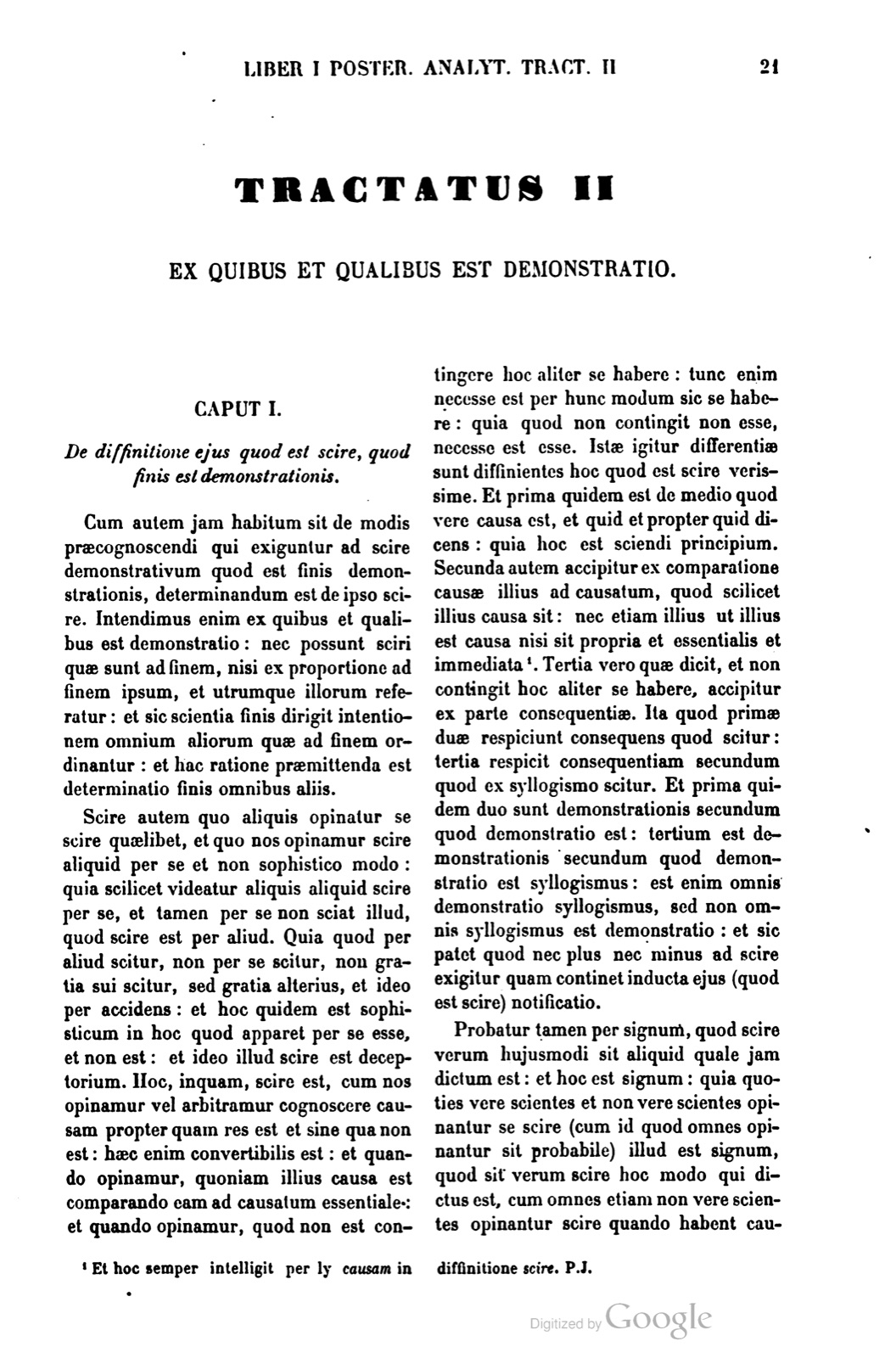
Caput I. De diffinitione ejus quod est scire, quod finis est demonstrationis.
Cum autem jam habitum sit de modis praecognoscendi qui exiguntur ad scire demonstrativum quod est finis demonstrationis, determinandum est de ipso scire. Intendimus enim ex quibus et qualibus est demonstratio: nec possunt sciri quae sunt ad finem, nisi ex proportione ad finem ipsum, et utrumque illorum referatur: et sic scientia finis dirigit intentionem omnium aliorum quae ad finem ordinantur: et hac ratione praemittenda est determinatio finis omnibus aliis.
Scire autem quo aliquis opinatur se scire quaelibet, et quo nos opinamur scire aliquid per se et non sophistico modo: quia scilicet videatur aliquis aliquid scire per se, et tamen per se non sciat illud, quod scire est per aliud. Quia quod per aliud scitur, non per se scitur, non gratia sui scitur, sed gratia alterius, et ideo per accidens: et hoc quidem est sophisticum in hoc quod apparet per se esse, et non est: et ideo illud scire est deceptorium. Hoc, inquam, scire est, cum nos opinamur vel arbitramur cognoscere causam propter quam res est et sine qua non est: haec enim convertibilis est: et quando opinamur, quoniam illius causa est comparando eam ad causatum essentiale: et quando opinamur, quod non est contingere hoc aliter se habere: tunc enim necesse est per hunc modum sic se habere: quia quod non contingit non esse, necesse est esse. Istae igitur differentiae sunt diffinientes hoc quod est scire verissime. Et prima quidem est de medio quod vere causa est, et quid et propter quid dicens: quia hoc est sciendi principium. Secunda autem accipitur ex comparatione causae illius ad causatum, quod scilicet illius causa sit: nec etiam illius ut illius est causa nisi sit propria et essentialis et immediata 6. Tertia vero quae dicit, et non contingit hoc aliter se habere, accipitur ex parte consequentiae. Ita quod primae duae respiciunt consequens quod scitur: tertia respicit consequentiam secundum quod ex syllogismo scitur. Et prima quidem duo sunt demonstrationis secundum quod demonstratio est: tertium est demonstrationis secundum quod demonstratio est syllogismus: est enim omnis demonstratio syllogismus, sed non omnis syllogismus est demonstratio: et sic patet quod nec plus nec minus ad scire exigitur quam continet inducta ejus quod est scire notificatio.
Probatur tamen per signum, quod scire verum hujusmodi sit aliquid quale jam dictum est: et hoc est signum: quia quoties vere scientes et non vere scientes opinantur se scire, cum id quod omnes opinantur sit probabile, illud est signum, quod sit verum scire hoc modo qui dictus est, cum omnes etiam non vere scientes opinantur scire quando habent causam et sciunt quod illius causa est, et quod non contingit illud se aliter habere: ergo hoc est verum scire. Sed differentia est: quia scientes tunc arbitrantur se scire et vere sciunt: non scientes autem propter similitudinem quam habent cum scientibus opinantur se hoc modo vere scire, quamvis non vere sciant. Propter hoc omnis ejus cujus est scientia, quae simpliciter et per se est scientia, hoc est impossibile aliter se habere quam dictum est.
Treatise II. From what things and of what sorts demonstration is.
Chapter I. On the definition of what it is to know, which is the end of demonstration.
But since we have already treated the modes of knowing beforehand which are required for demonstrative knowing, which is the end of demonstration, we must determine concerning knowing itself. For we intend to determine from what things and from what sorts of things demonstration is; and those things which are for the end cannot be known except from their proportion to the end itself, and each of those things is referred to it. And thus science of the end directs the intention of all the other things which are ordered to the end. For this reason the determination of the end must be put before all the others.
But the knowing by which someone thinks he knows anything whatever, and by which we think that we know something per se and not in a sophistical mode, is this: because someone may seem to know something through itself and yet not know it through itself, since that knowing is through another. Because what is known through another is not known through itself; it is not known for its own sake, but for the sake of another, and therefore by accident. And this is sophistical in this, that it appears to be through itself and is not; and therefore that knowing is deceptive. This, I say, is knowing: when we think or judge that we cognize the cause on account of which the thing is and without which it is not, for this is convertible; and when we think that it is the cause of that thing by comparing it to the essential caused thing; and when we think that it cannot happen for this to be otherwise. For then it is necessary in this mode to be so, because what cannot not be, must be. Therefore these differences most truly define what it is to know. The first indeed concerns the middle which is truly a cause, saying what and on account of what, because this is the principle of knowing. But the second is taken from the comparison of that cause to the caused thing, namely that it is the cause of that thing; nor is it the cause of that thing as that thing unless it is proper and essential and immediate 6. But the third, which says and it cannot happen for this to be otherwise, is taken on the part of the consequence. Thus the first two regard the consequent which is known; the third regards the consequence according as it is known from the syllogism. And the first two indeed belong to demonstration according as it is demonstration; the third belongs to demonstration according as demonstration is a syllogism. For every demonstration is a syllogism, but not every syllogism is a demonstration. And thus it is evident that neither more nor less is required for knowing than is contained in the introduced notification of what it is to know.
Yet it is proved by a sign that true knowing of this kind is something such as has now been said; and this is the sign: that whenever those truly knowing and those not truly knowing think that they know, since what all think is probable, that is a sign that true knowing is in the mode which has been stated, since even all those not truly knowing think that they know when they have a cause and know that it is the cause of that thing, and that it does not happen for it to be otherwise. Therefore this is true knowing. But the difference is that those who know then judge themselves to know and truly know; but those who do not know, on account of the likeness which they have with those who know, think that they truly know in this mode, although they do not truly know. On account of this, for everything of which there is science, which is science simply and per se, it is impossible for it to be otherwise than has been said.
Haec probatur ex origine scientiae, quae in primo ponitur primae philosophiae, quod ex admirari, et tunc et nunc philosophari inceptum. Admiratio enim est suspensio ad causam ejus quod apparet: suspensio autem causa est inquisitionis et causae ad effectum comparationis quod illius causa sit, et ipsum philosophari sic causatum, considerat convenientiam effectus ad causam secundum non contingere aliter se habere. Hoc modo naturale desiderium, quo omnes homines scire desiderant, procedit ad scire secundum actum: quod desiderium est et in vere scientibus, et in non vere scientibus. Hoc igitur modo est verum scire. Et hanc probationem ponit Theophrastus qui etiam primum librum, qui incipit, Omnes homines scire desiderant, Metaphysicae Aristotelis traditur addidisse: et ideo in Arabicis translationibus primus liber non habetur. Ista igitur est vera ejus quod est scire notificatio, et hoc modo sumendae et intelligendae et probandae sunt differentiae in notificatione illa positae. Scire igitur propriissime, sicut dictum est, determinatur.
Si quis igitur et alius aliquis est vere sciendi modus, de illo dicemus posterius, et circa finem libri, ubi de scientia loquemur principiorum, quae etiam vere sciuntur quantum ad suorum terminorum certitudinem, quamvis non habeant hunc modum demonstrationis, quod sciantur per medium demonstrationis 7. Hic sensus innuitur in Arabico commento: nam dicit Alfarabius, quod iste alius modus sciendi est per intelligentiam per quam vere res comprehenditur. Si quis autem dicere velit, quod alius est sciendi modus, quo sciuntur quae fiunt frequenter ex his quae sunt semper, ut dicit Aristoteles in sexto primae philosophiae 8, non peccabit meo judicio. Sed tunc quod posterius dicendum est, ad Posteriorum scientiam referendum est, sive ad primam philosophiam quae posterior quoad nos, quamvis natura sit prior.
Ex his igitur concluditur quod supponendum est quod dicamus, quod scire est per demonstrationem intelligere: quia demonstratio colligit ea quae dicta sunt: primum quidem in medio, secundum autem in consequente comparato ad causam, et tertium in consequentia syllogismi. Et propter hoc oportet diffinire demonstrationem per proprium effectum, dicendo quod demonstrationem dico, cujus effectus est scire, syllogismum qui proprie dicitur ἀποδικτίκον Graece, Latine autem dicimus syllogismum facientem scire. Ἀποδικτίκον dicimus syllogismum, secundum quem in habendo ipsum perfecte in principiis et consequentia et consequente scimus vere, sive veram scientiam habemus. Hoc igitur modo determinatur finis demonstrationis, in quem omnia alia referenda sunt.
This is proved from the origin of science, which is posited in the first book of first philosophy, that from wondering, both then and now, philosophizing began. For wonder is a suspension toward the cause of what appears; but suspension is the cause of inquiry and of the comparison of cause to effect, that it is the cause of that thing. And philosophizing itself, caused in this way, considers the agreement of the effect with the cause according to its not being able to be otherwise. In this way the natural desire, by which all men desire to know, proceeds to knowing according to act; and this desire is in those truly knowing and in those not truly knowing. Therefore in this mode there is true knowing. And Theophrastus posits this proof, who is also reported to have added the first book, which begins All men desire to know, to Aristotle's Metaphysics; and therefore in the Arabic translations the first book is not had. Therefore this is the true notification of what it is to know, and in this way the differences placed in that notification must be taken, understood, and proved. Therefore knowing is determined most properly as has been said.
Therefore if there is also some other mode of truly knowing, we shall speak of it later and around the end of the book, where we shall speak concerning the science of principles, which also are truly known as to the certainty of their terms, although they do not have this mode of demonstration, that they are known through the middle of demonstration 7. This sense is hinted at in the Arabic commentary; for Alfarabius says that this other mode of knowing is through intelligence, through which the thing is truly comprehended. But if someone wishes to say that there is another mode of knowing, by which those things which happen frequently from things which are always are known, as Aristotle says in the sixth book of first philosophy 8, he will not sin in my judgment. But then what must be said afterward is to be referred to the science of the Posterior Analytics, or to first philosophy, which is posterior with respect to us, although it is prior by nature.
From these things, therefore, it is concluded that it must be supposed that we say that to know is to understand through demonstration, because demonstration gathers together the things that have been said: the first in the middle, the second in the consequent compared to the cause, and the third in the consequence of the syllogism. And because of this it is necessary to define demonstration through its proper effect, saying that by demonstration, whose effect is to know, I mean the syllogism which in Greek is properly called ἀποδικτίκον, but in Latin we say a syllogism making one know. We call Ἀποδικτίκον the syllogism according to which, in having it perfectly in principles and consequence and consequent, we truly know, or have true science. Therefore in this mode the end of demonstration is determined, to which all other things must be referred.
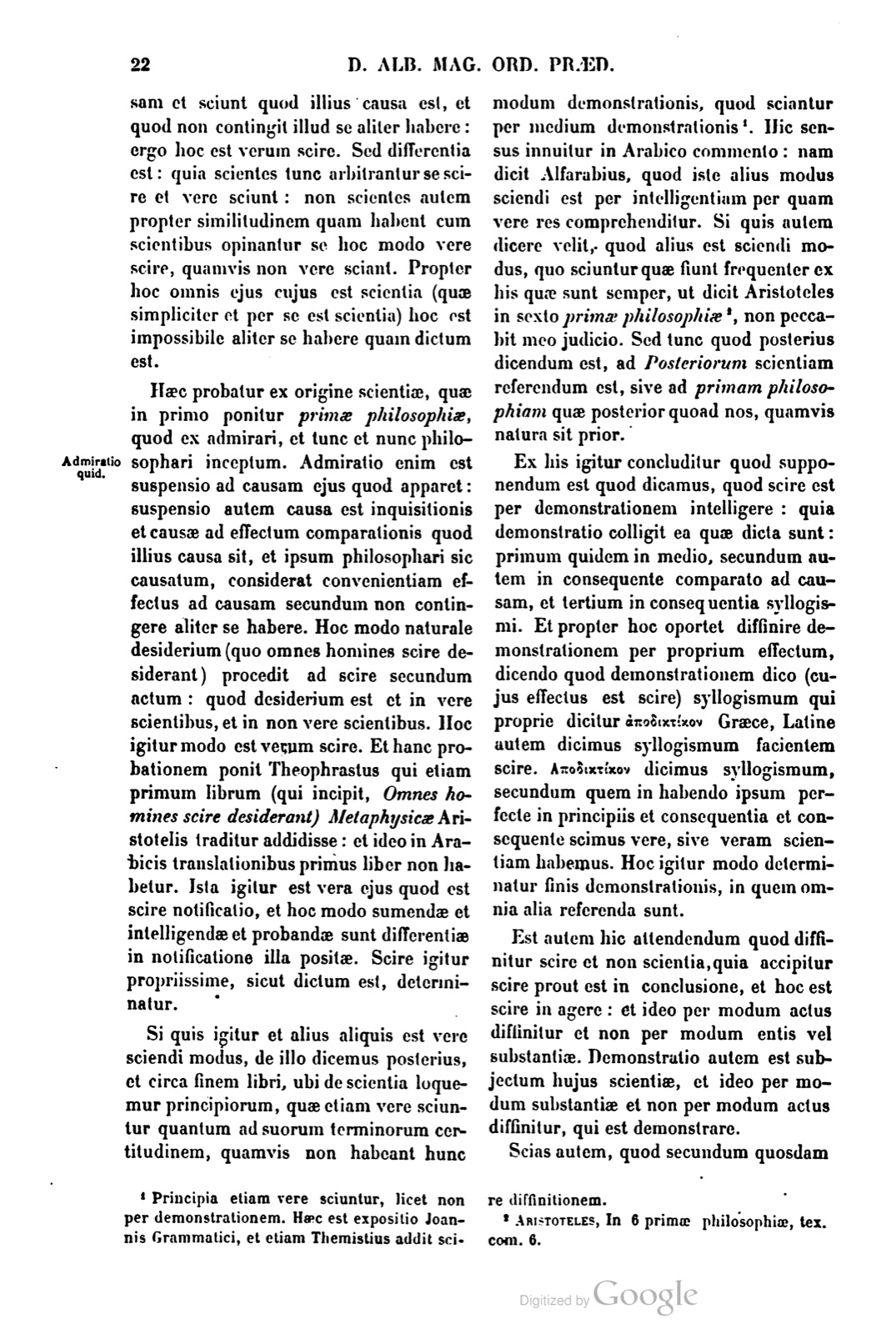
Est autem hic attendendum quod diffinitur scire et non scientia, quia accipitur scire prout est in conclusione, et hoc est scire in agere: et ideo per modum actus diffinitur et non per modum entis vel substantiae. Demonstratio autem est subjectum hujus scientiae, et ideo per modum substantiae et non per modum actus diffinitur, qui est demonstrare.
Scias autem, quod secundum quosdam quadrupliciter dicitur scire. Comprehensio enim rei per ea per quae potest quocumque modo concludi, largissime dicitur scientia: et sic etiam quae sunt contingentia ad utrumlibet, sciuntur. Et quia etiam potest concludi per ea quae frequenter uno modo se habent, quamvis non semper, ideo secundo modo magis proprie dicitur scire comprehensio veritatis rei per ea quae contingunt frequenter: et sic scitur contingens natum. Adhuc quia concluditur per ea quae uno modo semper se habent et sunt immutabilia, dicitur scire. Adhuc magis proprie comprehensio veritatis uno modo et immutabiliter se habentium, quod scire est commune principiis et conclusionibus demonstrativis. Maxime autem et quarto modo dicitur scire comprehensio veritatis uno modo se habentis et immutabilis per acceptionem alterius prioris a quo habet suam veritatem per suum esse: et hoc modo diffinitum est hic scire.
Cum autem dicimus cum causam cognoscimus, non causas in plurali: ideo quia una est principalis causa, quae est causa causarum, quae est finis, per quam potissime scitur: quia unumquodque maxime fine suo et optimo essentiali determinatur et scitur. Dicitur etiam causa ut subjecto intelligatur una: quia tres quae principium sunt sciendi, in unam coincidunt, efficiens et forma et finis, ut dicit Aristoteles in secundo Physicorum 9. Adhuc autem quamvis multae sint causae alicujus, una autem semper est completiva quae potissime est causa, et ad illam respiciendo dicitur, quod scire est cum causam cognoscimus.
But it must be noted here that knowing is defined and not science, because knowing is taken insofar as it is in the conclusion, and this is knowing in acting. Therefore it is defined through the mode of act and not through the mode of being or substance. But demonstration is the subject of this science, and therefore it is defined through the mode of substance and not through the mode of the act, which is to demonstrate.
You should know, moreover, that according to certain persons knowing is said in four ways. For comprehension of a thing through those things by which it can in any way be concluded is most broadly called science; and thus even things which are contingent to either side are known. And because it can also be concluded through those things which frequently have themselves in one way, although not always, therefore in a second and more proper mode the comprehension of the truth of a thing through those things which happen frequently is called knowing; and thus the naturally contingent is known. Furthermore, because it is concluded through those things which always have themselves in one way and are immutable, it is called knowing. Furthermore, more properly, knowing is the comprehension of the truth of things having themselves in one way and immutably, which knowing is common to principles and demonstrative conclusions. But most of all and in the fourth mode, knowing is called the comprehension of the truth of a thing having itself in one way and immutable through the reception of another prior thing from which it has its truth through its being; and in this mode knowing is defined here.
But when we say when we cognize the cause, we do not say causes in the plural, because there is one principal cause, which is the cause of causes, which is the end, through which a thing is most powerfully known, because each thing is determined and known especially by its end and essential best thing. Cause is also said so that one cause is understood as to the subject, because the three causes which are the principle of knowing coincide in one, efficient cause, form, and end, as Aristotle says in the second book of the Physics 9. Furthermore, although there are many causes of something, nevertheless one is always completive, which is most powerfully the cause, and with respect to that it is said that knowing is when we cognize the cause.
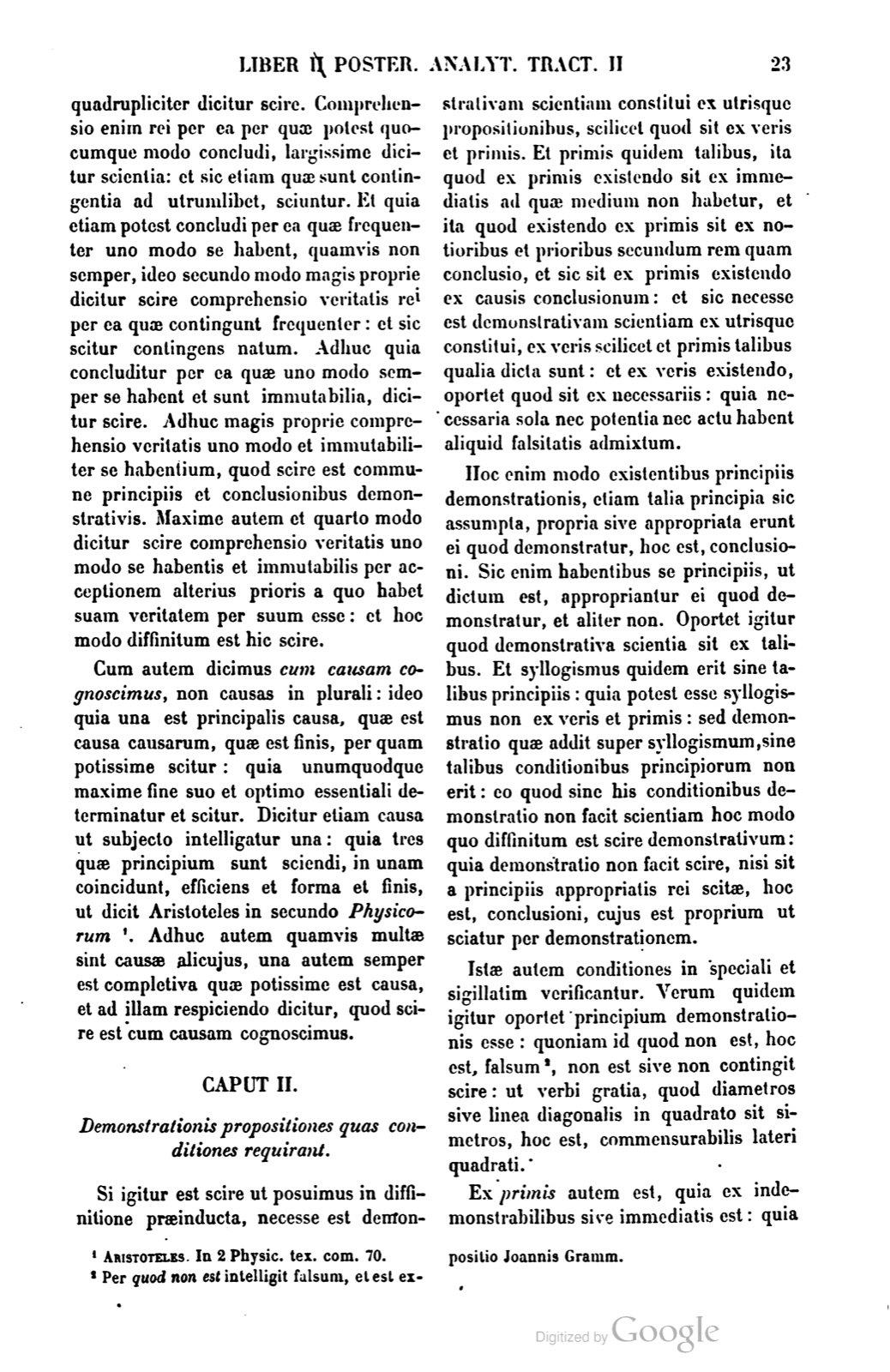
Caput II. Demonstrationis propositiones quas conditiones requirant.
Si igitur est scire ut posuimus in diffinitione praeinducta, necesse est demonstrativam scientiam constitui ex utrisque propositionibus, scilicet quod sit ex veris et primis. Et primis quidem talibus, ita quod ex primis existendo sit ex immediatis ad quae medium non habetur, et ita quod existendo ex primis sit ex notioribus et prioribus secundum rem quam conclusio, et sic sit ex primis existendo ex causis conclusionum: et sic necesse est demonstrativam scientiam ex utrisque constitui, ex veris scilicet et primis talibus qualia dicta sunt: et ex veris existendo, oportet quod sit ex necessariis: quia necessaria sola nec potentia nec actu habent aliquid falsitatis admixtum.
Hoc enim modo existentibus principiis demonstrationis, etiam talia principia sic assumpta, propria sive appropriata erunt ei quod demonstratur, hoc est, conclusioni. Sic enim habentibus se principiis, ut dictum est, appropriantur ei quod demonstratur, et aliter non. Oportet igitur quod demonstrativa scientia sit ex talibus. Et syllogismus quidem erit sine talibus principiis: quia potest esse syllogismus non ex veris et primis: sed demonstratio quae addit super syllogismum, sine talibus conditionibus principiorum non erit: eo quod sine his conditionibus demonstratio non facit scientiam hoc modo quo diffinitum est scire demonstrativum: quia demonstratio non facit scire, nisi sit a principiis appropriatis rei scitae, hoc est, conclusioni, cujus est proprium ut sciatur per demonstrationem.
Istae autem conditiones in speciali et sigillatim verificantur. Verum quidem igitur oportet principium demonstrationis esse: quoniam id quod non est, hoc est, falsum, non est sive non contingit scire: ut verbi gratia, quod diametros sive linea diagonalis in quadrato sit simetros, hoc est, commensurabilis lateri quadrati 10.
Ex primis autem est, quia ex indemonstrabilibus sive immediatis est: quia nisi sit ex primis et immediatis, non scit quis conclusionem simpliciter per ea, eo quod non habet demonstrationem illorum, hoc est, per illa quae non sunt prima et immediata. Scire enim demonstrationis est scire simpliciter: quando autem scitur per non prima et per non immediata, non scitur simpliciter, sed sub conditione si prima sint probata per alia priora se, quae medium sunt ad prima probanda sive concludenda. Patet igitur quod demonstratio non facit scire simpliciter nisi sit ex primis et immediatis. Scire enim secundum verissimum modum sciendi, est eorum quorum demonstratio est, non secundum accidens, hoc est, ex demonstrabilibus per alia: quia illa faciunt scire per alia vera secundum accidens.
Adhuc principia et propositiones oportet esse causas rei conclusae, et notiores conclusione: quia, sicut saepe dictum est, ignotum non fit notum nisi per notum: conclusio autem ante demonstrationem accipitur ut ignota. Et oportet esse primas. Et quod oportet esse causas, probatur ex hoc quod dictum est in diffinitione ejus quod est scire: quoniam tunc vere scimus quando causam cognoscimus. Si autem vere causae sunt, tunc sequitur quod sint priores simpliciter: quia causa prior simpliciter est, et effectus simpliciter posterior. Et si sint vere priores: tunc sequitur quod vere sint notiores: quia quod prius est, vere notius est per hoc quod est principium cognoscendi alterum: principium autem cognoscendi alterum prius et notius est illo, quod nisi notius esset, non esset principium cognoscendi illud.
Chapter II. What conditions the propositions of demonstration require.
Therefore, if knowing is as we posited in the definition introduced before, it is necessary for demonstrative science to be constituted from both kinds of propositions, namely that it be from true and first propositions. And indeed from first propositions of such a kind that, in being from first things, it is from immediate things for which no middle is had; and such that, in being from first things, it is from things more known and prior according to the thing than the conclusion; and thus it is from first things by being from the causes of conclusions. And thus it is necessary for demonstrative science to be constituted from both, namely from true things and from first things of such a kind as have been stated. And in being from true things, it must be from necessary things, because necessary things alone have nothing of falsity mixed in, neither in potency nor in act.
For when the principles of demonstration exist in this mode, such principles also, taken in this way, will be proper or appropriated to what is demonstrated, that is, to the conclusion. For with the principles having themselves in this way, as has been said, they are appropriated to what is demonstrated, and not otherwise. Therefore demonstrative science must be from such things. And indeed there will be syllogism without such principles, because there can be a syllogism not from true and first things; but demonstration, which adds above syllogism, will not exist without such conditions of principles, because without these conditions demonstration does not make science in the mode in which demonstrative knowing has been defined. For demonstration does not make one know unless it is from principles appropriated to the thing known, that is, to the conclusion, whose proper character is that it is known through demonstration.
But these conditions are verified in special and one by one. Therefore the principle of demonstration must be true, since that which is not, that is, the false, is not known or cannot be known. For example, that the diameter or diagonal line in a square is commensurable, that is, commensurable with the side of the square 10.
But it is from first things because it is from indemonstrable or immediate things; because unless it is from first and immediate things, one does not know the conclusion simply through them, because one does not have demonstration of those things, that is, through those things which are not first and immediate. For knowing of demonstration is knowing simply. But when something is known through things not first and not immediate, it is not known simply, but under the condition that the first things are proved through other things prior to themselves, which are the middle for proving or concluding the first things. Therefore it is evident that demonstration does not make one know simply unless it is from first and immediate things. For knowing according to the truest mode of knowing belongs to those things of which there is demonstration, not according to accident, that is, from things demonstrable through other things, because those make one know through other true things according to accident.
Furthermore, principles and propositions must be causes of the concluded thing and more known than the conclusion, because, as has often been said, the unknown does not become known except through the known. But before demonstration the conclusion is accepted as unknown. And the principles must be first. And that they must be causes is proved from what was said in the definition of what it is to know, since then we truly know when we cognize the cause. But if they are true causes, then it follows that they are prior simply, because the cause is prior simply and the effect posterior simply. And if they are truly prior, then it follows that they are truly more known, because what is prior is truly more known through this, that it is the principle of cognizing another. But the principle of cognizing another is prior and more known than that which, unless it were more known, would not be the principle of cognizing that thing.
Nec oportet quod tantum notiora sint altero modo, scilicet praeintelligendo quid est quod dicitur per nomen, sed etiam in sciendo, quoniam sunt vel quia sunt: quia enim sunt non potest sciri, nisi sciatur quid est quod dicitur per terminos in principiis positos: et nisi sciatur quia sunt, non erunt probantia conclusiones: et ideo dictum est, quod de principio oportet scire quia est. Quia enim scire praediffinitum non est nisi verorum, ideo oportet demonstrationem ex veris esse: non enim causaretur verum nisi per verum quod est in principio.
Et quia scire est simpliciter, et non sophistico modo, quod est secundum accidens, ideo oportet quod sit ex immediatis et primis. Si enim esset ex mediatis et non primis, per hujusmodi non faceret scire nisi sub conditione, hac scilicet, quod principia prius sciantur quam quae per priora sunt et mediata: et talis scientia non esset scientia simpliciter, sed secundum accidens. Adhuc quia scire est inductum per demonstrationem quae est per causam, oportet quod demonstratio sumat causam. Adhuc autem quia tale scire est inductum per cognitionem causae quam necesse est esse causam illius, ideo necesse est ipsam demonstrationem ex talibus causis esse, quae sint cum conditionibus prius dictis, hoc est, prioribus et notioribus. Cognoscens enim causam, quoniam est causa illius, pertractat causam comparando ad causatum et pertractat causam in ratione prioris et notioris, et causatum pertractat in ratione posterioris et minus noti. Adhuc autem quia scire superius diffinitum est tale, quod impossibile est aliter se habere: tale autem est necessarium: oportet demonstrationem esse ex necessariis. Ex tali autem scire concluditur per effectum, vel sicut id quod est ad finem, concluditur per finem habitum et jam inductum.
Sed attendendum est, quod quando demonstrativa scientia concluditur ex diffinitione ejus quod est scire, et concluditur, quod si tale est ut diffinitum est, quod tunc demonstrativam scientiam necesse est ex 11 veris et primis et immediatis et notioribus et prioribus et causis
Nor must they be more known only in another mode, namely by understanding beforehand what is said through the name, but also in knowing that they are or because they are. For that they are cannot be known unless it is known what is said through the terms placed in the principles; and unless it is known that they are, they will not be proving the conclusions. Therefore it was said that concerning a principle it is necessary to know that it is. For because the knowing defined before is only of true things, demonstration must be from true things; for the true would not be caused except through the true which is in the principle.
And because knowing is simply, and not in a sophistical mode, which is according to accident, therefore it must be from immediate and first things. For if it were from mediate things and not first things, through things of this kind it would not make one know except under a condition, namely this one, that the principles are known before the things which are through prior and mediate things; and such science would not be science simply, but according to accident. Furthermore, because knowing is introduced through demonstration which is through a cause, demonstration must take a cause. Furthermore, because such knowing is introduced through cognition of a cause which must be the cause of that thing, therefore it is necessary for the demonstration itself to be from such causes as are with the conditions previously stated, that is, prior and more known. For one cognizing the cause, since it is the cause of that thing, handles the cause by comparing it to the caused thing and handles the cause under the account of what is prior and more known, and handles the caused thing under the account of what is posterior and less known. Furthermore, because knowing as defined above is such that it is impossible for it to be otherwise, and such a thing is necessary, demonstration must be from necessary things. But from such knowing something is concluded through the effect, or, as that which is for the end, is concluded through the end had and already introduced.
But it must be noted that when demonstrative science is concluded from the definition of what it is to know, and it is concluded that if it is such as it has been defined, then demonstrative science must be from 11 true and first and immediate and more known and prior things and causes
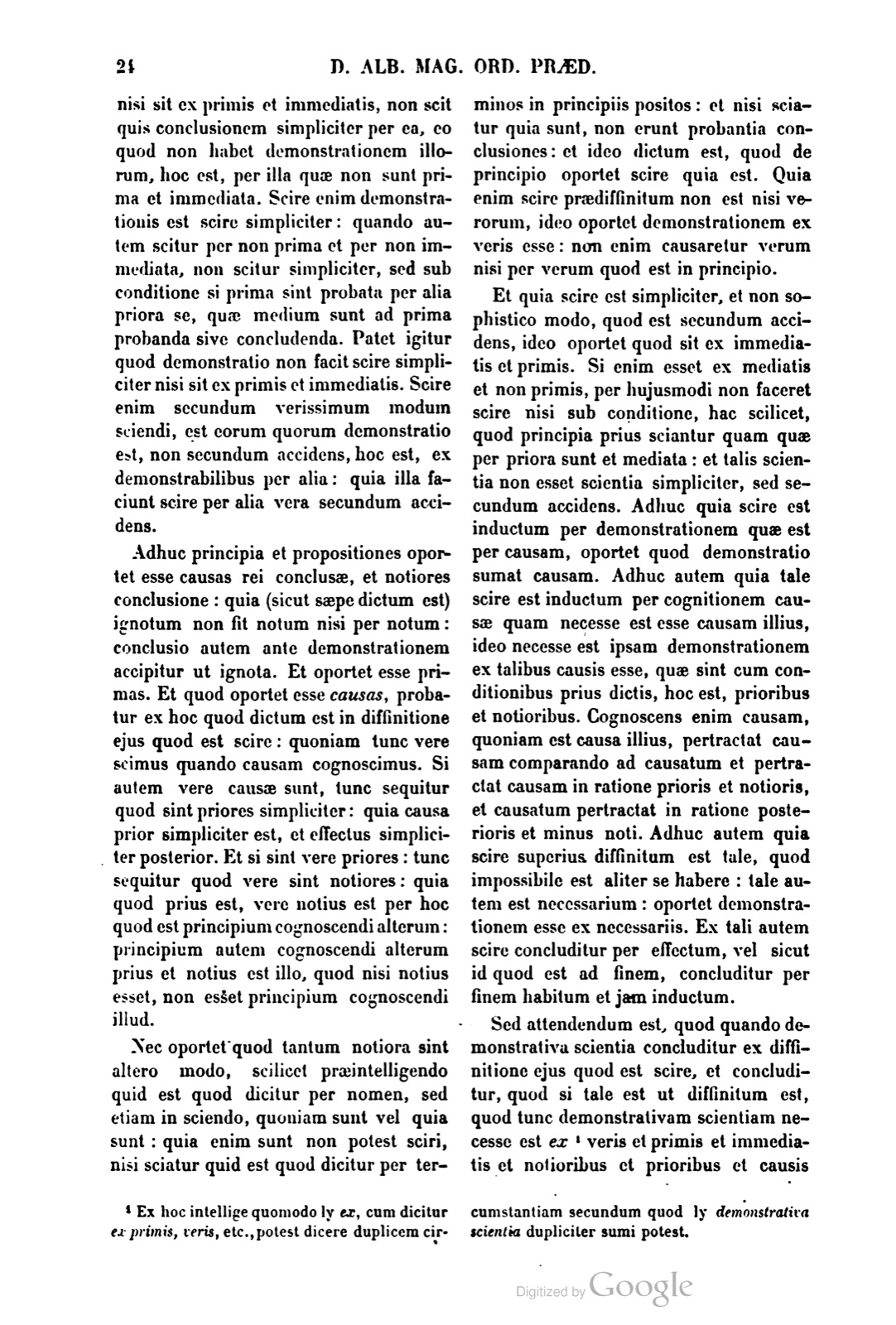
Notes
- Aristotle, in the fourth book of first philosophy, text-commentary 10. (ARISTOTELES, In 4 primae philosophiae, tex. com. 10.) ↩
- Therefore D. Albert wishes there to be three forecognitions, namely what only, that only, and what and that together. P. J. (Vult ergo D. Albertus tres esse praecognitiones, scilicet quid tantum, quia tantum, et simul quid et quia. P. J.) ↩
- The Author hints that the definition of the property is the middle in demonstration, and afterward he says that it is the definition of the subject; nevertheless this is in diverse ways, as is drawn from these words, and through this the contradiction is removed. P. J. (Innuit Auctor diffinitionem passionis esse medium in demonstratione, et postea dicit illud esse subjecti diffinitionem: tamen hoc est diversimode, ut elicitur ex verbis istis et per hoc tollitur contradictio. P. J.) ↩
- Text-commentary 1. (Tex. com. 1.) ↩
- Text-commentary 25. (Tex. com. 25.) ↩
- And he always understands this by the word cause in the definition of knowing. P. J. (Et hoc semper intelligit per ly causam in diffinitione scire. P. J.) ↩
- Principles also are truly known, although not through demonstration. This is the exposition of John the Grammarian, and Themistius also adds knowing a definition. (Principia etiam vere sciuntur, licet non per demonstrationem. Haec est expositio Joannis Grammatici, et etiam Themistius addit scire diffinitionem.) ↩
- Aristotle, in the sixth book of first philosophy, text-commentary 6. (ARISTOTELES, In 6 primae philosophiae, tex. com. 6.) ↩
- Aristotle, in the second book of the Physics, text-commentary 70. (ARISTOTELES, In 2 Physic. tex. com. 70.) ↩
- By that which is not he understands the false, and this is the exposition of John the Grammarian. (Per quod non est intelligit falsum, et est expositio Joannis Gramm.) ↩
- From this understand how the word from, when it is said from first, true things, and so on, can express a twofold circumstance according as the expression demonstrative science can be taken in two ways. (Ex hoc intellige quomodo ly ex, cum dicitur ex primis, veris, etc., potest dicere duplicem circumstantiam secundum quod ly demonstrativa scientia dupliciter sumi potest.) ↩
If a page does not appear, its photograph has not been uploaded yet.