Works › Posterior Analytics, Books I–II
Volume 2 · pp. 25–36
Treatise II, Chapter II. What Conditions the Propositions of Demonstration Require
A marker with ≈ is an approximate page boundary, placed by measure of the text; the page photographs remain the authority. In the paired views, clicking a page marker brings that page into view.
conclusionis, potest per demonstrativam scientiam accipi demonstratio: et tunc conclusio est diffinitio materialis demonstrationis demonstrata per diffinitionem ejus quod est scire. Et hoc quidem est verum secundum intellectum Aristotelis, et tunc praepositio quae proponitur cum dicitur, ex veris et primis, notat circumstantias causae materialis. Dicunt tamen aliqui quod demonstrativa scientia dicit scientiam in anima, qui est habitus acquisitus per demonstrationem: sed tunc non erit diffinitio demonstrata de diffinito: et tunc praepositio ex notat causam vel circumstantias causae efficientis: praemissae enim tales causa sunt efficiens talis habitus.
Attendendum autem quod sicut accipitur scire, ex cujus diffinitione concluditur quid est demonstrativa scientia, pro scire propriissime dicto, ita demonstratio cujus diffinitio concluditur, accipitur pro demonstratione potissime et propriissime dicta: et haec est demonstratio quid et propter quid dicens: et sic dicta et conclusa diffinitio non extendit se ad demonstrationem per impossibile, quae est ex falsis: neque extendit se ad demonstrationem quia, quae est per effectum vel per causam mediatam.
Primum autem dicitur per privationem anterioris: quia scilicet ante ipsum non est aliud: immediatum autem, eo quod inter ipsum et subjectum nullum est medium. Primum autem et prius in hoc differunt, quia primum per privationem ejus quod est ante dicitur: prius autem dicit comparationem ad posterius. Prius autem et notius in hoc differunt: quia dicitur prius comparatum ad rem: notius autem dicitur per comparationem ad noscentem. Et sic patet intellectus omnium conditionum demonstrationis hic inductarum in diffinitione demonstrationis.
Ista autem sunt quae dici consueverunt de conditionibus principiorum. Si quis intuetur dicta Aristotelis subtiliter, inveniet intellectum Aristotelis esse, quod ipse ponit conditiones principiorum demonstrationis sive demonstrativae propositionis duobus modis. Si enim principium est, oportet quod habeat id ex quo principiat, ex quo et ipsum principium habet principiandi virtutem, et habet actualem influentiam super principiatum. Et primo quidem modo consideratum principium, est primum, verum, et immediatum. Ex quo enim principiat, principium illud per se est in esse vero: et oportet quod sit determinatum ad hoc quod sit proprium ad principiatum: quia aliter non inferretur illud per se, et non aliud. Dicamus ergo quod principium ex hoc quod est per se, oportet quod primum sit: quia per se est, et non per aliud, sed per ipsum est principium. Verum autem: quia principium est secundum verum, propter quod cognoscitur de ipso quia est. Per hoc autem quod est appropriatum et essentiale, oportet quod sit immediatum: ita quod inter ipsum et id cujus est principium, nihil sit medium. Secundum modum autem principiandi considerandum est, quod modus aut est ex parte illius ex quo principiat, et sic est prius: vel ex parte veri ex quo principiat, et sic est notius: aut ex parte proprii ex quo principiat, hoc est, ex parte illa qua immediatum est, et sic est vera causa. Unde cum sex sint conditiones principiorum, primae tres sumuntur ab eis, ex quibus principiant: tres vero sequentes sumuntur penes modos principiandi ex parte eorum trium, ex quibus principiant.
of the conclusion, demonstration can be received through demonstrative science; and then the conclusion is the material definition of demonstration demonstrated through the definition of what it is to know. And this indeed is true according to the understanding of Aristotle, and then the preposition that is set forth when it is said from true and first things notes the circumstances of the material cause. Yet some say that demonstrative science means science in the soul, which is a habit acquired through demonstration; but then the definition will not be demonstrated of the defined thing, and then the preposition from notes the cause or the circumstances of the efficient cause, for such premises are the efficient cause of such a habit.
But it must be noted that just as knowing, from whose definition what demonstrative science is is concluded, is taken for knowing said most properly, so demonstration, whose definition is concluded, is taken for demonstration said most powerfully and most properly; and this is the demonstration saying what and on account of what. And the definition so stated and concluded does not extend itself to demonstration through the impossible, which is from false things; nor does it extend itself to demonstration that something is so, which is through an effect or through a mediate cause.
But first is said through privation of what is anterior, namely because before it there is not another thing; but immediate is said because between it and the subject there is no middle. First and prior differ in this, that first is said through privation of that which is before; but prior says comparison to what is posterior. Prior and more known differ in this, that prior is said in comparison to the thing, but more known is said through comparison to the knower. And thus the understanding of all the conditions of demonstration introduced here in the definition of demonstration is evident.
These, then, are the things which they have been accustomed to say about the conditions of principles. If someone looks subtly at the sayings of Aristotle, he will find Aristotle's understanding to be that he posits the conditions of the principles of demonstration, or of the demonstrative proposition, in two modes. For if it is a principle, it must have that from which it principles, from which the principle itself also has the power of principling, and it has actual influence upon the thing principiated. And in the first mode, the principle considered is first, true, and immediate. For from that from which it principles, that principle is per se in true being; and it must be determined to this, that it be proper to the thing principiated, because otherwise that thing and not another would not be inferred through itself. Therefore let us say that from the fact that a principle is per se, it must be first, because it is per se and not through another, but through itself it is a principle. But it is true because the principle is according to the true, on account of which it is cognized concerning it that it is. But through the fact that it is appropriated and essential, it must be immediate, so that between it and that of which it is a principle there is no middle. But according to the mode of principling it must be considered that the mode is either on the part of that from which it principles, and thus it is prior; or on the part of the true from which it principles, and thus it is more known; or on the part of the proper from which it principles, that is, on the part by which it is immediate, and thus it is a true cause. Hence, since there are six conditions of principles, the first three are taken from the things from which they principle; but the three following are taken according to the modes of principling on the part of those three things from which they principle.
Praescias autem quod inter tria prima, primum est in secundo, et primum et secundum sunt in tertio. Primum enim est in vero per se: quia per hoc quod est primum, est secundum seipsum verum et causa veritatis in sequentibus: et per hoc quod primum appropriatur, non amittit quod sit primum: secundum enim supponit primum, et primum est in secundo, et in tertio, et sic deinceps usque ad proximum immediatum: quia aliter sequentia non essent primi nota: quia Aristoteles vult quod primum et principium sunt idem. Et hoc patet, quia in ordine theorematum Euclidis secundum supponit primum, et tertium supponit secundum et primum, et sic deinceps sive per compositionem sive per resolutionem accipiatur, sicut animatum supponitur in animali, et animatum et animal supponitur in homine. Similiter est de aliis quae sunt modi istorum in principiando secundum actum: quia prius est in notiori, et prius et notius supponuntur in causa. Causa enim est: quia ad eam de necessitate sequitur aliud; et quia non convertitur, est prius: et quia principium quod est causa, est lumen cognitionis per quod cognoscitur aliud, ideo est notius: et secundum quod fluit ab eo esse secundum substantiam, est causa. Et ita quia causa est, non potest esse quin sit prius in ordine essendi, et notius in ordine cognoscendi, et causa in influendo esse causati. Iste videtur esse intellectus Aristotelis.
But you should know beforehand that among the first three, the first is in the second, and the first and second are in the third. For the first is in the true per se, because through the fact that it is first, it is true according to itself and the cause of truth in things following; and through the fact that the first is appropriated, it does not lose the fact that it is first. For the second supposes the first, and the first is in the second and in the third, and so onward up to the proximate immediate, because otherwise the things that follow would not be known by the first, since Aristotle wishes the first and the principle to be the same. And this is evident, because in the order of Euclid's theorems the second supposes the first, and the third supposes the second and the first, and so onward, whether it is taken through composition or through resolution, as animated is supposed in animal, and animated and animal are supposed in man. It is similar concerning the other things which are modes of these in principling according to act, because the prior is in the more known, and the prior and the more known are supposed in cause. For cause is so called because another thing follows it of necessity; and because it is not converted, it is prior; and because the principle which is the cause is the light of cognition through which another thing is cognized, therefore it is more known; and insofar as being according to substance flows from it, it is cause. And so, because it is cause, it cannot be but that it is prior in the order of being, and more known in the order of cognizing, and cause in flowing being into the caused thing. This seems to be the understanding of Aristotle.
Caput III. Quibus modis principium est prius et notius.
Priora autem et notiora dicuntur aliqua aliis dupliciter quae sunt dicta. Non enim idem est simpliciter et natura primum vel prius, et quoad nos prius: neque idem est notius simpliciter et quoad naturam, et notius quoad nos sive nobis notius. Dico autem, explanando ea quae dicta sunt, quoad nos sive nobis priora, quae proxima sensui sunt: simpliciter autem et secundum naturam sunt priora et notiora, quae longius sunt sive longinquiora a sensu. Et exemplum hujus est, quod longiora a sensu sunt universalia: et quo magis sunt universalia, sunt a sensu distantiora: et quae maxime universalia sunt, maxime a sensu longinquiora. Proxima autem sensibili acceptioni sunt singularia. Et haec opponuntur quoad modum, et non quoad naturam vel ad formam ad invicem. Sic ergo dupliciter dicitur prius et notius: et cum duo sint prius et notius, unum est causa alterius: quia prius esse est causa quod notius sit, sicut patet per ante dicta.
Scias autem quod quamvis multi multa dixerint, dicentes quod natura qua aliqua dicuntur priora, est natura universalis quae non movet nisi per intelligentiam motori proximo conjunctam; et sic secundum intellectum prius, est natura prius: hoc totum fabula est, et nihil penitus facit ad propositum. Sed dicendum est quod secundum intellectum Aristotelis, natura qua aliquid prius est, est ipsa natura ejus quod prius est: haec enim natura est qua principium principiat principiatum et dat ei naturam qua sit et qua diffiniatur in esse: et haec est natura quam Antiqui vocabant naturam naturantem: quia naturando sic constituit naturam sibi suppositam: et quae habent hanc naturam ut principium, sunt natura priora: quia talis natura est eis causa quod sint priora. Et ex opposito nobis priora sunt ea, quae per suam formam non habent hanc naturam: sed cum sint constituta in natura per id quod sunt formis sensibilium, super quae cadit sensus, proxima, ita quod in ipsis sensibilium formis determinata accipiuntur: et haec sunt quae vocantur sensibilia per accidens: haec enim sunt hic homo, et hoc animal in sensibilibus confusum, et sensibilibus determinatum, quod est vere particulare et singulare: particulare enim est sub natura communi per materiam particularizatum: et per accidens proprium singulare individuans ad esse singulare deductum, dicitur et est singulare.
Et ideo universale secundum id quod est, et particulare secundum id quod est, et singulare secundum id quod est, non differunt per naturam et substantiam, sed differunt per esse: quia aliud est esse universalis secundum rationem universalis, et aliud esse particularis secundum esse particularis, et aliud esse singularis secundum esse singularis. Et illud quod est universale, fit particulare divisum secundum esse per individuationem, et idem fit singulare ab accidente proprio et individuante. Et haec vocatur via compositionis secundum quam universale, secundum id quod est, principium formale est particularis: et particulare se habet ad singulare, sicut subjectum et suppositum in ipso: et hoc modo prius secundum naturam est universale, et posterius secundum naturam est particulare, et postremum secundum naturam est singulare, super quod immediate cadit sensus. In via autem resolutionis ultimum efficitur primum, et e converso primum fit ultimum. Resolutio enim est compositi in simplicia, et posterioris in prius, et causati in causam: et incipit ab ultimo secundum naturam quod immediatum sensibile est sensuum, non quidem per se vel commune sensatum, sed per accidens: quia in hoc albo crispo accipitur hic homo, et in hoc homine homo, et sic usque ad primum in quo stat resolutio. Et hoc igitur modo differunt nobis priora et notiora, ab his quae natura sunt priora et notiora.
Chapter III. In what modes a principle is prior and more known.
But certain things are called prior and more known than others in two ways, which have been stated. For what is first or prior simply and by nature is not the same as what is prior with respect to us; nor is what is more known simply and with respect to nature the same as what is more known with respect to us, or more known to us. But I say, explaining the things that have been said, that those things are prior with respect to us or to us which are nearest to sense; but simply and according to nature those things are prior and more known which are farther or more remote from sense. And an example of this is that universals are farther from sense; and the more universal they are, the more distant they are from sense; and those which are most universal are most remote from sense. But singulars are nearest to sensible reception. And these are opposed to one another as to mode, and not as to nature or as to form. Thus therefore prior and more known are said in two ways; and since prior and more known are two, one is the cause of the other, because being prior is the cause that something is more known, as is evident through what was said before.
But you should know that although many have said many things, saying that the nature by which some things are called prior is a universal nature which does not move except through an intelligence joined to the proximate mover, and thus what is prior according to intellect is prior by nature, all this is a tale, and does nothing at all for the present point. Rather, it must be said that according to the understanding of Aristotle, the nature by which something is prior is the very nature of that which is prior. For this nature is that by which the principle principles the principiated thing and gives to it the nature by which it exists and by which it is defined in being. And this is the nature which the Ancients called nature naturing, because by naturing in this way it constitutes the nature subjected to itself; and the things which have this nature as principle are prior by nature, because such a nature is the cause to them that they are prior. And oppositely, things prior to us are those which by their form do not have this nature; but since they are constituted in nature through the fact that they are proximate to forms of sensible things, upon which sense falls, so that in those forms of sensible things they are received as determined, these are the things which are called sensibles by accident. For these are this man, and this animal confused in sensible things and determined by sensible things, which is truly particular and singular. For the particular is particularized under common nature through matter; and by a proper accident individuating the singular, brought down to singular being, it is called and is singular.
And therefore the universal according to that which it is, and the particular according to that which it is, and the singular according to that which it is, do not differ through nature and substance, but they differ through being: because the being of the universal according to the account of universal is one thing, and the being of the particular according to the being of particular is another, and the being of the singular according to singular being is another. And that which is universal becomes a particular divided according to being through individuation, and the same becomes singular from a proper and individuating accident. And this is called the way of composition, according to which the universal, according to that which it is, is the formal principle of the particular; and the particular is related to the singular as subject and supposit in it. And in this mode the universal is prior according to nature, and the particular is posterior according to nature, and the last according to nature is the singular, upon which sense immediately falls. But in the way of resolution the last is made first, and conversely the first becomes last. For resolution is of the composite into simple things, and of the posterior into the prior, and of the caused into the cause; and it begins from the last according to nature, which is the immediate sensible of the senses, not indeed the per se sensible or the common sensible, but the sensible by accident, because in this white curly thing this man is received, and in this man, man, and so on to the first in which resolution stands. And therefore in this mode the things prior and more known to us differ from those things which are prior and more known by nature.
Et dicuntur natura priora, secundum intellectum notiora: quia via resolutionis est via intellectus abstrahentis, quae vadit ad primam naturam formaliter naturantem, quae est etiam principium intelligendi id quod naturat; et non dicitur secundum intellectum agentem et possibilem sive superiorem intelligentiam: sed dicitur prius natura prius intellectu ab intellectu formali, qui principium est intelligendi id cujus est natura. Et dicuntur singularia quoad nos prima: quia sensibili judicio sunt proxima. Proximum enim sensibili non est sensibile per se sive commune sive proprium, quia nihil est sibi ipsi proximum: sed proximum est sensibile per accidens quod est in natura particularizata et ad singulare deducta acceptum.
Quod autem dicitur quoad nos, disputat Aristoteles in septimo Ethicorum, utrum quoad nos dicatur quoad intellectum, cum homo secundum quod homo sit tantum intellectus: vel dicitur quoad nos secundum sensum qui nobis et brutis est communis. Et determinat quod quoad nos dicitur secundum sensibilem acceptionem: quia quoad nos dicit discretum in sensu et distans ab eo quod vere est natura: et ideo plures judicant secundum sensum. Et ideo quoad nos prius oppositum est in modo cognoscendi ei quod est notius et prius quoad naturam et intellectum. Et hic est intellectus Aristotelis. Et quod dicunt quidam, quod natura inferior non movet nisi conjungatur virtuti superioris, et quod illa intelligentia vel Angelus intendit universale et esse perpetuum, natura particularis intendit hoc particulare: nihil facit ad propositum, et pro maxima parte est falsum. Sunt etiam alii potius hic somniantes quam vera docentes, qui dicunt naturae sive formae, quae principaliter natura est, quatuor esse virtutes, quarum prima est perficere naturam sive ad esse terminare. Secunda autem est, ut dicunt, determinare et constituere in esse naturae suppositum quod est hoc aliquid: et hoc dicunt esse individuum habituale. Tertiam dicunt virtutem naturae multiplicare se per individua: et hanc dicunt universale esse quod primo est multa, et per hoc unum de multis dicitur: quia multa procedunt ex uno participantia totum secundum essentiam: quodlibet enim essentiam totam habet naturae. Quartam dicunt esse virtutem constituendi in natura hoc singulare: et sic universale primum esset apud naturam, et esset ante singulare. Et alia dicere deliramentum est: quia nihil horum est verum secundum aliquem Peripateticorum: quia haec natura non est per hoc universale: quia multiplicativa est sui per generationem: quia sicut probat Aristoteles in quinto Physicorum 1 hic generat hunc: conditio generantis est, quod sit singulariter constitutum in esse et potentia generantis. Nihil ergo horum dicendum est, sed primus intellectus est verus et perfectus.
And things prior by nature are called more known according to intellect, because the way of resolution is the way of the abstracting intellect, which goes to the first nature formally naturing, which is also the principle of understanding that which it natures. And this is not said according to the agent and possible intellect or a superior intelligence, but the prior by nature is called prior by intellect from the formal intellect, which is the principle of understanding that of which it is the nature. And singulars are called first with respect to us because they are nearest to sensible judgment. For what is nearest to the sensible is not the sensible per se, whether common or proper, because nothing is nearest to itself; rather, what is nearest is the sensible by accident, which is received in a particularized nature and brought down to the singular.
But Aristotle disputes in the seventh book of the Ethics about what is said with respect to us, whether with respect to us is said with respect to intellect, since man, insofar as he is man, is only intellect, or whether it is said with respect to us according to sense, which is common to us and to brute animals. And he determines that with respect to us is said according to sensible reception, because with respect to us says what is discrete in sense and distant from that which is truly nature; and therefore more people judge according to sense. And therefore what is prior with respect to us is opposed in the mode of cognizing to that which is more known and prior with respect to nature and intellect. And this is the understanding of Aristotle. And what certain persons say, that inferior nature does not move unless it is joined to the power of a superior, and that that intelligence or Angel intends the universal and perpetual being, while particular nature intends this particular, does nothing for the present point, and for the greatest part is false. There are also others here dreaming rather than teaching true things, who say that nature or form, which principally is nature, has four powers. The first of these is to perfect nature or terminate it toward being. But the second, as they say, is to determine and constitute in the being of nature the supposit which is this something; and this they say is the habitual individual. They say the third power of nature is to multiply itself through individuals; and they say that this is the universal, which first is many things, and through this one is said of many, because many things proceed from one while participating the whole according to essence; for each one has the whole essence of the nature. They say the fourth is the power of constituting this singular in nature; and thus the first universal would be with nature and would be before the singular. But to say the other things is delirium, because none of these things is true according to any of the Peripatetics, because this nature is not universal through this, that it is multiplicative of itself through generation; because as Aristotle proves in the fifth book of the Physics 1, this thing generates this thing. The condition of the generator is that it be singularly constituted in the being and power of the generator. Therefore none of these things must be said, but the first understanding is true and perfect.
Quod autem hic dicitur, universale longius est a sensu: et quod in principio Physicorum dicitur, quod universale secundum sensum est notius: intelligitur de sensibili apprehensione, ut dicit Avicenna in Sufficientia. Similiter autem quod in principio de Anima 2 dicitur, quod animal quod est universale aut nihil est aut posterius est: et quod in sex principiis dicitur, quod omnis communitas a singularitate procedit 3. Non sunt contraria his quae dicuntur, quod scilicet universale longinquius sit a sensu: quia universale duobus modis consideratur: uno scilicet modo prout confusum et mixtum in particulari: et hoc modo in signis citius sentitur universale, quam particulare per sensum: quia citius sentiuntur signa substantiae, quam animalis: et citius signa animalis, quam hominis: et citius signa hominis, quam Socratis. Et hoc modo exponit Avicenna illud quod est in physicis. Potest etiam accipi universale in sua puritate, in qua separatum est a particulari: et hoc modo non est nisi in intellectu, sicut in ante habitis dictum est, et est propinquum intellectui et longinquius a sensu, sicut hic dicitur. Potest etiam accipi universale ut confusum in sensibili, nec etiam purum intellectu, sed prout est universale in esse universalis: sic enim ab eo quod sibi accidit dicitur, scilicet ab eo quod relatum ad supposita secundum suam totam essentiam est in omnibus. Sic enim acceptum secundum substantiam naturae vel essentiam, habet relationem unius rationis ad omnia inferiora, in quibus est per unam rationem: eo quod ipsum actu et intellectu uno modo est in omnibus: et hoc modo in intellectu est secundum hoc esse: et nihil est in inferioribus in natura secundum hoc esse, sed est posterius eis: quia non est in eis, nisi quia per intellectum uno modo est in omnibus abstractum: hoc autem modo quo a singulari procedit commune, idem numero est cum illo quo universale est posterius, prout scilicet unum commune quod est in singulis per unum modum existens in eis: sic enim est eorum, quorum et nomen commune est et ratio substantiae secundum illud nomen est eadem: et hoc modo longinquius est a sensu, et proximum intellectui. Ex his igitur patet, quod alia sunt notiora quoad nos, et alia notiora apud naturam. Et sic patet quod jam expositum est quod dicitur, quod demonstratio sit ex prioribus et notioribus.
But what is said here, that the universal is farther from sense, and what is said at the beginning of the Physics, that the universal according to sense is more known, is understood of sensible apprehension, as Avicenna says in the Sufficientia. Similarly, what is said at the beginning of On the Soul 2, that animal, which is universal, either is nothing or is posterior, and what is said in the Six Principles, that every community proceeds from singularity 3, are not contrary to these things which are said, namely that the universal is more remote from sense. For the universal is considered in two modes: in one mode, namely as confused and mixed in the particular, and in this mode the universal is sensed in signs sooner than the particular is sensed through sense, because the signs of substance are sensed sooner than the signs of animal, and the signs of animal sooner than those of man, and the signs of man sooner than those of Socrates. And in this mode Avicenna explains that which is in the Physics. The universal can also be taken in its purity, in which it is separated from the particular; and in this mode it exists only in the intellect, as was said in what has gone before, and is near to the intellect and more remote from sense, as is said here. The universal can also be taken as confused in the sensible, and not yet pure in intellect, but as it is universal in the being of a universal. For thus it is said from that which happens to it, namely from the fact that, related to supposits according to its whole essence, it is in all. For taken in this way according to the substance of nature or essence, it has the relation of one account to all inferior things, in which it exists through one account, because in act and intellect it is in one mode in all; and in this mode it is in the intellect according to this being. And there is nothing in inferior things in nature according to this being, but it is posterior to them, because it is in them only because through intellect it is abstracted in one mode in all. But in the mode by which the common proceeds from the singular, it is the same in number with that by which the universal is posterior, namely as one common thing which is in singulars by one mode existing in them; for thus it belongs to those things whose common name is also one and whose account of substance according to that name is the same. And in this mode it is more remote from sense and nearest to intellect. From these things therefore it is evident that some things are more known with respect to us and others more known with nature. And thus it is evident that what is said has now been explained, namely that demonstration is from prior and more known things.
Caput IV. Qualiter demonstratio sit ex primis, et quid sit hoc dictum.
Ex primis autem est demonstratio: eo quod dicitur esse ex principiis primis et substantialibus, inter quae et conclusiones nihil est medium quo demonstrari possit conclusio: et sic primum est propinquissimum effectum demonstrando: et hoc modo primum non dicitur communissimum ante quod nihil: sed primum dicitur immediatum quod est essentiale principium, inter quod et principiatum nihil est medium: hoc enim modo acceptum primum, est idem quod substantiale principium: hoc enim proprie et simpliciter est principium.
Et hoc modo primum et principium est propositio demonstrationis immediata, hoc est, inter quam et id quod demonstratur, non est alia propositio per quam possit demonstrari. Aliter nihil prohibet unum immediatorum principiorum esse prius altero, hoc est, communius, sicut patet: quia omnium principiorum hoc communius, de quolibet est affirmatio vel negatio vera, et de nullo simul: et tamen multa sunt immediatiora quam ipsum sit. Unde immediata propositio est, qua non est altera prior per quod possit demonstrari: et hoc modo dicitur prior propositio, quae est ad demonstrandum potior.
Et ut hoc melius intelligatur, dicimus quod propositio quae ponitur in notificatione primi et immediati, est altera pars enuntiationis una in praedicato de uno subjecto: et haec est potissima propositio illius potissimae demonstrationis quae paulo ante diffinita est: haec enim pars enuntiationis est universalis affirmativa per se: quia in illa potissime est unum de uno.
Haec autem propositio a dialectica differt propositione. Et quia ex probabilibus procedit dialectica, et ex probabili non accipit unam partem contradictionis nisi cum formidine alterius, et sic quodammodo utramque accipit: ideo propositio dialectica similiter est accipiens quamlibet partem contradictionis: non enim accipit affirmationem sine negatione, nec negationem sine affirmatione.
Demonstrativa autem in potissima et ostentiva demonstratione accipit determinate alteram, affirmativam scilicet et universalem, et unam de uno, quod his dictis conditionibus verum est. Enuntiatio autem quae adhuc communior est quam propositio, accipit contradictionis quamlibet partem sive affirmativam sive negativam, sive universalem sive particularem, sive veram sive falsam, sive unam sive plures.
Ut sciatur quid sit altera pars contradictionis, dico quod contradictio secundum formalem et generalem diffinitionem ipsius, est oppositio cujus non est medium secundum se: est enim contradictio in genere oppositionis: et cum sint opposita mediata, ut contraria quorum potest esse medium, contradictio est, oppositio cujus non est medium secundum se: quoniam de quolibet alterum est verum, et non est aliquid de quo ambo simul nisi sint contradictoria per accidens et non secundum se: aliquid enim est quod neque caecum, neque videns est: et aliquid quod nec sanum, nec aegrum: et aliquid quod nec pater, nec filius: et hoc modo medium non est in contradictione. Pars autem una contradictionis quae enuntiat aliquid unum praedicatum de aliquo subjecto uno, praedicativa est, et vocatur affirmativa propositio, sive enuntiatio vel affirmatio, materialiter accipiendo affirmationem pro affirmativa propositione. Altera autem pars quae negat vel removeri significat aliquid vel aliquod praedicatum unum de uno subjecto, est negatio materialiter, hoc est, negativa propositio sive enuntiatio.
Chapter IV. How demonstration is from first things, and what this statement is.
But demonstration is from first things because it is said to be from first and substantial principles, between which and conclusions there is no middle by which the conclusion can be demonstrated; and thus the first is nearest by demonstrating the effect. And in this mode first does not mean the most common thing before which there is nothing, but first means the immediate which is an essential principle, between which and the principiated thing there is no middle. For first taken in this way is the same as substantial principle; for this properly and simply is principle.
And in this mode the first and the principle is the immediate proposition of demonstration, that is, one between which and that which is demonstrated there is no other proposition through which it can be demonstrated. Otherwise nothing prevents one of the immediate principles from being prior to another, that is, more common, as is evident; because of all principles this one is more common, namely that of anything affirmation or negation is true, and not both at the same time, and nevertheless many are more immediate than it is. Hence an immediate proposition is one than which there is no other prior through which it can be demonstrated; and in this mode that proposition is called prior which is more powerful for demonstrating.
And so that this may be understood better, we say that the proposition which is posited in the notification of the first and immediate is one alternate part of an enunciation, one predicate of one subject; and this is the most powerful proposition of that most powerful demonstration which was defined a little before. For this part of an enunciation is universal, affirmative, and per se, because in it most powerfully there is one thing of one thing.
But this proposition differs from a dialectical proposition. And because dialectic proceeds from probable things, and from the probable it does not receive one part of a contradiction except with fear of the other, and thus in some way receives each part, therefore a dialectical proposition is similarly receiving either part of a contradiction; for it does not receive affirmation without negation, nor negation without affirmation.
But in the most powerful and ostensive demonstration, the demonstrative proposition determinately receives one part, namely the affirmative and universal part, and one thing of one thing, which is true under the conditions that have been stated. But an enunciation, which is still more common than a proposition, receives either part of contradiction, whether affirmative or negative, whether universal or particular, whether true or false, whether one or many.
So that it may be known what an alternate part of contradiction is, I say that contradiction, according to its formal and general definition, is an opposition of which there is no middle according to itself. For contradiction is in the genus of opposition; and since there are mediate opposites, as contraries of which there can be a middle, contradiction is an opposition of which there is no middle according to itself, since of anything one of the two is true, and there is not something of which both are true at once unless they are contradictories by accident and not according to themselves. For there is something which is neither blind nor seeing, and something which is neither healthy nor sick, and something which is neither father nor son; and in this mode there is no middle in contradiction. But one part of a contradiction which enunciates one predicate of one subject is predicative, and is called an affirmative proposition, or enunciation or affirmation, taking affirmation materially for an affirmative proposition. But the other part, which negates or signifies that something or some one predicate is removed from one subject, is negation materially, that is, a negative proposition or enunciation.
Immediatum autem principium est propositio immediata, ut dictum est; immediati enim principii syllogistici et demonstrativi aliud est positio, et aliud dignitas. Positionem quidem dico, quam propter hoc quod est immediata, non est monstrare: et ideo ponitur, et ea posita utitur demonstrator, sicut patet in primo Euclidis: et quamvis non habeat demonstrationem, tamen non est necesse, quod aliquis docendus ante doctrinam habeat eam apud seipsum, et non sumat eam a doctrina doctoris. Illam enim propositionem immediati principii quam necesse est habere apud se per naturalem habitum eum qui est docendus, et non accipit eam per doctrinam, dicimus dignitatem vel maximam propositionem, quae, ut dicit Boetius, communis animi conceptio est, quam scilicet cognitis terminis quilibet probat auditam. Haec autem dignitas vocatur, quia omnibus dignior est: eo quod omnibus influit cognitionem et veritatem. Maxima dicitur, eo quod virtute influentiae lucis et veritatis omnia excedit immediata principia. Quaedam enim immediata principia sunt hujusmodi virtutem habentia, sicut de quolibet affirmare vel negare et de nullo simul, et quod omne totum majus est sua parte, et hujusmodi: et haec non ponitur, sed per seipsam est, et prius non habet quo demonstretur, et ideo non petitur ad ponendum. Et hoc nomen quod est dignitas vel maxima propositio vel communis animi conceptio, maxime consuevimus in hujusmodi sive in talibus propositionibus dicere, et illis adaptare. Et quamvis multiplex sit earum divisio, quod quaedam scilicet communis est ad omnes res, et quaedam determinati generis: et quamvis illae in diversis scientiis sint diversae, tamen hanc divisionem et diversitatem non prosequemur: quia non est nisi secundum usum et secundum analogiam plurium ad unum, et nos non intendimus hic nisi divisionem principii demonstrativi secundum differentiam substantialem.
But the immediate principle is an immediate proposition, as was said; for of an immediate syllogistic and demonstrative principle, position is one thing and dignity another. I call position that which, because it is immediate, is not to be shown; and therefore it is posited, and once it is posited the demonstrator uses it, as is evident in the first book of Euclid. And although it does not have demonstration, nevertheless it is not necessary that someone to be taught have it within himself before teaching and not take it from the teaching of the teacher. For that proposition of an immediate principle which one who is to be taught must have within himself through natural habit, and does not receive through teaching, we call a dignity or a maximal proposition, which, as Boethius says, is a common conception of the soul, which, namely, once the terms are known, anyone approves when he has heard it. But this is called a dignity because it is more worthy than all things, in that it flows cognition and truth into all things. It is called a maxim because by the power of the influence of light and truth it exceeds all immediate principles. For certain immediate principles have a power of this kind, such as to affirm or deny of anything and not both at once, and that every whole is greater than its part, and things of this kind. And this is not posited, but is through itself, and has nothing prior by which it may be demonstrated; and therefore it is not petitioned in order to be posited. And this name, dignity or maximal proposition or common conception of the soul, we are especially accustomed to say in things of this kind or in such propositions, and to adapt to them. And although their division is manifold, namely that one is common to all things and another belongs to a determinate genus, and although they are diverse in diverse sciences, nevertheless we shall not pursue this division and diversity, because it exists only according to use and according to the analogy of many things to one, and here we intend only the division of the demonstrative principle according to substantial difference.
Positionis autem sunt duae differentiae: una enim quae quamlibet partem sive affirmativam sive negativam accipit enuntiationis, dico autem esse in affirmativa, vel non esse in negativa, vocatur suppositio quando est immediata, de qua dicit Alexander et Themistius, quod utitur ea demonstrator ut probata et demonstrata, quamvis sit mediata, sicut patet de suppositionibus Euclidis in primo Geometriae. Quae vero sine hoc est, quod esse aliquid vel non esse non significet et tamen ponitur, diffinitio est, sicut ibidem patet in primo Geometriae. Diffinitio enim positio est et non conclusio demonstrabilis: quia arithmetica ponit et non demonstrat unitatem hoc sive tale indivisibile esse, quod scilicet non habet positionem in continuo, per quod separatur a puncti indivisibilitate: et ponit geometer punctum esse, cujus pars non est posita in continuo, et lineam esse longitudinem sine latitudine, et hujusmodi: quorum nihil demonstrat. Diffinitio autem suppositio non est: quod probatur ex hoc, quod quidem est unitas per nomen et diffinitionem, non est idem quod esse unitatem hoc vel illud: quia esse unitatem, est esse aliquid vere, et hoc non est nisi praedicetur aliquid de unitate per modum enuntiationis: diffinitio autem non est nisi pars propositionis, sive sit subjectum, sive praedicatum.
Et si dicatur, quod diffinitio positio est: et positio est propositio: ergo diffinitio propositio. Dicendum quod haec non est generalis, positio est propositio: quia quaedam positio propositio est: et non omnis positio propositio est: positio enim hic dicitur quod supponere necesse est in demonstratione et non demonstratur.
Et quamvis multis modis dividatur diffinitio, non dividemus hic, nec prosequemur modos multiplicitatis ipsius: eo quod tantum uno modo principium est potissimae et verissimae demonstrationis: et haec est quae dicit quid et propter quid. De petitione autem quae est principium demonstrationis, ut patet in primo Euclidis, non curamus: quia hic de partibus immediati principii determinamus. Petitio autem mediata est: et haec est causa quare etiam de aliis quae ad demonstrationem exiguntur, hic tacendo pertransimus.
But there are two differences of position. One, which receives either part of an enunciation, whether affirmative or negative, and by this I mean being in the affirmative or not being in the negative, is called supposition when it is immediate. Of this Alexander and Themistius say that the demonstrator uses it as proved and demonstrated, although it is mediate, as is evident concerning Euclid's suppositions in the first book of Geometry. But what is without this, namely that it does not signify something to be or not to be and nevertheless is posited, is a definition, as is evident there in the first book of Geometry. For definition is a position and not a demonstrable conclusion, because arithmetic posits and does not demonstrate that unity is this or such an indivisible thing, namely that it does not have position in the continuum, by which it is separated from the indivisibility of a point; and the geometer posits that a point is that whose part is not placed in the continuum, and that a line is length without breadth, and things of this kind, none of which he demonstrates. But definition is not supposition; this is proved from the fact that what unity is through name and definition is not the same as unity being this or that, because for unity to be is for something truly to be, and this is only if something is predicated of unity by the mode of enunciation. But definition is only a part of a proposition, whether it is the subject or the predicate.
And if it is said that definition is a position, and position is a proposition, therefore definition is a proposition, it must be said that this is not universal, that position is a proposition; because some position is a proposition, and not every position is a proposition. For here position means what it is necessary to suppose in demonstration and what is not demonstrated.
And although definition is divided in many modes, we shall not divide it here, nor shall we pursue the modes of its multiplicity, because in only one mode is it the principle of the most powerful and truest demonstration, and this is the definition which says what and on account of what. But we do not concern ourselves with petition, which is a principle of demonstration, as is evident in the first book of Euclid, because here we determine concerning the parts of the immediate principle. But petition is mediate, and this is the cause why we pass over in silence here also the other things which are required for demonstration.
Caput V. Qualiter sit demonstratio ex notioribus.
Habito qualiter demonstratio sit ex primis sive prioribus conclusione, nunc ostendemus qualiter demonstratio est ex notioribus. Sumamus igitur quod prius probatum est: quia oportet credere fidem adhibendo consequentiae, et scire certissime rem conclusam, accipiendo consequens per certam et stantem apprehensionem et habitum in habendo hujusmodi syllogismum quem vocamus demonstrationem: quia, sicut dictum est, syllogismus est faciens scire: hoc autem est, quia scimus per talem syllogismum ea ex quibus est talis conclusio, hoc est, ex quibus principiis sive propositionibus praemissis componitur syllogismus: tunc necessarium est quod non solum oportet praecognoscere prima sive principia sive propositiones ex quibus est syllogismus, aut omnia, aut quaedam: sed insuper oportet talia principia quae sunt praemissae in syllogismo magis scire conclusione. Dico autem aut omnia, aut quaedam: quia forte contingit, quod in secundis demonstrationibus quaedam praemissarum per alia sciuntur sicut et conclusiones: quia talis est ordo theorematum, quod id quod est conclusio in praecedenti, est praemissa in sequenti: et tunc quoddam praemissorum potest esse per se notum, et aliud per aliud notum: sicut quando aliquid probatur per principium, et forte per tertium et quartum. Sed oportet tamen illud quod habet aequalem notitiam conclusioni, in hoc quod per aliud est notum sicut conclusio, primo fieri notum, et accipi ut notius conclusione: quare oportet magis ipsum scire quam conclusionem. Dico autem magis scire: quia quod contingit per se scire et ut principium quod non scitur per aliud sed per seipsum, tale est magis scire quam id quod scitur per aliud: quia semper magis est res id quod convenit ei per se, quam illud quod convenit ei per aliud. Et hoc totum fundatur super hoc, quod non scitur ignotum nisi per notum, nec minus notum scitur nisi per magis notum.
Chapter V. How demonstration is from things more known.
Having established how demonstration is from first things or things prior to the conclusion, we shall now show how demonstration is from things more known. Therefore let us take what was proved before: because one must believe by applying faith to the consequence, and know the concluded thing most certainly by receiving the consequent through a certain and standing apprehension and habit in having this kind of syllogism which we call demonstration. For, as was said, a syllogism is what makes one know; and this is because through such a syllogism we know the things from which such a conclusion is, that is, from which principles or premised propositions the syllogism is composed. Then it is necessary not only that one must know beforehand the first things or principles or propositions from which the syllogism is, either all or some, but besides this one must know such principles, which are the premises in the syllogism, more than the conclusion. But I say either all or some because perhaps it happens that in second demonstrations some of the premises are known through others, just as conclusions are; for such is the order of theorems, that what is a conclusion in the preceding theorem is a premise in the following one. And then one of the premises can be known through itself and another known through another, as when something is proved through a principle and perhaps through a third and fourth. Yet that which has equal knowledge with the conclusion, in this respect that it is known through another as the conclusion is, must first become known and be received as more known than the conclusion; wherefore it is necessary to know it more than the conclusion. But I say know more because what happens to be known through itself and as a principle, which is not known through another but through itself, is more knowing than that which is known through another, because always a thing is more that which belongs to it through itself than that which belongs to it through another. And this whole matter is founded on this, that the unknown is not known except through the known, nor is the less known known except through the more known.
Semper enim et universaliter propter quod unumquodque est aliquid tale, illud propter quod est aliquid tale, illud magis est tale 4: et hoc est in omnibus causis univoce agentibus sicut si aliquid est calidum propter ignem, ignis magis est calidus: et sic in omnibus est in quibus agens et effectus unam formam secundum quam est causatio participant. In entibus autem per accidens agentibus non est hoc verum. Vinum enim per accidens inebriat: ex hoc enim inebriat, quod est evaporativum: et ideo non sequitur: homo est ebrius propter vinum: ergo vinum est magis ebrium: homo est calidus propter motum: ergo motus magis calidus: terra est calida propter solem: ergo sol est magis calidus. Nec sequitur etiam hoc in his quae dicuntur magis et minus per intensionem factam per accidens calefieri, et non per motum caliditatis: sicut patet quod lapis est calidus propter ignem et solem: et tamen lapis calidior est igne, ut vult Aristoteles in quarto Meteororum 5: quia propter spissitudinem et constantiam partium et densitatem, intensioris caliditatis est lapis calidus quam ignis. Sed in omnibus per se et univoce agentibus, in quibus passio est formalis et substantialis effectus activae actionis, verum est semper quod propter quod unumquodque sicut agens per se et univocum est tale, illud magis est tale.
Et hoc in causis finalibus etiam est verum. Unde propter quod sicut propter finem amamus aliquid, illud est nobis magis amicum et amatum: ut quia diligimus filium propter patrem: ergo patrem magis: divitias et potentatum propter felicitatem amamus: ergo felicitatem magis amamus. Ergo sequitur, quod ista propositio sit probata, quod si scimus conclusionem quoniam adesse credimus consequentiam conclusionis per prima, hoc est, propter principia formaliter agentia, ex notitia quidem ipsorum et ex habitudine eorum accipimus consequentiae fidem, quod prima magis scimus et credimus: eo quod propter illa credimus etiam posteriora, quae sunt ex ipsis consequentes conclusiones.
For always and universally, that on account of which each thing is some such thing is itself more such 4. And this is so in all causes acting univocally, as if something is hot on account of fire, fire is hotter; and thus it is in all things in which the agent and the effect participate one form according to which causation exists. But this is not true in beings acting by accident. For wine makes drunk by accident; for it makes drunk from the fact that it is evaporative. And therefore it does not follow: a man is drunk on account of wine; therefore wine is more drunk. A man is hot on account of motion; therefore motion is hotter. Earth is hot on account of the sun; therefore the sun is hotter. Nor does this follow in those things which are said to be heated more and less through intensification made by accident, and not through the motion of heat, as is evident because a stone is hot on account of fire and sun, and nevertheless the stone is hotter than fire, as Aristotle wishes in the fourth book of the Meteors 5, because on account of the thickness and constancy of its parts and density, a hot stone is of more intense heat than fire. But in all agents per se and univocally, in which the property is the formal and substantial effect of active action, it is always true that that on account of which each thing, as agent per se and univocal, is such, is itself more such.
And this is true also in final causes. Hence that on account of which we love something as on account of an end is more friendly and loved to us; for example, because we love the son on account of the father, therefore we love the father more; we love riches and power on account of happiness, therefore we love happiness more. Therefore it follows that this proposition has been proved: that if we know the conclusion because we believe the consequence of the conclusion to be present through first things, that is, on account of the principles formally acting, and indeed from knowledge of them and from their relation we receive faith in the consequence, then we know and believe the first things more, because on account of them we also believe the posterior things, which are conclusions consequent from them.
Si quis autem objiciat, quod non est univoca scientia praemissarum et conclusionis: quia prima per se, conclusiones vero per aliud cognoscuntur. Dico quod praemissae quae sunt causa per se conclusionis, univocantur in forma comprehensionis scientiae, sicut causa per se univocatur in forma essendi cum causato per se: quia eadem sunt principia essendi et sciendi: et quorum una est forma essendi, est una forma sciendi: et haec est forma comprehensionis necessariorum uno modo semper existentium. In hac enim forma univoca est scientia praemissarum et conclusionis demonstratae.
Non potest autem credere magis quae scit, quae non contingunt, neque sciens, neque melius dispositus quam sciens. Haec est vera littera Aristotelis et sic ordinanda. Sciens per principia conclusiones, et sciens melius dispositus, hoc est, per intellectum qui est habitus principiorum: qui melius est dispositus, quia per meliora dispositus, quia est dispositus per ea quae per se nota sunt, cum sciens conclusiones sciat per alia. Talis igitur utroque modo sciens scientiam non potest magis credere, hoc est, firmiorem credulitatem habere. Et altera negatio superfluit more Graecorum. Et est sensus et littera sic ordinanda. Sciens et melius dispositus quam sciens, sicut intelligens, non potest magis credere ea quae scit sicut conclusiones quas convenit scire per alia: magis dico his quae non contingunt, hoc est, principiis quae per se sciuntur, et ideo non contingunt: contingunt enim sciri quaecumque per alia sciuntur: quia contingit quod fit per aliud: si enim illa sciret vel crederet aeque vel magis quam principia, tunc sciret principia, quasi contingeret per aliud eorum scientia: et hoc est, quasi ipse sciens contingeret scire ea.
But if someone objects that the science of the premises and of the conclusion is not univocal, because the first things are cognized through themselves, but conclusions through another, I say that the premises which are the per se cause of the conclusion are univocated in the form of the comprehension of science, just as a per se cause is univocated in the form of being with the per se caused thing, because the principles of being and of knowing are the same, and of the things of which there is one form of being, there is one form of knowing. And this is the form of comprehension of necessary things existing always in one mode. For in this form the science of the premises and of the demonstrated conclusion is univocal.
But he cannot believe more the things which he knows, which do not happen otherwise, neither the knower nor one better disposed than the knower. This is the true letter of Aristotle, and it must be ordered in this way. One knowing conclusions through principles, and one knowing better disposed, that is, through the intellect which is the habit of principles, which is better disposed because disposed through better things, because it is disposed through those things which are known through themselves, while one knowing conclusions knows through other things. Therefore such a one, knowing science in both modes, cannot believe more, that is, have a firmer belief. And the other negation is superfluous according to the custom of the Greeks. And the sense and letter must be ordered thus. One knowing and better disposed than one knowing, as one understanding, cannot believe more those things which he knows as conclusions that must be known through others. I say more than those things which do not happen otherwise, that is, principles which are known through themselves and therefore do not happen otherwise. For whatever things are known through others happen to be known, because what comes to be through another happens. For if he knew or believed those things equally or more than the principles, then he would know the principles as though their science happened through another; and this is as though the knower himself happened to know them.
Ex quo sequitur, quod principia non solum sunt credibiliora et notiora conclusione: sed quod etiam non possunt conclusiones magis sciri vel credi quam principia. Accidit autem hoc inconveniens nisi dicatur, quod aliquis, hoc est, quicumque de numero credentium, id est, fidem conclusionis accipientium, praecognoverit, hoc est, melius noverit et notiora habuerit principia, credentium dico conclusiones propter demonstrationem jam factam ex principiis magis creditis. Magis enim necesse est credere principiis quae sunt demonstrationis, aut omnibus, ut primis, aut quibusdam, ut secundo ordine positis, quam conclusioni, sicut ex ratione inducta probatum est. Et hoc non tantum est in credulitate principiorum comparatorum ad suas conclusiones, sed etiam in oppositis principiorum comparatis ad conclusiones falsas quae sequuntur ex ipsis. Non enim tantum oportet principia esse notissima in veritate, sed etiam oportet quod opposita principiorum notissima sint in falsitate.
Unde addendo ad ea quae dicta, dicimus magis sive amplius, quod eum qui debet habere scientiam per demonstrationem, non solum oportet principia magis sive maxime cognoscere et magis ipsis credere quam conclusioni quae demonstratur: sed oportet etiam quod nihil aliud credibilius sit apud ipsum, nec notius in falsitate oppositis principiorum, ex quibus erit materialiter syllogismus contrariae deceptionis sive contrarii erroris in quo decipitur qui contraria suscipit principiorum. Haec autem ratio est: quia quidem scientem simpliciter, hoc est, demonstrative, oportet nullo modo in principiis incredibilem esse, sed omnia certius credere et principia et opposita principiorum, quam conclusiones: quia aliter ignotum fieret notum per ignotum, quod est impossibile, quia conclusio antequam concludatur, est ignota.
From this it follows that principles are not only more credible and more known than the conclusion, but also that conclusions cannot be known or believed more than principles. But this unfitting consequence happens unless it is said that someone, that is, anyone from the number of believers, that is, of those receiving faith in the conclusion, has foreknown, that is, has known better and has had the principles as more known; I mean those believing conclusions on account of a demonstration already made from principles more believed. For it is more necessary to believe the principles which belong to demonstration, either all of them as first principles or some of them as placed in the second order, than the conclusion, as was proved from the reason introduced. And this is not only in the belief of principles compared to their conclusions, but also in the opposites of principles compared to the false conclusions which follow from them. For not only must principles be most known in truth, but also the opposites of principles must be most known in falsity.
Hence, adding to the things that have been said, we say more or further that the one who ought to have science through demonstration must not only cognize the principles more or maximally, and believe them more than the conclusion which is demonstrated, but it is also necessary that nothing else be more credible to him, nor more known in falsity, than the opposites of the principles, from which materially there will be a syllogism of contrary deception or of the contrary error in which the one who receives the contraries of the principles is deceived. The reason is this: because one who knows simply, that is, demonstratively, must in no way be unbelieving in the principles, but must believe all things more certainly, both the principles and the opposites of the principles, than the conclusions; because otherwise the unknown would become known through the unknown, which is impossible, because before it is concluded, the conclusion is unknown.
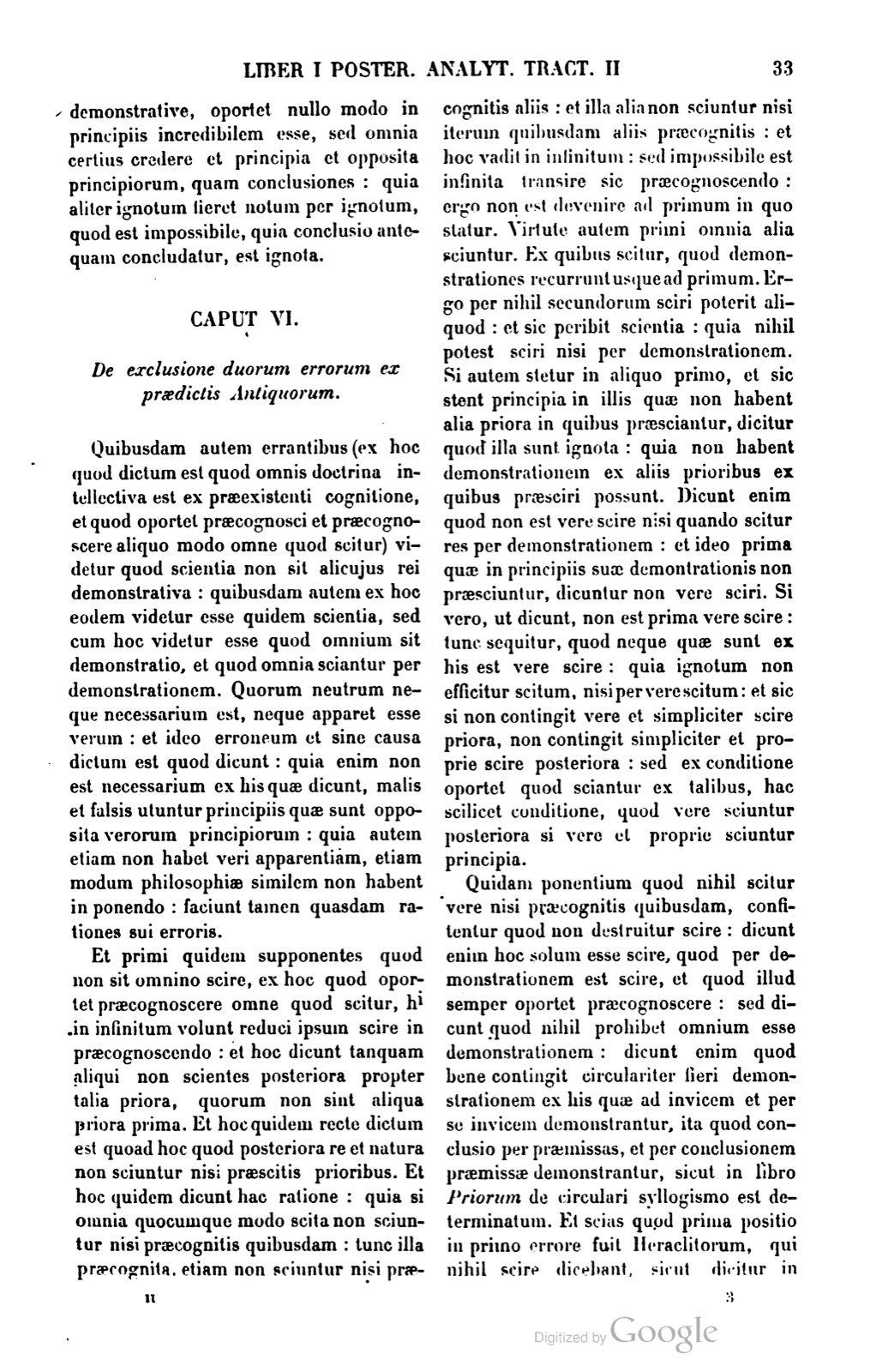
Caput VI. De exclusione duorum errorum ex praedictis Antiquorum.
Quibusdam autem errantibus, ex hoc quod dictum est quod omnis doctrina intellectiva est ex praeexistenti cognitione, et quod oportet praecognosci et praecognoscere aliquo modo omne quod scitur, videtur quod scientia non sit alicujus rei demonstrativa: quibusdam autem ex hoc eodem videtur esse quidem scientia, sed cum hoc videtur esse quod omnium sit demonstratio, et quod omnia sciantur per demonstrationem. Quorum neutrum neque necessarium est, neque apparet esse verum: et ideo erroneum et sine causa dictum est quod dicunt: quia enim non est necessarium ex his quae dicunt, malis et falsis utuntur principiis quae sunt opposita verorum principiorum: quia autem etiam non habet veri apparentiam, etiam modum philosophiae similem non habent in ponendo: faciunt tamen quasdam rationes sui erroris.
Et primi quidem supponentes quod non sit omnino scire, ex hoc quod oportet praecognoscere omne quod scitur, hi in infinitum volunt reduci ipsum scire in praecognoscendo: et hoc dicunt tanquam aliqui non scientes posteriora propter talia priora, quorum non sint aliqua priora prima. Et hoc quidem recte dictum est quoad hoc quod posteriora re et natura non sciuntur nisi praescitis prioribus. Et hoc quidem dicunt hac ratione: quia si omnia quocumque modo scita non sciuntur nisi praecognitis quibusdam: tunc illa praecognita, etiam non sciuntur nisi praecognitis aliis: et illa alia non sciuntur nisi iterum quibusdam aliis praecognitis: et hoc vadit in infinitum: sed impossibile est infinita transire sic praecognoscendo: ergo non est devenire ad primum in quo statur. Virtute autem primi omnia alia sciuntur. Ex quibus scitur, quod demonstrationes recurrunt usque ad primum. Ergo per nihil secundorum sciri poterit aliquid: et sic peribit scientia: quia nihil potest sciri nisi per demonstrationem.
Si autem stetur in aliquo primo, et sic stent principia in illis quae non habent alia priora in quibus praesciantur, dicitur quod illa sunt ignota: quia non habent demonstrationem ex aliis prioribus ex quibus praesciri possunt. Dicunt enim quod non est vere scire nisi quando scitur res per demonstrationem: et ideo prima quae in principiis suae demonstrationis non praesciuntur, dicuntur non vere sciri. Si vero, ut dicunt, non est prima vere scire: tunc sequitur, quod neque quae sunt ex his est vere scire: quia ignotum non efficitur scitum, nisi per vere scitum: et sic si non contingit vere et simpliciter scire priora, non contingit simpliciter et proprie scire posteriora: sed ex conditione oportet quod sciantur ex talibus, hac scilicet conditione, quod vere sciuntur posteriora si vere et proprie sciuntur principia.
Quidam ponentium quod nihil scitur vere nisi praecognitis quibusdam, confitentur quod non destruitur scire: dicunt enim hoc solum esse scire, quod per demonstrationem est scire, et quod illud semper oportet praecognoscere: sed dicunt quod nihil prohibet omnium esse demonstrationem: dicunt enim quod bene contingit circulariter fieri demonstrationem ex his quae ad invicem et per se invicem demonstrantur, ita quod conclusio per praemissas, et per conclusionem praemissae demonstrantur, sicut in libro Priorum de circulari syllogismo est determinatum. Et scias quod prima positio in primo errore fuit Heraclitorum, qui nihil scire dicebant, sicut dicitur in quarto primae philosophiae 6. Secunda autem post fuit Empedoclis qui simile simili dixit sciri: dixit enim quod nihil est similius quam idem sibi: et idem dixit idem seipso vel convertibile convertibili cognosci. Omnes tamen supponebant quod non est cognoscere nisi ignotum per notum, quia hoc quasi ipsa veritate coacti supponebant omnes. Hae sunt igitur opiniones erroneae Antiquorum cum rationibus suis.
Chapter VI. On the exclusion of two errors from the aforesaid errors of the Ancients.
To certain persons erring from this, that it has been said that every intellective teaching is from pre-existing cognition, and that everything which is known must be foreknown and known beforehand in some mode, it seems that there is no science demonstrative of any thing. But to certain others from this same point it seems indeed that there is science, but along with this it seems that there is demonstration of all things, and that all things are known through demonstration. Neither of these is necessary, nor does either appear to be true; and therefore what they say is erroneous and said without cause. For because it is not necessary from the things that they say, they use bad and false principles which are opposed to true principles; and because it also does not have the appearance of truth, they do not even have a mode similar to philosophy in positing it. Nevertheless they make certain reasons for their error.
And the first, indeed, supposing that there is no knowing at all, from this that it is necessary to know beforehand everything that is known, wish to reduce knowing itself to infinity in foreknowing; and they say this as though some persons did not know posterior things on account of such prior things of which there are not some prior first things. And this is rightly said insofar as posterior things in thing and nature are not known unless prior things are foreknown. And indeed they say this by this reason: because if all things known in whatever mode are known only when certain things have been known beforehand, then those foreknown things also are not known unless other things have been foreknown; and those other things are not known unless again certain other things have been foreknown; and this goes to infinity. But it is impossible to pass through infinite things by thus foreknowing; therefore there is no coming to a first in which one stands. But by the power of the first all other things are known. From these things it is known that demonstrations recur back to the first. Therefore through none of the second things will anything be able to be known; and thus science will perish, because nothing can be known except through demonstration.
But if one stands in some first thing, and thus principles stand in those things which do not have other prior things in which they are foreknown, it is said that those are unknown, because they do not have demonstration from other prior things from which they can be foreknown. For they say that there is no true knowing except when the thing is known through demonstration; and therefore first things which are not foreknown in the principles of their demonstration are said not truly to be known. But if, as they say, there is no truly knowing first things, then it follows that neither is there truly knowing the things which are from these, because the unknown is not made known except through what is truly known. And thus if it does not happen to know prior things truly and simply, it does not happen to know posterior things simply and properly; but they must be known from such things under a condition, namely this condition, that posterior things are truly known if the principles are truly and properly known.
Certain of those positing that nothing is known truly unless certain things have been foreknown confess that knowing is not destroyed. For they say that this alone is knowing, namely knowing which is through demonstration, and that this must always be foreknown. But they say that nothing prevents there being demonstration of all things; for they say that it indeed happens that demonstration is made circularly from those things which are demonstrated in relation to one another and through one another per se, so that the conclusion is demonstrated through the premises and the premises through the conclusion, as was determined in the book of the Priors concerning the circular syllogism. And you should know that the first position in the first error was that of the Heracliteans, who said that they knew nothing, as is said in the fourth book of first philosophy 6. But the second afterward was that of Empedocles, who said that like is known by like. For he said that nothing is more similar than the same thing to itself; and he said that the same thing is cognized by the same itself, or the convertible by the convertible. Yet all supposed that there is no cognizing except the unknown through the known, because all supposed this as though compelled by truth itself. Therefore these are the erroneous opinions of the Ancients with their reasons.
Nos autem ad ista quae dicta sunt respondentes, dicimus quod nec omnis scientia demonstrativa est hoc modo, quod omne quod scitur, per aliquod sciatur et per demonstrationem: sed quod quaedam sciuntur non per demonstrationem, sed per seipsa: et ideo scientia principiorum est indemonstrabilis, quia non est per aliud. Sicut in visu quaedam videntur in luce propria, ut per se lucentia: quaedam autem non videntur nisi luce aliena, sicut colorata. Et quod hoc quidem necessarium sit, manifestum est. Si enim ea quae priora sunt et principia, sciuntur per demonstrationem necessario, et aliter sciri non possunt, cum aliquando in aliquo summo sui necesse sit stare immediata, quia per se sibi invicem immediata sunt, tunc haec quidem in quibus est status, cum sint priora ex quibus est demonstratio, necesse est, quod haec in quibus stat demonstratio, cum sint priora quae ante se nihil habent, indemonstrabilia necesse est esse. Et haec quae sic indemonstrabilia sunt, non solum dicimus esse priora et indemonstrabilia, et scientiam esse primam de ipsis: sed etiam dicimus esse principium omnis scientiae: quia haec influentiam suae lucis intellectualis influunt super omnia sequentia: et ideo magis ipsa nota sunt et scita omnibus aliis. Et haec dicimus sciri non ex aliis, sed ipsa cognosci in quantum terminos in ipsis positos scimus: omnis enim sciens quid affirmatio et quid negatio, scit quod de quolibet est affirmatio vel negatio vera: et omnis sciens quid est totum et quid est pars, scit quod omne totum majus est sua parte.
Rationes autem quibus hoc quod dicunt probare videntur, non est difficile solvere: quod enim circulo sit aliquid impossibile demonstrari, ita quod simpliciter demonstretur, manifestum est si vere, sicut determinatum est, ex prioribus et notioribus oportet esse demonstrationem. Vere autem dico: quia idem sibi non est vere prius, sicut fit in circulari demonstratione. Impossibile enim est eadem sibi ipsis esse priora simul et notiora, nisi alio et alio modo sumatur prius et notius, sic scilicet quod prius secundum naturam sit posterius quoad nos. Quo etiam modo inductio facit notum et non demonstratio: quia inductio ex prioribus quoad nos notum facit universale quod notius est quoad naturam. Adhuc autem si sic est, ut dicunt Heraclitici, quod non est scientia, vel etiam quod scire est ex prioribus quoad nos: tunc non vere erit in physicis determinatum vel diffinitum scire, quod est negare suppositionem. Dicit enim Alexander in commento super librum de Sensu et Sensato, quod determinatis et probatis deinceps pro suppositione utimur. Et haec quidem dicta sint contra eos qui putant non esse statum demonstrationis, sed quod in infinitum oportet abire in praecognoscendo.
But we, responding to those things which have been said, say that not every demonstrative science is in this mode, that everything which is known is known through something and through demonstration, but that certain things are known not through demonstration but through themselves. And therefore the science of principles is indemonstrable, because it is not through another. As in sight, some things are seen in their own light, as things shining through themselves; but some things are seen only by another's light, as colored things are. And that this is necessary is manifest. For if those things which are prior and principles are necessarily known through demonstration and cannot be known otherwise, since at some highest point of itself it is sometimes necessary to stand at immediate things, because they are immediate to one another through themselves, then these things in which there is a stopping point, since they are prior things from which demonstration is, must necessarily be indemonstrable, since they are prior things which have nothing before them. And these things which are thus indemonstrable we say are not only prior and indemonstrable, and that there is first science concerning them, but we also say that they are the principle of every science, because they flow the influence of their intellectual light upon all following things; and therefore they themselves are more known and known than all the others. And we say that these are known not from others, but are cognized in themselves insofar as we know the terms posited in them. For everyone knowing what affirmation is and what negation is knows that concerning anything affirmation or negation is true; and everyone knowing what a whole is and what a part is knows that every whole is greater than its part.
But the reasons by which they seem to prove what they say are not difficult to solve. For that it is impossible for something to be demonstrated in a circle, so that it is demonstrated simply, is manifest if demonstration, as has been determined, must truly be from prior and more known things. But I say truly because the same thing is not truly prior to itself, as happens in circular demonstration. For it is impossible for the same things to be at once prior and more known than themselves, unless prior and more known are taken in one mode and another, namely so that what is prior according to nature is posterior with respect to us. In this mode induction too makes known, and not demonstration, because induction from things prior with respect to us makes known the universal which is more known with respect to nature. Furthermore, if it is so, as the Heracliteans say, that there is no science, or even that knowing is from things prior with respect to us, then knowing will not truly have been determined or defined in physics; this is to deny the supposition. For Alexander says in the commentary on the book On Sense and Sensibilia that once things have been determined and proved, we thereafter use them as a supposition. And let these things have been said against those who think there is no stopping point of demonstration, but that it is necessary to go away to infinity in knowing beforehand.
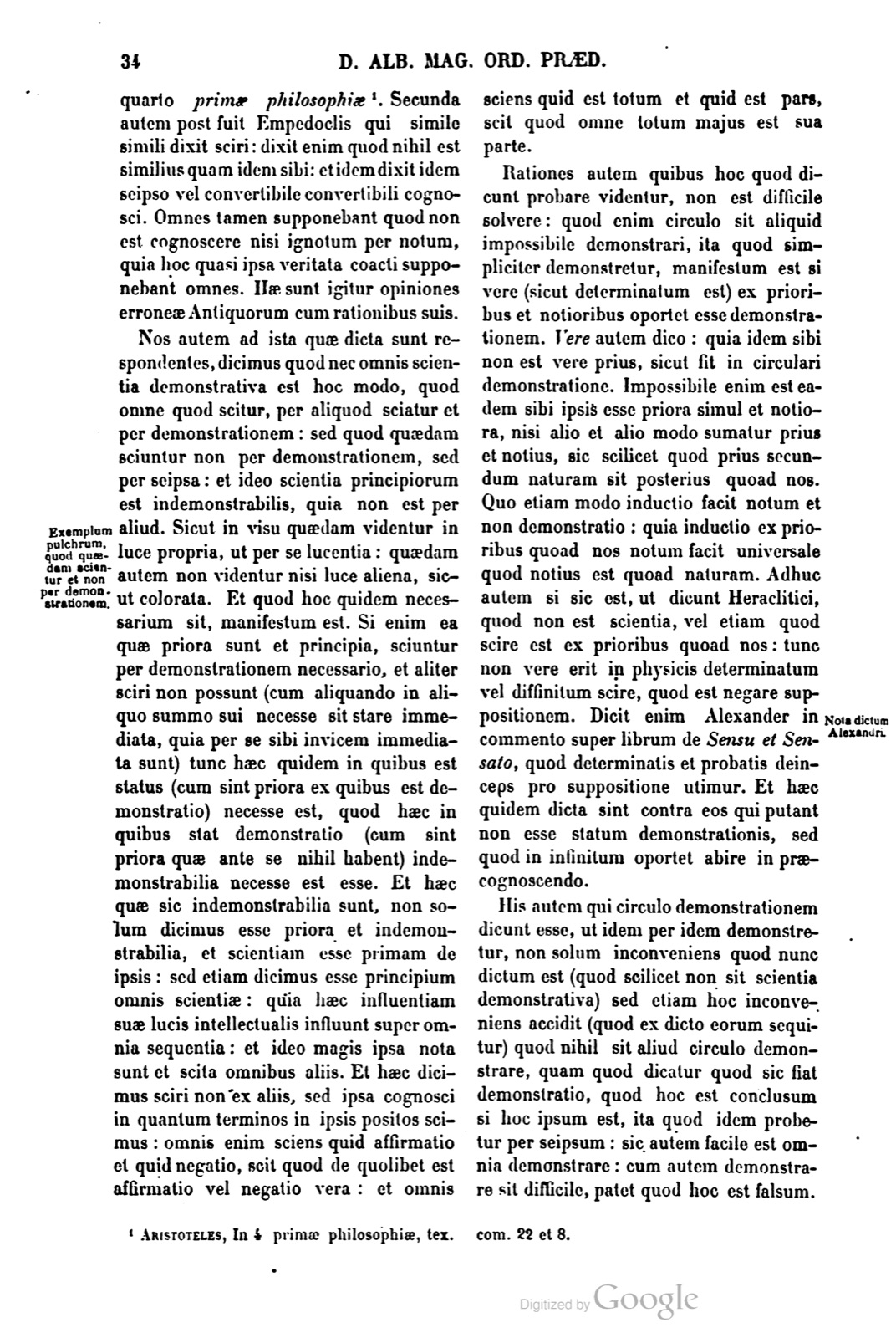
His autem qui circulo demonstrationem dicunt esse, ut idem per idem demonstretur, non solum inconveniens quod nunc dictum est, quod scilicet non sit scientia demonstrativa, sed etiam hoc inconveniens accidit, quod ex dicto eorum sequitur, quod nihil sit aliud circulo demonstrare, quam quod dicatur quod sic fiat demonstratio, quod hoc est conclusum si hoc ipsum est, ita quod idem probetur per seipsum: sic autem facile est omnia demonstrare: cum autem demonstrare sit difficile, patet quod hoc est falsum.
Quod autem accidat idem seipso demonstrari, manifestum est tribus terminis positis, qui gratia exempli sint A B C: tres enim termini ad hoc ostendendum sufficiunt: quia dicere quod ab eodem in idem per multa et pauca media circularis demonstratio reflectatur in idem, nihil differt quoad propositam intentionem: nec differt dicere per paucos aut duos fieri reflexionem. Cum enim supponatur, quod cum est A, ex necessitate sequitur esse B, et cum est B, ex necessitate sequitur esse C, sequitur a primo ad ultimum, quod cum est A ex necessitate erit C. Si igitur in tali processu fit circularis conversio, ita quod cum sit A necesse sit B esse: et fit conversio et regyratio circuli, ita quod cum sit B, e contra necesse sit esse A, hoc enim erat, sicut in Prioribus dictum est, circulo demonstrare. Ponantur ergo esse C B idem cum A, eo quod A non dici ponatur nisi de C et B: tali igitur positione facta, quod idem sit dicere A quod est dicere C, scilicet quia in convertibilibus tantum est circulus, hoc autem quod est esse non est dicere quando ponitur esse C, sed positum est C cum A idem esse: propter quod sequitur, quod nihil alterum est dicere, quantum ad eos qui dicunt circulo esse demonstrationem, nisi cum sit A est A, et idem probari et demonstrari per seipsum.
Hoc autem sic intelligendum est, quod si C probatur per A et C per B, si quis dicat quod A sit idem cum C in quantum C sequitur ad B, idem erit dicere, si A est, C est, quod est dicere, si A est, A est. Tres autem terminos ponimus, ne aliquis cavillando dicat quod non ex duobus terminis sed ex tribus: et duos conditionales posuimus, quia in paucioribus quam duobus, non fit processus a primo ad ultimum. Scias autem quod totus iste processus fundatur super hoc quod quidquid est principium principii, est etiam principium principiati: et quod est causa causae, est causa causati: et ideo si B probatur per A et C per B, sequitur quod C probatur per A, et si e converso A probatur per C, cum C probatur per A, sequitur quod A probatur per A, et sic idem prius et notius est seipso: et iste verus est intellectus Aristotelis. Sic autem omnia probare in qualibet figura leve est, et arte non indigens neque studio.
At vero nec hoc possibile eadem circulariter per se invicem ostendere, nisi in his quaecumque sunt convertibilia et quaecumque alternatim se sequuntur, ita quod utrumque sit accidens et consequens ad alterum, sicut sunt propria et species quarum sunt propria, ut homo et risibile, vel diffinitio et diffinitum. Et ex hoc etiam sequitur aliud inconveniens, scilicet quod aliquid demonstrative sequitur ex uno, quod non potest esse: quia ostensum est in Prioribus, quod uno quidem posito nequaquam ex illo unico sequitur syllogistice alterum. Dico autem uno posito: quia neque ex termino uno, neque ex positione sive ex propositione unica posita. Ex duabus autem propositionibus primis sive praemissis, et minimis sive ad totum minus, et tribus terminis aliquid sequi contingit syllogizare. Patet igitur, quod si A inhaereat ut principium ipsi B et ipsi C, et haec inhaereant sibi invicem, ita quod B C et C B et C converso inhaereant ipsi A sicut principiato ex ipsis et demonstrato: sic quidem contingit ex alterutris monstrare et inconvertibilibus in prima figura, in cujus primo modo et solo est perfecta circulatio, sicut ostensum est in his quae de syllogismo per se considerato sunt in libro Priorum determinata. Ostensum autem est ibidem, quod in aliis figuris aut non fit circularis syllogismus, aut non fit de acceptis, hoc est, sumptis ad propositum. Ea autem quae non sunt aequaliter praedicantia vel praedicata ad se invicem et convertibilia, nequaquam contingit monstrare circulo vel circulariter: cum tamen multa talia demonstrabilia sint.
But for those who say that demonstration is in a circle, so that the same is demonstrated through the same, not only does the unfitting consequence now stated follow, namely that there is no demonstrative science, but also this unfitting consequence occurs, which follows from their saying: that to demonstrate in a circle is nothing other than that it be said that demonstration happens thus, that this is concluded if this very thing is, so that the same is proved through itself. But in this way it is easy to demonstrate all things; yet since to demonstrate is difficult, it is evident that this is false.
But that the same thing happens to be demonstrated by itself is manifest when three terms are posited, which for the sake of example are A B C. For three terms suffice for showing this, because saying that circular demonstration is reflected from the same into the same through many or through few middles makes no difference for the proposed intention; nor does it differ to say that the reflection is made through few or through two. For when it is supposed that when A is, B follows of necessity, and when B is, C follows of necessity, it follows from the first to the last that when A is, C will be of necessity. Therefore if in such a process a circular conversion is made, so that when A is, B must be, and conversion and turning-back of the circle are made, so that when B is, conversely A must be, for this was, as was said in the Priors, to demonstrate in a circle, then let C and B be posited to be the same with A, because A is posited to be said only of C and B. Therefore, once such a position has been made, that to say A is the same as to say C, namely because a circle is only in convertibles, but to be is not to say this when C is posited to be, but C has been posited to be the same with A; on account of this it follows that saying something other, as far as those who say that demonstration is in a circle are concerned, is nothing except that when A is, A is, and that the same is proved and demonstrated through itself.
But this must be understood in this way: that if C is proved through A and C through B, if someone says that A is the same as C insofar as C follows upon B, it will be the same to say if A is, C is, as to say if A is, A is. But we posit three terms lest someone by cavilling say that it is not from two terms but from three; and we posited two conditionals because in fewer than two there is no process from the first to the last. But you should know that this whole process is founded upon this, that whatever is the principle of the principle is also the principle of the thing principiated, and that what is the cause of the cause is the cause of the caused. And therefore if B is proved through A and C through B, it follows that C is proved through A; and if conversely A is proved through C, since C is proved through A, it follows that A is proved through A, and thus the same is prior and more known than itself. And this is the true understanding of Aristotle. But to prove all things in this way in any figure is easy, and needs neither art nor study.
Yet truly it is not possible to show the same things circularly through one another per se, except in whatever things are convertible and whatever things follow one another alternately, so that each is an accident and consequent to the other, as properties and the species of which they are properties are, such as man and risible, or definition and the defined. And from this another unfitting consequence also follows, namely that something follows demonstratively from one thing, which cannot be, because it was shown in the Priors that when one thing has been posited, another in no way follows syllogistically from that single thing. But I say when one thing has been posited because neither from one term nor from a single position or proposition posited does another thing follow. But from two first propositions or premises, and minimal ones or fewer in relation to the whole, and from three terms, it happens to syllogize that something follows. Therefore it is evident that if A inheres as a principle in B itself and C itself, and these inhere in one another so that B C and C B and C conversely inhere in A itself as in what is principiated from them and demonstrated, then indeed it happens from alternates to show even in inconvertibles in the first figure, in whose first mode alone there is perfect circulation, as was shown in those things which were determined in the book of the Priors concerning syllogism considered through itself. But it was shown in the same place that in the other figures either a circular syllogism is not made, or it is not made from the things accepted, that is, taken for the proposed point. But those things which are not equally predicating or predicated in relation to one another and convertible can by no means be shown in a circle or circularly, although nevertheless there are many such demonstrable things.
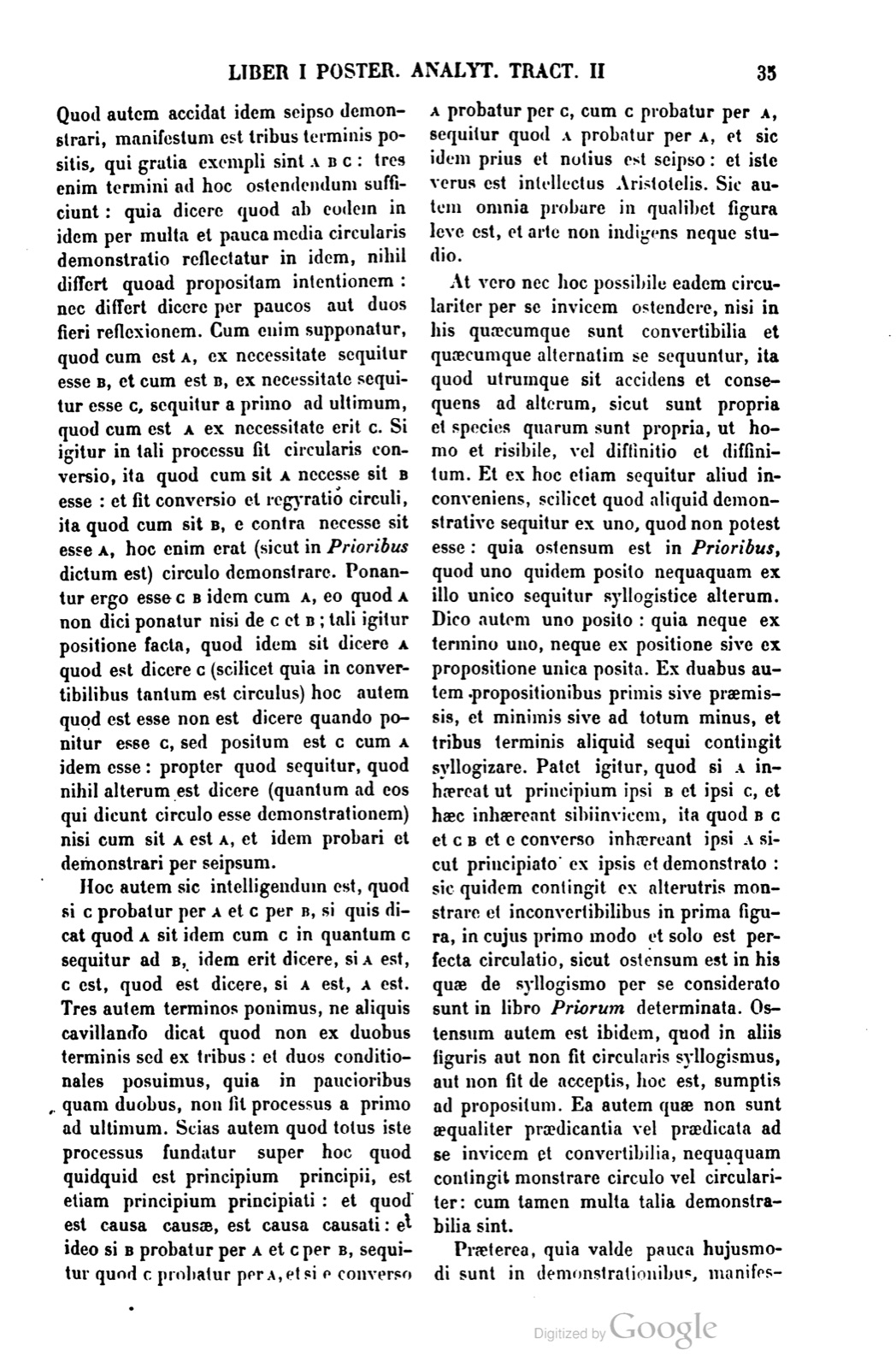
Praeterea, quia valde pauca hujusmodi sunt in demonstrationibus, manifestum est quod vanum sit pro convertibilibus et impossibile pro omnibus aliis esse demonstrationem ex his quae sunt ad invicem demonstratis. Et propter hoc sequitur ex necessitate, quod error sic dicentium sit manifestatus, quod contingit omnium esse demonstrationem, sicut isti dicebant. Et sic stat quod ante dictum est, alia et meliori scientia sciri principia, et alia conclusiones: et conclusiones esse demonstrabiles, principia autem indemonstrabilia.
Attendendum autem hic, quod circularis demonstratio esse non potest secundum hoc quod simpliciter et prius natura aliqua et per causam scita non possunt demonstrari ex se invicem circulariter: quia sic in praehabitis accepta est demonstratio secundum propriissime scita. Adhuc autem non intelligitur quod, in circulariter generatis non possit esse quaecumque demonstratio, ut in nube, vapore, et pluvia, sicut in secundo hujus ejusdem scientiae libro probabitur: sed intelligitur hic, quod illae demonstrationes non faciunt scire simpliciter secundum quod diffinitum est: aut enim neutrum illorum est prius altero secundum naturam, aut sicut unum prius altero secundum naturam, sic una demonstratio erit per causam, et altera per effectum. Posset tamen dici quod haec possent per se invicem demonstrari, ut in secundo dicitur: nec tamen fit circulatio vera, quia non fit motus ab eodem in idem penitus: quia cum nubes generat pluviam, et iterum ex pluvia nubes generatur, non est eadem nubes generans et generata: et sic non est ibi vera circulatio. Extenso tamen nomine demonstrationis potest aliquid circulariter demonstrari, ut causa per effectum, et effectus per causam.
Moreover, because very few things of this kind exist in demonstrations, it is manifest that demonstration from things mutually demonstrated is vain for convertibles and impossible for all other things. And because of this it follows of necessity that the error of those speaking in this way is made manifest, namely that there happens to be demonstration of all things, as those men were saying. And thus what was said before stands: principles are known by one and better science, and conclusions by another; and conclusions are demonstrable, but principles are indemonstrable.
But it must be noted here that circular demonstration cannot exist according to this, that things known simply, prior by nature, and through a cause cannot be demonstrated from one another circularly, because in the things held before, demonstration was taken according to things known most properly. Furthermore, it is not understood that in things generated circularly there cannot be any demonstration, as in cloud, vapor, and rain, as will be proved in the second book of this same science; rather it is understood here that those demonstrations do not make one know simply according as knowing has been defined. For either neither of those things is prior to the other according to nature, or as one is prior to the other according to nature, so one demonstration will be through a cause and the other through an effect. Yet it could be said that these could be demonstrated through one another, as is said in the second book; and nevertheless true circulation does not occur, because motion does not occur from the same into altogether the same, because when a cloud generates rain, and again from rain a cloud is generated, it is not the same cloud generating and generated. And thus there is no true circulation there. Yet when the name of demonstration is extended, something can be demonstrated circularly, as a cause through an effect and an effect through a cause.
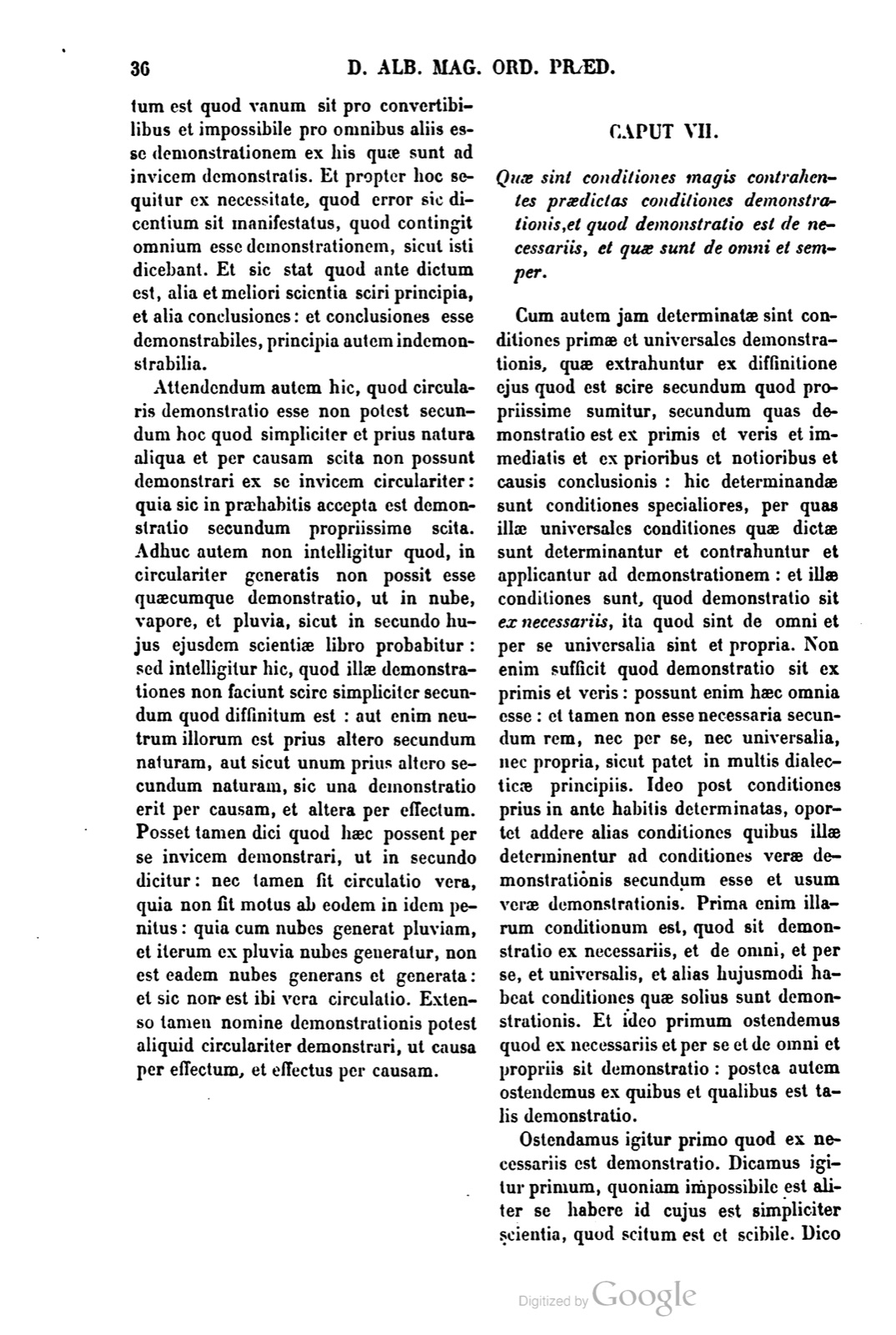
Caput VII. Quae sint conditiones magis contrahentes praedictas conditiones demonstrationis, et quod demonstratio est de necessariis, et quae sunt de omni et semper.
Cum autem jam determinatae sint conditiones primae et universales demonstrationis, quae extrahuntur ex diffinitione ejus quod est scire secundum quod propriissime sumitur, secundum quas demonstratio est ex primis et veris et immediatis et ex prioribus et notioribus et causis conclusionis: hic determinandae sunt conditiones specialiores, per quas illae universales conditiones quae dictae sunt determinantur et contrahuntur et applicantur ad demonstrationem: et illae conditiones sunt, quod demonstratio sit ex necessariis, ita quod sint de omni et per se universalia sint et propria. Non enim sufficit quod demonstratio sit ex primis et veris: possunt enim haec omnia esse: et tamen non esse necessaria secundum rem, nec per se, nec universalia, nec propria, sicut patet in multis dialecticae principiis. Ideo post conditiones prius in ante habitis determinatas, oportet addere alias conditiones quibus illae determinentur ad conditiones verae demonstrationis secundum esse et usum verae demonstrationis. Prima enim illarum conditionum est, quod sit demonstratio ex necessariis, et de omni, et per se, et universalis, et alias hujusmodi habeat conditiones quae solius sunt demonstrationis. Et ideo primum ostendemus quod ex necessariis et per se et de omni et propriis sit demonstratio: postea autem ostendemus ex quibus et qualibus est talis demonstratio.
Ostendamus igitur primo quod ex necessariis est demonstratio. Dicamus igitur primum, quoniam impossibile est aliter se habere id cujus est simpliciter scientia, quod scitum est et scibile. Dico
Chapter VII. What are the conditions more contracting the aforesaid conditions of demonstration, and that demonstration is about necessary things, and which things are of every and always.
But since the first and universal conditions of demonstration have now been determined, which are drawn out from the definition of what it is to know according as it is taken most properly, according to which demonstration is from first and true and immediate things and from prior and more known things and causes of the conclusion, here the more special conditions must be determined, through which those universal conditions that have been stated are determined and contracted and applied to demonstration. And those conditions are that demonstration be from necessary things, so that they are of every, and are universal and proper per se. For it is not sufficient that demonstration be from first and true things; for all these things can exist and nevertheless not be necessary according to the thing, nor per se, nor universal, nor proper, as is evident in many dialectical principles. Therefore after the conditions previously determined in the things held before, it is necessary to add other conditions by which those are determined to the conditions of true demonstration according to the being and use of true demonstration. For the first of those conditions is that demonstration be from necessary things, and of every, and per se, and universal, and that it have other conditions of this kind which belong to demonstration alone. And therefore first we shall show that demonstration is from necessary things and per se and of every and from proper things; but afterward we shall show from what things and what sorts of things such demonstration is.
Therefore let us first show that demonstration is from necessary things. Therefore let us say first that it is impossible for that of which there is science simply to have itself otherwise, namely what has been known and is knowable. I say
Notes
- Aristotle, in the fifth book of the Physics, text-commentary 13. (ARISTOTELES, In 5 Physic. tex. com. 13.) ↩
- Compare further Aristotle, Physics I, text-commentary 4, and On the Soul I, chapter 1; and Avicenna, Sufficientia I, text-commentary 8. (Cf. adhuc Aristotelem, I Physic. tex. com. 4 et I de Anima, cap. 1; et Avicennam, I de Sufficientia, tex. com. 8.) ↩
- That saying of Gilbert, every community proceeds from singularity, is understood of the universal which either is nothing or is posterior to singulars. P. J. (Dictum illud Gilberti, omnis communitas a singularitate procedit, intelligitur de universali quod aut nihil est, aut posterius singularibus. P. J.) ↩
- That on account of which each thing is such is itself more such. The exposition of Zimarra seems clear, when he says: Whenever there is some disposition receiving more and less, formally denominating cause and caused, and it belongs to the caused thing on account of the cause, it is always said first and simply of the cause, and afterward and in a qualified respect of the caused thing. Smiglecius seems to say the same thing, when he says that for this axiom two conditions are required. First, that each of the things between which the comparison is made be such, or that each be able formally to receive that denomination in itself. Second, that one be such because the other is such, so that one such thing is the physical cause and reason why the other is such. And hence, what could be a third condition, those things which are thus compared among themselves must receive more and less by this very fact, because they must ordinarily be such things, that is, among qualities, which alone receive more and less. Hence you will easily gather that these argumentations have no force: 1. A man is drunk on account of wine, therefore wine is more drunk; for the first condition fails, since wine is not formally called drunk. 2. A thief is hanged on account of theft, therefore theft is more hanged. Here the second condition fails, because theft is not the true physical cause of hanging, but only the moral cause. 3. A sign becomes fire on account of fire, therefore fire more becomes fire, and so on. Here the third condition fails, for fire does not receive more and less, and so on. In this proposition the axiom is altogether verified: God is necessarily more perfect than any creature. (Propter quod unumquodque tale, et illud magis. Clara videtur expositio Zimarrae, dum ait: Quotiescumque fuerit aliqua dispositio recipiens magis et minus denominans formaliter causam et causatum, et competit causato propter causam, semper per prius et simpliciter dicitur de causa, et posterius et secundum quid dicitur de causato. Hoc idem dicere videtur Smiglecius, dum ait pro hoc axiomate duas conditiones requiri. Prima, ut utrumque inter quae fit comparatio sit tale, seu utrumque illam denominationem formaliter in se recipere possit. Secunda, ut utrum sit tale, quia aliud est tale, ita ut unum tale sit causa physica et ratio, cur alterum sit tale. Et hinc, quae poterat esse tertia conditio, illa, quae ita inter se comparantur, debent suscipere magis et minus, hoc ipso, quia debent esse ordinarie talia, hoc est, inter qualitates quae solae recipiunt magis et minus. Unde facile colliges, quod hae argumentationes nihil valeant: 1. Homo est ebrius propter vinum, ergo vinum magis est ebrium: nam deficit prima conditio, nam vinum formaliter non dicitur ebrium. 2. Fur suspenditur propter furtum, ergo furtum magis suspenditur. Hic deficit secunda conditio, quia furtum non vera physica causa suspensionis est, sed tantum moralis. 3. Signum fit ignis propter ignem, ergo ignis magis fit ignis, etc. Deficit hic tertia conditio nam ignis non suscipit magis et minus, etc. In hac propositione omnino verificatur axioma: Deus quavis creatura necessario est perfectior.) ↩
- Aristotle, in the fourth book of the Meteors, text-commentary 3. (ARISTOTELES, In 4 metereorum, tex. com. 3.) ↩
- Aristotle, in the fourth book of first philosophy, text-commentaries 22 and 8. (ARISTOTELES, In 4 primae philosophiae, tex. com. 22 et 8.) ↩
If a page does not appear, its photograph has not been uploaded yet.