Works › Posterior Analytics, Books I–II
Volume 2 · pp. 1–12
First Book of the Posterior Analytics, Treatise I, Chapter I
A marker with ≈ is an approximate page boundary, placed by measure of the text; the page photographs remain the authority. In the paired views, clicking a page marker brings that page into view.
D. Alberti Magni, Ratisbonensis episcopi, Ordinis Praedicatorum, Logica.
Liber primus Posteriorum analyticorum.
Tractatus I. De his quae praemitti habent ante scientiam, et de universali sciendi modo.
Caput I. De praeambulis ante scientiam.
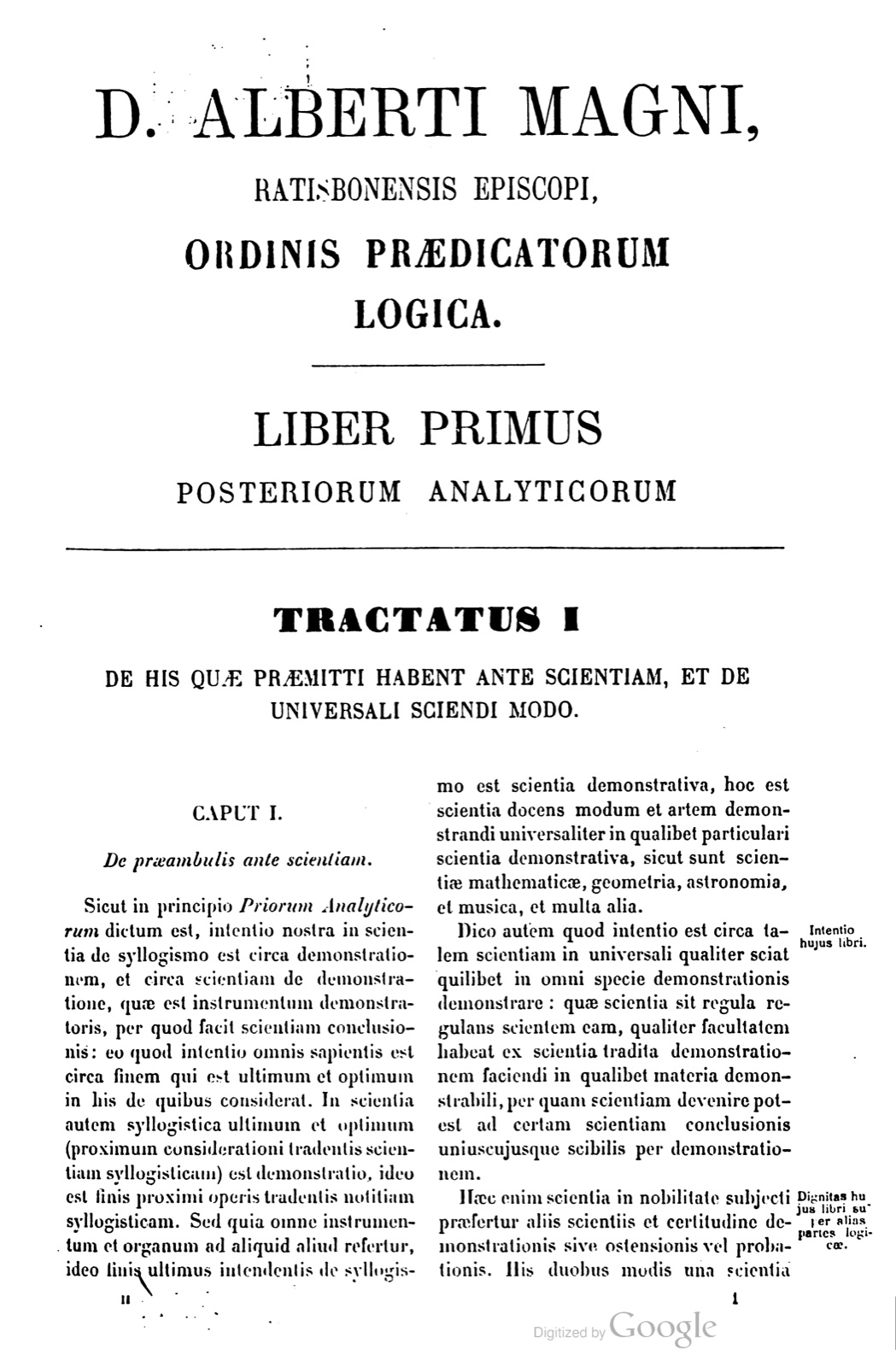
Sicut in principio Priorum Analyticorum dictum est, intentio nostra in scientia de syllogismo est circa demonstrationem, et circa scientiam de demonstratione, quae est instrumentum demonstratoris, per quod facit scientiam conclusionis: eo quod intentio omnis sapientis est circa finem qui est ultimum et optimum in his de quibus considerat. In scientia autem syllogistica ultimum et optimum, proximum considerationi tradentis scientiam syllogisticam, est demonstratio, ideo est finis proximi operis tradentis notitiam syllogisticam. Sed quia omne instrumentum et organum ad aliquid aliud refertur, ideo finis ultimus intendentis de syllogismo est scientia demonstrativa, hoc est scientia docens modum et artem demonstrandi universaliter in qualibet particulari scientia demonstrativa, sicut sunt scientiae mathematicae, geometria, astronomia, et musica, et multa alia.
Dico autem quod intentio est circa talem scientiam in universali, qualiter sciat quilibet in omni specie demonstrationis demonstrare: quae scientia sit regula regulans scientem eam, qualiter facultatem habeat ex scientia tradita demonstrationem faciendi in qualibet materia demonstrabili, per quam scientiam devenire potest ad certam scientiam conclusionis uniuscujusque scibilis per demonstrationem.
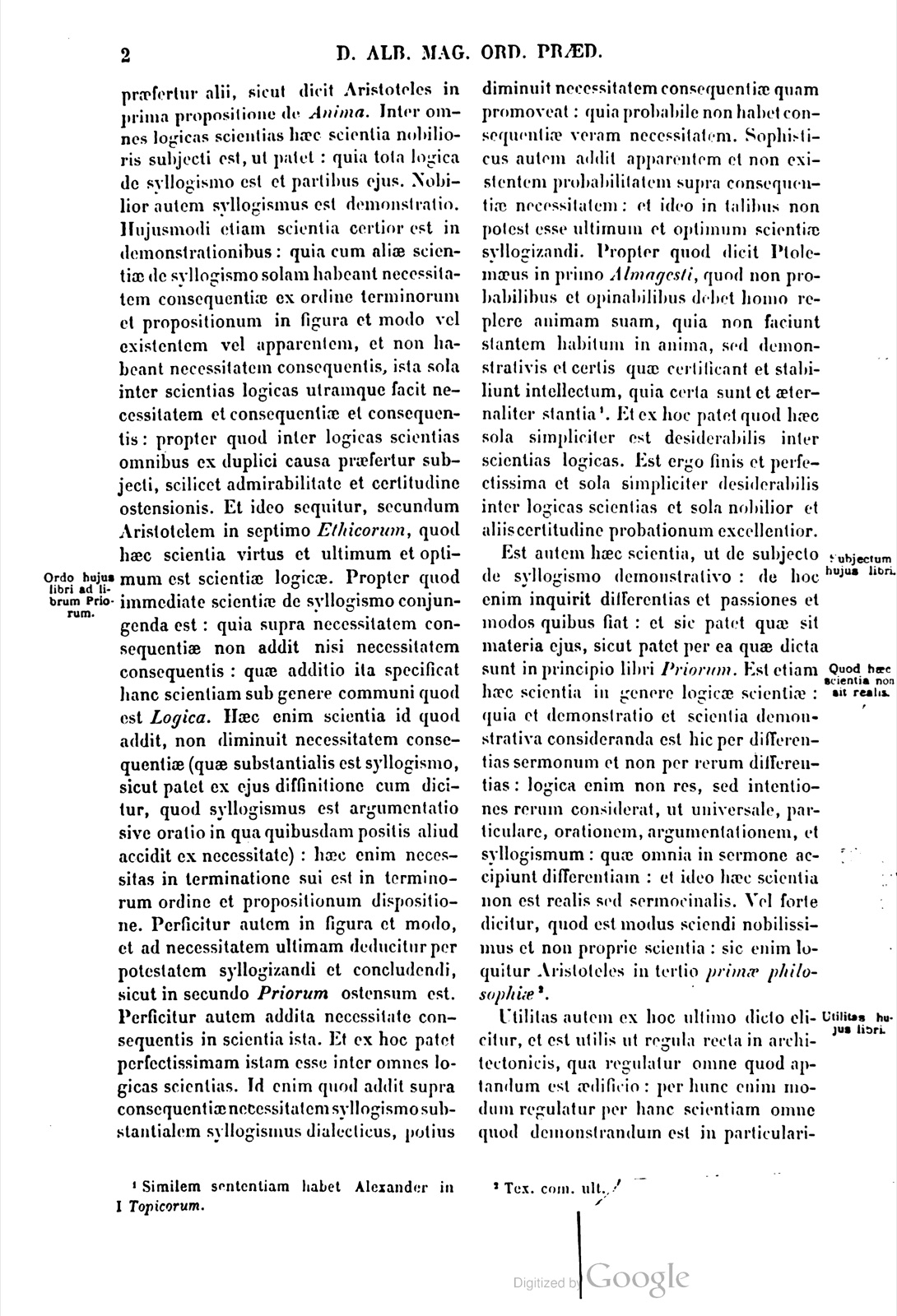
Haec enim scientia in nobilitate subjecti praefertur aliis scientiis et certitudine demonstrationis sive ostensionis vel probationis. His duobus modis una scientia praefertur alii, sicut dicit Aristoteles in prima propositione de Anima. Inter omnes logicas scientias haec scientia nobilioris subjecti est, ut patet: quia tota logica de syllogismo est et partibus ejus. Nobilior autem syllogismus est demonstratio. Hujusmodi etiam scientia certior est in demonstrationibus: quia cum aliae scientiae de syllogismo solam habeant necessitatem consequentiae ex ordine terminorum et propositionum in figura et modo vel existentem vel apparentem, et non habeant necessitatem consequentis, ista sola inter scientias logicas utramque facit necessitatem et consequentiae et consequentis: propter quod inter logicas scientias omnibus ex duplici causa praefertur subjecti, scilicet admirabilitate et certitudine ostensionis. Et ideo sequitur, secundum Aristotelem in septimo Ethicorum, quod haec scientia virtus et ultimum et optimum est scientiae logicae. Propter quod immediate scientiae de syllogismo conjungenda est: quia supra necessitatem consequentiae non addit nisi necessitatem consequentis: quae additio ita specificat hanc scientiam sub genere communi quod est Logica. Haec enim scientia id quod addit, non diminuit necessitatem consequentiae, quae substantialis est syllogismo, sicut patet ex ejus diffinitione cum dicitur quod syllogismus est argumentatio sive oratio in qua quibusdam positis aliud accidit ex necessitate: haec enim necessitas in terminatione sui est in terminorum ordine et propositionum dispositione. Perficitur autem in figura et modo, et ad necessitatem ultimam deducitur per potestatem syllogizandi et concludendi, sicut in secundo Priorum ostensum est. Perficitur autem addita necessitate consequentis in scientia ista. Et ex hoc patet perfectissimam istam esse inter omnes logicas scientias. Id enim quod addit supra consequentiae necessitatem syllogismo substantialem syllogismus dialecticus, potius diminuit necessitatem consequentiae quam promoveat: quia probabile non habet consequentiae veram necessitatem. Sophisticus autem addit apparentem et non existentem probabilitatem supra consequentiae necessitatem: et ideo in talibus non potest esse ultimum et optimum scientiae syllogizandi. Propter quod dicit Ptolemaeus in primo Almagesti, quod non probabilibus et opinabilibus debet homo replere animam suam, quia non faciunt stantem habitum in anima, sed demonstrativis et certis quae certificant et stabiliunt intellectum, quia certa sunt et aeternaliter stantia 1. Et ex hoc patet quod haec sola simpliciter est desiderabilis inter scientias logicas. Est ergo finis et perfectissima et sola simpliciter desiderabilis inter logicas scientias et sola nobilior et aliis certitudine probationum excellentior.
Of D. Albert the Great, bishop of Regensburg, of the Order of Preachers, Logic.
First book of the Posterior Analytics.
Treatise I. On the things which have to be put first before science, and on the universal mode of knowing.
Chapter I. On the preliminaries before science.
As was said at the beginning of the Prior Analytics, our intention in the science about syllogism is concerned with demonstration, and with the science about demonstration, which is the instrument of the demonstrator, through which he makes science of the conclusion: because the intention of every wise man is concerned with the end, which is the last and best thing in those matters about which he considers. But in syllogistic science the last and best thing, proximate to the consideration of one handing down syllogistic science, is demonstration; therefore it is the end of the proximate work of one handing down knowledge of syllogistic science. But because every instrument and organ is referred to something else, therefore the ultimate end of one intending to treat of syllogism is demonstrative science, that is, the science teaching the mode and art of demonstrating universally in any particular demonstrative science, as are the mathematical sciences, geometry, astronomy, and music, and many others.
But I say that the intention is concerned with such a science in the universal, namely how anyone may know how to demonstrate in every species of demonstration: that science should be a rule regulating the one who knows it, how he may have, from the science handed down, the faculty of making a demonstration in any demonstrable matter, through which science he can come to the certain science of the conclusion of each knowable thing through demonstration.
For this science is preferred to the other sciences in the nobility of its subject and in the certainty of demonstration or showing or proof. In these two modes one science is preferred to another, as Aristotle says in the first proposition of On the Soul. Among all the logical sciences this science is of a nobler subject, as is evident: because the whole of logic is about syllogism and its parts. But the nobler syllogism is demonstration. A science of this kind is also more certain in demonstrations: because, while the other sciences about syllogism have only the necessity of consequence from the order of terms and propositions in figure and mode, whether existing or apparent, and do not have the necessity of the consequent, this one alone among the logical sciences makes both necessities, both of consequence and of the consequent. On account of this, among logical sciences it is preferred to all from the twofold cause of the subject, namely from admirability and from certainty of showing. And therefore it follows, according to Aristotle in the seventh book of the Ethics, that this science is the virtue and the last and best thing of logical science. On account of this it must immediately be joined to the science about syllogism: because above the necessity of consequence it adds only the necessity of the consequent. This addition so specifies this science under the common genus which is Logic. For this science, by what it adds, does not diminish the necessity of consequence, which is substantial to syllogism, as is evident from its definition when it is said that a syllogism is an argumentation or discourse in which, certain things having been posited, something else follows of necessity: for this necessity, in its termination, is in the order of terms and the disposition of propositions. It is perfected in figure and mode, and it is led to ultimate necessity through the power of syllogizing and concluding, as was shown in the second book of the Priors. But it is perfected by the added necessity of the consequent in this science. And from this it is evident that this science is the most perfect among all logical sciences. For that which the dialectical syllogism adds above the substantial necessity of consequence to syllogism rather diminishes the necessity of consequence than advances it: because the probable does not have the true necessity of consequence. But the sophistical syllogism adds an apparent and non-existing probability above the necessity of consequence; and therefore in such things there cannot be the last and best thing of the science of syllogizing. On account of this Ptolemy says in the first book of the Almagest that a man ought not to fill his soul with probable and opinionable things, because they do not make a standing habit in the soul, but with demonstrative and certain things, which make the intellect certain and stable, because they are certain and eternally standing 1. And from this it is evident that this science alone, simply speaking, is desirable among the logical sciences. Therefore it is the end, and the most perfect, and alone simply desirable among the logical sciences, and alone nobler and more excellent than the others in certainty of proofs.
Est autem haec scientia, ut de subjecto, de syllogismo demonstrativo: de hoc enim inquirit differentias et passiones et modos quibus fiat: et sic patet quae sit materia ejus, sicut patet per ea quae dicta sunt in principio libri Priorum. Est etiam haec scientia in genere logicae scientiae: quia et demonstratio et scientia demonstrativa consideranda est hic per differentias sermonum et non per rerum differentias: logica enim non res, sed intentiones rerum considerat, ut universale, particulare, orationem, argumentationem, et syllogismum: quae omnia in sermone accipiunt differentiam: et ideo haec scientia non est realis sed sermocinalis. Vel forte dicitur, quod est modus sciendi nobilissimus et non proprie scientia: sic enim loquitur Aristoteles in tertio primae philosophiae 2.
Utilitas autem ex hoc ultimo dicto elicitur, et est utilis ut regula recta in architectonicis, qua regulatur omne quod aptandum est aedificio: per hunc enim modum regulatur per hanc scientiam omne quod demonstrandum est in particularibus scientiis demonstrativis. Per quod patet quod utilitas ejus universalis est: et ideo utilior quam illae scientiae quae particulariter utiles sunt.
Now this science is, as concerning its subject, about demonstrative syllogism: for concerning this it inquires into the differences and properties and modes by which it comes to be; and thus it is evident what its matter is, as is evident through those things which were said at the beginning of the book of the Priors. This science also is in the genus of logical science: because both demonstration and demonstrative science must be considered here through differences of discourses and not through differences of things. For logic does not consider things, but intentions of things, such as universal, particular, discourse, argumentation, and syllogism: all these receive difference in speech, and therefore this science is not real but sermocinal. Or perhaps it is said that it is the noblest mode of knowing and not properly a science: for thus Aristotle speaks in the third book of first philosophy 2.
But its utility is drawn from this last statement, and it is useful as a right rule in architectonic matters, by which everything that must be fitted to a building is ruled. For in this mode, through this science, everything that must be demonstrated in the particular demonstrative sciences is ruled. Through this it is evident that its utility is universal, and therefore more useful than those sciences which are useful particularly.
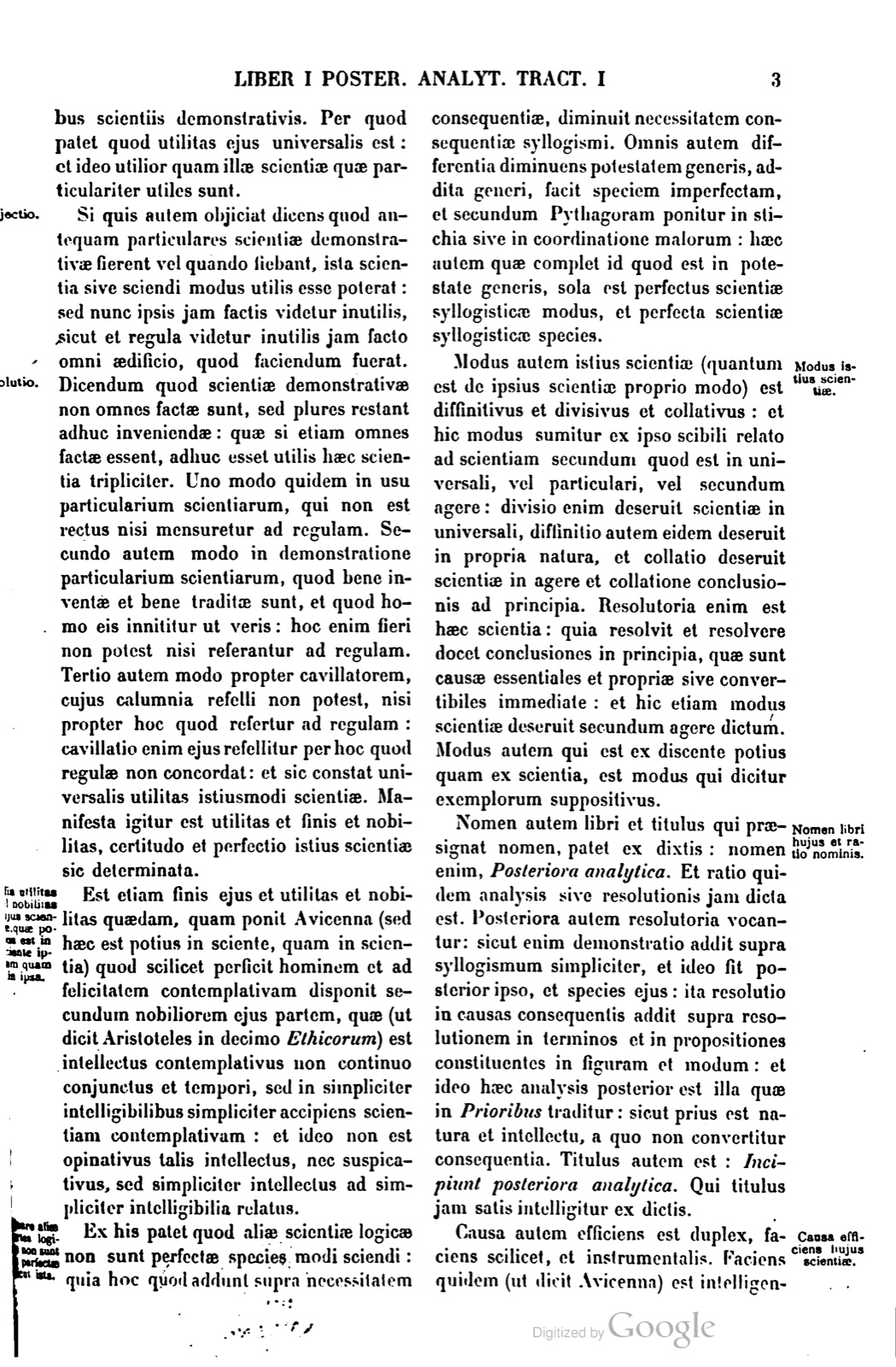
Si quis autem objiciat dicens quod antequam particulares scientiae demonstrativae fierent vel quando fiebant, ista scientia sive sciendi modus utilis esse poterat: sed nunc ipsis jam factis videtur inutilis, sicut et regula videtur inutilis jam facto omni aedificio, quod faciendum fuerat.
Dicendum quod scientiae demonstrativae non omnes factae sunt, sed plures restant adhuc inveniendae: quae si etiam omnes factae essent, adhuc esset utilis haec scientia tripliciter. Uno modo quidem in usu particularium scientiarum, qui non est rectus nisi mensuretur ad regulam. Secundo autem modo in demonstratione particularium scientiarum, quod bene inventae et bene traditae sunt, et quod homo eis innititur ut veris: hoc enim fieri non potest nisi referantur ad regulam. Tertio autem modo propter cavillatorem, cujus calumnia refelli non potest, nisi propter hoc quod refertur ad regulam: cavillatio enim ejus refellitur per hoc quod regulae non concordat: et sic constat universalis utilitas istiusmodi scientiae. Manifesta igitur est utilitas et finis et nobilitas, certitudo et perfectio istius scientiae sic determinata.
Est etiam finis ejus et utilitas et nobilitas quaedam, quam ponit Avicenna, sed haec est potius in sciente quam in scientia, quod scilicet perficit hominem et ad felicitatem contemplativam disponit secundum nobiliorem ejus partem, quae, ut dicit Aristoteles in decimo Ethicorum, est intellectus contemplativus non continuo conjunctus et tempori, sed in simpliciter intelligibilibus simpliciter accipiens scientiam contemplativam: et ideo non est opinativus talis intellectus, nec suspicativus, sed simpliciter intellectus ad simpliciter intelligibilia relatus.
Ex his patet quod aliae scientiae logicae non sunt perfectae species modi sciendi: quia hoc quod addunt supra necessitatem consequentiae, diminuit necessitatem consequentiae syllogismi. Omnis autem differentia diminuens potestatem generis, addita generi, facit speciem imperfectam, et secundum Pythagoram ponitur in stichia sive in coordinatione malorum: haec autem quae complet id quod est in potestate generis, sola est perfectus scientiae syllogisticae modus, et perfecta scientiae syllogisticae species.
Modus autem istius scientiae, quantum est de ipsius scientiae proprio modo, est diffinitivus et divisivus et collativus: et hic modus sumitur ex ipso scibili relato ad scientiam secundum quod est in universali, vel particulari, vel secundum agere: divisio enim deseruit scientiae in universali, diffinitio autem eidem deseruit in propria natura, et collatio deseruit scientiae in agere et collatione conclusionis ad principia. Resolutoria enim est haec scientia: quia resolvit et resolvere docet conclusiones in principia, quae sunt causae essentiales et propriae sive convertibiles immediate: et hic etiam modus scientiae deseruit secundum agere dictum. Modus autem qui est ex discente potius quam ex scientia, est modus qui dicitur exemplorum suppositivus.
But if someone objects, saying that before the particular demonstrative sciences came to be, or while they were coming to be, this science or mode of knowing could be useful, but now, when they have already been made, it seems useless, just as a rule seems useless when the whole building which had to be made has already been made:
It must be said that not all demonstrative sciences have been made, but more still remain to be discovered. Even if they had all been made, this science would still be useful in three ways. In one way, indeed, in the use of the particular sciences, which is not right unless it is measured by a rule. In a second way, in the demonstration of the particular sciences, that they have been well discovered and well handed down, and that a man relies on them as true; for this cannot happen unless they are referred to a rule. In a third way, on account of the caviller, whose calumny cannot be refuted except because it is referred to a rule; for his cavillation is refuted through this, that it does not agree with the rule. And thus the universal utility of a science of this kind is established. Therefore the utility and end and nobility, certainty and perfection of this science are manifest, when determined in this way.
There is also a certain end and utility and nobility of it which Avicenna posits, but this is rather in the knower than in the science, namely that it perfects man and disposes him toward contemplative happiness according to his nobler part. This part, as Aristotle says in the tenth book of the Ethics, is the contemplative intellect, not continuously conjoined to time, but receiving contemplative science simply in things simply intelligible. Therefore such an intellect is not opinionative nor suspicative, but is simply intellect referred to things simply intelligible.
From these things it is evident that the other logical sciences are not perfect species of the mode of knowing: because that which they add above the necessity of consequence diminishes the necessity of the consequence of syllogism. But every difference diminishing the power of a genus, when added to the genus, makes an imperfect species, and according to Pythagoras is placed among the elements or in the coordination of evils. But this science, which completes what is in the power of the genus, alone is the perfect mode of syllogistic science and the perfect species of syllogistic science.
But the mode of this science, insofar as concerns the proper mode of the science itself, is definitive and divisive and collative; and this mode is taken from the knowable itself as related to science according as it is in the universal, or in the particular, or according to acting. For division serves science in the universal, definition serves the same science in its proper nature, and collation serves science in acting and in the comparison of the conclusion to the principles. For this science is resolutory, because it resolves and teaches how to resolve conclusions into principles, which are essential and proper causes, or immediately convertible causes. And this mode too serves science according to the acting that has been mentioned. But the mode which is from the learner rather than from the science is the suppositive mode of examples, as it is called.
Nomen autem libri et titulus qui praesignat nomen, patet ex dictis: nomen enim, Posteriora analytica. Et ratio quidem analysis sive resolutionis jam dicta est. Posteriora autem resolutoria vocantur: sicut enim demonstratio addit supra syllogismum simpliciter, et ideo fit posterior ipso, et species ejus: ita resolutio in causas consequentis addit supra resolutionem in terminos et in propositiones constituentes in figuram et modum: et ideo haec analysis posterior est illa quae in Prioribus traditur: sicut prius est natura et intellectu, a quo non convertitur consequentia. Titulus autem est: Incipiunt posteriora analytica. Qui titulus jam satis intelligitur ex dictis.
Causa autem efficiens est duplex, faciens scilicet, et instrumentalis. Faciens quidem, ut dicit Avicenna, est intelligentia vel decimi ordinis vel primi, quae super alias irradiat ad horum quae dicenda sunt manifestationem. Instrumentalis autem causa ex his qui ad nos venerunt Philosophis fuit Aristoteles Stagirita, ad hoc illustratus ab intelligentia, et primus inter eos qui venerunt ad nos. Fertur tamen quod Zeno ante Aristotelem fecit hanc artem sive scientiam, et illius scientiae Zenonis ad nos venerunt quaedam excerpta. Sic ergo satis patet de his quae sunt huic scientiae praeambula.
Multa autem sunt propositionum genera, ut dicit Algazel, in quibus nihil proximius est syllogismo quam necessitas in materia propositionum: et ideo haec scientia immediate post scientiam de syllogismo est ordinanda. Sed scientia syllogismi dicitur tota scientia libri Priorum primi et secundi, et etiam scientia de syllogismis hypotheticis, quam fecit Boetius, quam et nos exposuimus suo proprio loco post librum Priorum. Ad adminiculum autem libri Priorum fecit Boetius librum categoricorum syllogismorum, quem et nos ante librum Priorum a nobis expositum breviter ordinavimus. Patet igitur istius libri ordo in scientia logices.
The name of the book, and the title which sets forth the name beforehand, is evident from what has been said: for the name is Posterior Analytics. And the reason for analysis or resolution has already been stated. But they are called posterior resolutories: for just as demonstration adds above syllogism simply, and therefore becomes posterior to it and a species of it, so resolution into causes of the consequent adds above resolution into the terms and into the propositions constituting figure and mode; and therefore this analysis is posterior to that which is handed down in the Priors, just as what is prior in nature and in intellect is that from which the consequence is not converted. But the title is: Here begin the Posterior Analytics. This title is now sufficiently understood from what has been said.
The efficient cause is twofold, namely the making cause and the instrumental cause. The making cause, as Avicenna says, is an intelligence either of the tenth order or of the first, which shines forth upon the others for the manifestation of those things that must be said. But the instrumental cause, from those Philosophers who have come down to us, was Aristotle the Stagirite, illuminated for this by the intelligence, and the first among those who have come down to us. Yet it is reported that Zeno before Aristotle made this art or science, and certain excerpts of that science of Zeno have come down to us. Thus, therefore, enough is evident about those things which are preliminaries to this science.
But there are many kinds of propositions, as Algazel says, in which nothing is more proximate to syllogism than necessity in the matter of propositions; and therefore this science is to be ordered immediately after the science about syllogism. But the science of syllogism means the whole science of the first and second book of the Priors, and also the science concerning hypothetical syllogisms, which Boethius made and which we too have expounded in its proper place after the book of the Priors. For the assistance of the book of the Priors, moreover, Boethius made the book of categorical syllogisms, which we too briefly ordered before the book of the Priors as expounded by us. Therefore the order of this book in the science of logic is evident.
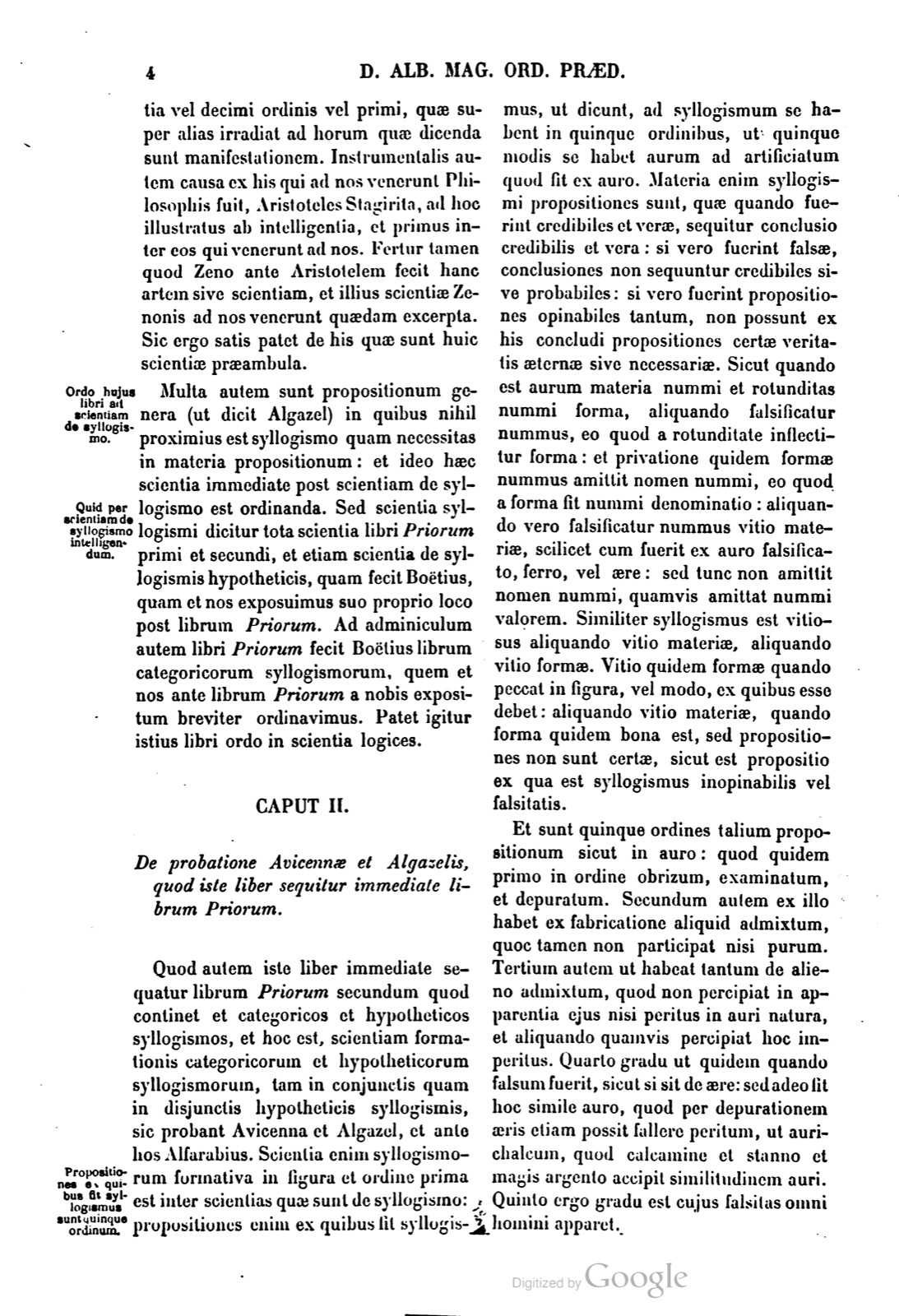
Caput II. De probatione Avicennae et Algazelis, quod iste liber sequitur immediate librum Priorum.
Quod autem iste liber immediate sequatur librum Priorum secundum quod continet et categoricos et hypotheticos syllogismos, et hoc est, scientiam formationis categoricorum et hypotheticorum syllogismorum, tam in conjunctis quam in disjunctis hypotheticis syllogismis, sic probant Avicenna et Algazel, et ante hos Alfarabius. Scientia enim syllogismorum formativa in figura et ordine prima est inter scientias quae sunt de syllogismo: propositiones enim ex quibus fit syllogismus, ut dicunt, ad syllogismum se habent in quinque ordinibus, ut quinque modis se habet aurum ad artificiatum quod fit ex auro. Materia enim syllogismi propositiones sunt, quae quando fuerint credibiles et verae, sequitur conclusio credibilis et vera: si vero fuerint falsae, conclusiones non sequuntur credibiles sive probabiles: si vero fuerint propositiones opinabiles tantum, non possunt ex his concludi propositiones certae veritatis aeternae sive necessariae. Sicut quando est aurum materia nummi et rotunditas nummi forma, aliquando falsificatur nummus, eo quod a rotunditate inflectitur forma: et privatione quidem formae nummus amittit nomen nummi, eo quod a forma fit nummi denominatio: aliquando vero falsificatur nummus vitio materiae, scilicet cum fuerit ex auro falsificato, ferro, vel aere: sed tunc non amittit nomen nummi, quamvis amittat nummi valorem. Similiter syllogismus est vitiosus aliquando vitio materiae, aliquando vitio formae. Vitio quidem formae quando peccat in figura, vel modo, ex quibus esse debet: aliquando vitio materiae, quando forma quidem bona est, sed propositiones non sunt certae, sicut est propositio ex qua est syllogismus inopinabilis vel falsitatis.
Et sunt quinque ordines talium propositionum sicut in auro: quod quidem primo in ordine obrizum, examinatum, et depuratum. Secundum autem ex illo habet ex fabricatione aliquid admixtum, quod tamen non participat nisi purum. Tertium autem ut habeat tantum de alieno admixtum, quod non percipiat in apparentia ejus nisi peritus in auri natura, et aliquando quamvis percipiat hoc imperitus. Quarto gradu ut quidem quando falsum fuerit, sicut si sit de aere: sed adeo fit hoc simile auro, quod per depurationem aeris etiam possit fallere peritum, ut aurichalcum, quod calamine et stanno et magis argento accipit similitudinem auri. Quinto ergo gradu est cujus falsitas omni homini apparet.
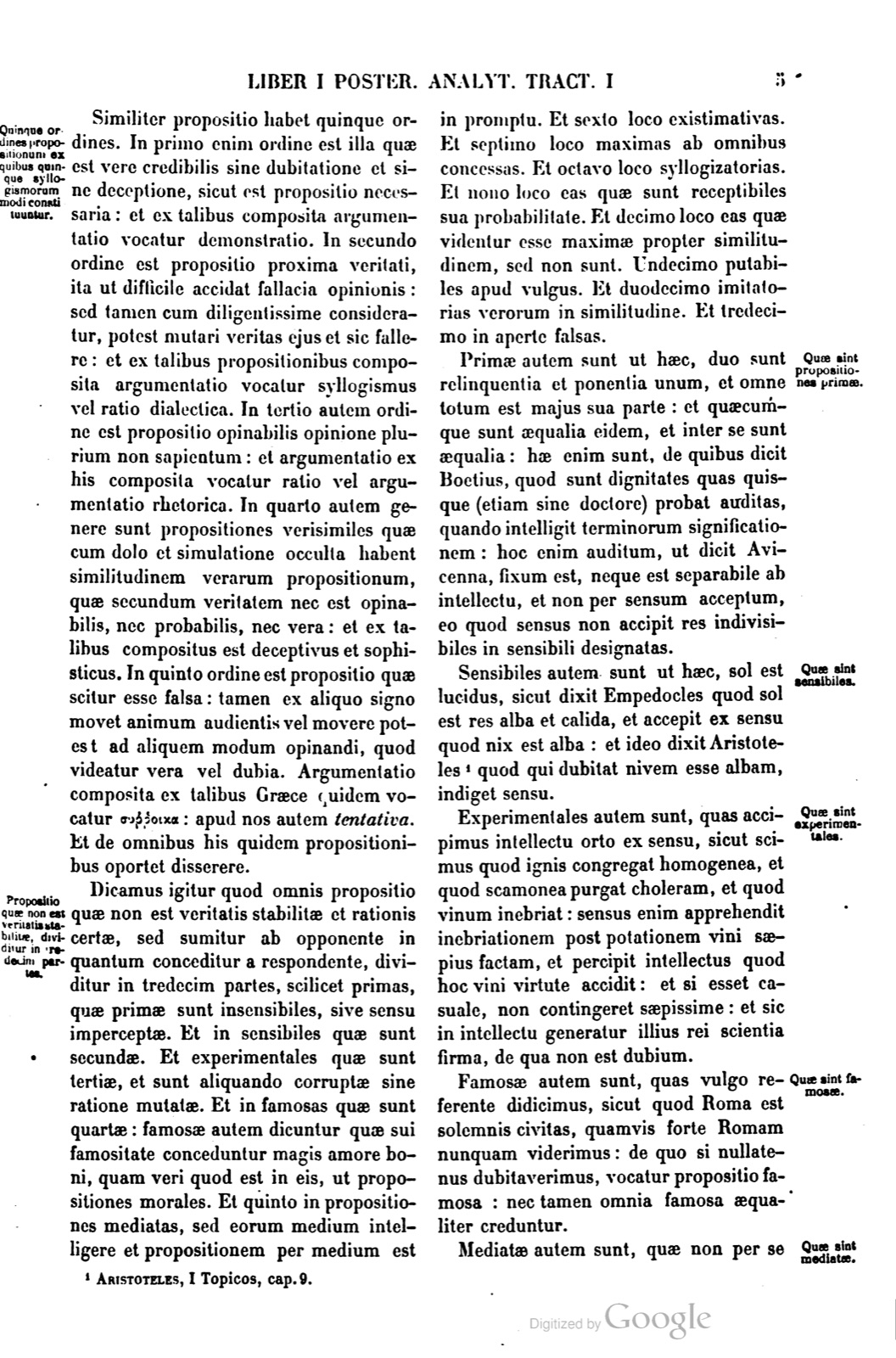
Similiter propositio habet quinque ordines. In primo enim ordine est illa quae est vere credibilis sine dubitatione et sine deceptione, sicut est propositio necessaria: et ex talibus composita argumentatio vocatur demonstratio. In secundo ordine est propositio proxima veritati, ita ut difficile accidat fallacia opinionis: sed tamen cum diligentissime consideratur, potest mutari veritas ejus et sic fallere: et ex talibus propositionibus composita argumentatio vocatur syllogismus vel ratio dialectica. In tertio autem ordine est propositio opinabilis opinione plurium non sapientum: et argumentatio ex his composita vocatur ratio vel argumentatio rhetorica. In quarto autem genere sunt propositiones verisimiles quae cum dolo et simulatione occulta habent similitudinem verarum propositionum, quae secundum veritatem nec est opinabilis, nec probabilis, nec vera: et ex talibus compositus est deceptivus et sophisticus. In quinto ordine est propositio quae scitur esse falsa: tamen ex aliquo signo movet animum audientis vel movere potest ad aliquem modum opinandi, quod videatur vera vel dubia. Argumentatio composita ex talibus Graece quidem vocatur συῤῥοικα: apud nos autem tentativa. Et de omnibus his quidem propositionibus oportet disserere.
Chapter II. On the proof of Avicenna and Algazel, that this book immediately follows the book of the Priors.
But that this book immediately follows the book of the Priors, insofar as that book contains both categorical and hypothetical syllogisms, and this is the science of the formation of categorical and hypothetical syllogisms, both in conjoined and in disjoined hypothetical syllogisms, Avicenna and Algazel prove in this way, and before them Alfarabius. For the science formative of syllogisms in figure and order is first among the sciences which are about syllogism. For the propositions from which syllogism is made, as they say, are related to syllogism in five orders, as gold is related in five modes to an artifact which is made from gold. For propositions are the matter of syllogism; when they are credible and true, a credible and true conclusion follows. But if they are false, credible or probable conclusions do not follow. But if they are propositions that are only opinionable, propositions of certain eternal or necessary truth cannot be concluded from them. Thus, when gold is the matter of a coin and roundness is the form of the coin, sometimes the coin is falsified because the form is bent away from roundness; and indeed by privation of form the coin loses the name of coin, because the naming of coin comes from the form. But sometimes the coin is falsified by a defect of matter, namely when it has been made from falsified gold, iron, or bronze; but then it does not lose the name of coin, although it loses the value of a coin. Similarly, a syllogism is defective sometimes by a defect of matter, sometimes by a defect of form. It is defective by a defect of form when it sins in figure or mode, from which it ought to have its being; and sometimes it is defective by a defect of matter, when the form is indeed good, but the propositions are not certain, as is the proposition from which there is a syllogism of what is unbelievable or of falsity.
And there are five orders of such propositions as in gold. The first in order is refined, examined, and purified. The second has something mixed into it from fabrication, which nevertheless participates only in the pure. The third has so much foreign matter mixed in that in its appearance only one skilled in the nature of gold perceives it, and sometimes even an unskilled person perceives this. In the fourth grade it is indeed false, as if it is made of bronze; but this becomes so similar to gold that, by purification of the bronze, it can even deceive an expert, as brass does, which by calamine and tin and especially silver receives the likeness of gold. Therefore in the fifth grade is that whose falsity is apparent to every man.
Similarly a proposition has five orders. In the first order is the proposition which is truly credible without doubt and without deception, as a necessary proposition is; and an argumentation composed from such propositions is called demonstration. In the second order is a proposition close to truth, so that a fallacy of opinion happens with difficulty; nevertheless, when it is considered most diligently, its truth can be changed and so deceive; and an argumentation composed from such propositions is called a syllogism or dialectical reasoning. But in the third order is a proposition opinionable by the opinion of many who are not wise; and the argumentation composed from these is called reasoning or rhetorical argumentation. In the fourth genus are truthlike propositions which, with hidden deceit and simulation, have a likeness of true propositions, although according to truth such a proposition is neither opinionable, nor probable, nor true; and from such propositions the deceptive and sophistical argument is composed. In the fifth order is a proposition which is known to be false; nevertheless, from some sign it moves the soul of the hearer, or can move it, to some mode of opining, so that it seems true or doubtful. Argumentation composed from such propositions is indeed called in Greek συῤῥοικα, but among us tentative. And concerning all these propositions we must discuss.
Dicamus igitur quod omnis propositio quae non est veritatis stabilitae et rationis certae, sed sumitur ab opponente in quantum conceditur a respondente, dividitur in tredecim partes, scilicet primas, quae primae sunt insensibiles, sive sensu imperceptae. Et in sensibiles quae sunt secundae. Et experimentales quae sunt tertiae, et sunt aliquando corruptae sine ratione mutatae. Et in famosas quae sunt quartae: famosae autem dicuntur quae sui famositate conceduntur magis amore boni quam veri quod est in eis, ut propositiones morales. Et quinto in propositiones mediatas, sed eorum medium intelligere et propositionem per medium est in promptu. Et sexto loco existimativas. Et septimo loco maximas ab omnibus concessas. Et octavo loco syllogizatorias. Et nono loco eas quae sunt receptibiles sua probabilitate. Et decimo loco eas quae videntur esse maximae propter similitudinem, sed non sunt. Undecimo putabiles apud vulgus. Et duodecimo imitatorias verorum in similitudine. Et tredecimo in aperte falsas.
Primae autem sunt ut haec, duo sunt relinquentia et ponentia unum, et omne totum est majus sua parte: et quaecumque sunt aequalia eidem, et inter se sunt aequalia: hae enim sunt, de quibus dicit Boetius, quod sunt dignitates quas quisque, etiam sine doctore, probat auditas, quando intelligit terminorum significationem: hoc enim auditum, ut dicit Avicenna, fixum est, neque est separabile ab intellectu, et non per sensum acceptum, eo quod sensus non accipit res indivisibiles in sensibili designatas.
Sensibiles autem sunt ut haec, sol est lucidus, sicut dixit Empedocles quod sol est res alba et calida, et accepit ex sensu quod nix est alba: et ideo dixit Aristoteles 3 quod qui dubitat nivem esse albam, indiget sensu.
Experimentales autem sunt, quas accipimus intellectu orto ex sensu, sicut scimus quod ignis congregat homogenea, et quod scamonea purgat choleram, et quod vinum inebriat: sensus enim apprehendit inebriationem post potationem vini saepius factam, et percipit intellectus quod hoc vini virtute accidit: et si esset casuale, non contingeret saepissime: et sic in intellectu generatur illius rei scientia firma, de qua non est dubium.
Famosae autem sunt, quas vulgo referente didicimus, sicut quod Roma est solemnis civitas, quamvis forte Romam nunquam viderimus: de quo si nullatenus dubitaverimus, vocatur propositio famosa: nec tamen omnia famosa aequaliter creduntur.
Mediatae autem sunt, quae non per se statim, sed per medium accipiuntur: quod tamen quando in promptu est intelligere, putatur propositio esse prima: cum tamen illa quae vere est prima, sciatur sine medio termino: intentio enim argumentationis syllogisticae est invenire medium terminum ab antecedentibus vel consequentibus vel repugnantibus. Quaesita autem in syllogismo sunt major et minor extremitas. Cujus exemplum est, quod cum auditur haec proposita propositio, binarius est quaternarii medietas, haec statim scitur per medium sic, medietas est una partium totius aequalis alteri: sed binarius est una partium quaternarii aequalis alteri: ergo binarius est medietas quaternarii: et tale accipit intellectus frequenter sine medio et argumentatione, cum tamen sine medio non sit, quia in promptu est medium.
Therefore let us say that every proposition which is not of stable truth and certain reason, but is taken from the opponent insofar as it is granted by the respondent, is divided into thirteen parts, namely first propositions, which are first and insensible, or imperceptible by sense; and into sensible propositions, which are second; and experimental propositions, which are third, and are sometimes corrupted, changed without reason; and into famous propositions, which are fourth. Famous propositions are said to be those which by their fame are granted more from love of the good than of the true which is in them, as moral propositions are. And fifth, into mediated propositions, but to understand their middle and the proposition through the middle is ready at hand. And in the sixth place, estimative propositions. And in the seventh place, maxims granted by all. And in the eighth place, syllogizing propositions. And in the ninth place, those which are receivable by their probability. And in the tenth place, those which seem to be maxims because of likeness, but are not. In the eleventh place, putable propositions among the common people. And in the twelfth place, imitative propositions of true things in likeness. And in the thirteenth place, propositions openly false.
The first propositions are such as these: two are the things which remove and posit one; and every whole is greater than its part; and whatever things are equal to the same thing are also equal among themselves. For these are the things about which Boethius says that they are dignities which each person, even without a teacher, proves when he has heard them, when he understands the signification of the terms. For this heard thing, as Avicenna says, is fixed, and is not separable from the intellect, and it is not received through sense, because sense does not receive indivisible things designated in the sensible.
But sensible propositions are such as these: the sun is bright, as Empedocles said that the sun is a white and hot thing, and he accepted from sense that snow is white; and therefore Aristotle said 3 that he who doubts that snow is white needs sense.
But experimental propositions are those which we receive by an intellect arisen from sense, as we know that fire gathers homogeneous things, and that scammony purges choler, and that wine makes one drunk. For sense apprehends drunkenness after the drinking of wine has happened many times, and the intellect perceives that this occurs by the power of wine. And if it were casual, it would not happen very often. And thus in the intellect there is generated firm science of that thing, concerning which there is no doubt.
But famous propositions are those which we have learned from the report of the common people, as that Rome is a solemn city, although perhaps we have never seen Rome. If we have in no way doubted concerning this, it is called a famous proposition; nevertheless not all famous propositions are believed equally.
But mediated propositions are those which are not received immediately through themselves, but through a middle. Nevertheless, when understanding this is ready at hand, the proposition is thought to be first, although that which is truly first is known without a middle term. For the intention of syllogistic argumentation is to discover a middle term from antecedents or consequents or repugnants. But the things sought in a syllogism are the major and minor extremes. An example of this is that when this proposed proposition is heard, namely that two is the half of four, this is at once known through a middle in this way: half is one of the parts of a whole equal to the other; but two is one of the parts of four equal to the other; therefore two is the half of four. And the intellect frequently receives such a thing without a middle and argumentation, although it is not without a middle, because the middle is ready at hand.
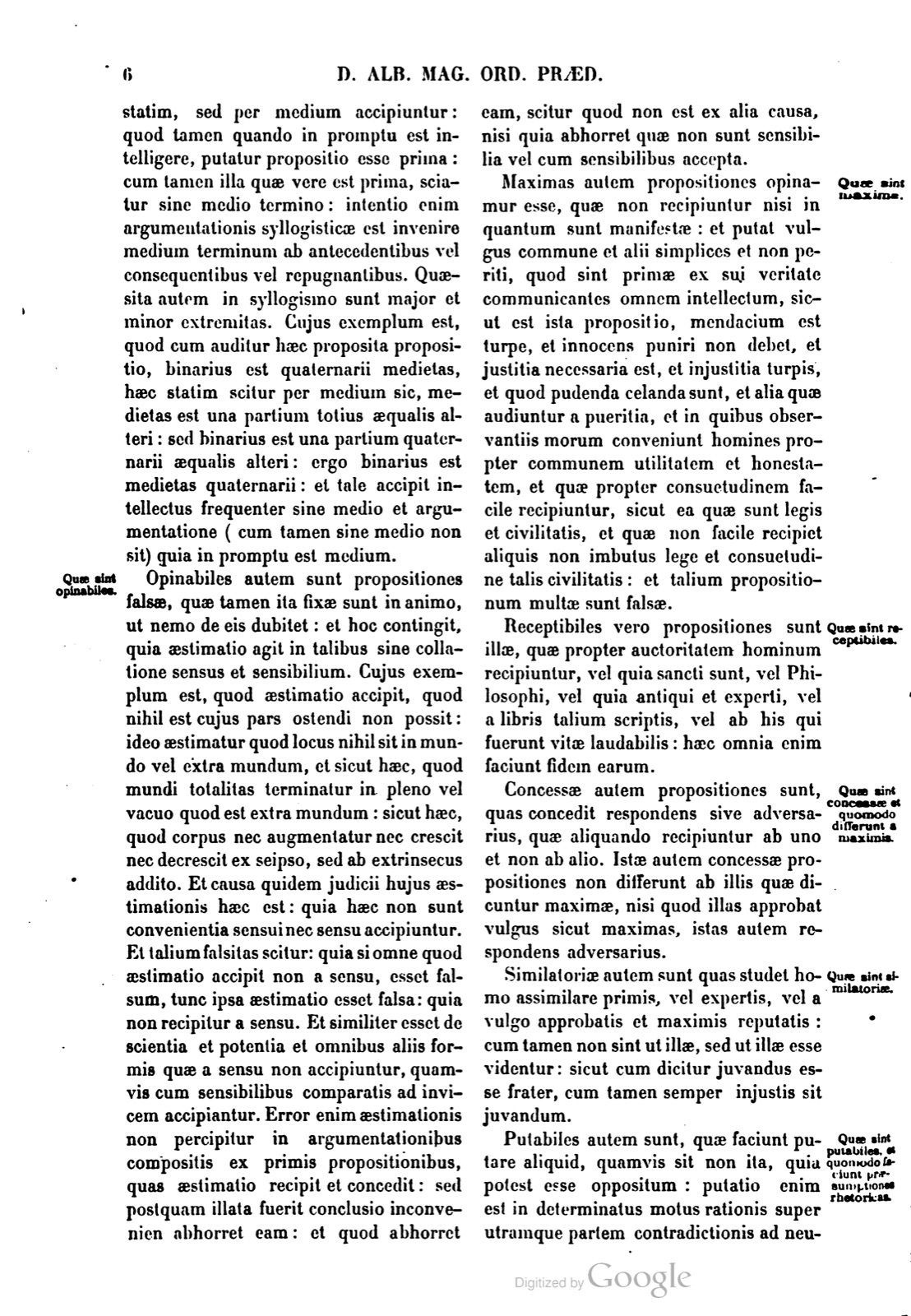
Opinabiles autem sunt propositiones falsae, quae tamen ita fixae sunt in animo, ut nemo de eis dubitet: et hoc contingit, quia aestimatio agit in talibus sine collatione sensus et sensibilium. Cujus exemplum est, quod aestimatio accipit, quod nihil est cujus pars ostendi non possit: ideo aestimatur quod locus nihil sit in mundo vel extra mundum, et sicut haec, quod mundi totalitas terminatur in pleno vel vacuo quod est extra mundum: sicut haec, quod corpus nec augmentatur nec crescit nec decrescit ex seipso, sed ab extrinsecus addito. Et causa quidem judicii hujus aestimationis haec est: quia haec non sunt convenientia sensui nec sensu accipiuntur. Et talium falsitas scitur: quia si omne quod aestimatio accipit non a sensu, esset falsum, tunc ipsa aestimatio esset falsa: quia non recipitur a sensu. Et similiter esset de scientia et potentia et omnibus aliis formis quae a sensu non accipiuntur, quamvis cum sensibilibus comparatis ad invicem accipiantur. Error enim aestimationis non percipitur in argumentationibus compositis ex primis propositionibus, quas aestimatio recipit et concedit: sed postquam illata fuerit conclusio inconveniens, abhorret eam: et quod abhorret eam, scitur quod non est ex alia causa, nisi quia abhorret quae non sunt sensibilia vel cum sensibilibus accepta.
Maximas autem propositiones opinamur esse, quae non recipiuntur nisi in quantum sunt manifestae: et putat vulgus commune et alii simplices et non periti, quod sint primae ex sui veritate communicantes omnem intellectum, sicut est ista propositio, mendacium est turpe, et innocens puniri non debet, et justitia necessaria est, et injustitia turpis, et quod pudenda celanda sunt, et alia quae audiuntur a pueritia, et in quibus observantiis morum conveniunt homines propter communem utilitatem et honestatem, et quae propter consuetudinem facile recipiuntur, sicut ea quae sunt legis et civilitatis, et quae non facile recipiet aliquis non imbutus lege et consuetudine talis civilitatis: et talium propositionum multae sunt falsae.
Receptibiles vero propositiones sunt illae, quae propter auctoritatem hominum recipiuntur, vel quia sancti sunt, vel Philosophi, vel quia antiqui et experti, vel a libris talium scriptis, vel ab his qui fuerunt vitae laudabilis: haec omnia enim faciunt fidem earum.
Concessae autem propositiones sunt, quas concedit respondens sive adversarius, quae aliquando recipiuntur ab uno et non ab alio. Istae autem concessae propositiones non differunt ab illis quae dicuntur maximae, nisi quod illas approbat vulgus sicut maximas, istas autem respondens adversarius.
Similatoriae autem sunt quas studet homo assimilare primis, vel expertis, vel a vulgo approbatis et maximis reputatis: cum tamen non sint ut illae, sed ut illae esse videntur: sicut cum dicitur juvandus esse frater, cum tamen semper injustis sit juvandum.
Putabiles autem sunt, quae faciunt putare aliquid, quamvis sit non ita, quia potest esse oppositum: putatio enim est indeterminatus motus rationis super utramque partem contradictionis ad neutram partem per rationem probabilem adjutus, sicut cum dicitur, qui nocte vadit, malefactor est et istae faciunt praesumptiones rhetoricas: et sicut hoc quod dicitur, qui associat inimicum, inimicus est, quamvis forte non sit ita.
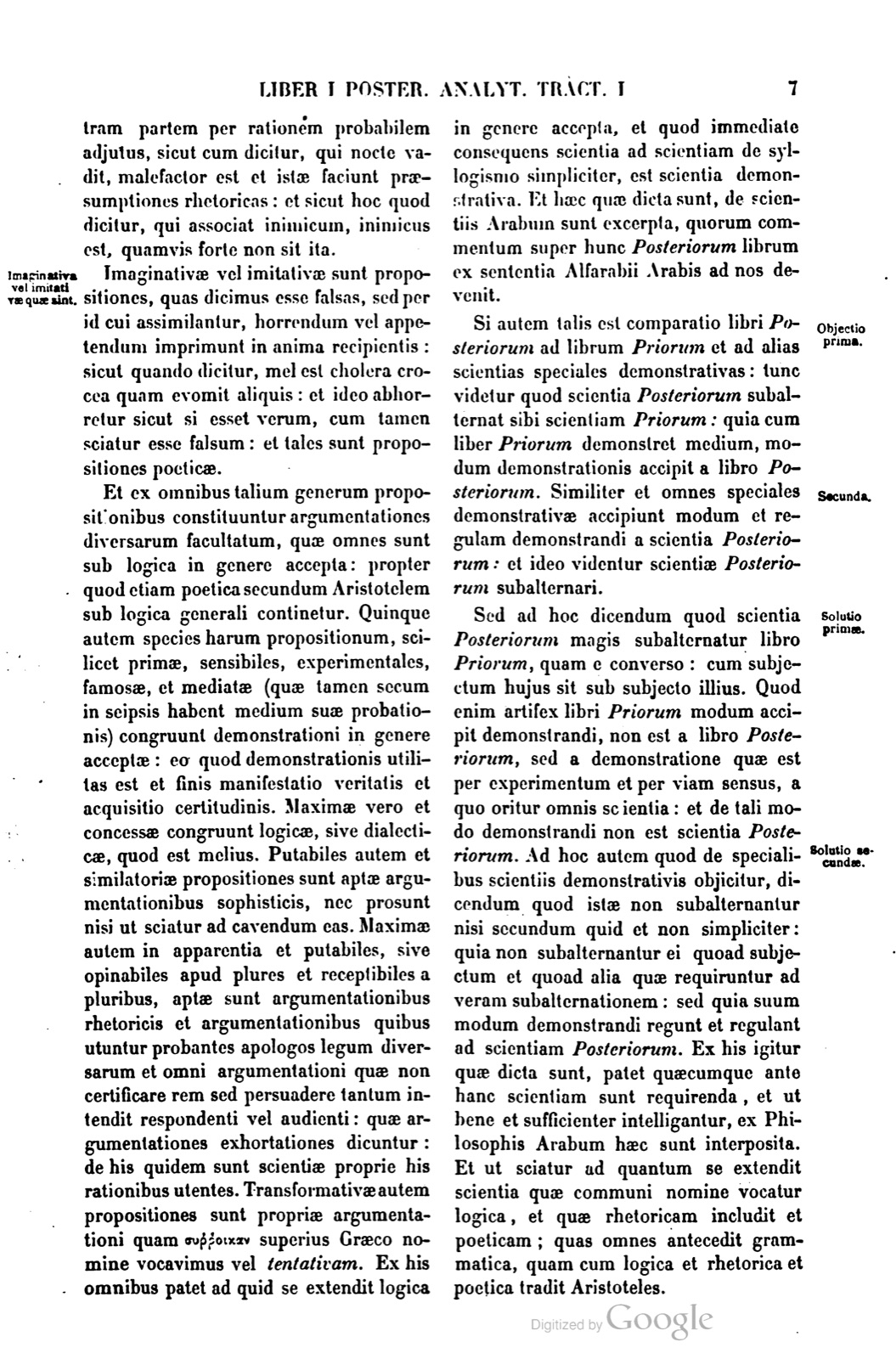
Imaginativae vel imitativae sunt propositiones, quas dicimus esse falsas, sed per id cui assimilantur, horrendum vel appetendum imprimunt in anima recipientis: sicut quando dicitur, mel est cholera crocea quam evomit aliquis: et ideo abhorretur sicut si esset verum, cum tamen sciatur esse falsum: et tales sunt propositiones poeticae.
But opinionable propositions are false propositions which nevertheless are so fixed in the soul that no one doubts them. This happens because estimation acts in such matters without comparison of sense and sensible things. An example of this is that estimation receives that there is nothing whose part cannot be shown; therefore it is estimated that place is nothing in the world or outside the world; and likewise this, that the totality of the world is terminated in the full or in the void which is outside the world; and likewise this, that a body is neither augmented nor grows nor decreases from itself, but from something added extrinsically. And the cause of the judgment of this estimation is this: because these things are not things agreeing with sense, nor are they received by sense. And the falsity of such things is known because, if everything that estimation receives not from sense were false, then estimation itself would be false, because it is not received from sense. And it would be similar concerning science and potency and all the other forms which are not received from sense, although they are received by comparison with sensible things in relation to one another. For the error of estimation is not perceived in argumentations composed from first propositions, which estimation receives and grants; but after an unfitting conclusion has been inferred, it abhors that conclusion. And that it abhors it is known to be from no other cause than because it abhors things that are not sensible or received with sensible things.
But we opine maxims to be propositions which are not received except insofar as they are manifest. And the common crowd and other simple and unskilled people think that they are first propositions communicating every intellect from their own truth, as is this proposition: a lie is base; and an innocent person ought not to be punished; and justice is necessary; and injustice is base; and shameful things must be hidden; and other things which are heard from boyhood, and in whose observances of morals men agree on account of common utility and honor, and which are easily received because of custom, such as those which belong to law and civic life, and which someone not imbued with the law and custom of such a civic life will not easily receive. And many of such propositions are false.
But receivable propositions are those which are received because of the authority of men, either because they are saints, or Philosophers, or because they are ancient and experienced, or from books written by such men, or from those who were of praiseworthy life; for all these things make faith in them.
But granted propositions are those which the respondent or adversary grants, which are sometimes received by one person and not by another. These granted propositions do not differ from those which are called maxims, except that the crowd approves those as maxims, but the respondent adversary approves these.
But assimilative propositions are those which a man strives to assimilate to first propositions, or to experienced propositions, or to those approved by the crowd and reckoned as maxims; although they are not as those are, but seem to be as those are. For example, when it is said that a brother must be helped, although nevertheless it is always the unjust whom one must help.
But putable propositions are those which make one think something, although it is not so, because the opposite can be the case. For thinking is an indeterminate motion of reason over each part of a contradiction, helped toward neither part by probable reason, as when it is said: he who goes by night is an evildoer; and these make rhetorical presumptions. And likewise this which is said, that one who associates with an enemy is an enemy, although perhaps it is not so.
Imaginative or imitative propositions are propositions which we say are false, but through that to which they are assimilated they impress something horrible or desirable on the soul of the receiver. For example, when it is said: honey is yellow choler which someone vomits; and therefore it is abhorred as if it were true, although nevertheless it is known to be false. And such are poetic propositions.
Et ex omnibus talium generum propositionibus constituuntur argumentationes diversarum facultatum, quae omnes sunt sub logica in genere accepta: propter quod etiam poetica secundum Aristotelem sub logica generali continetur. Quinque autem species harum propositionum, scilicet primae, sensibiles, experimentales, famosae, et mediatae, quae tamen secum in seipsis habent medium suae probationis, congruunt demonstrationi in genere acceptae: eo quod demonstrationis utilitas est et finis manifestatio veritatis et acquisitio certitudinis. Maximae vero et concessae congruunt logicae, sive dialecticae, quod est melius. Putabiles autem et similatoriae propositiones sunt aptae argumentationibus sophisticis, nec prosunt nisi ut sciatur ad cavendum eas. Maximae autem in apparentia et putabiles, sive opinabiles apud plures et receptibiles a pluribus, aptae sunt argumentationibus rhetoricis et argumentationibus quibus utuntur probantes apologos legum diversarum et omni argumentationi quae non certificare rem sed persuadere tantum intendit respondenti vel audienti: quae argumentationes exhortationes dicuntur: de his quidem sunt scientiae proprie his rationibus utentes. Transformativae autem propositiones sunt propriae argumentationi quam συῤῥοικαν superius Graeco nomine vocavimus vel tentativam. Ex his omnibus patet ad quid se extendit logica in genere accepta, et quod immediate consequens scientia ad scientiam de syllogismo simpliciter, est scientia demonstrativa. Et haec quae dicta sunt, de scientiis Arabum sunt excerpta, quorum commentum super hunc Posteriorum librum ex sententia Alfarabii Arabis ad nos devenit.
Si autem talis est comparatio libri Posteriorum ad librum Priorum et ad alias scientias speciales demonstrativas: tunc videtur quod scientia Posteriorum subalternat sibi scientiam Priorum: quia cum liber Priorum demonstret medium, modum demonstrationis accipit a libro Posteriorum. Similiter et omnes speciales demonstrativae accipiunt modum et regulam demonstrandi a scientia Posteriorum: et ideo videntur scientiae Posteriorum subalternari.
Sed ad hoc dicendum quod scientia Posteriorum magis subalternatur libro Priorum, quam e converso: cum subjectum hujus sit sub subjecto illius. Quod enim artifex libri Priorum modum accipit demonstrandi, non est a libro Posteriorum, sed a demonstratione quae est per experimentum et per viam sensus, a quo oritur omnis scientia: et de tali modo demonstrandi non est scientia Posteriorum. Ad hoc autem quod de specialibus scientiis demonstrativis objicitur, dicendum quod istae non subalternantur nisi secundum quid et non simpliciter: quia non subalternantur ei quoad subjectum et quoad alia quae requiruntur ad veram subalternationem: sed quia suum modum demonstrandi regunt et regulant ad scientiam Posteriorum. Ex his igitur quae dicta sunt, patet quaecumque ante hanc scientiam sunt requirenda, et ut bene et sufficienter intelligantur, ex Philosophis Arabum haec sunt interposita. Et ut sciatur ad quantum se extendit scientia quae communi nomine vocatur logica, et quae rhetoricam includit et poeticam; quas omnes antecedit grammatica, quam cum logica et rhetorica et poetica tradit Aristoteles.
And from all propositions of such genera there are constituted the argumentations of diverse faculties, all of which are under logic taken in the genus. On account of this, according to Aristotle, poetics also is contained under general logic. But five species of these propositions, namely first, sensible, experimental, famous, and mediated propositions, which nevertheless have with themselves in themselves the middle of their proof, agree with demonstration taken in the genus, because the utility and end of demonstration is the manifestation of truth and the acquisition of certainty. But maxims and granted propositions agree with logic, or dialectic, which is better. But putable and assimilative propositions are apt for sophistical argumentations, and are of use only so that they may be known in order to avoid them. But maxims in appearance, and putable propositions, or opinionable propositions among many, and propositions receivable by many, are apt for rhetorical argumentations and for the argumentations which those proving apologues of diverse laws use, and for every argumentation which does not intend to certify the thing but only to persuade the respondent or hearer. These argumentations are called exhortations; concerning them there are sciences properly using these reasonings. But transformative propositions are proper to the argumentation which above we called by the Greek name συῤῥοικαν, or tentative. From all these things it is evident how far logic taken in the genus extends, and that the science immediately consequent upon the science about syllogism simply is demonstrative science. And these things which have been said are excerpted from the sciences of the Arabs, whose commentary on this book of the Posterior Analytics has come down to us from the opinion of Alfarabius the Arab.
But if such is the comparison of the book of the Posterior Analytics to the book of the Priors and to the other special demonstrative sciences, then it seems that the science of the Posterior Analytics subalternates to itself the science of the Priors, because, since the book of the Priors demonstrates the middle, it receives the mode of demonstration from the book of the Posterior Analytics. Similarly, all the special demonstrative sciences receive the mode and rule of demonstrating from the science of the Posterior Analytics; and therefore they seem to be subalternated to the sciences of the Posterior Analytics.
But to this it must be said that the science of the Posterior Analytics is more subalternated to the book of the Priors than conversely, since the subject of this science is under the subject of that one. For the fact that the artisan of the book of the Priors receives the mode of demonstrating is not from the book of the Posterior Analytics, but from demonstration which is through experience and by way of sense, from which every science arises; and concerning such a mode of demonstrating the science of the Posterior Analytics is not concerned. But as to what is objected concerning the special demonstrative sciences, it must be said that these are not subalternated except in a qualified respect and not simply, because they are not subalternated to it as to subject and as to the other things which are required for true subalternation, but because they rule and regulate their mode of demonstrating according to the science of the Posterior Analytics. From these things therefore which have been said, it is evident what things are required before this science; and so that they may be understood well and sufficiently, these things have been inserted from the Arab Philosophers. And so that it may be known how far the science which by the common name is called logic extends, and which includes rhetoric and poetics, all of which grammar precedes, Aristotle hands grammar down with logic and rhetoric and poetics.
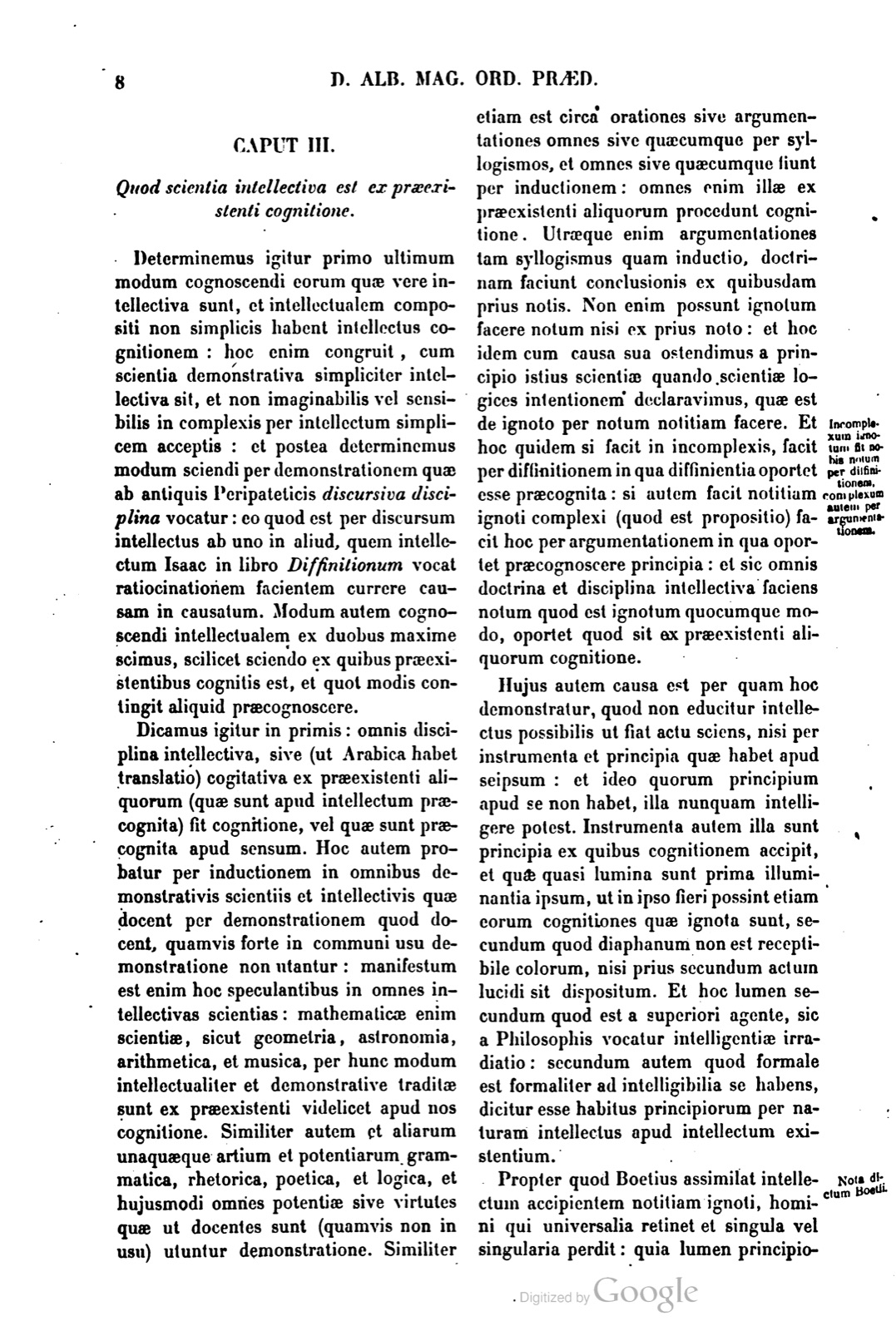
Caput III. Quod scientia intellectiva est ex praeexistenti cognitione.
Determinemus igitur primo ultimum modum cognoscendi eorum quae vere intellectiva sunt, et intellectualem compositi non simplicis habent intellectus cognitionem: hoc enim congruit, cum scientia demonstrativa simpliciter intellectiva sit, et non imaginabilis vel sensibilis in complexis per intellectum simplicem acceptis: et postea determinemus modum sciendi per demonstrationem quae ab antiquis Peripateticis discursiva disciplina vocatur: eo quod est per discursum intellectus ab uno in aliud, quem intellectum Isaac in libro Diffinitionum vocat ratiocinationem facientem currere causam in causatum. Modum autem cognoscendi intellectualem ex duobus maxime scimus, scilicet sciendo ex quibus praeexistentibus cognitis est, et quot modis contingit aliquid praecognoscere.
Dicamus igitur in primis: omnis disciplina intellectiva, sive, ut Arabica habet translatio, cogitativa, ex praeexistenti aliquorum, quae sunt apud intellectum praecognita, fit cognitione, vel quae sunt praecognita apud sensum. Hoc autem probatur per inductionem in omnibus demonstrativis scientiis et intellectivis quae docent per demonstrationem quod docent, quamvis forte in communi usu demonstratione non utantur: manifestum est enim hoc speculantibus in omnes intellectivas scientias: mathematicae enim scientiae, sicut geometria, astronomia, arithmetica, et musica, per hunc modum intellectualiter et demonstrative traditae sunt ex praeexistenti videlicet apud nos cognitione. Similiter autem et aliarum unaquaeque artium et potentiarum grammatica, rhetorica, poetica, et logica, et hujusmodi omnes potentiae sive virtutes quae ut docentes sunt, quamvis non in usu, utuntur demonstratione. Similiter etiam est circa orationes sive argumentationes omnes sive quaecumque per syllogismos, et omnes sive quaecumque fiunt per inductionem: omnes enim illae ex praeexistenti aliquorum procedunt cognitione. Utraeque enim argumentationes tam syllogismus quam inductio, doctrinam faciunt conclusionis ex quibusdam prius notis. Non enim possunt ignotum facere notum nisi ex prius noto: et hoc idem cum causa sua ostendimus a principio istius scientiae quando scientiae logices intentionem declaravimus, quae est de ignoto per notum notitiam facere. Et hoc quidem si facit in incomplexis, facit per diffinitionem in qua diffinientia oportet esse praecognita: si autem facit notitiam ignoti complexi, quod est propositio, facit hoc per argumentationem in qua oportet praecognoscere principia: et sic omnis doctrina et disciplina intellectiva faciens notum quod est ignotum quocumque modo, oportet quod sit ex praeexistenti aliquorum cognitione.
Hujus autem causa est per quam hoc demonstratur, quod non educitur intellectus possibilis ut fiat actu sciens, nisi per instrumenta et principia quae habet apud seipsum: et ideo quorum principium apud se non habet, illa nunquam intelligere potest. Instrumenta autem illa sunt principia ex quibus cognitionem accipit, et quae quasi lumina sunt prima illuminantia ipsum, ut in ipso fieri possint etiam eorum cognitiones quae ignota sunt, secundum quod diaphanum non est receptibile colorum, nisi prius secundum actum lucidi sit dispositum. Et hoc lumen secundum quod est a superiori agente, sic a Philosophis vocatur intelligentiae irradiatio: secundum autem quod formale est formaliter ad intelligibilia se habens, dicitur esse habitus principiorum per naturam intellectus apud intellectum existentium.
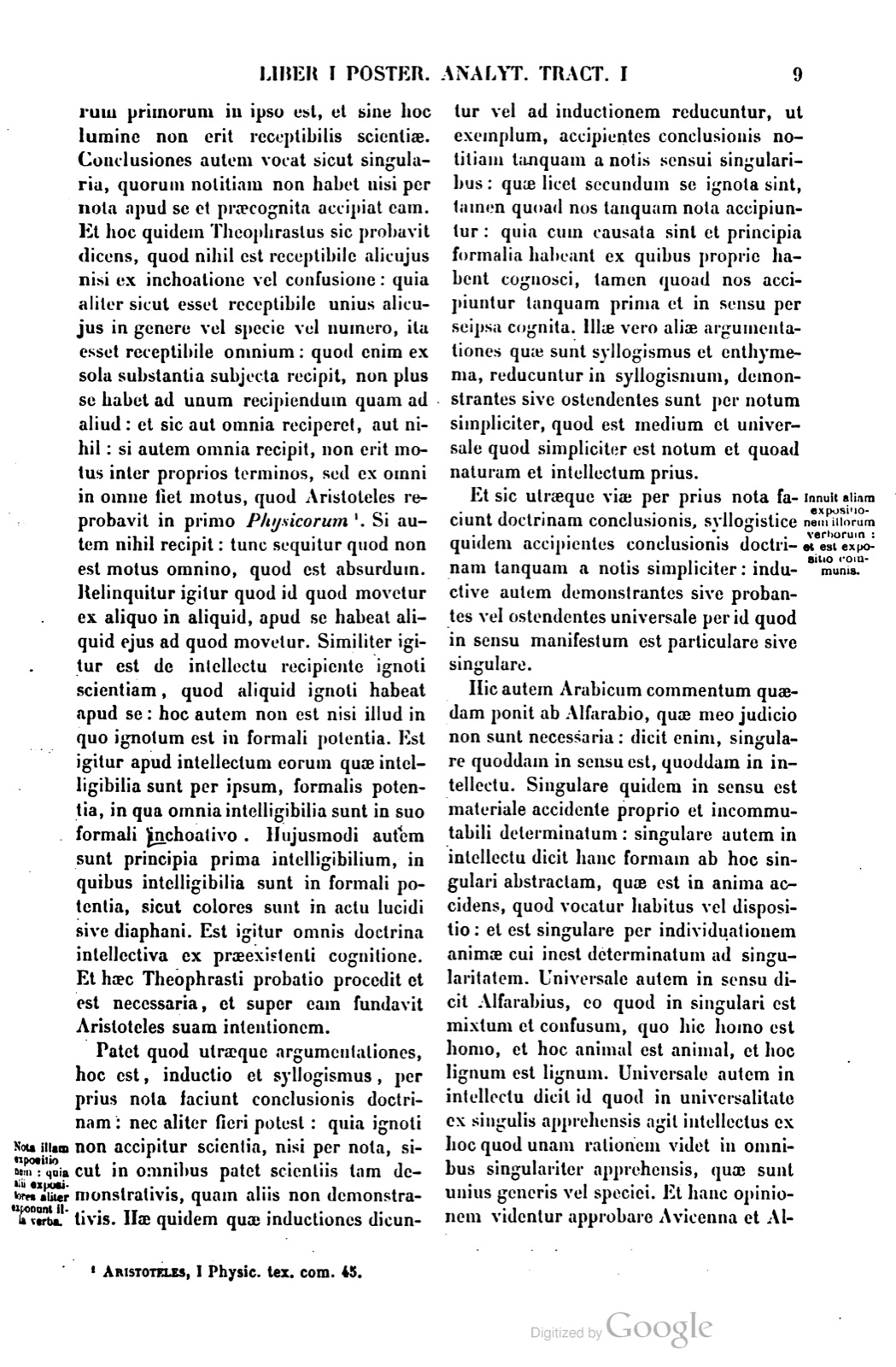
Propter quod Boetius assimilat intellectum accipientem notitiam ignoti, homini qui universalia retinet et singula vel singularia perdit: quia lumen principiorum primorum in ipso est, et sine hoc lumine non erit receptibilis scientiae. Conclusiones autem vocat sicut singularia, quorum notitiam non habet nisi per nota apud se et praecognita accipiat eam. Et hoc quidem Theophrastus sic probavit dicens, quod nihil est receptibile alicujus nisi ex inchoatione vel confusione: quia aliter sicut esset receptibile unius alicujus in genere vel specie vel numero, ita esset receptibile omnium: quod enim ex sola substantia subjecta recipit, non plus se habet ad unum recipiendum quam ad aliud: et sic aut omnia reciperet, aut nihil: si autem omnia recipit, non erit motus inter proprios terminos, sed ex omni in omne fiet motus, quod Aristoteles reprobavit in primo Physicorum 4. Si autem nihil recipit: tunc sequitur quod non est motus omnino, quod est absurdum. Relinquitur igitur quod id quod movetur ex aliquo in aliquid, apud se habeat aliquid ejus ad quod movetur. Similiter igitur est de intellectu recipiente ignoti scientiam, quod aliquid ignoti habeat apud se: hoc autem non est nisi illud in quo ignotum est in formali potentia. Est igitur apud intellectum eorum quae intelligibilia sunt per ipsum, formalis potentia, in qua omnia intelligibilia sunt in suo formali inchoativo. Hujusmodi autem sunt principia prima intelligibilium, in quibus intelligibilia sunt in formali potentia, sicut colores sunt in actu lucidi sive diaphani. Est igitur omnis doctrina intellectiva ex praeexistenti cognitione. Et haec Theophrasti probatio procedit et est necessaria, et super eam fundavit Aristoteles suam intentionem.
Chapter III. That intellectual science is from pre-existing cognition.
Therefore let us first determine the ultimate mode of knowing those things which are truly intellective, and which have intellectual cognition of a composite intellect, not of a simple one. For this is fitting, since demonstrative science is simply intellective, and is not imaginable or sensible in complexes received through the simple intellect. And afterward let us determine the mode of knowing through demonstration, which by the ancient Peripatetics is called discursive discipline, because it is through a discourse of the intellect from one thing into another, which intellect Isaac in the book of Definitions calls reasoning that makes the cause run into the caused. But we know the intellectual mode of knowing especially from two things, namely by knowing from what pre-existing known things it is, and in how many modes it happens that something is known beforehand.
Therefore let us say first: every intellective discipline, or, as the Arabic translation has it, cogitative discipline, comes to be from the pre-existing cognition of certain things which are known beforehand in the intellect, or which are known beforehand in sense. This is proved by induction in all demonstrative and intellective sciences which teach by demonstration what they teach, although perhaps in common use they do not use demonstration. For this is manifest to those speculating into all intellective sciences: for the mathematical sciences, such as geometry, astronomy, arithmetic, and music, have been handed down intellectually and demonstratively through this mode, namely from a cognition pre-existing in us. Similarly also each of the other arts and powers, grammar, rhetoric, poetics, and logic, and all powers or virtues of this kind, which as teaching powers, although not in use, use demonstration. Similarly it is also the case concerning all discourses or argumentations, or whatever are made through syllogisms, and all or whatever are made through induction; for all those proceed from pre-existing cognition of certain things. For each argumentation, both syllogism and induction, makes teaching of the conclusion from certain things known before. For they cannot make the unknown known except from something known before. And we showed this same thing with its cause from the beginning of this science, when we declared the intention of the science of logic, which is to make knowledge concerning the unknown through the known. And if this makes knowledge in incomplex things, it does so through definition, in which the defining things must be known beforehand; but if it makes knowledge of an unknown complex, which is a proposition, it does this through argumentation, in which it is necessary to know the principles beforehand. And thus every intellective teaching and discipline which makes known what is unknown in whatever mode must be from pre-existing cognition of certain things.
The cause of this, through which it is demonstrated, is that the possible intellect is not drawn out so that it becomes actually knowing except through instruments and principles which it has within itself. And therefore those things whose principle it does not have within itself, it can never understand. But those instruments are principles from which it receives cognition, and which are as first lights illuminating it, so that in it the cognitions even of those things which are unknown can come to be, according as the diaphanous is not receptive of colors unless it has first been disposed according to the actuality of the lucid. And this light, insofar as it is from a superior agent, is in this way called by the Philosophers an irradiation of intelligence; but insofar as it is formal, having itself formally toward intelligible things, it is said to be the habit of principles existing by the nature of intellect within the intellect.
On account of this Boethius likens the intellect receiving knowledge of the unknown to a man who retains universals and loses individual or singular things, because the light of the first principles is in him, and without this light he will not be receptive of science. But he calls conclusions like singular things, of which the intellect does not have knowledge unless it receives it through things known and foreknown within itself. And Theophrastus proved this in this way, saying that nothing is receptive of something except from an inchoation or confusion of it, because otherwise, just as it would be receptive of some one thing in genus or species or number, so it would be receptive of all things. For that which receives from the subject substance alone is not more disposed to receiving one thing than another; and thus it would either receive all things or nothing. But if it receives all things, there will not be motion between proper termini, but motion will come to be from every thing into every thing, which Aristotle rejected in the first book of the Physics 4. But if it receives nothing, then it follows that there is no motion at all, which is absurd. Therefore it remains that what is moved from something into something has within itself something of that to which it is moved. Similarly, therefore, it is with the intellect receiving science of the unknown, that it has within itself something of the unknown. But this is only that in which the unknown is in formal potency. Therefore there is in the intellect a formal potency of those things which are intelligible through it, in which all intelligible things are in their formal inchoative state. Of this kind are the first principles of intelligible things, in which intelligible things are in formal potency, as colors are in the actuality of the lucid or diaphanous. Therefore every intellective teaching is from pre-existing cognition. And this proof of Theophrastus proceeds and is necessary, and upon it Aristotle founded his intention.
Patet quod utraeque argumentationes, hoc est, inductio et syllogismus, per prius nota faciunt conclusionis doctrinam: nec aliter fieri potest: quia ignoti non accipitur scientia, nisi per nota, sicut in omnibus patet scientiis tam demonstrativis, quam aliis non demonstrativis. Illae quidem quae inductiones dicuntur vel ad inductionem reducuntur, ut exemplum, accipientes conclusionis notitiam tanquam a notis sensui singularibus: quae licet secundum se ignota sint, tamen quoad nos tanquam nota accipiuntur: quia cum causata sint et principia formalia habeant ex quibus proprie habent cognosci, tamen quoad nos accipiuntur tanquam prima et in sensu per seipsa cognita. Illae vero aliae argumentationes quae sunt syllogismus et enthymema, reducuntur in syllogismum, demonstrantes sive ostendentes sunt per notum simpliciter, quod est medium et universale quod simpliciter est notum et quoad naturam et intellectum prius.
Et sic utraeque viae per prius nota faciunt doctrinam conclusionis, syllogistice quidem accipientes conclusionis doctrinam tanquam a notis simpliciter: inductive autem demonstrantes sive probantes vel ostendentes universale per id quod in sensu manifestum est particulare sive singulare.
Hic autem Arabicum commentum quaedam ponit ab Alfarabio, quae meo judicio non sunt necessaria: dicit enim, singulare quoddam in sensu est, quoddam in intellectu. Singulare quidem in sensu est materiale accidente proprio et incommunicabili determinatum: singulare autem in intellectu dicit hanc formam ab hoc singulari abstractam, quae est in anima accidens, quod vocatur habitus vel dispositio: et est singulare per individuationem animae cui inest determinatum ad singularitatem. Universale autem in sensu dicit Alfarabius, eo quod in singulari est mixtum et confusum, quo hic homo est homo, et hoc animal est animal, et hoc lignum est lignum. Universale autem in intellectu dicit id quod in universalitate ex singulis apprehensis agit intellectus ex hoc quod unam rationem videt in omnibus singulariter apprehensis, quae sunt unius generis vel speciei. Et hanc opinionem videntur approbare Avicenna et Algazel et quidam alii, quam et ego non vitupero: eo quod multorum est, et fere omnium etiam Latinorum. Sed hoc dico, quod haec opinio non congruit dictis Aristotelis, nec universaliter est vera: quia ex hoc quod universale denudatur a materia et individuantibus, eo ipso est universale: et quod hoc modo abstrahitur ab uno, est idem cum eo quod abstrahitur ab alio: unde eo ipso quod est in intellectu, est universale.
It is evident that both argumentations, that is, induction and syllogism, make teaching of the conclusion through things known before; nor can it happen otherwise, because science of the unknown is not received except through things known, as is evident in all sciences, both demonstrative sciences and other non-demonstrative ones. Those indeed which are called inductions, or are reduced to induction, as an example is, receive knowledge of the conclusion as from singular things known to sense. Although these are unknown in themselves, nevertheless with respect to us they are received as known, because, although they are caused things and have formal principles from which they properly have to be known, nevertheless with respect to us they are received as first and known through themselves in sense. But those other argumentations which are syllogism and enthymeme are reduced to syllogism; demonstrating or showing, they are through what is known simply, which is the middle and universal, which is known simply and is prior with respect to nature and intellect.
And thus both ways make teaching of the conclusion through things known before: syllogistically, indeed, receiving teaching of the conclusion as from things known simply; but inductively, demonstrating or proving or showing the universal through that which is manifest in sense, the particular or singular.
Here the Arabic commentary posits certain things from Alfarabius which, in my judgment, are not necessary. For it says that one singular is in sense, another in intellect. The singular in sense indeed is determined by a proper and incommunicable material accident. But by the singular in intellect it means this form abstracted from this singular, which is an accident in the soul, which is called a habit or disposition; and it is singular through the individuation of the soul in which it inheres, determined to singularity. But Alfarabius says that the universal in sense is that by which in the singular there is something mixed and confused, by which this man is man, and this animal is animal, and this wood is wood. But he says that the universal in intellect is that which the intellect, in universality from singular things apprehended, acts from this, that it sees one account in all singularly apprehended things which are of one genus or species. And Avicenna and Algazel and certain others seem to approve this opinion, which I too do not blame, because it belongs to many, and to almost all the Latins as well. But I say this: that this opinion does not agree with the sayings of Aristotle, nor is it universally true, because from the fact that the universal is stripped of matter and individuating things, by that very fact it is universal; and what is abstracted in this way from one thing is the same as what is abstracted from another. Hence by the very fact that it is in the intellect, it is universal.
Et quod quidam dicunt, quod individuatur per intellectum sicut per subjectum, non est dictum secundum Aristotelem, nec secundum Peripateticos: quia non est in intellectu sicut accidens in subjecto, nec intellectus universalis hoc modo est receptivus, sed potius prout est in lumine intelligentiae, formaliter illustratur: et ideo recipit ipsum sicut species ejus quod est intelligibile, sicut lucidum secundum actum species est formalis colorum, et recipit ipsum secundum quod sunt in esse abstractionis. Aliter enim sequeretur quod intellectus a quolibet intelligibili denominaretur sicut subjectum denominatur ab accidente: et sicut homo dicitur albus, vel niger, vel coloratus, et qualis: et sic intellectus diceretur humanus ab hominis forma, et asininus ab asini forma, et ligneus a forma ligni, quod absurdum est. Et ideo secundum Aristotelem, universale est in intellectu in esse abstractionis: et hoc est sibi in intellectu esse quod est abstractum esse, quod est in actu lucidi esse. Et ideo non denominat intellectum: quia specificatum non denominat speciem vel specificans, sed potius species et specificans denominat specificatum: intellectus species est intelligibilium: et ideo id quod intelligitur, dicitur intellectuale secundum suum esse, et dicitur universale secundum suam potentiam: et intellectus non dicitur universalis, neque humanus, neque asininus. Ista est directe opinio et sententia Aristotelis loquentis contra Theophrastum, qui fuit de priori opinione quae dicta est, quod intellectus receptivus sit formae abstractae, sicut materia receptiva est formae.
Hujus autem adhuc alia ratio est: quia universalis mixti in singularibus causa individuationis non est substantia universalis quae de se communicabilis est, nec potest esse idem principium communicabilitatis et incommunicabilitatis, sed causa individuationis est materia et proprium accidens: cessante ergo causa, universale remanet universale: cessat autem causa separata materia et accidente proprio individuante: manet ergo universale sicut fuit de sui natura et substantia: sic autem cessat causa per intellectum: ergo in intellectu est universale, et est universale per hoc quod est in intellectu, et secundum quod est in intellectu.
Adhuc si quod abstrahitur a Socrate, singulariter est in intellectu, et id quod abstrahitur a Platone, et ita de aliis: tunc sequeretur quod ejusdem penitus rationis formae multae simul et semel et secundum idem essent in eodem subjecto, quod est impossibile et non intelligibile.
Adhuc autem vane et frustra essent ibi multa diversa a singularibus accepta: quia idem judicium intellectus est per unum sicut per multa. Et haec omnia dicit Aristoteles in diversis locis, et sunt vera: et ideo opinio sua est, quod universale est universal per hoc quod in intellectu est, nec aliquo modo potest individuari in ipso.
Dicat tamen quilibet quod vult, quod ego non praejudicio alicui, sed dico quod dictum Aristotelis intelligo: dictum autem illorum qui dicunt universale per esse individuum esse in intellectu sicut in subjecto, nullo modo possum intelligere. Sicut autem est in scientiis perfectam argumentationem habentibus, ita etiam est in potentiis et artibus habentibus argumentationem imperfectam, quod omnes fiunt ex praeexistenti cognitione et ex praecognitis.
Similiter enim, sicut dictum est, et rhetoricae scientiae persuadent. Dico autem persuadent: quia non vere probant vel concludunt propter mediorum suorum et principiorum imperfectionem, quae generalia non sunt, et dici de omni vel de nullo non habent: et ideo ex verisimilibus potius generant persuasionem et suspicionem quam certam scientiam: aut enim persuadent per exempla prius nota, quod est facere quamdam inductionem, quia multa exempla inductionem faciunt, non quidem sola, sed addito quod simile sit in omnibus, vel quod sic sit de singulis: et ideo exempla sola non sunt vera inductio, sed inductionis aliquid, et tunc persuadent ex prius notis, ut paulo ante dictum est: aut persuadent per enthymemata, quod scilicet persuadere vere est syllogismus: quia duo enthymemata sine omni alio addito faciunt syllogismum vere: et haec in fine secundi Priorum demonstrata sunt: et si syllogismus est ex praeexistenti cognitione, tunc sequitur quod etiam enthymema sit ex praeexistenti cognitione. Probatum est ergo et per inductionem scientiarum et per inductionem argumentationum et perfectarum et imperfectarum, quod omnis scientia intellectiva est ex praeexistenti cognitione.
And what certain persons say, that it is individuated through the intellect as through a subject, is not said according to Aristotle, nor according to the Peripatetics, because it is not in the intellect as an accident is in a subject, nor is the universal intellect receptive in this mode. Rather, insofar as it is in the light of intelligence, it is formally illuminated; and therefore it receives it as the species of that which is intelligible, as the lucid according to actuality is the formal species of colors, and it receives it according as they are in the being of abstraction. For otherwise it would follow that the intellect would be denominated by any intelligible thing, just as a subject is denominated by an accident; and as a man is called white or black or colored and qualified, so the intellect would be called human from the form of man, and asinine from the form of ass, and wooden from the form of wood, which is absurd. And therefore according to Aristotle the universal is in the intellect in the being of abstraction; and for it to be in the intellect is this, namely to be abstracted, which is to be in the actuality of the lucid. And therefore it does not denominate the intellect, because the specified thing does not denominate the species or the specifying thing, but rather the species and the specifying thing denominate the specified thing. The intellect is the species of intelligible things; and therefore that which is understood is called intellectual according to its being, and is called universal according to its potency; and the intellect is not called universal, nor human, nor asinine. This is directly the opinion and judgment of Aristotle speaking against Theophrastus, who held the earlier opinion that has been stated, that the receptive intellect is receptive of the abstracted form as matter is receptive of form.
There is still another reason for this: because the cause of individuation of the mixed universal in singulars is not the universal substance, which of itself is communicable, nor can the same principle be the principle of communicability and incommunicability; rather, the cause of individuation is matter and a proper accident. Therefore when the cause ceases, the universal remains universal. But the cause ceases when matter and the proper individuating accident have been separated; therefore the universal remains as it was from its own nature and substance. But in this way the cause ceases through the intellect; therefore in the intellect it is universal, and it is universal through this, that it is in the intellect, and according as it is in the intellect.
Furthermore, if what is abstracted from Socrates is singularly in the intellect, and likewise what is abstracted from Plato, and so with the others, then it would follow that many forms of altogether the same account would be at once and together and according to the same thing in the same subject, which is impossible and unintelligible.
Furthermore, many diverse things accepted from singulars would be there vainly and uselessly, because the judgment of the intellect is the same through one as through many. And Aristotle says all these things in diverse places, and they are true; and therefore his opinion is that the universal is universal through this, that it is in the intellect, nor can it in any way be individuated in it.
Nevertheless let anyone say what he wishes; I do not prejudice anyone, but I say that I understand the saying of Aristotle. But the saying of those who say that the universal through individual being is in the intellect as in a subject, I can in no way understand. But as it is in the sciences having perfect argumentation, so it is also in the powers and arts having imperfect argumentation, that all come to be from pre-existing cognition and from things known beforehand.
Similarly, as has been said, rhetorical sciences also persuade. But I say persuade because they do not truly prove or conclude, on account of the imperfection of their middles and principles, which are not general and do not have being said of every or of none. Therefore from truthlike things they generate persuasion and suspicion rather than certain science. For either they persuade through examples known before, which is to make a certain induction, because many examples make an induction, not indeed by themselves alone, but with the addition that the similar is in all things, or that it is so concerning singulars; and therefore examples alone are not true induction, but something of induction, and then they persuade from things known before, as was said a little earlier. Or they persuade through enthymemes, because to persuade truly is a syllogism, since two enthymemes without anything else added make a syllogism truly. And these things were demonstrated at the end of the second book of the Priors. And if syllogism is from pre-existing cognition, then it follows that enthymeme too is from pre-existing cognition. Therefore it has been proved, both through induction of sciences and through induction of argumentations, both perfect and imperfect, that every intellective science is from pre-existing cognition.
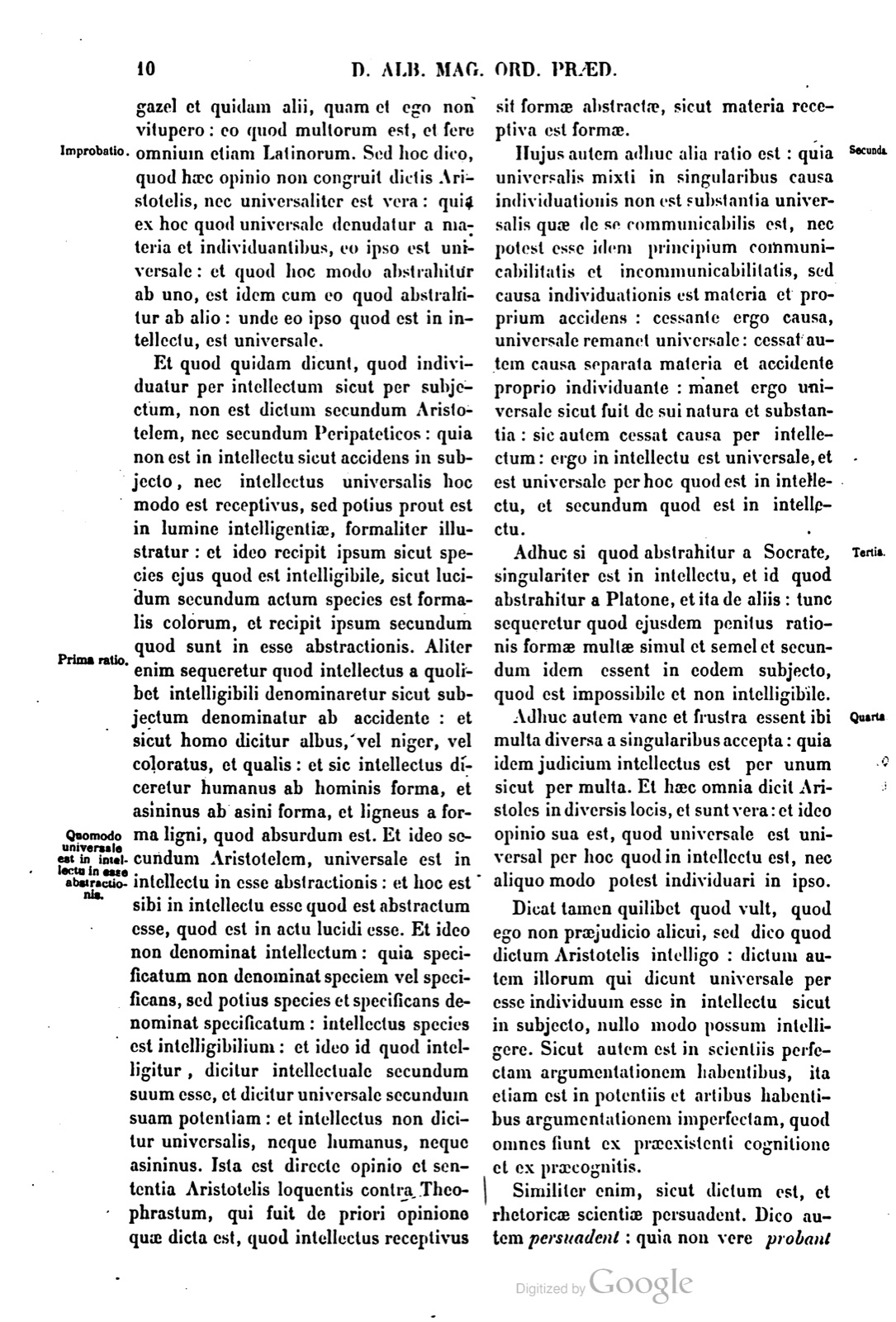
Nec dicitur scientia intellectiva, eo quod aliqua sit scientia sensibilis: sed ideo dicitur, quia aliqua cognitio est experimentalis quae non est ex praeexistenti cognitione, sed potius ex immediata acceptione sensibilium et sensibilium collatione per intellectum reflexum ad sensum, non per intellectum secundum se et purum. Habet autem Arabica translatio, cogitativa, innuens hic illud quod dicit Augustinus, quod cogitatio est coagitatio aliquorum per intellectum, sicut fit in scientia per argumentationem accepta: in illa enim cogitantur principia ad invicem et ad conclusionem: et talis est logica scientia et pars ejus quae est demonstrativa: et sic intellectiva est in composito intellectu, qui verorum est, ut dicit Aristoteles in secundo de Anima. Et tunc dicitur intellectiva scientia ad differentiam scientiae incomplexorum, quae dicitur ab Avicenna scientia per informationem et non per actum intellectus. Et scias quod secundum haec scientia intellectiva est secundum scientiam in agere dictam, quam agit intellectus ex scientia in universali et ex scientia in particulari sive in propria natura dicta.
Scias etiam quod ab omnibus dicitur quod doctrina et disciplina et scientia differunt secundum quid, cum haec omnia sint subjecto unum, scientia scilicet conclusionis: sed dicitur scientia prout secundum se adepta quiescit in anima, sed doctrina prout est ab ore doctoris transfusa, disciplina autem prout est a discente suscepta. Sed scias quod hic non est intellectus Aristotelis, sed vocat scientiam habitum conclusionis, doctrinam secundum quod emanat ex principiis. Unde dicit in principio Metaphysicae, quod signum scientis et maxime sapientis est posse docere. Disciplinam autem: quia non nisi per medium et per principia est suscepta, et sine quibus non susciperetur: et tunc disciplina non est nisi scientia mediata et principiata.
Et hoc modo plane verum est et cuilibet manifestum, quod omnis doctrina et omnis disciplina est ex praeexistenti cognitione: et hoc totum fundatur super hoc quod dudum est dictum et probatum est: quia nihil ignotum potest fieri notum nisi per aliud notum, et quod intellectus non accipit scientiam aliquorum, nisi quorum principia et inchoationes sunt apud eum: et hic procul dubio Aristotelis est intellectus. Et est advertendum quod cum demonstrativa scientia sit intellectiva et maxime et praecipue sit doctrina et inter omnes magis sit hoc modo dicta disciplina, de ipsa praecipue est vera propositio quae dicit, quod omnis doctrina et omnis disciplina intellectiva est ex praeexistenti cognitione. Sic propositio prima reducitur in syllogismum et demonstrationem. Haec enim de pertinentibus ad primam propositionem dicta sunt.
Nor is it called intellective science because some science is sensible; rather it is so called because some cognition is experimental, which is not from pre-existing cognition, but rather from immediate reception of sensible things and from a comparison of sensible things by the intellect reflected toward sense, not by the intellect according to itself and pure. But the Arabic translation has cogitative, hinting here at what Augustine says, that cogitation is a co-agitation of certain things through the intellect, as happens in science received through argumentation. For in that science principles are thought together in relation to one another and to the conclusion; and such is logical science and the part of it that is demonstrative. And thus intellective science is in the composite intellect, which is of truths, as Aristotle says in the second book On the Soul. And then it is called intellective science to distinguish it from the science of incomplex things, which by Avicenna is called science through information and not through the act of intellect. And you should know that according to these things intellective science is according to the science called science in acting, which the intellect carries out from science in the universal and from science in the particular, or from science called science in its proper nature.
You should also know that it is said by all that teaching and discipline and science differ in a qualified respect, although all these are one in subject, namely science of the conclusion. But it is called science insofar as, once acquired according to itself, it rests in the soul; teaching insofar as it has been poured forth from the mouth of the teacher; and discipline insofar as it has been received by the learner. But you should know that this is not the understanding of Aristotle here; rather, he calls science the habit of the conclusion, and teaching according as it emanates from the principles. Hence he says at the beginning of the Metaphysics that the sign of one who knows, and especially of the wise man, is to be able to teach. But he says discipline because it is not received except through a middle and through principles, and without them it would not be received; and then discipline is nothing other than mediated and principiated science.
And in this mode it is plainly true and manifest to anyone that every teaching and every discipline is from pre-existing cognition. And this whole matter is founded upon what was said and proved a little earlier: because nothing unknown can become known except through something else known, and because the intellect does not receive science of any things unless their principles and inchoations are within it. And this without doubt is the understanding of Aristotle. And it must be noted that, since demonstrative science is intellective, and is especially and chiefly teaching, and among all things is more in this mode called discipline, the proposition which says that every teaching and every intellective discipline is from pre-existing cognition is chiefly true of it. Thus the first proposition is reduced to syllogism and demonstration. For these things have been said concerning the things pertaining to the first proposition.
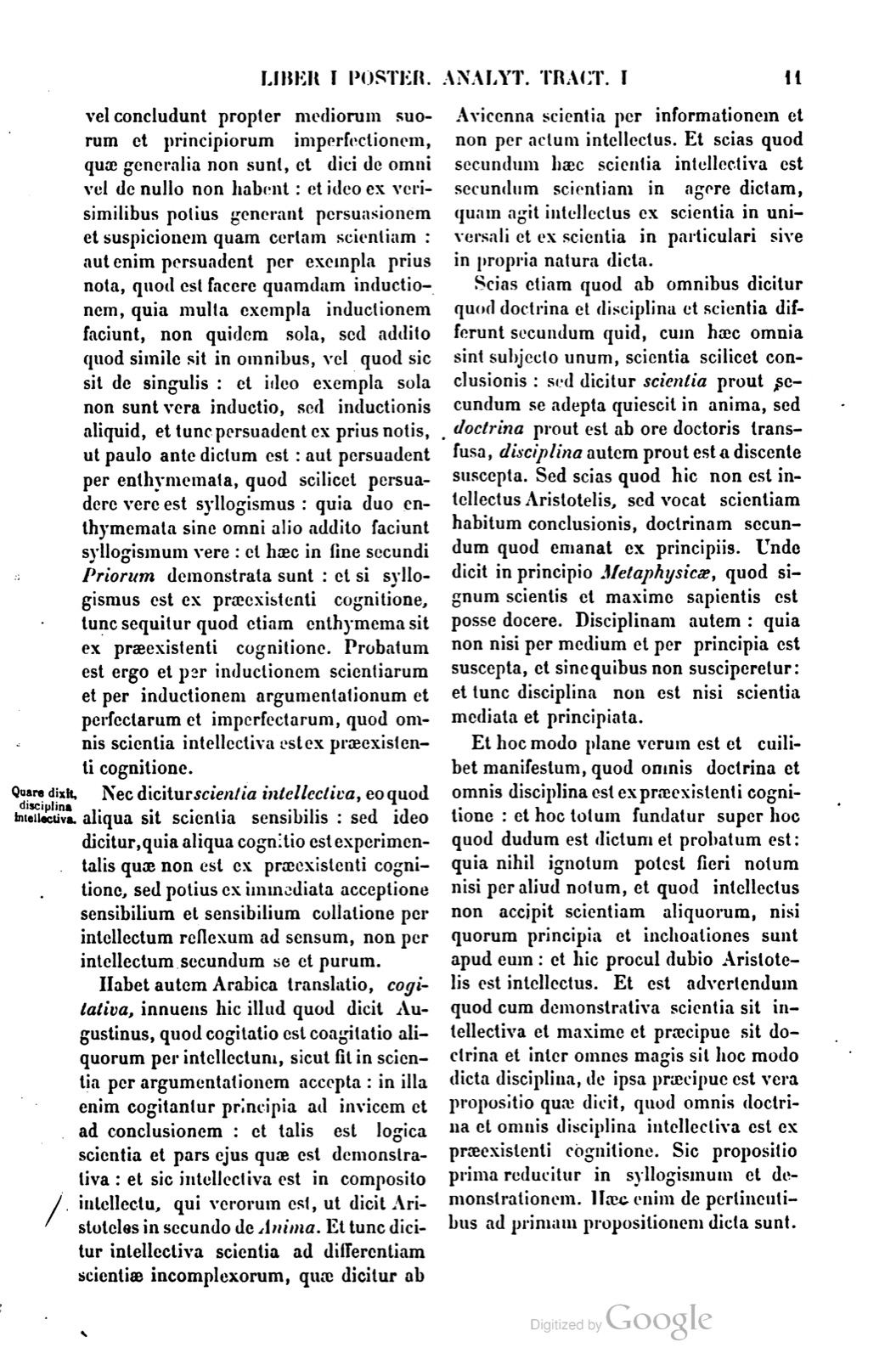
Caput IV. Quod duplex est praecognoscere et praecipue in scientia demonstrativa.
Quia igitur doctrina est ex praeexistenti cognitione, oportet determinare quibus et quot modis contingit praecognoscere, et hoc primo determinando circa principia, deinde circa conclusiones. Determinemus igitur primo modos praecognoscendi, et dicamus quae oportet circa illos praecognoscere. Dicamus igitur quod de quibusdam oportet praecognoscere et praeopinari, quia sunt, ut de dignitatibus. De quibusdam autem praecognoscere oportet quid est quod dicitur per nomen, ut de passionibus. De quibusdam vero oportet utroque modo praecognoscere, ut de subjectis. Exemplum autem istorum est, quod de ista dignitate, quae omnibus aliis est prior, ut dicit Aristoteles in quarto primae philosophiae 6, quod de omni est affirmatio vel negatio vera 5, oportet praecognoscere et praesupponere quia est: haec enim si negetur, ostensive probari non potest, quamvis probetur per deductionem ad impossibile: quod tamen impossibile non reputaretur ab eo qui dicit contradictoria simul esse vera. De passione autem quae est triangulus, quoniam hoc quidem significat, hoc est, quid dicitur per nomen ejus: et hoc est ideo, quia non potest sciri quid est passio nisi per subjectum et subjecti proprii diffinitionem, per quam subjecto probatur inesse: et hoc est post demonstrationem qua probatur inesse subjecto, et non ante ipsam: sed si nesciatur quid est quod dicitur per nomen, de subjecto passio probari non potest: quia per diffinitionem passionis probatur inesse subjecto: unde in passione quid est, est praecognitio: principium enim est ad cognoscendum quia est: et ideo cognitio quid est, praecedit demonstrationem: et cognitio quia est, sequitur eamdem. Nec est inconveniens, quod triangulus denominative dictus sit passio: quia quamvis triangulus secundum quod dicit subjectum et figurae speciem, sit subjectum multarum passionum, tamen ipse triangulus circa figuram passio est, quae probatur de subjecto, sicut patet in omnibus figuris quae sunt de compositione trianguli, sicut est prima Euclidis, et multae aliae quae de compositione trianguli sunt vel hujus trianguli vel illius in specie triangulationis determinari.
Quaedam autem oportet praecognoscere utraque praecognitione, sive utroque modo, ut de subjecto, sicut de unitate, oportet praecognoscere et quia est, et quid est quod dicitur per nomen: quia aliter passio non potest probari de illo, sicut patebit in sequentibus. Non enim similiter, hoc est, uno modo praecognitionis, horum unumquodque praemanifestum ante demonstrationem est nobis. Cum enim dicitur, quod oportet praecognoscere principium, communiter accipitur principium ut comprehendit principium complexum quod est dignitas, et principium incomplexum quod est subjectum vel passio: quamvis enim passio secundum suam diffinitionem non sit principium, sed principiatum ut ex alio fluens et alii inhaerens, oportet tamen quod sit praejacens ad demonstrationem scire quid sit: quia aliter per demonstrationem non posset probari inesse subjecto.
Attendendum tamen, quod etiamsi dignitate debeat uti demonstrator, oportet quod sciat quidquid dicitur per nomina in dignitate posita: tamen quia scientia quid quod dicitur, est per diffinitionem,
Chapter IV. That knowing beforehand is twofold, and especially in demonstrative science.
Therefore, because teaching is from pre-existing cognition, it is necessary to determine in what ways and in how many ways it happens to know beforehand; and this is to be done first by determining concerning principles, and then concerning conclusions. Therefore let us first determine the modes of knowing beforehand, and let us say what things must be known beforehand concerning them. Therefore let us say that concerning some things it is necessary to know beforehand and to opine beforehand that they are, as concerning dignities. But concerning some things it is necessary to know beforehand what that is which is said through the name, as concerning properties. But concerning some things it is necessary to know beforehand in both modes, as concerning subjects. An example of these things is that concerning that dignity which is prior to all the others, as Aristotle says in the fourth book of first philosophy 6, namely that of everything affirmation or negation is true 5, it is necessary to know beforehand and presuppose that it is. For if this is denied, it cannot be proved ostensively, although it is proved by deduction to the impossible. Yet that impossible would not be reckoned impossible by the one who says that contradictories are true at the same time. But concerning the property which is triangle, since this indeed signifies, that is, what is said through its name, and this is so because what a property is cannot be known except through the subject and the definition of the proper subject, through which it is proved to belong to the subject; and this is after the demonstration by which it is proved to belong to the subject, and not before that demonstration. But if what it is which is said through the name is not known, the property cannot be proved of the subject, because through the definition of the property it is proved to belong to the subject. Hence in a property, what it is is a forecognition; for it is a principle for knowing that it is. And therefore cognition of what it is precedes demonstration, and cognition that it is follows that same demonstration. Nor is it unfitting that triangle, spoken denominatively, is a property, because although triangle, according as it says a subject and the species of figure, is the subject of many properties, nevertheless triangle itself concerning figure is a property which is proved of a subject, as is evident in all figures which concern the composition of a triangle, as is the first proposition of Euclid, and many others which concern the composition of a triangle, whether of this triangle or of that one, to be determined in the species of triangulation.
But certain things must be known beforehand by each forecognition, or in each mode, as concerning a subject, as concerning unity: it is necessary to know beforehand both that it is and what it is which is said through the name, because otherwise a property cannot be proved of it, as will be clear in what follows. For not similarly, that is, not by one mode of forecognition, is each one of these things pre-manifest to us before demonstration. For when it is said that it is necessary to know a principle beforehand, principle is taken commonly as comprehending the complex principle which is a dignity, and the incomplex principle which is a subject or a property. For although a property according to its definition is not a principle, but something principiated as flowing from another and inhering in another, nevertheless it must be something lying beforehand for demonstration to know what it is, because otherwise it could not be proved through demonstration to belong to the subject.
Nevertheless it must be noted that even if the demonstrator ought to use a dignity, he must know whatever is said through the names placed in the dignity; nevertheless, because the science of what that is which is said is through definition,
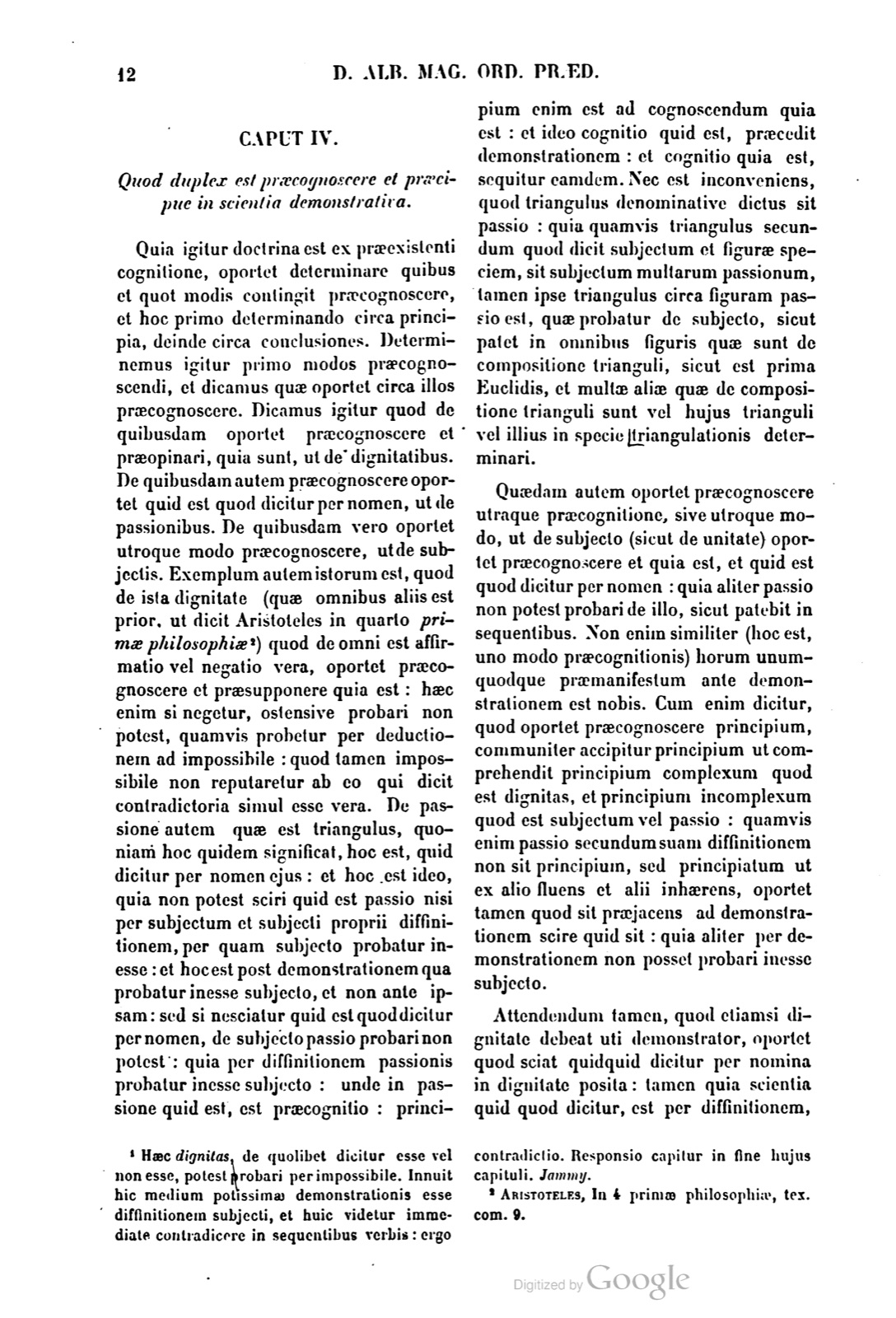
Notes
- Alexander has a similar opinion in the first book of the Topics. (Similem sententiam habet Alexander in I Topicorum.) ↩
- Text-commentary, last. (Tex. com. ult.) ↩
- Aristotle, Topics I, chapter 9. (ARISTOTELES, I Topicos, cap. 9.) ↩
- Aristotle, Physics I, text-commentary 45. (ARISTOTELES, I Physic. tex. com. 45.) ↩
- This dignity, that of anything it is said to be or not to be, can be proved through the impossible. He hints here that the middle of the most powerful demonstration is the definition of the subject, and this seems immediately to contradict the following words: therefore there is a contradiction. The response is taken up at the end of this chapter. Jammy. (Haec dignitas, de quolibet dicitur esse vel non esse, potest probari per impossibile. Innuit hic medium potissimae demonstrationis esse diffinitionem subjecti, et huic videtur immediate contradicere in sequentibus verbis: ergo contradictio. Responsio capitur in fine hujus capituli. Jammy.) ↩
- Aristotle, in the fourth book of first philosophy, text-commentary 9. (ARISTOTELES, In 4 primae philosophiae, tex. com. 9.) ↩
If a page does not appear, its photograph has not been uploaded yet.