Works › Sophistical Refutations, Books I–II
Volume 2 · pp. 705–706
Tractate IV. Chapter II
A marker with ≈ is an approximate page boundary, placed by measure of the text; the page photographs remain the authority. In the paired views, clicking a page marker brings that page into view.
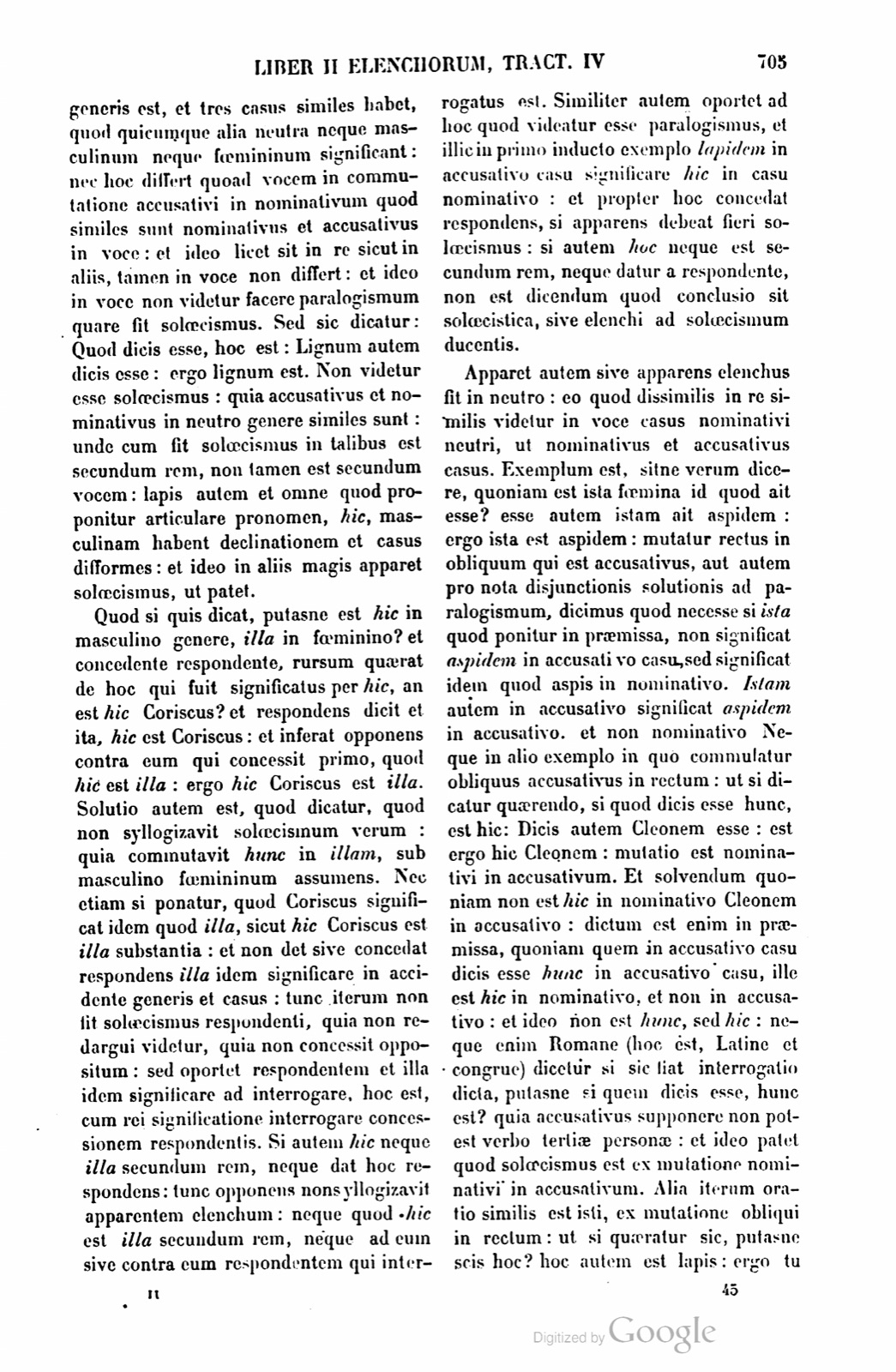
generis est, et tres casus similes habet, quod quicumque alia neutra neque masculinum neque foemininum significant: nec hoc differt quoad vocem in commutatione accusativi in nominativum quod similes sunt nominativus et accusativus in voce: et ideo licet sit in re sicut in aliis, tamen in voce non differt: et ideo in voce non videtur facere paralogismum quare fit solaecismus. Sed sic dicatur: Quod dicis esse, hoc est: Lignum autem dicis esse: ergo lignum est. Non videtur esse solaecismus: quia accusativus et nominativus in neutro genere similes sunt: unde cum fit solaecismus in talibus est secundum rem, non tamen est secundum vocem: lapis autem et omne quod proponitur articulare pronomen, hic, masculinam habent declinationem et casus difformes: et ideo in aliis magis apparet solaecismus, ut patet.
Quod si quis dicat, putasne est hic in masculino genere, illa in foeminino? et concedente respondente, rursum quaerat de hoc qui fuit significatus per hic, an est hic Coriscus? et respondens dicit et ita, hic est Coriscus: et inferat opponens contra eum qui concessit primo, quod hic est illa: ergo hic Coriscus est illa. Solutio autem est, quod dicatur, quod non syllogizavit solaecismum verum: quia commutavit hunc in illam, sub masculino foemininum assumens. Nec etiam si ponatur, quod Coriscus significat idem quod illa, sicut hic Coriscus est illa substantia: et non det sive concedat respondens illa idem significare in accidente generis et casus: tunc iterum non fit solaecismus respondenti, quia non redargui videtur, quia non concessit oppositum: sed oportet respondentem et illa idem significare ad interrogare, hoc est, cum rei significatione interrogare concessionem respondentis. Si autem hic neque illa secundum rem, neque dat hoc respondens: tunc opponens nonsyllogizavit apparentem elenchum: neque quod hic est illa secundum rem, neque ad eum sive contra eum respondentem qui interrogatus est. Similiter autem oportet ad hoc quod videatur esse paralogismus, et illic in primo inducto exemplo lapidem in accusativo casu significare hic in casu nominativo: et propter hoc concedat respondens, si apparens debeat fieri solaecismus: si autem hoc neque est secundum rem, neque datur a respondente, non est dicendum quod conclusio sit solaecistica, sive elenchi ad solaecismum ducentis.
Apparet autem sive apparens elenchus fit in neutro: eo quod dissimilis in re similis videtur in voce casus nominativi neutri, ut nominativus et accusativus casus. Exemplum est, sitne verum dicere, quoniam est ista foemina id quod ait esse? esse autem istam ait aspidem: ergo ista est aspidem: mutatur rectus in obliquum qui est accusativus, aut autem pro nota disjunctionis solutionis ad paralogismum, dicimus quod necesse si ista quod ponitur in praemissa, non significat aspidem in accusativo casu, sed significat idem quod aspis in nominativo. Istam autem in accusativo significat aspidem in accusativo, et non nominativo. Neque in alio exemplo in quo commutatur obliquus accusativus in rectum: ut si dicatur quaerendo, si quod dicis esse hunc, est hic: dicis autem Cleonem esse: est ergo hic Cleonem: mutatio est nominativi in accusativum. Et solvendum quoniam non est hic in nominativo Cleonem in accusativo: dictum est enim in praemissa, quoniam quem in accusativo casu dicis esse hunc in accusativo casu, ille est hic in nominativo, et non in accusativo: et ideo non est hunc, sed hic: neque enim Romane (hoc est, Latine et congrue) dicetur si sic fiat interrogatio dicta, putasne si quem dicis esse, hunc est? quia accusativus supponere non potest verbo tertiae personae et ideo patet quod solaecismus est ex mutatione nominativi in accusativum. Alia iterum oratio similis est isti, ex mutatione obliqui in rectum: ut si quaeratur sic, putasne scis hoc? hoc autem est lapis: ergo tu scis lapis. In praemissa enim hoc est accusativi casus: assumit autem in nominativo cum dicit, hoc autem est lapis, et infert in nominativo secundum quod terminat transitionem verbi quando dicit, scis ergo lapis: et sic fit solaecismus: unde aut nota subjunctionis est: unde non idem (hoc est, in eodem casu) significat hoc: quia in praemissa est in accusativo cum dicitur, scis hoc: cum autem dicitur, hoc est, hoc in assumpta accipitur in nominativo: unde in prima quidem significat hunc in accusativo, in posteriori autem significat hic in nominativo.
it is of the neuter gender, and has three cases alike, because any other neuter terms signify neither masculine nor feminine. Nor does this differ as to the spoken word in the commutation of the accusative into the nominative, because the nominative and accusative are alike in utterance; and therefore, although it is in the thing as in the others, nevertheless in the utterance it does not differ, and therefore in utterance it does not seem to make the paralogism by which a solecism is made. But let it be said thus: What you say to be, this is; but you say wood to be; therefore wood is. It does not seem to be a solecism, because the accusative and nominative in the neuter gender are alike. Hence when a solecism is made in such things, it is according to the thing, but not according to the utterance. But stone and everything for which the articulate pronoun this is put forward have masculine declension and cases unlike in form; and therefore in other things the solecism appears more, as is clear.
But if someone says, do you think this-man is in the masculine gender, that-woman in the feminine? and when the respondent concedes, again asks about this who was signified by this-man, whether this is Coriscus; and the respondent says, yes, this is Coriscus; and the opponent infers against him who first conceded that this is that-woman; therefore this Coriscus is that-woman. But the solution is that it should be said that he has not syllogized a true solecism, because he changed this-man into that-woman, assuming the feminine under the masculine. Nor even if it is posited that Coriscus signifies the same as that-woman, as this Coriscus is that substance, and the respondent does not give or concede that that-woman signifies the same in the accident of gender and case, then again no solecism is made for the respondent, because he does not seem to be refuted, since he has not conceded the opposite. Rather, it is necessary for the respondent also to signify that-woman as the same for asking, that is, to ask the respondent's concession together with the signification of the thing. But if this-man and that-woman are not the same according to the thing, nor does the respondent give this, then the opponent has not syllogized an apparent refutation, neither that this-man is that-woman according to the thing, nor with respect to him or against the respondent who has been asked. Similarly, for this to seem to be a paralogism, also there in the first example brought in, stone in the accusative case must signify this in the nominative case; and on account of this let the respondent concede, if an apparent solecism must be made. But if this is neither according to the thing nor is given by the respondent, it must not be said that the conclusion is solecistic, or of a refutation leading to solecism.
But an apparent refutation appears, or is made, in the neuter, because a case of the neuter nominative unlike in reality seems like in utterance, as the nominative and accusative case. The example is: is it true to say that this woman is what she says she is? But she says that she is this asp; therefore this-woman is asp in the accusative. The direct case is changed into the oblique which is accusative. Or else, for a mark of the disjunction of the solution to the paralogism, we say that necessarily this-woman which is put in the premise does not signify asp in the accusative case, but signifies the same as asp in the nominative. But this-woman in the accusative signifies asp in the accusative and not in the nominative. Nor in another example in which the oblique accusative is changed into the direct, as if it is said by asking: if what you say to be this-one is this-man; but you say Cleon to be; therefore this-man is Cleon in the accusative. There is a change of nominative into accusative. And it must be solved because this-man in the nominative is not Cleon in the accusative; for it was said in the premise that whom you say to be this-one in the accusative case, that one is this-man in the nominative and not in the accusative; and therefore it is not this-one in the accusative, but this-man. For it will not be said Romanly, that is, in Latin and congruously, if the question stated is made thus: do you think, if whom you say to be, this-one is? because an accusative cannot be subject to the verb of the third person. And therefore it is clear that the solecism is from change of nominative into accusative. Another speech again is similar to this, from change of the oblique into the direct, as if it is asked thus: do you think you know this? but this is a stone; therefore you know stone in the nominative. For in the premise this is of the accusative case; but he assumes it in the nominative when he says, but this is a stone, and he infers in the nominative according as it terminates the transition of the verb when he says, therefore you know stone; and thus a solecism is made. Hence either it is a mark of subjoining; hence this does not signify the same, that is, in the same case, because in the premise it is in the accusative when it is said, you know this; but when it is said, this is, this in the assumption is taken in the nominative; hence in the first it signifies this-one in the accusative, but in the later it signifies this-man in the nominative.
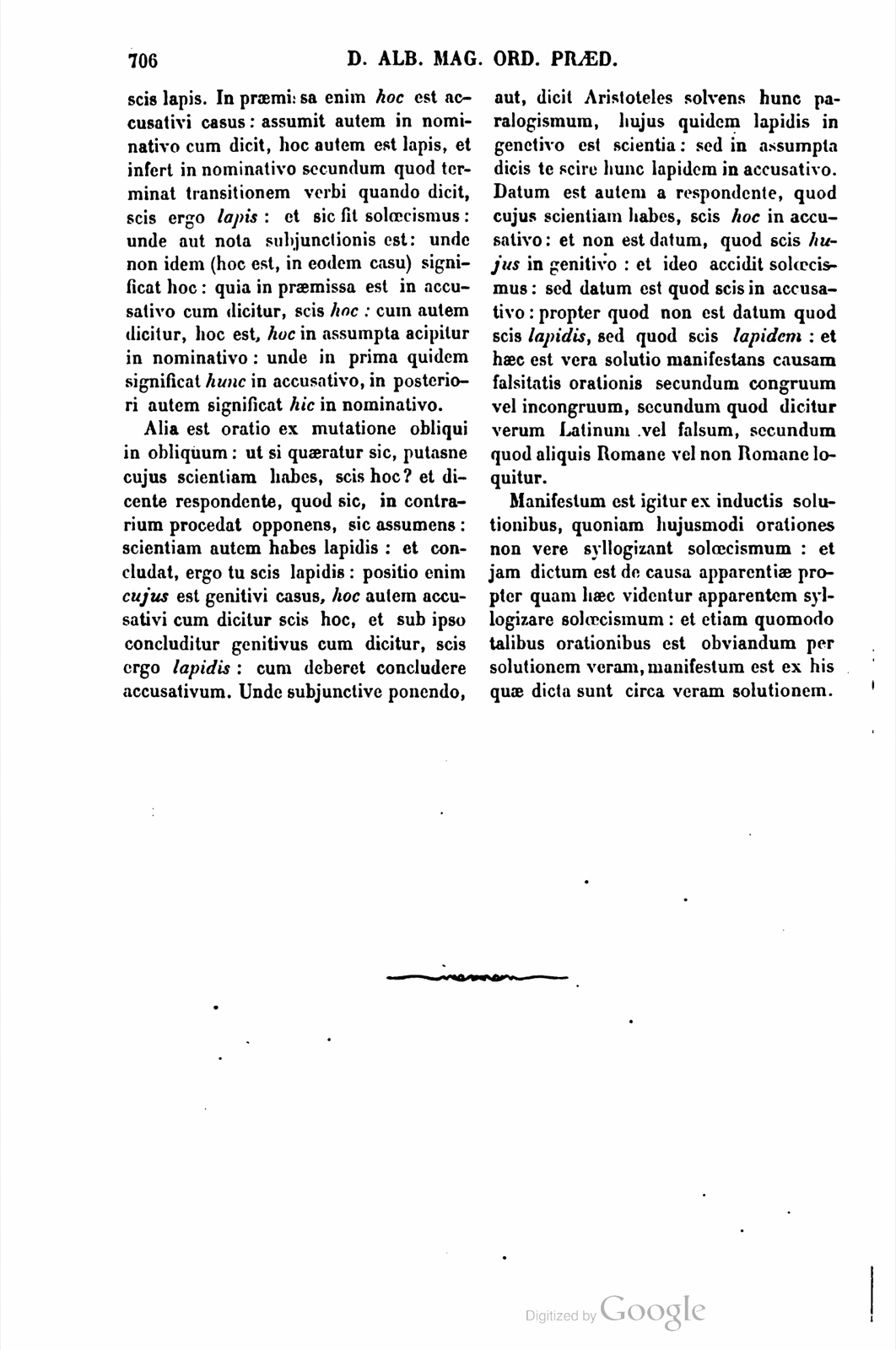
Alia est oratio ex mutatione obliqui in obliquum: ut si quaeratur sic, putasne cujus scientiam habes, scis hoc? et dicente respondente, quod sic, in contrarium procedat opponens, sic assumens: scientiam autem habes lapidis: et concludat, ergo tu scis lapidis: positio enim cujus est genitivi casus, hoc autem accusativi cum dicitur scis hoc, et sub ipso concluditur genitivus cum dicitur, scis ergo lapidis: cum deberet concludere accusativum. Unde subjunctive ponendo, aut, dicit Aristoteles solvens hunc paralogismum, hujus quidem lapidis in genitivo est scientia: sed in assumpta dicis te scire hunc lapidem in accusativo. Datum est autem a respondente, quod cujus scientiam habes, scis hoc in accusativo: et non est datum, quod scis hujus in genitivo: et ideo accidit solaecismus: sed datum est quod scis in accusativo: propter quod non est datum quod scis lapidis, sed quod scis lapidem: et haec est vera solutio manifestans causam falsitatis orationis secundum congruum vel incongruum, secundum quod dicitur verum Latinum vel falsum, secundum quod aliquis Romane vel non Romane loquitur.
Manifestum est igitur ex inductis solutionibus, quoniam hujusmodi orationes non vere syllogizant solaecismum: et jam dictum est de causa apparentiae propter quam haec videntur apparentem syllogizare solaecismum: et etiam quomodo talibus orationibus est obviandum per solutionem veram, manifestum est ex his quae dicta sunt circa veram solutionem.
There is another speech from change of oblique into oblique, as if it is asked thus: do you think that of which you have knowledge, you know this? And when the respondent says yes, let the opponent proceed to the contrary by assuming thus: but you have knowledge of stone; and let him conclude: therefore you know of-stone. For the position of of-which is of the genitive case, but this is of the accusative when it is said you know this, and under it the genitive is concluded when it is said, therefore you know of-stone, when he ought to conclude the accusative. Hence by putting it subjunctively, or, Aristotle says in solving this paralogism: of this stone indeed there is knowledge in the genitive, but in the assumption you say that you know this stone in the accusative. But it was given by the respondent that of which you have knowledge, you know this in the accusative; and it was not given that you know of-this in the genitive; and therefore the solecism happens. But it was given that you know in the accusative; because of which it was not given that you know of-stone, but that you know stone. And this is the true solution manifesting the cause of the falsity of the speech according to the congruous or incongruous, according as true Latin or false Latin is spoken, according as someone speaks Romanly or not Romanly.
Therefore it is manifest from the solutions introduced that speeches of this kind do not truly syllogize a solecism; and it has already been said concerning the cause of appearance because of which these seem to syllogize an apparent solecism; and also in what way such speeches must be met through true solution is manifest from the things which have been said about true solution.
If a page does not appear, its photograph has not been uploaded yet.