Works › Sophistical Refutations, Books I–II
Volume 2 · pp. 702–704
Tractate IV. Chapters I-II
A marker with ≈ is an approximate page boundary, placed by measure of the text; the page photographs remain the authority. In the paired views, clicking a page marker brings that page into view.
TRACTATUS IV. DE SOLUTIONE PARALOGISMORUM AD ALIAS METAS DUCENTIUM QUAM AD REDARGUTIONEM.
CAPUT I. De solutione eorum qui ducunt ad solaecismum.
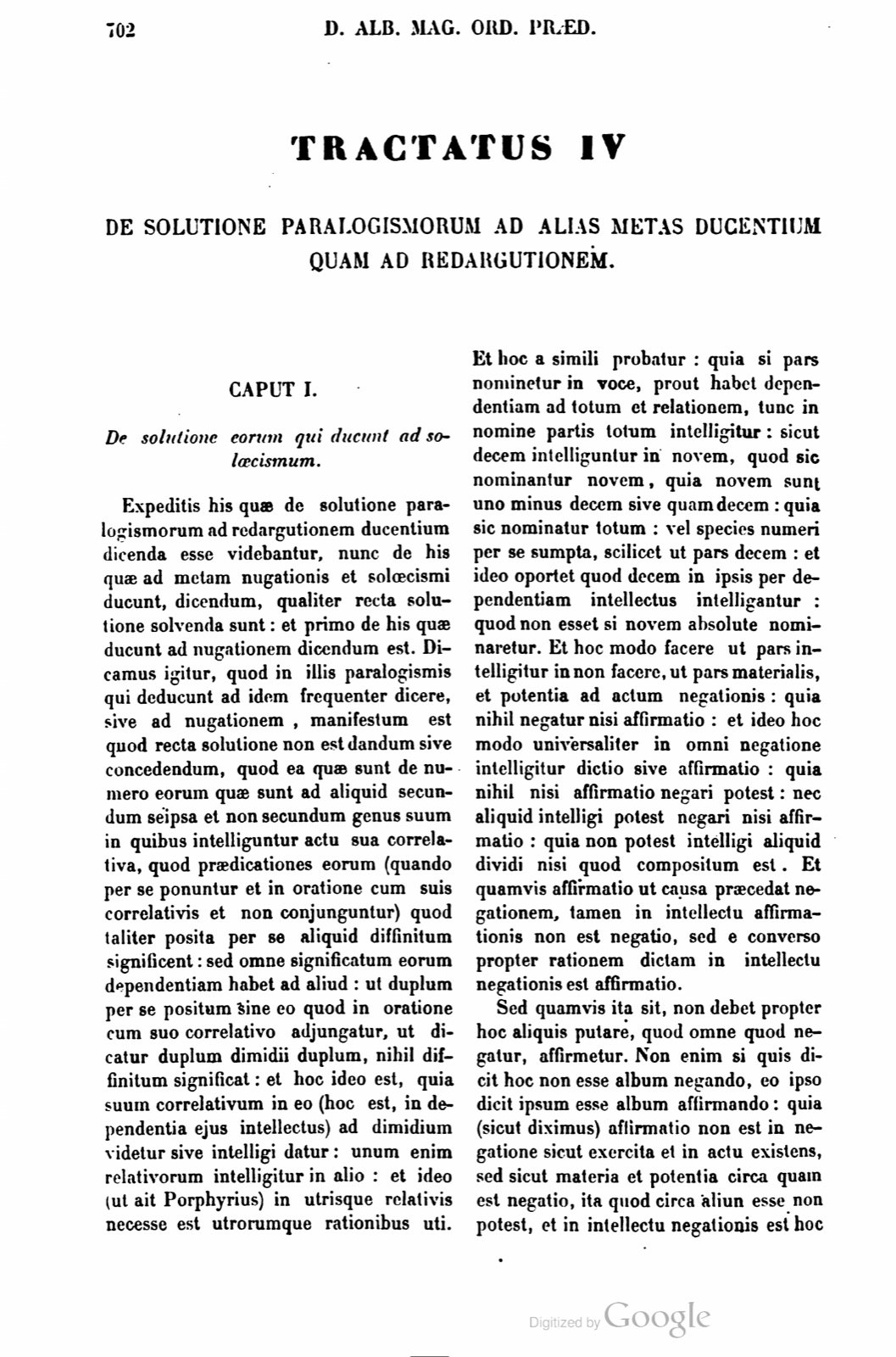
Expeditis his quae de solutione paralogismorum ad redargutionem ducentium dicenda esse videbantur, nunc de his quae ad metam nugationis et solaecismi ducunt, dicendum, qualiter recta solutione solvenda sunt: et primo de his quae ducunt ad nugationem dicendum est. Dicamus igitur, quod in illis paralogismis qui deducunt ad idem frequenter dicere, sive ad nugationem, manifestum est quod recta solutione non est dandum sive concedendum, quod ea quae sunt de numero eorum quae sunt ad aliquid secundum seipsa et non secundum genus suum in quibus intelliguntur actu sua correlativa, quod praedicationes eorum (quando per se ponuntur et in oratione cum suis correlativis et non conjunguntur) quod taliter posita per se aliquid diffinitum significent: sed omne significatum eorum dependentiam habet ad aliud: ut duplum per se positum sine eo quod in oratione cum suo correlativo adjungatur, ut dicatur duplum dimidii duplum, nihil diffinitum significat: et hoc ideo est, quia suum correlativum in eo (hoc est, in dependentia ejus intellectus) ad dimidium videtur sive intelligi datur: unum enim relativorum intelligitur in alio: et ideo (ut ait Porphyrius) in utrisque relativis necesse est utrorumque rationibus uti. Et hoc a simili probatur: quia si pars nominetur in voce, prout habet dependentiam ad totum et relationem, tunc in nomine partis totum intelligitur: sicut decem intelliguntur in novem, quod sic nominantur novem, quia novem sunt uno minus decem sive quam decem: quia sic nominatur totum: vel species numeri per se sumpta, scilicet ut pars decem: et ideo oportet quod decem in ipsis per dependentiam intellectus intelligantur: quod non esset si novem absolute nominaretur. Et hoc modo facere ut pars intelligitur in non facere, ut pars materialis, et potentia ad actum negationis: quia nihil negatur nisi affirmatio: et ideo hoc modo universaliter in omni negatione intelligitur dictio sive affirmatio: quia nihil nisi affirmatio negari potest: nec aliquid intelligi potest negari nisi affirmatio: quia non potest intelligi aliquid dividi nisi quod compositum est. Et quamvis affirmatio ut causa praecedat negationem, tamen in intellectu affirmationis non est negatio, sed e converso propter rationem dictam in intellectu negationis est affirmatio.
Sed quamvis ita sit, non debet propter hoc aliquis putare, quod omne quod negatur, affirmetur. Non enim si quis dicit hoc non esse album negando, eo ipso dicit ipsum esse album affirmando: quia (sicut diximus) affirmatio non est in negatione sicut exercita et in actu existens, sed sicut materia et potentia circa quam est negatio, ita quod circa aliud esse non potest, et in intellectu negationis est hoc quod circa alterum non sit. Similiter autem duplum per se nihil significat diffinitum sicut nec negatio: et hoc dicit Aristoteles, neque significat nihil, quod more Graecorum altera negatio superfluit. Dico autem quod nihil significat diffinitum, quemadmodum diffinite significare potest quod per dependentiam sui intellectus individuatur, ut in correlativo sui ad quod est et dicitur. Quod ergo in illis paralogismis qui ducunt ad negationem per rationem relativorum est, notandum est quod si relativum per se positum nihil diffinite significat, et correlativum ejus intelligitur in ipso quando per se ponitur. Secundo autem notandum, quod si relativum fortasse aliquid significat indiffinite, ita quod intellectus ejus indiffinitus ad alterum dependet, et ideo in ipso correlativum ejus intelligitur: tunc notandum quod idem significat etiam copulatum in oratione cum suo correlativo: quia tunc determinatum est per adjunctum sibi in oratione, et non dependet ad alterum: et ideo tunc non intelligitur in ipso. Et ideo cum ducens ad nugationem dicit, duplum dimidii duplum: et in duplo intelligitur dimidium: ergo est duplum dimidii duplum dimidii duplum. Dicendum et solvendum per interemptionem: quia cum in oratione copulatur dimidio duplum, tunc in ipso non amplius intelligitur: quia tunc per aliud junctum sibi est diffinitum: et tunc non potest ducere ad nugationem. Cum autem dicimus duplum aliud et aliud per se positum in oratione positum significare, accipimus large significare, secundum quod omne illud in oratione significari dicitur, quod datur intelligi per significationis ejus modum et rationem: et non intelligimus per hoc fieri aequivocum duplum quod per se ponitur et in oratione.
TRACTATE IV. CONCERNING THE SOLUTION OF PARALOGISMS LEADING TO OTHER GOALS THAN TO REFUTATION.
CHAPTER I. Concerning the solution of those which lead to solecism.
After those things which seemed to have to be said concerning the solution of paralogisms leading to refutation have been dispatched, now concerning those which lead to the goal of nugation and solecism, one must say in what way they must be solved by right solution; and first one must speak about those things which lead to nugation. Therefore let us say that in those paralogisms which lead one to say the same thing frequently, or to nugation, it is manifest that by right solution it must not be given or conceded that those things which are from the number of things that are relative according to themselves and not according to their genus, in which their correlatives are understood actually, that their predications, when they are posited by themselves and are not conjoined in speech with their correlatives, that when so posited by themselves they signify something definite. Rather, every signification of them has dependence on another, as double posited by itself, without being joined in speech with its correlative, so that double of half double is said, signifies nothing definite. And this is so because its correlative in it, that is, in the dependence of its understanding, is seen or is given to be understood with respect to half. For one of the relatives is understood in the other; and therefore, as Porphyry says, in both relatives it is necessary to use the accounts of both. And this is proved from a likeness: because if a part is named in speech as it has dependence and relation to a whole, then in the name of the part the whole is understood, just as ten is understood in nine, because they are named nine thus, since nine are one less than ten or than ten, because the whole is named thus; or the species of number taken by itself, namely as a part of ten; and therefore it is necessary that ten be understood in them through dependence of understanding, which would not be so if nine were named absolutely. And in this way to do, as a part, is understood in not doing, as a material part and potency with respect to the act of negation, because nothing is denied except affirmation; and therefore in this way, universally in every negation, diction or affirmation is understood, because nothing except affirmation can be denied, nor can anything be understood to be denied except affirmation, because something cannot be understood to be divided unless it is composite. And although affirmation as a cause precedes negation, nevertheless in the understanding of affirmation there is not negation; but conversely, because of the reason stated, in the understanding of negation there is affirmation.
But although it is so, no one ought on account of this to think that everything which is denied is affirmed. For if someone says by denying that this is not white, by that very fact he does not say by affirming that it is white, because, as we said, affirmation is not in negation as exercised and existing in act, but as matter and potency about which negation is concerned, so that it cannot be about another being, and in the understanding of negation is this, that it not be about the other. Similarly, double by itself signifies nothing definite, just as negation does not; and Aristotle says this: neither does it signify nothing, in which, after the custom of the Greeks, the second negation is superfluous. But I say that it signifies nothing definite in the way that that can signify definitely which is individuated through the dependence of its understanding, as in its correlative to which it is and is said. Therefore concerning what is in those paralogisms which lead to negation through the account of relatives, it must be noted that if a relative posited by itself signifies nothing definitely, its correlative is understood in it when it is posited by itself. But secondly it must be noted that if a relative perhaps signifies something indefinitely, so that its indefinite understanding depends on another, and therefore its correlative is understood in it, then it must be noted that it also signifies the same when coupled in speech with its correlative, because then it is determined by what is joined to it in speech and does not depend on another; and therefore then it is not understood in it. And therefore when one leading to nugation says, double of half double, and half is understood in double, therefore it is double of half double of half double, one must speak and solve through destruction, because when double is coupled to half in speech, then half is no longer understood in it, because then it is defined through another joined to it; and then it cannot lead to nugation. But when we say that double posited by itself and posited in speech signifies another and another thing, we take signify broadly, according as everything is said to be signified in speech which is given to be understood through the mode and account of its signification; and by this we do not understand double which is posited by itself and in speech to become equivocal.
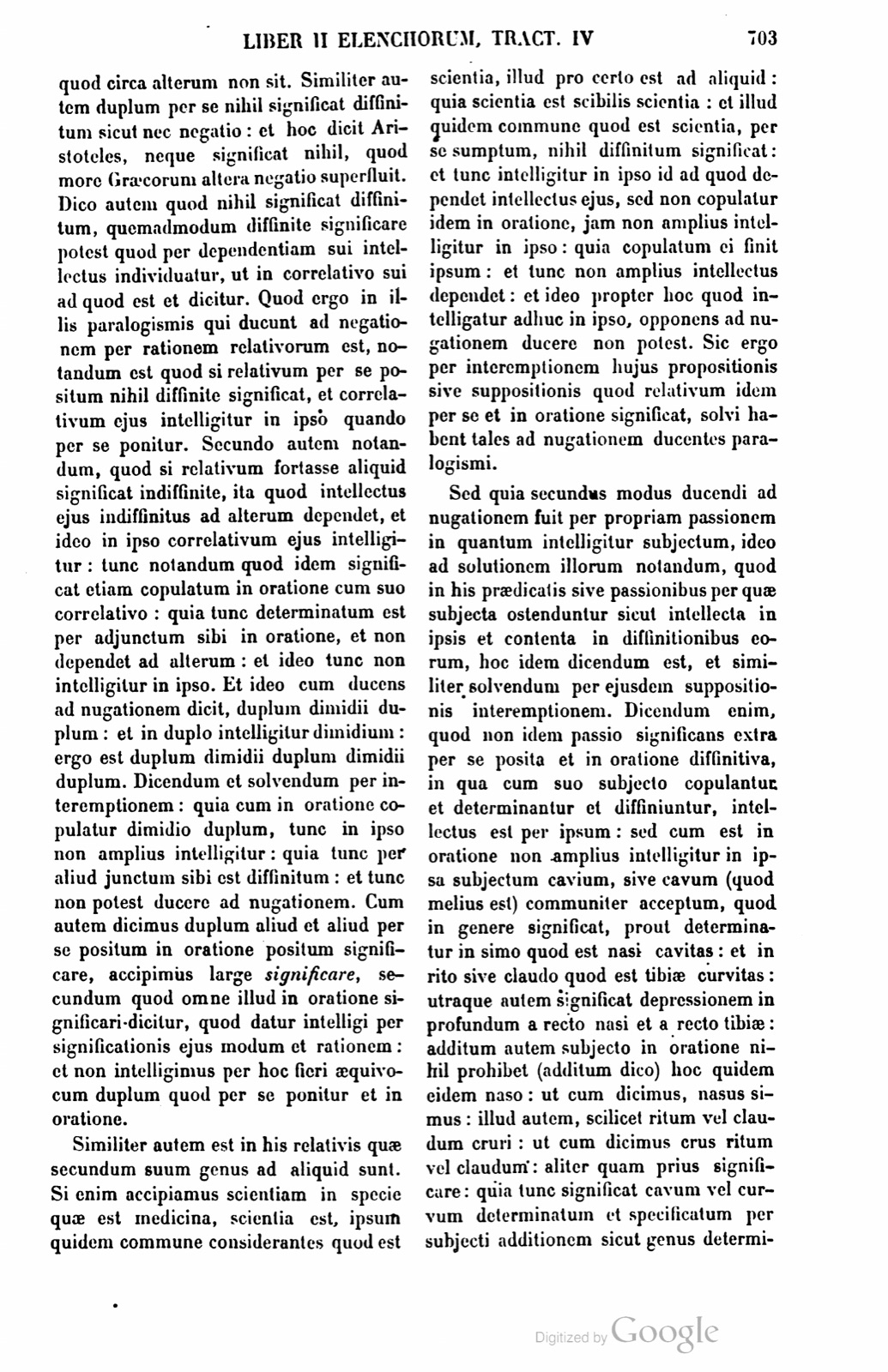
Similiter autem est in his relativis quae secundum suum genus ad aliquid sunt. Si enim accipiamus scientiam in specie quae est medicina, scientia est, ipsum quidem commune considerantes quod est scientia, illud pro certo est ad aliquid: quia scientia est scibilis scientia: et illud quidem commune quod est scientia, per se sumptum, nihil diffinitum significat: et tunc intelligitur in ipso id ad quod dependet intellectus ejus, sed non copulatur idem in oratione, jam non amplius intelligitur in ipso: quia copulatum ei finit ipsum: et tunc non amplius intellectus dependet: et ideo propter hoc quod intelligatur adhuc in ipso, opponens ad nugationem ducere non potest. Sic ergo per interemptionem hujus propositionis sive suppositionis quod relativum idem per se et in oratione significat, solvi habent tales ad nugationem ducentes paralogismi.
Sed quia secundus modus ducendi ad nugationem fuit per propriam passionem in quantum intelligitur subjectum, ideo ad solutionem illorum notandum, quod in his praedicatis sive passionibus per quae subjecta ostenduntur sicut intellecta in ipsis et contenta in diffinitionibus eorum, hoc idem dicendum est, et similiter solvendum per ejusdem suppositionis interemptionem. Dicendum enim, quod non idem passio significans extra per se posita et in oratione diffinitiva, in qua cum suo subjecto copulantur, et determinantur et diffiniuntur, intellectus est per ipsum: sed cum est in oratione non amplius intelligitur in ipsa subjectum cavium, sive cavum (quod melius est) communiter acceptum, quod in genere significat, prout determinatur in simo quod est nasi cavitas: et in rito sive claudo quod est tibiae curvitas: utraque autem significat depressionem in profundum a recto nasi et a recto tibiae: additum autem subjecto in oratione nihil prohibet (additum dico) hoc quidem eidem naso: ut cum dicimus, nasus simus: illud autem, scilicet ritum vel claudum cruri: ut cum dicimus crus ritum vel claudum: aliter quam prius significare: quia tunc significat cavum vel curvum determinatum et specificatum per subjecti additionem sicut genus determinatur per differentiam. Nam huic additum, scilicet naso, significat simum: sed nasus curvus significat explicite idem quod simus significat implicite. Illud autem curvum additum cruri significat ritum vel claudum: et tunc potest addi determinationi qua determinatur generalis ratio curvitatis: et sic nihil differt dicere, nasus simus, et nasus cavus: et ideo quando in oratione additur subjecto subjectum, non amplius intelligitur in illo: et ideo non potest duci ad nugationem.
But it is similar in those relatives which according to their genus are relative. For if we take knowledge in a species which is medicine, it is knowledge, considering the common itself which is knowledge, and that for certain is relative, because knowledge is knowledge of the knowable; and that common which is knowledge, taken by itself, signifies nothing definite, and then in it is understood that on which its understanding depends. But when the same is coupled in speech, now it is no longer understood in it, because what is coupled to it bounds it, and then the understanding no longer depends; and therefore because it is still understood in it, the opponent cannot lead to nugation. Thus therefore by destruction of this proposition or supposition, that a relative signifies the same by itself and in speech, such paralogisms leading to nugation must be solved.
But because the second mode of leading to nugation was through a proper passion insofar as the subject is understood, therefore for the solution of those one must note that in these predicates or passions through which subjects are shown as understood in them and contained in their definitions, the same must be said, and similarly they must be solved through destruction of the same supposition. For one must say that a passion signifying when posited outside by itself and when in a definitive speech, in which they are coupled with their subject and are determined and defined, is not the same as to what is understood through it. But when it is in speech, the subject of hollows is no longer understood in it, or rather the hollow, which is better, commonly accepted, which signifies in the genus, according as it is determined in snub, which is the hollowness of the nose, and in rited or lame, which is the curvature of the shin. But each signifies a depression in depth from the straightness of the nose and from the straightness of the shin. But nothing prevents what is added to a subject in speech, I say added, this indeed to the same nose, as when we say, a snub nose, but that, namely rited or lame, to the leg, as when we say, a rited or lame leg, from signifying otherwise than before, because then it signifies hollow or curved determined and specified through addition of the subject as a genus is determined through a difference. For added to this, namely to the nose, it signifies snub; but curved nose signifies explicitly the same as snub signifies implicitly. But that curved added to the leg signifies rited or lame; and then it can be added to the determination by which the general account of curvature is determined. And thus it makes no difference to say, snub nose, and hollow nose; and therefore when in speech a subject is added to the subject, it is no longer understood in that, and therefore it cannot be led to nugation.
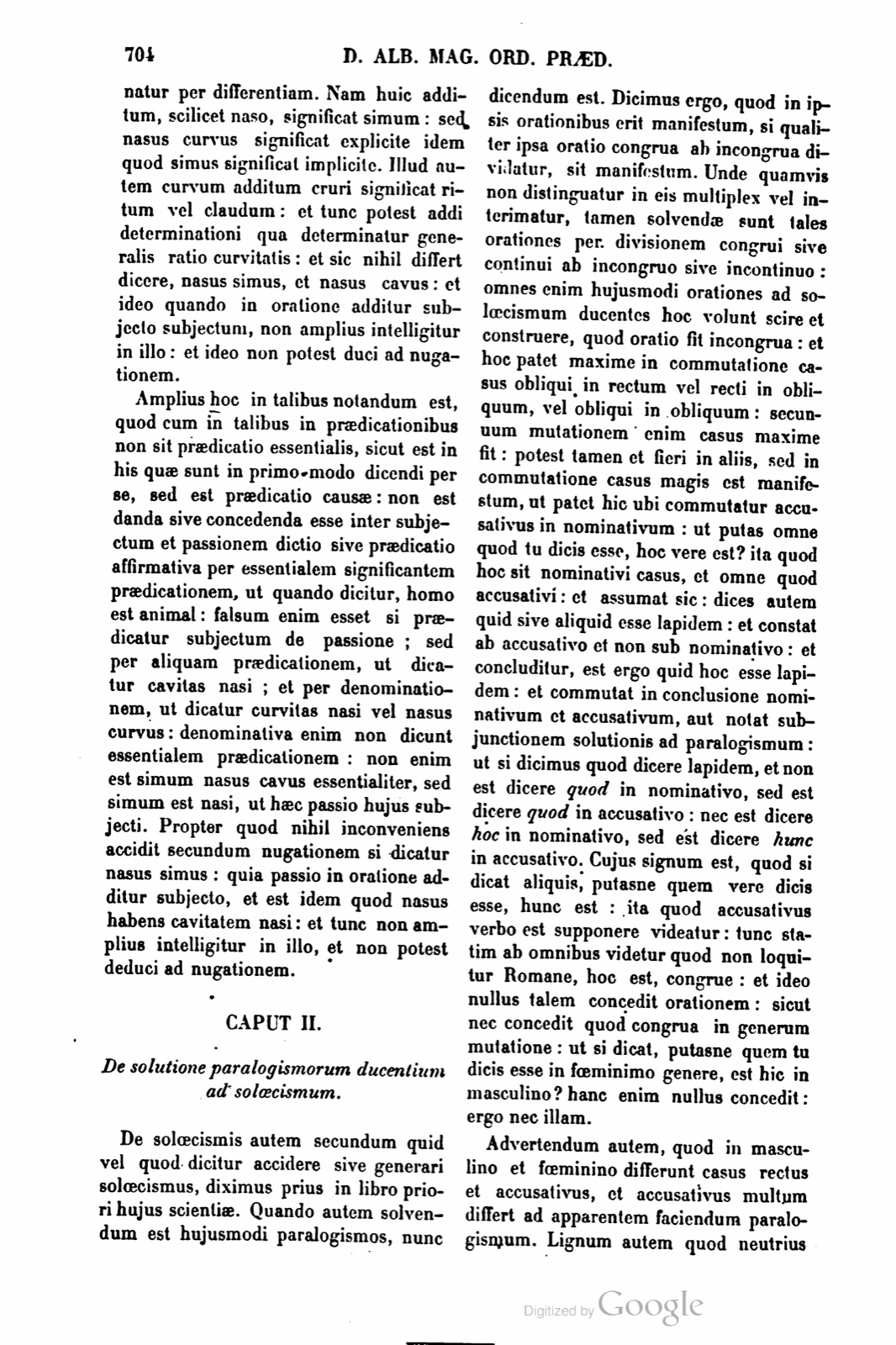
Amplius hoc in talibus notandum est, quod cum in talibus in praedicationibus non sit praedicatio essentialis, sicut est in his quae sunt in primo modo dicendi per se, sed est praedicatio causae: non est danda sive concedenda esse inter subjectum et passionem dictio sive praedicatio affirmativa per essentialem significantem praedicationem, ut quando dicitur, homo est animal: falsum enim esset si praedicatur subjectum de passione; sed per aliquam praedicationem, ut dicatur cavitas nasi; et per denominationem, ut dicatur curvitas nasi vel nasus curvus: denominativa enim non dicunt essentialem praedicationem: non enim est simum nasus cavus essentialiter, sed simum est nasi, ut haec passio hujus subjecti. Propter quod nihil inconveniens accidit secundum nugationem si dicatur nasus simus: quia passio in oratione additur subjecto, et est idem quod nasus habens cavitatem nasi: et tunc non amplius intelligitur in illo, et non potest deduci ad nugationem.
CAPUT II. De solutione paralogismorum ducentium ad solaecismum.
De solaecismis autem secundum quid vel quod dicitur accidere sive generari solaecismus, diximus prius in libro priori hujus scientiae. Quando autem solvendum est hujusmodi paralogismos, nunc dicendum est. Dicimus ergo, quod in ipsis orationibus erit manifestum, si qualiter ipsa oratio congrua ab incongrua dividatur, sit manifestum. Unde quamvis non distinguatur in eis multiplex vel interimatur, tamen solvendae sunt tales orationes per divisionem congrui sive continui ab incongruo sive incontinuo: omnes enim hujusmodi orationes ad solaecismum ducentes hoc volunt scire et construere, quod oratio fit incongrua: et hoc patet maxime in commutatione casus obliqui in rectum vel recti in obliquum, vel obliqui in obliquum: secundum mutationem enim casus maxime fit: potest tamen et fieri in aliis, sed in commutatione casus magis est manifestum, ut patet hic ubi commutatur accusativus in nominativum: ut putas omne quod tu dicis esse, hoc vere est? ita quod hoc sit nominativi casus, et omne quod accusativi: et assumat sic: dices autem quid sive aliquid esse lapidem: et constat ab accusativo et non sub nominativo: et concluditur, est ergo quid hoc esse lapidem: et commutat in conclusione nominativum et accusativum, aut notat subjunctionem solutionis ad paralogismum: ut si dicimus quod dicere lapidem, et non est dicere quod in nominativo, sed est dicere quod in accusativo: nec est dicere hoc in nominativo, sed est dicere hunc in accusativo. Cujus signum est, quod si dicat aliquis, putasne quem vere dicis esse, hunc est: ita quod accusativus verbo est supponere videatur: tunc statim ab omnibus videtur quod non loquitur Romane, hoc est, congrue: et ideo nullus talem concedit orationem: sicut nec concedit quod congrua in generum mutatione: ut si dicat, putasne quem tu dicis esse in foeminino genere, est hic in masculino? hanc enim nullus concedit: ergo nec illam.
Advertendum autem, quod in masculino et foeminino differunt casus rectus et accusativus, et accusativus multum differt ad apparentem faciendum paralogismum. Lignum autem quod neutrius
Furthermore this must be noted in such things: since in such predications there is not essential predication, as there is in those things which are in the first mode of speaking per se, but it is predication of a cause, it must not be given or conceded that there is between subject and passion a diction or affirmative predication signifying through an essential predication, as when it is said, man is an animal. For it would be false if the subject were predicated of the passion; but through some predication, as let hollowness of nose be said; and through denomination, as let curvature of nose or curved nose be said. For denominatives do not speak essential predication. For snub is not essentially hollow nose, but snub belongs to the nose, as this passion of this subject. Because of this, nothing unfitting happens according to nugation if snub nose is said, because the passion in speech is added to the subject, and it is the same as a nose having hollowness of nose; and then it is no longer understood in it and cannot be deduced to nugation.
CHAPTER II. Concerning the solution of paralogisms leading to solecism.
But concerning solecisms qualifiedly, or concerning that which is said to happen or to be generated as a solecism, we spoke earlier in the prior book of this science. But now it must be said when such paralogisms must be solved. Therefore we say that in those speeches it will be manifest if it is manifest how the congruous speech itself is divided from the incongruous. Hence although a multiple is not distinguished in them or destroyed, nevertheless such speeches must be solved through division of the congruous or continuous from the incongruous or discontinuous. For all speeches of this sort leading to solecism wish to know and construct this, that a speech becomes incongruous; and this is clear especially in the commutation of an oblique case into a direct case, or a direct into an oblique, or an oblique into an oblique. For it is made especially according to the change of case; nevertheless it can also be made in other things, but in the commutation of case it is more manifest, as is clear here where the accusative is changed into the nominative: as, do you think everything that you say to be, this truly is? so that this is of the nominative case and everything that of the accusative. And let him assume thus: but you say that a what or something is a stone; and it consists from the accusative and not under the nominative; and it is concluded: therefore some what, this, is to be a stone; and in the conclusion he changes nominative and accusative. Or it marks the subjoining of the solution to the paralogism: as if we say that to say stone is not to say what in the nominative, but is to say what in the accusative; nor is it to say this in the nominative, but it is to say this-one in the accusative. A sign of this is that if someone says, do you think whom you truly say to be, this-one is? so that the accusative would seem to be subject to the verb is, then immediately to everyone it seems that he does not speak Romanly, that is, congruously; and therefore no one concedes such a speech, just as he does not concede what is congruous in a change of genders, as if he says, do you think whom you say to be in the feminine gender is this man in the masculine? For no one concedes this; therefore neither that.
But one must note that in masculine and feminine the direct case and the accusative differ, and the accusative differs much for making an apparent paralogism. But wood, which is of neither
If a page does not appear, its photograph has not been uploaded yet.