Works › Sophistical Refutations, Books I–II
Volume 2 · pp. 698–701
Tractate III. Chapters V-VIII
A marker with ≈ is an approximate page boundary, placed by measure of the text; the page photographs remain the authority. In the paired views, clicking a page marker brings that page into view.
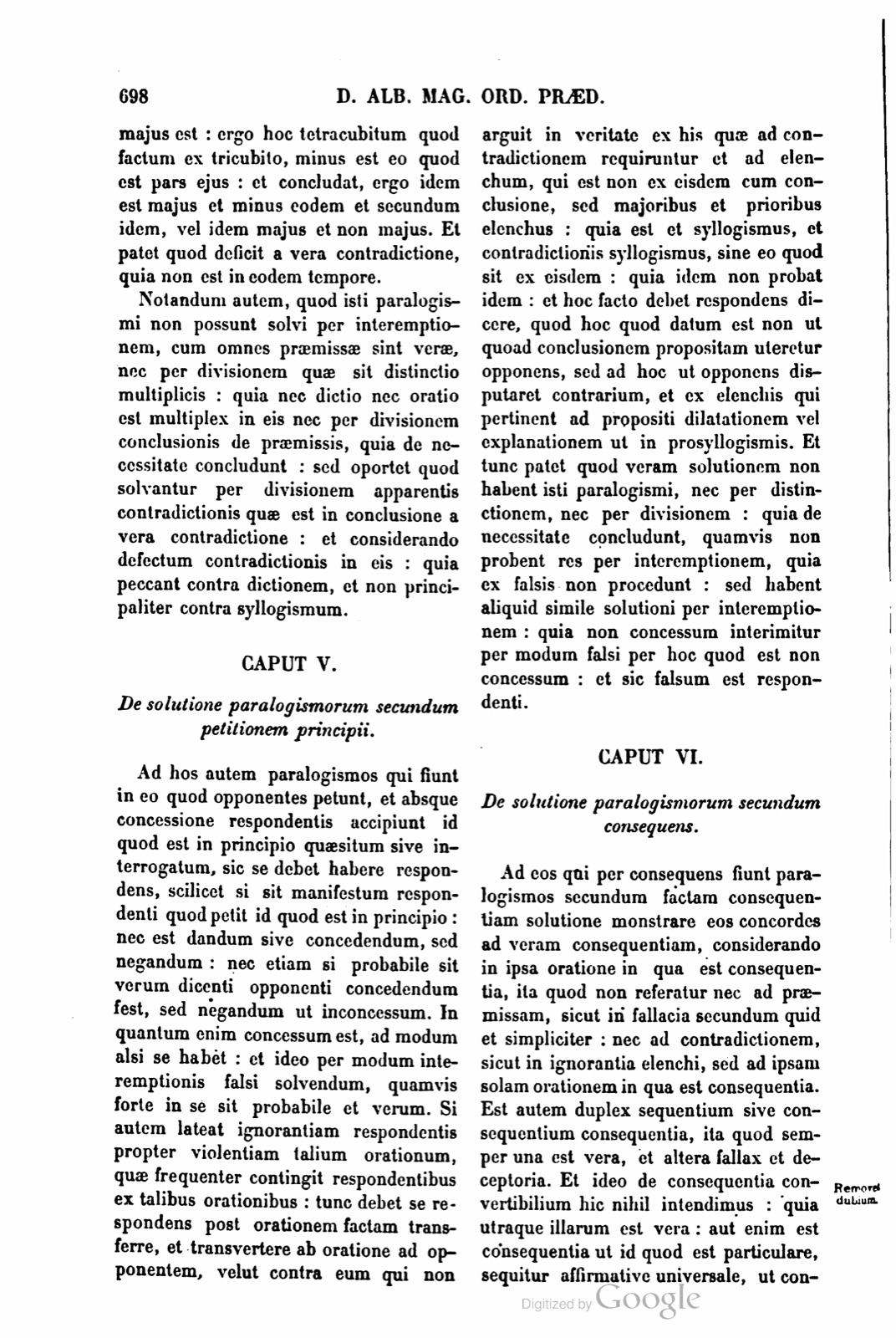
CAPUT V. De solutione paralogismorum secundum petitionem principii.
Ad hos autem paralogismos qui fiunt in eo quod opponentes petunt, et absque concessione respondentis accipiunt id quod est in principio quaesitum sive interrogatum, sic se debet habere respondens, scilicet si sit manifestum respondenti quod petit id quod est in principio: nec est dandum sive concedendum, sed negandum: nec etiam si probabile sit verum dicenti opponenti concedendum est, sed negandum ut inconcessum. In quantum enim concessum est, ad modum falsi se habet: et ideo per modum interemptionis falsi solvendum, quamvis forte in se sit probabile et verum. Si autem lateat ignorantiam respondentis propter violentiam talium orationum, quae frequenter contingit respondentibus ex talibus orationibus: tunc debet se respondens post orationem factam transferre, et transvertere ab oratione ad opponentem, velut contra eum qui non arguit in veritate ex his quae ad contradictionem requiruntur et ad elenchum, qui est non ex eisdem cum conclusione, sed majoribus et prioribus elenchus: quia est et syllogismus, et contradictionis syllogismus, sine eo quod sit ex eisdem: quia idem non probat idem: et hoc facto debet respondens dicere, quod hoc quod datum est non ut quoad conclusionem propositam uteretur opponens, sed ad hoc ut opponens disputaret contrarium, et ex elenchis qui pertinent ad propositi dilatationem vel explanationem ut in prosyllogismis. Et tunc patet quod veram solutionem non habent isti paralogismi, nec per distinctionem, nec per divisionem: quia de necessitate concludunt, quamvis non probent res per interemptionem, quia ex falsis non procedunt: sed habent aliquid simile solutioni per interemptionem: quia non concessum interimitur per modum falsi per hoc quod est non concessum: et sic falsum est respondenti.
CAPUT VI. De solutione paralogismorum secundum consequens.
Ad eos qui per consequens fiunt paralogismos secundum factam consequentiam solutione monstrare eos concordes ad veram consequentiam, considerando in ipsa oratione in qua est consequentia, ita quod non referatur nec ad praemissam, sicut in fallacia secundum quid et simpliciter: nec ad contradictionem, sicut in ignorantia elenchi, sed ad ipsam solam orationem in qua est consequentia. Est autem duplex sequentium sive consequentium consequentia, ita quod semper una est vera, et altera fallax et deceptoria. Et ideo de consequentia convertibilium hic nihil intendimus: quia utraque illarum est vera: aut enim est consequentia ut id quod est particulare, sequitur affirmative universale, ut consequens affirmatum antecedens affirmatum: et haec vocatur consequentia in ipso, ut hominem sive ad hominem sequitur animal: et tunc falsa consequentia est, ut affirmative sequatur antecedens affirmatum ad consequens affirmatum: probant enim sive approbant aliqui decepti per consequens, quod si hoc consequens affirmatum est cum illo antecedente affirmato, et e converso, et illud antecedens affirmatum esse cum hoc consequente affirmato, hoc est, quod sicut affirmative consequens sequitur ad antecedens, ita e converso antecedens affirmative sequitur ad consequens: et hoc non est necessarium: quia ad antecedens affirmatum sequitur consequens affirmatum, ita per oppositum ad consequens negatum sequitur antecedens negatum. Aut disjunctive cum alia consequentia e contrario quae est inter opposita: nam si huic antecedenti illud consequens affirmatur: tunc ex opposito consequentis sequitur oppositum antecedens. Ut si ad hominem sequitur animal, ad oppositum animalis quod est non animal, sequitur oppositum antecedentis quod est non homo. Sicut patet quod peccat Melissi oratio: sic enim arguit: si quod factum est, habet principium, ita quod ad positionem antecedentis sequitur positio consequentis: tunc quod factum non est, non habet principium, ita quod ad oppositum antecedentis sequatur oppositum consequentis: quare consequentia non valet: et sic probat caelum et mundum non habere durationis principium: quia si ingenitum est caelum non habens suae generationis principium, sequitur quod si non est factum per generationem, quod non habet suae durationis principium. Haec autem consequentia non est consequentia: quia in taliter oppositis sicut est genitum et ingenitum, e contrario et non in ipso est consequentia: et manifestare in ipsa oratione talem consequentiae falsitatem vera est solutio.
CHAPTER V. Concerning the solution of paralogisms according to petition of the principle.
But with respect to these paralogisms which are made in this, that opponents beg and, without the respondent's concession, take that which was sought or asked at the beginning, the respondent ought to conduct himself thus: namely, if it is manifest to the respondent that he begs what is in the beginning, it must not be given or conceded, but denied; nor even if it is probable and true to the one speaking, the opponent, must it be conceded, but it must be denied as not conceded. For insofar as it has been conceded, it has itself in the manner of something false; and therefore it must be solved in the manner of destroying something false, although perhaps in itself it is probable and true. But if it escapes the respondent's ignorance because of the force of such speeches, which frequently happens to respondents from such speeches, then after the speech has been made the respondent must transfer himself and turn himself back from the speech to the opponent, as against one who in truth does not argue from those things which are required for contradiction and for refutation, which refutation is not from the same things as the conclusion, but from greater and prior things; because it is both a syllogism and a syllogism of contradiction, without being from the same things, because the same does not prove the same. And when this has been done, the respondent ought to say that what was given was not so that the opponent would use it with respect to the proposed conclusion, but so that the opponent might dispute the contrary and from refutations which pertain to the enlargement or explanation of the proposed thing, as in prosyllogisms. And then it is clear that these paralogisms do not have a true solution either through distinction or through division, because they conclude of necessity, although they do not prove the matters through destruction, because they do not proceed from false things. But they have something similar to solution through destruction, because what was not conceded is destroyed in the manner of the false through the fact that it was not conceded; and thus it is false for the respondent.
CHAPTER VI. Concerning the solution of paralogisms according to consequent.
With respect to those which become paralogisms through consequent, according to the consequence made, one must show by solution that they agree with true consequence by considering in the very speech in which the consequence is, so that it is not referred either to the premise, as in the fallacy according to qualifiedly and simply, nor to contradiction, as in ignorance of refutation, but to the very speech alone in which the consequence is. But there is a twofold consequence of things following or consequents, so that always one is true and the other fallacious and deceptive. And therefore concerning the consequence of convertibles we intend nothing here, because both of those are true. For either there is consequence as what is particular follows an affirmative universal, as the consequent affirmed follows the antecedent affirmed, and this is called consequence in itself, as animal follows man or with respect to man. And then the false consequence is that the antecedent affirmed should affirmatively follow upon the consequent affirmed. For certain people deceived by consequent prove or approve that if this consequent affirmed is with that antecedent affirmed, and conversely, that antecedent affirmed is with this consequent affirmed; that is, that just as affirmatively the consequent follows upon the antecedent, so conversely the antecedent affirmatively follows upon the consequent. And this is not necessary, because upon the antecedent affirmed the consequent affirmed follows, and so by the opposite upon the consequent denied the antecedent denied follows. Or disjunctively with another contrary consequence which is between opposites: for if that consequent is affirmed of this antecedent, then from the opposite of the consequent follows the opposite antecedent. As if animal follows upon man, upon the opposite of animal, which is non-animal, follows the opposite of the antecedent, which is non-man. Thus it is clear that the speech of Melissus sins; for he argues thus: if what has been made has a principle, so that upon the positing of the antecedent follows the positing of the consequent, then what has not been made does not have a principle, so that upon the opposite of the antecedent there follows the opposite of the consequent. Therefore the consequence is not valid. And thus he proves that the heaven and the world do not have a principle of duration, because if the heaven is ungenerated, not having a principle of its generation, it follows that, if it was not made by generation, it does not have a principle of its duration. But this consequence is not a consequence, because in opposites of such a kind, as generated and ungenerated are, the consequence is by the contrary and not in itself; and to manifest such falsity of consequence in the speech itself is the true solution.
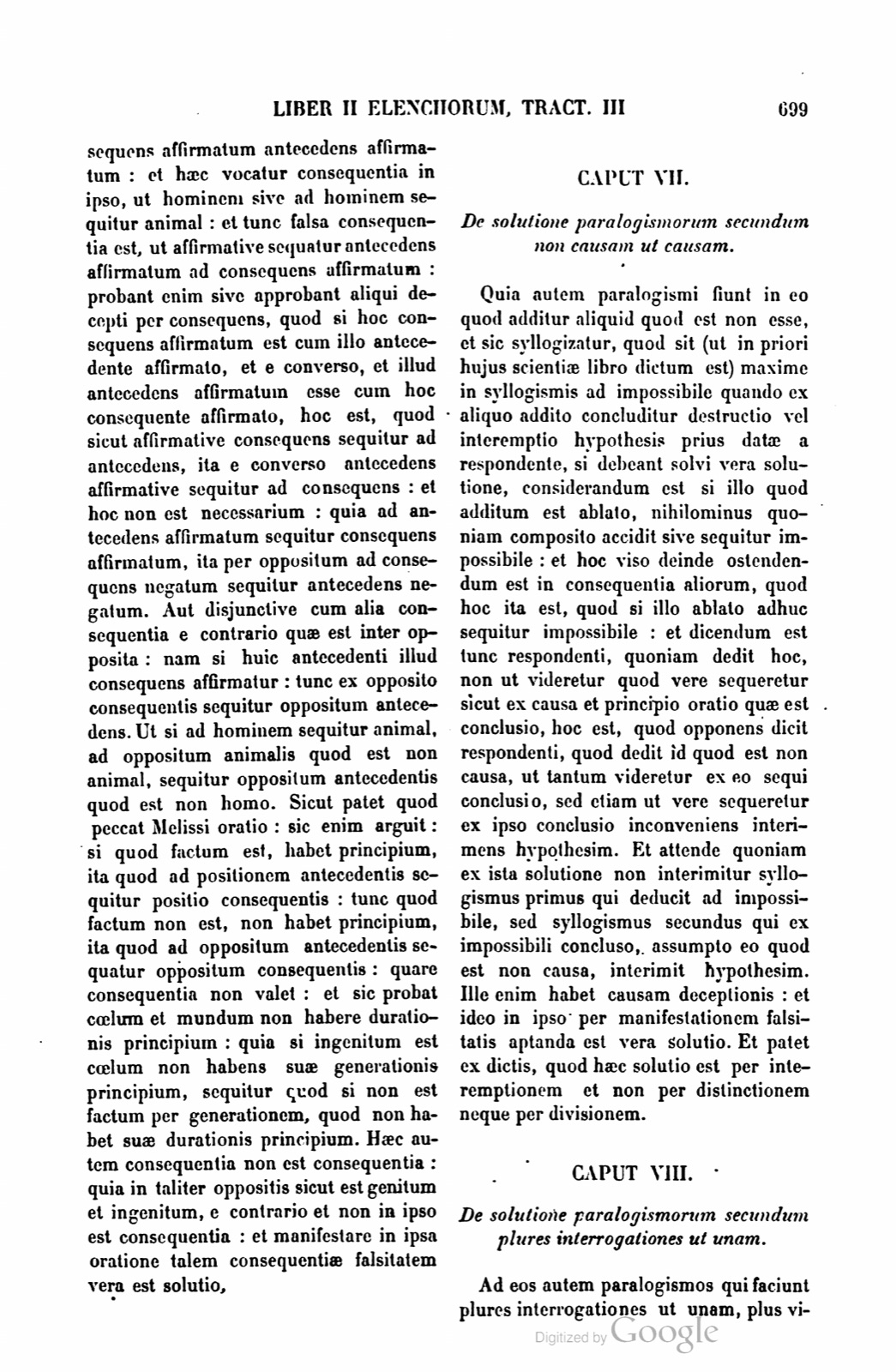
CAPUT VII. De solutione paralogismorum secundum non causam ut causam.
Quia autem paralogismi fiunt in eo quod additur aliquid quod est non esse, et sic syllogizatur, quod sit (ut in priori hujus scientiae libro dictum est) maxime in syllogismis ad impossibile quando ex aliquo addito concluditur destructio vel interemptio hypothesis prius datae a respondente, si debeant solvi vera solutione, considerandum est si illo quod additum est ablato, nihilominus quoniam composito accidit sive sequitur impossibile: et hoc viso deinde ostendendum est in consequentia aliorum, quod hoc ita est, quod si illo ablato adhuc sequitur impossibile: et dicendum est tunc respondenti, quoniam dedit hoc, non ut videretur quod vere sequeretur sicut ex causa et principio oratio quae est conclusio, hoc est, quod opponens dicit respondenti, quod dedit id quod est non causa, ut tantum videretur ex eo sequi conclusio, sed etiam ut vere sequeretur ex ipso conclusio inconveniens interimens hypothesim. Et attende quoniam ex ista solutione non interimitur syllogismus primus qui deducit ad impossibile, sed syllogismus secundus qui ex impossibili concluso, assumpto eo quod est non causa, interimit hypothesim. Ille enim habet causam deceptionis: et ideo in ipso per manifestationem falsitatis aptanda est vera solutio. Et patet ex dictis, quod haec solutio est per interemptionem et non per distinctionem neque per divisionem.
CAPUT VIII. De solutione paralogismorum secundum plures interrogationes ut unam.
Ad eos autem paralogismos qui faciunt plures interrogationes ut unam, plus videndum est, et in quibus pluribus responsionibus utendum est, et in quibus una. Unde hoc statim in principio est determinandum a respondente. Nam interrogatio simpliciter una est, ad quam ordinatur una simpliciter responsio: propter quod in una interrogatione neque interrogatur unum praedicatum de multis subjectis, neque plura praedicata interrogantur de uno subjecto, sed unum praedicatum de uno subjecto in simpliciter una interrogatione: et haec omnia in priori hujus scientiae libro sufficienter determinata sunt. Unde in interrogatione quae simpliciter una est, unum praedicatum de uno subjecto simpliciter dicendum est, vel negandum unum praedicatum ab uno subjecto. Sicut in aequivocis quae plura significant actu, quandoque quidem ambobus (hoc est, secundum utrumque sensum) inest praedicatum, et tunc in utroque sensu vera: quandoque autem neutri, hoc est, secundum neutrum sensum inest praedicatum, et tunc in utroque sensu sunt falsa. Ita etiam est quando interrogatio est plures, quod scilicet in omni sensu inest praedicatum, vel neutri inest: et in tali casu licet non simpliciter sit una interrogatio, tamen simpliciter, hoc est, una responsione respondentibus nihil accidit pati ab opponentibus de redargutione. Sic neque in aequivocis pati accidit, quando in omni sensu vera, vel quando in omni sensu falsa: sicut si quaeratur, curruntne Socrates et Plato? et ponamus quod ambo currant: et dicatur, currunt, unica responsione, nihil procedit redargutio. Vel Plato curritne et disputat? et ponatur quod nec currit nec disputat, et dicam una responsione, non, nihil procedit contradictio ab opponente secundum veram redargutionem: licet interimatur disputare secundum apparentem solutionem, ut in principio hujus secundi libri dictum est: sed secundum veram solutionem nihil contingit pati inconvenientis ab opponente. Sicut neque in aequivocis si dicatur, canisne in omni suo significato mordax est, vel non? et dicatur, sic, quod mordax est et latrabile et marinum et caeleste. Vel sic: canisne secundum omne suum significatum volatile est? et dicatur, non, nihil accidit pati verae redargutionis: sed apparenter interimitur disputare.
CHAPTER VII. Concerning the solution of paralogisms according to non-cause as cause.
But because paralogisms are made in this, that something is added which is not being, and thus it is syllogized that it is, as was said in the prior book of this science, especially in syllogisms to the impossible when from something added the destruction or removal of the hypothesis previously given by the respondent is concluded, if they ought to be solved by true solution, one must consider whether, when that which was added has been removed, nevertheless because it happened to the composite or an impossible follows. And when this has been seen, next one must show in the consequence of the others that this is so, namely that if that has been removed, still the impossible follows. And then it must be said by the respondent that he gave this not so that it would seem that the speech which is the conclusion truly followed as from a cause and principle; that is, that the opponent says to the respondent that he gave what is not a cause so that only a conclusion would seem to follow from it, but also so that from it there would truly follow an unfitting conclusion removing the hypothesis. And attend that by this solution the first syllogism which leads to the impossible is not destroyed, but the second syllogism, which from the impossible concluded, with that which is not a cause assumed, removes the hypothesis. For that one has the cause of deception, and therefore in it the true solution must be adapted through manifestation of falsity. And it is clear from what has been said that this solution is through destruction and not through distinction nor through division.
CHAPTER VIII. Concerning the solution of paralogisms according to many questions as one.
With respect to those paralogisms which make many questions as one, one must see more, both in which cases many responses must be used and in which cases one. Hence this must immediately be determined by the respondent at the beginning. For a simply one question is that to which a simply one response is ordered. Because of this, in one question neither is one predicate asked about many subjects, nor are many predicates asked about one subject, but one predicate about one subject in a simply one question; and all these things have been sufficiently determined in the prior book of this science. Hence in a question which is simply one, one predicate must simply be said of one subject, or one predicate denied of one subject. As in equivocal terms which signify several things actually, sometimes indeed the predicate belongs to both, that is, according to both senses, and then it is true in both senses; but sometimes it belongs to neither, that is, according to neither sense does the predicate belong, and then in both senses they are false. So also it is when the question is many: namely, that in every sense the predicate belongs, or belongs to neither; and in such a case, although it is not simply one question, nevertheless simply, that is, with one response, nothing happens to respondents to suffer from opponents concerning refutation. So neither in equivocal terms does it happen to suffer when it is true in every sense, or when false in every sense; as if it is asked, do Socrates and Plato run? and let us posit that both run, and let it be said, they run, with one response, no refutation proceeds. Or, does Plato run and dispute? and let it be posited that he neither runs nor disputes, and let me say with one response, no, no contradiction proceeds from the opponent according to true refutation, although disputing is destroyed according to apparent solution, as was said at the beginning of this second book. But according to true solution nothing unfitting happens to be suffered from the opponent. Just as neither in equivocal terms, if it is said, is dog in every one of its significations biting, or not? and it is said, yes, because it is biting and barkable and marine and heavenly. Or thus: is dog according to every one of its significations winged? and it is said, no, nothing happens to suffer true refutation; but apparently disputing is destroyed.
Patet igitur quod quando plura praedicata insunt uni vel unum pluribus inest subjectis, simpliciter danti unam responsionem, vel quando non inest utrique si dat unam responsionem, et delinquit secundum hoc peccatum quod unam dat responsionem ad interrogationes quae plures est, nihil contrarii vel inconvenientis accidit secundum veram redargutionem ab opponente: nisi quia interimitur apparens disputatio. In tali ergo casu non debet uti hac arte, quod ad interrogationem quae est plures, plures dentur responsiones. Quando autem praedicatum inest uni subjecto, huic autem alii subjecto non inest: et unum quidem est verum, et alterum falsum: aut quando plura praedicata interrogantur de pluribus subjectis, et contingit quod aliquando insunt ambo ambobus subjectis, et contingit quod non insunt ambo ambobus subjectis: et est etiam quando unum inest uni, et alterum non inest alteri: tunc quidem quando ambo insunt, potest dari una affirmativa responsio: et quando ambo non insunt, potest dari una negativa responsio: et quando unum inest uni, et alterum non inest: tunc formidandum est dare unicam responsionem, quia tunc contingit pati inconveniens ab opponente. Ut patet in his orationibus, demonstratis duobus quorum unum est bonum et alterum malum, quaeratur utrum hoc est dicere bonum vel malum? Si enim dicat quod est verum dicere hoc esse bonum, sequitur quod hoc, demonstrato malo, est bonum: ergo malum est bonum. Et si dicat quod verum est dicere hoc esse malum, sequitur quod bonum est malum: et rursum sive ulterius sequitur, quod utrumque istorum neque bonum est neque malum: quia si detur quod utrumque est bonum, tunc sequitur quod malum est bonum: si est malum: ergo non bonum: ergo neque malum neque bonum. Et similiter est si detur quod haec sunt malum, sicut patet facile cuilibet consideranti: quia deducitur ad hoc quod utrumque istorum neque bonum est neque malum: et per consequens sequitur quod idem est bonum et malum, et quod utrumque istorum neque bonum est neque malum. Non ergo danda est una responsio, sed dicendum est, hoc est bonum, et illud est malum, ut singulis interrogationibus sua aptetur responsio.
Therefore it is clear that when several predicates belong to one thing or one predicate belongs to several subjects, if one gives one response simply, or when it does not belong to both, if he gives one response and faults according to this fault, namely that he gives one response to questions which are many, nothing contrary or unfitting happens according to true refutation from the opponent, except that apparent disputation is destroyed. Therefore in such a case one must not use this art, that to a question which is many, many responses should be given. But when the predicate belongs to one subject and does not belong to this other subject, and one indeed is true and the other false; or when many predicates are asked about many subjects, and it happens that sometimes both belong to both subjects, and it happens that both do not belong to both subjects, and it also is the case when one belongs to one and the other does not belong to the other; then indeed when both belong, one affirmative response can be given, and when both do not belong, one negative response can be given. But when one belongs to one and the other does not belong, then giving a single response must be feared, because then it happens to suffer something unfitting from the opponent. As is clear in these speeches: when two things are shown, one of which is good and the other evil, let it be asked whether this is to say good or evil. For if he says that it is true to say this is good, it follows that this, with the evil thing shown, is good; therefore evil is good. And if he says that it is true to say this is evil, it follows that good is evil; and again or further it follows that each of these is neither good nor evil, because if it is granted that each is good, then it follows that evil is good; if it is evil, therefore not good; therefore neither evil nor good. And it is similar if it is granted that these are evil, as is easily clear to anyone considering, because he is led to this, that each of these is neither good nor evil; and consequently it follows that the same thing is good and evil, and that each of these is neither good nor evil. Therefore one response must not be given, but it must be said: this is good, and that is evil, so that its own response may be adapted to each question.
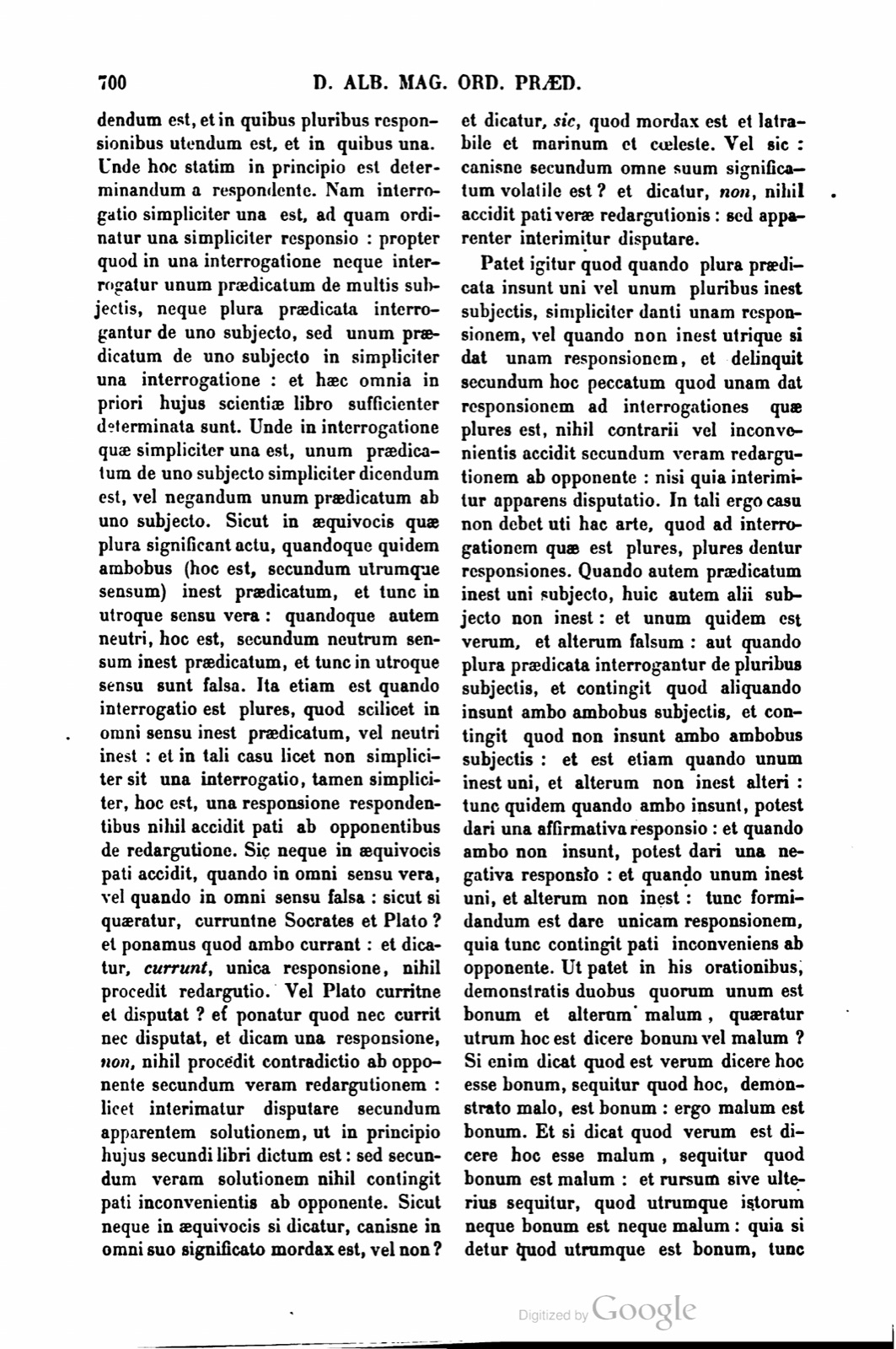
Alia autem oratio secundum plures interrogationes ut unam haec est, si vel an singulum sit sibi idem, et alii diversum? in qua plura de uno interrogantur: et si dicat respondens una responsione, quod sic, opponens procedit contra eum dicens, quod quaecumque talia sunt, quod sunt sibi idem et cum hoc diversa ab aliis, non sunt eadem aliis sed sibi, et diversa sunt aliis non sibi: ergo sunt diversa et eadem: ergo si uni diversa sunt et eadem, duabus responsionibus respondendum est, et dicendum quod sunt sibi eadem et non aliis, et sunt diversa aliis et non sibi.
Amplius tertia oratio est. Ponantur duo, bonum scilicet et malum: et fiat de bono malum, et de malo bonum: et quaeratur utrum ista sunt bonum et malum? et respondente, quod sic, adversetur opponens dicens: ergo illud fit bonum et malum, et illud similiter fit bonum et malum. Unde non una responsione dicendum, sed pluribus sic: hoc fit malum, et hoc fit bonum. Quarta oratio est talis: sint duo homines aequales, et fiant inaequales: et quaeratur, an isti sunt aequales vel inaequales? obviet opponens, duum et aequalium utrumque sibi est inaequale et aequale, quia aequale sibi et alteri inaequale: et aliud similiter sibi aequale et alteri inaequale: ergo hoc est sibi aequale et inaequale: et aliud similiter: ergo idem aequale sibi et non aequale. Unde non una responsione solvendum, sed dicendum, hoc est sibi aequale, et alteri inaequale: et similiter illud aliud sibi est aequale, et alteri inaequale.
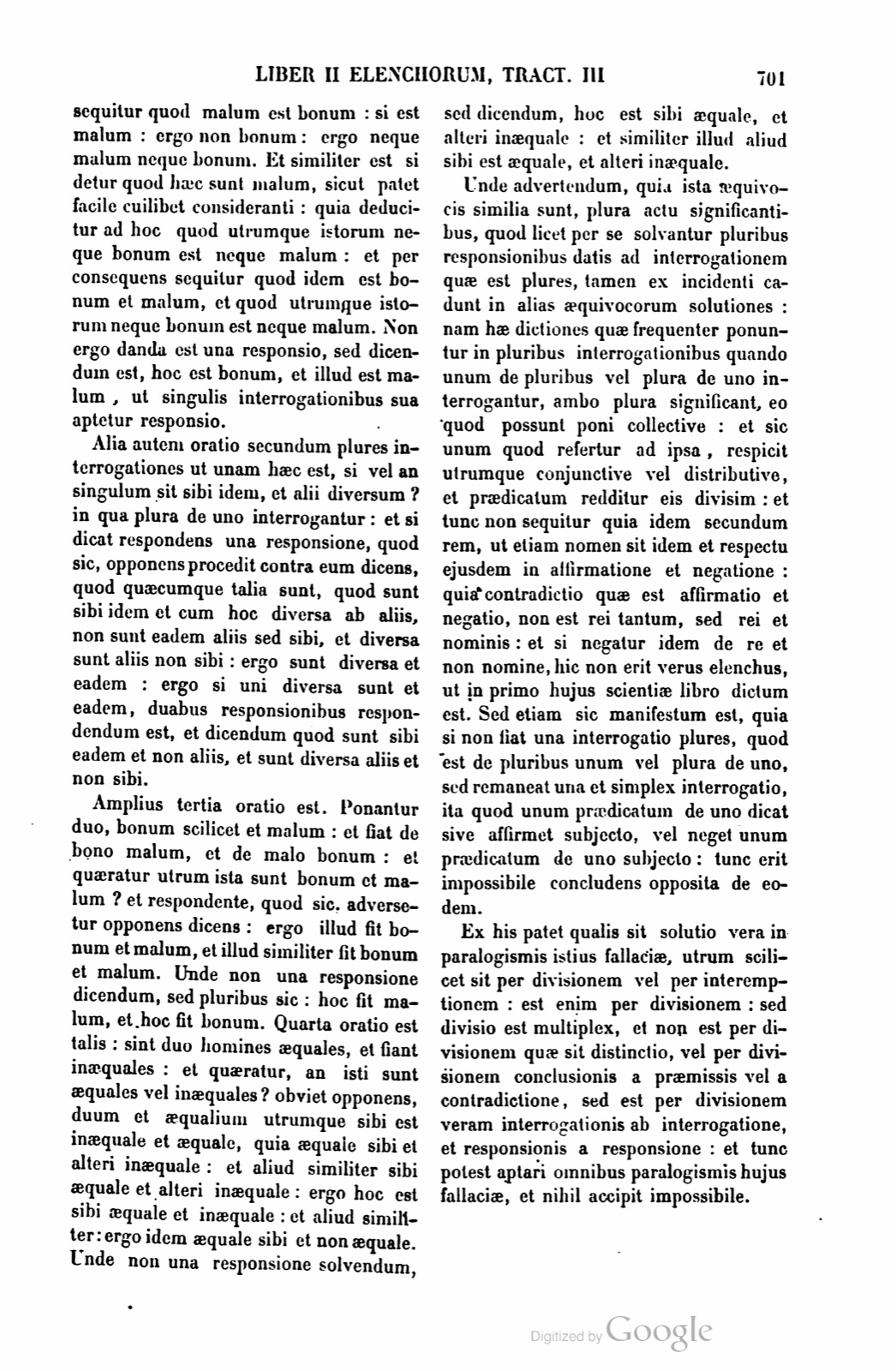
Unde advertendum, quia ista aequivocis similia sunt, plura actu significantibus, quod licet per se solvantur pluribus responsionibus datis ad interrogationem quae est plures, tamen ex incidenti cadunt in alias aequivocorum solutiones: nam hae dictiones quae frequenter ponuntur in pluribus interrogationibus quando unum de pluribus vel plura de uno interrogantur, ambo plura significant, eo quod possunt poni collective: et sic unum quod refertur ad ipsa, respicit utrumque conjunctive vel distributive, et praedicatum redditur eis divisim: et tunc non sequitur quia idem secundum rem, ut etiam nomen sit idem et respectu ejusdem in affirmatione et negatione: quia contradictio quae est affirmatio et negatio, non est rei tantum, sed rei et nominis: et si negatur idem de re et non nomine, hic non erit verus elenchus, ut in primo hujus scientiae libro dictum est. Sed etiam sic manifestum est, quia si non fiat una interrogatio plures, quod est de pluribus unum vel plura de uno, sed remaneat una et simplex interrogatio, ita quod unum praedicatum de uno dicat sive affirmet subjecto, vel neget unum praedicatum de uno subjecto: tunc erit impossibile concludens opposita de eodem.
Ex his patet qualis sit solutio vera in paralogismis istius fallaciae, utrum scilicet sit per divisionem vel per interemptionem: est enim per divisionem: sed divisio est multiplex, et non est per divisionem quae sit distinctio, vel per divisionem conclusionis a praemissis vel a contradictione, sed est per divisionem veram interrogationis ab interrogatione, et responsionis a responsione: et tunc potest aptari omnibus paralogismis hujus fallaciae, et nihil accipit impossibile.
But another speech according to many questions as one is this: whether or whether each thing is the same as itself and diverse from another? In this, many things are asked about one. And if the respondent says with one response that it is so, the opponent proceeds against him, saying that whatever things are such that they are the same as themselves and with this diverse from others are not the same as others but as themselves, and are diverse from others, not from themselves; therefore they are diverse and the same; therefore if they are diverse and the same as one, one must respond with two responses and say that they are the same as themselves and not as others, and are diverse from others and not from themselves.
Furthermore there is a third speech. Let two things be posited, namely good and evil, and let evil come to be from good, and good from evil; and let it be asked whether these are good and evil. And when the respondent says yes, let the opponent oppose, saying: therefore that thing becomes good and evil, and that thing likewise becomes good and evil. Hence it must not be said with one response, but with several thus: this becomes evil, and this becomes good. The fourth speech is such: let there be two equal men, and let them become unequal; and let it be asked whether they are equal or unequal. Let the opponent meet him: of two and equal things, each is unequal and equal to itself, because equal to itself and unequal to the other; and the other similarly equal to itself and unequal to the other. Therefore this one is equal to itself and unequal, and the other similarly; therefore the same thing is equal to itself and not equal. Hence it must not be solved with one response, but it must be said: this is equal to itself and unequal to the other, and similarly that other is equal to itself and unequal to the other.
Hence one must note that because these are similar to equivocal terms actually signifying several things, although through themselves they are solved by giving several responses to a question which is many, nevertheless incidentally they fall into the other solutions of equivocal terms. For these words which are frequently posited in many questions, when one thing is asked of many or many of one, both signify several things, because they can be posited collectively; and thus the one thing which is referred to them regards each conjunctively or distributively, and the predicate is returned to them dividedly. And then it does not follow because it is the same according to the thing, so that also the name is the same and with respect to the same in affirmation and negation, because contradiction, which is affirmation and negation, is not of the thing only, but of the thing and the name. And if the same is denied of the thing and not of the name, here there will not be a true refutation, as was said in the first book of this science. But even thus it is manifest, because if one question is not made many, which is one thing about many or many about one, but remains one and simple question, so that one predicate says or affirms of one subject, or denies one predicate of one subject, then it will be impossible as concluding opposites about the same thing.
From these things it is clear what sort the true solution is in the paralogisms of this fallacy, namely whether it is through division or through destruction. For it is through division; but division is multiple, and it is not through division which is distinction, nor through division of the conclusion from the premises or from contradiction, but through the true division of question from question and of response from response. And then it can be adapted to all paralogisms of this fallacy, and it accepts nothing impossible.
If a page does not appear, its photograph has not been uploaded yet.