Works › Sophistical Refutations, Books I–II
Volume 2 · pp. 697–698
Tractate III. Chapter IV
A marker with ≈ is an approximate page boundary, placed by measure of the text; the page photographs remain the authority. In the paired views, clicking a page marker brings that page into view.
CAPUT IV. De solutione paralogismorum secundum ignorantiam elenchi.
Hos vero paralogismos qui fiunt secundum diffinitionem elenchi, hoc est, ignorantiam diffinitionis vel omissionem alicujus positorum in vera elenchi diffinitione, solvendum per considerationem conclusionis et comparationem ad veram contradictionem, quemadmodum scriptum est prius in hujus scientiae libro priori, ubi scriptum est quod quatuor specialiter considerantur in vera contradictionis diffinitione, et per illam solventem oportet obviare fallaciae decipienti in paralogismis ignorantiae elenchi, considerando scilicet et conferendo conclusionem ad veram contradictionem: hoc autem sic ut contradictio vera sit circa idem et ad idem et secundum idem et similiter et in eodem tempore: et ideo non est haec solutio eadem cum ea quae datur ad paralogismos fallaciae secundum quid ad simpliciter: quia diversis causis decipiendi diversas necesse est adaptare solutiones falsitatem manifestantes: ibi enim contradictio conclusionis aptatur et confertur praemisso ut diximus. Haec autem contradictio apparens (quae est in conclusione) confertur ad veram contradictionem et non ad praemissam, ut videatur quae conditio verae contradictionis deficit in apparente contradictione, quae est in conclusione paralogismorum ignorantiae elenchi. Sed in hac fallacia respondenti cautela habenda est: si enim opponens in principio interrogat ea ex quibus videtur sequi contradictio respondenti, non statim fatendum est sive concedendum, ne redargui videatur: et non est fatendum quod impossibile sit idem esse duplum et non duplum: sed post orationem factam dicendum est respondenti, quod non sic in vera contradictione conclusit ut erat concessum vere redarguere: sed ignoravit aliquid eorum quae pertinent ad veram redargutionem. Haec autem generalis solutio omnibus orationibus ignorantiae elenchi aptabilis est.
CHAPTER IV. Concerning the solution of paralogisms according to ignorance of refutation.
But these paralogisms which are made according to the definition of refutation, that is, through ignorance of the definition or omission of some one of the things posited in the true definition of refutation, must be solved through consideration of the conclusion and comparison to true contradiction, just as it was written earlier in the prior book of this science, where it was written that four things are specially considered in the true definition of contradiction. Through that, the one solving must meet the fallacy deceiving in the paralogisms of ignorance of refutation, namely by considering and comparing the conclusion to true contradiction. But this is so that true contradiction be about the same thing, and with respect to the same thing, and according to the same thing, and similarly, and at the same time. And therefore this solution is not the same as that which is given for the paralogisms of the fallacy according to qualifiedly and simply, because to diverse causes of deceiving it is necessary to adapt diverse solutions manifesting falsity. For there the contradiction of the conclusion is adapted and compared to the premise, as we said. But this apparent contradiction, which is in the conclusion, is compared to true contradiction and not to the premise, so that it may be seen which condition of true contradiction is lacking in the apparent contradiction which is in the conclusion of paralogisms of ignorance of refutation. But in this fallacy caution must be had by the respondent: for if the opponent at the beginning asks those things from which a contradiction seems to follow against the respondent, one must not immediately confess or concede, lest he seem to be refuted; and one must not confess that it is impossible that the same thing be double and not double. Rather, after the speech has been made, it must be said by the respondent that he did not conclude thus in true contradiction as had been conceded to refute truly, but was ignorant of something of those things which pertain to true refutation. But this general solution is adaptable to all speeches of ignorance of refutation.
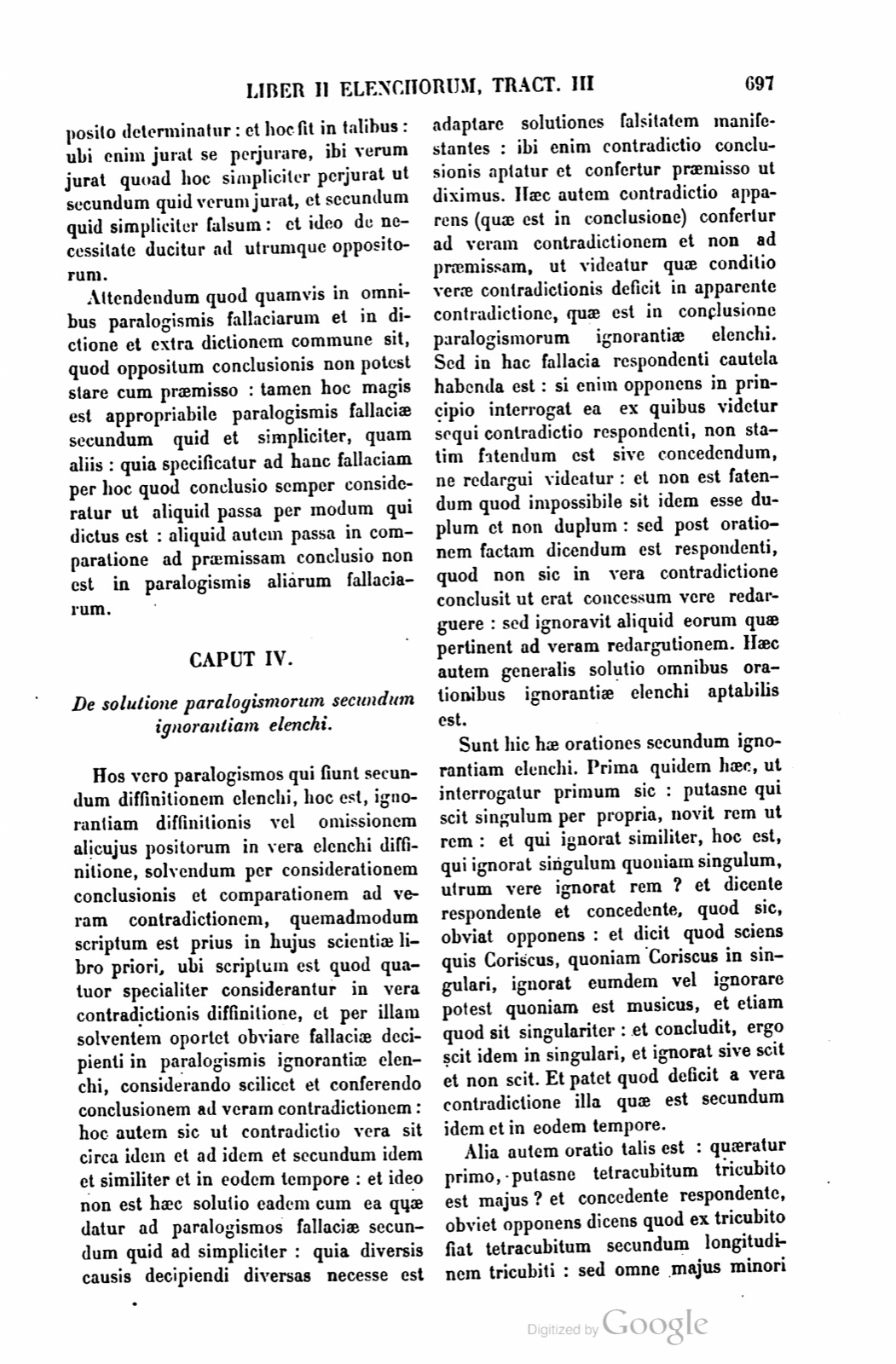
Sunt hic hae orationes secundum ignorantiam elenchi. Prima quidem haec, ut interrogatur primum sic: putasne qui scit singulum per propria, novit rem ut rem: et qui ignorat similiter, hoc est, qui ignorat singulum quoniam singulum, utrum vere ignorat rem? et dicente respondente et concedente, quod sic, obviat opponens: et dicit quod sciens quis Coriscus, quoniam Coriscus in singulari, ignorat eumdem vel ignorare potest quoniam est musicus, et etiam quod sit singulariter: et concludit, ergo scit idem in singulari, et ignorat sive scit et non scit. Et patet quod deficit a vera contradictione illa quae est secundum idem et in eodem tempore.
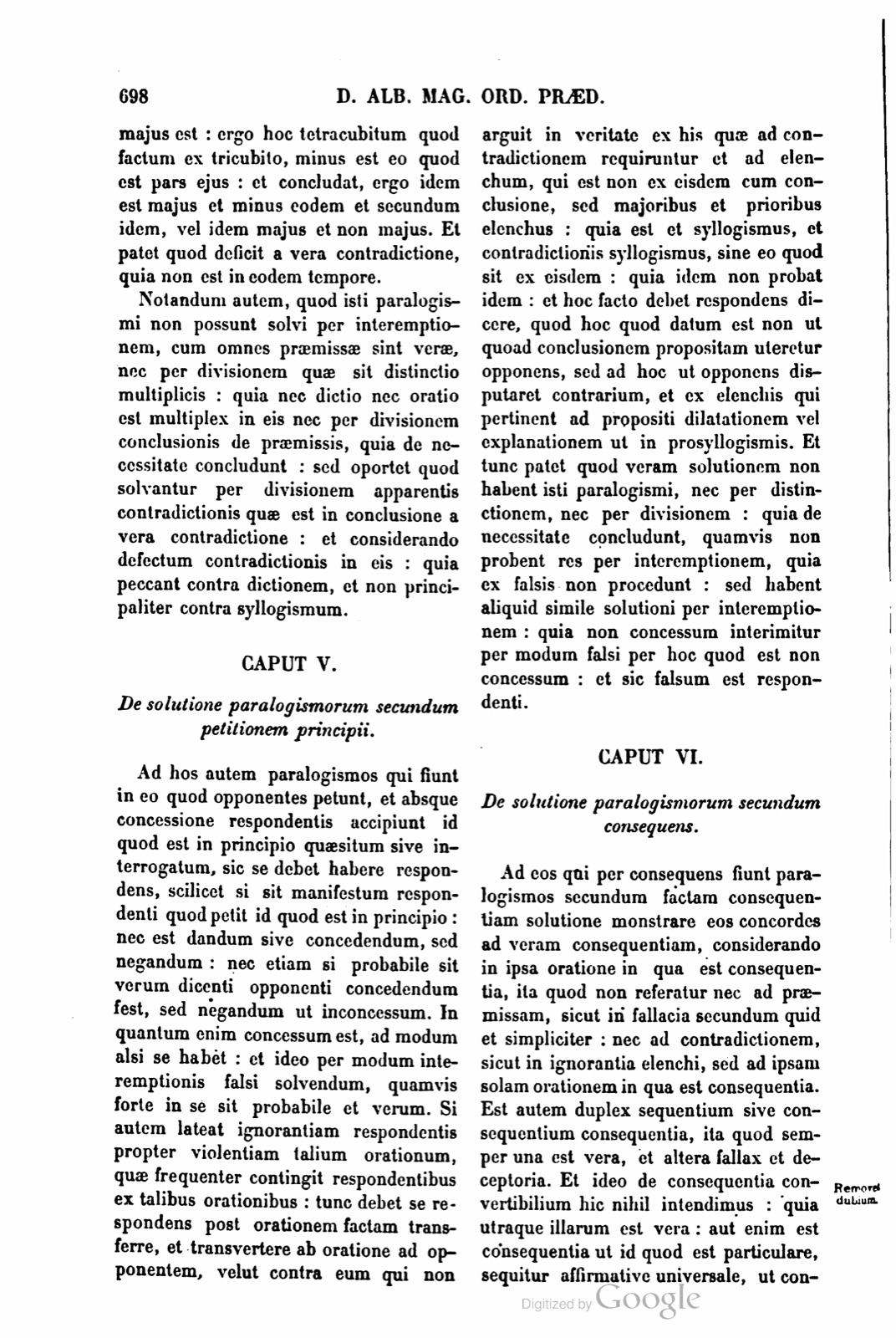
Alia autem oratio talis est: quaeratur primo, putasne tetracubitum tricubito est majus? et concedente respondente, obviet opponens dicens quod ex tricubito fiat tetracubitum secundum longitudinem tricubiti: sed omne majus minori majus est: ergo hoc tetracubitum quod factum ex tricubito, minus est eo quod est pars ejus: et concludat, ergo idem est majus et minus eodem et secundum idem, vel idem majus et non majus. Et patet quod deficit a vera contradictione, quia non est in eodem tempore.
Notandum autem, quod isti paralogismi non possunt solvi per interemptionem, cum omnes praemissae sint verae, nec per divisionem quae sit distinctio multiplicis: quia nec dictio nec oratio est multiplex in eis nec per divisionem conclusionis de praemissis, quia de necessitate concludunt: sed oportet quod solvantur per divisionem apparentis contradictionis quae est in conclusione a vera contradictione: et considerando defectum contradictionis in eis: quia peccant contra dictionem, et non principaliter contra syllogismum.
Here are these speeches according to ignorance of refutation. The first indeed is this: let it first be asked thus, do you think that he who knows a singular thing through its proper features knows the thing as a thing, and that he who is similarly ignorant, that is, who is ignorant of a singular because it is singular, truly is ignorant of the thing? And when the respondent says and concedes yes, the opponent meets him and says that someone knowing Coriscus, because Coriscus in the singular, is ignorant of the same or can be ignorant of him because he is musical, and also because he may be singularly; and he concludes: therefore he knows the same thing in the singular and is ignorant, or knows and does not know. And it is clear that that contradiction falls short of true contradiction which is according to the same thing and at the same time.
But another speech is such: first let it be asked, do you think that the four-cubit thing is greater than the three-cubit thing? And when the respondent concedes, let the opponent meet him, saying that from the three-cubit thing a four-cubit thing is made according to the length of the three-cubit thing; but everything greater is greater than the lesser; therefore this four-cubit thing which was made from the three-cubit thing is less than that which is its part; and let him conclude: therefore the same thing is greater and less than the same and according to the same thing, or the same thing is greater and not greater. And it is clear that it falls short of true contradiction because it is not at the same time.
But it must be noted that these paralogisms cannot be solved through destruction, since all the premises are true, nor through division which is a distinction of something multiple, because neither the diction nor the speech is multiple in them, nor through division of the conclusion from the premises, because they conclude of necessity. Rather, they must be solved through division of the apparent contradiction which is in the conclusion from true contradiction, and by considering the defect of contradiction in them, because they sin against diction and not principally against syllogism.
If a page does not appear, its photograph has not been uploaded yet.