Works › Sophistical Refutations, Books I–II
Volume 2 · pp. 693–697
Tractate III. Chapter III
A marker with ≈ is an approximate page boundary, placed by measure of the text; the page photographs remain the authority. In the paired views, clicking a page marker brings that page into view.
Cujus probatio est, quia si aliquid significamus oratione truncata a quo aliquid auferimus, nec determinate et perfecta tali ablatione facimus, quod multiplex oratio illa sit. Verbi gratia cum dicitur, homo est de numero animalium, haec oratio non est multiplex: unde si auferamus hoc quod dico, de numero, et dicamus hoc est animalium, non per hoc erit multiplex: quod patet per simile: quia si Homeri vel Ovidii dicamus dimidium versum et imperfectum, tali truncatione non facimus quod est multiplex sic: sed quod subintelligitur addendum est. Ut verbi gratia, si dicamus, da mihi, non est oratio: sed supplere oportet Iliada, Graecus accusativus. Ilias enim est liber in quo versus de Ilion (hoc est, de historia Troiana) continentur. Si dicamus versus truncatim Homeri dicentes, iram pande mihi: et subintelligitur dea: quamvis sit determinatum, tamen per hoc non sit oratio multiplex. Similiter igitur cum dicitur, hoc est horum, quamvis non addatur qualiter hoc sit horum, scilicet possessione vel partitione, non propter hoc oratio fit multiplex, praecipue multiplicitate quae sit causa falsi sive apparentis syllogismi: ideo manifestatio talis multiplicitatis non est vera solutio.
CAPUT III. De solutione paralogismorum fallaciae secundum quid et simpliciter.
Hos autem paralogismos qui sunt secundum quid et simpliciter, qui scilicet sunt in eo quod aliquid dicitur principaliter (hoc est, simpliciter hoc) vel secundum quid sive quo est (hoc est, quoad hoc) vel ubi (hoc est, secundum aliquod ubi) vel dicuntur aliquo modo (hoc est, secundum illum modum vel illum) et non simpliciter, vel dicuntur ad aliquid et non simpliciter, et generaliter secundum aliquam determinationem ad hoc vel illud determinate, per determinationem ejus quod est simpliciter, omnes illos paralogismos solvendum est considerando et comparando conclusionem ad contradictionem, considerando scilicet si oppositum conclusionis potest stare cum praemissa. Si enim hoc cum praemissa stare potest, tunc ex praemissa non sequitur conclusio: quia cum quocumque stat antecedens, cum eodem stat consequens. Unde si contingit conclusionem aliquam esse falsam, quod oppositum ejus stat cum praemissa: tunc etiam conclusio non stat cum eodem: et sic non fuit conclusio sequens ex tali praemissa: et sic manifestata est causa falsitatis syllogismi. Hujus autem ratio est, quod contraria et etiam opposita secundum affirmationem et negationem (quae sunt simpliciter contraria vel simpliciter contradictoria) impossibile est inesse eidem secundum idem similiter et in eodem tempore: quo autem (hoc est, secundum aliquam determinationem diminuentem id quod est simpliciter) vel aliquid (hoc est, secundum partem aliquam) vel aliquo modo contingit inesse simul utrumque contrariorum vel contradictoriorum, ut album esse secundum dentes et non album secundum pedes: vel etiam ambo contingit esse contraria, ut hic unum contrariorum insit quo (hoc est, secundum quid) aliud autem simplex, ut nigrum secundum pedes inest cygno: simpliciter tamen est albus: sic enim nihil prohibet eidem inesse contraria et contradictoria, ut esse album simpliciter et non esse album simpliciter. Unde si probatur unum oppositorum inesse simpliciter, aliud autem oppositum illius probatur inesse quo sive secundum quid, nondum probatus est verus elenchus, hoc est, contradictionis syllogismus: quia contradictio est unus et ejusdem et secundum idem simpliciter et in eodem tempore. Hoc autem est considerandum in conclusione comparando eam ad contradictionem: et haec est solutio generalis, quae ut adaptetur ad omnes paralogismos illius fallaciae, ponitur specialiter.
The proof of this is that if we signify something by a truncated speech from which we remove something, we do not, by such a removal not determinate and not perfected, make that speech multiple. For example, when it is said, a man is from the number of animals, this speech is not multiple; hence if we remove this which I say, from the number, and say, this is of animals, it will not thereby be multiple. This is clear through a likeness, because if we speak a half and imperfect verse of Homer or Ovid, by such truncation we do not make what is multiple thus, but what is understood under it must be added. For example, if we say, give me, it is not a speech, but one must supply Iliad, a Greek accusative. For the Iliad is the book in which verses about Ilion, that is, about the Trojan history, are contained. If we say verses of Homer in truncated fashion, saying, unfold wrath for me, and goddess is understood under it, although it is determinate, nevertheless through this the speech is not multiple. Therefore similarly, when it is said, this is of these things, although there is not added in what way this is of these things, namely by possession or partition, the speech does not on account of this become multiple, especially with a multiplicity which would be the cause of a false or apparent syllogism. Therefore the manifestation of such multiplicity is not the true solution.
CHAPTER III. Concerning the solution of paralogisms of the fallacy according to qualifiedly and simply.
But these paralogisms which are according to qualifiedly and simply, namely those which are in this, that something is said principally, that is, simply this, or according to something or in respect of which it is, that is, with respect to this, or where, that is, according to some where, or are said in some mode, that is, according to this mode or that, and not simply, or are said in relation to something and not simply, and generally according to some determination to this or that determinately, by a determination of what is simply, all those paralogisms must be solved by considering and comparing the conclusion to the contradiction, namely by considering whether the opposite of the conclusion can stand with the premise. For if this can stand with the premise, then the conclusion does not follow from the premise, because with whatever the antecedent stands, with the same the consequent stands. Hence if it happens that some conclusion is false, because its opposite stands with the premise, then the conclusion also does not stand with the same thing; and thus it was not a conclusion following from such a premise; and thus the cause of the falsity of the syllogism has been manifested. But the reason for this is that contraries and also opposites according to affirmation and negation, which are simply contraries or simply contradictories, cannot be in the same thing according to the same thing, similarly, and at the same time. But in respect of which, that is, according to some determination diminishing what is simply, or something, that is, according to some part, or in some mode, it happens that both of the contraries or contradictories are in the same thing at once, as to be white according to the teeth and not white according to the feet; or it even happens that both are contraries, as here one of the contraries is present in respect of which, that is, qualifiedly, while the other is simple, as black according to the feet is present in the swan, yet simply it is white. For thus nothing prevents contraries and contradictories from being in the same thing, as to be white simply and not to be white simply. Hence if one of the opposites is proved to be present simply, but the other opposite of it is proved to be present in respect of which or qualifiedly, a true refutation has not yet been proved, that is, a syllogism of contradiction, because contradiction belongs to one and the same thing and according to the same thing simply and at the same time. But this must be considered in the conclusion by comparing it to the contradiction; and this is the general solution, which, so that it may be adapted to all the paralogisms of that fallacy, is put down specially.
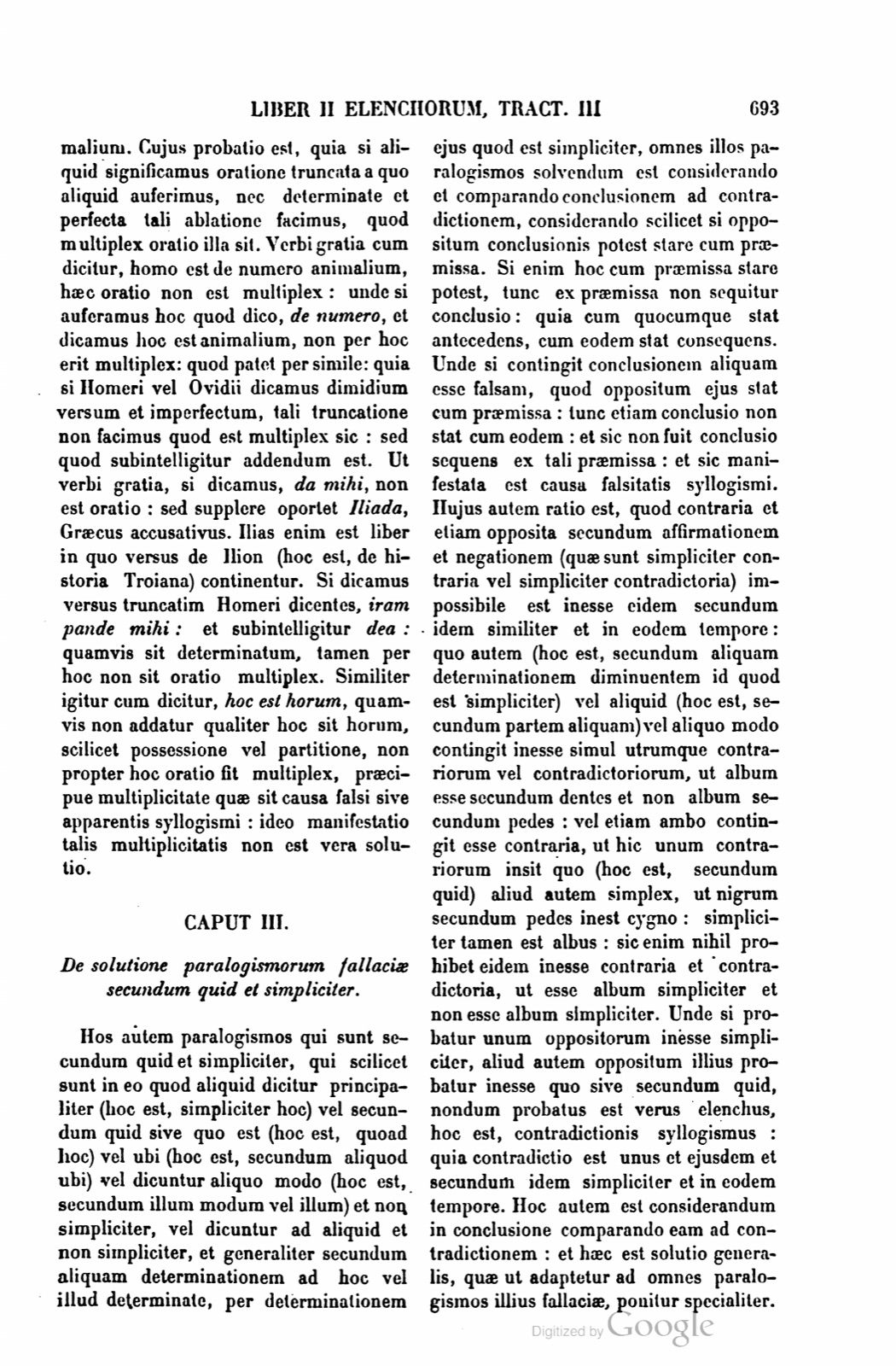
Sunt ergo omnes hujusmodi orationes sive paralogismi qui sunt secundum quid et simpliciter hoc habentes, hoc est, defectum contradictionis in aliqua conditione contradictionis, sicut ille qui concludit, ergo contingit quod non est esse, et formatur sic: quod est in opinione, est: sed falsum est in opinione: ergo falsum est. Sed falsum in opinione, non est: ergo quod non est, contingit esse. Et solvitur: quia quod in opinione est, secundum quid est: et quod simpliciter non est, falsum est: et haec non contradicunt simpliciter non esse et secundum quid esse. Alia oratio similis isti est quod est, ut homo simpliciter non est aliquid eorum quae sunt, ut asinus: ergo quod est, non est: et solvitur: quia non contradicunt ista, esse simpliciter aliquid et non esse hoc. Tertia autem oratio similis istis est, quae concludit, ergo contingit eumdem simul jurare et perjurare: et ponatur, quod aliquis juret se perjurare, utrum jurat et bene jurat secundum quid, et secundum hoc quando simpliciter perjurat: et patet solutio, quia non contradicunt, simul perjurare simpliciter et bene jurare secundum quid. Alia ratio similis istis est, quae concludit quod impossibile est eumdem suadere eidem et dissuadere: et ponatur quod aliquis suadeat alicui ut dissuadeatur ei quod vult facere: hic enim secundum aliquid suadet et simpliciter dissuadet, quae simpliciter stare possunt et non contradicunt: quia non secundum idem suadet et dissuadet.
Solvuntur autem istae orationes respiciendo ad contradictionem, dicendo quod aut sic dicendum: aut dicendum quod non sunt idem esse quid (hoc est, secundum quid) et esse simpliciter: et similiter non sunt idem non esse quid et non esse simpliciter: et haec non contradicunt, et possunt stare simul: quod enim non est simpliciter, non propter hoc si est quid (hoc est, secundum quid) sequitur quod est simpliciter. Neque sequitur, si bene jurat (hoc est, quoad hoc) necesse est propter hoc et illum bene jurare simpliciter: nam qui jurat se perjuratum, bene jurat perjurans hoc, hoc est, secundum hoc: simpliciter autem non bene jurat. Neque sequitur quod qui dissuadet, suadet simpliciter, sed suadet secundum quid, sive quod hoc est secundum quid, suadet.
Similiter autem est etiam in hac oratione in qua concluditur, quod est simul eumdem mentiri et verum esse in dicendo: ponatur enim, quod aliquis dicat, ego dico falsum: et dicat falsum: hic enim secundum quid est verus, simpliciter autem in dicendo est mendax: et haec stant simul et non contradicunt. Sed quia in talibus paralogismis non est facile videre utro modo quis assignet opposita eidem inesse, utrum scilicet utrumque secundum quid vel utrumque simpliciter, vel unum quid et alterum simpliciter, sicut utrum, scilicet quid dicat verum vel simpliciter, vel secundum quid mentiatur vel simpliciter, videtur difficile esse utrum sit contradictio vel non. Prohibet autem nihil quidem eumdem simpliciter esse mendacem, quo autem (hoc est, secundum quid) verum sive veracem esse: et nihil prohibet aliquo (hoc est, secundum aliquid) aliquem esse verum, simpliciter autem non, verum, sicut patet in exemplo quod inductum est. Similiter autem est etiam in his orationibus, in quibus proceditur a simpliciter ad quid sive secundum quid, ut in ad aliquid, et ubi, et quando, hoc est, in determinationibus secundum quid dictis secundum ad aliquid, vel ubi, vel quando: omnes enim hujus orationes a simpliciter ad secundum quid procedentes, accidunt secundum hoc, hoc est, secundum fallaciam secundum quid et simpliciter. Si quaeritur, si sanitas vel divitiae sunt bonum? et cum conceditur quod sic, in contrarium itur per secundum quid sic: divitiae et sanitas non sunt bonum alicui, quia insipienti et non recte viventi, sed malum: ergo idem bonum et non bonum, et idem bonum et malum. Et similiter si quaeratur: ergo sanum esse vel posse in civitate (hoc est, potentatum habere) est bonum? et concedendo, quod sic, inferat oppositum dicens: sed est quando non est melius vel bonum aeque, esse sanum vel potentatum habere in civitate, quia tempore belli: ergo idem bonum et non bonum: et sic idem eidem bonum et non bonum: haec enim non opponuntur in diversis temporibus, aut diversis hominibus, sicut sapienti et insipienti, aut sicut dictum est. Solutum est etiam ad hoc dicendo, quod nihil prohibet quod simpliciter est bonum, huic sicut male utenti non esse bonum: aut quod huic quidem simpliciter est bonum, non esse nunc eidem bonum, ut potentem esse in civitate tempori belli: vel quod huic simpliciter est bonum, non esse in hoc loco vel tempore bonum.
Therefore all speeches or paralogisms of this kind, which are according to qualifiedly and simply, have this, that is, a defect of contradiction in some condition of contradiction, as that one which concludes, therefore it happens that what is not is, and is formed thus: what is in opinion, is; but the false is in opinion; therefore the false is. But the false in opinion is not; therefore what is not happens to be. And it is solved because what is in opinion is qualifiedly, and what simply is not is false; and these, simply not to be and qualifiedly to be, do not contradict. Another speech similar to this is that what is, as man, simply is not any of the things which are, as an ass; therefore what is, is not. And it is solved because these do not contradict, to be something simply and not to be this. The third speech similar to these is that which concludes, therefore it happens that the same person at once swears and perjures himself. And let it be posited that someone swears that he perjures himself, whether he swears and swears well qualifiedly and according to this when he perjures himself simply. The solution is clear, because they do not contradict, at once to perjure oneself simply and to swear well qualifiedly. Another argument similar to these is that which concludes that it is impossible for the same person to persuade and dissuade the same person. And let it be posited that someone persuades someone that he be dissuaded from what he wants to do. For here according to something he persuades and simply he dissuades; these can stand simply and do not contradict, because he does not persuade and dissuade according to the same thing.
But those speeches are solved by looking to contradiction, by saying either that it must be said thus, or that it must be said that to be something qualifiedly and to be simply are not the same; and similarly not to be something qualifiedly and not to be simply are not the same; and these do not contradict and can stand together. For because something simply is not, if it is something, that is, qualifiedly, it does not for this reason follow that it is simply. Nor does it follow, if he swears well, that is, with respect to this, that because of this it is necessary that he also swear well simply; for he who swears that he is perjured swears well while perjuring this, that is, according to this, but simply he does not swear well. Nor does it follow that he who dissuades persuades simply, but he persuades qualifiedly, or because this is qualifiedly, he persuades.
It is similar also in this speech in which it is concluded that the same person is at once lying and true in speaking. For let it be posited that someone says, I say what is false, and let him say what is false. For here he is true qualifiedly, but simply in speaking he is a liar; and these stand together and do not contradict. But because in such paralogisms it is not easy to see in which way someone assigns opposites to be present in the same thing, namely whether both are qualifiedly or both simply, or one qualifiedly and the other simply, as namely whether he says true qualifiedly or simply, or lies qualifiedly or simply, it seems difficult whether there is contradiction or not. Yet nothing prevents the same person from being simply a liar, but in respect of which, that is, qualifiedly, true or truthful; and nothing prevents someone from being true in something, that is, according to something, but simply not true, as is clear in the example that has been introduced. But similarly it is also in those speeches in which one proceeds from simply to something or qualifiedly, as in relation to something, and where, and when, that is, in determinations said qualifiedly according to relation, or where, or when; for all speeches of this kind which proceed from simply to qualifiedly happen according to this, that is, according to the fallacy according to qualifiedly and simply. If it is asked whether health or riches are a good, and when it is conceded that they are, one goes to the contrary through qualifiedly thus: riches and health are not a good for someone, because for the unwise and the one not living rightly they are an evil; therefore the same thing is good and not good, and the same thing good and evil. And similarly if it is asked: therefore to be healthy or to have power in the state, that is, to have political power, is a good? and by conceding that it is so he infers the opposite, saying: but there is a time when it is not better or equally good to be healthy or to have power in the state, namely in time of war; therefore the same thing is good and not good; and thus the same thing is good and not good for the same person. For these are not opposed in diverse times, or in diverse men, as in the wise and the unwise, or as has been said. It has also been solved to this by saying that nothing prevents what simply is good from not being good for this person as one using it badly, or what simply is good for this person from not now being good for the same person, as to be powerful in the state in time of war, or what simply is good for this person from not being good in this place or time.
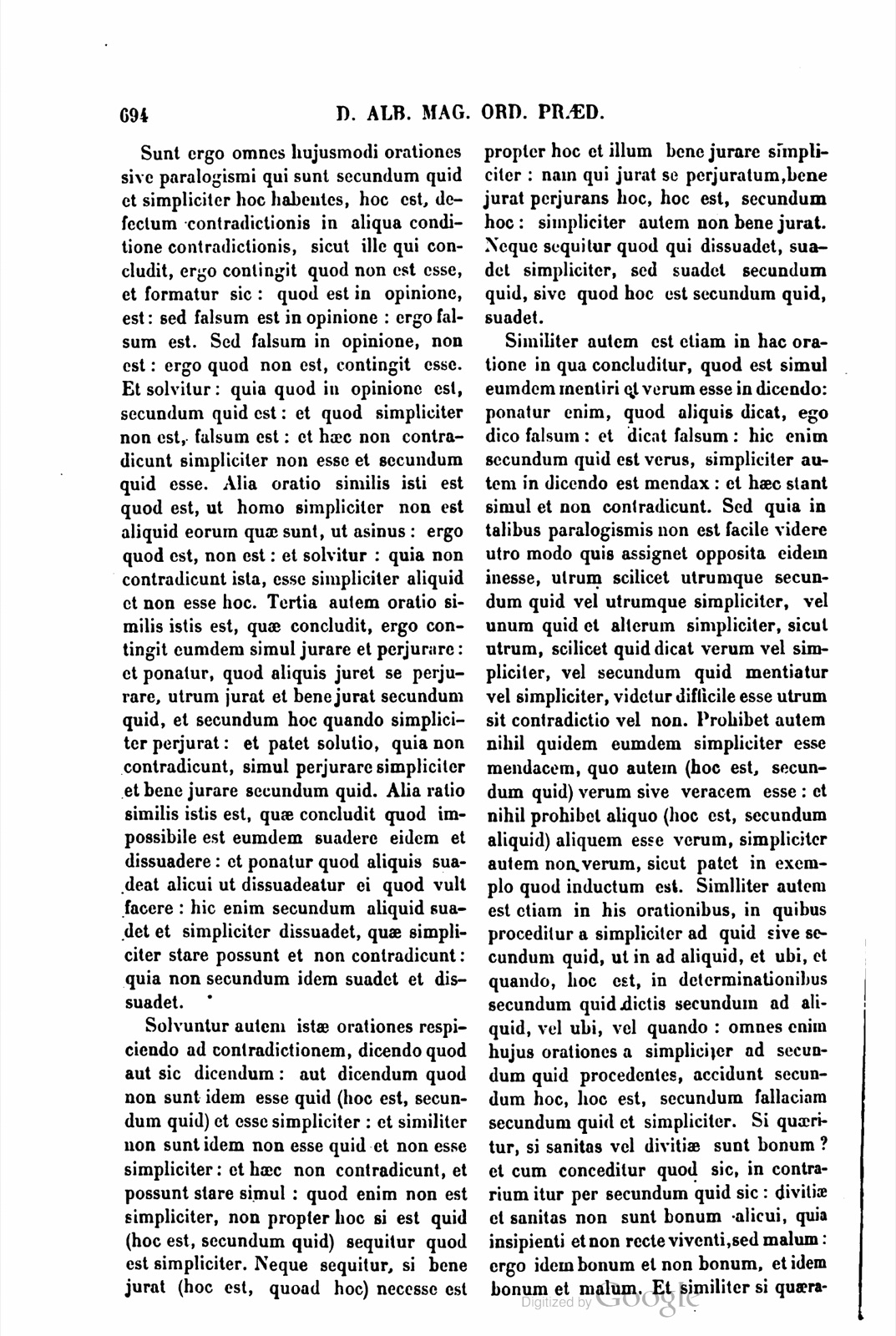
Similiter autem est in his quae quaerunt, si malum est quod non vult sapiens: non vult autem amittere bonum: et inferatur ex hoc: ergo non vult bonum ut simpliciter inferatur ex eo quod est secundum quid: et ex illa ulterius inferatur: quod non vult sapiens, est malum: bonum amittere non vult sapiens: ergo bonum malum. Patet quod est secundum quid: et simpliciter non vult amittere bonum: ergo non vult bonum. Et solvitur: quia non est idem dicere, amittere bonum esse malum, et bonum simpliciter esse malum, vel non bonum. Similiter autem est etiam oratio quae est de fure si sic dicatur, quod fur est malum: fur vult sumere bonum: ergo vult bonum: ergo malum bonum. Patet enim quod fur non vult malum, sed bonum: nam sumere est bonum, cum bonum et secundum quid malum, in quantum scilicet sumitur ut bonum. Similiter autem est in hac oratione, bonum est amittere aegritudinem: sed aegritudo est malum: ergo bonum est malum. Quia aegritudo simpliciter malum est: sed amittere aegritudinem non est malum, sed bonum: et amittere aegritudinem non est aegritudo simpliciter, sed secundum quid, prout scilicet est in amittendo.
Similiter est de oratione concludente, quod injustum justo, et quod injuste fit, eo quod juste fit, magis est eligendum: et formatur sic in paralogismum. Magis est eligendum injuste (hoc est, non propter malum meritum) mori, quam juste (hoc est, propter malum meritum) mori: sed injuste mori est injustum, et juste mori est justum: ergo injustum magis est eligendum quam justum. Et patet quod non sequitur, quod simpliciter injustum magis sit eligendum, quam simpliciter justum: quoniam injustum in hoc, et secundum quid est magis eligendum justo in hoc: et haec est solutio paralogismi. Similis solutio est in paralogismo simili in quo quaeritur (ut ex quaestione formetur paralogismus) utrum justum est sua habere quemque sive quemlibet? et dicente respondente, quod sic, adversetur opponens dicendo: si quae aliquis judicat secundum propriam opinionem, et si sunt falsae opiniones suae, haec singula sua ex lege suae opinionis: ergo justum est illa eum habere: sed si justum est habere quemcumque sua, per oppositum injustum est habere aliena: sed haec ex lege suae opinionis sunt sua: ergo idem justum et injustum, sive idem justum et non justum. Et patet solutio, quod secundum legem suae opinionis justum non est justum nisi secundum quid: et hoc est simpliciter non justum quod stat cum praemisso quod est justum secundum legem suae opinionis.
But it is similar in those things which ask whether what the wise man does not wish is evil. But he does not wish to lose a good, and from this let it be inferred: therefore he does not wish the good, so that simply may be inferred from what is qualifiedly; and from that let it be further inferred: what the wise man does not wish is evil; the wise man does not wish to lose a good; therefore good is evil. It is clear that this is qualifiedly, and simply he does not wish to lose the good; therefore he does not wish the good. And it is solved because it is not the same to say that to lose a good is evil and that good simply is evil or not good. Likewise also there is the speech about the thief if it is said thus, that the thief is evil; the thief wishes to take a good; therefore he wishes a good; therefore evil is good. For it is clear that the thief does not wish evil, but a good; for taking is good, since it is good and qualifiedly evil, insofar as it is taken as a good. It is likewise also in this speech: it is good to lose sickness; but sickness is evil; therefore good is evil. Because sickness is simply evil, but to lose sickness is not evil but good; and to lose sickness is not sickness simply, but qualifiedly, namely insofar as it is in losing.
It is similar concerning the speech concluding that the unjust is more choiceworthy than the just, and what is done unjustly more than what is done justly; and it is formed thus into a paralogism. To die unjustly, that is, not on account of evil desert, is more choiceworthy than to die justly, that is, on account of evil desert; but to die unjustly is unjust, and to die justly is just; therefore the unjust is more choiceworthy than the just. And it is clear that it does not follow that what is simply unjust is more choiceworthy than what is simply just, since the unjust in this respect and qualifiedly is more choiceworthy than the just in this respect; and this is the solution of the paralogism. A similar solution is in a similar paralogism in which it is asked, so that a paralogism may be formed from the question, whether it is just for anyone or everyone to have his own things. And when the respondent says yes, the opponent opposes by saying: if someone judges certain things according to his own opinion, and if his opinions are false, each of these things is his own by the law of his opinion; therefore it is just for him to have them. But if it is just for anyone to have his own things, by the opposite it is unjust to have another's things; but these things by the law of his opinion are his own; therefore the same thing is just and unjust, or the same thing is just and not just. And the solution is clear, that according to the law of his opinion the just is not just except qualifiedly; and this is simply not just, which stands with the premise which is just according to the law of his opinion.
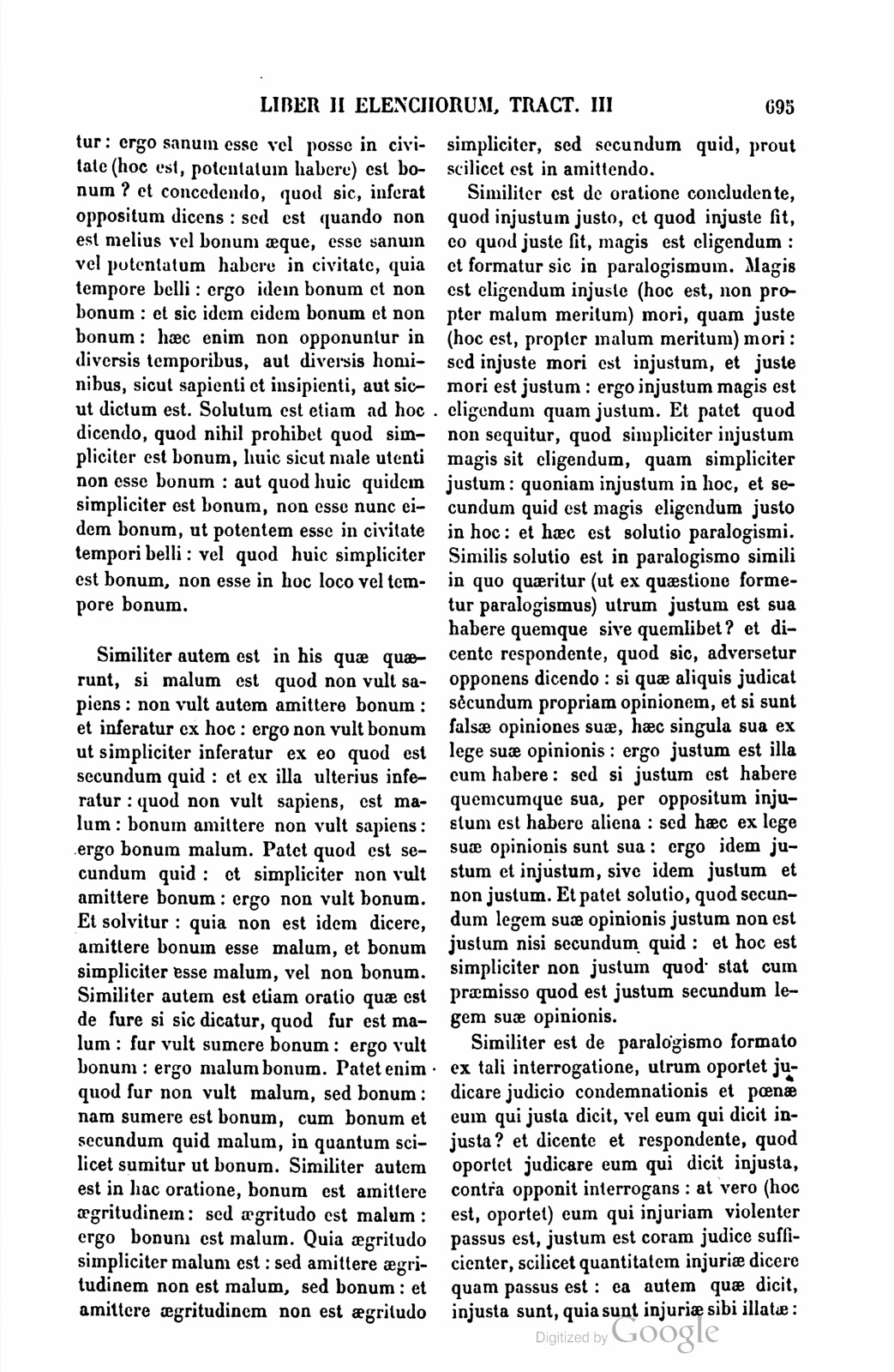
Similiter est de paralogismo formato ex tali interrogatione, utrum oportet judicare judicio condemnationis et poenae eum qui justa dicit, vel eum qui dicit injusta? et dicente et respondente, quod oportet judicare eum qui dicit injusta, contra opponit interrogans: at vero (hoc est, oportet) eum qui injuriam violenter passus est, justum est coram judice sufficienter, scilicet quantitatem injuriae dicere quam passus est: ea autem quae dicit, injusta sunt, quia sunt injuriae sibi illatae: ergo talem oportet punire, quod falsum est. Et solvitur ista oratio: primo quidem, quia non sequitur, si pati injuste aliquid magis est eligendum quam juste, quod propter hoc simpliciter injustum magis sit eligendum quam justum: sed simpliciter quidem magis eligendum est juste eo quod injuste: hoc autem est in hoc, vel secundum hoc nihil prohibet secundum quod id quod injuste fit, magis esse eligendum pati, quam id quod est pati juste.
Similiter solvitur alius paralogismus: quia habere quemquam sua, simpliciter est justum: alienum autem habere, simpliciter non justum, etc.: hoc nihil prohibet judicium (quoad hoc) justum esse. Verbi gratia, si sit justum secundum opinionem judicantis, quod et simpliciter sit justum. Similiter enim quae simpliciter injusta sunt, nihil prohibet injusta esse huic vel sic: non enim etiam in aliquo paralogismo sequitur, si quae quis passus est, dicere est justum, quod id quod dicit, simpliciter sit justum: sicut nec sequitur, si aliquid utile est dicere judici vel alii est utile, quod ea quae dicit, sint simpliciter utilia: et similiter est injustus ad dicere injusta: propter quod non ille qui dicit injusta, sive non propter hoc si ea quae dicuntur ab eo qui injuriam passus est, sunt simpliciter injusta, ille qui dicit coram judice haec injusta quae passus est, vincitur (hoc est, convincitur) esse injustus et puniendus: dicit enim quae dicere justa sunt, secundum hoc quod est dicere coram judice. Simpliciter autem haec pati sive ad patiendum sunt ea quae dicit injusta. In rationibus autem his et similibus est una et similis solutio. Procedunt enim omnes hujusmodi orationes vel a secundum quid ad simpliciter, vel e converso a simpliciter ad secundum quid. Unde semper considerandum est ad contradictionem conclusionis, utrum possit stare cum praemissa ex qua procedit: et sic considerandum est ad contradictionem conclusionis, et conferendum ad praemissam: quia si oppositum conclusionis stat cum praemissa, non sequitur conclusio: quia oppositum consequentis non stat cum antecedente, quamvis oppositum antecedentis bene stet cum consequente, ut patet: Ethiops est albus dentem: ergo est albus. Oppositum enim conclusionis quod est non esse album, stat cum praemissa quod est albus dentes. Et similiter est quando a simpliciter proceditur ad secundum quid: ut Ethiops est niger: ergo non est albus dentes. Oppositum enim conclusionis quod est esse album dentes, stat cum hoc praemisso quod est, Aethiops est niger: et in omnibus his conclusio est aliquid passa: quia vero proceditur ab eo quod est secundum quid ad simpliciter, conclusio patitur defectum determinationis impropriae quae est in praemissa, et aufertur a conclusione. Si autem simpliciter proceditur ad secundum quid: tunc passa est conclusio appositionem determinationis impropriae, quae non fuit in praemissa: et sic patet, quod conclusio semper aliquid est passa, quando consideratur contradictio conclusionis, et confertur ad praemissam.
It is similar concerning a paralogism formed from such a question: whether one ought to judge with a judgment of condemnation and penalty the one who says just things, or the one who says unjust things. And when he says and answers that one ought to judge the one who says unjust things, the opponent asks against him: but indeed, that is, one ought, for one who has violently suffered injury to say sufficiently before the judge, namely the quantity of the injury which he suffered, is just; but the things which he says are unjust, because they are injuries inflicted on him; therefore one must punish such a person, which is false. And this speech is solved first because it does not follow, if suffering something unjustly is more choiceworthy than suffering it justly, that simply on account of this the unjust is more choiceworthy than the just. Rather, simply, what is justly rather than unjustly is more choiceworthy; but in this or according to this nothing prevents it from being more choiceworthy to suffer what is done unjustly than to suffer what is suffered justly.
Similarly another paralogism is solved, because for anyone to have his own things is simply just, but to have another's thing is simply not just, and so forth; this does not prevent the judgment from being just with respect to this. For example, if it is just according to the opinion of the one judging, that it also be simply just. For similarly the things which are simply unjust, nothing prevents from being unjust for this person or in this way. For it does not follow in any paralogism that if to say the things which one has suffered is just, that what he says is simply just; just as neither does it follow, if something is useful to say to a judge or is useful to another, that the things which he says are simply useful. And similarly he is unjust as to saying unjust things. For this reason, not the one who says unjust things, or not because of this, if the things which are said by him who has suffered injury are simply unjust, is that one who says before the judge these unjust things which he has suffered convicted, that is, proved, to be unjust and to be punished. For he says the things which it is just to say according to this, that is, to say before the judge. But simply these things to suffer, or with respect to being suffered, are the unjust things which he says. In these arguments and similar ones there is one and a similar solution. For all speeches of this sort proceed either from qualifiedly to simply, or conversely from simply to qualifiedly. Hence one must always consider with respect to the contradiction of the conclusion whether it can stand with the premise from which it proceeds; and thus one must consider with respect to the contradiction of the conclusion and compare it to the premise, because if the opposite of the conclusion stands with the premise, the conclusion does not follow. For the opposite of the consequent does not stand with the antecedent, although the opposite of the antecedent well stands with the consequent, as is clear: an Ethiopian is white as to the tooth; therefore he is white. For the opposite of the conclusion, which is not to be white, stands with the premise that he is white as to the teeth. And it is similar when one proceeds from simply to qualifiedly, as: an Ethiopian is black; therefore he is not white as to the teeth. For the opposite of the conclusion, which is to be white as to the teeth, stands with this premise, that an Ethiopian is black. And in all these the conclusion has undergone something; for because one proceeds from what is qualifiedly to simply, the conclusion undergoes the lack of the improper determination which is in the premise and is removed from the conclusion. But if one proceeds from simply to qualifiedly, then the conclusion has undergone the apposition of an improper determination which was not in the premise. And thus it is clear that the conclusion always has undergone something when the contradiction of the conclusion is considered and is compared to the premise.
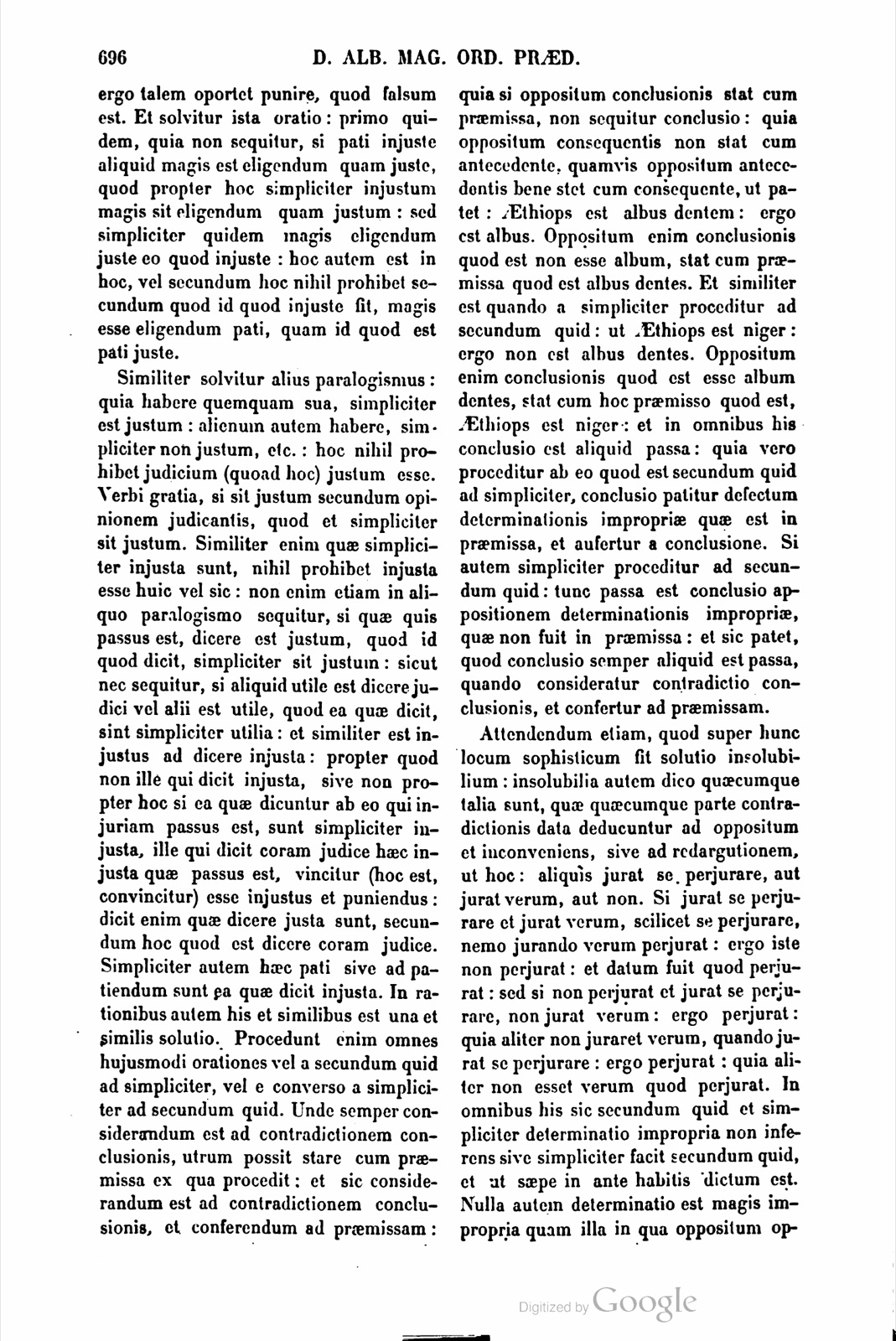
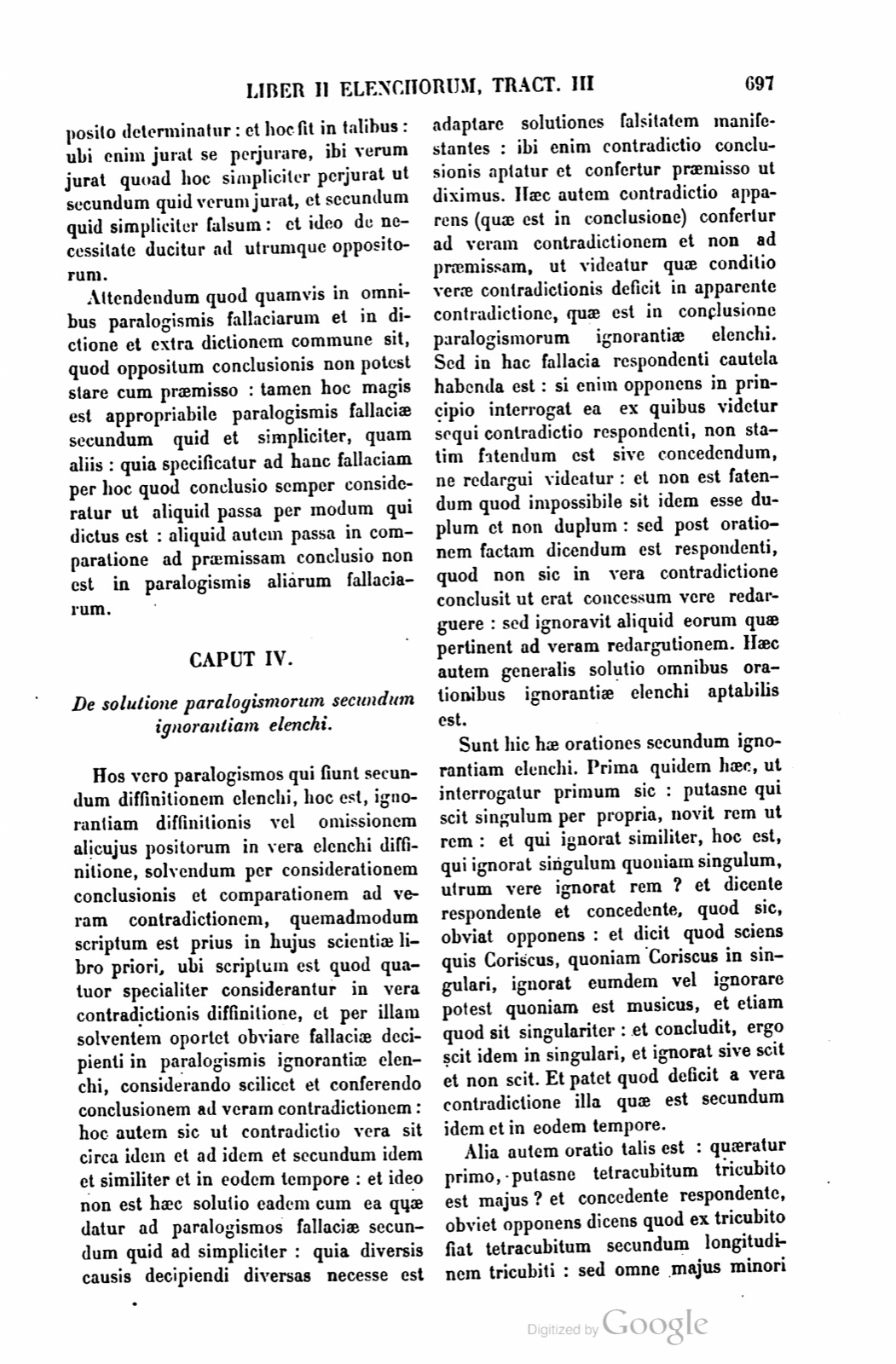
Attendendum etiam, quod super hunc locum sophisticum fit solutio insolubilium: insolubilia autem dico quaecumque talia sunt, quae quaecumque parte contradictionis data deducuntur ad oppositum et inconveniens, sive ad redargutionem, ut hoc: aliquis jurat se perjurare, aut jurat verum, aut non. Si jurat se perjurare et jurat verum, scilicet se perjurare, nemo jurando verum perjurat: ergo iste non perjurat: et datum fuit quod perjurat: sed si non perjurat et jurat se perjurare, non jurat verum: ergo perjurat: quia aliter non juraret verum, quando jurat se perjurare: ergo perjurat: quia aliter non esset verum quod perjurat. In omnibus his sic secundum quid et simpliciter determinatio impropria non inferens sive simpliciter facit secundum quid, et ut saepe in ante habitis dictum est. Nulla autem determinatio est magis impropria quam illa in qua oppositum opposito determinatur: et hoc fit in talibus: ubi enim jurat se perjurare, ibi verum jurat quoad hoc simpliciter perjurat ut secundum quid verum jurat, et secundum quid simpliciter falsum: et ideo de necessitate ducitur ad utrumque oppositorum.
Attendendum quod quamvis in omnibus paralogismis fallaciarum et in dictione et extra dictionem commune sit, quod oppositum conclusionis non potest stare cum praemisso: tamen hoc magis est appropriabile paralogismis fallaciae secundum quid et simpliciter, quam aliis: quia specificatur ad hanc fallaciam per hoc quod conclusio semper consideratur ut aliquid passa per modum qui dictus est: aliquid autem passa in comparatione ad praemissam conclusio non est in paralogismis aliarum fallaciarum.
One must also attend that concerning this sophistical place the solution of insolubles is made. But I call insolubles whatever things are such that, whichever part of the contradiction is granted, they are led to the opposite and the unfitting, or to refutation, as this: someone swears that he perjures himself, either he swears what is true, or not. If he swears that he perjures himself and swears what is true, namely that he perjures himself, no one by swearing what is true perjures himself; therefore this one does not perjure himself; and it was granted that he perjures himself. But if he does not perjure himself and swears that he perjures himself, he does not swear what is true; therefore he perjures himself, because otherwise he would not fail to swear what is true when he swears that he perjures himself; therefore he perjures himself, because otherwise it would not be true that he perjures himself. In all these, thus, the improper determination according to qualifiedly and simply, not inferring, or simply, makes qualifiedly, and as has often been said in the preceding things. But no determination is more improper than that in which an opposite is determined by an opposite; and this happens in such cases. For where he swears that he perjures himself, there he swears what is true with respect to this; he simply perjures himself insofar as he swears what is true qualifiedly and what is simply false qualifiedly; and therefore of necessity he is led to both opposites.
One must attend that although in all the paralogisms of fallacies, both in diction and outside diction, it is common that the opposite of the conclusion cannot stand with the premise, nevertheless this is more appropriate to paralogisms of the fallacy according to qualifiedly and simply than to others, because it is specified to this fallacy by the fact that the conclusion is always considered as having undergone something in the way that has been stated. But the conclusion is not something having undergone something in comparison to the premise in the paralogisms of the other fallacies.
If a page does not appear, its photograph has not been uploaded yet.