Works › Sophistical Refutations, Books I–II
Volume 2 · pp. 686–692
Tractate I. Chapters I-II
A marker with ≈ is an approximate page boundary, placed by measure of the text; the page photographs remain the authority. In the paired views, clicking a page marker brings that page into view.
TRACTATUS I. DE SOLUTIONE PARALOGISMORUM FALLACIARUM EXTRA DICTIONEM.
CAPUT I. De generali solutione paralogismorum accidentis, et adaptatione ejus ad paralogismos.
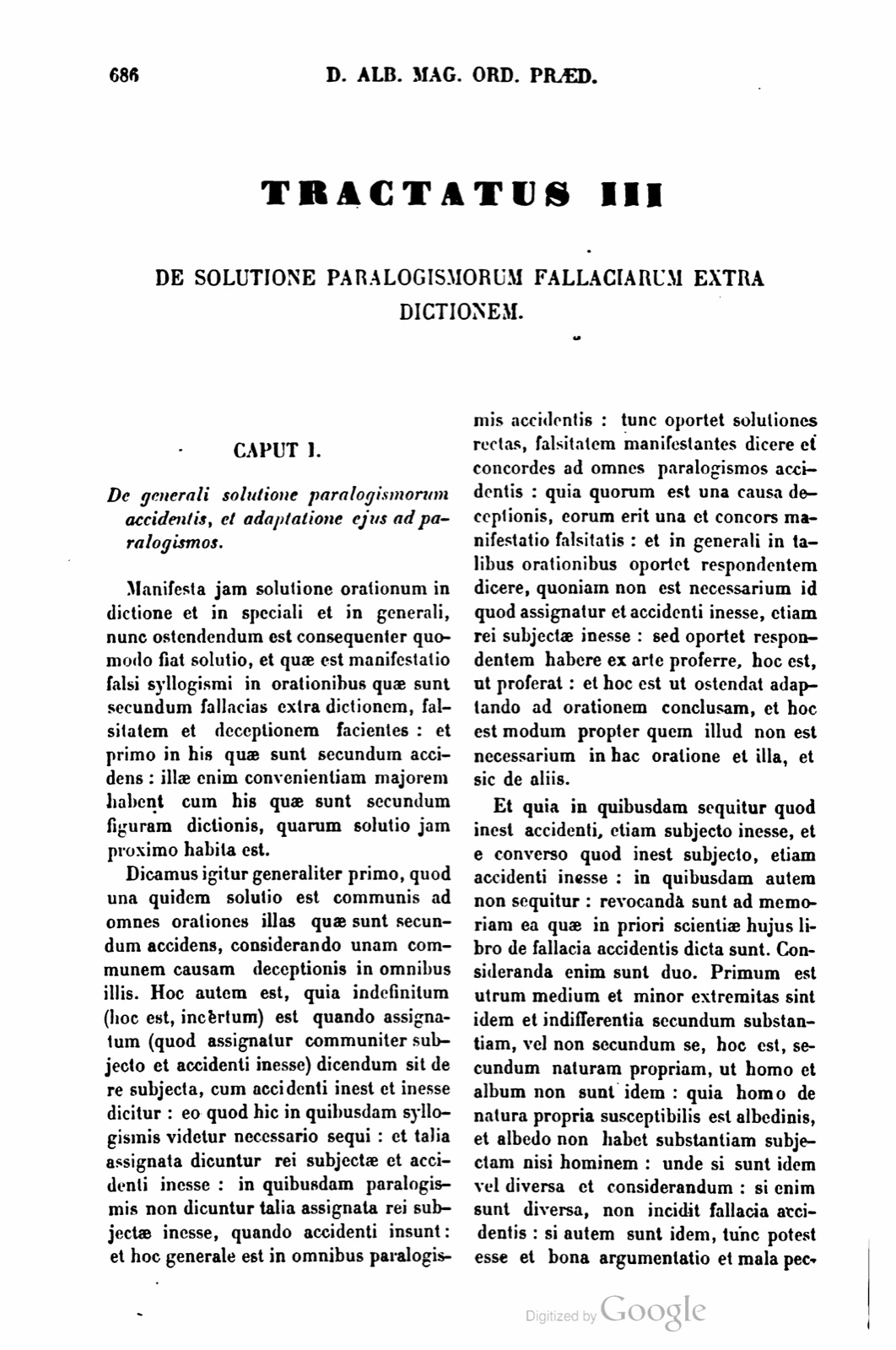
Manifesta jam solutione orationum in dictione et in speciali et in generali, nunc ostendendum est consequenter quomodo fiat solutio, et quae est manifestatio falsi syllogismi in orationibus quae sunt secundum fallacias extra dictionem, falsitatem et deceptionem facientes: et primo in his quae sunt secundum accidens: illae enim convenientiam majorem habent cum his quae sunt secundum figuram dictionis, quarum solutio jam proximo habita est.
Dicamus igitur generaliter primo, quod una quidem solutio est communis ad omnes orationes illas quae sunt secundum accidens, considerando unam communem causam deceptionis in omnibus illis. Hoc autem est, quia indefinitum (hoc est, incertum) est quando assignatum (quod assignatur communiter subjecto et accidenti inesse) dicendum sit de re subjecta, cum accidenti inest et inesse dicitur: eo quod hic in quibusdam syllogismis videtur necessario sequi: et talia assignata dicuntur rei subjectae et accidenti inesse: in quibusdam paralogismis non dicuntur talia assignata rei subjectae inesse, quando accidenti insunt: et hoc generale est in omnibus paralogismis accidentis: tunc oportet solutiones rectas, falsitatem manifestantes dicere et concordes ad omnes paralogismos accidentis: quia quorum est una causa deceptionis, eorum erit una et concors manifestatio falsitatis: et in generali in talibus orationibus oportet respondentem dicere, quoniam non est necessarium id quod assignatur et accidenti inesse, etiam rei subjectae inesse: sed oportet respondentem habere ex arte proferre, hoc est, ut proferat: et hoc est ut ostendat adaptando ad orationem conclusam, et hoc est modum propter quem illud non est necessarium in hac oratione et illa, et sic de aliis.
Et quia in quibusdam sequitur quod inest accidenti, etiam subjecto inesse, et e converso quod inest subjecto, etiam accidenti inesse: in quibusdam autem non sequitur: revocanda sunt ad memoriam ea quae in priori scientiae hujus libro de fallacia accidentis dicta sunt. Consideranda enim sunt duo. Primum est utrum medium et minor extremitas sint idem et indifferentia secundum substantiam, vel non secundum se, hoc est, secundum naturam propriam, ut homo et album non sunt idem: quia homo de natura propria susceptibilis est albedinis, et albedo non habet substantiam subjectam nisi hominem: unde si sunt idem vel diversa et considerandum: si enim sunt diversa, non incidit fallacia accidentis: si autem sunt idem, tunc potest esse et bona argumentatio et mala peccans secundum accidens. Et ideo si sunt idem et indifferentia secundum substantiam medium et minor extremitas, tunc considerandum et ulterius, utrum sunt idem et indifferentia comparata ad majorem extremitatem quae dicitur assignatum: et hoc in priori libro diximus notandum esse tali documento, quod considerandum utrum medio secundum quod est in minori extremitate, possit convenire oppositum majoris extremitatis, aut non. Si non potest convenire, semper bonum est argumentum, ut hic: omnis homo currit: Socrates est homo: ergo Socrates currit. Homini enim secundum quod est in Socrate (quod est minor extremitas) convenire non potest non currere quod est oppositum majoris extremitatis: et ideo tale procedit argumentum: omnis homo currit: Socrates est homo: ergo Socrates currit. Si autem oppositum majoris extremitatis potest convenire medio secundum quod praedicatur de minori extremitate, tunc semper incidit fallacia accidentis: et ostenso illo est ostensa causa falsitatis: ut homo est animal: animal est genus: ergo homo est genus. Secundum enim quod animal praedicatur de homine, animal non est genus: et sic oppositum majoris extremitatis (quod est non esse genus) potest inesse animali secundum quod praedicatur de homine quod est minor extremitas. Sic ergo cognoscitur quando assignatum accidenti inest rei subjectae et quando non. Hac igitur arte utendum est.
TRACTATE I. CONCERNING THE SOLUTION OF PARALOGISMS OF FALLACIES OUTSIDE DICTION.
CHAPTER I. Concerning the general solution of paralogisms of accident, and its adaptation to paralogisms.
Now that the solution of speeches in diction has been made manifest both specially and generally, next it must now be shown how solution is made, and what the manifestation of the false syllogism is in speeches which are according to fallacies outside diction, making falsity and deception; and first in those which are according to accident, for those have greater agreement with those which are according to figure of diction, whose solution has now immediately been had.
Therefore let us first say generally that one solution indeed is common to all those speeches which are according to accident, by considering one common cause of deception in all of them. But this is that it is indefinite, that is, uncertain, when what is assigned, which is commonly assigned to belong to the subject and to the accident, must be said of the subject reality when it belongs to the accident and is said to belong; because here in some syllogisms it seems to follow necessarily, and such assigned things are said to belong to the subject reality and to the accident; but in some paralogisms such assigned things are not said to belong to the subject reality when they belong to the accident. And this is general in all paralogisms of accident: then one must state right solutions, manifesting falsity and concordant for all paralogisms of accident, because for those things whose cause of deception is one, there will be one and concordant manifestation of falsity. And in general in such speeches the respondent must say that it is not necessary that what is assigned to belong to the accident also belong to the subject reality; but the respondent must have it from art to bring forward, that is, so that he may bring forward, and this is so that he may show, by adapting to the concluded speech, the mode on account of which that is not necessary in this speech and in that one, and so with the others.
And because in some cases it follows that what belongs to the accident also belongs to the subject, and conversely that what belongs to the subject also belongs to the accident, but in some cases it does not follow, those things which were said in the prior book of this science about the fallacy of accident must be recalled to memory. For two things must be considered. First, whether the middle and the minor extreme are the same and indifferent according to substance, or not according to themselves, that is, according to their proper nature, as man and white are not the same, because man according to his proper nature is susceptible of whiteness, and whiteness has no subject substance except man. Hence whether they are the same or diverse must be considered; for if they are diverse, the fallacy of accident does not occur; but if they are the same, then there can be both a good argumentation and a bad one sinning according to accident. And therefore, if the middle and the minor extreme are the same and indifferent according to substance, then one must consider further whether they are the same and indifferent when compared to the major extreme, which is called the assigned thing. And in the prior book we said that this must be noted by such a teaching, that one must consider whether the opposite of the major extreme can belong to the middle according as it is in the minor extreme, or not. If it cannot belong, the argument is always good, as here: every man runs; Socrates is a man; therefore Socrates runs. For to man according as it is in Socrates, which is the minor extreme, not running, which is the opposite of the major extreme, cannot belong; and therefore such an argument proceeds: every man runs; Socrates is a man; therefore Socrates runs. But if the opposite of the major extreme can belong to the middle according as it is predicated of the minor extreme, then the fallacy of accident always occurs; and once this has been shown, the cause of falsity has been shown, as: man is an animal; animal is a genus; therefore man is a genus. For according as animal is predicated of man, animal is not a genus; and thus the opposite of the major extreme, which is not being a genus, can belong to animal according as it is predicated of man, which is the minor extreme. Thus therefore it is known when what is assigned to the accident belongs to the subject reality and when not. This art, therefore, must be used.
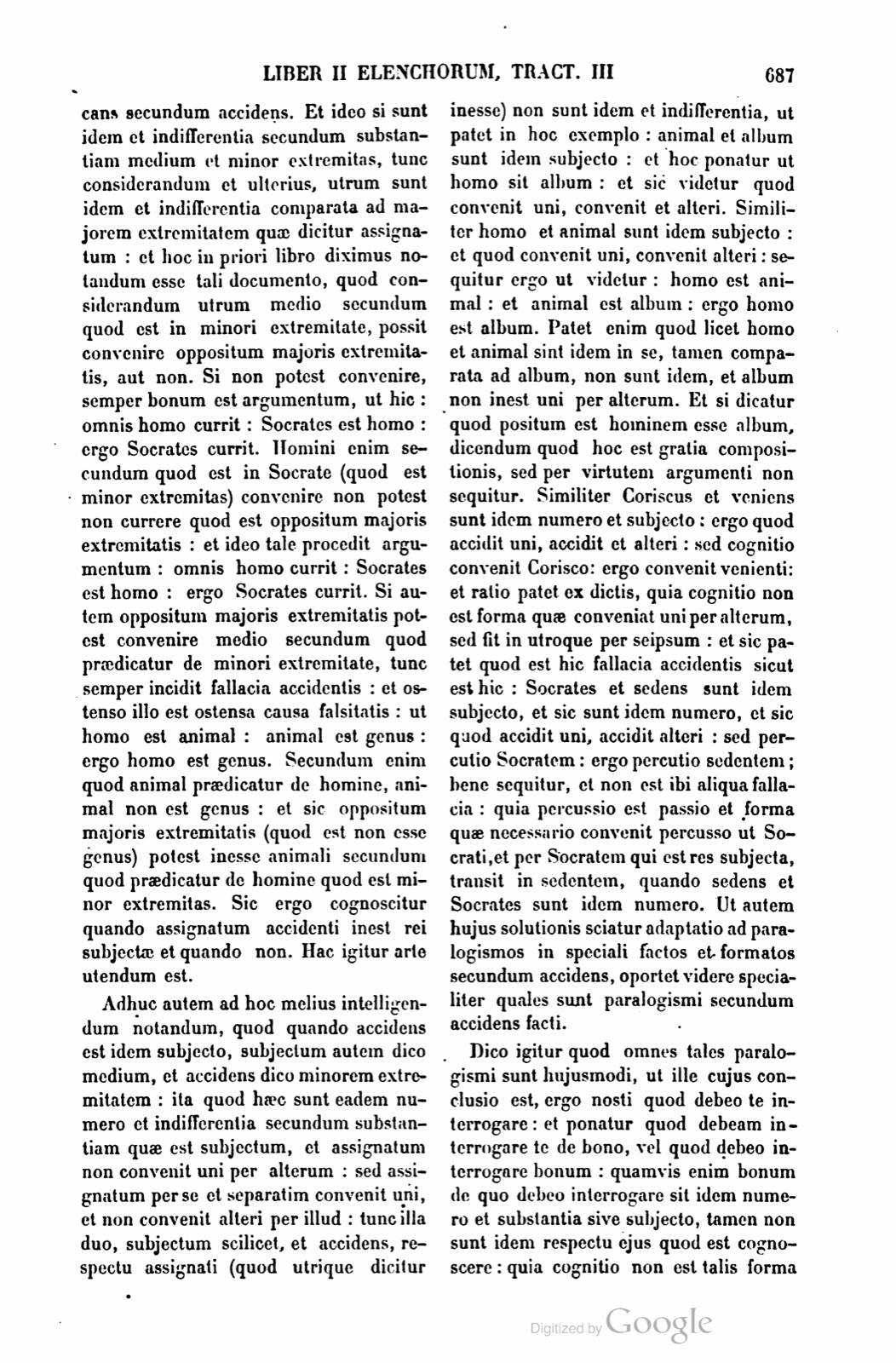
Adhuc autem ad hoc melius intelligendum notandum, quod quando accidens est idem subjecto, subjectum autem dico medium, et accidens dico minorem extremitatem: ita quod haec sunt eadem numero et indifferentia secundum substantiam quae est subjectum, et assignatum non convenit uni per alterum: sed assignatum per se et separatim convenit uni, et non convenit alteri per illud: tunc illa duo, subjectum scilicet, et accidens, respectu assignati (quod utrique dicitur inesse) non sunt idem et indifferentia, ut patet in hoc exemplo: animal et album sunt idem subjecto: et hoc ponatur ut homo sit album: et sic videtur quod convenit uni, convenit et alteri. Similiter homo et animal sunt idem subjecto: et quod convenit uni, convenit alteri: sequitur ergo ut videtur: homo est animal: et animal est album: ergo homo est album. Patet enim quod licet homo et animal sint idem in se, tamen comparata ad album, non sunt idem, et album non inest uni per alterum. Et si dicatur quod positum est hominem esse album, dicendum quod hoc est gratia compositionis, sed per virtutem argumenti non sequitur. Similiter Coriscus et veniens sunt idem numero et subjecto: ergo quod accidit uni, accidit et alteri: sed cognitio convenit Corisco: ergo convenit venienti: et ratio patet ex dictis, quia cognitio non est forma quae conveniat uni per alterum, sed fit in utroque per seipsum: et sic patet quod est hic fallacia accidentis sicut est hic: Socrates et sedens sunt idem subjecto, et sic sunt idem numero, et sic quod accidit uni, accidit alteri: sed percutio Socratem: ergo percutio sedentem; bene sequitur, et non est ibi aliqua fallacia: quia percussio est passio et forma quae necessario convenit percusso ut Socrati, et per Socratem qui est res subjecta, transit in sedentem, quando sedens et Socrates sunt idem numero. Ut autem hujus solutionis sciatur adaptatio ad paralogismos in speciali factos et formatos secundum accidens, oportet videre specialiter quales sunt paralogismi secundum accidens facti.
Dico igitur quod omnes tales paralogismi sunt hujusmodi, ut ille cujus conclusio est, ergo nosti quod debeo te interrogare: et ponatur quod debeam interrogare te de bono, vel quod debeo interrogare bonum: quamvis enim bonum de quo debeo interrogare sit idem numero et substantia sive subjecto, tamen non sunt idem respectu ejus quod est cognoscere: quia cognitio non est talis forma uni per alterum. Alia oratio cujus conclusio talis, ergo cognoscis venientem vel coopertum, et formatur sic: Coriscus est veniens vel coopertus: tu cognoscis Coriscum: ergo tu cognoscis venientem vel coopertum. Et patet solutio, quia licet Coriscus sit idem numero venienti vel cooperto, tamen haec duo differentia sunt relata ad hoc assignatum quod est cognitio: quia cognitio non est talis forma quae conveniat uni per alterum, sed sistit in utroque divisim et per seipsum. Tertia oratio est, cujus conclusio est, ergo statua est tuum opus, et formatur sic: haec statua est tuum: et est opus: ergo est tuum opus. Quamvis enim statua et tuum sint idem numero, tamen comparata ad hoc quod est esse opus, non sunt idem: quia statua est possessio sacerdotis vel templi, opus autem Policleti vel alterius statuarii. Quarta autem ratio cujus conclusio est, ergo pater tuus canis, et formatur sic: iste canis est tuus: et est pater: ergo est tuus pater. Quia licet canis et tuus sint idem et substantia numero, tamen comparata ad esse patrem, non sunt unum, secundum quod hoc assignatum, esse patrem, non convenit ei quod est tuum esse patrem canem. Quinta oratio est, cujus conclusio est, ergo raro pauca sunt pauca, et dicuntur raro pauca, quae simpliciter invenimus, ut pauca in civitate, vel pauca in foro, in quibus simpliciter pauca raro sunt vel inveniuntur, et formatur sic: ista sunt pauca, demonstratis his quae sunt in vico: et ista sunt raro pauca, demonstratis his quae sunt in civitate vel foro: ergo raro pauca sunt pauca simpliciter. Et patet solutio, quia quamvis ista sint simpliciter idem ista et pauca, non tamen sunt eadem et indifferentia, comparata ad ea quae sunt raro pauca.
Further, for understanding this better, it must be noted that when the accident is the same as the subject, and I call the subject the middle and the accident the minor extreme, so that these are the same in number and indifferent according to the substance which is the subject, and the assigned thing does not belong to one through the other, but the assigned thing belongs to one per se and separately and does not belong to the other through it, then those two, namely subject and accident, with respect to the assigned thing which is said to belong to each, are not the same and indifferent, as is clear in this example: animal and white are the same in subject, and let this be posited, that man is white; and thus it seems that what belongs to one belongs also to the other. Similarly man and animal are the same in subject, and what belongs to one belongs to the other; therefore it seems to follow: man is an animal, and animal is white; therefore man is white. For it is clear that although man and animal are the same in themselves, nevertheless when compared to white they are not the same, and white does not belong to one through the other. And if it is said that it has been posited that man is white, one must say that this is by reason of composition, but it does not follow through the force of the argument. Similarly Coriscus and the one coming are the same in number and subject; therefore what happens to one happens also to the other; but cognition belongs to Coriscus; therefore it belongs to the one coming. And the reason is clear from the things said, because cognition is not a form which belongs to one through the other, but comes about in each dividedly and through itself. And thus it is clear that there is here a fallacy of accident, as there is here: Socrates and the one sitting are the same in subject, and thus are the same in number, and so what happens to one happens to the other; but I strike Socrates; therefore I strike the one sitting. This follows well, and there is not any fallacy there, because striking is a passion and form which necessarily belongs to the one struck, as to Socrates, and through Socrates, who is the subject reality, passes into the one sitting, when the one sitting and Socrates are the same in number. But so that the adaptation of this solution to paralogisms specially made and formed according to accident may be known, one must see specially what sort the paralogisms made according to accident are.
Therefore I say that all such paralogisms are of this kind, as that one whose conclusion is: therefore you know what I ought to ask you; and let it be posited that I ought to ask you about the good, or that I ought to ask the good. For although the good about which I ought to ask is the same in number and substance or subject, nevertheless they are not the same with respect to that which is knowing, because cognition is not such a form in one through the other. Another speech has such a conclusion: therefore you know the one coming or covered, and it is formed thus: Coriscus is the one coming or covered; you know Coriscus; therefore you know the one coming or covered. And the solution is clear, because although Coriscus is the same in number as the one coming or covered, nevertheless these two different things are related to this assigned thing which is cognition, because cognition is not such a form as belongs to one through the other, but stands in each dividedly and through itself. The third speech is one whose conclusion is: therefore the statue is your work, and it is formed thus: this statue is yours, and it is a work; therefore it is your work. For although the statue and yours are the same in number, nevertheless when compared to this which is to be a work they are not the same, because the statue is the possession of the priest or temple, but the work of Polyclitus or another sculptor. The fourth reasoning has this conclusion: therefore your father is a dog, and it is formed thus: this dog is yours, and it is a father; therefore it is your father. For although the dog and yours are the same and one substance in number, nevertheless when compared to being a father, they are not one, insofar as this assigned thing, being a father, does not belong to that which is yours as being a father dog. The fifth speech is one whose conclusion is: therefore rarely few are few; and those things are called rarely few which we find simply, as few in a city or few in a marketplace, in which simply few things rarely are or are found. And it is formed thus: these are few, with those things which are in a village being shown; and these are rarely few, with those things which are in a city or marketplace being shown; therefore rarely few are few simply. And the solution is clear, because although these and few are simply the same, nevertheless they are not the same and indifferent when compared to those things which are rarely few.
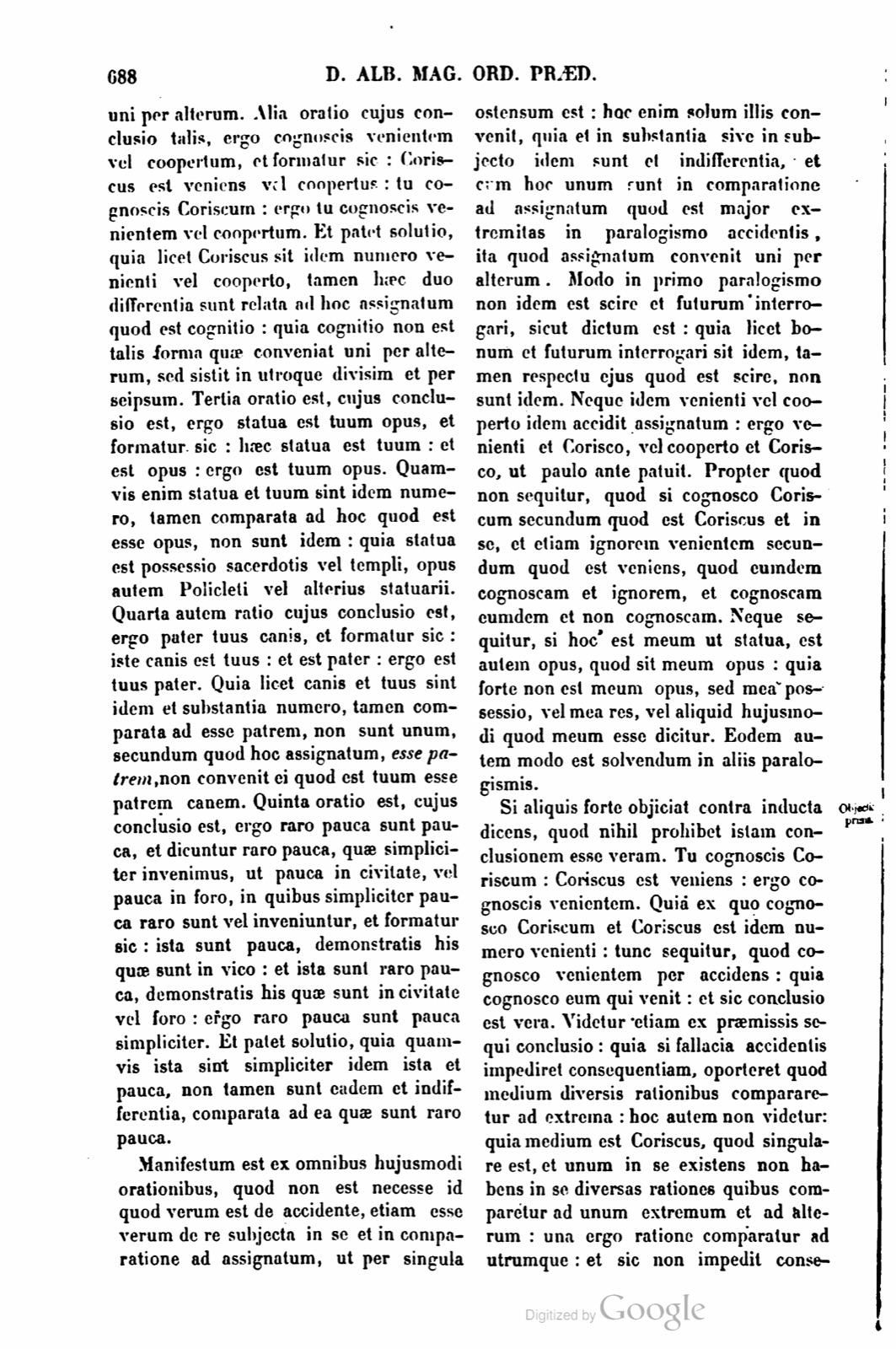
Manifestum est ex omnibus hujusmodi orationibus, quod non est necesse id quod verum est de accidente, etiam esse verum de re subjecta in se et in comparatione ad assignatum, ut per singula ostensum est: haec enim solum illis convenit, quia et in substantia sive in subjecto idem sunt et indifferentia, et cum hoc unum sunt in comparatione ad assignatum quod est major extremitas in paralogismo accidentis, ita quod assignatum convenit uni per alterum. Modo in primo paralogismo non idem est scire et futurum interrogari, sicut dictum est: quia licet bonum et futurum interrogari sit idem, tamen respectu ejus quod est scire, non sunt idem. Neque idem venienti vel cooperto idem accidit assignatum: ergo venienti et Corisco, vel cooperto et Corisco, ut paulo ante patuit. Propter quod non sequitur, quod si cognosco Coriscum secundum quod est Coriscus et in se, et etiam ignorem venientem secundum quod est veniens, quod eumdem cognoscam et ignorem, et cognoscam eumdem et non cognoscam. Neque sequitur, si hoc est meum ut statua, est autem opus, quod sit meum opus: quia forte non est meum opus, sed mea possessio, vel mea res, vel aliquid hujusmodi quod meum esse dicitur. Eodem autem modo est solvendum in aliis paralogismis.
Si aliquis forte objiciat contra inducta dicens, quod nihil prohibet istam conclusionem esse veram. Tu cognoscis Coriscum: Coriscus est veniens: ergo cognoscis venientem. Quia ex quo cognosco Coriscum et Coriscus est idem numero venienti: tunc sequitur, quod cognosco venientem per accidens: quia cognosco eum qui venit: et sic conclusio est vera. Videtur etiam ex praemissis sequi conclusio: quia si fallacia accidentis impediret consequentiam, oporteret quod medium diversis rationibus compararetur ad extrema: hoc autem non videtur: quia medium est Coriscus, quod singulare est, et unum in se existens non habens in se diversas rationes quibus comparetur ad unum extremum et ad alterum: una ergo ratione comparatur ad utrumque: et sic non impedit consequentiam diversa ratio comparationis medii ad extrema.
Adhuc autem in syllogismo expositorio, sicut dicit Aristoteles in secundo Priorum, ubi singulare pro medio subjicitur in utraque praemissarum, de necessitate concluditur extremum de extremo. Sic autem est hic: Coriscum cognoscis: Coriscus est veniens: ergo tu cognoscis venientem. Videtur quod conclusio sequatur necessario. Sequitur etiam in prima figura sola facta transpositione terminorum sic: Coriscus est veniens: et cognoscis Coriscum: ergo cognoscis venientem. Adhuc si est in talibus fallacia, potius videtur esse fallacia figurae dictionis: eo quod mutatur quid in quale: quia Coriscus est quid, veniens autem quale.
It is manifest from all speeches of this kind that it is not necessary that what is true of the accident also be true of the subject reality in itself and in comparison to the assigned thing, as has been shown through the individual cases. For this belongs only to those things because they are the same and indifferent both in substance or in subject, and along with this are one in comparison to the assigned thing which is the major extreme in the paralogism of accident, so that the assigned thing belongs to one through the other. Now in the first paralogism knowing and being about to be asked are not the same, as was said, because although the good and being about to be asked are the same, nevertheless with respect to that which is knowing, they are not the same. Nor does the same assigned thing happen to the one coming or covered; therefore neither to the one coming and Coriscus, or to the one covered and Coriscus, as was clear a little before. For this reason it does not follow that if I know Coriscus according as he is Coriscus and in himself, and also do not know the one coming according as he is coming, that I know and do not know the same man, and know the same man and do not know him. Nor does it follow, if this is mine as a statue and is a work, that it is my work, because perhaps it is not my work but my possession, or my thing, or something of this kind which is said to be mine. But in the same way the other paralogisms must be solved.
If someone perhaps objects against the things brought in, saying that nothing prevents this conclusion from being true: you know Coriscus; Coriscus is the one coming; therefore you know the one coming. Because from the fact that I know Coriscus and Coriscus is the same in number as the one coming, then it follows that I know the one coming accidentally, because I know him who comes; and thus the conclusion is true. The conclusion also seems to follow from the premises, because if the fallacy of accident impeded the consequence, it would be necessary that the middle be compared to the extremes under diverse accounts; but this does not seem so, because the middle is Coriscus, which is singular and one existing in itself, not having in itself diverse accounts by which it is compared to one extreme and to the other. Therefore it is compared to each under one account, and thus the diverse account of comparison of the middle to the extremes does not impede the consequence.
Further, in an expository syllogism, as Aristotle says in the second book of the Prior Analytics, where the singular is put under as the middle in each of the premises, the extreme is concluded of necessity about the extreme. But it is so here: you know Coriscus; Coriscus is the one coming; therefore you know the one coming. It seems that the conclusion follows necessarily. It also follows in the first figure by only making a transposition of terms thus: Coriscus is the one coming; and you know Coriscus; therefore you know the one coming. Further, if there is a fallacy in such things, it seems rather to be the fallacy of figure of diction, because what is changed into what sort, for Coriscus is a what, but coming is what sort.
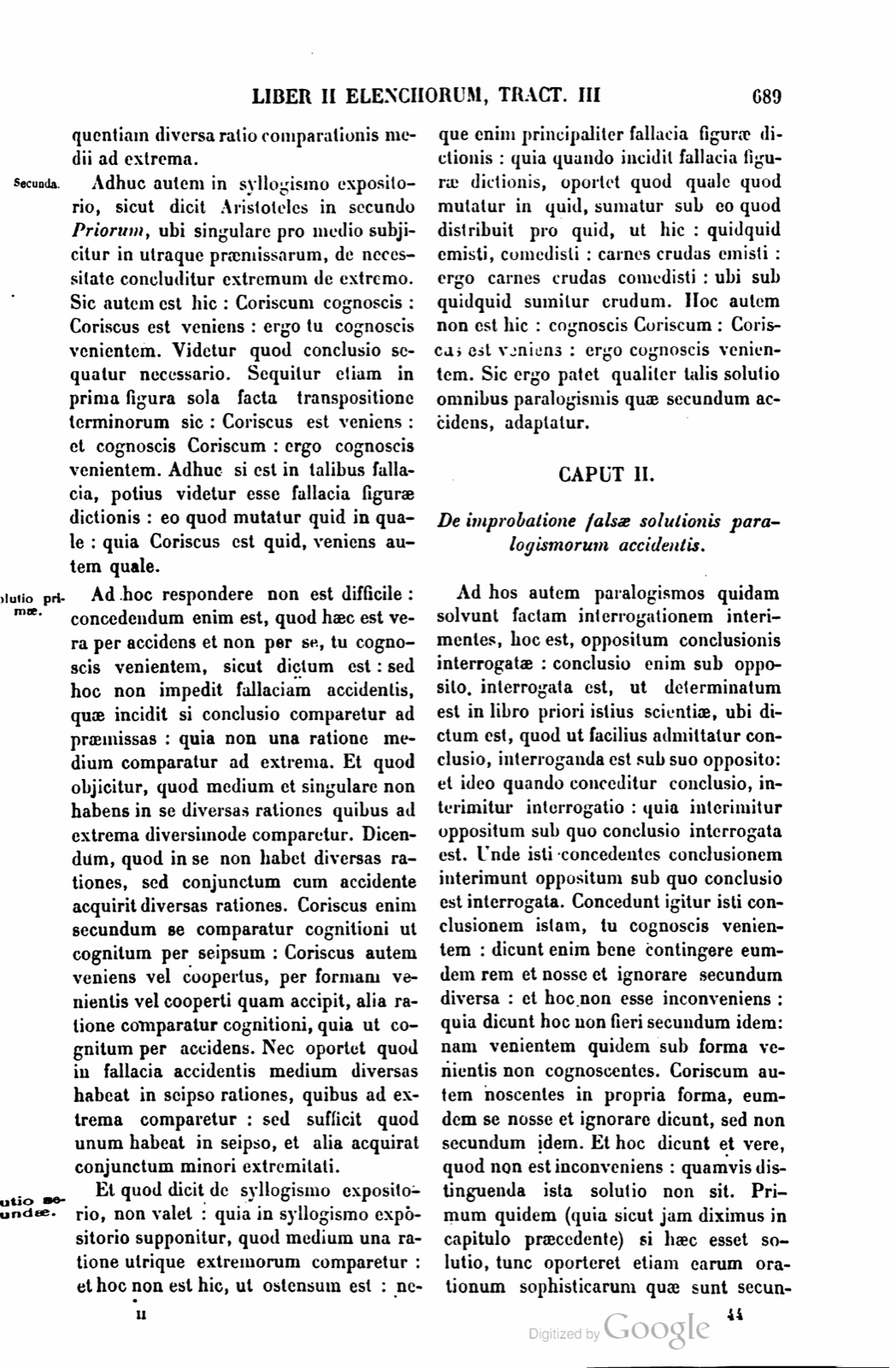
Ad hoc respondere non est difficile: concedendum enim est, quod haec est vera per accidens et non per se, tu cognoscis venientem, sicut dictum est: sed hoc non impedit fallaciam accidentis, quae incidit si conclusio comparetur ad praemissas: quia non una ratione medium comparatur ad extrema. Et quod objicitur, quod medium et singulare non habens in se diversas rationes quibus ad extrema diversimode comparetur. Dicendum, quod in se non habet diversas rationes, sed conjunctum cum accidente acquirit diversas rationes. Coriscus enim secundum se comparatur cognitioni ut cognitum per seipsum: Coriscus autem veniens vel coopertus, per formam venientis vel cooperti quam accipit, alia ratione comparatur cognitioni, quia ut cognitum per accidens. Nec oportet quod in fallacia accidentis medium diversas habeat in seipso rationes, quibus ad extrema comparetur: sed sufficit quod unum habeat in seipso, et alia acquirat conjunctum minori extremitati.
Et quod dicit de syllogismo expositorio, non valet: quia in syllogismo expositorio supponitur, quod medium una ratione utrique extremorum comparetur: et hoc non est hic, ut ostensum est: neque enim principaliter fallacia figurae dictionis: quia quando incidit fallacia figurae dictionis, oportet quod quale quod mutatur in quid, sumatur sub eo quod distribuit pro quid, ut hic: quidquid emisti, comedisti: carnes crudas emisti: ergo carnes crudas comedisti: ubi sub quidquid sumitur crudum. Hoc autem non est hic: cognoscis Coriscum: Coriscus est veniens: ergo cognoscis venientem. Sic ergo patet qualiter talis solutio omnibus paralogismis quae secundum accidens, adaptatur.
CAPUT II. De improbatione falsae solutionis paralogismorum accidentis.
Ad hos autem paralogismos quidam solvunt factam interrogationem interimendo, hoc est, oppositum conclusionis interrogatae: conclusio enim sub opposito, interrogata est, ut determinatum est in libro priori istius scientiae, ubi dictum est, quod ut facilius admittatur conclusio, interroganda est sub suo opposito: et ideo quando conceditur conclusio, interimitur interrogatio: quia interimitur oppositum sub quo conclusio interrogata est. Unde isti concedentes conclusionem interimunt oppositum sub quo conclusio est interrogata. Concedunt igitur isti conclusionem istam, tu cognoscis venientem: dicunt enim bene contingere eumdem rem et nosse et ignorare secundum diversa: et hoc non esse inconveniens: quia dicunt hoc non fieri secundum idem: nam venientem quidem sub forma venientis non cognoscentes. Coriscum autem noscentes in propria forma, eumdem se nosse et ignorare dicunt, sed non secundum idem. Et hoc dicunt et vere, quod non est inconveniens: quamvis distinguenda ista solutio non sit. Primum quidem (quia sicut jam diximus in capitulo praecedente) si haec esset solutio, tunc oporteret etiam earum orationum sophisticarum quae sunt secundum idem genus deceptionis sive eamdem et similem causam deceptionis, eamdem esse correctionem sive solutionem quae falsitatem manifestando corrigit: hoc autem patet, quod non est verum: ergo a destructione consequentis patet quod haec non est solutio.
Cujus probatio est, quia si quis in simili oratione sive paralogismo accidentis ponat terminos non in nosse sive noscere sive cognoscere, sed ponat eos in esse vel in aliquo modo se habere, et illis accipiat idem probamentum sive modum probationis sophisticum paralogizando, ille solvere non potest per hoc quod contingat idem nosse et ignorare secundum respectus diversos: quia tunc nihil ponitur in oratione de cognitione et ignorantia ejusdem secundum diversa, ut hic: iste est pater: et est tuus: ergo est tuus pater: sicut de cane in habitis dictum est. Nam hoc quod dicunt, in quibusdam est verum: quia quaedam contingit ignorare et scire secundum diversos respectus. Sed tamen hoc quod dicunt, nihil verae solutioni communicat: quia (ut diximus) si esset solutio vera unius, oporteret quod omnia similia solverentur. Alia autem ad ejusdem dicti improbationem causa est: quia saepius dictum est, nihil prohibet eamdem orationem sophistice paralogizantem plures habere fallendi sive decipiendi sive falsitatis syllogismi orationes sive causas: sed tamen non omnis fallaciae manifestatio solutio est paralogismi.
To respond to this is not difficult. For one must grant that this is true accidentally and not per se, you know the one coming, as was said; but this does not impede the fallacy of accident, which occurs if the conclusion is compared to the premises, because the middle is not compared to the extremes under one account. And concerning what is objected, that the middle and singular does not have in itself diverse accounts by which it may be compared to the extremes in diverse ways, one must say that in itself it does not have diverse accounts, but joined with the accident it acquires diverse accounts. For Coriscus according to himself is compared to cognition as known through himself; but Coriscus coming or covered, through the form of the one coming or covered which he receives, is compared to cognition under another account, because as known accidentally. Nor is it necessary that in the fallacy of accident the middle have in itself diverse accounts by which it is compared to the extremes; rather it is enough that it have one in itself and acquire others when joined to the minor extreme.
And what he says about the expository syllogism is not valid, because in an expository syllogism it is supposed that the middle is compared under one account to each of the extremes, and this is not so here, as has been shown; nor is it principally the fallacy of figure of diction, because when the fallacy of figure of diction occurs, the qualified thing which is changed into what must be taken under that which distributes for what, as here: whatever you bought, you ate; you bought raw meats; therefore you ate raw meats, where raw is taken under whatever. But this is not so here: you know Coriscus; Coriscus is the one coming; therefore you know the one coming. Thus therefore it is clear how such a solution is adapted to all paralogisms which are according to accident.
CHAPTER II. Concerning the disproof of the false solution of paralogisms of accident.
But to these paralogisms certain persons solve by destroying the question made, that is, the opposite of the conclusion asked; for the conclusion has been asked under the opposite, as was determined in the prior book of this science, where it was said that so that the conclusion may be admitted more easily, it must be asked under its opposite. And therefore when the conclusion is granted, the question is destroyed, because the opposite under which the conclusion was asked is destroyed. Hence those people granting the conclusion destroy the opposite under which the conclusion was asked. Therefore those people grant this conclusion, you know the one coming; for they say that it can well happen that the same reality is both known and not known according to diverse things, and that this is not unfitting, because they say that this does not happen according to the same thing. For not knowing the one coming under the form of coming, but knowing Coriscus in his proper form, they say that they know and do not know the same thing, but not according to the same thing. And they say this and truly, that it is not unfitting, although this solution should not be distinguished. First indeed, because, as we have already said in the preceding chapter, if this were the solution, then it would also be necessary that of those sophistical speeches which are according to the same genus of deception or the same and similar cause of deception, there be the same correction or solution which corrects by manifesting falsity. But it is clear that this is not true; therefore from destruction of the consequent it is clear that this is not the solution.
The proof of this is that if someone in a similar speech or paralogism of accident posits the terms not in knowing or recognizing or cognizing, but posits them in being or in some mode of having oneself, and with them takes the same proof or sophistical mode of proving by paralogizing, that person cannot solve through the fact that it happens for the same thing to be known and not known according to diverse respects, because then nothing is posited in the speech concerning cognition and ignorance of the same thing according to diverse things, as here: this is a father, and is yours; therefore he is your father, as was said in the preceding things concerning the dog. For what they say is true in some cases, because certain things can happen to be unknown and known according to diverse respects. Nevertheless what they say communicates nothing to true solution, because, as we said, if it were the true solution of one, all similar cases would have to be solved. But another cause for disproving the same saying is that it has been said rather often that nothing prevents the same speech paralogizing sophistically from having several deceptive or deceiving or falsity-producing speeches or causes of syllogism; nevertheless the manifestation of every fallacy is not the solution of the paralogism.
Contingit enim aliquando aliquem ostendere, quoniam aliquis falsum syllogizavit, hoc est, contingit quod aliquis apparenter syllogizatam conclusionem ostendat esse falsam: et contingit quod licet conclusionem ostendat esse falsam, non tamen ostendit secundum quid peccans in syllogismo syllogizatur facta conclusio: et ille non manifestat secundum quid in syllogismo infertur conclusio falsa, et ideo non solvit vera solutione: quia vera solutio causam manifestat falsitatis illius in syllogismo secundum quod falsum sequi videtur falsa conclusio. Cujus exemplum est in Zenonis oratione quae concludit, quoniam non est vel contingit movere vel moveri: quae facile ostenditur falsa per deductionem ad impossibile: propter quod etiam si quis conetur ostendere illam conclusionem falsam, et colligere conetur talem orationem ut impossibilem deducere ad impossibile, peccat: quia veram solutionem non ponit: et si millies ducat ad impossibile, et per hoc ostendat millies eam esse falsam: quia multiplicare inconveniens non est solvere: hic enim non est solutio vera, sed inconvenientis multiplicatio: erat enim (sicut praedeterminatum est) vera solutio manifestatio falsi syllogismi in illo, sicut accidit falsum, hoc est, in causa per quam accidit et sequi videtur falsa conclusio: quia in hoc quod est causa falsae conclusionis, est falsus et deceptorius syllogismus: et hoc est comparare praemissas secundum consequentiam ad conclusionem, et ostendere manifeste in praemissis vel in ordine terminorum defectum congruae conclusionis. Et patet quod si aliquis objicientium non vere syllogizavit, sed apparenter, sive conetur colligere sive collective syllogizare vel verum vel falsum in conclusione illius defectus, quae conclusio non sequitur ex praemissis, manifestatio vera solutio est, quando scilicet ostenditur qualiter et propter quid conclusio non sequitur ex praemissis.
Fortasse autem aliquando etiam hoc quod ipsi dicunt accidere, nihil prohibet, scilicet quod illud ignoretur et cognoscatur secundum diversos respectus, sed in his paralogismis, de quibus modo loquimur: nec hoc quod dicunt, videbitur habere locum quoad veram paralogismi solutionem, quod aliquando concedat eumdem nosse et ignorare diversis respectibus. Quod ex hoc patet, quia aliquis aliquando Coriscum, et quoniam Coriscus, est sive per hoc quod Coriscus est, noscit, et forte venientem etiam noscit sub forma venientis, si scit quoniam Coriscus est veniens: et tamen videtur aliquando contingere, quod idem subjecto noscatur ab aliquo, et non noscatur, ut si ponamus idem subjecto esse album et musicum, contingit alicui noscere illum quoniam albus, sive sub forma albedinis, et contingit eidem eumdem non noscere quoniam est musicus, sive secundum quod est sub forma musici: videt enim album, et nullam ab eodem audivit vel percepit musicam: sicut enim idem noscit ille et non noscit, sed non secundum idem: venientem autem si sic ponatur, et Coriscum quoniam veniens est, et quoniam Coriscus est, noscit: et tamen non impedit, quin in consequentia paralogismi fiat fallacia accidentis: eo quod non valet consequentia propter diversam habitudinem medii ad extrema quae sunt accidens subjecti et adjunctum rei subjectae et accidenti, sicut per ante habita satis patuit. Sive ergo sic noscat, et sic ignoret, sive sic et sic noscat, non impeditur fallacia: et sic patet quod solutio eorum est nulla.
For it sometimes happens that someone shows that someone syllogized what is false, that is, it happens that someone shows an apparently syllogized conclusion to be false; and it happens that although he shows the conclusion to be false, nevertheless he does not show according to what the conclusion made is syllogized while sinning in the syllogism. And he does not manifest according to what in the syllogism the false conclusion is inferred, and therefore he does not solve by true solution, because true solution manifests the cause of that falsity in the syllogism according to which the false conclusion seems to follow as false. An example of this is in the speech of Zeno which concludes that there is not or there cannot be moving or being moved, which is easily shown to be false through reduction to the impossible. For this reason, even if someone tries to show that conclusion false and tries to gather such a speech as impossible by reducing it to the impossible, he sins, because he does not posit the true solution; and if he leads it to the impossible a thousand times, and through this shows a thousand times that it is false, because to multiply the unfitting thing is not to solve. For here there is not true solution, but multiplication of the unfitting thing. For, as was predetermined, true solution was the manifestation of the false syllogism in that in which the false occurs, that is, in the cause through which the false conclusion occurs and seems to follow, because in that which is the cause of the false conclusion there is a false and deceptive syllogism. And this is to compare the premises according to consequence to the conclusion, and to show manifestly in the premises or in the order of terms the defect of a fitting conclusion. And it is clear that if one of those objecting has not syllogized truly but apparently, whether he tries to gather or collectively syllogize either the true or the false in the conclusion of that defect, which conclusion does not follow from the premises, the true manifestation is solution, namely when it is shown how and why the conclusion does not follow from the premises.
But perhaps sometimes also what they say happens is not prevented, namely that the same thing is unknown and known according to diverse respects; but in these paralogisms about which we are now speaking, not even what they say will seem to have a place with respect to the true solution of the paralogism, namely that one sometimes grants that the same thing is known and not known under diverse respects. This is clear from the fact that someone sometimes knows Coriscus and that he is Coriscus, or through the fact that Coriscus is, and perhaps also knows the one coming under the form of one coming, if he knows that Coriscus is coming. And nevertheless it seems sometimes to happen that the same subject is known by someone and is not known, as if we posit that the same subject is white and musical, it happens to someone to know him because he is white, or under the form of whiteness, and it happens to the same person not to know the same man because he is musical, or according as he is under the form of the musical; for he sees the white thing and has heard or perceived no music from the same man. Just as that man knows and does not know the same thing, but not according to the same thing; but if the one coming is posited thus, he knows both Coriscus because he is coming and because he is Coriscus. And nevertheless this does not prevent the fallacy of accident from being made in the consequence of the paralogism, because the consequence is not valid on account of the diverse disposition of the middle to the extremes, which are accident of the subject and what is joined to the subject reality and to the accident, as has appeared sufficiently through the preceding things. Therefore whether he knows in this way and is ignorant in that way, or knows both in this way and that, the fallacy is not impeded; and thus it is clear that their solution is nothing.
Similiter autem peccant etiam illi qui solvunt (hoc est, solvere conantur) istam orationem: ista sunt pauca: et ista raro pauca: ergo pauca sunt raro pauca. Dicunt isti solvere conantes paralogismum, quod conclusio est vera: dicunt enim isti, quoniam omnis numerus est paucus: nullus enim est numerus ad quem non sit accipere majorem respectu cujus paucus est minor numerus: unus enim respectu pluris est paucum. Et qui sic solvunt, peccant sicut et illi quos diximus: quia scilicet non manifestant causam falsitatis syllogismi. Nam isti non manifestant si non est conclusio simile, sive id propter quod concludit paralogismus, sicut nec priores, et hoc opinantes, propter quod non conclusit syllogismus. Verum esse dicunt id quod conclusum est, sive veram dicunt esse conclusionem: dicunt enim omnia quae sunt in numero, esse multum et paucum: multum quidem respectu numeri superioris: et ideo non referentes conclusionem ad praemissas, nec ostendentes in quo deficit consequentia, peccant sicut et primi.
Quidam autem etiam errantes solvunt dicentes duplices esse syllogismos (hoc est, secundum duplex peccantes paralogismos) ut apparentes syllogismos accidentis; ut verbi gratia istos, ut iste canis est tuus: et est pater: ergo est tuus pater. Et hunc: iste est tuus: et est filius: ergo est tuus filius. Et iste est tuus: et est servus: ergo est tuus servus. Et fuit distinctio istorum ex compositione et divisione, ex eo quod hoc quod dico, tuus, potest conjungi cum hoc quod dico, canis: et sic est composita et vera et non sequitur ex ea conclusio quae infertur, vel potest separari adhuc et conjungi cum hoc quod dico, pater; et sic est divisa et falsa: et sequitur ex ea conclusio quae infertur. Et similiter distinguebant in omnibus aliis, sicut in his; iste est tuus filius: et iste est tuus servus, et sic de aliis: et haec etiam fuit ratio quae induxit istos ad distinguendum et ad dicendum, quod multiplex est oratio. Sed quod errent sic solvendo, primo probatur tali ratione: quia si iste videtur elenchus, hoc est, apparens elenchus, eo quod multiplex dicitur sive propter peccatum multiplicis: oportet in ipso apparenti elencho nomen vel orationem plurium esse significativum, principaliter apparentis elenchi causativum, ex cujus distinctione solvatur elenchus apparens.
Hoc autem non est in propositionibus apparentis elenchi, qui inductus est. Quod patet: quia hunc nemo dicit hujus esse proprie, eo quod est natus: hic enim hujus non dicitur esse proprie, eo quod est natus: hoc enim hujus non dicitur esse proprie et absolute, nisi sit ejus possessio: unde si domus est nati sive ejus qui est et dicitur natus, non propter hoc dicitur hujus natus. Non enim sic solvendum per distinctionem, sed dicendum quod divisorum per accidens sive per fallaciam accidentis fit compositio: quia divisim dicitur: est tuus, et est pater, et inferuntur divisa conjunctim cum dicitur ergo est tuus pater. Sic hic: quaerat enim primo opponens et dicat, putasne hoc est tuum? et respondens dicat, utique hoc est meum: et paralogizet opponens: hoc autem est natum: et inferat: ergo est tuum natum: patet quod ex multiplici paralogizat, sed ex suppositione eorum quae divisim data sunt, quorum utrumque accidit: quoniam accidit uni et eidem et tuum esse et natum esse divisim: sed non esse tuum natum conjunctim: quia non quaecumque praedicantur de aliquo divisim, praedicabuntur de eodem conjunctim, impediente praedicabili accidentali praedicatione, ut in paralogismis dictum est; et ideo non sequitur, quod si est tuum, et est natum, quod sit tuum natum: sicut non sequitur: iste est bonus, et est sutor: ergo est bonus sutor.
Similarly also those people sin who solve, that is, try to solve, this speech: these are few, and these are rarely few; therefore few are rarely few. Those trying to solve the paralogism say that the conclusion is true; for they say that every number is few, since there is no number with respect to which a greater cannot be taken, in relation to which the lesser number is few; for one is few in relation to more. And those who solve thus sin just like those whom we mentioned, because they do not manifest the cause of the falsity of the syllogism. For these do not manifest whether the conclusion is not similar, or that because of which the paralogism concludes, just as neither did the earlier people, and those thinking this, on account of which the syllogism did not conclude. They say that what has been concluded is true, or that the conclusion is true; for they say that all things which are in number are many and few, many indeed in relation to a higher number; and therefore, not referring the conclusion to the premises nor showing in what the consequence is defective, they sin just as the first did.
But certain others, also erring, solve by saying that the syllogisms are double, that is, paralogisms sinning according to the double, as apparent syllogisms of accident; for example these: this dog is yours, and is a father; therefore it is your father. And this one: this is yours, and is a son; therefore it is your son. And this is yours, and is a servant; therefore it is your servant. And their distinction was from composition and division, from the fact that what I call yours can be joined with what I call dog, and thus it is composed and true and the conclusion which is inferred does not follow from it; or it can still be separated and joined with what I call father, and thus it is divided and false, and the conclusion which is inferred follows from it. And similarly they used to distinguish in all other cases, as in these: this is your son, and this is your servant, and so with the others; and this also was the reasoning which induced those people to distinguish and to say that the speech is multiple. But that they err in solving thus is first proved by such a reason: because if this seems to be a refutation, that is, an apparent refutation, because something is said multiply or because of the sin of multiplicity, then in that apparent refutation the name or speech must be significative of several things and principally causative of the apparent refutation, from whose distinction the apparent refutation is solved.
But this is not so in the propositions of the apparent refutation which has been brought in. This is clear because no one properly says that this is of this because it was born; for this is not said to be of this properly because it was born; for this is not said to be of this properly and absolutely unless it is its possession. Hence if a house belongs to one born, or to one who is and is called born, it is not for this reason called this one's born. For it must not be solved by distinction thus, but one must say that composition of divided things is made through accident or through the fallacy of accident, because it is said dividedly, it is yours, and it is a father, and the divided things are inferred conjointly when it is said, therefore it is your father. So here, let the opponent first ask and say, do you think this is yours? and let the respondent say, certainly, this is mine; and let the opponent paralogize: but this was born; and let him infer: therefore it is your born thing. It is clear that he paralogizes from the multiple, but from the supposition of those things which have been given dividedly, each of which happens, since it happens to one and the same thing both to be yours and to have been born dividedly, but not to be your born thing conjointly, because not whatever things are predicated of something dividedly will be predicated of the same conjointly, with accidental predication impeding, as was said in the paralogisms. And therefore it does not follow that if it is yours and was born, that it is your born thing, just as it does not follow: this man is good, and is a shoemaker; therefore he is a good shoemaker.
Sic etiam ex multiplicitate amphibologiae solvebant paralogismum in quo concluditur quoddam malorum esse bonum: et formatur sic: disciplina vel prudentia est malorum: prudentia est bonum: ergo quoddam bonum est malorum. Cum enim simpliciter sine determinatione hoc aliquid dicitur esse malorum, non dicitur esse multiplex, sed uno modo quem habitudo genitivi principaliter designat (qui est possessorius modus) et ideo dicitur hoc esse horum vel possessio horum. Si forte objiciendo contra hoc aliquis dicat, quod hoc horum dicitur multiplex: quia istas habitudines importat genitivus cum nominativo constructus. Dicimus enim quod homo est vel hominem esse animalium: sed non dicimus hominem animalium, seu possessionem animalium, sed secundum partitivam constructionem, ut sit sensus, quod homo est aliquid de numero animalium. Et si quid ad aliquid ad mala dicitur relatum ut prudentia dicitur disciplina malorum, dicitur ut relatum ad mala velut in habitudine objecti vel materiae circa quam est: non propter hoc malorum est simpliciter et sine determinatione: quia hi sic simpliciter et sine determinatione horum determinatur, tunc esset illorum possessio, eo quod genitivus sine determinatione trahente ipsum ad aliam habitudinem, non notat nisi possessionem.
In talibus ergo non est multiplicitas, nisi differenter accipiantur secundum quid, hoc est, secundum determinationem: et simpliciter, hoc est, indeterminata: quia determinata trahuntur ad aliam habitudinem qua haec horum dicuntur: simpliciter autem accepto si hoc horum dicitur, non intelligitur nisi horum possessio: quantumcumque (sicut jam diximus) ex determinatione contingat fortasse bonum aliquod esse malorum dupliciter, et sic habere multiplex secundum amphibologiam: sed hoc non contingit in hac oratione paralogismi secundum fallaciam accidentis.
Hoc autem adhuc probatur in oratione quae dictis orationibus similis est, et in qua magis videtur esse multiplicitas quam in his quae dictae sunt: et tamen in ea non est multiplicitas, quae tales orationes faciat falsos syllogismos sive apparentes elenchos: ut verbi gratia haec, aliquod bonum est servum mali: in hac enim oratione tres sunt nominativi, qui ex eadem parte orationis conjungi possunt genitivo vel ex diversa. In praeinductis autem orationibus non sunt nisi duo cum dicitur, hoc bonum est malorum: potest enim sic jungi, hoc bonum malorum est: vel sic, hoc bonum est malorum: et similiter hoc bonum servum est malorum. Cum ergo major multiplicitas appareat esse ex tribus quam ex duobus, et non in ista est multiplicitas quae faciat apparentem elenchum: ergo nec in illa est multiplicitas, quae hoc faciat, quod sit apparens elenchus: fortasse autem nec sic, supple, fit apparens elenchus ex multiplicitate: sed potius ex comparatione eorum quae divisim et eidem accidunt, ut praedictum est: non enim sequitur impediente fallacia, si hoc est bonum et est hujus, quod conjunctim sit bonum hujus.
Similiter autem neque multipliciter dicitur hoc quod dico hominem esse animalium.
Thus also they used to solve from the multiplicity of amphibology the paralogism in which it is concluded that some good is of evils; and it is formed thus: discipline or prudence is of evils; prudence is a good; therefore some good is of evils. For when without determination and simply this something is said to be of evils, it is not said to be multiple, but in one way which the relation of the genitive principally designates, which is the possessive mode; and therefore this is said to be of these things or the possession of these things. If perhaps someone objects against this and says that this of these is said multiply, because the genitive constructed with the nominative imports these relations, for we say that man is, or that to be a man is, of animals; but we do not say man of animals, or possession of animals, but according to a partitive construction, so that the sense is that man is something from the number of animals. And if something is said in relation to evils, as prudence is called the discipline of evils, it is said as related to evils as in the relation of object or matter about which it is concerned; it is not for this reason of evils simply and without determination, because if of these is thus determined simply and without determination, then it would be their possession, since the genitive without a determination drawing it to another relation notes nothing except possession.
Therefore in such matters there is not multiplicity, unless they are accepted differently according to a qualification, that is, according to a determination, and simply, that is, indeterminately; because determined things are drawn to another relation by which these things are said to be of these, but if it is taken simply when this is said to be of these, nothing is understood except the possession of these, however much, as we have already said, from determination it perhaps happens that some good is of evils in two ways, and thus has a multiple according to amphibology. But this does not happen in this speech of the paralogism according to the fallacy of accident.
But this is still proved in a speech similar to the speeches stated, and in which there seems more to be multiplicity than in those which have been mentioned; and nevertheless in it there is not multiplicity which would make such speeches false syllogisms or apparent refutations, as for example this: some good is a servant of evil. For in this speech there are three nominatives which can be joined to the genitive from the same part of the speech or from a diverse part. But in the speeches previously introduced there are only two when it is said, this good is of evils; for it can be joined thus, this good of evils is, or thus, this good is of evils, and similarly this good servant is of evils. Therefore, since greater multiplicity seems to be from three than from two, and in that case there is not multiplicity which makes an apparent refutation, therefore neither in that other case is there multiplicity which makes it an apparent refutation. But perhaps not even thus, supply: an apparent refutation is made from multiplicity, but rather from the comparison of those things which happen dividedly to the same thing, as was said before; for with the fallacy impeding, it does not follow, if this is good and is of this, that conjointly it is the good of this.
Similarly, moreover, this which I say, a man to be of animals, is not said multiply.
If a page does not appear, its photograph has not been uploaded yet.