Works › Sophistical Refutations, Books I–II
Volume 2 · p. 685
Tractate II. Chapter VIII
CAPUT VIII. De solutione generali omnium paralogismorum in dictione.
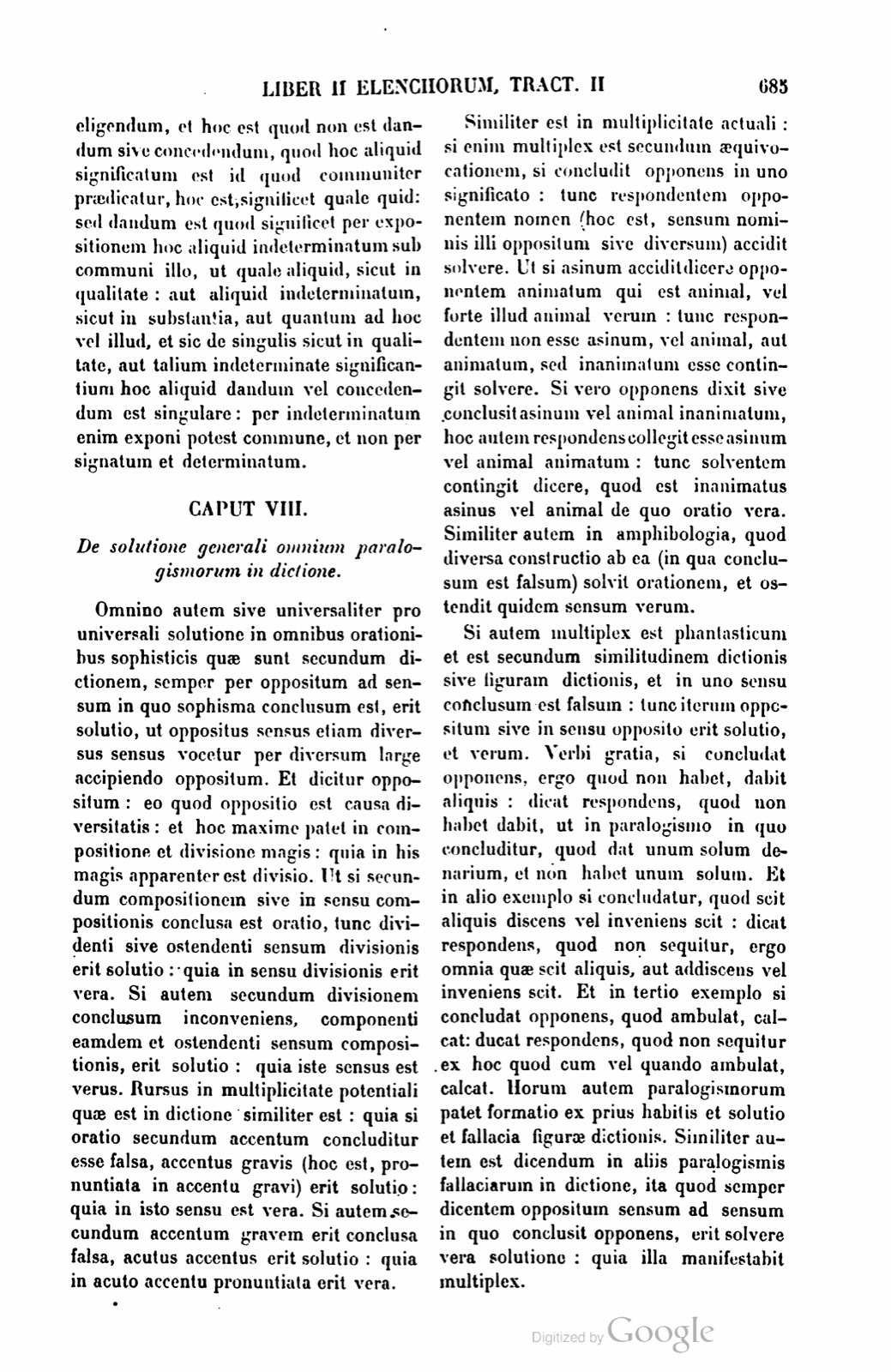
Omnino autem sive universaliter pro universali solutione in omnibus orationibus sophisticis quae sunt secundum dictionem, semper per oppositum ad sensum in quo sophisma conclusum est, erit solutio, ut oppositus sensus etiam diversus sensus vocetur per diversum large accipiendo oppositum. Et dicitur oppositum: eo quod oppositio est causa diversitatis: et hoc maxime patet in compositione et divisione magis: quia in his magis apparenter est divisio. Ut si secundum compositionem sive in sensu compositionis conclusa est oratio, tunc dividenti sive ostendenti sensum divisionis erit solutio: quia in sensu divisionis erit vera. Si autem secundum divisionem conclusum inconveniens, componenti eamdem et ostendenti sensum compositionis, erit solutio: quia iste sensus est verus. Rursus in multiplicitate potentiali quae est in dictione similiter est: quia si oratio secundum accentum concluditur esse falsa, accentus gravis (hoc est, pronuntiata in accentu gravi) erit solutio: quia in isto sensu est vera. Si autem secundum accentum gravem erit conclusa falsa, acutus accentus erit solutio: quia in acuto accentu pronuntiata erit vera.
Similiter est in multiplicitate actuali: si enim multiplex est secundum aequivocationem, si concludit opponens in uno significato: tunc respondentem opponentem nomen (hoc est, sensum nominis illi oppositum sive diversum) accidit solvere. Ut si asinum accidit dicere opponentem animatum qui est animal, vel forte illud animal verum: tunc respondentem non esse asinum, vel animal, aut animatum, sed inanimatum esse contingit solvere. Si vero opponens dixit sive conclusit asinum vel animal inanimatum, hoc autem respondens collegit esse asinum vel animal animatum: tunc solventem contingit dicere, quod est inanimatus asinus vel animal de quo oratio vera. Similiter autem in amphibologia, quod diversa constructio ab ea (in qua conclusum est falsum) solvit orationem, et ostendit quidem sensum verum.
Si autem multiplex est phantasticum et est secundum similitudinem dictionis sive figuram dictionis, et in uno sensu conclusum est falsum: tunc iterum oppositum sive in sensu opposito erit solutio, et verum. Verbi gratia, si concludat opponens, ergo quod non habet, dabit aliquis: dicat respondens, quod non habet dabit, ut in paralogismo in quo concluditur, quod dat unum solum denarium, et non habet unum solum. Et in alio exemplo si concludatur, quod scit aliquis discens vel inveniens scit: dicat respondens, quod non sequitur, ergo omnia quae scit aliquis, aut addiscens vel inveniens scit. Et in tertio exemplo si concludat opponens, quod ambulat, calcat: ducat respondens, quod non sequitur ex hoc quod cum vel quando ambulat, calcat. Horum autem paralogismorum patet formatio ex prius habitis et solutio et fallacia figurae dictionis. Similiter autem est dicendum in aliis paralogismis fallaciarum in dictione, ita quod semper dicentem oppositum sensum ad sensum in quo conclusit opponens, erit solvere vera solutione: quia illa manifestabit multiplex.
CHAPTER VIII. Concerning the general solution of all paralogisms in diction.
But altogether or universally, for a universal solution in all sophistical speeches which are according to diction, the solution will always be through the opposite to the sense in which the sophism has been concluded, so that the opposite sense is also called a diverse sense by taking opposite broadly through diverse. And it is called opposite because opposition is the cause of diversity; and this is most of all clear more in composition and division, because in these division is more apparent. For if the speech has been concluded according to composition or in the sense of composition, then for one dividing or showing the sense of division there will be solution, because in the sense of division it will be true. But if an unfitting thing has been concluded according to division, for one composing the same and showing the sense of composition there will be solution, because that sense is true. Again, it is similar in potential multiplicity which is in diction, because if a speech according to accent is concluded to be false, the grave accent, that is, pronounced in a grave accent, will be the solution, because in that sense it is true. But if it is concluded false according to the grave accent, the acute accent will be the solution, because when pronounced in the acute accent it will be true.
It is similar in actual multiplicity. For if the multiple is according to equivocation, if the opponent concludes in one signified thing, then it happens that the respondent solves by opposing the name, that is, the sense of the name opposite or diverse to that one. As if it happens that the opponent says an ass is animated, which is an animal, or perhaps that animal is true, then it happens that the respondent solves by saying it is not an ass or animal or animated, but is inanimate. But if the opponent said or concluded an inanimate ass or animal, but the respondent gathered that this is an animated ass or animal, then it happens that the one solving says that it is an inanimate ass or animal about which the speech is true. Similarly in amphibology, a construction diverse from that in which the false thing has been concluded solves the speech and indeed shows the true sense.
But if the multiple is phantasmal and is according to likeness of diction or figure of diction, and in one sense a false thing has been concluded, then again the opposite, or in the opposite sense, will be the solution and true. For example, if the opponent concludes: therefore someone will give what he does not have, let the respondent say: what he does not have, he will give, as in the paralogism in which it is concluded that he gives one denarius only and does not have one only. And in another example, if it is concluded that what someone knows he knows by learning or discovering, let the respondent say that it does not follow: therefore all things which someone knows, he knows either by learning or discovering. And in a third example, if the opponent concludes that what he walks he treads, let the respondent draw out that it does not follow from this, that when or while he walks, he treads. But the formation of these paralogisms and the solution and fallacy of figure of diction are clear from the things previously held. Similarly one must speak in the other paralogisms of fallacies in diction, so that for one always saying the opposite sense to the sense in which the opponent concluded, there will be solving by true solution, because that will manifest the multiple.
If a page does not appear, its photograph has not been uploaded yet.