Works › Sophistical Refutations, Books I–II
Volume 2 · pp. 681–685
Tractate II. Chapters VI-VII
A marker with ≈ is an approximate page boundary, placed by measure of the text; the page photographs remain the authority. In the paired views, clicking a page marker brings that page into view.
novit, aut inveniens: et cum dicit omnia, assumit plurale sub singulari, et commutat modum praedicandi: et in omnibus talibus nihil est difficile solvere, ita quod commutatio praedicamenti vel speciei praedicamenti in aliam speciem praedicamenti, vel modi praedicandi in alium modum praedicandi est causa falsitatis syllogismi.
CAPUT VII. De solutione paralogismorum tertii modi figurae dictionis.
Similiter autem haec (quae dicta est) solutio adaptatur paralogismis tertii modi figurae dictionis: ut quando mutatur quale quid in hoc aliquid. Est autem quale quid dupliciter: uno enim modo omne inferius est quale quid respectu sui superioris, ut species respectu generis: quia superius est forma et quale, inferius autem quid formatum sub ipso: alio autem modo quando per accidens adveniens est quale, et quid est in seipso.
Et secundum primum modum fit talis paralogismus, ex quo sequitur apparenter, quoniam est quis tertius homo a se sic: Coriscus est tertius ab homine, quia ab aliquo homine: et Coriscus est homo: ergo Coriscus est tertius a seipso. Et eodem modo concluditur apparenter, quod est tertius ab unoquoque homine sic: Coriscus est tertius ab homine: Socrates est homo: ergo Coriscus est tertius a Socrate. Et sic potest fieri de quolibet: ergo Coriscus est tertius ab unoquoque homine. Solvitur autem hic paralogismus: quia homo et omne commune non significat hoc aliquid, sed quale quid: et ideo cum assumat Socratem, mutat quale quid in hoc aliquid: et sic patet quae est manifestatio falsitatis paralogismi: et ideo solutio ista est recta et vera.
Potest tamen hic quaeri de hoc paralogismo: quia idem paralogismus in priori hujus scientiae libro pro exemplo positus est in generatione paralogismorum accidentis. Adhuc etiam cum sic arguitur: Coriscus est alter ab homine: et ipse est homo: ergo est alter a se: videtur esse fallacia consequentis: eo quod a superiori proceditur ad inferius affirmando. Sed ad hoc dicendum, quod nihil prohibet plures orationes fallendi coincidere in una et eadem oratione. Unde in dicto paralogismo coincidunt tres fallaciae sive deceptiones. Si enim aliquis videns Coriscum alterum esse ab homine: propter hoc quod ab inferiori ad superius valet processus affirmando, ut Coriscus est alter a se: ipse est homo: ergo est alter ab homine: et decipiatur in ipsa consequentia, ut credat converti quod non convertitur, ut quod sicut ab inferiori ad superius proceditur affirmando, sic e converso affirmando etiam procedatur a superiori ad inferius, ut Coriscus est alter ab homine: ipse est homo: ergo est alter a seipso: hic talis decipitur secundum fallaciam consequentis. Si autem quia videt, quod esse alterum convenit Corisco respectu hominis, et sic respectu accidentis: et credit quod propter hoc conveniat ipsi rei subjectae quae est Coriscus respectu sui ipsius, et sic credat inesse subjecto quod inest accidenti: hic talis decipitur secundum fallaciam accidentis. Si autem videt unam figuram dictionis in hoc tertio homine quando stat infinite in communi, et quando stat determinate pro hoc vel illo, et ideo credat posse argui a communiter supponente ad supponens, pro hoc decipitur secundum fallaciam figurae dictionis.
knows it, or by discovering; and when he says all things, he assumes the plural under the singular and changes the mode of predicating; and in all such things there is nothing difficult to solve, so that commutation of a predicament or of a species of predicament into another species of predicament, or of a mode of predicating into another mode of predicating, is the cause of the falsity of the syllogism.
CHAPTER VII. Concerning the solution of paralogisms of the third mode of figure of diction.
But similarly this solution which has been stated is adapted to paralogisms of the third mode of figure of diction, as when a qualified what is changed into this something. But qualified what is twofold: for in one way every inferior is a qualified what with respect to its superior, as species with respect to genus, because the superior is form and quality, while the inferior is the what formed under it; in another way, when what comes by accident is quality, and the what is in itself.
And according to the first mode such a paralogism is made, from which it follows apparently that someone is a third man from himself thus: Coriscus is a third from man, because from some man; and Coriscus is a man; therefore Coriscus is a third from himself. And in the same way it is apparently concluded that he is a third from every man thus: Coriscus is a third from man; Socrates is a man; therefore Coriscus is a third from Socrates. And thus it can be made concerning anyone; therefore Coriscus is a third from every man. But this paralogism is solved because man and every common term do not signify this something, but a qualified what; and therefore when he assumes Socrates, he changes qualified what into this something. Thus it is clear what the manifestation of the falsity of the paralogism is, and therefore that solution is right and true.
Nevertheless one can ask here about this paralogism, because the same paralogism was posited as an example in the prior book of this science in the generation of paralogisms of accident. Further, also when it is argued thus: Coriscus is other than man, and he himself is a man; therefore he is other than himself, it seems to be the fallacy of consequent, because one proceeds from the superior to the inferior affirmatively. But to this one must say that nothing prevents several deceptive speeches from coinciding in one and the same speech. Hence in the stated paralogism three fallacies or deceptions coincide. For if someone, seeing that Coriscus is other than man, because an affirmative process is valid from the inferior to the superior, as Coriscus is other than himself; he is a man; therefore he is other than man, is deceived in the consequence itself so that he believes that what is not converted is converted, namely that just as one proceeds affirmatively from inferior to superior, so conversely one also proceeds affirmatively from superior to inferior, as Coriscus is other than man; he is a man; therefore he is other than himself, such a person is deceived according to the fallacy of consequent. But if, because he sees that being other belongs to Coriscus with respect to man, and thus with respect to an accident, he believes that because of this it belongs to the subject reality itself, which is Coriscus, with respect to itself, and thus believes that what belongs to the accident belongs to the subject, such a person is deceived according to the fallacy of accident. But if he sees one figure of diction in this third man when it stands indefinitely in common and when it stands determinately for this or that, and therefore believes that one can argue from what supposits commonly to what supposits, in this he is deceived according to the fallacy of figure of diction.
Est etiam attendendum hic, quod terminus communis aut consideratur in se (hoc est, in natura sua simplici) quae est forma multis communicabilis, et sic omnis terminus communis ad aliqua significat quale quid: et potest etiam considerari ad aliquid et determinatus per comparationem ad illud, et hoc quadrupliciter, scilicet ad superius, vel ad inferius, vel ad seipsum, secundum quod stans sub una suppositione comparatur ad se secundum quod est sub alia suppositione, et significare potest hoc aliquid1. Ut est inferius comparatum ad suum superius, respectu illius determinatam habet suppositionem et significat hoc aliquid. Similiter tractum ad inferius, determinatam acquirit suppositionem, et significat hoc aliquid, ut animal quale quid, homo hoc aliquid significat, et homo quale quid, hic homo hoc aliquid. Ad seipsum autem sub una suppositione ad se sub alia suppositione: ut homo quale quid, omnis homo, vel albus homo hoc aliquid: quia confusum et distributum respectu sui ipsius non confusi et distributi est hoc aliquid determinatum: in se autem commune ad diversum modum suppositionis significat quale quid. Unde hic, homo currit: ergo omnis homo currit: mutatur quale quid in hoc aliquid. Et sic solvuntur ista sophismata: cujuslibet hominis asinus currit: ergo asinus cujuslibet hominis currit. Quia iste terminus, asinus, sequens terminum distributum per signum immediate accipit confusam suppositionem, et sic determinatum et hoc aliquid significat: cum autem praecedit non significat nisi quale quid: quia tunc non confunditur per distributionem. Similiter est hic: omne caput habens, est unum solum caput habens: ergo habens omne caput, est habens unum solum caput. Quia haec dictio, habens, post signum posita, confusam habet suppositionem, quam non habet posita ante idem signum. Et similiter hic: omnis homo est unus solus homo: ergo unus solus homo est omnis homo: quia hoc quod dico, solus homo, confunditur post signum, et ante signum non confunditur propter hanc regulam, quod terminus communis sequens signum distributivum affirmativum immediate confunditur et distribuitur ab ipso signo, ita quod sub ipso potest fieri descensus ad quodlibet sub ipso contentum: sequens autem ipsum mediate, sive in subjecto positum, sive in praedicato, confunditur solum, sed non distribuitur, ita quod sub ipso possit fieri descensus, quamvis multa confundantur in ipso: ut omnis homo est animal: potest fieri descensus sub homine, sed non sub animali, ut dicatur: omnis homo est hoc animal vel illud. Sed bene sequitur: omnis homo est animal: ergo Socrates est animal, et sic de aliis. Sic ergo ex diversa comparatione potest idem quod secundum se significat quale quid, hoc aliquid significare.
Intelligendum etiam, quod terminus communis significet quale quid: hoc habet aut ex seipso, aut ex adjuncto: quale quid enim significare est in communi ad aliqua stare, ita quod non ad hoc determinate vel illud se habet ex se, cum ex se non dicat hoc aliquid. Et ideo si infertur ex illo, fit fallacia figurae dictionis: ut homo currit: ergo hic homo currit. Quia hoc non sequitur. Sed si ad non ignotum, sed ad vagum descenditur, tunc sequitur: ut homo currit: ergo quidam homo, vel hic, vel ille, vel aliquis alius currit, sicut paulo post in sequenti capitulo ostendetur. Si autem habet ex adjuncto quod ipsum indefinite faciat supponere pro pluribus indeterminate, hoc quadrupliciter fieri potest. Aut enim habet hoc ex signo affirmativo cui mediate postponitur, et ex hoc confusam et infinitam accipit suppositionem: ut cum dicitur: omnis homo est animal, confuse et quale quid significat animal. Aut hoc habet ex praedicato sibi adjuncto, ut cum dicitur: homo est species: quia homo ibi non hoc aliquid, sed quale quid significat. Aut habet ex suppositione verbi praeteriti temporis vel futuri, cui supponendo in communi stat pro praesenti vel praeterito, supponit verbo praeteriti temporis: aut pro praesenti vel futuro, si supponit verbo futuri temporis: et sic significat quale quid commune ad praesens vel praeteritum, vel commune ad praesens vel futurum, sicut patet ex regulis suppositionum et ampliationum. Et semper incidit fallacia figurae dictionis si mutatur quale quid in hoc aliquid, sicut hic: homo est species: ergo hic homo est species. Vel homo est disputaturus: ergo hic homo est disputaturus. Vel homo disputabit: ergo hic praesens homo vel hic praeteritus homo.
It must also be noted here that a common term is considered either in itself, that is, in its simple nature, which is a form communicable to many, and thus every common term signifies a qualified what with respect to some things; and it can also be considered in relation to something and determined by comparison to it, and this in four ways, namely to a superior, or to an inferior, or to itself, according as, standing under one supposition, it is compared to itself according as it is under another supposition, and it can signify this something1. As an inferior compared to its superior, it has a determinate supposition with respect to that and signifies this something. Similarly, drawn down to the inferior, it acquires a determinate supposition and signifies this something, as animal signifies a qualified what, man signifies this something, and man a qualified what, this man this something. But to itself under one supposition in relation to itself under another supposition: as man a qualified what, every man or white man this something, because what is confused and distributed with respect to itself not confused and distributed is this something determinate; but in itself common to a diverse mode of supposition it signifies a qualified what. Hence here, man runs; therefore every man runs, qualified what is changed into this something. And thus these sophisms are solved: the ass of any man runs; therefore the ass of any man runs. Because this term ass, following a distributed term immediately through the sign, receives confused supposition, and thus signifies something determinate and this something; but when it precedes, it signifies only a qualified what, because then it is not confused through distribution. Similarly it is here: everyone having a head is one having only one head; therefore one having every head is one having only one head. Because this word having, posited after the sign, has confused supposition which it does not have when posited before the same sign. And similarly here: every man is one sole man; therefore one sole man is every man, because what I call sole man is confused after the sign and before the sign is not confused, because of this rule: a common term immediately following an affirmative distributive sign is confused and distributed by that sign, so that under it a descent can be made to anything contained under it; but one following it mediately, whether posited in the subject or in the predicate, is only confused but not distributed, so that a descent cannot be made under it, although many things are confused in it. As every man is an animal: a descent can be made under man, but not under animal, so that it be said: every man is this animal or that. But it follows well: every man is an animal; therefore Socrates is an animal, and so with the others. Thus therefore from diverse comparison the same thing which according to itself signifies qualified what can signify this something.
It must also be understood that a common term signifies qualified what: it has this either from itself or from what is joined to it. For to signify qualified what is to stand in common to some things, so that from itself it does not have itself determinately to this or that, since from itself it does not state this something. And therefore if it is inferred from that, the fallacy of figure of diction is made, as: man runs; therefore this man runs. For this does not follow. But if one descends not to something unknown but to something vague, then it follows, as man runs; therefore some man, or this or that or some other man runs, as will be shown a little later in the following chapter. But if it has from something joined to it that it makes it suppose indefinitely for several things indeterminately, this can happen in four ways. For either it has this from an affirmative sign to which it is mediately postponed, and from this it receives confused and infinite supposition, as when it is said: every man is an animal, animal signifies confusedly and as a qualified what. Or it has this from a predicate joined to it, as when it is said: man is a species, because man there signifies not this something but a qualified what. Or it has it from supposition to a verb of past or future time: by supposing to it in common it stands for present or past if it supposes to a verb of past time, or for present or future if it supposes to a verb of future time; and thus it signifies qualified what common to present or past, or common to present or future, as is clear from the rules of supposition and ampliation. And the fallacy of figure of diction always occurs if qualified what is changed into this something, as here: man is a species; therefore this man is a species. Or man is going to dispute; therefore this man is going to dispute. Or man will dispute; therefore this present man or this past man.
Si autem id quod intelligitur in aliquo, inferatur ex illo, non fit fallacia figurae dictionis, sicut patet hic: omnis homo est animal: quidam homo est homo: ergo quidam homo est animal. Cum enim dicitur: omnis homo est animal, vel omnis homo currit: iste terminus, homo, universaliter distribuitur: et sic in ipso intelligitur aliquis homo, et hic homo, et ille homo: et sic non fit mutatio suppositionis, ut ex quale quid inferatur hoc aliquid, quinimo in utroque stat pro eo quod est hoc aliquid. Aliter enim incideret semper fallacia figurae dictionis in tertio primae figurae et in primo tertiae, ex hoc quod in praemissis confusam suppositionem habet et distributam, et in conclusione hoc aliquid infertur ex ipso. Pro eodem enim supponit in praemissa cum subjectum confusum sit et distributum, sicut de eodem est affirmatio universalis et negatio particularis. Et quamvis in majori propositione tertii primae figurae subjectum sit confusum et distributum, et in minori assumatur pro hoc vel illo, non tamen est fallacia figurae dictionis: quia particulare idem numero intelligitur, et est in universali distributo: et quia etiam fallacia figurae dictionis fit ex commutatione ejus quod est quale quid in praemissis, et in conclusione infertur ut hoc aliquid, fallacia enim fit in illatione conclusionis, et non in ordine praemissarum.
Sic etiam patet quare non fit fallacia figurae dictionis ex hoc quod mutatur hoc aliquid in quale quid, sicut e contrario: quia hoc aliquid intelligitur et est actu in quale quid: et ideo bona est argumentatio qua infertur ex ipso. Et sic etiam patet quare non est fallacia figurae dictionis, quando infertur pars ex toto in quantitate, ut hic: omnis homo currit: ergo quidam homo currit. Quia pars per intellectum actu est in toto et infertur ex ipso. Patet etiam quare non est fallacia in conversione universalis affirmativae in particularem, sic: omnis homo est animal: ergo quoddam animal est homo. Quia haec, quoddam animal est homo, aequipollet huic, quidam homo est animal: et haec, quidam homo est animal, per intellectum est in hac, omnis homo est animal: et sic et illa, quoddam animal est homo: unde non quaelibet mutatio modi suppositionis inducit fallaciam, sed quaedam sic, et quaedam non.
But if what is understood in something is inferred from it, the fallacy of figure of diction is not made, as is clear here: every man is an animal; some man is a man; therefore some man is an animal. For when it is said, every man is an animal, or every man runs, this term man is universally distributed; and thus in it some man and this man and that man are understood; and thus there is no change of supposition, as if this something were inferred from qualified what, indeed in each it stands for that which is this something. Otherwise the fallacy of figure of diction would always occur in the third mode of the first figure and in the first mode of the third, from this, that in the premises it has confused and distributed supposition, and in the conclusion this something is inferred from it. For it supposits for the same thing in the premise, when the subject is confused and distributed, just as universal affirmation and particular negation are about the same. And although in the major proposition of the third mode of the first figure the subject is confused and distributed, and in the minor it is assumed for this or that, nevertheless there is not a fallacy of figure of diction, because the same particular in number is understood and is in the distributed universal; and also because the fallacy of figure of diction is made from the commutation of that which is qualified what in the premises, and in the conclusion is inferred as this something, for the fallacy is made in the inference of the conclusion and not in the order of the premises.
Thus it is also clear why the fallacy of figure of diction is not made from this, that this something is changed into qualified what, as conversely, because this something is understood and is actually in qualified what; and therefore the argumentation which is inferred from it is good. And thus also it is clear why there is not a fallacy of figure of diction when a part is inferred from a whole in quantity, as here: every man runs; therefore some man runs. Because the part is actually in the whole through understanding and is inferred from it. It is also clear why there is not a fallacy in the conversion of a universal affirmative into a particular, thus: every man is an animal; therefore some animal is a man. Because this, some animal is a man, is equivalent to this, some man is an animal; and this, some man is an animal, is through understanding in this, every man is an animal; and thus also that, some animal is a man. Hence not every change of the mode of supposition induces a fallacy, but certain changes do and certain do not.
Similiter autem sicut est quale quid quando indefinite et ad plura communiter supponit, et infertur hoc aliquid sub ipso indefinite contentum, sic est etiam quale quid ex adjuncto sibi adjectivo quum infertur hoc aliquid determinatum sub adjectivo illo, sicut in his terminis: Coriscus musicus, ut si quaeratur, utrum hic Coriscus et Coriscus musicus sit unum, vel sit alterum? et fiat talis paralogismus: Coriscus musicus est alter a musico: quia a quodam musico: est autem Coriscus musicus musicus: ergo est alter a seipso: sic enim incidit fallacia figurae dictionis: nam hic quidem (scilicet Coriscus) significat aliquid: illud autem (scilicet Coriscus musicus) significat quale: et sic mutatur quale quid in hoc aliquid, sicut patet cuilibet intuenti. Propter quod patet quod hic fit fallacia figurae dictionis, quia mutatur quale quid in hoc aliquid: Coriscus enim musicus est quale quid ex adjuncto sibi adjectivo: et sic convenit sibi alterum esse a musico: Coriscus autem est hoc aliquid: quare infertur alterum esse a seipso: et ideo mutatur quale quid in praemissa, in hoc aliquid in conclusione, et incidit fallacia figurae dictionis.
Est autem adhuc notandum, quod quando incidit fallacia figurae dictionis ex hoc quod commutatur quale quid in hoc aliquid, tunc ista commutatio est inter praemissas, aut inter praemissas et conclusionem. Si inter praemissas, tunc non facit fallaciam figurae dictionis, ut hic: omnis homo est animal: hic homo est homo: ergo hic homo est animal: est enim bonus processus, quia pars assumitur pro toto quae actu et intellectu est in illo. Si autem est inter praemissas et conclusionem: aut aliquid comparatur ad idem significatum in minori praemissa et conclusione, aut ad diversa. Si comparatur ad diversa, tunc non incidit fallacia figurae dictionis. Et per hoc iterum patet, quod in tertio primae et in primo tertiae non incidit fallacia figurae dictionis: quia licet in praemissa minori significetur hoc aliquid, et in majori quale quid, et in conclusione similiter hoc aliquid: tamen ad diversa fit comparatio: in praemissa enim minori comparatur ad medium, in conclusione autem ad majorem extremitatem. Si autem ad idem fiat comparatio, tunc adhuc est distinguendum: aut enim oratio quae fecit ipsum stare pro quali quo, remanet tam in praemissa, quam in conclusione: aut non remanet eadem. Si remanet eadem, tunc semper incidit fallacia figurae dictionis. Si autem non remanet eadem in utroque, tunc non incidit fallacia, ut hic: omnis homo est animal: ergo animal est omnis homo. Vel sic: omnis homo est animal: ergo omnis homo est hoc animal. Hoc enim signum distributivum affirmativum quod facit terminum communem mediate sibi adjunctum stare pro quolibet quo, remanet tam in praemissa quam in conclusione. Sic etiam quando praedicatum quod facit terminum communem stare pro aliquo, remanet tam in praemissa, quam in conclusione, ut homo est species: et eodem modo est de termino supposito verbo praeteriti temporis vel futuri; ut homo est disputaturus: ergo homo qui est, est disputaturus: vel homo qui fuit, est disputaturus. Sic ergo patet quando ex commutatione ejus quod significat quale quid in hoc aliquid, incidit fallacia, et quando non.
Similarly, just as there is a qualified what when it supposits indefinitely and commonly for several things, and this something indefinitely contained under it is inferred, so also there is a qualified what from an adjective joined to it when some determinate this something is inferred under that adjective, as in these terms: musical Coriscus. For example, if it is asked whether this Coriscus and musical Coriscus are one, or whether he is another, and such a paralogism is made: musical Coriscus is other than the musical man, because other than some musical man; but musical Coriscus is musical; therefore he is other than himself. For thus the fallacy of figure of diction occurs; for this one, namely Coriscus, signifies something, but that, namely musical Coriscus, signifies a quality, and thus qualified what is changed into this something, as is clear to anyone looking. Therefore it is clear that here the fallacy of figure of diction is made, because qualified what is changed into this something. For musical Coriscus is a qualified what from the adjective joined to him, and thus it belongs to him to be other than a musical man; but Coriscus is this something. Therefore being other than himself is inferred; and therefore qualified what is changed in the premise into this something in the conclusion, and the fallacy of figure of diction occurs.
But it must still be noted that when the fallacy of figure of diction occurs from this, that qualified what is changed into this something, then this commutation is either between the premises, or between the premises and the conclusion. If between the premises, then it does not make a fallacy of figure of diction, as here: every man is an animal; this man is a man; therefore this man is an animal. For it is a good process, because the part is assumed for the whole, which is actually and by understanding in it. But if it is between premises and conclusion, either something is compared to the same signified in the minor premise and conclusion, or to diverse ones. If to diverse ones, then the fallacy of figure of diction does not occur. And through this it is again clear that in the third mode of the first figure and in the first of the third, the fallacy of figure of diction does not occur, because although in the minor premise this something is signified, and in the major qualified what, and in the conclusion likewise this something, nevertheless the comparison is made to diverse things: for in the minor premise it is compared to the middle, but in the conclusion to the major extreme. But if the comparison is made to the same thing, then one must still distinguish: for either the speech which made it stand for a qualified what remains both in the premise and in the conclusion, or the same does not remain. If the same remains, then the fallacy of figure of diction always occurs. But if it does not remain the same in both, then the fallacy does not occur, as here: every man is an animal; therefore an animal is every man. Or thus: every man is an animal; therefore every man is this animal. For this affirmative distributive sign which makes the common term mediately joined to it stand for any qualified what remains both in the premise and in the conclusion. So also when the predicate which makes the common term stand for something remains both in the premise and in the conclusion, as man is a species; and in the same way it is concerning a term supposed to a verb of past or future time, as: man is going to dispute; therefore man who is, is going to dispute; or man who was, is going to dispute. Thus therefore it is clear when, from commutation of that which signifies qualified what into this something, a fallacy occurs, and when not.
Ex omnibus autem inductis patet, quod commune quod significat quale quid, non est exponere per hoc aliquid, hoc est, individuum signatum, ut sub ipso quod est quale quid, inferatur hoc aliquid signatum: verumtamen ipsum commune exponere per hoc aliquid determinatum, non facit hoc inconveniens, quod sequatur tertium hominem esse a se vel ab altero, ut superius dictum est in formatione paralogismi. Si enim exponatur hoc aliquid indeterminatum, ut homo per hunc vel illum, et sic de singulis, non sequitur praedictum inconveniens, sed praedictum inconveniens, quod scilicet sit tertius a se vel a Socrate vel alio, facit exponere hominem quod est quale quid, et idem esse concedere quod hoc aliquid signatum et determinatum, et nihil habere diversum ab isto. Et hujus causa est, quia hoc aliquid esse indeterminate, non est idem esse quod Calliam esse vel aliud significatum: quia hoc aliquid est aliquod indeterminate esse, et non significatum hoc quod est Callias: nec erit hoc quod homo est, sive quod est quale commune indeterminatum.
Adhuc autem nihil distabit quantum ad inconveniens quod sequitur, si quis dicat quod expositum quod est quale quid dicat non esse idem quod est esse hoc aliquid: ut si quis dicat quod esse universalis non est esse particularis: sed dicat quod quale quid significans sit quiddam per se separatum: tunc enim non evitabit hoc inconveniens, quod scilicet secundum hoc universale quod significat quale quid, erit quid secundum se separatum, quod est praeter plures particulares homines, et separatum ab eis, ut homo erit separatum praeter particulares homines in se existens, et non est in illis. Si autem dicat quod exponitur quale quid (hoc est, commune) per hoc aliquid, tunc incidit fallacia figurae dictionis: et hoc iterum est inconveniens.
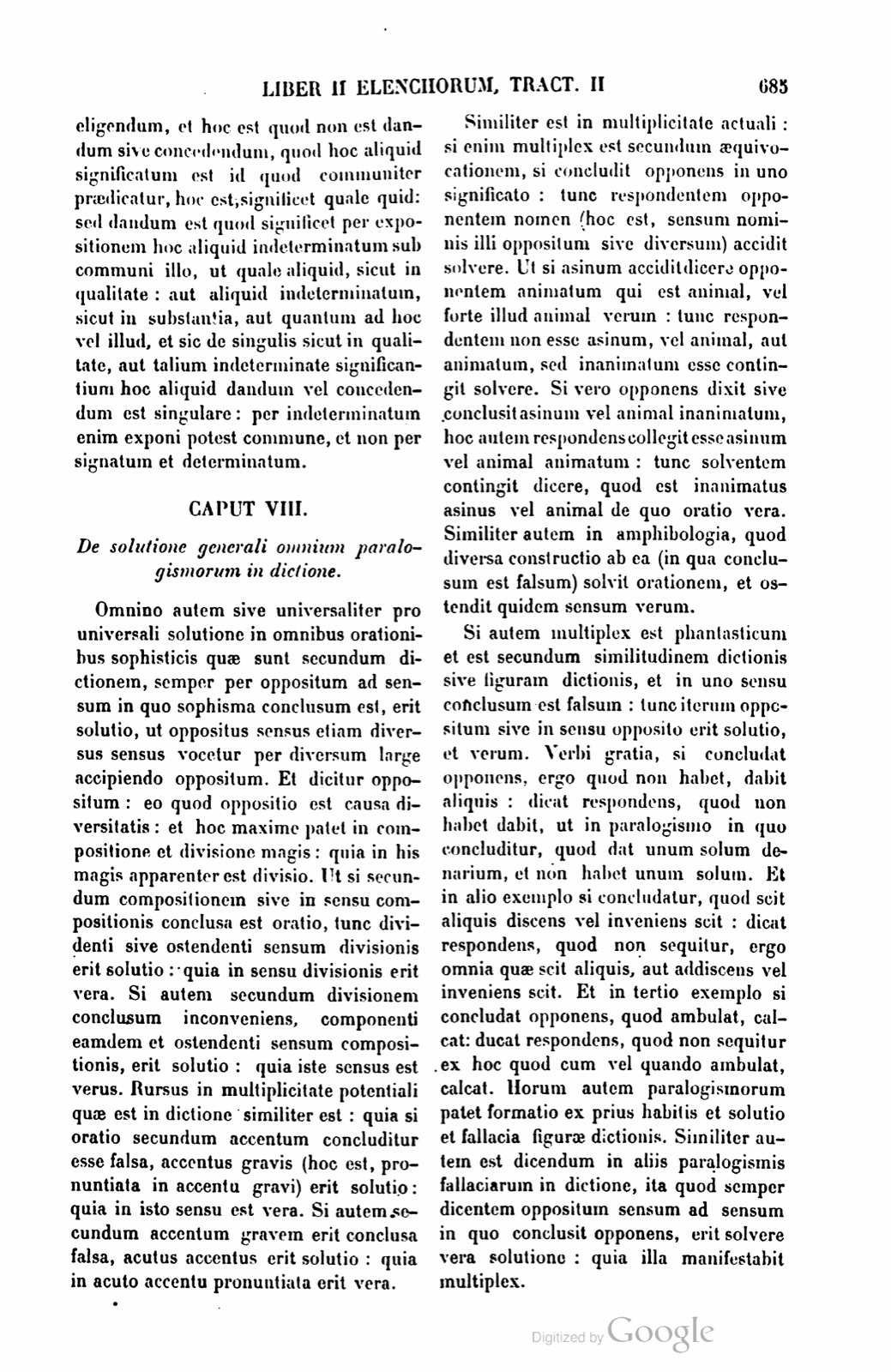
Manifestum est ergo quod medium est eligendum, et hoc est quod non est dandum sive concedendum, quod hoc aliquid significatum est id quod communiter praedicatur, hoc est, significet quale quid: sed dandum est quod significet per expositionem hoc aliquid indeterminatum sub communi illo, ut quale aliquid, sicut in qualitate: aut aliquid indeterminatum, sicut in substantia, aut quantum ad hoc vel illud, et sic de singulis sicut in qualitate, aut talium indeterminate significantium hoc aliquid dandum vel concedendum est singulare: per indeterminatum enim exponi potest commune, et non per signatum et determinatum.
But from all the things brought in it is clear that a common term which signifies qualified what is not to be expounded through this something, that is, a designated individual, so that under that which is qualified what, this designated something is inferred. Nevertheless to expound the common itself through this something indeterminate does not make this unfitting consequence follow, that a third man is from himself or from another, as was said above in the formation of the paralogism. For if this something indeterminate is expounded, as man through this or that man, and so concerning singulars, the aforesaid unfitting consequence does not follow; but the aforesaid unfitting consequence, namely that he is a third from himself or from Socrates or another, makes man, which is a qualified what, be expounded and be granted to be the same as this something designated and determined, and to have nothing diverse from it. And the cause of this is that to be this something indeterminately is not the same as to be Callias or another signified thing, because this something is some being indeterminately and not this signified which is Callias; nor will this be what man is, or what the common indeterminate qualified thing is.
Furthermore, as to the unfitting consequence which follows, it will make no difference if someone says that the thing expounded which is qualified what does not say the same as the being of this something, as if someone says that the being of the universal is not the being of the particular, but says that what signifies qualified what is something separated by itself. For then he will not avoid this unfitting consequence, namely that according to this the universal which signifies qualified what will be some what separated according to itself, which is besides the many particular men and separated from them, as man will be a separated thing existing in itself besides particular men, and is not in them. But if he says that the qualified what, that is, the common, is expounded through this something, then the fallacy of figure of diction occurs; and this again is unfitting.
Therefore it is manifest that the middle must be chosen, and this is that one must not give or grant that this signified something is that which is commonly predicated, that is, signifies qualified what. But one must give that it signifies through exposition this something indeterminate under that common term, as some qualified thing, as in quality, or something indeterminate, as in substance, or how much with respect to this or that, and so concerning singulars as in quality; or the singular must be given or granted of such things indeterminately signifying this something. For the common can be expounded through the indeterminate, and not through the designated and determined.
Notes
- From this it is clear how a common term, taken in diverse ways, either in itself or in comparison to other terms, sometimes signifies a qualified what, and sometimes this something. P. J. (Ex hoc patet quomodo terminus communis diversimode sumptus, vel in se vel in comparatione ad alios terminos, quandoque significat quale quid, et quandoque hoc aliquid. P. J.) ↩
If a page does not appear, its photograph has not been uploaded yet.