Works › Sophistical Refutations, Books I–II
Volume 2 · pp. 675–677
Tractate II. Chapter V
A marker with ≈ is an approximate page boundary, placed by measure of the text; the page photographs remain the authority. In the paired views, clicking a page marker brings that page into view.
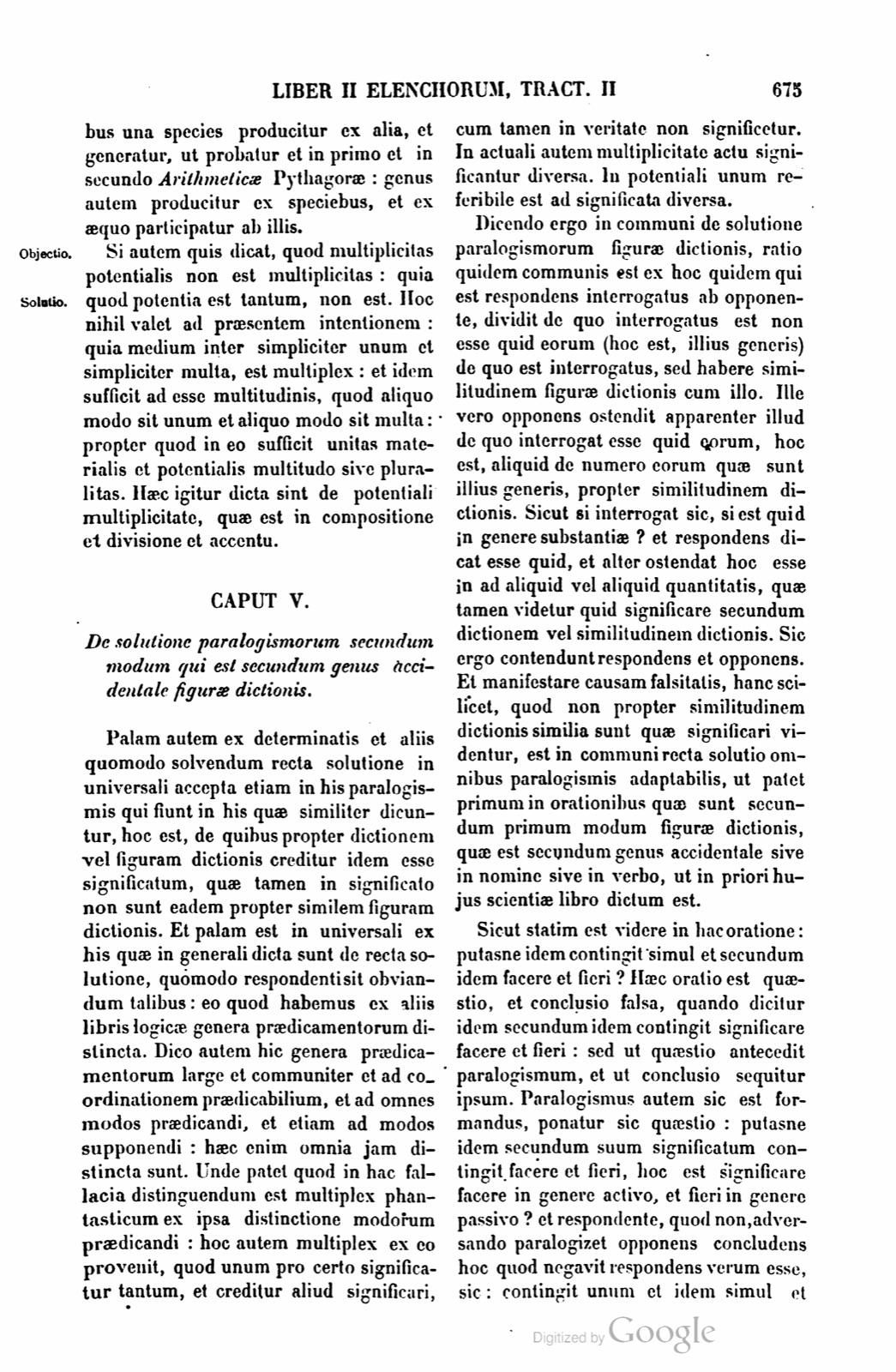
CAPUT V. De solutione paralogismorum secundum modum qui est secundum genus accidentale figurae dictionis.
Palam autem ex determinatis et aliis quomodo solvendum recta solutione in universali accepta etiam in his paralogismis qui fiunt in his quae similiter dicuntur, hoc est, de quibus propter dictionem vel figuram dictionis creditur idem esse significatum, quae tamen in significato non sunt eadem propter similem figuram dictionis. Et palam est in universali ex his quae in generali dicta sunt de recta solutione, quomodo respondenti sit obviandum talibus: eo quod habemus ex aliis libris logicae genera praedicamentorum distincta. Dico autem hic genera praedicamentorum large et communiter et ad coordinationem praedicabilium, et ad omnes modos praedicandi, et etiam ad modos supponendi: haec enim omnia jam distincta sunt. Unde patet quod in hac fallacia distinguendum est multiplex phantasticum ex ipsa distinctione modorum praedicandi: hoc autem multiplex ex eo provenit, quod unum pro certo significatur tantum, et creditur aliud significari, cum tamen in veritate non significetur. In actuali autem multiplicitate actu significantur diversa. In potentiali unum referibile est ad significata diversa.
Dicendo ergo in communi de solutione paralogismorum figurae dictionis, ratio quidem communis est ex hoc quidem qui est respondens interrogatus ab opponente, dividit de quo interrogatus est non esse quid eorum (hoc est, illius generis) de quo est interrogatus, sed habere similitudinem figurae dictionis cum illo. Ille vero opponens ostendit apparenter illud de quo interrogat esse quid eorum, hoc est, aliquid de numero eorum quae sunt illius generis, propter similitudinem dictionis. Sicut si interrogat sic, si est quid in genere substantiae? et respondens dicat esse quid, et alter ostendat hoc esse in ad aliquid vel aliquid quantitatis, quae tamen videtur quid significare secundum dictionem vel similitudinem dictionis. Sic ergo contendunt respondens et opponens. Et manifestare causam falsitatis, hanc scilicet, quod non propter similitudinem dictionis similia sunt quae significari videntur, est in communi recta solutio omnibus paralogismis adaptabilis, ut patet primum in orationibus quae sunt secundum primum modum figurae dictionis, quae est secundum genus accidentale sive in nomine sive in verbo, ut in priori hujus scientiae libro dictum est.
Sicut statim est videre in hac oratione: putasne idem contingit simul et secundum idem facere et fieri? Haec oratio est quaestio, et conclusio falsa, quando dicitur idem secundum idem contingit significare facere et fieri: sed ut quaestio antecedit paralogismum, et ut conclusio sequitur ipsum. Paralogismus autem sic est formandus, ponatur sic quaestio: putasne idem secundum suum significatum contingit facere et fieri, hoc est significare facere in genere activo, et fieri in genere passivo? et respondente, quod non, adversando paralogizet opponens concludens hoc quod negavit respondens verum esse, sic: contingit unum et idem simul et secundum idem videre et non videri: sed videre est facere et videri fieri: ergo contingit unum et idem et secundum idem facere et fieri. Videre autem supponitur esse facere, propter similem terminationem dictionis cum activis: videri autem supponitur esse fieri, propter similem terminationem cum passivis. Et solvitur iste paralogismus negata minori cum sua suppositione, scilicet videre sit facere, et videri fieri propter similem terminationem cum passivis et activis: multa enim sunt similis terminationis, quae non propter hoc sunt similis suppositionis.
CHAPTER V. Concerning the solution of paralogisms according to the mode which is according to the accidental genus of figure of diction.
But from the things determined and from other things it is plain how one must solve by right solution, taken universally, also in these paralogisms which are made in those things that are said similarly, that is, concerning which because of diction or figure of diction the same thing is believed to be signified, although nevertheless they are not the same in signification because of the similar figure of diction. And it is plain universally from those things which were said in general concerning right solution how the respondent must resist such things, because from other books of logic we have the genera of predicaments distinguished. But here I call genera of predicaments broadly and commonly both with respect to the coordination of predicables, and with respect to all modes of predicating, and also with respect to modes of supposing; for all these have already been distinguished. Hence it is clear that in this fallacy the phantasmal multiple must be distinguished from the very distinction of the modes of predicating. But this multiple arises from the fact that one thing only is signified for certain, and another is believed to be signified, although nevertheless in truth it is not signified. But in actual multiplicity diverse things are signified actually. In potential multiplicity one thing is referable to diverse significates.
Therefore, speaking in common concerning the solution of paralogisms of figure of diction, the common account indeed is from this: that the respondent questioned by the opponent divides what he has been asked about, saying that it is not something of those things, that is, of that genus, about which he was asked, but has a likeness of figure of diction with it. But the opponent shows apparently that what he asks about is something of those things, that is, something from the number of the things which are of that genus, because of the likeness of diction. As if he asks thus whether it is something in the genus of substance, and the respondent says that it is something, and the other shows that this is in relation or something of quantity, which nevertheless seems to signify a what according to diction or the likeness of diction. Thus therefore the respondent and opponent contend. And to manifest the cause of falsity, namely this, that things which seem to be signified are not similar because of the likeness of diction, is in common the right solution adaptable to all paralogisms, as is clear first in speeches which are according to the first mode of figure of diction, which is according to accidental genus either in the noun or in the verb, as was said in the prior book of this science.
As is immediately to be seen in this speech: do you think that the same thing can at once and according to the same thing do and be done? This speech is a question and a false conclusion when it is said that the same thing according to the same thing can signify doing and being done; but as a question it precedes the paralogism, and as a conclusion it follows it. But the paralogism must be formed thus. Let the question be posited thus: do you think that the same thing according to its signification can do and be done, that is, signify doing in the active genus and being done in the passive genus? And when the respondent says no, let the opponent, by opposing, paralogize by concluding that what the respondent denied is true, thus: one and the same thing can at once and according to the same thing see and not be seen; but to see is to do, and to be seen is to be done; therefore one and the same thing according to the same thing can do and be done. But to see is supposed to be to do because of a similar ending of the word with active forms; and to be seen is supposed to be to be done because of a similar ending with passive forms. And this paralogism is solved by denying the minor with its supposition, namely that to see is to do and to be seen is to be done because of the similar ending with passive and active forms. For many things are of a similar ending which are not, for this reason, of similar supposition.
Secunda ratio similis isti per omnia, et est quaestio et conclusio est ista: ponatur enim quaestio sic: putasne est quid vel aliquid eorum quae sunt facere, hoc est, in genere actionis, pati quidem, hoc est, in genere passionis vel passivorum? et dicente respondente, quod non, sic paralogizet opponens: secatur, uritur, operatur, sunt similis terminationis: ergo ejusdem generis sive significationis: et sic omnia ista pati significant. Et addat rursum (ut ostendat scribere esse activum), dicere, scribere, currere, similiter sibi invicem dicuntur, et terminationem habent activam secundum modum infinitivum: ergo omnia sunt activae significationis, et agere significant. Et ad inferendum conclusionem adhuc addat opponens: sed scribere est operari aliquid: et operari pati: ergo scribere significat aliquid quod simul significat facere sive agere et pati, sive facere et pati. Et solvitur iterum per interemptionem majoris cum sua suppositione, sicut oratio praecedens. Unde si aliquis respondentium illic in interrogatione opponentis negando minorem paralogismi det non contingere idem facere et fieri, videre et videri propter similem terminationem cum activis et passivis: tunc nondum factus est ei, nec potest fieri elenchus apparens: et ideo negat minorem ne fiat elenchus apparens ei, scilicet si non dicat videre esse facere quid propter similem terminationem cum activis, et videri pati quid propter similem terminationem cum passivis. Opponens enim ad faciendum apparentem elenchum indiget hac interrogatione sibi concessa a respondente quae est minor propositio, si apparentem debeat ad illam conclusionem facere elenchum. Sed ipse opponens ab audiente respondente scilicet opinatur illam datam esse in similibus: quia secare est facere quid et secari est aliquid fieri: et ideo videri et videre dicit facere et fieri significare, hoc est, accipit quia datum, et quaecumque alia activis et passivis similiter dicuntur secundum figuram et similitudinem terminationis. Nam ipse respondens qui audit opponentem, addit reliquam, hoc scilicet, quod generaliter sit verum, quod quae sunt ejusdem figurae dictionis, sunt et ejusdem significationis sive generis: et ideo quod videre sit facere, et videri fieri: et hoc est falsum: quia non necessario similiter dicitur secundum significationem, licet similiter dici videatur secundum dictionis terminationem.
The second reasoning is like this one in all respects, and the question and conclusion are this: for let the question be posited thus: do you think that to suffer, that is, in the genus of passion or passive things, is some what or something of those things which are to do, that is, in the genus of action? And when the respondent says no, let the opponent paralogize thus: to be cut, to be burned, to work, are of similar ending; therefore they are of the same genus or signification, and thus all those things signify suffering. And let him add again, so that he may show that to write is active: to speak, to write, to run are said similarly to one another and have an active ending according to the mode of the infinitive; therefore all are of active signification and signify acting. And for inferring the conclusion let the opponent still add: but to write is to work something, and to work is to suffer; therefore to write signifies something which at once signifies doing or acting and suffering, or doing and suffering. And again it is solved through the destruction of the major with its supposition, as the preceding speech was. Hence if one of the respondents there, in the questioning of the opponent, by denying the minor of the paralogism grants that the same thing cannot do and be done, see and be seen because of the similar ending with active and passive forms, then an apparent refutation has not yet been made for him, nor can it be made; and therefore he denies the minor lest an apparent refutation be made for him, namely if he does not say that to see is to do something because of a similar ending with active forms, and that to be seen is to suffer something because of a similar ending with passive forms. For the opponent, in order to make an apparent refutation, needs this question to be granted to him by the respondent, which is the minor proposition, if he must make an apparent refutation toward that conclusion. But the opponent himself, from the respondent who hears him, namely, thinks that it was given in similar cases, because to cut is to do something and to be cut is for something to be done; and therefore he says that to be seen and to see signify doing and being done, that is, he accepts it as given, and likewise any other things which are said similarly to active and passive forms according to the figure and likeness of ending. For the respondent himself who hears the opponent adds the remainder, namely this, that it is generally true that things which are of the same figure of diction are also of the same signification or genus; and therefore that to see is to do and to be seen is to be done. And this is false, because it is not necessarily said similarly according to signification, although it seems to be said similarly according to the ending of diction.
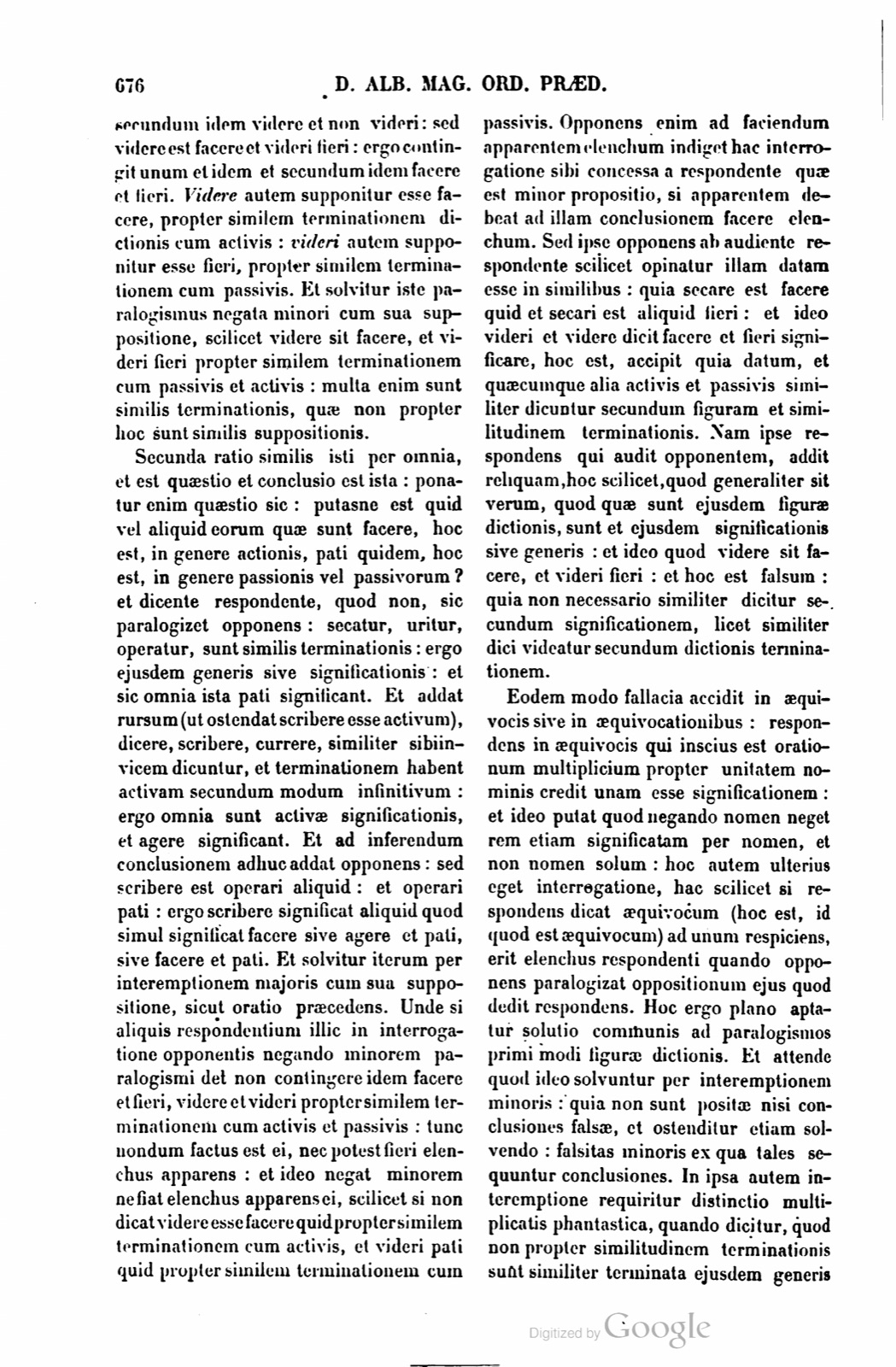
Eodem modo fallacia accidit in aequivocis sive in aequivocationibus: respondens in aequivocis qui inscius est orationum multiplicium propter unitatem nominis credit unam esse significationem: et ideo putat quod negando nomen neget rem etiam significatam per nomen, et non nomen solum: hoc autem ulterius eget interrogatione, hac scilicet si respondens dicat aequivocum (hoc est, id quod est aequivocum) ad unum respiciens, erit elenchus respondenti quando opponens paralogizat oppositionum ejus quod dedit respondens. Hoc ergo plano aptatur solutio communis ad paralogismos primi modi figurae dictionis. Et attende quod ideo solvuntur per interemptionem minoris: quia non sunt positae nisi conclusiones falsae, et ostenditur etiam solvendo: falsitas minoris ex qua tales sequuntur conclusiones. In ipsa autem interemptione requiritur distinctio multiplicitatis phantastica, quando dicitur, quod non propter similitudinem terminationis sunt similiter terminata ejusdem generis vel significationis: in hoc enim datur intelligi, quod propter similitudinem terminationis plura apparent in uno significari. Et sic patet quod, sicut supradictum est, per distinctionem et sensum ad conclusionis adaptationem manifestatur causa falsitatis in syllogismo, sive in apparenti elencho. Sic ergo solvendi sunt parelenchi qui sunt secundum primum modum figurae dictionis.
In the same way the fallacy happens in equivocal terms or in equivocations: the respondent in equivocal terms, who is ignorant of multiple speeches, because of the unity of the name believes there is one signification, and therefore thinks that by denying the name he also denies the reality signified by the name, and not only the name. But this further needs a question, namely this: if the respondent says an equivocal term, that is, that which is equivocal, while looking to one thing, there will be a refutation for the respondent when the opponent paralogizes concerning the opposites of what the respondent gave. Therefore, with this plain, the common solution is adapted to paralogisms of the first mode of figure of diction. And note that they are solved through the destruction of the minor for this reason: because only false conclusions have been posited, and also in solving there is shown the falsity of the minor from which such conclusions follow. But in the very destruction there is required the distinction of phantasmal multiplicity, when it is said that things similarly ended are not of the same genus or signification because of the likeness of ending; for in this it is given to be understood that because of the likeness of ending several things appear to be signified in one. And thus it is clear that, as was said above, through distinction and the adaptation of sense to the conclusion, the cause of falsity in the syllogism or in the apparent refutation is manifested. Thus therefore para-refutations which are according to the first mode of figure of diction must be solved.
If a page does not appear, its photograph has not been uploaded yet.