Works › Sophistical Refutations, Books I–II
Volume 2 · pp. 670–675
Tractate II. Chapters III-IV
A marker with ≈ is an approximate page boundary, placed by measure of the text; the page photographs remain the authority. In the paired views, clicking a page marker brings that page into view.
CAPUT III. De solutione paralogismorum secundum compositionem et divisionem.
Ex his autem quae dicta sunt, manifestum est quomodo solvendum est etiam eos paralogismos, qui sunt secundum compositionem et divisionem: quia si divisa (hoc est, divisim prolata oratio) et composita (hoc est, composite prolata) aliud et aliud significat: eo quod licet materialiter una sit, tamen formaliter diversa est, ut in priori hujus scientiae libro determinatum est. Si ergo conclusa est composita et falsa, dicendum est contrarium, quod scilicet divisa est vera: et si divisa conclusa est falsa, iterum dicendum est contrarium, quod scilicet composita est vera. Et hoc in exemplis manifestetur, oportet scire quod omnes hujusmodi orationes quae sunt secundum compositionem vel divisionem sunt tales: putasne quo vidisti tu hunc percussum, hoc percussus est hic? Et debet sic formari paralogismus: quocumque vidisti hunc per aliquem vel ab aliquo percussum, hoc percussus est hic: sed oculo vidisti hunc ab aliquo percussum: ergo oculo percussus est hic. Major enim multiplex in hoc paralogismo secundum compositionem et divisionem, ex eo quod haec determinatio, quo, potest componi sive continue proferri cum hoc verbo, vidisti, cum quo naturaliter componitur: et sic est composita et falsa, sub hoc sensu, quo vidisti aliquem percussum ab aliquo, ille sive illo percussus est: hoc enim falsum est. Vel potest dividi ab hoc verbo, vidisti, et continue proferri cum hoc participio percussus: et sic est divisa et vera, sub hoc sensu, quo percussum vidisti aliquem, illo sicut instrumento percussionis percussus est. Alia autem oratio quae penes istam formationem est, haec est, et quo percussus est, hoc tu vidisti: et formatur sic: quo percussus est aliquis, hoc vidisti ipsum percussum: sed gladio vel baculo percussus est aliquis: ergo baculo vidisti ipsum percussum. Et est hic multiplicitas in praemissa et in conclusione. In praemissa quidem, eo quod haec dictio, quo, potest componi cum hoc verbo, vidisti, et est composita et falsa: vel dividi ab illo, et componi cum participio, percussum, et est vera sicut prius. Et similiter dicendum est de conclusione, sicut patet cuilibet intuenti. Oportet enim addi ad hanc orationem (quo percussus est, hoc tu vidisti) addi ipsum percussum: vel non incidit multiplicitas compositionis et divisionis: unde cum dicitur, quo percussus est, hoc tu vidisti, subintelligitur ipsum percussum esse.
Quamvis autem sic per distinctionem cujusdam multiplicis solvantur hujusmodi orationes quae sunt secundum compositionem et divisionem, tamen non vere sunt multiplices, ita quod habeant actualem multiplicitatem in una voce, quae naturaliter et formaliter una est significativa: sed habent aliquid dubiarum interrogationum sive propositionum quae est secundum potentialem multiplicitatem: et hoc est dupliciter secundum compositionem: non enim est vere duplex compositum: quia non nisi potentia divisum est, quod est compositum. Si enim dividatur, divisa non est eadem formaliter omnino cum composita. Et hujus probatio est, quia sicut est in dictione multiplici secundum diversos intellectus, sic est in oratione divisa et composita: dictio autem diversificata secundum accentus, non est eadem dictio formaliter forma prolationis. Siquidem hoc est: quia certe etiam malum cujus prima longa est, pomum significat: et malum cujus prima brevis est, privationem boni significat, secundum diversum accentum vel tempus et breve prolata formaliter aliud et aliud sunt et significant: sed in scriptis quidem, in quibus non est prolatio, idem nomen est, cum eisdem scribatur elementis, et etiam in scriptis jam grammatici signa diversa faciunt, acutum vel gravem accentum denotantia, et per consequens diversa prolatione nomen esse pronuntiandum: prolata autem in diverso accentu dictio, constat quod formaliter non est una: quod autem vere multiplex est sub una materialiter et formaliter voce prolata, habet significata: propter quod cum dictio composita et divisa formaliter non sit oratio una, patet quod non est duplex quod est secundum compositionem et divisionem multiplex. Et ex hoc manifestum etiam est, quod non omnes elenchi sophistici peccant secundum duplex quod est vere duplex sic ut actualem habeat multiplicitatem, sicut quidam errantes dicunt.
CHAPTER III. Concerning the solution of paralogisms according to composition and division.
But from the things which have been said, it is manifest how those paralogisms also are to be solved which are according to composition and division, because if the divided speech, that is, the speech uttered dividedly, and the composed speech, that is, uttered compositely, signify one thing and another, although it is one materially, nevertheless it is formally diverse, as was determined in the prior book of this science. Therefore if the composed and false thing has been concluded, the contrary must be said, namely that the divided thing is true; and if the divided thing has been concluded as false, again the contrary must be said, namely that the composed thing is true. And that this may be manifested in examples, one must know that all speeches of this kind which are according to composition or division are such as these: do you think that by what you saw this man struck, by this he was struck? And the paralogism must be formed thus: by whatever you saw this man struck by someone or from someone, by this this man was struck; but with the eye you saw this man struck by someone; therefore with the eye this man was struck. For the major is multiple in this paralogism according to composition and division, from the fact that this determination, by which, can be composed or uttered continuously with this verb, you saw, with which it is naturally composed; and thus it is composed and false, under this sense: by what you saw someone struck by someone, that man was struck by that. For this is false. Or it can be divided from this verb, you saw, and uttered continuously with this participle struck; and thus it is divided and true, under this sense: by what instrument you saw someone struck, by that he was struck as by an instrument of striking. But another speech which is according to this formation is this: and by what he was struck, this you saw. And it is formed thus: by what someone was struck, this you saw him struck; but someone was struck by a sword or staff; therefore with a staff you saw him struck. And here there is multiplicity in the premise and in the conclusion. In the premise indeed, because this word, by which, can be composed with this verb, you saw, and is composed and false; or it can be divided from it and composed with the participle struck, and is true as before. And similarly one must speak concerning the conclusion, as is clear to anyone looking at it. For to this speech, by what he was struck, this you saw, one must add that he was struck; otherwise the multiplicity of composition and division does not occur. Hence when it is said, by what he was struck, this you saw, it is understood beneath that he was struck.
But although speeches of this kind which are according to composition and division are solved thus through the distinction of a certain multiple, nevertheless they are not truly multiple, so that they have actual multiplicity in one word which is naturally and formally one significative word. Rather they have something of doubtful questions or propositions which is according to potential multiplicity; and this is twofold according to composition. For the composed thing is not truly double, because that which is composed is divided only in potency. For if it is divided, the divided speech is not altogether formally the same as the composed speech. And the proof of this is that, as it is in a multiple word according to diverse understandings, so it is in divided and composed speech. But a word diversified according to accents is not formally the same word in the form of utterance. Indeed this is so because malum whose first syllable is long signifies an apple, and malum whose first syllable is short signifies the privation of good; uttered according to diverse accent or time and shortness, they formally are and signify one thing and another. But in writings, in which there is no utterance, the name is the same, since it is written with the same elements; and even in writings grammarians now make diverse signs denoting acute or grave accent, and consequently that the name must be pronounced with diverse utterance. But it is established that a word uttered with a diverse accent is not formally one. But what is truly multiple has meanings under one materially and formally uttered word; for this reason, since composed and divided diction is not formally one speech, it is clear that what is multiple according to composition and division is not double. And from this it is also manifest that not all sophistical refutations sin according to the double which is truly double so as to have actual multiplicity, as certain erring persons say.
Patet igitur qualiter recta solutione dividendum ei qui respondet secundum prolationem et prolationis distinctionem. Non enim idem est oculis videre percussum, et dicere videre oculis percussum. Haec autem solutio omnibus talibus paralogismis aptatibilis est, sicut etiam patet in ea quae est cujusdam Euthydemi sophistae oratio, quae est haec quaeratur enim, putasne vidisti tu nunc coexistentes in Piraeo naves, in Sicilia ens? Est autem Piraeus portus navium in Graecia, qui contemplatur ab existente in littore maris ex opposito in Sicilia. Et formatur sic paralogismus: quicumque videt naves nunc coexistentes in Piraeo ens in Sicilia, est extra Siciliam: sed tu ens in Sicilia, vides naves nunc coexistentes in Piraeo: ergo tu existens in Sicilia, ens extra Siciliam. Quae conclusio falsa est: et est istius paralogismi minor multiplex ex compositione et divisione: eo quod est in ea unum determinabile, et duae determinationes: et potest illud determinabile per determinationem antecedentem vel subsequentem determinari: et hoc determinabile est ens, si determinetur per hanc determinationem, in Sicilia, sic est composita et vera, sub hoc sensu, tu ens in Sicilia, vides naves nunc coexistentes in Piraeo. Vel potest dici determinabile ens dividi ab eadem determinatione cum hac determinatione, in Piraeo: et sic est divisa et falsa: quia sic haec determinatio, in Sicilia, retorquetur ad hoc quod dico naves coexistentes, sub hoc sensu, tu vides in Piraeo, in Sicilia: sive tu ens in Piraeo, vides naves coexistentes in Sicilia: quod est contra hoc quod positum est: quia positum est, quod tu ens in Sicilia, videas naves coexistentes in Piraeo. Dico autem hanc orationem magis esse compositam quam divisam, quando posterior determinatio refertur ad participium ens: quia posterior determinatio magis habet naturam determinationis quam prior, licet posterior ponatur, quamvis utraque istarum determinationum in oratione Euthydemi praecedat determinabile secundum vocem, tamen secundum intellectum posterior determinatio sequitur ipsum ut naturaliter sibi adjuncta.
Similiter distinguendum est hoc si dicatur in formatione syllogismi: quicumque videt naves nunc coexistentes in Piraeo ens in Sicilia, est extra Siciliam: sed opposito modo est vera et falsa. Si enim participium ens componatur cum hac determinatione, in Sicilia, sic est falsa et composita sub hoc sensu, quicumque ens in Sicilia, videt naves coexistentes in Piraeo, est: et divisa est vera: quia sic haec determinatio, in Sicilia, retorquetur ad hoc determinabile quod dico, naves coexistentes, et est sensus: quicumque ens in Piraeo, videt naves nunc coexistentes in Sicilia, est extra Siciliam: hoc enim verum est. Alii autem dixerunt quod illae orationes duplices sunt: ex eo quod adverbium, nunc, potest componi cum hoc participio, coexistentes, vel cum hoc verbo, videt. Sed in talibus non est facienda magna vis, quia non ponitur nisi ad exemplum adaptationis rectae solutionis ad paralogismum compositionis et divisionis.
Therefore it is clear how, by right solution, one responding must divide according to utterance and the distinction of utterance. For it is not the same to see a struck man with the eyes and to say that one saw with struck eyes. But this solution is adaptable to all such paralogisms, as is also clear in the speech which belongs to a certain sophist Euthydemus, which is this: let it be asked, do you think that you, being in Sicily, saw ships now coexisting in Piraeus? But Piraeus is a harbor of ships in Greece, which is contemplated by one existing on the shore of the sea opposite in Sicily. And the paralogism is formed thus: whoever, being in Sicily, sees ships now coexisting in Piraeus is outside Sicily; but you, being in Sicily, see ships now coexisting in Piraeus; therefore you, existing in Sicily, are outside Sicily. This conclusion is false. And the minor of this paralogism is multiple from composition and division, because in it there is one determinable and two determinations; and that determinable can be determined through an antecedent or consequent determination. And this determinable is being: if it is determined through this determination, in Sicily, thus it is composed and true, under this sense: you, being in Sicily, see ships now coexisting in Piraeus. Or the determinable being can be said to be divided from the same determination with this determination, in Piraeus; and thus it is divided and false, because thus this determination, in Sicily, is bent back to what I call ships coexisting, under this sense: you see in Piraeus, in Sicily, or you, being in Piraeus, see ships coexisting in Sicily. This is contrary to what was posited, because it was posited that you, being in Sicily, see ships coexisting in Piraeus. But I say that this speech is more composed than divided when the posterior determination is referred to the participle being, because the posterior determination has the nature of a determination more than the prior one does, although it is posited later; although both of those determinations in the speech of Euthydemus precede the determinable according to word, nevertheless according to understanding the posterior determination follows it as naturally joined to it.
Similarly this must be distinguished if it is said in the formation of a syllogism: whoever, being in Sicily, sees ships now coexisting in Piraeus is outside Sicily; but in the opposite way it is true and false. For if the participle being is composed with this determination, in Sicily, then it is false and composed under this sense: whoever, being in Sicily, sees ships coexisting in Piraeus, is; and it is divided and true, because thus this determination, in Sicily, is bent back to this determinable which I call ships coexisting, and the sense is: whoever, being in Piraeus, sees ships now coexisting in Sicily is outside Sicily; for this is true. But others have said that those speeches are double from this, that the adverb now can be composed with this participle coexisting, or with this verb sees. But in such things no great force must be placed, because it is posited only for an example of the adaptation of right solution to the paralogism of composition and division.
Idem est in oratione ista, si quaeratur sic: putasne bonum sutorem malum esse? et dicente aliquo, quod sic, inferat: sed quicumque malus est, non est bonus: bonus sutor malus est: ergo non est bonus: ergo bonus non est bonus. Patet autem quod major hujus paralogismi multiplex est, ex eo quod determinabile sutor potest componi cum determinatione sequentis adjectivi quae est malus, et sic est composita et falsa, sub hoc sensu: quicumque malus sutor est, ipse non est bonus: et sic falsa est: quia bonus est aliquando malus sutor, et non simpliciter est bonus. Vel idem determinabile potest dividi ab eo adjectivo et componi cum adjectivo, bonus, et sic est vera: quia quicumque bonus sutor malus, ipse non est bonus.
Alia ratio similiter solvenda similis illi est: putasne quorum scientiae bonae sunt, bonas esse disciplinas, hoc est, bonum esse ut discantur: et formari debet sic: quorum scientiae bonae sunt, bonae sunt disciplinae, et e converso. Sed mali scientia bona. Quia dicit Boetius, quod scientia mali bono deesse non potest: quia non vitatur malum nisi cognitum. Ergo mali est disciplina bona, hoc est, quod addiscatur malum: et hoc falsum est: quia dicit Aristoteles in XI primae philosophiae, quia melius est quaedam mala non discere vel scire per disciplinam. Unde cum quaeritur, putasne quorum scientiae bonae, bonas esse disciplinas? et dante respondente, quod sic, inferat opponens: mali autem disciplina est scientia bona, et concludat: ergo disciplina mali est bonum. Et procedat ulterius opponens in contrarium sic: at vero et malum est disciplina mali: quare (hoc est, propter quod) quia mali disciplina est malum, et mali disciplina non est bonum. Et contra hoc iterum procedendo dicat opponens: sed malorum sunt disciplinae bonae: quia scientiae malorum sunt bonae. Et haec potest etiam esse solutio ut dicatur, quod malorum disciplinae bonae, et non mala disciplina bona. Quod, ut melius intelligatur, dicatur quod major paralogismi positi dicatur multiplex ex hoc quod dico, disciplinae, potest construi, id est, componi cum hoc adjectivo, bonae, quod sequitur ipsum: et tunc hoc totum, disciplinae bonae, cadit in praedicatum: et sic est composita et falsa sub hoc sensu: illa quorum sunt scientiae bonae, sunt disciplinae bonae: hoc enim falsum est: quia mala quorum scientiae bonae, non sunt disciplinae bonae. Vel potest hoc ipsum, disciplinae, dividi ab adjectivo sequente: et tunc hoc ipsum quod dico, disciplinae, cadit in parte subjecti: et hoc quod dico, bonae, cadit in parte praedicati: et haec propositio est divisa et vera sub hoc sensu: quorum scientiae sunt bonae, illorum disciplinae sunt bonae: et in hoc sensu non potest concludi, quod mali disciplina bona: sed malorum est disciplina bona, disciplina scilicet contemplativa: quia disciplina aequivoca est ad disciplinam contemplativam quae est per demonstrationem quae Graece vocatur epiphormi, et ad disciplinam practicam quae est eruditio operativa in moribus, quae Graece vocatur edia: et haec generat difficultatem in ista oratione.
It is the same in this speech, if it is asked thus: do you think that a good shoemaker is bad? And when someone says yes, let him infer: but whoever is bad is not good; a good shoemaker is bad; therefore he is not good; therefore a good thing is not good. But it is clear that the major of this paralogism is multiple from the fact that the determinable shoemaker can be composed with the determination of the following adjective which is bad, and thus it is composed and false under this sense: whoever is a bad shoemaker is not good; and thus it is false, because someone good is sometimes a bad shoemaker and is not simply good. Or the same determinable can be divided from that adjective and composed with the adjective good; and thus it is true, because whoever is a bad good shoemaker is not good.
Another reason to be solved similarly and like that one is this: do you think that those things whose sciences are good are good disciplines, that is, are good to be learned? And it must be formed thus: those things whose sciences are good are good disciplines, and conversely. But the science of evil is good. For Boethius says that knowledge of evil cannot be lacking to the good, because evil is not avoided unless it is known. Therefore the discipline of evil is good, that is, that evil should be learned; and this is false, because Aristotle says in book XI of first philosophy that it is better not to learn or know certain evils through discipline. Hence when it is asked, do you think that those things whose sciences are good are good disciplines? and with the respondent granting yes, let the opponent infer: but the discipline of evil is a good science, and let him conclude: therefore the discipline of evil is good. And let the opponent proceed further to the contrary thus: but the discipline of evil is also evil; wherefore, that is, because, the discipline of evil is evil, and the discipline of evil is not good. And against this, proceeding again, let the opponent say: but the disciplines of evils are good, because the sciences of evils are good. And this can also be the solution, that it be said that the disciplines of evils are good, and not that an evil discipline is good. So that this may be better understood, let it be said that the major of the posited paralogism is said to be multiple from the fact that what I call discipline can be constructed, that is, composed with this adjective good which follows it; and then this whole, good disciplines, falls in the predicate, and thus it is composed and false under this sense: those things whose sciences are good are good disciplines. For this is false, because evils whose sciences are good are not good disciplines. Or this very thing, disciplines, can be divided from the following adjective; and then this very thing which I call disciplines falls on the part of the subject, and what I call good falls on the part of the predicate; and this proposition is divided and true under this sense: those things whose sciences are good, their disciplines are good. And in this sense it cannot be concluded that the discipline of evil is good; rather, of evils there is a good discipline, namely contemplative discipline, because discipline is equivocal to contemplative discipline, which is through demonstration and is called in Greek epiphormi, and to practical discipline, which is operative training in morals and is called in Greek edia; and this generates difficulty in that speech.
Similiter est in hac oratione, putasne verum dicere nunc, quoniam tu factus es: et dicente et respondente, quod sic, inferat, ergo tu factus es nunc: et potest formari sic paralogismus: de quocumque verum est dicere, quod nunc factus est, factus est ipse nunc: sed nunc verum est dicere, quoniam tu factus es: ergo tu es factus nunc. Aut aliud significat divisum et compositum: et haec est solutio: quia minor propositio paralogismi significat aliud prolata divisim, et aliud significat prolata composite: quia verum est dicere nunc, quoniam tu es factus: sed non est verum dicere, quoniam tu nunc factus es: potest enim haec determinatio, nunc, componi cum verbo praesenti quod est dicere, et sic propositio est composita et vera: et cum sequenti, quod nunc factus es: et hoc modo est divisa et falsa, sicut planum est videre cuilibet: verum enim est dicere nunc, quoniam tu factus es: sed non est verum dicere, quoniam tu factus es nunc.
Similis modus est in hac oratione, putasne ut potes et quae potes, sic et ipsa facies? et dicente respondente, quod sic, in contrarium procedat opponens: non citharizans autem habes citharizandi potestatem: citharizabis ergo non citharizans. Formari potest sic paralogismus: quaecumque potes et ut ipsa potes, sic et ipsa facies: sed non citharizans potes citharizare: ergo non citharizans citharizabis. Aut interrogatio nota solutionis: et non hujusmodi habes potestatem, ut non citharizans (hoc est, dum non citharizas) citharizes: sed potius habes potestatem, ut facias postea quod non fecisti ante hoc: minor enim paralogismi multiplex: ex eo quod hoc quod dico, non citharizans, potest continue proferri cum hoc quod dico, habes potestatem citharizandi: et sic est composita et falsa, sub hoc sensu: tu potes citharizare non citharizans, hoc est, dum non citharizas: et hoc falsum est dum implicas te opposita facere posse simul. Vel idem cum eodem discontinue potest proferri: et sic est divisa et vera, sub hoc sensu: tu qui non es modo citharizans, potes citharizare.
Solvunt autem hunc ultimum paralogismum quidam errantes etiam aliter dicentes, quod prima propositio paralogismi non est data universaliter, haec scilicet, quae potes et ut potes, facies: non enim sic data est, quod facies omni modo quo potes, sed infinite ut potes facies: ergo non faciens facies, licet non faciens possit facere. Unde illi non dicunt accidere per consequentiam, si dedit ut potes facere, non citharizantem citharizare posse: non enim omnino sive universaliter potest facere datum est, quando datum est ut posse: et dicunt non idem esse, ut potes facere indefinite, et omnino ut potes facere universaliter.
Similarly it is in this speech: do you think it is true to say now that you have been made? And when one says and responds yes, let him infer: therefore you have been made now. And the paralogism can be formed thus: concerning whatever it is true to say that it has now been made, it itself has been made now; but now it is true to say that you have been made; therefore you have been made now. Or the divided and the composed signify another thing; and this is the solution, because the minor proposition of the paralogism signifies one thing when uttered dividedly and signifies another thing when uttered compositely. For it is true to say now that you have been made, but it is not true to say that you have now been made. For this determination, now, can be composed with the present verb which is to say, and thus the proposition is composed and true; and with the following phrase, that you have now been made, and in this way it is divided and false, as is plain for anyone to see. For it is true to say now that you have been made, but it is not true to say that you have been made now.
A similar mode is in this speech: do you think that as you are able and the things which you are able to do, so also you will do these very things? And when the respondent says yes, let the opponent proceed to the contrary: but while not playing the cithara, you have the power of playing the cithara; therefore you will play the cithara while not playing the cithara. The paralogism can be formed thus: whatever things you are able to do and as you are able to do them, so also you will do them; but while not playing the cithara you are able to play the cithara; therefore while not playing the cithara you will play the cithara. Or the question shows the solution: and you do not have power of this sort, namely that while not playing the cithara, that is, while you do not play the cithara, you play the cithara; rather you have the power to do afterward what you did not do before this. For the minor of the paralogism is multiple from the fact that what I say, not playing the cithara, can be uttered continuously with what I say, you have the power of playing the cithara; and thus it is composed and false, under this sense: you are able to play the cithara while not playing the cithara, that is, while you do not play the cithara; and this is false while you imply that you are able to do opposites at once. Or the same phrase can be uttered discontinuously with the same; and thus it is divided and true, under this sense: you who are not now playing the cithara are able to play the cithara.
But certain erring persons solve this last paralogism also otherwise, saying that the first proposition of the paralogism was not given universally, namely this: the things which you are able to do and as you are able, you will do. For it was not given thus, that you will do in every way in which you are able, but indefinitely, as you are able, you will do; therefore, not doing, you will do, although not doing you are able to do. Hence they do not say that it happens through consequence, if he granted that as you are able to do, someone not playing the cithara is able to play the cithara; for the ability to do was not given entirely or universally when it was given as being able. And they say that it is not the same thing to do as you are able indefinitely and entirely to do as you are able universally.
Sed manifestum est, quod non est haec recta solutio: nam omnium orationum sophisticarum quae propter idem falsam (hoc est, propter eumdem defectum) est una et eadem solutio. Si ergo est haec solutio, omnibus apparentibus paralogismis secundum compositionem et divisionem conveniet. Sed haec solutio aliis paralogismis non potest adaptari qui habent eamdem causam falsitatis, et sunt secundum eamdem fallaciam: ergo manifestum est quod non est recta solutio: quia non convenit in omnes hujus fallaciae similes paralogismos, nec omnino sive universaliter convenit ad orationes interrogatas secundum compositionem et divisionem: et ideo haec solutio est ad hominem interrogantem sive opponentem ad impediendum, et non est ad orationes solvendum.
CAPUT IV. De solutione eorum paralogismorum qui sunt secundum accentum.
Secundum accentum autem orationes voce tenus (nisi metrica pronuntiatione proferantur) non multum sunt: cum metro enim productae vel correptae, et cum aspiratione et sine aspiratione proferuntur, et aliquando duae dictiones sub uno, et aliquando una sub duobus proferuntur accidentibus: et tunc frequenter secundum accentum fiunt paralogismi: nec etiam in his orationibus quae scribuntur, nisi sicut dictum est, signa accentum super syllabas et dictiones fiant, ut antiquitus fieri consuevit: nec fiunt etiam in his orationibus quae dicuntur voce tenus prosaica prolatione, excepto si quae paucae fiant, ut hic: justos viros oportet (hoc est, opportunum est) pendere media correpta, hoc est, magis ponderare et aestimare: justos viros non oportet pendere media producta, hoc est, suspendere in occulto vel patibulo. Pendere media producta est pati: pendere autem media correpta non est pati, sed honorem recipere. Quomodo autem solvendum sit quidem tales orationes, palam est quia per distinctionem ejus quod est pendere: non enim idem significat pendere in media syllaba graviter (hoc est, producte) et acute (hoc est, correpte) pronuntiata: et sic diversitas significationis sub una materialiter dictione accepta, est fallaciae et falsitatis causa, qua distincta et adaptata, opponentis solvere est recta solutione paralogismos.
Attende autem, quod non videtur aliquibus esse haec duplicitas: eo quod dictio non est una quae diversis accentibus profertur, et sic sub uno aliquo plura non colliguntur, quod exigitur multiplicibus: et ideo quidam dixerunt, quod in potentiali multiplicitate unitas dictionis vel orationis est ista quae est in mente: cujus signum est ea quae est in voce: et illius signum est quae est in scripto: et ideo dicunt, quod unum sub quo accipiuntur, non est nisi unitas orationis quae est mente: vel si est oratio in voce vel in scripto, non est in ea nisi secundum quod refertur ad mentem. Sed hoc nihil esse probatur, ex hoc quod orationi secundum quod est in mente, non convenit accentus: unum autem multiplicitatis (in quo ut in uno colliguntur multa) oportet quod sit tale unum quod ad multa referatur, et quod contineat illa in seipso: et hoc nullo modo potest esse mentalis oratio, nec etiam illa quae est in scripto, propter eamdem orationem. Et ideo tenendum est, quod in priori hujus scientiae libro dictum est, quod scilicet unitas in qua colliguntur multa (quae multiplicitatem faciunt) est unitas materialis quae consistit in dono elementorum et syllabarum, et est unitas dictionum et orationum, in quam plura colliguntur, et non unitas formalis quae est in modo prolationis. Et ideo dicitur multiplicitas potentialis: quia talis materialis unitas referibilis est ad diversas formas prolationis ut ad sensus refertur diversos.
But it is manifest that this is not the right solution. For of all sophistical speeches which are false because of the same thing, that is, because of the same defect, there is one and the same solution. Therefore if this is the solution, it will fit all apparent paralogisms according to composition and division. But this solution cannot be adapted to other paralogisms which have the same cause of falsity and are according to the same fallacy; therefore it is manifest that it is not the right solution, because it does not fit all similar paralogisms of this fallacy, nor does it entirely or universally fit speeches asked according to composition and division. And therefore this solution is to the man questioning or opposing, for impeding him, and is not for solving the speeches.
CHAPTER IV. Concerning the solution of those paralogisms which are according to accent.
But speeches according to accent, when only by voice, are not many unless they are uttered with metrical pronunciation; for with meter they are uttered as lengthened or shortened, and with aspiration and without aspiration, and sometimes two words are uttered under one accident, and sometimes one under two accidents, and then frequently paralogisms are made according to accent. Nor are they made even in those speeches which are written, unless, as was said, signs for accent are made over syllables and words, as was customary to be done in ancient times. Nor are they made even in those speeches which are spoken by voice with prose utterance, except if a few are made, as here: just men ought, that is, it is fitting, to weigh, with the middle syllable shortened, that is, to ponder and esteem more; one ought not to hang just men, with the middle syllable lengthened, that is, suspend them in concealment or on a gibbet. To be hung, with the middle syllable lengthened, is to suffer; but to weigh, with the middle syllable shortened, is not to suffer but to receive honor. But how such speeches must be solved is indeed plain: through the distinction of what is to hang or weigh. For it does not signify the same thing when pendere is pronounced in the middle syllable gravely, that is, lengthened, and acutely, that is, shortened; and thus diversity of signification accepted under one materially identical word is the cause of fallacy and falsity, and when it has been distinguished and adapted, it belongs to the opponent to solve the paralogisms by right solution.
But note that this doubleness does not seem to some persons to exist, because a word which is uttered with diverse accents is not one, and thus several things are not gathered under one something, which is required in multiples. And therefore certain persons have said that in potential multiplicity the unity of diction or speech is that which is in the mind, of which that which is in the voice is the sign, and of that, that which is in writing is the sign; and therefore they say that the one under which the many are accepted is nothing except the unity of speech which is in the mind, or, if it is speech in voice or in writing, it is in it only according as it is referred to the mind. But this is proved to be nothing from this, that accent does not belong to speech insofar as it is in the mind. But the one of multiplicity, in which many things are gathered as in one, must be such a one as is referred to many things and contains those things in itself; and this can in no way be mental speech, nor also the speech which is in writing, for the same reason. And therefore one must hold what was said in the prior book of this science, namely that the unity in which many things are gathered, which make multiplicity, is material unity, which consists in the gift of elements and syllables, and is the unity of words and speeches into which several things are gathered, and not formal unity, which is in the mode of utterance. And therefore it is called potential multiplicity, because such material unity can be referred to diverse forms of utterance as it is referred to diverse senses.
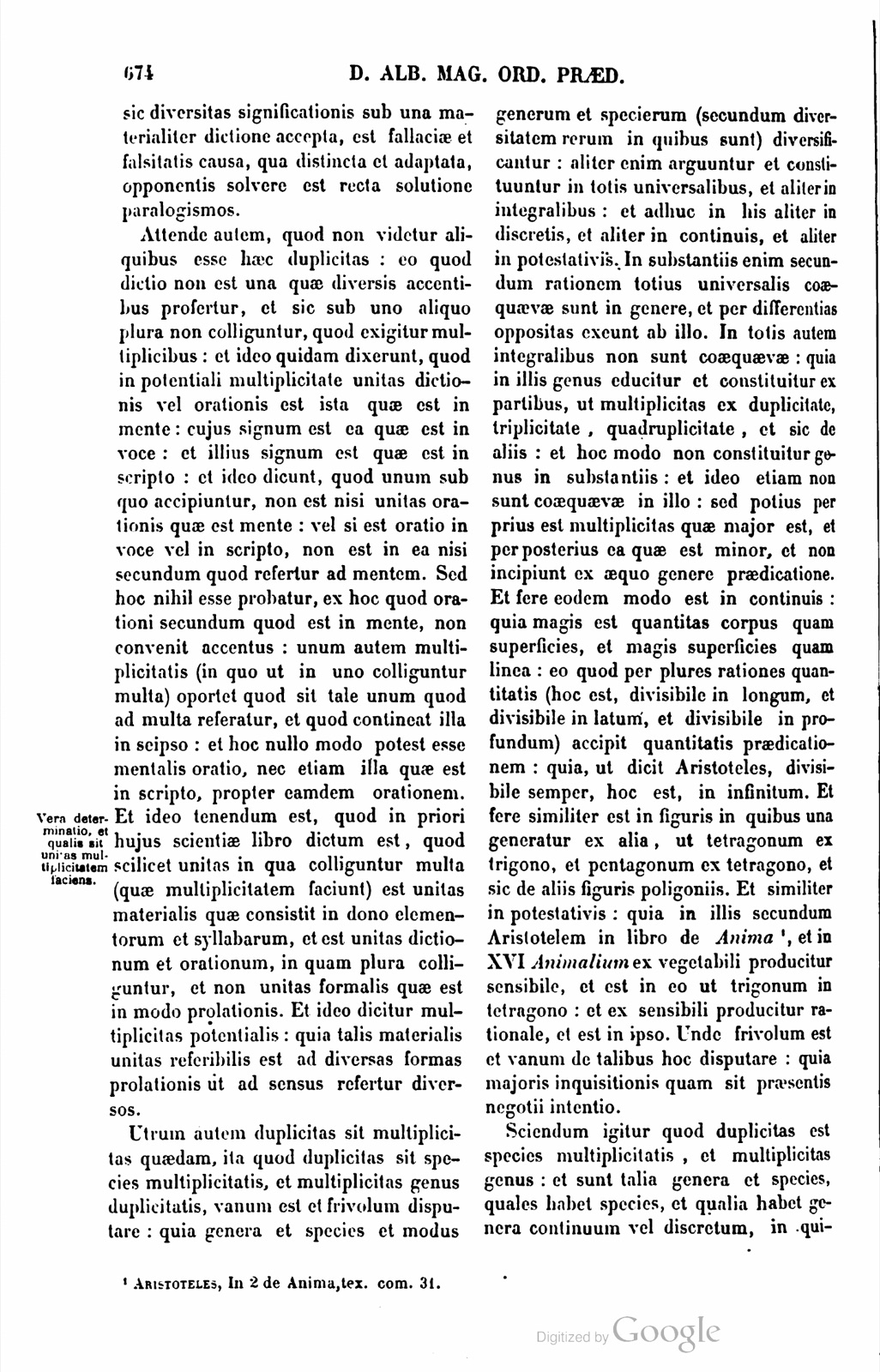
Utrum autem duplicitas sit multiplicitas quaedam, ita quod duplicitas sit species multiplicitatis, et multiplicitas genus duplicitatis, vanum est et frivolum disputare: quia genera et species et modus generum et specierum (secundum diversitatem rerum in quibus sunt) diversificantur: aliter enim arguuntur et constituuntur in totis universalibus, et aliter in integralibus: et adhuc in his aliter in discretis, et aliter in continuis, et aliter in potestativis. In substantiis enim secundum rationem totius universalis coaequaevae sunt in genere, et per differentias oppositas exeunt ab illo. In totis autem integralibus non sunt coaequaevae: quia in illis genus educitur et constituitur ex partibus, ut multiplicitas ex duplicitate, triplicitate, quadruplicitate, et sic de aliis: et hoc modo non constituitur genus in substantiis: et ideo etiam non sunt coaequaevae in illo: sed potius per prius est multiplicitas quae major est, et per posterius ea quae est minor, et non incipiunt ex aequo genere praedicatione. Et fere eodem modo est in continuis: quia magis est quantitas corpus quam superficies, et magis superficies quam linea: eo quod per plures rationes quantitatis (hoc est, divisibile in longum, et divisibile in latum, et divisibile in profundum) accipit quantitatis praedicationem: quia, ut dicit Aristoteles, divisibile semper, hoc est, in infinitum. Et fere similiter est in figuris in quibus una generatur ex alia, ut tetragonum ex trigono, et pentagonum ex tetragono, et sic de aliis figuris poligoniis. Et similiter in potestativis: quia in illis secundum Aristotelem in libro de Anima1, et in XVI Animalium ex vegetabili producitur sensibile, et est in eo ut trigonum in tetragono: et ex sensibili producitur rationale, et est in ipso. Unde frivolum est et vanum de talibus hoc disputare: quia majoris inquisitionis quam sit praesentis negotii intentio.
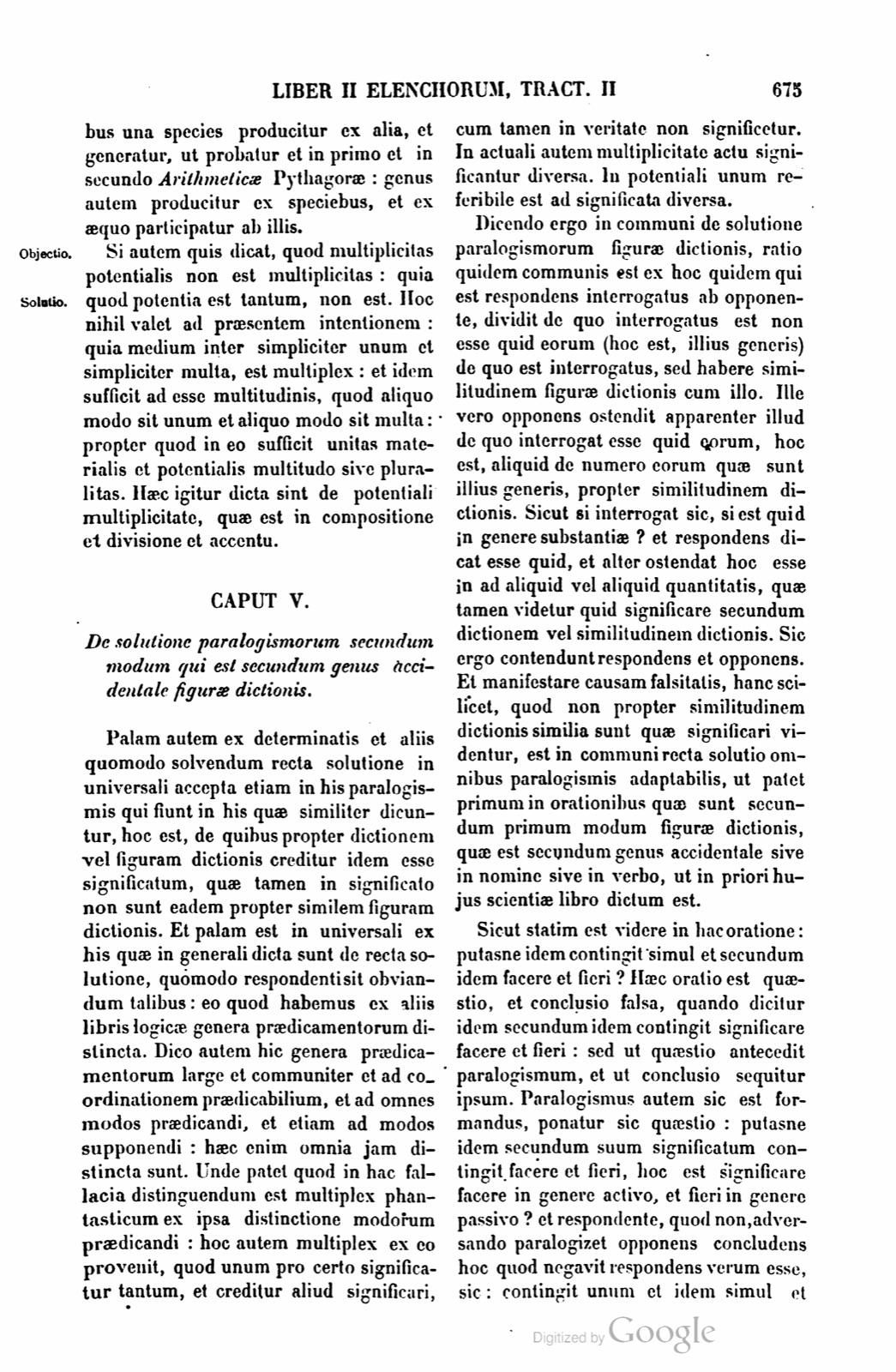
Sciendum igitur quod duplicitas est species multiplicitatis, et multiplicitas genus: et sunt talia genera et species, quales habet species, et qualia habet genera continuum vel discretum, in quibus una species producitur ex alia, et generatur, ut probatur et in primo et in secundo Arithmeticae Pythagorae: genus autem producitur ex speciebus, et ex aequo participatur ab illis.
Si autem quis dicat, quod multiplicitas potentialis non est multiplicitas: quia quod potentia est tantum, non est. Hoc nihil valet ad praesentem intentionem: quia medium inter simpliciter unum et simpliciter multa, est multiplex: et idem sufficit ad esse multitudinis, quod aliquo modo sit unum et aliquo modo sit multa: propter quod in eo sufficit unitas materialis et potentialis multitudo sive pluralitas. Haec igitur dicta sint de potentiali multiplicitate, quae est in compositione et divisione et accentu.
But whether doubleness is a certain multiplicity, so that doubleness is a species of multiplicity and multiplicity is the genus of doubleness, is vain and frivolous to dispute, because genera and species and the mode of genera and species are diversified according to the diversity of the things in which they are. For they are argued and constituted in one way in universal wholes, and in another way in integral wholes, and further in those things in one way in discrete things, another in continuous things, and another in powers. For in substances, according to the account of the universal whole, they are coeval in the genus and go out from it through opposed differences. But in integral wholes they are not coeval, because in them the genus is led out and constituted from parts, as multiplicity from doubleness, tripleness, fourfoldness, and so with the others; and in this way a genus is not constituted in substances, and therefore they are not coeval in that either. Rather, the multiplicity which is greater is prior, and that which is lesser is posterior, and they do not begin equally from the genus in predication. And in almost the same way it is in continuous things, because body is quantity more than surface is, and surface more than line, because it receives the predication of quantity through more accounts of quantity, that is, divisible in length, divisible in breadth, and divisible in depth, because, as Aristotle says, it is always divisible, that is, to infinity. And it is almost similar in figures in which one is generated from another, as the quadrangle from the triangle, and the pentagon from the quadrangle, and so with other polygonal figures. And similarly in powers, because in those, according to Aristotle in the book On the Soul1, and in book XVI On Animals, the sensitive is produced from the vegetative, and is in it as a triangle in a quadrangle; and from the sensitive the rational is produced, and is in it. Hence it is frivolous and vain to dispute about such things, because this belongs to a greater inquiry than the intention of the present business.
Therefore it must be known that doubleness is a species of multiplicity, and multiplicity is the genus; and they are such genera and species as the continuous or discrete has species and genera, in which one species is produced and generated from another, as is proved both in the first and in the second book of the Arithmetic of Pythagoras; but the genus is produced from the species and is participated equally by them.
But if someone says that potential multiplicity is not multiplicity, because what is only in potency is not, this has no force for the present intention, because the middle between the simply one and the simply many is multiple; and for the being of multitude it is sufficient that it be one in some way and many in some way. For this reason material unity and potential multitude or plurality are sufficient in it. Therefore let these things have been said concerning potential multiplicity, which is in composition and division and accent.
Notes
- Aristotle, On the Soul, book 2, text/commentary 31. (Aristoteles, In 2 de Anima, tex. com. 31.) ↩
If a page does not appear, its photograph has not been uploaded yet.