Works › Sophistical Refutations, Books I–II
Volume 2 · p. 669
Tractate II. Chapter II
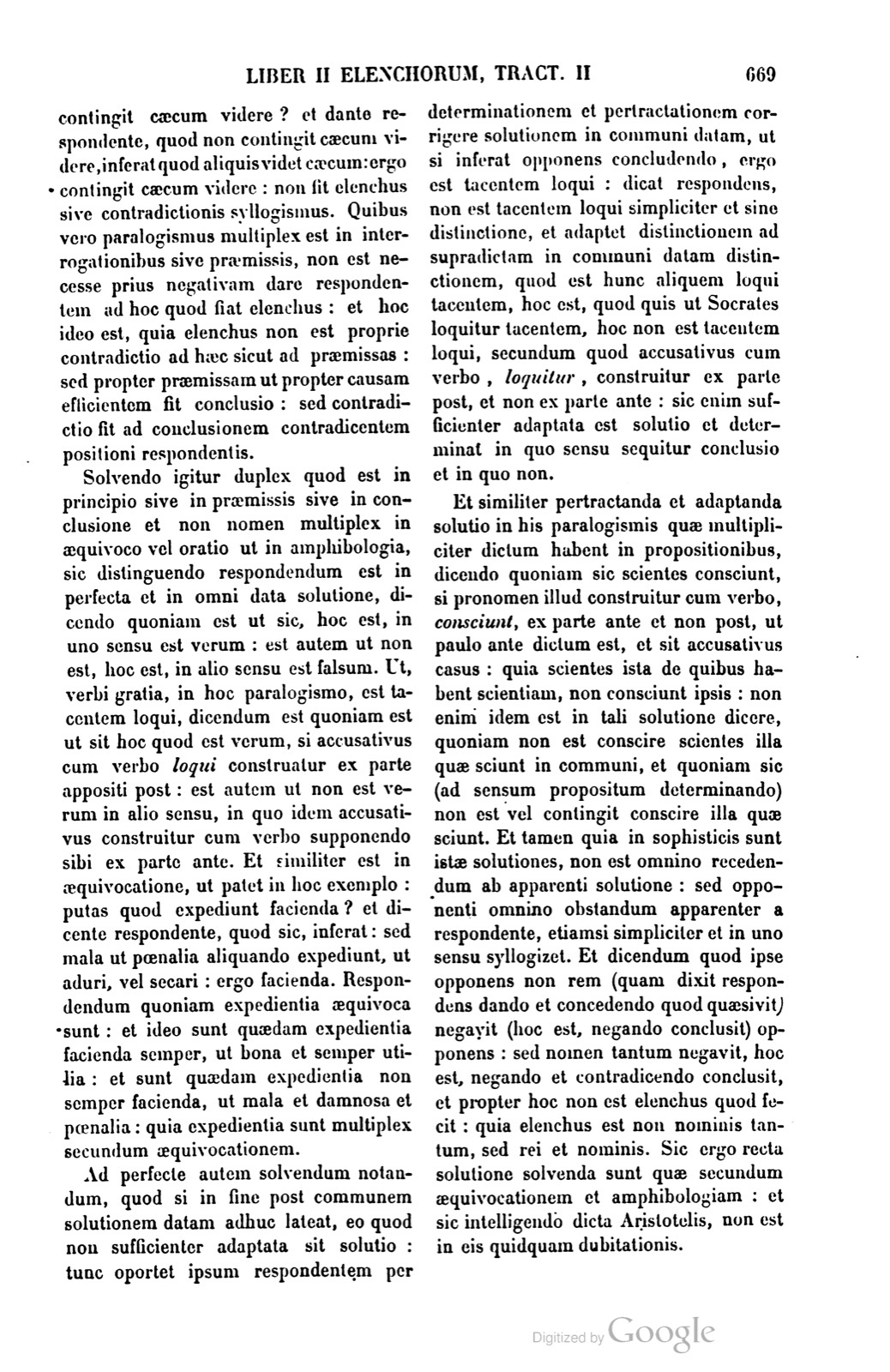
contingit caecum videre? et dante respondente, quod non contingit caecum videre, inferat quod aliquis videt caecum: ergo contingit caecum videre: non fit elenchus sive contradictionis syllogismus. Quibus vero paralogismus multiplex est in interrogationibus sive praemissis, non est necesse prius negativam dare respondentem ad hoc quod fiat elenchus: et hoc ideo est, quia elenchus non est proprie contradictio ad haec sicut ad praemissas: sed propter praemissam ut propter causam efficientem fit conclusio: sed contradictio fit ad conclusionem contradicentem positioni respondentis.
Solvendo igitur duplex quod est in principio sive in praemissis sive in conclusione et non nomen multiplex in aequivoco vel oratio ut in amphibologia, sic distinguendo respondendum est in perfecta et in omni data solutione, dicendo quoniam est ut sic, hoc est, in uno sensu est verum: est autem ut non est, hoc est, in alio sensu est falsum. Ut, verbi gratia, in hoc paralogismo, est tacentem loqui, dicendum est quoniam est ut sit hoc quod est verum, si accusativus cum verbo loqui construatur ex parte appositi post: est autem ut non est verum in alio sensu, in quo idem accusativus construitur cum verbo supponendo sibi ex parte ante. Et similiter est in aequivocatione, ut patet in hoc exemplo: putas quod expediunt facienda? et dicente respondente, quod sic, inferat: sed mala ut poenalia aliquando expediunt, ut aduri, vel secari: ergo facienda. Respondendum quoniam expedientia aequivoca sunt: et ideo sunt quaedam expedientia facienda semper, ut bona et semper utilia: et sunt quaedam expedientia non semper facienda, ut mala et damnosa et poenalia: quia expedientia sunt multiplex secundum aequivocationem.
Ad perfecte autem solvendum notandum, quod si in fine post communem solutionem datam adhuc lateat, eo quod non sufficienter adaptata sit solutio: tunc oportet ipsum respondentem per determinationem et pertractationem corrigere solutionem in communi datam, ut si inferat opponens concludendo, ergo est tacentem loqui: dicat respondens, non est tacentem loqui simpliciter et sine distinctione, et adaptet distinctionem ad supradictam in communi datam distinctionem, quod est hunc aliquem loqui tacentem, hoc est, quod quis ut Socrates loquitur tacentem, hoc non est tacentem loqui, secundum quod accusativus cum verbo, loquitur, construitur ex parte post, et non ex parte ante: sic enim sufficienter adaptata est solutio et determinat in quo sensu sequitur conclusio et in quo non.
Et similiter pertractanda et adaptanda solutio in his paralogismis quae multipliciter dictum habent in propositionibus, dicendo quoniam sic scientes consciunt, si pronomen illud construitur cum verbo, consciunt, ex parte ante et non post, ut paulo ante dictum est, et sit accusativus casus: quia scientes ista de quibus habent scientiam, non consciunt ipsis: non enim idem est in tali solutione dicere, quoniam non est conscire scientes illa quae sciunt in communi, et quoniam sic (ad sensum propositum determinando) non est vel contingit conscire illa quae sciunt. Et tamen quia in sophisticis sunt istae solutiones, non est omnino recedendum ab apparenti solutione: sed opponenti omnino obstandum apparenter a respondente, etiamsi simpliciter et in uno sensu syllogizet. Et dicendum quod ipse opponens non rem (quam dixit respondens dando et concedendo quod quaesivit) negavit (hoc est, negando conclusit) opponens: sed nomen tantum negavit, hoc est, negando et contradicendo conclusit, et propter hoc non est elenchus quod fecit: quia elenchus est non nominis tantum, sed rei et nominis. Sic ergo recta solutione solvenda sunt quae secundum aequivocationem et amphibologiam: et sic intelligendo dicta Aristotelis, non est in eis quidquam dubitationis.
does it happen that a blind man sees? And with the respondent granting that it does not happen that a blind man sees, let him infer that someone sees a blind man; therefore it happens that a blind man sees: no refutation or syllogism of contradiction is made. But in those cases in which the paralogism is multiple in the questions or premises, it is not necessary for the respondent first to give a negative in order that a refutation may be made; and this is because a refutation is not properly a contradiction to these things as to premises, but because of the premise as because of an efficient cause the conclusion is made; but contradiction is made to the conclusion contradicting the respondent's position.
Therefore in solving the double which is in the beginning or in the premises or in the conclusion, and not the multiple name in the equivocal term or the speech as in amphibology, one must respond thus by distinguishing in a perfect and in every given solution, saying that it is as thus, that is, in one sense it is true, but it is as it is not, that is, in another sense it is false. As, for example, in this paralogism, there is a silent thing speaking, one must say that it is so that this which is true may be, if the accusative is constructed with the verb to speak from the part of the object after it; but it is not true in the other sense, in which the same accusative is constructed with the verb by being subject to it from the part before. And similarly it is in equivocation, as is clear in this example: do you think that advantageous things are to be done? And when the respondent says yes, let him infer: but bad things, as penal things, are sometimes advantageous, such as to be burned or cut; therefore they are to be done. One must answer that advantageous things are equivocal; and therefore some advantageous things are always to be done, as good and always useful things, and some advantageous things are not always to be done, as evil and harmful and penal things, because advantageous things are multiple according to equivocation.
But for solving perfectly it must be noted that if at the end, after the common solution has been given, it still lies hidden, because the solution has not been sufficiently adapted, then the respondent himself must correct the solution given in common through determination and treatment. For example, if the opponent infers by concluding, therefore there is a silent thing speaking, let the respondent say: there is not simply and without distinction a silent thing speaking; and let him adapt the distinction to the aforesaid distinction given in common, namely that this is some man speaking a silent thing, that is, that someone, as Socrates, speaks a silent thing. This is not a silent thing speaking, insofar as the accusative is constructed with the verb speaks from the part after and not from the part before. For thus the solution has been sufficiently adapted and determines in what sense the conclusion follows and in what sense not.
And similarly the solution must be treated and adapted in those paralogisms which have something said multiply in the propositions, by saying that in this way knowers know together, if that pronoun is constructed with the verb know together from the part before and not after, as was said a little before, and is of the accusative case; because the knowers do not know together with those things about which they have knowledge. For in such a solution it is not the same to say that it is not knowing together for knowers those things which they know in common, and that thus, by determining to the proposed sense, it is not or it does not happen that they know together those things which they know. And nevertheless, because in sophistical matters these are solutions, one must not wholly depart from apparent solution; rather the opponent must altogether be resisted apparently by the respondent, even if he syllogizes simply and in one sense. And one must say that the opponent himself did not deny the reality which the respondent stated by giving and granting what he asked, that is, did not conclude by denying it, but denied only the name, that is, concluded by denying and contradicting; and because of this what he did is not a refutation, because a refutation is not only of the name but of the reality and the name. Thus therefore those things which are according to equivocation and amphibology must be solved by right solution; and by understanding Aristotle's words thus, there is not anything of doubt in them.
If a page does not appear, its photograph has not been uploaded yet.