Works › Sophistical Refutations, Books I–II
Volume 2 · pp. 666–668
Tractate II. Chapters I-II
A marker with ≈ is an approximate page boundary, placed by measure of the text; the page photographs remain the authority. In the paired views, clicking a page marker brings that page into view.
TRACTATUS II. DE RECTA SOLUTIONE FALSARUM ORATIONUM.
CAPUT I. Quae in communi et qualis sit falsae orationis recta solutio.
Jam habitis sufficienter his quae ad apparentem solutionem videntur pertinere, de recta solutione determinandum est, quae ideo recta solutio vocatur, quia cum solutio communiter secundum analogiam de apparenti et recta solutione dicatur, recta solutio est, quae per prius est vera et habet ea quae habere debet omnia quae de natura sunt verae solutionis.
Dicamus igitur quoniam est recta solutio manifestatio falsi syllogismi, in communi accepta recta solutione. Dico autem manifestatio falsi syllogismi secundum quamlibet interrogationem, hoc est, secundum quemcumque modum interrogationis sive propositionis accidat falsum, sive in materia ut in propositionibus, sive in consequentia conclusionis ex indebito ordine propositionum ad conclusionem, vera et recta solutio semper est falsitatis et esse falsitatis manifestatio, cum sufficienti pertractatione et ostensione qua de causa et quomodo sit falsus syllogismus. Et haec solutio erit circa communia falsi syllogismi: quia sophista et dialecticus sunt circa communia: et ideo intenta in hac scientia recta solutio non curat de falsigrapho, qui est circa falsam orationem: eo quod accipit opposita propriis principiis in qualibet disciplina. Falsus autem syllogismus (cujus falsitatis manifestatio est vera in hac scientia manifestatio) fit dupliciter: aut enim fit uno modo si syllogizatum est falsum (hoc est, conclusio falsa) ex falsis propositionibus eorum, sicut per causam: non enim syllogizatur falsum nisi ex falso: quamvis apparenter quodcumque falsum sequatur vel sequi videatur ex veris, sicut accidit in figura dictionis, et secundum quid et simpliciter, et aliquando in fallacia accidentis, ut dictum est in libro priori hujus scientiae. Aut secundo modo cum in veritate secundum formam syllogismi dialectici non est syllogizatum: quia non est syllogismus qui non habet formam syllogismi: videtur tamen secundum aliquem locum sophisticum esse syllogismus ut qui peccat in forma, et sub illa parte duo comprehendit figurae orationis syllogismi, scilicet quae nihil syllogizat, cum tamen syllogizare videatur, et quae non syllogizat ad propositum quae est secundum non causam ut causam.
Et sequitur ex his quae dicta sunt, quod solutio recta est dupliciter. Est enim ut dictum est, recta solutio apparentis syllogismi correctio falsitatis, secundum quamcumque videtur interrogationum sive quemcumque modum falsitatis syllogismi et interrogationibus sive propositionibus. Propositiones enim hic vocamus interrogationes, sicut et in Topicis. Propter quod accidit sive sequitur ex dictis in diffinitione solutionis verae, quod orationes quae in materia peccant, eo quod sint ex falsis, sed syllogizatae sunt, quia formam habent syllogismi topici, interimentum aliquem sive interimendo falsum, et ostendendo et pertractando causam falsitatis solvere: apparentes autem orationes sive rationes syllogisticas quae in forma peccant et apparentes syllogismi sunt vel esse videntur, cum non sint in rei veritate, accidit solvere aliquem dividentem. Dividendo autem dupliciter scilicet dividendo multiplex si est in propositionibus vel in conclusione, vel dividendo a praemissis et ostendendo causam falsae consequentiae ex indebito ordine et forma praemissarum ad conclusionem, sicut accidit in fallaciis extra dictionem quae peccant contra consequentiam syllogismi.
TRACTATE II. CONCERNING THE RIGHT SOLUTION OF FALSE SPEECHES.
CHAPTER I. What, in common, and what sort, the right solution of false speech is.
Now, with those things sufficiently held which seem to pertain to apparent solution, one must determine concerning right solution. It is called right solution for this reason: because, although solution is said commonly according to analogy of apparent and right solution, right solution is that which is true in the prior way and has all those things which it ought to have and which belong to the nature of true solution.
Therefore let us say that right solution is the manifestation of a false syllogism, taking right solution in common. But I mean manifestation of a false syllogism according to any question whatever, that is, according to whatever mode of question or proposition falsity happens, whether in matter, as in the propositions, or in the consequence of the conclusion from the undue order of the propositions to the conclusion. True and right solution is always a manifestation of falsity and of the being of falsity, with sufficient treatment and showing for what cause and in what way the syllogism is false. And this solution will be concerned with the common things of the false syllogism, because the sophist and the dialectician are concerned with common things; and therefore the right solution intended in this science does not take care of the falsigraph, which is concerned with false speech, because it takes opposites to proper principles in any discipline. But a false syllogism, the manifestation of whose falsity is the true manifestation in this science, is made in two ways. For in one way it is made if a false thing has been syllogized, that is, a false conclusion, from false propositions of them, as through a cause; for a false thing is not syllogized except from a false thing, although apparently any false thing follows or seems to follow from true things, as happens in figure of diction, and in according to a qualification and simply, and sometimes in the fallacy of accident, as was said in the prior book of this science. Or, in the second way, when in truth it has not been syllogized according to the form of a dialectical syllogism, because that is not a syllogism which does not have the form of syllogism; nevertheless according to some sophistical place it seems to be a syllogism, as one which sins in form. And under that part he comprehends two things of the figure of syllogistic speech, namely that which syllogizes nothing, although nevertheless it seems to syllogize, and that which does not syllogize to the proposed thing, which is according to non-cause as cause.
And it follows from the things which have been said that right solution is twofold. For, as was said, right solution is the correction of the falsity of an apparent syllogism, according to whatever one of the questions or whatever mode of falsity of the syllogism it seems to be and in questions or propositions. For here we call propositions questions, as also in the Topics. For this reason it happens or follows from the things said in the definition of true solution that speeches which sin in matter, because they are from false things, but have been syllogized, because they have the form of a topical syllogism, are solved by someone's destroying, or by destroying the false thing, and by showing and treating the cause of falsity. But apparent speeches or syllogistic reasons which sin in form and are apparent syllogisms, or seem to be, although they are not in the truth of the matter, it happens that someone solves by dividing. But by dividing in two ways, namely by dividing the multiple if it is in the propositions or in the conclusion, or by dividing from the premises and showing the cause of the false consequence from the undue order and form of the premises to the conclusion, as happens in fallacies outside diction which sin against the consequence of syllogism.
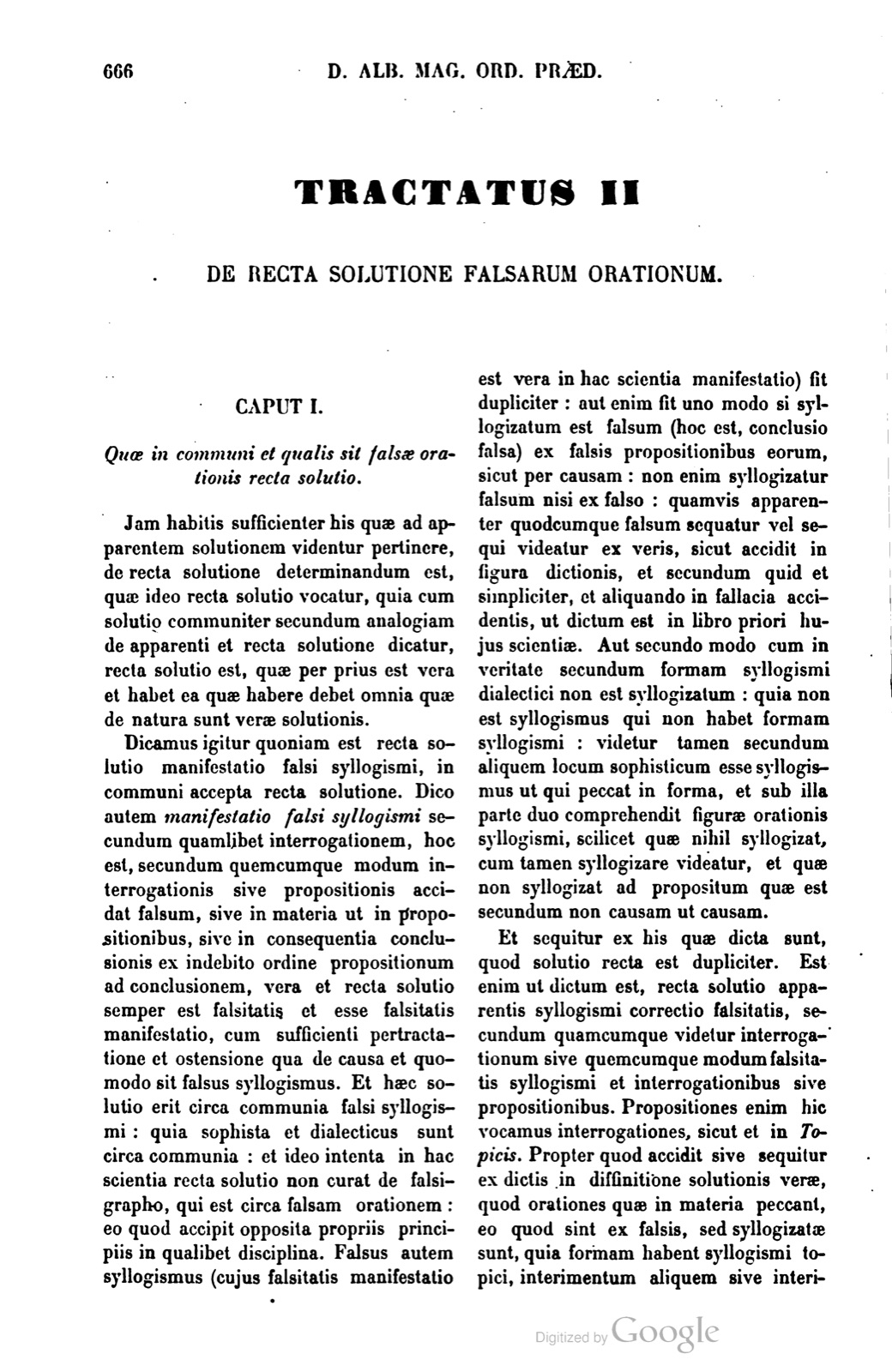
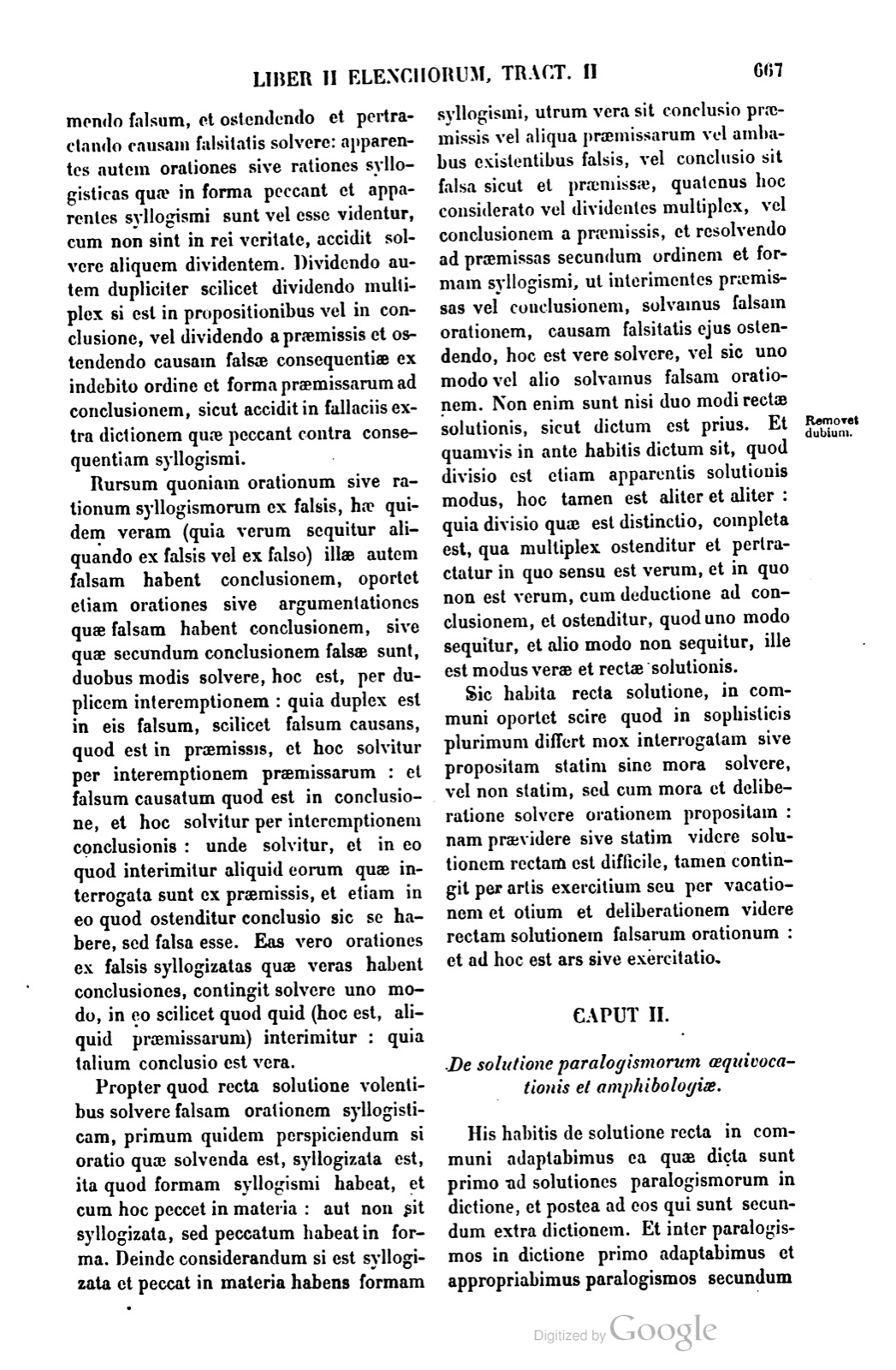
Rursum quoniam orationum sive rationum syllogismorum ex falsis, hae quidem veram (quia verum sequitur aliquando ex falsis vel ex falso) illae autem falsam habent conclusionem, oportet etiam orationes sive argumentationes quae falsam habent conclusionem, sive quae secundum conclusionem falsae sunt, duobus modis solvere, hoc est, per duplicem interemptionem: quia duplex est in eis falsum, scilicet falsum causans, quod est in praemissis, et hoc solvitur per interemptionem praemissarum: et falsum causatum quod est in conclusione, et hoc solvitur per interemptionem conclusionis: unde solvitur, et in eo quod interimitur aliquid eorum quae interrogata sunt ex praemissis, et etiam in eo quod ostenditur conclusio sic se habere, sed falsa esse. Eas vero orationes ex falsis syllogizatas quae veras habent conclusiones, contingit solvere uno modo, in eo scilicet quod quid (hoc est, aliquid praemissarum) interimitur: quia talium conclusio est vera.
Propter quod recta solutione volentibus solvere falsam orationem syllogisticam, primum quidem perspiciendum si oratio quae solvenda est, syllogizata est, ita quod formam syllogismi habeat, et cum hoc peccet in materia: aut non sit syllogizata, sed peccatum habeat in forma. Deinde considerandum si est syllogizata et peccat in materia habens formam syllogismi, utrum vera sit conclusio praemissis vel aliqua praemissarum vel ambabus existentibus falsis, vel conclusio sit falsa sicut et praemissae, quatenus hoc considerato vel dividentes multiplex, vel conclusionem a praemissis, et resolvendo ad praemissas secundum ordinem et formam syllogismi, ut interimentes praemissas vel conclusionem, solvamus falsam orationem, causam falsitatis ejus ostendo, hoc est vere solvere, vel sic uno modo vel alio solvamus falsam orationem. Non enim sunt nisi duo modi rectae solutionis, sicut dictum est prius. Et quamvis in ante habitis dictum sit, quod divisio est etiam apparentis solutionis modus, hoc tamen est aliter et aliter: quia divisio quae est distinctio, completa est, qua multiplex ostenditur et pertractatur in quo sensu est verum, et in quo non est verum, cum deductione ad conclusionem, et ostenditur, quod uno modo sequitur, et alio modo non sequitur, ille est modus verae et rectae solutionis.
Sic habita recta solutione, in communi oportet scire quod in sophisticis plurimum differt mox interrogatam sive propositam statim sine mora solvere, vel non statim, sed cum mora et deliberatione solvere orationem propositam: nam praevidere sive statim videre solutionem rectam est difficile, tamen contingit per artis exercitium seu per vacationem et otium et deliberationem videre rectam solutionem falsarum orationum: et ad hoc est ars sive exercitatio.
CAPUT II. De solutione paralogismorum aequivocationis et amphibologiae.
His habitis de solutione recta in communi adaptabimus ea quae dicta sunt primo ad solutiones paralogismorum in dictione, et postea ad eos qui sunt secundum extra dictionem. Et inter paralogismos in dictione primo adaptabimus et appropriabimus paralogismos secundum aequivocationem et amphibologiam: quia istae duae fallaciae sunt secundum multiplex actuale, et non differunt in causa apparentiae et causa non existentiae. Nec obstat, quod una sit in dictione et altera in oratione: quia unum modum habent in manifestatione falsitatis falsi syllogismi.
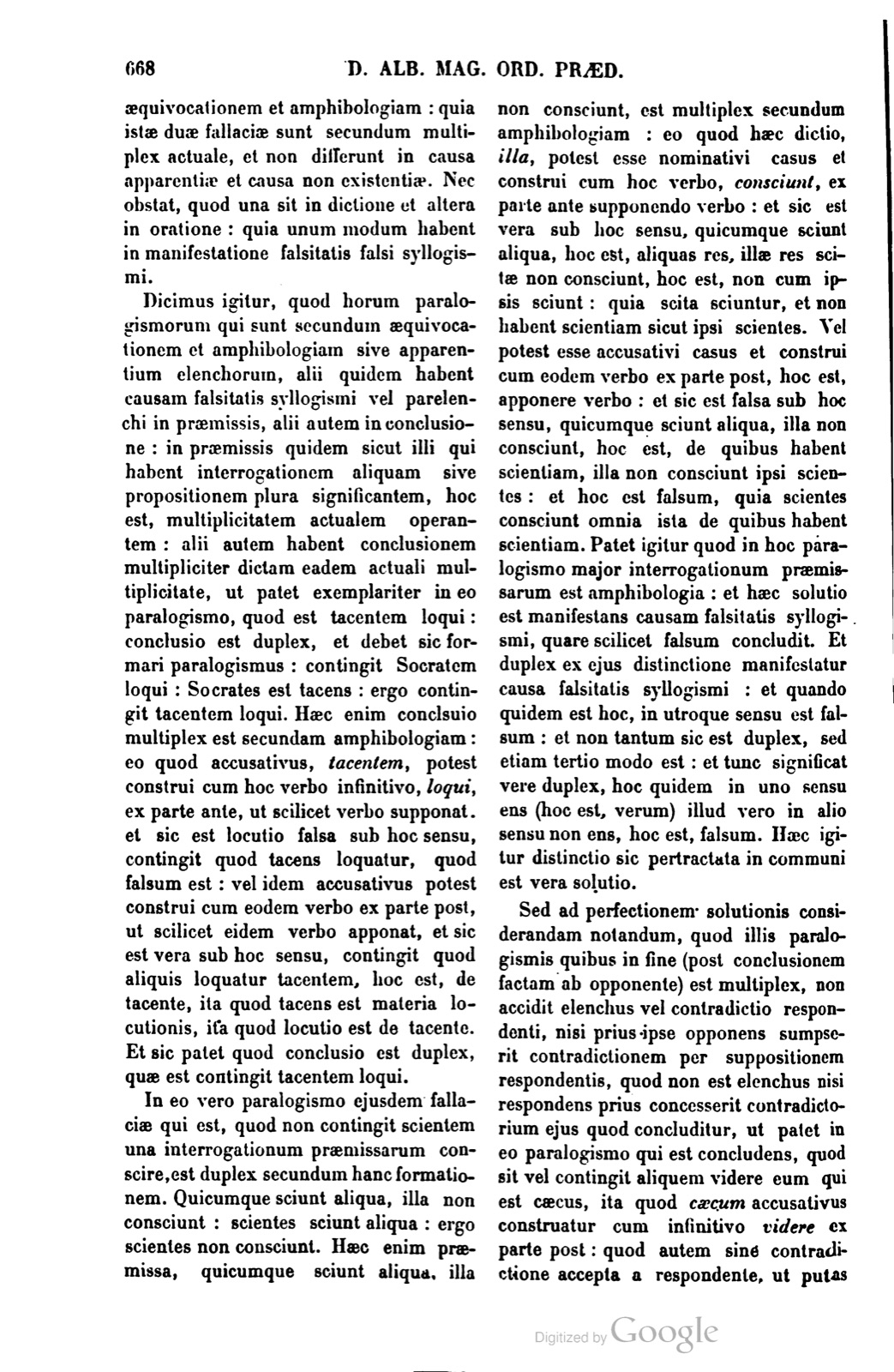
Dicimus igitur, quod horum paralogismorum qui sunt secundum aequivocationem et amphibologiam sive apparentium elenchorum, alii quidem habent causam falsitatis syllogismi vel parelenchi in praemissis, alii autem in conclusione: in praemissis quidem sicut illi qui habent interrogationem aliquam sive propositionem plura significantem, hoc est, multiplicitatem actualem operantem: alii autem habent conclusionem multipliciter dictam eadem actuali multiplicitate, ut patet exemplariter in eo paralogismo, quod est tacentem loqui: conclusio est duplex, et debet sic formari paralogismus: contingit Socratem loqui: Socrates est tacens: ergo contingit tacentem loqui. Haec enim conclusio multiplex est secundum amphibologiam: eo quod accusativus, tacentem, potest construi cum hoc verbo infinitivo, loqui, ex parte ante, ut scilicet verbo supponat: et sic est locutio falsa sub hoc sensu, contingit quod tacens loquatur, quod falsum est: vel idem accusativus potest construi cum eodem verbo ex parte post, ut scilicet eidem verbo apponat, et sic est vera sub hoc sensu, contingit quod aliquis loquatur tacentem, hoc est, de tacente, ita quod tacens est materia locutionis, ita quod locutio est de tacente. Et sic patet quod conclusio est duplex, quae est contingit tacentem loqui.
Again, since among speeches or reasons of syllogisms from false things, some have a true conclusion, because the true sometimes follows from false things or from a false thing, but others have a false conclusion, it is also necessary to solve the speeches or argumentations which have a false conclusion, or which are false according to the conclusion, in two ways, that is, through a double destruction. For there is a double false in them: namely the causing false, which is in the premises, and this is solved through the destruction of the premises; and the caused false, which is in the conclusion, and this is solved through the destruction of the conclusion. Hence it is solved both in that something of those things which were asked from the premises is destroyed, and also in that the conclusion is shown to have itself thus, but to be false. But those speeches syllogized from false things which have true conclusions can be solved in one way, namely in that something, that is, something of the premises, is destroyed, because the conclusion of such speeches is true.
For this reason, for those wishing to solve a false syllogistic speech by right solution, one must first indeed look carefully whether the speech which must be solved has been syllogized, so that it has the form of syllogism and with this sins in matter, or whether it has not been syllogized but has sin in form. Then one must consider, if it has been syllogized and sins in matter while having the form of syllogism, whether the conclusion is true when the premises, or one of the premises, or both are false, or whether the conclusion is false just as the premises are false, so that, when this has been considered, either by dividing the multiple, or by dividing the conclusion from the premises, and by resolving to the premises according to the order and form of syllogism, as destroying the premises or the conclusion, we may solve the false speech, by showing the cause of its falsity, that is, to solve truly; or thus in one way or the other way we may solve the false speech. For there are only two modes of right solution, as was said earlier. And although in the preceding things it has been said that division is also a mode of apparent solution, this nevertheless is in different ways, because the division which is distinction is complete, by which the multiple is shown and it is treated in what sense it is true and in what sense it is not true, with deduction to the conclusion, and it is shown that in one way it follows and in another way it does not follow; that is the mode of true and right solution.
Thus, with right solution held in common, one must know that in sophistical matters it makes the greatest difference whether one solves a speech immediately after it has been asked or proposed, at once without delay, or solves the proposed speech not at once but with delay and deliberation. For to foresee or to see at once the right solution is difficult; nevertheless through the exercise of art, or through leisure and quiet and deliberation, it happens that one sees the right solution of false speeches; and art or exercise is for this.
CHAPTER II. Concerning the solution of paralogisms of equivocation and amphibology.
With these things held concerning right solution in common, we shall adapt those things which have been said first to the solutions of paralogisms in diction, and afterward to those which are according to things outside diction. And among paralogisms in diction we shall first adapt and appropriate the paralogisms according to equivocation and amphibology, because these two fallacies are according to actual multiplicity, and they do not differ in the cause of appearance and the cause of non-existence. Nor is it an obstacle that one is in diction and the other in speech, because they have one mode in the manifestation of the falsity of a false syllogism.
Therefore we say that of these paralogisms which are according to equivocation and amphibology or of apparent refutations, some indeed have the cause of the falsity of the syllogism or para-refutation in the premises, but others in the conclusion: in the premises, indeed, as those which have some question or proposition signifying several things, that is, an actual multiplicity working; but others have a conclusion spoken multiply with the same actual multiplicity, as is clear by example in that paralogism which is about a silent thing speaking. The conclusion is double, and the paralogism must be formed thus: it happens that Socrates speaks; Socrates is silent; therefore it happens that a silent one speaks. For this conclusion is multiple according to amphibology, because the accusative, silent, can be constructed with this infinitive verb, to speak, from the part before, so that it is subject to the verb; and thus the utterance is false under this sense: it happens that the silent one speaks, which is false. Or the same accusative can be constructed with the same verb from the part after, so that it is object to the same verb; and thus it is true under this sense: it happens that someone speaks a silent thing, that is, about a silent thing, so that the silent thing is the matter of the speech, so that the speech is about the silent thing. And thus it is clear that the conclusion is double, namely: it happens that a silent thing speaks.
In eo vero paralogismo ejusdem fallaciae qui est, quod non contingit scientem una interrogationum praemissarum conscire, est duplex secundum hanc formationem. Quicumque sciunt aliqua, illa non consciunt: scientes sciunt aliqua: ergo scientes non consciunt. Haec enim praemissa, quicumque sciunt aliqua, illa non consciunt, est multiplex secundum amphibologiam: eo quod haec dictio, illa, potest esse nominativi casus et construi cum hoc verbo, consciunt, ex parte ante supponendo verbo: et sic est vera sub hoc sensu, quicumque sciunt aliqua, hoc est, aliquas res, illae res scitae non consciunt, hoc est, non cum ipsis sciunt: quia scita sciuntur, et non habent scientiam sicut ipsi scientes. Vel potest esse accusativi casus et construi cum eodem verbo ex parte post, hoc est, apponere verbo: et sic est falsa sub hoc sensu, quicumque sciunt aliqua, illa non consciunt, hoc est, de quibus habent scientiam, illa non consciunt ipsi scientes: et hoc est falsum, quia scientes consciunt omnia ista de quibus habent scientiam. Patet igitur quod in hoc paralogismo major interrogationum praemissarum est amphibologia: et haec solutio est manifestans causam falsitatis syllogismi, quare scilicet falsum concludit. Et duplex ex ejus distinctione manifestatur causa falsitatis syllogismi: et quando quidem est hoc, in utroque sensu est falsum: et non tantum sic est duplex, sed etiam tertio modo est: et tunc significat vere duplex, hoc quidem in uno sensu ens (hoc est, verum) illud vero in alio sensu non ens, hoc est, falsum. Haec igitur distinctio sic pertractata in communi est vera solutio.
Sed ad perfectionem solutionis considerandam notandum, quod illis paralogismis quibus in fine (post conclusionem factam ab opponente) est multiplex, non accidit elenchus vel contradictio respondenti, nisi prius ipse opponens sumpserit contradictionem per suppositionem respondentis, quod non est elenchus nisi respondens prius concesserit contradictorium ejus quod concluditur, ut patet in eo paralogismo qui est concludens, quod sit vel contingit aliquem videre eum qui est caecus, ita quod caecum accusativus construatur cum infinitivo videre ex parte post: quod autem sine contradictione accepta a respondente, ut putas
But in the paralogism of the same fallacy which is this, that it does not happen for one knowing to know together with one of the questions of the premises, it is double according to this formation: whoever know some things do not know together with those; those knowing know some things; therefore those knowing do not know together with them. For this premise, whoever know some things do not know together with those, is multiple according to amphibology, because this word, those, can be of the nominative case and be constructed with this verb, know together, from the part before by being subject to the verb; and thus it is true under this sense: whoever know some things, that is, some realities, those known realities do not know together, that is, do not know with them, because known things are known and do not have knowledge as the knowers themselves do. Or it can be of the accusative case and be constructed with the same verb from the part after, that is, be object to the verb; and thus it is false under this sense: whoever know some things do not know together with those, that is, those things of which they have knowledge, the knowers themselves do not know together with those; and this is false, because knowers know together all those things of which they have knowledge. Therefore it is clear that in this paralogism the major of the questions of the premises is an amphibology; and this solution manifests the cause of the falsity of the syllogism, namely why it concludes what is false. And from its distinction the double cause of the falsity of the syllogism is manifested. And when indeed this is the case, in each sense it is false; and it is not only double thus, but it is also in a third way, and then it signifies truly double, this indeed in one sense being, that is, true, but that in another sense non-being, that is, false. Therefore this distinction, thus treated in common, is true solution.
But for considering the perfection of solution it must be noted that in those paralogisms in which the multiple is in the end, after the conclusion has been made by the opponent, refutation or contradiction does not happen to the respondent unless the opponent himself has first taken a contradiction through the respondent's supposition, because there is no refutation unless the respondent has first granted the contradictory of that which is concluded, as is clear in the paralogism which concludes that someone who is blind is or happens to be seen, so that the accusative blind is constructed with the infinitive to see from the part after; but without a contradiction accepted from the respondent, as you think
If a page does not appear, its photograph has not been uploaded yet.