Works › Sophistical Refutations, Books I–II
Volume 2 · pp. 661–665
Book II. Tractate I. Chapters III-IV
A marker with ≈ is an approximate page boundary, placed by measure of the text; the page photographs remain the authority. In the paired views, clicking a page marker brings that page into view.
CAPUT III. Et est probatio, quod in apparenti solutione multiplex est ostendendum.
Quod autem in apparenti solutione in responsione ad hominem est multiplex sic assignandum et ostendendum, ad impediendum apparentem redargutionem, sic probatur. Si enim quis opponendo interrogantium duas interrogationes ut unam faceret, et una concessa aliam redarguendo concluderet: tunc manifestum est quod non propter multiplex aequivocationis vel amphibologiae fieret paralogismus, sed potius propter plura ut unum interrogata: sed tunc fieret vel elenchus verus, vel non, sed parelenchus: et ideo ad cavendum elenchum vel parelenchum oportet dividere plura interrogata ut unum. Similiter ergo in multiplici aequivoco in quo sunt actu plura vel in quo multiplici multiplex est ostendendum, ut videatur fieri elenchus vel parelenchus: quid enim differt interrogare propositionem quae plures est, scilicet si Callias et Themistocles musici sunt? in qua unum de pluribus interrogatur, quam si ambobus dictis existentibus diversis in re, nomen aequivocum datum esset, et sub illo nomine unum de pluribus interrogaretur. Constat, quod quantum ad apparentem elenchum nihil differret: cujus ratio est, quia si haec plura significet uno aequivoco nomine, constat quod plura (hoc est, propositionem quae plures est vel unum de pluribus) interrogavit.
Si ergo non rectum est probare sive approbare sumi a respondente unam responsionem ad duas interrogationes propter pluralitatem interrogatorum: tunc manifestum est quoniam etiam nulli eorum quae aequivoca vel universaliter multiplicia sunt, convenit simpliciter respondere, hoc est, unam non distinctam responsionem dare simpliciter sine distinctione: nec etiam hoc convenit etiamsi de omnibus quae in aequivoco continentur, in omni sensu verum sit quod videlicet quaeritur, ut volunt quidam errantes, quod quando in omni sensu verum est, una debeat dari responsio: cujus ratio est, quia nihil differt hoc quod sub uno nomine aequivoco aliquid quaeratur de pluribus, vel si de pluribus quaeratur sub diversis nominibus. Verbi gratia, ut si quaeratur Callias et Coriscus, utrum domi sint? sive ambo simul sunt domi praesentes, et de utroque verum est, quod domi est: sive non ambo simul sunt domi praesentes, sed de uno verum est, quod domi est, et de altero non est verum. Nihil autem differre dico quoad interrogationem quae est plures: utrinque enim haec sive in utroque sensu vera sit sive in altero, semper est plures propositio, et propositiones quae sunt plures: non enim propterea efficitur propositio vel interrogatio una quae plures est, quod de pluribus idem verum est dicere. Et hoc probatur deducendo ad inconveniens: quoniam possibile de mille aliis interrogatis, utrum verum sit dicere vel non sit verum dicere de eis idem, attamen de nullo eorum (quamvis uniformiter convenit eis aliquid vel non convenit) respondendum est una responsione: si enim una datur responsio, tunc interimitur disputare: quia quaesito de omnibus dicitur, sic est vel non est: et sic finis est disputationis: et hoc est inconveniens: ergo de multiplici una non est danda responsio. Hoc autem quod de pluribus una datur responsio, simile est ei tanquam si pluribus unum nomen sit positum, quo quodlibet significatur in illo. Per distinctionem ergo manifestandum multiplex (quod ut simpliciter est interrogatum) ad apparentis redargutionis impedimentum.
CHAPTER III. And there is proof that in apparent solution the multiple must be shown.
But that in apparent solution, in a response to the man, the multiple must thus be assigned and shown, in order to impede apparent refutation, is proved thus. For if someone, by opposing, made two questions of those asking into one, and, once one had been granted, concluded the other by refuting, then it is manifest that the paralogism would not come about because of the multiple of equivocation or amphibology, but rather because several things were asked as one. But then either a true refutation would be made, or not, but a para-refutation; and therefore, in order to beware of refutation or para-refutation, one must divide the several things asked as one. Similarly therefore, in an equivocal multiple in which there are several things in act, or in which multiple, the multiple must be shown, so that there may seem to be a refutation or para-refutation. For what difference is there between asking a proposition which is several, namely whether Callias and Themistocles are musicians, in which one thing is asked of several, and, if both the said things existed as diverse in reality, an equivocal name had been given, and under that name one thing of several were asked? It is established that as to apparent refutation there would be no difference. The reason for this is that, if it signifies these several things by one equivocal name, it is established that he asked several things, that is, a proposition which is several or one thing concerning several.
Therefore if it is not right to prove or approve that one response to two questions should be taken from the respondent on account of the plurality of the things asked, then it is manifest that also to none of those things which are equivocal or universally multiple does it belong to answer simply, that is, to give one undistinguished response simply and without distinction. Nor does this belong even if concerning all the things which are contained in the equivocal term, in every sense what is sought is true, as certain erring persons will, namely that when it is true in every sense one response ought to be given. The reason for this is that there is no difference between this, that under one equivocal name something is asked about several things, and if about several things it is asked under diverse names. For example, if it is asked of Callias and Coriscus whether they are at home: whether both are present at home together, and of each it is true that he is at home, or whether both are not present at home together, but of one it is true that he is at home and of the other it is not true. But I say that there is no difference as to the question which is several; for on both sides, whether this is true in both senses or in the other, it is always a several proposition, and propositions which are several. For a proposition or question which is several is not made one for this reason, that the same thing is true to say of several things. And this is proved by leading to an unfitting consequence: since it is possible concerning a thousand other things asked, whether it is true to say or not true to say the same thing of them, nevertheless about none of them, although something belongs or does not belong to them uniformly, must one respond with one response. For if one response is given, then disputing is destroyed, because once one has asked about all, it is said, it is thus or it is not; and thus there is an end of disputation. And this is unfitting; therefore one response must not be given about a multiple. But this, that one response is given concerning several things, is similar to it as if one name were posited for several things, by which each thing is signified in it. Therefore through distinction the multiple, which has been asked as if simply, must be manifested for the impediment of apparent refutation.
Si ergo non oportet ad duas interrogationes unam responsionem et simplicem dare: tunc a simili manifestum est, quoniam neque in aequivocis multiplicibus danda est una simplex responsio una, ut simplici responsione dicatur affirmative vel negative: eo quod sic unam dans responsionem, non respondit, sed dixit quaedam impertinentia ad multiplex: et sic unum voce dixit, sed quaerenti nec oratione respondit, sed quodammodo non solvendo nec respondendo sine distinctione ipsi respondentes concedunt multiplex: eo quod lateat eos inconveniens quod accidit.
Sicut ergo diximus paulo ante in ante habitis istius rationis, quoniam elenchi quidem apparentes videntur esse qui non sunt: eo quod in forma peccant eodem modo, et solutiones ad orationem, quas diximus quandoque magis oportere ferre contra opponentes in agonisticis disputationibus ad impedimentum gloriae opponentis, quam veras quae ad orationes sunt solutiones, et quae sunt in obviatione respondentis cum obviat opponenti ad duplex, distinguendo scilicet et ostendendo duplex, ut praediximus: quia ostenso multiplici obviatur opponenti, ne procedere possit. Quae autem sit propositio una vel plures, in Perihermenia est requirendum. In praehabitis autem superioris libri scitur, quis sit syllogismus probabilis sive apparens et non existens: non enim hic dicimus syllogismum probabilem eum qui est ex probabilibus ut est dialecticus, qui licet probabilis sit in materia, tamen in consequentia necessarius est, sicut cum dicitur, quod omnis mater diligit: Medea est mater: ergo Medea diligit. Quae consequentia necessaria est si prima universalis esse ponatur: quia dialectica propositio universalis esse conceditur, si probabilis sit, quamvis in aliquibus habeat instantiam. Sed probabilem hic dicimus syllogismum, qui videtur per locum sophisticum esse probabilis, quamvis per causam defectus non inferat ex necessitate.
CAPUT IV. De decem cautelis sive elenchis quibus utendum est in apparenti solutione.
His autem sic determinatis (per quae scitur quod solutio apparens aliquando utilis est, praecipue ad hominem et ad opponentem, ne gloriam consequi videatur), danda sunt elementa apparentiae responsionis, quae decem sunt.
Et primum quidem est, quod si respondenti interrogatio probabilis proponatur in his quae sibi probabilia videntur, conveniens est esse respondentem dicentem sic, hoc est, in quantum sic probabilis est, concedo eam: quia sic neque simpliciter concedit eam, nec simpliciter negat eam: et sic non fiet ad se (hoc est, contra se) elenchus sive videbitur fieri.
Secundum autem elementum est, quod si sit positio vel interrogatio et in hoc praevideat, quod si simpliciter concedat eam per opponentem cogatur dicere improbabilia: tunc non debet respondere per sic, sed hoc in tali casu addendo maxime sic videri, hoc est, sic videtur: quia hoc ipsum videri signum est falsitatis: quia timetur in positione si concedatur. Istae ergo duae cautelae sive elementa sumuntur per differentias positionis ad quam est respondendum, quae licet in Topicis per tres differentias dividatur, probabilem scilicet, improbabilem, et neutram, quia ibi per contrarietatem formarum et differentiarum positio dividitur: tamen hic non dividitur nisi per duo: quia non per contrarias formas, sed per privationis et habitus oppositionem hic dividi positio subintelligitur: et sic positio neutra sub positione improbabili continetur, et medium habet indifferens vel otiosum: considerata autem per se opponuntur ut privatio et habitus, et medium non habent, quia sit indifferens, eo quia quod non est bonum, est malum.
Therefore if one ought not to give one and simple response to two questions, then by similarity it is manifest that neither in equivocal multiples must one simple response be given, so that by a simple response it is said affirmatively or negatively, because one giving a response thus has not responded but has said certain things impertinent to the multiple; and thus he said one thing in word, but did not respond to the one asking, not even by speech, but in a certain way by not solving and not responding without distinction the respondents themselves grant the multiple, because the unfitting thing which happens escapes them.
Therefore, as we said a little before in the preceding parts of this reasoning, apparent refutations indeed seem to be which are not, because they sin in form in the same way; and solutions to the speech, which we said sometimes must be brought against opponents in agonistic disputations for impeding the opponent's glory more than true solutions which are to the speeches, and which are in the resistance of the respondent when he resists the opponent concerning the double, namely by distinguishing and showing the double, as we said before, because once the multiple has been shown the opponent is resisted, so that he cannot proceed. But what proposition is one or several is to be sought in the Perihermenias. In the preceding things of the prior book, however, it is known what a probable or apparent and non-existent syllogism is. For here we do not call that syllogism probable which is from probable things, as the dialectical syllogism is, which, although it is probable in matter, nevertheless is necessary in consequence, as when it is said that every mother loves; Medea is a mother; therefore Medea loves. This consequence is necessary if the first proposition is posited to be universal, because a dialectical proposition is granted to be universal if it is probable, although in some things it has an instance. But here we call a syllogism probable which seems through a sophistical place to be probable, although because of the cause of defect it does not infer from necessity.
CHAPTER IV. Concerning the ten precautions or refutations which must be used in apparent solution.
But with these things thus determined, through which it is known that apparent solution is sometimes useful, especially to the man and against the opponent, lest he seem to obtain glory, the elements of the appearance of response must be given; and these are ten.
And the first indeed is that if a probable question is proposed to the respondent in those things which seem probable to him, it is fitting for the respondent to say thus, that is, insofar as it is thus probable, I grant it; because in this way he neither grants it simply nor denies it simply, and thus a refutation will not be made against him, that is, against himself, or seem to be made.
But the second element is that if there is a position or question, and in this he foresees that, if he grants it simply, he will be compelled by the opponent to say improbable things, then he ought not to respond by "thus," but by adding this in such a case, that it especially seems thus, that is, it so seems; because this very seeming is a sign of falsity, because danger is feared in the position if it is granted. Therefore these two precautions or elements are taken through the differences of the position to which one must respond; and although in the Topics the position is divided through three differences, namely the probable, the improbable, and the neutral, because there the position is divided through contrariety of forms and differences, nevertheless here it is divided only through two, because here the position is understood to be divided not through contrary forms but through the opposition of privation and habit. And thus the neutral position is contained under the improbable position and has a mean that is indifferent or idle; but considered in themselves they are opposed as privation and habit, and have no mean, because it is indifferent, since what is not good is evil.
Tertia cautela sive elementum est per ea quae in Topicis determinata sunt, quomodo et quibus modis petitur id quod est in principio. Putant autem assistentes coram quibus opponens quaerit gloriam, quod quando aliquid positioni est propinquum, quod id interimendum sit tanquam non probans, eo quod idem sit cum proposito, vel idem esse videatur: tunc id si ad probandum propositum ab opponente assumatur, interimendum est, et non assumendum vel concedendum ut probans propositum: et dicendum de talibus, quod sunt quaedam de his similia velut sunt a petitione quod in principio est assumpta: hoc enim maxime fit per petitionem principii, quae cum syllogismo inferente maximam habet convenientiam: eo quod infert de necessitate sicut syllogismus: quamvis non probet, eo quod idem per idem non potest probari.
Quarta autem cautela sive elementum est, quod quando quis sive aliquis opponentium probaverit sive approbaverit ad assumendum aliquid per quod probetur propositum, quod sicut consequens ex posito necessarium est accidere, ex ipsa positione quam interrogat opponens: est autem falsum vel inopinabile; et hoc videt respondens: tunc idem dicendum est quod prius, scilicet quod petit id quod est in principio: quia quae ex necessitate accidunt et sequuntur ex posito, videbuntur assistentibus et audientibus ejusdem esse positionis cum proposito et petitioni in proposito.
Amplius quintum elementum est, quando ab opponente in interrogatione sua universale sumitur non ipso nomine, sed parabola (hoc est, obscuro nomine sub aliqua similitudine parabolica) sicut est universale in naturis, quod omne animal carens dentibus superioribus, habet cornua. Sumatur ergo sub parabola ad illud sic: omne animal findens ungulam, culinos non habens, habet cornua: et inferatur sic: sus est animal findens ungulam, non habens culinos: ergo habet cornua. Tunc respondendum est, quoniam universale non sumpsit ut datum est, hoc est, sub similitudine in qua proposuit: quoniam similitudo non potest esse ad multa: et quando sumit aliud, non potest esse vera per similitudinem ad aliud: et sic iterum apparenter instat opponenti. Nam saepe fit elenchus apparens, quia ad debitae similitudinis universale non sumitur secundum proportionem: quia enim in bove et ariete oriuntur cornua, eo quod superiorum dentium materia transit in cornua, putatur quod in porco qui findit ungulam, similiter cornua debeant oriri: et tunc non bene assumpsit pro universali pro quo datum fuit universale: quia pro bove datum fuit et ariete, et ille assumpsit pro porco. Si autem ab opponente prohibeatur, nec qui respondet possit venire ad hoc, quoniam non bene ostensum est hoc quod non possit ostendere quod non bene in ostendendo assumptum est universale, dicente et fortiter asserente opponente, quod ipse bene et pro quo debuit, assumpsit universale: tunc respondenti obvianti ei qui opponit, eadem via eumdem contra opponentem secundum dictam determinationem de opponente, dicendo scilicet e contra et asserendo quod non bene assumpsit, hoc est, opponens non probat, sed asserit unum se bene assumpsisse, et respondens asserit contrarium, tantum valet assertio respondentis sicut opponentis. In his ergo (hoc est, in his quae proprie non in parabola sumuntur universalibus et propriis nominibus) necesse est respondentem respondere, vel simpliciter verum est, vel falsum est, vel divisim distinguere si est multiplex.
The third precaution or element is through those things which have been determined in the Topics, how and in what ways that which is in the beginning is begged. But the bystanders before whom the opponent seeks glory think that when something is near to the position, it must be destroyed as not proving, because it is the same as the proposed thing or seems to be the same; then, if that is assumed by the opponent for proving what is proposed, it must be destroyed and not assumed or granted as proving what is proposed. And concerning such things one must say that there are certain things from among these similar, as they are from begging what is assumed in the beginning. For this happens especially through begging the principle, which has the greatest agreement with the syllogism that infers, because it infers by necessity like a syllogism, although it does not prove, because the same thing cannot be proved through the same.
But the fourth precaution or element is that when someone or some one of the opponents has proved or approved something to be assumed through which what is proposed may be proved, because it is necessary that it happen as a consequent from what has been posited, from the very position which the opponent asks, but it is false or unthinkable, and the respondent sees this, then the same thing must be said as before, namely that he begs what is in the beginning, because those things which happen by necessity and follow from what has been posited will seem to the bystanders and hearers to be of the same position with what is proposed and to belong to begging in the proposed matter.
Further, the fifth element is when by the opponent in his questioning the universal is taken not by its own name, but by a parable, that is, by an obscure name under some parabolic likeness; such is the universal in natures, that every animal lacking upper teeth has horns. Therefore let it be taken under a parable for that thus: every animal splitting the hoof, not having upper incisors, has horns; and let it be inferred thus: a pig is an animal splitting the hoof, not having upper incisors; therefore it has horns. Then one must answer that he has not taken the universal as it was given, that is, under the likeness in which he proposed it, because likeness cannot be to many things; and when he takes another thing, it cannot be true through likeness to another. And thus again he apparently presses the opponent. For often an apparent refutation is made because the universal of the due likeness is not taken according to proportion; for because horns arise in an ox and a ram because the matter of the upper teeth passes into horns, it is thought that in a pig, which splits the hoof, horns ought similarly to arise. And then he has not well assumed it for the universal for which the universal was given, because it was given for the ox and the ram, and he assumed it for the pig. But if he is hindered by the opponent, and the one who responds cannot come to this, since it has not been well shown that he cannot show that the universal was not well assumed in the showing, with the opponent saying and strongly asserting that he himself assumed the universal well and for what he ought, then for the respondent resisting him who opposes, by the same way, the same thing against the opponent according to the stated determination concerning the opponent, namely by saying the contrary and asserting that he did not assume it well, that is, the opponent does not prove, but asserts only that he assumed it well, and the respondent asserts the contrary, the assertion of the respondent is worth as much as that of the opponent. Therefore in these things, that is, in those which are not properly taken in a parable with universal and proper names, it is necessary for the respondent to answer either that it is simply true, or that it is false, or to distinguish dividedly if it is multiple.
Sextum autem elementum est, si proponatur oratio truncata quam subintelligendo aliquid subintelligimus, et non plane et perfecte proponatur cum determinatione intellectus quem facere debet, sicut maxime contingit in multiplici secundum amphibologiam: propter hoc aliquando accidit vel accidere videtur elenchus. Verbi gratia, sicut si proponatur in constitutione genitivi, qui licet proprie construatur secundum virtutem possessoriam, tamen infinitas habet alias habitudines secundum quas vel partitive vel formaliter vel in designatione essentiae vel secundum aliam habitudinem construitur. Cujus exemplum, si sic interrogetur: Putasne quidquid est Danaum sive Graecorum, est possessio Danaum? et dicat respondens, utique: propter hoc quod genitivus proprie est in habitudine possessoria: inferat opponens: tunc similiter est in aliis genitivi habitudinibus, et tunc inferat: sed homo est animalium: et dicimus respondentes utique, hoc concedendo ut partitivam habet et non possessoriam constructionem: et inferat opponens: ergo homo possessio animalium. Si, inquam, truncata constructio proponatur, non debet respondere respondens, nisi determinetur habitudo constructionis: quia hominem dicimus partitive animalium esse: quoniam ipse homo animal est: et sic dicimus Leandrum esse Lacedemoniorum, quia est Lacedemonius. Manifestum est igitur ex dictis, quoniam in quibus ex amphibologia obscurum est ex dictis quod proponitur, non est simpliciter concedendum a respondente nisi prius determinetur.
Septimum autem est elementum sive documentum quando interrogatio opponentis refertur ad duo, quorum unum est antecedens, et alterum consequens: sic enim duo sunt in interrogatione opponentis, quorum alterum quando est ut antecedens, necesse est alterum esse, quod est consequens: quia hoc sequitur ex antecedente: et cum alterum sive reliquum est interrogatum ut consequens, tunc non est ex necessitate hoc quod est antecedens: quia non necessario sequitur ex consequente: tunc prius (hoc est, melius et convenientius) oportet dare respondentem id quod minus est, hoc est, ad quod minus indiget rationibus, et ex quibus minus habet rationes opponens ad inferendum reliquum, et hoc est consequens: quia ex illo non potest inferre antecedens: quia dato illo difficilius erit opponenti syllogizare de pluribus antecedentibus inferendis ex illo.
But the sixth element is if a truncated speech is proposed, which we understand by understanding something beneath it, and it is not proposed plainly and perfectly with the determination of the understanding which it ought to make, as happens especially in the multiple according to amphibology; because of this a refutation sometimes happens or seems to happen. For example, as if it is proposed in the construction of the genitive, which, although it is properly constructed according to possessive force, nevertheless has infinite other relations according to which it is constructed either partitively or formally or in designation of essence or according to another relation. An example of this is if it is asked thus: do you think that whatever belongs to the Danaans or Greeks is a possession of the Danaans? And let the respondent say, certainly, because the genitive is properly in a possessive relation. Let the opponent infer: then it is likewise in the other relations of the genitive, and then let him infer: but a man is of animals; and we respondents say certainly, granting this as it has a partitive and not possessive construction; and let the opponent infer: therefore a man is a possession of animals. If, I say, a truncated construction is proposed, the respondent ought not to answer unless the relation of construction is determined, because we say partitively that man is of animals, since man himself is an animal; and thus we say that Leander is of the Lacedaemonians, because he is a Lacedaemonian. Therefore it is manifest from the things said that in things in which, from amphibology, what is proposed is obscure from the words said, it must not be granted simply by the respondent unless it is first determined.
But the seventh is an element or teaching when the question of the opponent is referred to two things, one of which is antecedent and the other consequent. For thus there are two things in the opponent's question, and when one of them is as antecedent, the other, which is consequent, must be, because this follows from the antecedent; and when the other or remaining thing is asked as consequent, then what is antecedent is not from necessity, because it does not follow necessarily from the consequent. Then first, that is, better and more fittingly, the respondent ought to give what is less, that is, that for which he has less need of reasons, and from which the opponent has fewer reasons for inferring the remaining thing; and this is the consequent, because from it he cannot infer the antecedent, since, when that has been given, it will be more difficult for the opponent to syllogize concerning several antecedents to be inferred from it.
Octavum autem elementum, quod si conetur opponens ad contraria, et huic quidem uni est contrarium, illi autem non est contrarium, si oratio vera sit quam interrogat opponens, tunc debet dicere respondens, quod huic quidem est contrarium sicut et illi: sed nomen dicat non esse positum alterius contrariorum, et ideo non videatur habere contrarium.
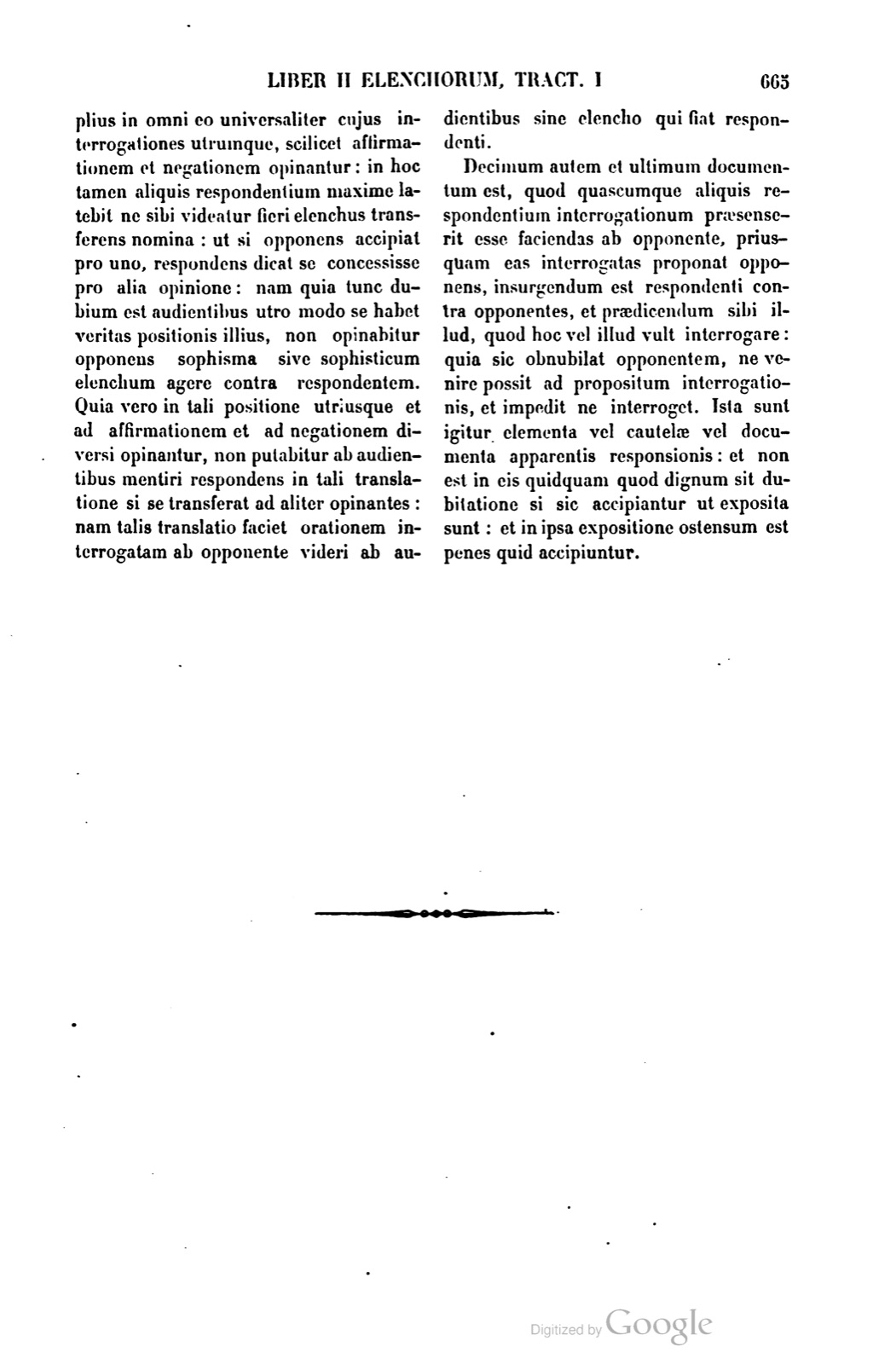
Nonum elementum sive documentum est in his interrogationibus ab opponente factis quae sunt secundum opinionem plurium, et quae habentur quasi pro communibus animi conceptionibus: quia quaedam quae sunt de numero eorum quae dicunt plures et habent pro communi animi conceptione, et dicunt eum mentiri qui non concedit illa: quaedam autem non sunt talia ut sunt ea quaecumque diversi utrinque, hoc est, ad utramque partem, veram scilicet et falsam opinantur. Verbi gratia in exemplo: quia utrum corruptibilis vel immortalis sive incorruptibilis sit anima animalium, non determinatum est multis Philosophis. Pythagoras enim dixit omnem animam animalium immortalem esse. Stoici autem tantum animam hominis immortalem esse concedebant. In interrogationibus ergo in quibus dubium est utro modo soleat dici propositum, utrum scilicet accipiendae sint ut communes animi conceptiones et suppositiones: eo quod illi vocant conceptiones et veras opiniones affirmativas, et etiam vocant conceptiones totas (hoc est, universales negationes), hoc est, quae universaliter negatae verae sunt, ut haec, diameter est incommensurabilis sive non est commensurabilis, quae est negatio universaliter vera. Amplius in omni eo universaliter cujus interrogationes utrumque, scilicet affirmationem et negationem opinantur: in hoc tamen aliquis respondentium maxime latebit ne sibi videatur fieri elenchus transferens nomina: ut si opponens accipiat pro uno, respondens dicat se concessisse pro alia opinione: nam quia tunc dubium est audientibus utro modo se habet veritas positionis illius, non opinabitur opponens sophisma sive sophisticum elenchum agere contra respondentem. Quia vero in tali positione utriusque et ad affirmationem et ad negationem diversi opinantur, non putabitur ab audientibus mentiri respondens in tali translatione si se transferat ad aliter opinantes: nam talis translatio faciet orationem interrogatam ab opponente videri ab audientibus sine elencho qui fiat respondenti.
Decimum autem et ultimum documentum est, quod quascumque aliquis respondentium interrogationum praesenserit esse faciendas ab opponente, priusquam eas interrogatas proponat opponens, insurgendum est respondenti contra opponentes, et praedicendum sibi illud, quod hoc vel illud vult interrogare: quia sic obnubilat opponentem, ne venire possit ad propositum interrogationis, et impedit ne interroget. Ista sunt igitur elementa vel cautelae vel documenta apparentis responsionis: et non est in eis quidquam quod dignum sit dubitatione si sic accipiantur ut exposita sunt: et in ipsa expositione ostensum est penes quid accipiuntur.
But the eighth element is that if the opponent strives toward contraries, and to this one thing there is indeed a contrary, but to that other thing there is no contrary, if the speech which the opponent asks is true, then the respondent ought to say that to this there is indeed a contrary just as to that; but let him say that the name of the other of the contraries has not been posited, and therefore it does not seem to have a contrary.
The ninth element or teaching is in those questions made by the opponent which are according to the opinion of many and which are held as if for common conceptions of the mind, because some things are from the number of those which the many say and hold as a common conception of the mind, and they say that one lies who does not grant them; but some things are not such, as those things whatever about which diverse persons opine on each side, that is, toward each part, namely the true and the false. For example, because whether the soul of animals is corruptible or immortal or incorruptible has not been determined by many philosophers. For Pythagoras said that every soul of animals is immortal; but the Stoics granted that only the soul of a human being is immortal. Therefore in questions in which it is doubtful in what way the proposed matter is accustomed to be said, namely whether they should be accepted as common conceptions and suppositions of the mind, because they call affirmative conceptions and true opinions conceptions, and they also call whole conceptions, that is, universal negations, conceptions, that is, those which when universally denied are true, as this one: the diameter is incommensurable or is not commensurable, which is a universally true negation. Further, in every universal matter whose questions they opine both things, namely affirmation and negation, in this nevertheless some respondent will be especially hidden, lest a refutation seem to be made against him, by transferring names; as if the opponent accepts it for one opinion, the respondent may say that he granted it for another opinion. For since then it is doubtful to the hearers in what way the truth of that position has itself, the opponent will not be thought to carry on a sophism or sophistical refutation against the respondent. But because in such a position diverse people opine on each side, both toward affirmation and toward negation, the respondent will not be thought by the hearers to lie in such a translation if he transfers himself to those opining otherwise; for such a translation will make the speech asked by the opponent seem to the hearers to be without a refutation made against the respondent.
But the tenth and last teaching is that whatever questions one of the respondents has perceived beforehand are to be made by the opponent, before the opponent proposes them as questions, the respondent must rise up against the opponents and foretell to him that he wishes to ask this or that, because thus he clouds over the opponent, lest he can come to the proposed question, and impedes him from asking. These therefore are the elements or precautions or teachings of apparent response, and there is not anything in them which is worthy of doubt if they are accepted as they have been explained; and in the very explanation it has been shown under what aspect they are accepted.
If a page does not appear, its photograph has not been uploaded yet.