Works › Sophistical Refutations, Books I–II
Volume 2 · pp. 655–656
Book II. Tractate I. Chapter I
A marker with ≈ is an approximate page boundary, placed by measure of the text; the page photographs remain the authority. In the paired views, clicking a page marker brings that page into view.
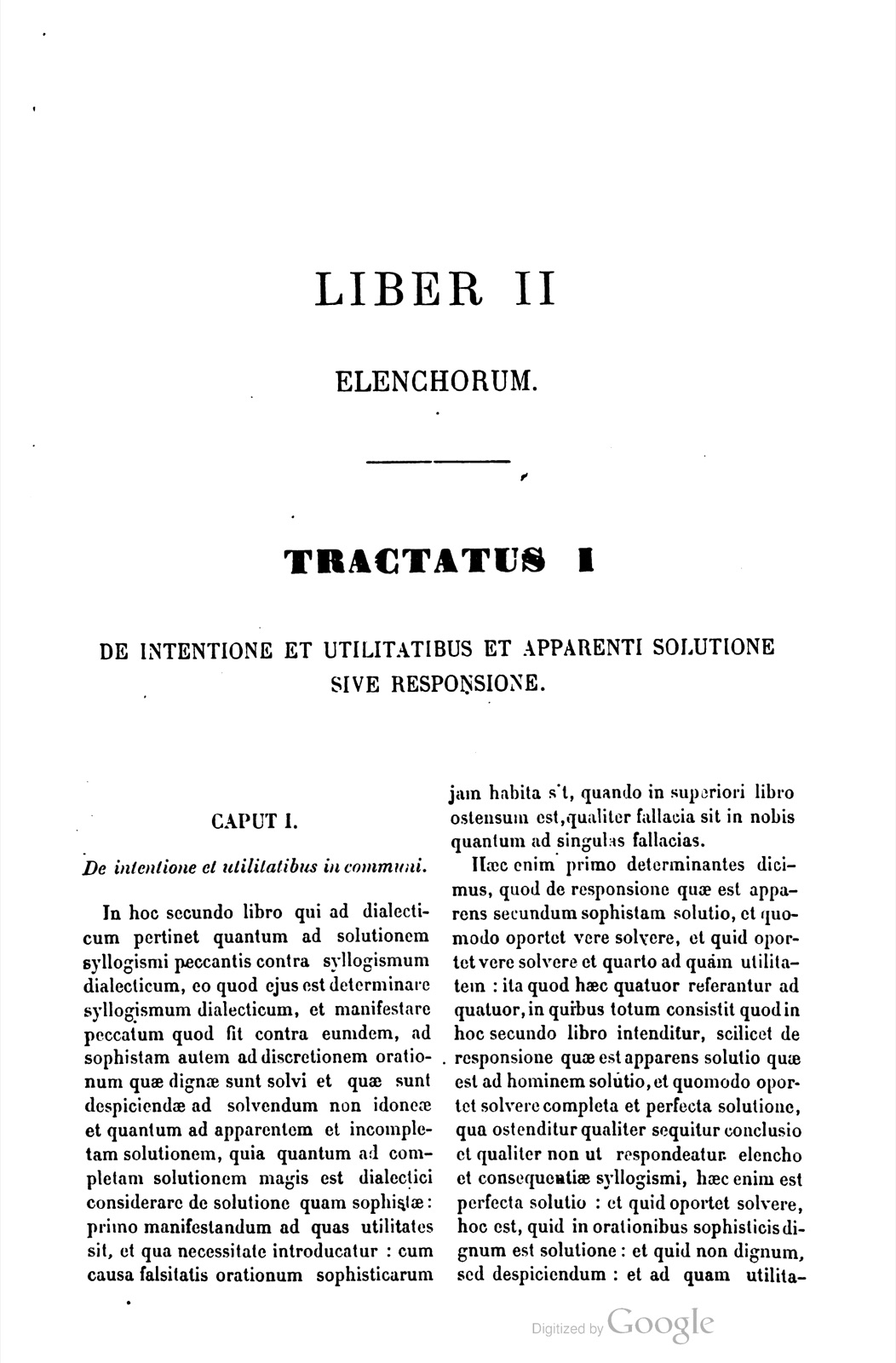
LIBER II ELENCHORUM.
TRACTATUS I. DE INTENTIONE ET UTILITATIBUS ET APPARENTI SOLUTIONE SIVE RESPONSIONE.
CAPUT I. De intentione et utilitatibus in communi.
In hoc secundo libro qui ad dialecticum pertinet quantum ad solutionem syllogismi peccantis contra syllogismum dialecticum, eo quod ejus est determinare syllogismum dialecticum, et manifestare peccatum quod fit contra eumdem, ad sophistam autem ad discretionem orationum quae dignae sunt solvi et quae sunt despiciendae ad solvendum non idoneae et quantum ad apparentem et incompletam solutionem, quia quantum ad completam solutionem magis est dialectici considerare de solutione quam sophistae: primo manifestandum ad quas utilitates sit, et qua necessitate introducatur: cum causa falsitatis orationum sophisticarum jam habita sit, quando in superiori libro ostensum est, qualiter fallacia sit in nobis quantum ad singulas fallacias.
Haec enim primo determinantes dicimus, quod de responsione quae est apparens secundum sophistam solutio, et quomodo oportet vere solvere, et quid oportet vere solvere et quarto ad quam utilitatem: ita quod haec quatuor referantur ad quatuor, in quibus totum consistit quod in hoc secundo libro intenditur, scilicet de responsione quae est apparens solutio quae est ad hominem solutio, et quomodo oportet solvere completa et perfecta solutione, qua ostenditur qualiter sequitur conclusio et qualiter non ut respondeatur elencho et consequentiae syllogismi, haec enim est perfecta solutio: et quid oportet solvere, hoc est, quid in orationibus sophisticis dignum est solutione: et quid non dignum, sed despiciendum: et ad quam utilitatem: circa quatuor haec complebitur nostra in hoc secundo intentio. Sed utilitates praeponimus, quia illae sunt fines negotii illius: et non potest sciri in quid dirigatur intentio tractantis, nisi praesumatur et praedeterminetur finis: haec igitur (post haec quae in primo libro determinata sunt) dicenda sunt.
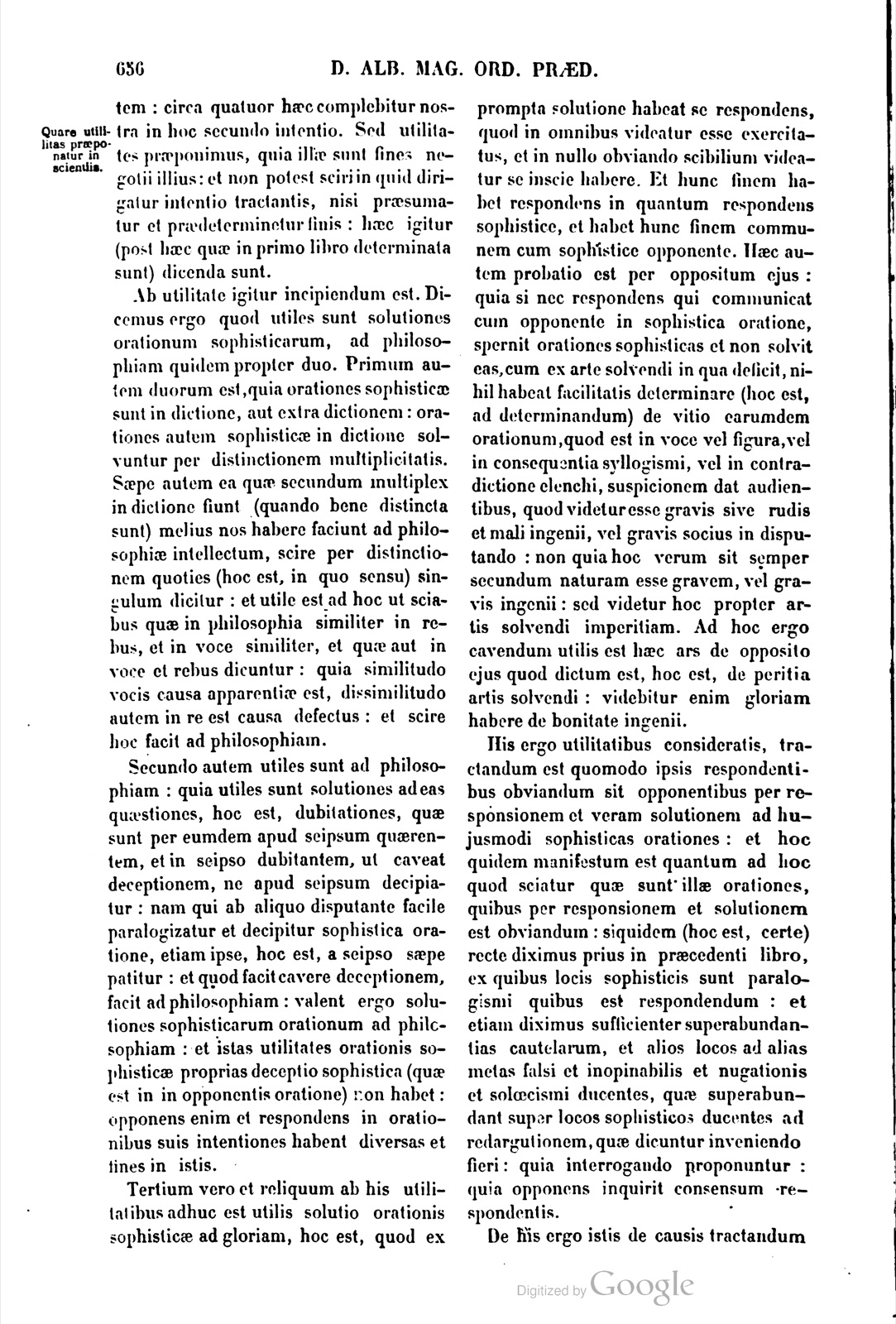
Ab utilitate igitur incipiendum est. Dicemus ergo quod utiles sunt solutiones orationum sophisticarum, ad philosophiam quidem propter duo. Primum autem duorum est, quia orationes sophisticae sunt in dictione, aut extra dictionem: orationes autem sophisticae in dictione solvuntur per distinctionem multiplicitatis. Saepe autem ea quae secundum multiplex in dictione fiunt (quando bene distincta sunt) melius nos habere faciunt ad philosophiae intellectum, scire per distinctionem quoties (hoc est, in quo sensu) singulum dicitur: et utile est ad hoc ut sciamus quae in philosophia similiter in rebus, et in voce similiter, et quae aut in voce et rebus dicuntur: quia similitudo vocis causa apparentiae est, dissimilitudo autem in re est causa defectus: et scire hoc facit ad philosophiam.
BOOK II OF THE REFUTATIONS.
TRACTATE I. CONCERNING THE INTENTION AND USEFULNESSES, AND CONCERNING APPARENT SOLUTION OR RESPONSE.
CHAPTER I. Concerning the intention and usefulnesses in common.
In this second book, which pertains to the dialectician with respect to the solution of a syllogism sinning against the dialectical syllogism, because it belongs to him to determine the dialectical syllogism and to manifest the sin which is made against the same; but it pertains to the sophist with respect to the discretion of speeches which are worthy to be solved and which are to be despised as not suitable for solution, and with respect to apparent and incomplete solution, because with respect to complete solution it belongs more to the dialectician than to the sophist to consider solution: first it must be manifested for what usefulnesses it is, and by what necessity it is introduced, since the cause of the falsity of sophistical speeches has already been had, when in the preceding book it was shown how fallacy is in us with respect to the individual fallacies.
For determining these things first, we say that it is concerning the response which is apparent solution according to the sophist, and how it is necessary truly to solve, and what it is necessary truly to solve, and fourthly, toward what usefulness, so that these four are referred to four things in which the whole that is intended in this second book consists: namely concerning the response which is an apparent solution, which is a solution to the man; and how one must solve with a complete and perfect solution, by which it is shown how the conclusion follows and how it does not, so that answer may be made to the refutation and to the consequence of the syllogism, for this is the perfect solution; and what must be solved, that is, what in sophistical speeches is worthy of solution, and what is not worthy but to be despised; and toward what usefulness. Around these four things our intention in this second book will be completed. But we put the usefulnesses first, because they are the ends of that business, and it cannot be known to what the intention of the one treating is directed unless the end is presumed and predetermined. These things therefore must be said after those which were determined in the first book.
Therefore one must begin from usefulness. Therefore we shall say that solutions of sophistical speeches are useful, indeed for philosophy, on account of two things. But the first of the two is that sophistical speeches are either in diction or outside diction; but sophistical speeches in diction are solved through the distinction of multiplicity. Often, however, those things which occur according to multiplicity in diction, when they have been well distinguished, make us better disposed toward understanding philosophy, to know through distinction how many times, that is, in what sense, each thing is said; and it is useful for this, that we may know what things in philosophy are said similarly in things, and similarly in word, and what things are said either in word and things, because likeness of word is the cause of appearance, but unlikeness in the thing is the cause of defect, and to know this contributes to philosophy.
Secundo autem utiles sunt ad philosophiam: quia utiles sunt solutiones ad eas quaestiones, hoc est, dubitationes, quae sunt per eumdem apud seipsum quaerentem, et in seipso dubitantem, ut caveat deceptionem, ne apud seipsum decipiatur: nam qui ab aliquo disputante facile paralogizatur et decipitur sophistica oratione, etiam ipse, hoc est, a seipso saepe patitur: et quod facit cavere deceptionem, facit ad philosophiam: valent ergo solutiones sophisticarum orationum ad philosophiam: et istas utilitates orationis sophisticae proprias deceptio sophistica (quae est in in opponentis oratione) non habet: opponens enim et respondens in orationibus suis intentiones habent diversas et fines in istis.
Tertium vero et reliquum ab his utilitatibus adhuc est utilis solutio orationis sophisticae ad gloriam, hoc est, quod ex prompta solutione habeat se respondens, quod in omnibus videatur esse exercitatus, et in nullo obviando scibilium videatur se inscie habere. Et hunc finem habet respondens in quantum respondens sophistice, et habet hunc finem communem cum sophistice opponente. Haec autem probatio est per oppositum ejus: quia si nec respondens qui communicat cum opponente in sophistica oratione, spernit orationes sophisticas et non solvit eas, cum ex arte solvendi in qua deficit, nihil habeat facilitatis determinare (hoc est, ad determinandum) de vitio earumdem orationum, quod est in voce vel figura, vel in consequentia syllogismi, vel in contradictione elenchi, suspicionem dat audientibus, quod videtur esse gravis sive rudis et mali ingenii, vel gravis socius in disputando: non quia hoc verum sit semper secundum naturam esse gravem, vel gravis ingenii: sed videtur hoc propter artis solvendi imperitiam. Ad hoc ergo cavendum utilis est haec ars de opposito ejus quod dictum est, hoc est, de peritia artis solvendi: videbitur enim gloriam habere de bonitate ingenii.
His ergo utilitatibus consideratis, tractandum est quomodo ipsis respondentibus obviandum sit opponentibus per responsionem et veram solutionem ad hujusmodi sophisticas orationes: et hoc quidem manifestum est quantum ad hoc quod sciatur quae sunt illae orationes, quibus per responsionem et solutionem est obviandum: siquidem (hoc est, certe) recte diximus prius in praecedenti libro, ex quibus locis sophisticis sunt paralogismi quibus est respondendum: et etiam diximus sufficienter superabundantias cautelarum, et alios locos ad alias metas falsi et inopinabilis et nugationis et solaecismi ducentes, quae superabundant super locos sophisticos ducentes ad redargutionem, quae dicuntur inveniendo fieri: quia interrogando proponuntur: quia opponens inquirit consensum respondentis.
De his ergo istis de causis tractandum
But secondly they are useful for philosophy because solutions are useful for those questions, that is, doubts, which arise through the same person seeking within himself and doubting in himself, so that he may beware of deception, lest he be deceived within himself. For he who is easily paralogized by someone disputing and deceived by a sophistical speech often also suffers this himself, that is, from himself; and what makes one beware of deception contributes to philosophy. Therefore the solutions of sophistical speeches are of value for philosophy; and sophistical deception, which is in the speech of the opponent, does not have these usefulnesses proper to sophistical speech, for the opponent and respondent in their speeches have diverse intentions and ends in these things.
But the third, remaining apart from these usefulnesses, is that the solution of sophistical speech is still useful for glory, that is, that from prompt solution the respondent should have himself such that he seems to be exercised in all things and seems to have himself ignorantly in no knowable things when resisting. And the respondent has this end insofar as he responds sophistically, and he has this end in common with the sophistical opponent. But this proof is through its opposite, because if even the respondent who communicates with the opponent in sophistical speech despises sophistical speeches and does not solve them, since from the art of solving in which he is deficient he has no facility for determining, that is, for making a determination, about the vice of the same speeches, which is in word or figure, or in the consequence of the syllogism, or in the contradiction of the refutation, he gives to the hearers the suspicion that he seems to be dull or rude and of bad talent, or a burdensome partner in disputing. This is not because it is always true according to nature that he is dull or of dull talent, but this seems so because of lack of skill in the art of solving. Therefore this art is useful for avoiding this by the opposite of what has been said, that is, by skill in the art of solving; for he will seem to have glory from goodness of talent.
Therefore with these usefulnesses considered, one must treat how the opponents are to be resisted by the respondents themselves through response and true solution to sophistical speeches of this sort. And this indeed is manifest with respect to this, that it should be known which are those speeches which must be resisted through response and solution: if indeed, that is, certainly, we have rightly said earlier in the preceding book from what sophistical places the paralogisms are to which one must respond; and we have also sufficiently stated the overabundances of precautions, and the other places leading to the other goals of the false and improbable and nugation and solecism, which overabound beyond the sophistical places leading to refutation, which are said to be made by finding, because they are proposed by questioning, since the opponent inquires into the respondent's consent.
Therefore concerning these things, for these causes, one must treat
If a page does not appear, its photograph has not been uploaded yet.