Works › Sophistical Refutations, Books I–II
Volume 2 · pp. 650–654
Tractate VII. Chapters I-III
A marker with ≈ is an approximate page boundary, placed by measure of the text; the page photographs remain the authority. In the paired views, clicking a page marker brings that page into view.
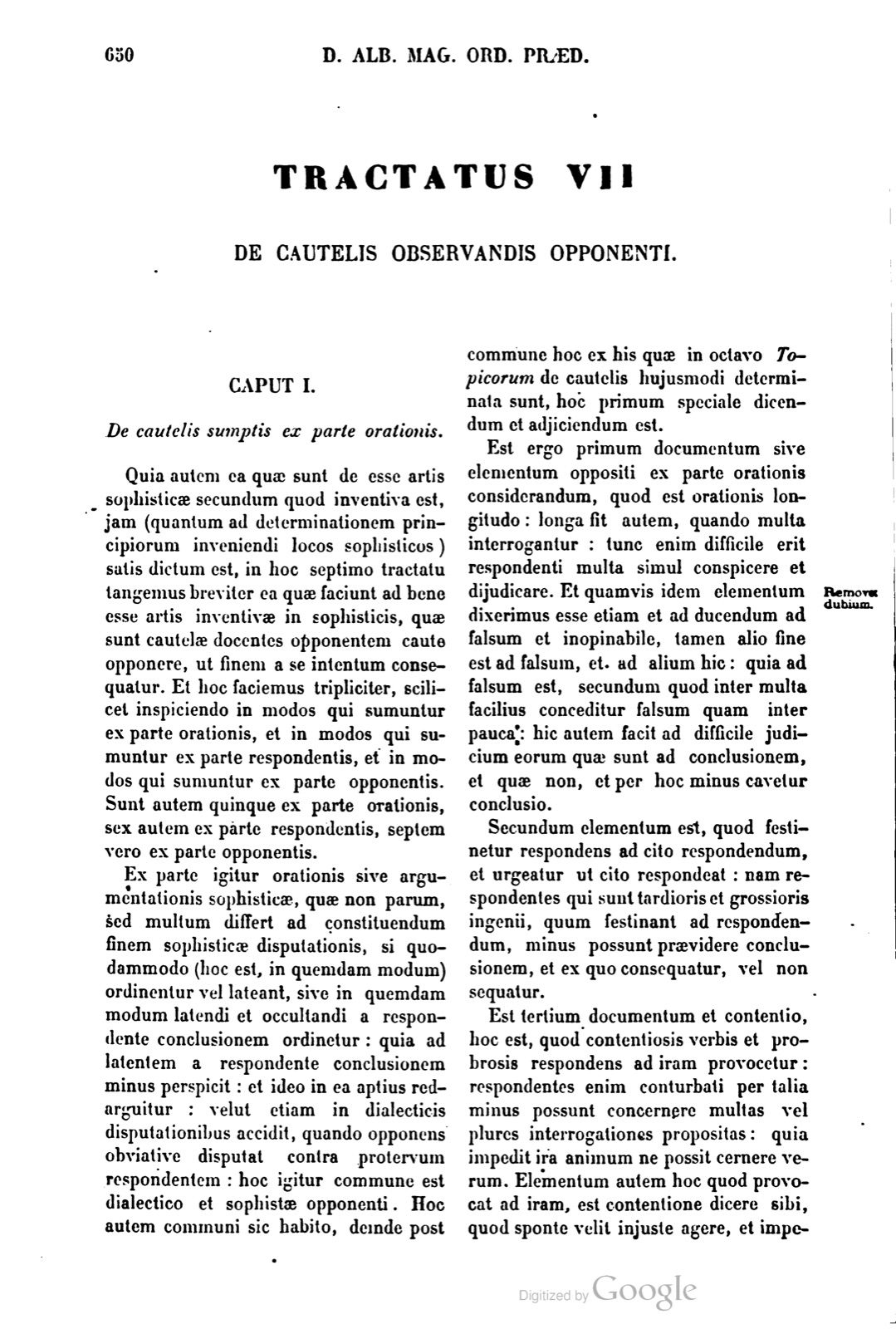
TRACTATUS VII. DE CAUTELIS OBSERVANDIS OPPONENTI.
CAPUT I. De cautelis sumptis ex parte orationis.
Quia autem ea quae sunt de esse artis sophisticae secundum quod inventiva est, jam (quantum ad determinationem principiorum inveniendi locos sophisticos) satis dictum est, in hoc septimo tractatu tangemus breviter ea quae faciunt ad bene esse artis inventivae in sophisticis, quae sunt cautelae docentes opponentem caute opponere, ut finem a se intentum consequatur. Et hoc faciemus tripliciter, scilicet inspiciendo in modos qui sumuntur ex parte orationis, et in modos qui sumuntur ex parte respondentis, et in modos qui sumuntur ex parte opponentis. Sunt autem quinque ex parte orationis, sex autem ex parte respondentis, septem vero ex parte opponentis.
Ex parte igitur orationis sive argumentationis sophisticae, quae non parum, sed multum differt ad constituendum finem sophisticae disputationis, si quodammodo (hoc est, in quemdam modum) ordinentur vel lateant, sive in quemdam modum latendi et occultandi a respondente conclusionem ordinetur: quia ad latentem a respondente conclusionem minus perspicit: et ideo in ea aptius redarguitur: velut etiam in dialecticis disputationibus accidit, quando opponens obviative disputat contra protervum respondentem: hoc igitur commune est dialectico et sophistae opponenti. Hoc autem communi sic habito, deinde post commune hoc ex his quae in octavo Topicorum de cautelis hujusmodi determinata sunt, hoc primum speciale dicendum et adjiciendum est.
Est ergo primum documentum sive elementum oppositi ex parte orationis considerandum, quod est orationis longitudo: longa fit autem, quando multa interrogantur: tunc enim difficile erit respondenti multa simul conspicere et dijudicare. Et quamvis idem elementum dixerimus esse etiam et ad ducendum ad falsum et inopinabile, tamen alio fine est ad falsum, et ad alium hic: quia ad falsum est, secundum quod inter multa facilius conceditur falsum quam inter pauca: hic autem facit ad difficile judicium eorum quae sunt ad conclusionem, et quae non, et per hoc minus cavetur conclusio.
Secundum elementum est, quod festinetur respondens ad cito respondendum, et urgeatur ut cito respondeat: nam respondentes qui sunt tardioris et grossioris ingenii, quum festinant ad respondendum, minus possunt praevidere conclusionem, et ex quo consequatur, vel non sequatur.
Est tertium documentum et contentio, hoc est, quod contentiosis verbis et probrosis respondens ad iram provocetur: respondentes enim conturbati per talia minus possunt concernere multas vel plures interrogationes propositas: quia impedit ira animum ne possit cernere verum. Elementum autem hoc quod provocat ad iram, est contentione dicere sibi, quod sponte velit injuste agere, et impedire disputationem, et quod ista sit consuetudo sua, quod circa omnes disputationes et circa omnia disputabilia impudens sit et protervus.
Amplius quartum elementum sive documentum est interrogationes sive propositiones diversorum syllogismorum sive prosyllogismorum permutatim ponere, ut propositiones quae faciunt ad conclusionem unius syllogismi, permutentur et ordinentur ad conclusionem alterius syllogismi: et utile est sic permutare interrogationes sive ad idem (hoc est, ad eamdem conclusionem) aliquis habeat plures propositiones plurium syllogismorum ex diversis mediis ad idem ordinatis, sive plures habeat plurium syllogismorum ad oppositas conclusiones, sicut syllogismi dialectici probabiliter sunt ad opposita sive contraria, ut quoniam affirmatio, et quoniam non fit negatio; tunc enim accidit respondenti simul ad plura interrogata et permutata facere observationes judiciorum: et hoc non facile est respondenti: quia pluribus et inordinate propositis credere est difficile: quia pluribus intentus minor est ad singula sensus.
TRACTATE VII. CONCERNING PRECAUTIONS TO BE OBSERVED BY THE OPPONENT.
CHAPTER I. Concerning precautions taken from the part of the speech.
But because enough has already been said concerning those things which belong to the being of sophistical art according as it is inventive, with respect to the determination of the principles of finding sophistical places, in this seventh tractate we shall touch briefly those things which contribute to the well-being of the inventive art in sophistical matters, which are precautions teaching the opponent to oppose cautiously, so that he may attain the end intended by himself. And we shall do this threefoldly, namely by inspecting the modes which are taken from the part of speech, and the modes which are taken from the part of the respondent, and the modes which are taken from the part of the opponent. There are five from the part of speech, six from the part of the respondent, but seven from the part of the opponent.
Therefore from the part of the speech or sophistical argumentation, which differs not a little but much for establishing the end of sophistical disputation, if they are ordered in a certain way, that is, into a certain mode, or lie hidden, or are ordered into a certain mode of hiding and concealing the conclusion from the respondent; because he less sees through to a conclusion hidden from the respondent, and therefore he is more aptly refuted in it, just as also happens in dialectical disputations when the opponent disputes by way of resistance against a stubborn respondent, this therefore is common to the dialectical opponent and the sophistical opponent. But with this common point thus held, then after this common point, from those things which in the eighth book of the Topics have been determined concerning precautions of this kind, this first special point must be said and added.
Therefore the first teaching or element of the opposite to be considered from the part of speech is the length of speech. But it becomes long when many things are asked; for then it will be difficult for the respondent to behold and judge many things at once. And although we have said that the same element also belongs to leading to the false and improbable, nevertheless it is for the false with one end and here for another: because it is for the false according as the false is more easily granted among many things than among few; but here it contributes to the difficult judgment of those things which are for the conclusion and those which are not, and through this the conclusion is less guarded against.
The second element is that the respondent be hastened to responding quickly, and be urged to respond quickly. For respondents who are of slower and grosser talent, when they hasten to respond, are less able to foresee the conclusion and from what it follows or does not follow.
The third teaching and contention is this, that with contentious and reproachful words the respondent be provoked to anger. For respondents disturbed by such things are less able to discern the many or several questions proposed, because anger impedes the mind so that it cannot discern the true. But this element which provokes to anger is to say contentiously to him that he wishes willingly to act unjustly and to impede the disputation, and that this is his custom, that regarding all disputations and all disputable things he is shameless and stubborn.
Further, the fourth element or teaching is to put questions or propositions of diverse syllogisms or prosyllogisms interchangeably, so that propositions which make toward the conclusion of one syllogism are interchanged and ordered toward the conclusion of another syllogism. And it is useful thus to interchange questions, whether someone has several propositions of several syllogisms ordered from diverse middles to the same thing, that is, to the same conclusion, or has several propositions of several syllogisms toward opposite conclusions, just as dialectical syllogisms are probably toward opposites or contraries, as that affirmation is, and that negation is not made. For then it happens that the respondent must at once make observations of judgments toward several things asked and interchanged; and this is not easy for the respondent, because to believe several and inordinately proposed things is difficult, since a sense intent on several things is less with respect to each.
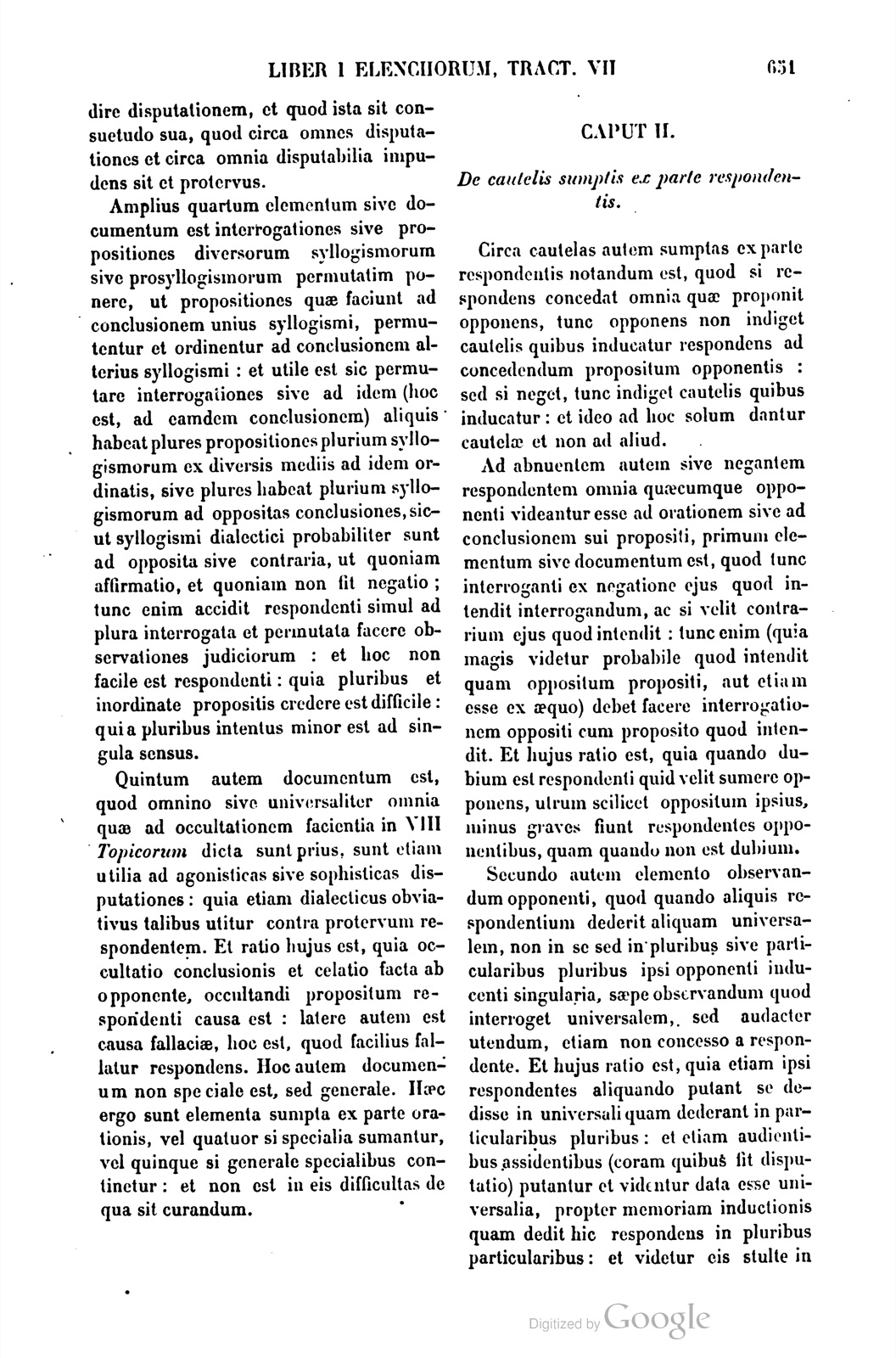
Quintum autem documentum est, quod omnino sive universaliter omnia quae ad occultationem facientia in VIII Topicorum dicta sunt prius, sunt etiam utilia ad agonisticas sive sophisticas disputationes: quia etiam dialecticus obviativus talibus utitur contra protervum respondentem. Et ratio hujus est, quia occultatio conclusionis et celatio facta ab opponente, occultandi propositum respondenti causa est: latere autem est causa fallaciae, hoc est, quod facilius fallatur respondens. Hoc autem documentum non speciale est, sed generale. Haec ergo sunt elementa sumpta ex parte orationis, vel quatuor si specialia sumantur, vel quinque si generale specialibus continetur: et non est in eis difficultas de qua sit curandum.
CAPUT II. De cautelis sumptis ex parte respondentis.
Circa cautelas autem sumptas ex parte respondentis notandum est, quod si respondens concedat omnia quae proponit opponens, tunc opponens non indiget cautelis quibus inducatur respondens ad concedendum propositum opponentis: sed si neget, tunc indiget cautelis quibus inducatur: et ideo ad hoc solum dantur cautelae et non ad aliud.
Ad abnuentem autem sive negantem respondentem omnia quaecumque opponenti videantur esse ad orationem sive ad conclusionem sui propositi, primum elementum sive documentum est, quod tunc interroganti ex negatione ejus quod intendit interrogandum, ac si velit contrarium ejus quod intendit: tunc enim (quia magis videtur probabile quod intendit quam oppositum propositi, aut etiam esse ex aequo) debet facere interrogationem oppositi cum proposito quod intendit. Et hujus ratio est, quia quando dubium est respondenti quid velit sumere opponens, utrum scilicet oppositum ipsius, minus graves fiunt respondentes opponentibus, quam quando non est dubium.
Secundo autem elemento observandum opponenti, quod quando aliquis respondentium dederit aliquam universalem, non in se sed in pluribus sive particularibus pluribus ipsi opponenti inducenti singularia, saepe observandum quod interroget universalem, sed audacter utendum, etiam non concesso a respondente. Et hujus ratio est, quia etiam ipsi respondentes aliquando putant se dedisse in universali quam dederant in particularibus pluribus: et etiam audientibus assidentibus (coram quibus fit disputatio) putantur et videntur data esse universalia, propter memoriam inductionis quam dedit hic respondens in pluribus particularibus: et videtur eis stulte in eis dedisse universalia velut non interrogata sint universalia.
Tertium autem elementum sive documentum est, quod utendum est talibus in quibus non nomine ipso significatur universale concessum in particularibus, sed similitudine: quia concesso universali in aliquibus particularibus, concessum erit in omnibus similibus: talibus enim uti expedit ad celandum propositum: quia scilicet similitudo vel similatio facit et operatur ad latere: eo quod magis latet quod in simili, quam id quod in seipso proponitur.
But the fifth teaching is that all things altogether or universally which were earlier said in book VIII of the Topics as making for concealment are also useful for agonistic or sophistical disputations, because even the dialectician who resists uses such things against a stubborn respondent. And the reason for this is that the hiding of the conclusion and the concealment made by the opponent is the cause of concealing the proposition from the respondent; but to be hidden is the cause of fallacy, that is, that the respondent is more easily deceived. But this teaching is not special, but general. These therefore are the elements taken from the part of speech, either four if the special ones are taken, or five if the general is contained with the special ones; and there is no difficulty in them about which one should be concerned.
CHAPTER II. Concerning precautions taken from the part of the respondent.
But concerning precautions taken from the part of the respondent it must be noted that if the respondent grants all things which the opponent proposes, then the opponent does not need precautions by which the respondent may be induced to granting the proposition of the opponent. But if he denies, then he needs precautions by which he may be induced; and therefore precautions are given only for this and not for another thing.
But toward a respondent refusing or denying all things whatever seem to the opponent to belong to the speech or to the conclusion of his proposition, the first element or teaching is that then, for the questioner, from the negation of that which he intends, the thing must be asked as if he wished the contrary of what he intends. For then, because what he intends seems more probable than the opposite of the proposition, or even equal, he ought to make the question of the opposite together with the proposition which he intends. And the reason for this is that when it is doubtful to the respondent what the opponent wishes to take, whether namely its opposite, respondents become less burdensome to opponents than when it is not doubtful.
But in the second element the opponent must observe that when one of the respondents has given some universal, not in itself but in several things or several particulars to the opponent himself inducing singulars, often it must be observed that he ask the universal, but use it boldly even when it has not been granted by the respondent. And the reason for this is that even the respondents themselves sometimes think that they have given universally what they had given in several particulars; and also to the hearers sitting by, before whom the disputation is made, universals are thought and seem to have been given, because of the memory of the induction which this respondent gave in several particulars; and to them he seems to have foolishly given universals in those things, as if the universals had not been asked.
But the third element or teaching is that one must use such things in which the universal conceded in particulars is not signified by the very name, but by likeness; because when a universal has been conceded in some particulars, it will be conceded in all similar things. For it is expedient to use such things for concealing the proposition, because likeness or assimilation makes and works toward being hidden, since that which is in a similar thing is more hidden than that which is proposed in itself.
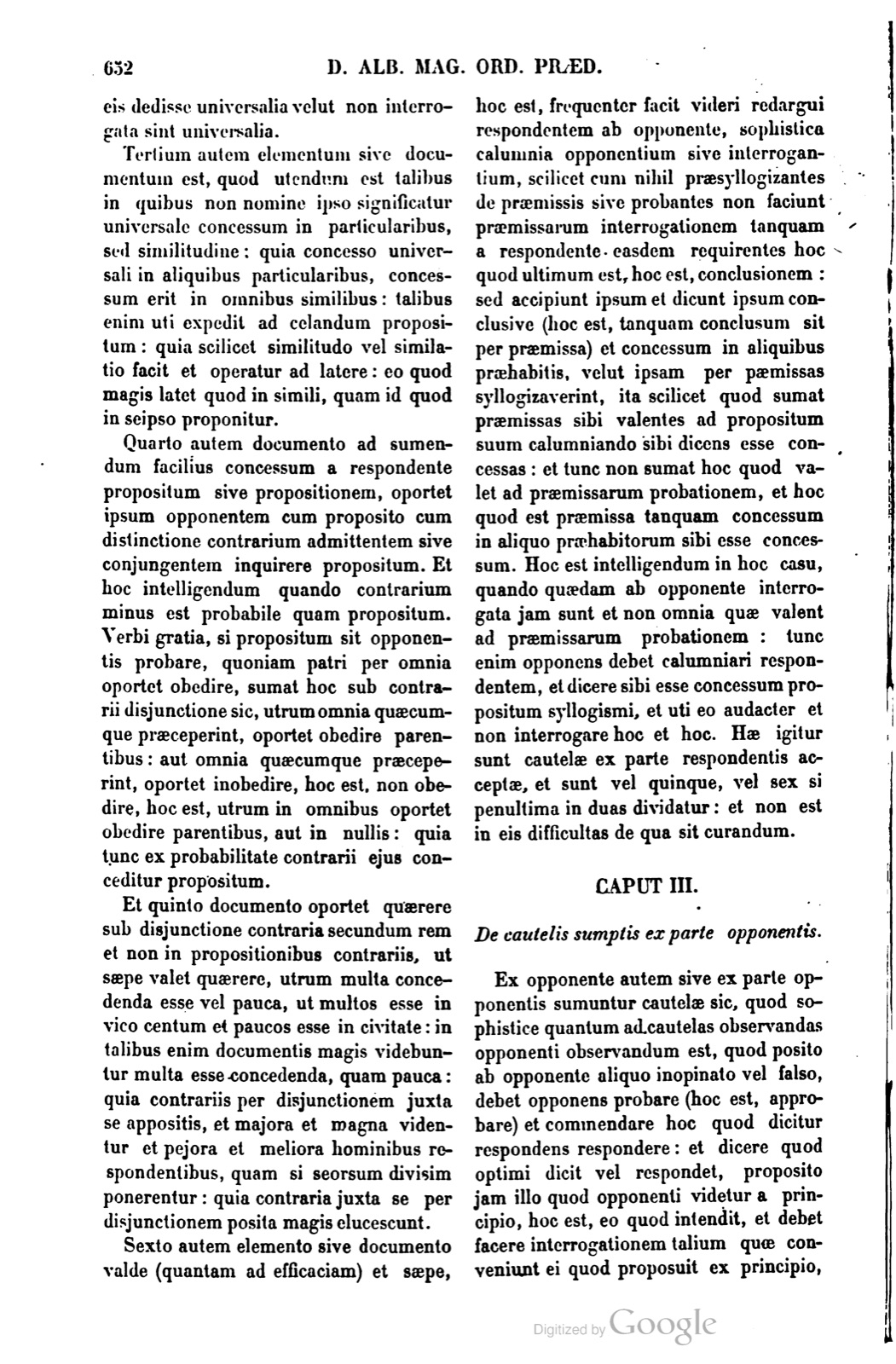
Quarto autem documento ad sumendum facilius concessum a respondente propositum sive propositionem, oportet ipsum opponentem cum proposito cum distinctione contrarium admittentem sive conjungentem inquirere propositum. Et hoc intelligendum quando contrarium minus est probabile quam propositum. Verbi gratia, si propositum sit opponentis probare, quoniam patri per omnia oportet obedire, sumat hoc sub contrarii disjunctione sic, utrum omnia quaecumque praeceperint, oportet obedire parentibus: aut omnia quaecumque praeceperint, oportet inobedire, hoc est, non obedire, hoc est, utrum in omnibus oportet obedire parentibus, aut in nullis: quia tunc ex probabilitate contrarii ejus conceditur propositum.
Et quinto documento oportet quaerere sub disjunctione contraria secundum rem et non in propositionibus contrariis, ut saepe valet quaerere, utrum multa concedenda esse vel pauca, ut multos esse in vico centum et paucos esse in civitate: in talibus enim documentis magis videbuntur multa esse concedenda, quam pauca: quia contrariis per disjunctionem juxta se appositis, et majora et magna videntur et pejora et meliora hominibus respondentibus, quam si seorsum divisim ponerentur: quia contraria juxta se per disjunctionem posita magis elucescunt.
Sexto autem elemento sive documento valde (quantum ad efficaciam) et saepe, hoc est, frequenter facit videri redargui respondentem ab opponente, sophistica calumnia opponentium sive interrogantium, scilicet cum nihil praesyllogizantes de praemissis sive probantes non faciunt praemissarum interrogationem tanquam a respondente easdem requirentes hoc quod ultimum est, hoc est, conclusionem: sed accipiunt ipsum et dicunt ipsum conclusive (hoc est, tanquam conclusum sit per praemissa) et concessum in aliquibus prae habitis, velut ipsam per praemissas syllogizaverint, ita scilicet quod sumat praemissas sibi valentes ad propositum suum calumniando sibi dicens esse concessas: et tunc non sumat hoc quod valet ad praemissarum probationem, et hoc quod est praemissa tanquam concessum in aliquo prae habitorum sibi esse concessum. Hoc est intelligendum in hoc casu, quando quaedam ab opponente interrogata jam sunt et non omnia quae valent ad praemissarum probationem: tunc enim opponens debet calumniari respondentem, et dicere sibi esse concessum propositum syllogismi, et uti eo audacter et non interrogare hoc et hoc. Hae igitur sunt cautelae ex parte respondentis acceptae, et sunt vel quinque, vel sex si penultima in duas dividatur: et non est in eis difficultas de qua sit curandum.
CAPUT III. De cautelis sumptis ex parte opponentis.
Ex opponente autem sive ex parte opponentis sumuntur cautelae sic, quod sophistice quantum ad cautelas observandas opponenti observandum est, quod posito ab opponente aliquo inopinato vel falso, debet opponens probare (hoc est, approbare) et commendare hoc quod dicitur respondens respondere: et dicere quod optimi dicit vel respondet, proposito jam illo quod opponenti videtur a principio, hoc est, eo quod intendit, et debet facere interrogationem talium quae conveniunt ei quod proposuit ex principio, hoc est, quae sunt falsa et inopinabilia: et dicere post commendationem responsionis, utrumne tibi videtur hoc esse concedendum vel non? tunc enim propter commendationem et confidentiam opponentis de responsione, minus cavet sibi respondens ab opponente. Et tunc necesse est unum trium accidere (si sit interrogatio facta ab opponente et concessum a respondente de aliquo eorum ex quibus fit syllogismus) aut elenchus verus, ut inopinabile sive falsum fieri, aut elenchi simile. Cum enim respondens dat id cujus oppositum concludit opponens: tunc necesse est elenchum fieri, quia per syllogismum contradictionis concluditur oppositum dati a respondente. Cum autem non dat quod proponit opponens: tunc cum syllogizat opponens falsum in quod consensit respondens, necesse est sibi dare falsum vel inopinabile quod sequitur ex falso vel ex inopinabili dato a respondente. Cum autem non dat oppositum, videtur tamen dedisse falsum propositum propter commendationem opponentis: tunc fit sive sequitur aliquid simile elencho: quia videbitur duci ad oppositum dati, quamvis non ducatur: eo quod oppositum non dedit, sed dedisse videbitur.
But in the fourth teaching, for taking more easily the proposition or proposed thing conceded by the respondent, the opponent himself must inquire into the proposed thing with the contrary admitted or joined together with the proposed thing under a distinction. And this must be understood when the contrary is less probable than the proposition. For example, if the opponent's proposition is to prove that one ought to obey one's father in all things, let him take this under disjunction of the contrary thus: whether all things whatever they command, one ought to obey parents, or all things whatever they command, one ought to disobey, that is, not obey; that is, whether in all things one ought to obey parents, or in none, because then from the probability of its contrary the proposition is conceded.
And in the fifth teaching one must ask under a disjunction contrary according to the thing and not in contrary propositions, as it is often worthwhile to ask whether many things should be conceded or few, as that there are many, a hundred, in a village and few in a city. For in such teachings many things will seem more to be conceded than few, because when contraries are placed next to one another through disjunction, both greater and great things, and worse and better things, seem so to men responding more than if they were posited separately and distinctly; because contraries placed next to one another through disjunction shine forth more.
But in the sixth element or teaching, sophistical accusation of opponents or questioners very much, with respect to efficacy, and often, that is, frequently, makes the respondent seem to be refuted by the opponent: namely when, pre-syllogizing nothing about the premises or proving nothing, they do not make the question of the premises as though requiring the same from the respondent as the last thing, that is, the conclusion, but accept it and say it conclusively, that is, as though it had been concluded through the premises, and as conceded in some preceding things, as if they had syllogized it through the premises. Namely, he takes premises valid for his own proposition by accusing him and saying that they have been conceded to him; and then he does not take what is valid for the proof of the premises, and this which is a premise as conceded to him in some preceding matters. This must be understood in this case, when certain things have already been asked by the opponent and not all things which are valid for the proof of the premises. For then the opponent ought to accuse the respondent and say that the proposition of the syllogism has been conceded to him, and use it boldly and not ask this and this. These therefore are the precautions accepted from the part of the respondent, and they are either five or six if the penultimate is divided in two; and there is no difficulty in them about which one should be concerned.
CHAPTER III. Concerning precautions taken from the part of the opponent.
But from the opponent, or from the part of the opponent, precautions are taken thus, that sophistically, with respect to precautions to be observed by the opponent, it must be observed that, once something improbable or false has been posited by the opponent, the opponent ought to prove, that is, approve and commend, what the respondent is said to respond, and to say that he says or responds excellently, when that which seems to the opponent from the beginning has already been proposed, that is, that which he intends; and he ought to make a question of such things as agree with that which he proposed from the beginning, that is, which are false and improbable, and after the commendation of the response to say, does this seem to you to have to be granted or not? For then, because of the commendation and the opponent's confidence concerning the response, the respondent takes less precaution against the opponent. And then one of three things must happen, if there is a question made by the opponent and a concession by the respondent about some one of those things from which a syllogism is made: either a true refutation, as the improbable or false being made, or something like a refutation. For when the respondent gives that whose opposite the opponent concludes, then a refutation must be made, because through a syllogism of contradiction the opposite of what was given by the respondent is concluded. But when he does not give what the opponent proposes, then when the opponent syllogizes the false thing to which the respondent consented, he must give the false or improbable thing which follows from the false or from the improbable given by the respondent. But when he does not give the opposite, nevertheless because of the commendation of the opponent he seems to have given the false proposition; then something similar to a refutation is made or follows, because he will seem to be led to the opposite of what was given, although he is not led, because he did not give the opposite but will seem to have given it.
Amplius autem in secundo elemento sive documento considerandum est opponenti quemadmodum fit in rhetoricis et accusationibus, quod similiter faciant contra respondentem in apparentibus elenchis. In rhetoricis enim consideratur si accusatus nunquam fecerit contrarium boni et honesti: et si hoc aliquando fecit, praesumitur quod etiam fecerit illud de quo accusatus est. Ita etiam hic considerandum si respondens concesserit contrarium ei quod nunc affirmat: et sic conferendo quoddam concessum ad hoc concessum facilius videbitur redargui: si autem ipse non concesserit aliquando contrarium, considerandum utrum aliquibus eorum Philosophorum (de quorum secta se esse confitetur) contradicat talem sustinendo positionem. Et si hoc inveniri non potest, nec in ipso, nec in secta eorum, de quibus esse se profitetur, conferendum est hoc quod dicit ad eos qui videntur esse hujus opinionis qualis est ipse respondens: utrumne illi aliquid contrarium dixerint. Et si hoc iterum non invenitur, conferendum est dictum respondentis ad similes sibi in opposito, utrum erit ad omnes aut ad plures eorum: et ex contrario dicto illorum facilius convincitur respondens.
Amplius autem tertio elemento vel documento observandum est opponenti id quod saepe faciunt respondentes: saepe enim cum redarguuntur (hoc est, redargui videntur) faciunt (hoc est, fingunt) dupliciter, si viderint quod debeat eis accidere redargui, hoc est, quod redarguantur: et dicunt se in uno sensu hoc dixisse, in alio autem non. Et hac cautela est interrogantibus etiam utendum: et hoc quandoque faciendum est contra respondentes instantes, hoc est, resistentes eis quando scilicet praesenserint quod respondens videt multipliciter aliquo interrogatus ab ipsis: tunc enim debet praevenire respondentem et distinguendo multipliciter dicere, quod si sic (hoc est, in hoc sensu) accipiatur multipliciter, accidit vel sequitur conclusio: sic autem non, hoc est, in alio sensu acceptum, non accidit vel sequitur conclusio. Et hoc confirmatur: quoniam sic sumpsit multiplex et distinxit, et sic facit Cleophon in Mandrobulo suo, qui a discipulo (cui scripsit) nominavit eumdem: sic enim respondens minus cavebit sibi ab opponente, et facilius decipietur.
Moreover, in the second element or teaching the opponent must consider, just as happens in rhetorical matters and accusations, that they should do similarly against the respondent in apparent refutations. For in rhetorical matters it is considered whether the accused has ever done the contrary of the good and honorable; and if he has ever done this, it is presumed that he also did that of which he is accused. So also here it must be considered whether the respondent has conceded the contrary of that which he now affirms, and thus by comparing a certain concession to this concession he will more easily seem to be refuted. But if he himself has not ever conceded the contrary, one must consider whether, by sustaining such a position, he contradicts some of those philosophers of whose sect he confesses himself to be. And if this cannot be found either in him or in the sect of those among whom he professes himself to be, then what he says must be compared with those who seem to be of an opinion such as the respondent himself is, whether they have said something contrary. And if this again is not found, the saying of the respondent must be compared to those similar to him in the opposite, whether it will be to all or to several of them; and from the contrary saying of those men the respondent is more easily convicted.
Moreover, in the third element or teaching the opponent must observe what respondents often do. For often, when they are refuted, that is, seem to be refuted, they do, that is, pretend, in two ways if they have seen that it ought to happen to them to be refuted, that is, that they are refuted; and they say that they said this in one sense, but not in another. And questioners too must use this precaution; and this must sometimes be done against respondents who are pressing, that is, resisting them, namely when they have perceived beforehand that the respondent sees multiplicity in something asked by them. For then he ought to anticipate the respondent and, by distinguishing the multiplicity, say that if it is taken thus, that is, in this sense, the conclusion happens or follows, but thus not, that is, taken in another sense, the conclusion does not happen or follow. And this is confirmed, because thus he took the multiple and distinguished it, and thus Cleophon does in his Mandrobulus, which he named the same from the disciple to whom he wrote; for thus the respondent will take less precaution against the opponent and will be more easily deceived.
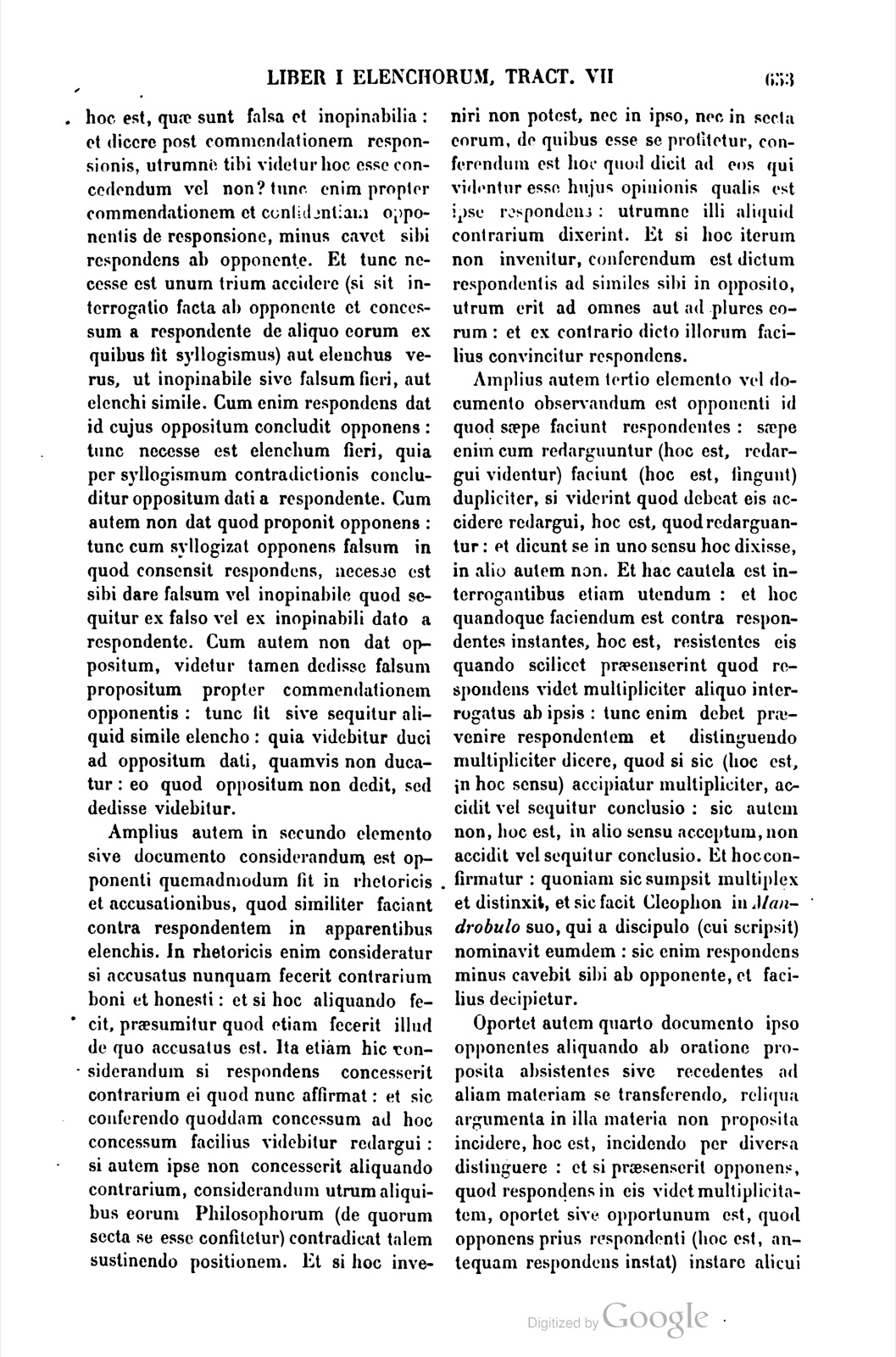
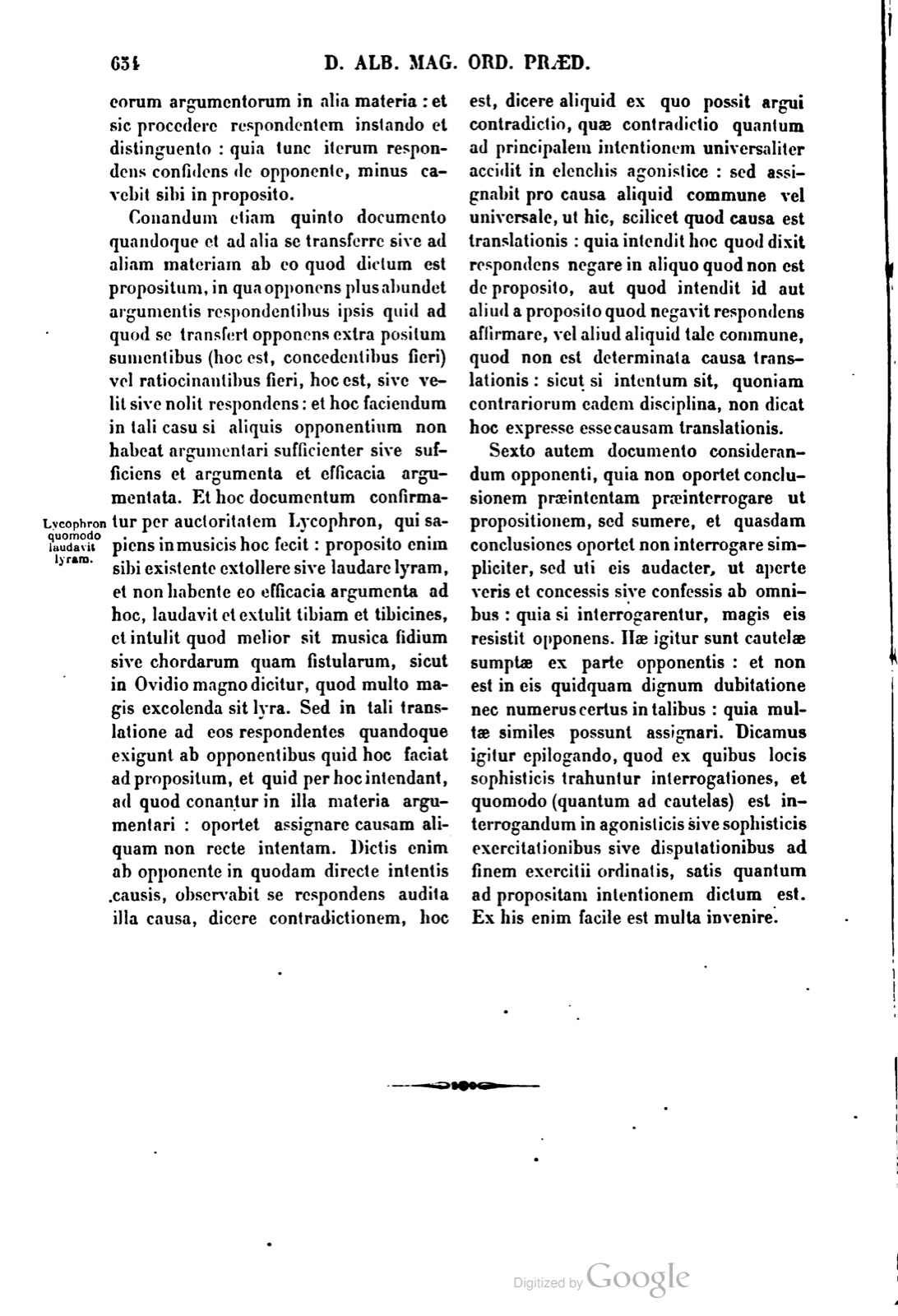
Oportet autem quarto documento ipso opponentes aliquando ab oratione proposita absistentes sive recedentes ad aliam materiam se transferendo, reliqua argumenta in illa materia non proposita incidere, hoc est, incidendo per diversa distinguere: et si praesenserit opponens, quod respondens in eis videt multiplicitatem, oportet sive opportunum est, quod talis opponens prius respondenti (hoc est, antequam respondens instat) instare alicui eorum argumentorum in alia materia: et sic procedere respondentem instando et distinguendo: quia tunc iterum respondens confidens de opponente, minus cavebit sibi in proposito.
Conandum etiam quinto documento quandoque et ad alia se transferre sive ad aliam materiam ab eo quod dictum est propositum, in qua opponens plus abundet argumentis respondentibus ipsis quid ad quod se transfert opponens extra positum sumentibus (hoc est, concedentibus fieri) vel ratiocinantibus fieri, hoc est, sive velit sive nolit respondens: et hoc faciendum in tali casu si aliquis opponentium non habeat argumentari sufficienter sive sufficiens et argumenta et efficacia argumentata. Et hoc documentum confirmatur per auctoritatem Lycophron, qui sapiens in musicis hoc fecit: proposito enim sibi extollere sive laudare lyram, et non habente eo efficacia argumenta ad hoc, laudavit et extulit tibiam et tibicines, et intulit quod melior sit musica fidium sive chordarum quam fistularum, sicut in Ovidio magno dicitur, quod multo magis excolenda sit lyra. Sed in tali translatione ad eos respondentes quandoque exigunt ab opponentibus quid hoc faciat ad propositum, et quid per hoc intendant, ad quod conantur in illa materia argumentari: oportet assignare causam aliquam non recte intentam. Dictis enim ab opponente in quodam directe intentis causis, observabit se respondens audita illa causa, dicere contradictionem, hoc est, dicere aliquid ex quo possit argui contradictio, quae contradictio quantum ad principalem intentionem universaliter accidit in elenchis agonistice: sed assignabit pro causa aliquid commune vel universale, ut hic, scilicet quod causa est translationis: quia intendit hoc quod dixit respondens negare in aliquo quod non est de proposito, aut quod intendit id aut aliud a proposito quod negavit respondens affirmare, vel aliud aliquid tale commune, quod non est determinata causa translationis: sicut si intentum sit, quoniam contrariorum eadem disciplina, non dicat hoc expresse esse causam translationis.
Sexto autem documento considerandum opponenti, quia non oportet conclusionem praeintentam praeinterrogare ut propositionem, sed sumere, et quasdam conclusiones oportet non interrogare simpliciter, sed uti eis audacter, ut aperte veris et concessis sive confessis ab omnibus: quia si interrogarentur, magis eis resistit opponens. Hae igitur sunt cautelae sumptae ex parte opponentis: et non est in eis quidquam dignum dubitatione nec numerus certus in talibus: quia multae similes possunt assignari. Dicamus igitur epilogando, quod ex quibus locis sophisticis trahuntur interrogationes, et quomodo (quantum ad cautelas) est interrogandum in agonisticis sive sophisticis exercitationibus sive disputationibus ad finem exercitii ordinatis, satis quantum ad propositam intentionem dictum est. Ex his enim facile est multa invenire.
But in the fourth teaching it is necessary for the opponents themselves sometimes, by abstaining or withdrawing from the proposed speech and transferring themselves to another matter, to fall upon the remaining arguments not proposed in that matter, that is, to distinguish by falling upon diverse things. And if the opponent has perceived beforehand that the respondent sees multiplicity in them, it is necessary or opportune that such an opponent first, before the respondent presses, press the respondent with some one of those arguments in another matter, and thus proceed while the respondent presses and distinguishes, because then again the respondent, trusting the opponent, will take less precaution for himself in the proposed matter.
In the fifth teaching one must also sometimes try to transfer oneself to other things or to another matter from that which was stated as the proposition, in which the opponent abounds more in arguments, while the respondents themselves take, that is, concede to be made, or reason to be made, what that is toward which the opponent transfers himself outside what was posited, that is, whether the respondent wishes or not. And this must be done in such a case if one of the opponents does not have enough to argue, or sufficient and efficacious arguments. And this teaching is confirmed by the authority of Lycophron, who, being wise in musical matters, did this: for when it had been proposed to him to exalt or praise the lyre, and he did not have efficacious arguments for this, he praised and exalted the pipe and pipe-players, and inferred that the music of strings or cords is better than that of pipes, as in great Ovid it is said that the lyre is to be cultivated much more. But in such a transfer to these things, respondents sometimes demand from opponents what this does for the proposition, and what they intend through this, toward which they try to argue in that matter. One must assign some cause not rightly intended. For when causes directly intended in a certain thing have been stated by the opponent, the respondent, having heard that cause, will watch himself to say a contradiction, that is, to say something from which a contradiction can be argued, which contradiction with respect to the principal intention universally happens in agonistic refutations. But he will assign as cause something common or universal, as here, namely that it is the cause of transfer, because he intends to deny in something not belonging to the proposition that which the respondent said, or because he intends to affirm that or something else apart from the proposition which the respondent denied, or some other such common thing, which is not the determinate cause of the transfer; as if the thing intended is that there is the same discipline of contraries, let him not say expressly that this is the cause of the transfer.
But in the sixth teaching the opponent must consider that it is not necessary to pre-question the pre-intended conclusion as a proposition, but to take it; and certain conclusions must not be asked simply, but one must use them boldly, as openly true and conceded or confessed by all, because if they were asked, the opponent would resist them more. These therefore are the precautions taken from the part of the opponent; and there is not anything in them worthy of doubt nor a certain number in such things, because many similar ones can be assigned. Therefore let us say by epiloguing that from what sophistical places questions are drawn, and how, with respect to precautions, one must question in agonistic or sophistical exercises or disputations ordered to the end of exercise, has been said sufficiently with respect to the proposed intention. For from these things it is easy to discover many.
If a page does not appear, its photograph has not been uploaded yet.