Works › Sophistical Refutations, Books I–II
Volume 2 · pp. 639–643
Tractate VI. Chapter I
A marker with ≈ is an approximate page boundary, placed by measure of the text; the page photographs remain the authority. In the paired views, clicking a page marker brings that page into view.
TRACTATUS VI. DE DEDUCTIONE AD QUATUOR METAS, SCILICET FALSUM, INOPINABILE, SOLAECISMUM ET NUGATIONEM.
CAPUT I. De deductione ad falsum et nugationem.
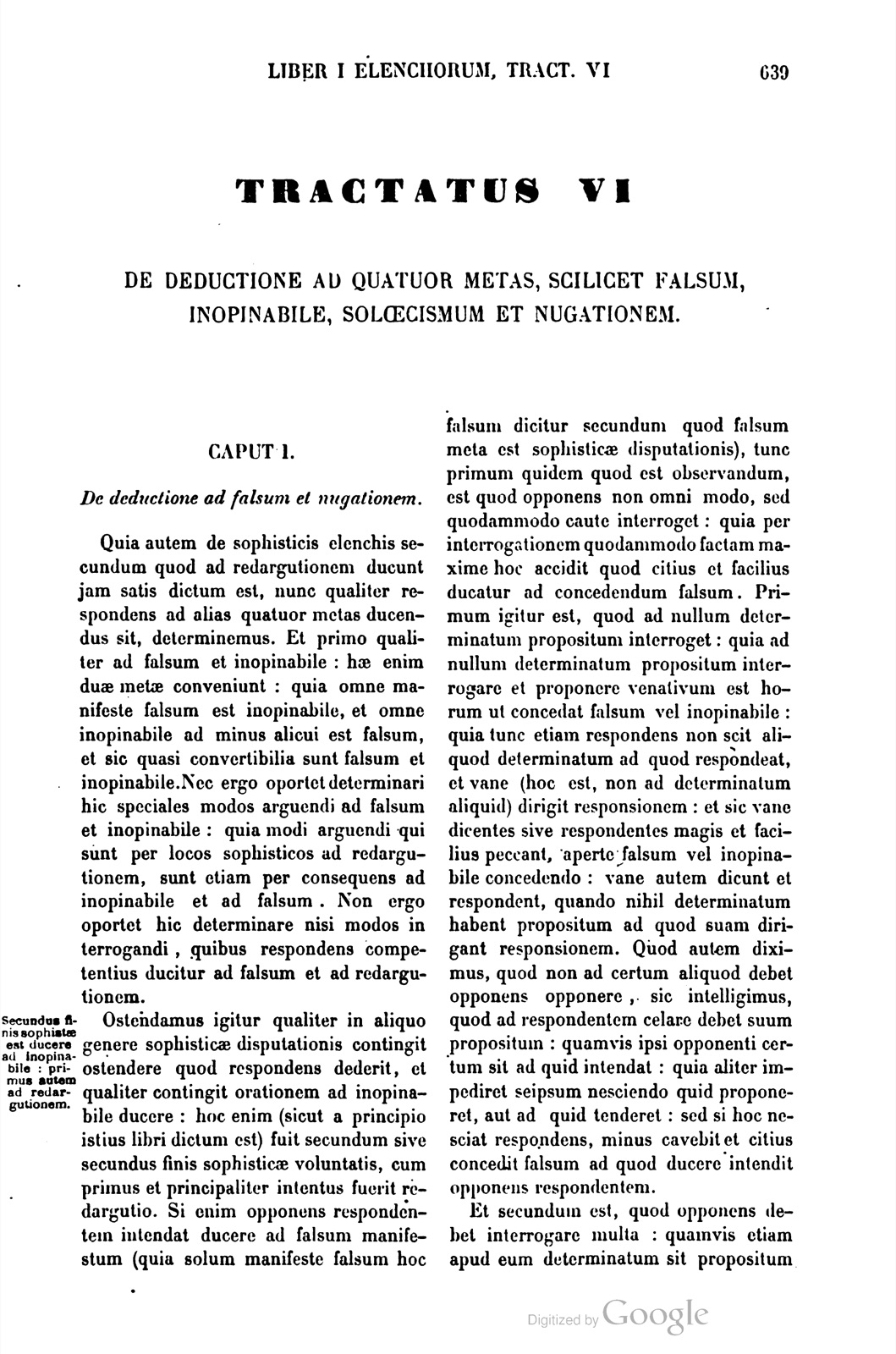
Quia autem de sophisticis elenchis secundum quod ad redargutionem ducunt jam satis dictum est, nunc qualiter respondens ad alias quatuor metas ducendus sit, determinemus. Et primo qualiter ad falsum et inopinabile: hae enim duae metae conveniunt: quia omne manifeste falsum est inopinabile, et omne inopinabile ad minus alicui est falsum, et sic quasi convertibilia sunt falsum et inopinabile. Nec ergo oportet determinari hic speciales modos arguendi ad falsum et inopinabile: quia modi arguendi qui sunt per locos sophisticos ad redargutionem, sunt etiam per consequens ad inopinabile et ad falsum. Non ergo oportet hic determinare nisi modos interrogandi, quibus respondens competentius ducitur ad falsum et ad redargutionem.
Ostendamus igitur qualiter in aliquo genere sophisticae disputationis contingit ostendere quod respondens dederit, et qualiter contingit orationem ad inopinabile ducere: hoc enim (sicut a principio istius libri dictum est) fuit secundum sive secundus finis sophisticae voluntatis, cum primus et principaliter intentus fuerit redargutio. Si enim opponens respondentem intendat ducere ad falsum manifestum (quia solum manifeste falsum hoc falsum dicitur secundum quod falsum meta est sophisticae disputationis), tunc primum quidem quod est observandum, est quod opponens non omni modo, sed quodammodo caute interroget: quia per interrogationem quodammodo factam maxime hoc accidit quod citius et facilius ducatur ad concedendum falsum. Primum igitur est, quod ad nullum determinatum propositum interroget: quia ad nullum determinatum propositum interrogare et proponere venativum est horum ut concedat falsum vel inopinabile: quia tunc etiam respondens non scit aliquid determinatum ad quod respondeat, et vane (hoc est, non ad determinatum aliquid) dirigit responsionem: et sic vane dicentes sive respondentes magis et facilius peccant, aperte falsum vel inopinabile concedendo: vane autem dicunt et respondent, quando nihil determinatum habent propositum ad quod suam dirigant responsionem. Quod autem diximus, quod non ad certum aliquod debet opponens opponere, sic intelligimus, quod ad respondentem celare debet suum propositum: quamvis ipsi opponenti certum sit ad quid intendat: quia aliter impediret seipsum nesciendo quid proponeret, aut ad quid tenderet: sed si hoc nesciat respondens, minus cavebit et citius concedit falsum ad quod ducere intendit opponens respondentem.
Et secundum est, quod opponens debet interrogare multa: quamvis etiam apud eum determinatum sit propositum suum ad quod disputat: hoc enim facile est opponenti facere in his in quibus abundat syllogismis et rationibus: quod facile est in his quae apparent probabilia: quia ista in multis sunt et facile inveniuntur: multis enim sic interrogatis confunditur respondens, et facilius concedit falsum et inopinabile.
TRACTATE VI. CONCERNING DEDUCTION TO THE FOUR GOALS, NAMELY THE FALSE, THE IMPROBABLE, SOLECISM, AND NUGATION.
CHAPTER I. Concerning deduction to the false and to nugation.
But because enough has already been said concerning sophistical refutations according as they lead to refutation, let us now determine how the respondent is to be led to the other four goals. And first, how he is led to the false and to the improbable; for these two goals agree, because everything manifestly false is improbable, and everything improbable is at least false to someone, and thus the false and the improbable are as it were convertible. Therefore special modes of arguing to the false and improbable need not be determined here, because the modes of arguing which are through sophistical places to refutation are also consequently to the improbable and to the false. Therefore it is necessary here to determine only the modes of questioning by which the respondent is more fittingly led to the false and to refutation.
Therefore let us show how in some genus of sophistical disputation it happens to show what the respondent has given, and how it happens to lead speech to the improbable. For this, as was said from the beginning of this book, was the second, or second end, of the sophistical will, since the first and principally intended end was refutation. For if the opponent intends to lead the respondent to a manifest falsehood, because only the manifestly false is called false according as the false is the goal of sophistical disputation, then the first thing which must be observed is that the opponent question not in every way, but cautiously in a certain way, because through questioning made in a certain way this especially happens, that he is more quickly and more easily led to granting the false. Therefore the first thing is that he not question toward any determinate proposition, because to question and propose toward no determinate proposition is something hunting for these things, so that he may grant the false or improbable; for then also the respondent does not know anything determinate to which he should respond, and vainly, that is, not toward anything determinate, directs his response. And thus those who speak or respond vainly sin more and more easily by openly granting the false or improbable. But they speak and respond vainly when they have nothing determinate proposed to which they may direct their response. But what we said, that the opponent ought not to oppose toward some certain thing, we understand thus: that he ought to hide his proposition from the respondent, although it is certain to the opponent himself toward what he intends, because otherwise he would impede himself by not knowing what he would propose or toward what he would tend. But if the respondent does not know this, he will take less precaution and more quickly grants the false to which the opponent intends to lead the respondent.
And the second is that the opponent ought to ask many things, although even for him his proposition toward which he disputes is determinate. For this is easy for the opponent to do in those things in which he abounds in syllogisms and reasons, which is easy in those things which appear probable, because these are in many things and are easily found. For when many things are asked in this way, the respondent is confused and more easily grants the false and improbable.
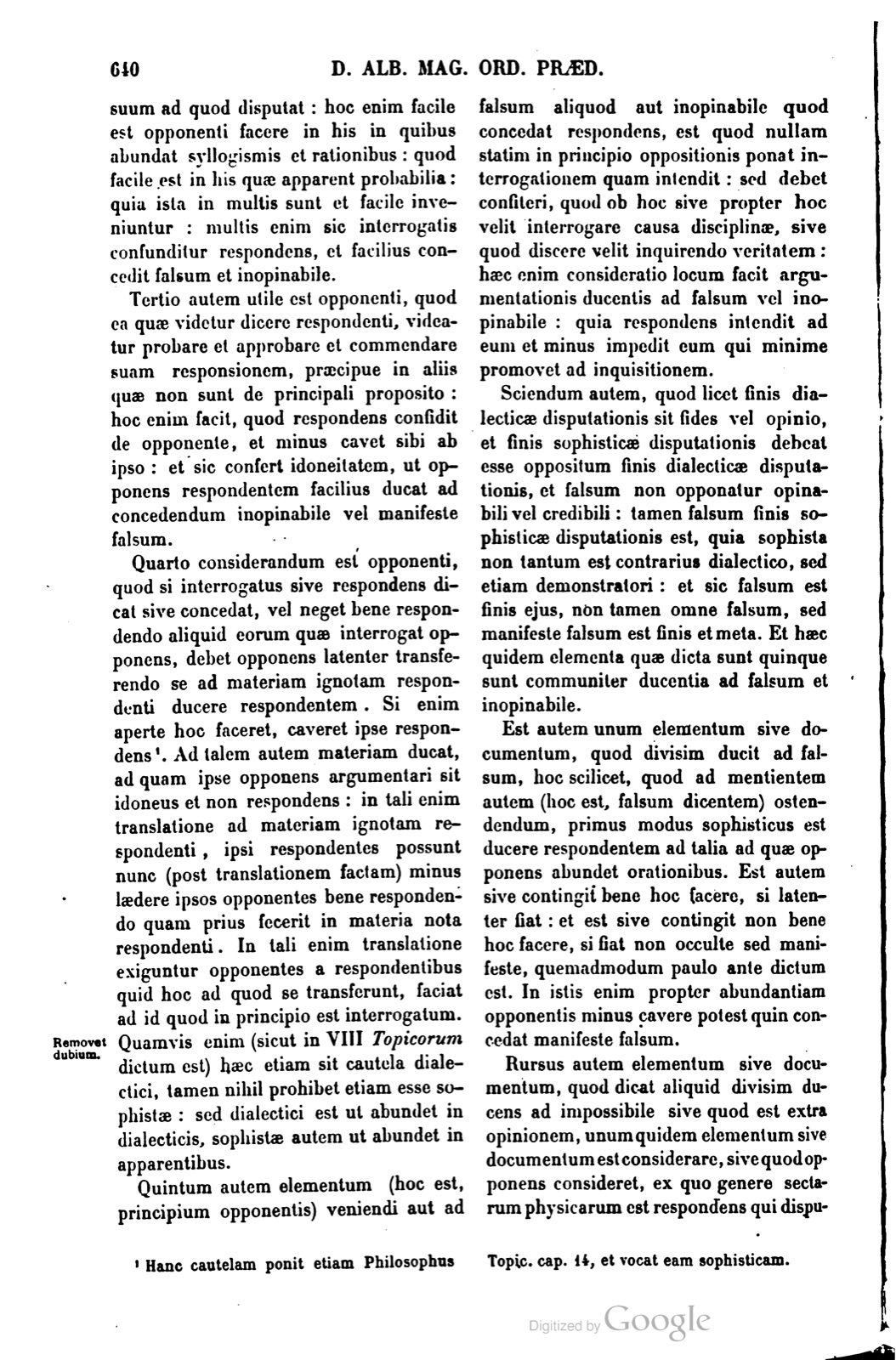
Tertio autem utile est opponenti, quod ea quae videtur dicere respondenti, videatur probare et approbare et commendare suam responsionem, praecipue in aliis quae non sunt de principali proposito: hoc enim facit, quod respondens confidit de opponente, et minus cavet sibi ab ipso: et sic confert idoneitatem, ut opponens respondentem facilius ducat ad concedendum inopinabile vel manifeste falsum.
Quarto considerandum est opponenti, quod si interrogatus sive respondens dicat sive concedat, vel neget bene respondendo aliquid eorum quae interrogat opponens, debet opponens latenter transferendo se ad materiam ignotam respondenti ducere respondentem. Si enim aperte hoc faceret, caveret ipse respondens1. Ad talem autem materiam ducat, ad quam ipse opponens argumentari sit idoneus et non respondens: in tali enim translatione ad materiam ignotam respondenti, ipsi respondentes possunt nunc (post translationem factam) minus laedere ipsos opponentes bene respondendo quam prius fecerit in materia nota respondenti. In tali enim translatione exiguntur opponentes a respondentibus quid hoc ad quod se transferunt, faciat ad id quod in principio est interrogatum. Quamvis enim (sicut in VIII Topicorum dictum est) haec etiam sit cautela dialectici, tamen nihil prohibet etiam esse sophistae: sed dialectici est ut abundet in dialecticis, sophistae autem ut abundet in apparentibus.
Quintum autem elementum (hoc est, principium opponentis) veniendi aut ad falsum aliquod aut inopinabile quod concedat respondens, est quod nullam statim in principio oppositionis ponat interrogationem quam intendit: sed debet confiteri, quod ob hoc sive propter hoc velit interrogare causa disciplinae, sive quod discere velit inquirendo veritatem: haec enim consideratio locum facit argumentationis ducentis ad falsum vel inopinabile: quia respondens intendit ad eum et minus impedit eum qui minime promovet ad inquisitionem.
Sciendum autem, quod licet finis dialecticae disputationis sit fides vel opinio, et finis sophisticae disputationis debeat esse oppositum finis dialecticae disputationis, et falsum non opponatur opinabili vel credibili: tamen falsum finis sophisticae disputationis est, quia sophista non tantum est contrarius dialectico, sed etiam demonstratori: et sic falsum est finis ejus, non tamen omne falsum, sed manifeste falsum est finis et meta. Et haec quidem elementa quae dicta sunt quinque sunt communiter ducentia ad falsum et inopinabile.
Est autem unum elementum sive documentum, quod divisim ducit ad falsum, hoc scilicet, quod ad mentientem autem (hoc est, falsum dicentem) ostendendum, primus modus sophisticus est ducere respondentem ad talia ad quae opponens abundet orationibus. Est autem sive contingit bene hoc facere, si latenter fiat: et est sive contingit non bene hoc facere, si fiat non occulte sed manifeste, quemadmodum paulo ante dictum est. In istis enim propter abundantiam opponentis minus cavere potest quin concedat manifeste falsum.
But third, it is useful to the opponent that those things which he seems to say to the respondent should seem to prove and approve and commend his response, especially in other things which are not about the principal proposition. For this causes the respondent to trust the opponent and to take less precaution against him; and thus it confers suitability, so that the opponent may more easily lead the respondent to granting the improbable or the manifestly false.
Fourth, the opponent must consider that if the questioned person or respondent says or grants, or denies by responding well, something of those things which the opponent asks, the opponent ought to lead the respondent by secretly transferring himself to matter unknown to the respondent. For if he did this openly, the respondent himself would take precaution1. But let him lead him to such matter as the opponent himself is fit to argue about, and not the respondent. For in such a transfer to matter unknown to the respondent, the respondents themselves can now, after the transfer has been made, harm the opponents less by responding well than they previously did in matter known to the respondent. For in such a transfer the opponents are required by the respondents to say what that to which they transfer themselves does toward that which was questioned in the beginning. For although, as was said in book VIII of the Topics, this too is a precaution of the dialectician, nevertheless nothing prevents it also being a precaution of the sophist; but it belongs to the dialectician to abound in dialectical things, and to the sophist to abound in apparent things.
But the fifth element, that is, principle of the opponent, for coming either to some false or improbable thing which the respondent may grant, is that at once in the beginning of the opposition he posit no question which he intends; rather he ought to confess that for this or because of this he wishes to ask for the sake of learning, or that he wishes to learn by inquiring into the truth. For this consideration makes a place of argumentation leading to the false or improbable, because the respondent attends to him and impedes less the one who least advances toward inquiry.
But it must be known that although the end of dialectical disputation is belief or opinion, and the end of sophistical disputation ought to be the opposite of the end of dialectical disputation, and the false is not opposed to the opinionable or credible, nevertheless the false is the end of sophistical disputation, because the sophist is not only contrary to the dialectician but also to the demonstrator; and thus the false is his end, not however every false thing, but the manifestly false is the end and goal. And these five elements which have been stated are commonly leading to the false and improbable.
But there is one element or teaching which separately leads to the false, namely this: that for showing one lying, that is, saying the false, the first sophistical mode is to lead the respondent to such things in which the opponent abounds in speeches. But it is, or happens to be, good to do this if it is done secretly; and it is, or happens to be, not good to do this if it is done not hiddenly but manifestly, as was said a little before. For in these things, because of the abundance of the opponent, he can take less precaution against granting the manifestly false.
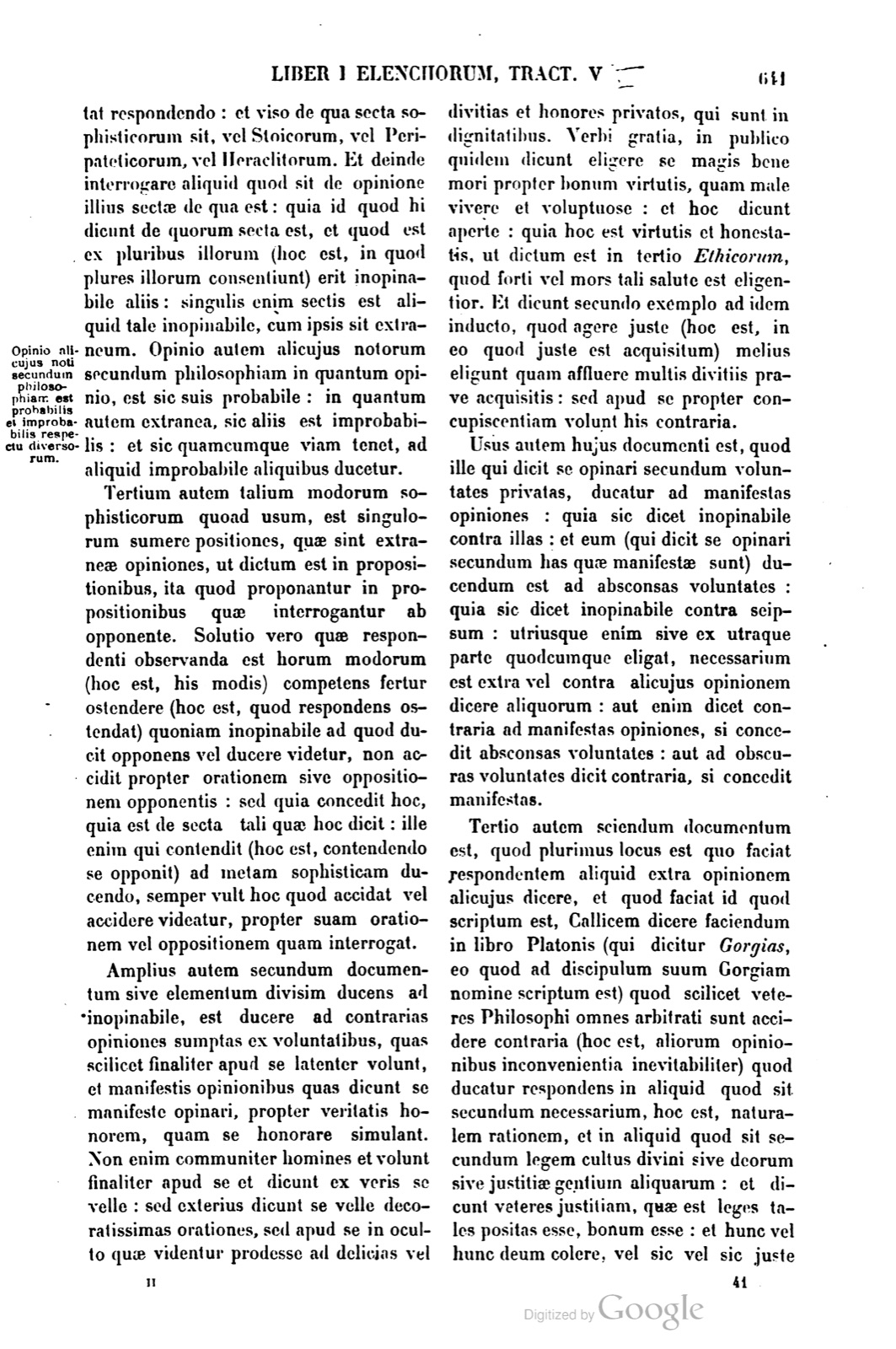
Rursus autem elementum sive documentum, quod dicat aliquid divisim ducens ad impossibile sive quod est extra opinionem, unum quidem elementum sive documentum est considerare, sive quod opponens consideret, ex quo genere sectarum physicarum est respondens qui disputat respondendo: et viso de qua secta sophisticorum sit, vel Stoicorum, vel Peripateticorum, vel Heraclitorum. Et deinde interrogare aliquid quod sit de opinione illius sectae de qua est: quia id quod hi dicunt de quorum secta est, et quod est ex pluribus illorum (hoc est, in quod plures illorum consentiunt) erit inopinabile aliis: singulis enim sectis est aliquid tale inopinabile, cum ipsis sit extraneum. Opinio autem alicujus notorum secundum philosophiam in quantum opinio, est sic suis probabile: in quantum autem extranea, sic aliis est improbabile: et sic quamcumque viam tenet, ad aliquid improbabile aliquibus ducetur.
Tertium autem talium modorum sophisticorum quoad usum, est singulorum sumere positiones, quae sint extraneae opiniones, ut dictum est in propositionibus, ita quod proponantur in propositionibus quae interrogantur ab opponente. Solutio vero quae respondenti observanda est horum modorum (hoc est, his modis) competens fertur ostendere (hoc est, quod respondens ostendat) quoniam inopinabile ad quod ducit opponens vel ducere videtur, non accidit propter orationem sive oppositionem opponentis: sed quia concedit hoc, quia est de secta tali quae hoc dicit: ille enim qui contendit (hoc est, contendendo se opponit) ad metam sophisticam ducendo, semper vult hoc quod accidat vel accidere videatur, propter suam orationem vel oppositionem quam interrogat.
Amplius autem secundum documentum sive elementum divisim ducens ad inopinabile, est ducere ad contrarias opiniones sumptas ex voluntatibus, quas scilicet finaliter apud se latenter volunt, et manifestis opinionibus quas dicunt se manifeste opinari, propter veritatis honorem, quam se honorare simulant. Non enim communiter homines et volunt finaliter apud se et dicunt ex veris se velle: sed exterius dicunt se velle decoratissimas orationes, sed apud se in occulto quae videntur prodesse ad delicias vel divitias et honores privatos, qui sunt in dignitatibus. Verbi gratia, in publico quidem dicunt eligere se magis bene mori propter bonum virtutis, quam male vivere et voluptuose: et hoc dicunt aperte: quia hoc est virtutis et honestatis, ut dictum est in tertio Ethicorum, quod forti vel mors tali salute est eligentior. Et dicunt secundo exemplo ad idem inducto, quod agere juste (hoc est, in eo quod juste est acquisitum) melius eligunt quam affluere multis divitiis prave acquisitis: sed apud se propter concupiscentiam volunt his contraria.
Usus autem hujus documenti est, quod ille qui dicit se opinari secundum voluntates privatas, ducatur ad manifestas opiniones: quia sic dicet inopinabile contra illas: et eum (qui dicit se opinari secundum has quae manifestae sunt) ducendum est ad absconsas voluntates: quia sic dicet inopinabile contra seipsum: utriusque enim sive ex utraque parte quodcumque eligat, necessarium est extra vel contra alicujus opinionem dicere aliquorum: aut enim dicet contraria ad manifestas opiniones, si concedit absconsas voluntates: aut ad obscuras voluntates dicit contraria, si concedit manifestas.
Again, an element or teaching which says something separately leading to the impossible or to what is outside opinion is this one element or teaching: to consider, or that the opponent consider, from what genus of physical sects the respondent is who disputes by responding; and once it has been seen from what sect he is, whether of the Sophists or Stoics or Peripatetics or Heracliteans, then to ask something which is of the opinion of that sect of which he is. For that which these men say, of whose sect he is, and which is from several of them, that is, that to which several of them consent, will be improbable to others; for to individual sects something of this sort is improbable, since it is foreign to them. But the opinion of some known persons according to philosophy, insofar as it is an opinion, is thus probable to its own people; but insofar as it is foreign, it is thus improbable to others. And thus whatever way he holds, he will be led to something improbable to some people.
But the third of such sophistical modes with respect to use is to take the positions of individuals which are foreign opinions, as was said in the propositions, so that they are proposed in propositions which are asked by the opponent. But the solution which must be observed by the respondent, fitting for these modes, that is, in these modes, is said to show, that is, that the respondent should show, that the improbable thing to which the opponent leads or seems to lead does not happen because of the speech or opposition of the opponent, but because he grants this, because he is of such a sect which says this. For he who contends, that is, opposes himself by contending, by leading to the sophistical goal, always wishes this to happen or seem to happen because of his speech or opposition which he asks.
Moreover, the second teaching or element separately leading to the improbable is to lead to contrary opinions taken from wills, namely from those which they finally and secretly will within themselves, and from the manifest opinions which they say that they manifestly hold because of the honor of truth, which they pretend to honor. For commonly men do not both finally will within themselves and say from true things that they will; rather outwardly they say that they will the most seemly speeches, but within themselves in secret they will those things which seem to profit for delights or riches and private honors which are in dignities. For example, in public they indeed say that they more choose to die well because of the good of virtue than to live badly and voluptuously, and they say this openly, because this belongs to virtue and honorable goodness, as was said in the third book of the Ethics, that for the brave man even such a death is more choiceworthy than safety. And they say by a second example brought in to the same point that they better choose to act justly, that is, in that which has been justly acquired, than to overflow with many badly acquired riches; but within themselves because of concupiscence they will the contrary to these.
But the use of this teaching is that the one who says that he opines according to private wills be led to manifest opinions, because thus he will say something improbable against those; and that he who says that he opines according to those which are manifest be led to hidden wills, because thus he will say something improbable against himself. For from either side or from each part, whatever he chooses, it is necessary to say something outside or against the opinion of some people; for either he will say things contrary to manifest opinions, if he grants hidden wills, or he says things contrary to obscure wills, if he grants manifest ones.
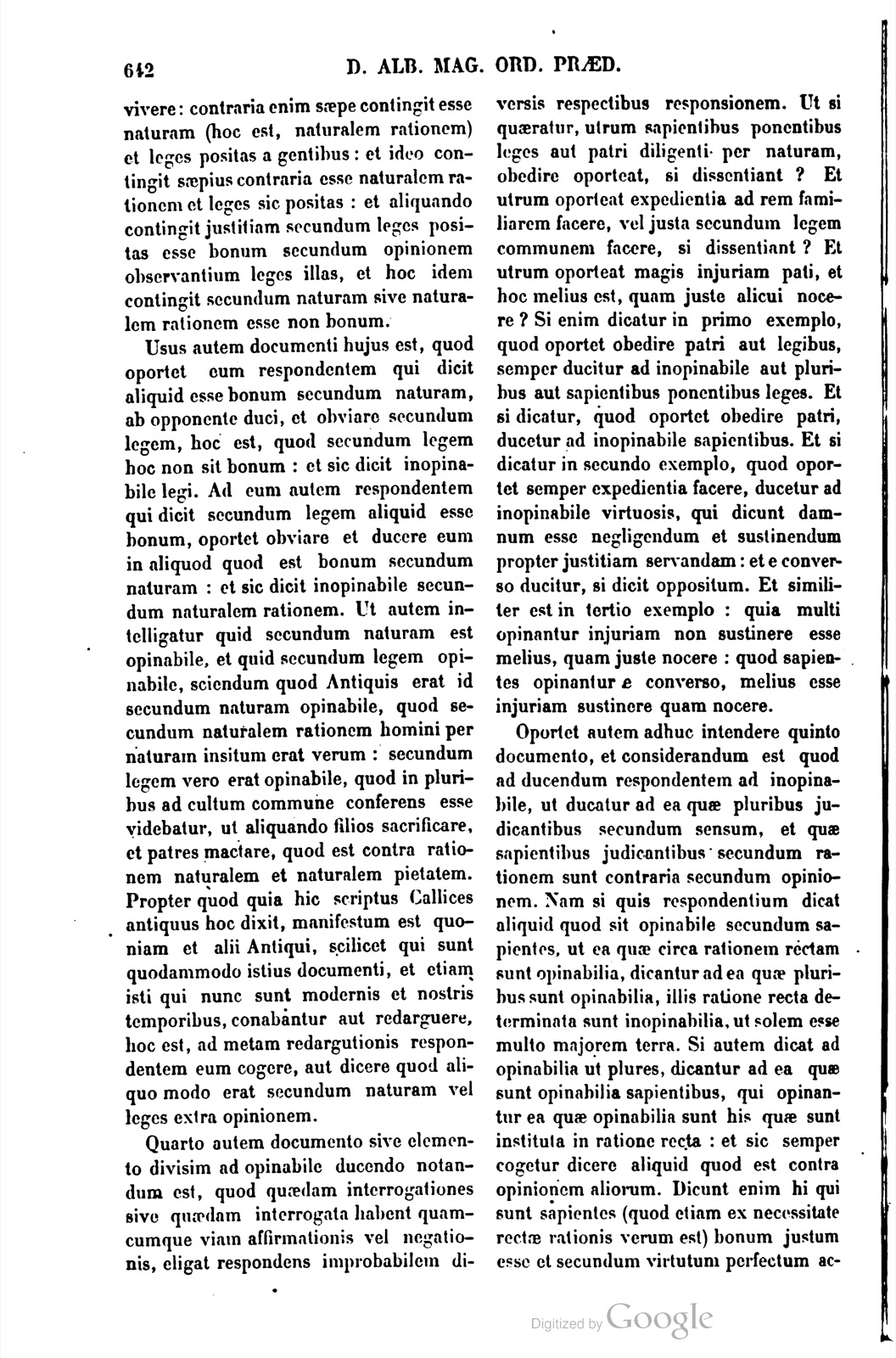
Tertio autem sciendum documentum est, quod plurimus locus est quo faciat respondentem aliquid extra opinionem alicujus dicere, et quod faciat id quod scriptum est, Callicem dicere faciendum in libro Platonis (qui dicitur Gorgias, eo quod ad discipulum suum Gorgiam nomine scriptum est) quod scilicet veteres Philosophi omnes arbitrati sunt accidere contraria (hoc est, aliorum opinionibus inconvenientia inevitabiliter) quod ducatur respondens in aliquid quod sit secundum necessarium, hoc est, naturalem rationem, et in aliquid quod sit secundum legem cultus divini sive deorum sive justitiae gentium aliquarum: et dicunt veteres justitiam, quae est leges tales positas esse, bonum esse: et hunc vel hunc deum colere, vel sic vel sic juste vivere: contraria enim saepe contingit esse naturam (hoc est, naturalem rationem) et leges positas a gentibus: et ideo contingit saepius contraria esse naturalem rationem et leges sic positas: et aliquando contingit justitiam secundum leges positas esse bonum secundum opinionem observantium leges illas, et hoc idem contingit secundum naturam sive naturalem rationem esse non bonum.
Usus autem documenti hujus est, quod oportet cum respondentem qui dicit aliquid esse bonum secundum naturam, ab opponente duci, et obviare secundum legem, hoc est, quod secundum legem hoc non sit bonum: et sic dicit inopinabile legi. Ad eum autem respondentem qui dicit secundum legem aliquid esse bonum, oportet obviare et ducere eum in aliquod quod est bonum secundum naturam: et sic dicit inopinabile secundum naturalem rationem. Ut autem intelligatur quid secundum naturam est opinabile, et quid secundum legem opinabile, sciendum quod Antiquis erat id secundum naturam opinabile, quod secundum naturalem rationem homini per naturam insitum erat verum: secundum legem vero erat opinabile, quod in pluribus ad cultum commune conferens esse videbatur, ut aliquando filios sacrificare, et patres mactare, quod est contra rationem naturalem et naturalem pietatem. Propter quod quia hic scriptus Callicles antiquus hoc dixit, manifestum est quoniam et alii Antiqui, scilicet qui sunt quodammodo istius documenti, et etiam isti qui nunc sunt modernis et nostris temporibus, conabantur aut redarguere, hoc est, ad metam redargutionis respondentem eum cogere, aut dicere quod aliquo modo erat secundum naturam vel leges extra opinionem.
Quarto autem documento sive elemento divisim ad opinabile ducendo notandum est, quod quaedam interrogationes sive quaedam interrogata habent quamcumque viam affirmationis vel negationis, eligat respondens improbabilem diversis respectibus responsionem. Ut si quaeratur, utrum sapientibus ponentibus leges aut patri diligenti per naturam, obedire oporteat, si dissentiant? Et utrum oporteat expedientia ad rem familiarem facere, vel justa secundum legem communem facere, si dissentiant? Et utrum oporteat magis injuriam pati, et hoc melius est, quam juste alicui nocere? Si enim dicatur in primo exemplo, quod oportet obedire patri aut legibus, semper ducitur ad inopinabile aut pluribus aut sapientibus ponentibus leges. Et si dicatur, quod oportet obedire patri, ducetur ad inopinabile sapientibus. Et si dicatur in secundo exemplo, quod oportet semper expedientia facere, ducetur ad inopinabile virtuosis, qui dicunt damnum esse negligendum et sustinendum propter justitiam servandam: et e converso ducitur, si dicit oppositum. Et similiter est in tertio exemplo: quia multi opinantur injuriam non sustinere esse melius, quam juste nocere: quod sapientes opinantur e converso, melius esse injuriam sustinere quam nocere.
But third, the teaching to be known is that there is a very frequent place by which he may make the respondent say something outside the opinion of someone, and by which he may make what is written, that Callicles must be made to say in Plato's book, which is called Gorgias because it was written to his disciple by the name Gorgias: namely that all the ancient philosophers judged that contrary things happen, that is, things unfitting to the opinions of others inevitably, because the respondent is led into something which is according to necessity, that is, natural reason, and into something which is according to the law of divine worship or of the gods or of the justice of some peoples. And the ancients say that justice, which is that such posited laws exist, is good, and that to worship this or that god, or to live justly in this way or that way, is good. For nature, that is, natural reason, and laws posited by peoples often happen to be contrary; and therefore natural reason and laws thus posited happen rather often to be contrary. And sometimes justice according to posited laws happens to be good according to the opinion of those observing those laws, and this same thing happens according to nature or natural reason to be not good.
But the use of this teaching is that, with the respondent who says that something is good according to nature, he must be led by the opponent and resisted according to law, that is, that according to law this is not good; and thus he says something improbable to law. But toward that respondent who says that something is good according to law, one must resist and lead him into something which is good according to nature; and thus he says something improbable according to natural reason. But in order that it may be understood what is opinionable according to nature and what is opinionable according to law, it must be known that for the ancients that was opinionable according to nature which, according to natural reason, was true as implanted in man by nature; but according to law that was opinionable which in many cases seemed to contribute something common to worship, as sometimes to sacrifice sons and to slaughter fathers, which is against natural reason and natural piety. For this reason, because this ancient Callicles who is written here said this, it is manifest that both other ancients, namely those who in some way belong to this teaching, and also those who are now in modern and our times, tried either to refute, that is, to compel that respondent to the goal of refutation, or to say that in some way it was outside opinion according to nature or laws.
But in the fourth teaching or element leading separately to the opinionable, it must be noted that certain questions or certain things questioned have, whichever way of affirmation or negation the respondent chooses, an improbable response in diverse respects. As if it is asked whether one ought to obey wise men positing laws or a father loving by nature, if they disagree? And whether one ought to do advantageous things for household affairs, or do just things according to common law, if they disagree? And whether one ought rather to suffer injury, and this is better, than justly to harm someone? For if in the first example it is said that one ought to obey the father or the laws, he is always led to the improbable either to many people or to wise men positing laws. And if it is said that one ought to obey the father, he will be led to the improbable to wise men. And if in the second example it is said that one must always do advantageous things, he will be led to the improbable to virtuous persons, who say that loss must be neglected and sustained for the sake of justice being preserved; and conversely he is led if he says the opposite. And likewise it is in the third example, because many opine that not sustaining injury is better than justly harming; but wise men opine conversely, that to sustain injury is better than to harm.
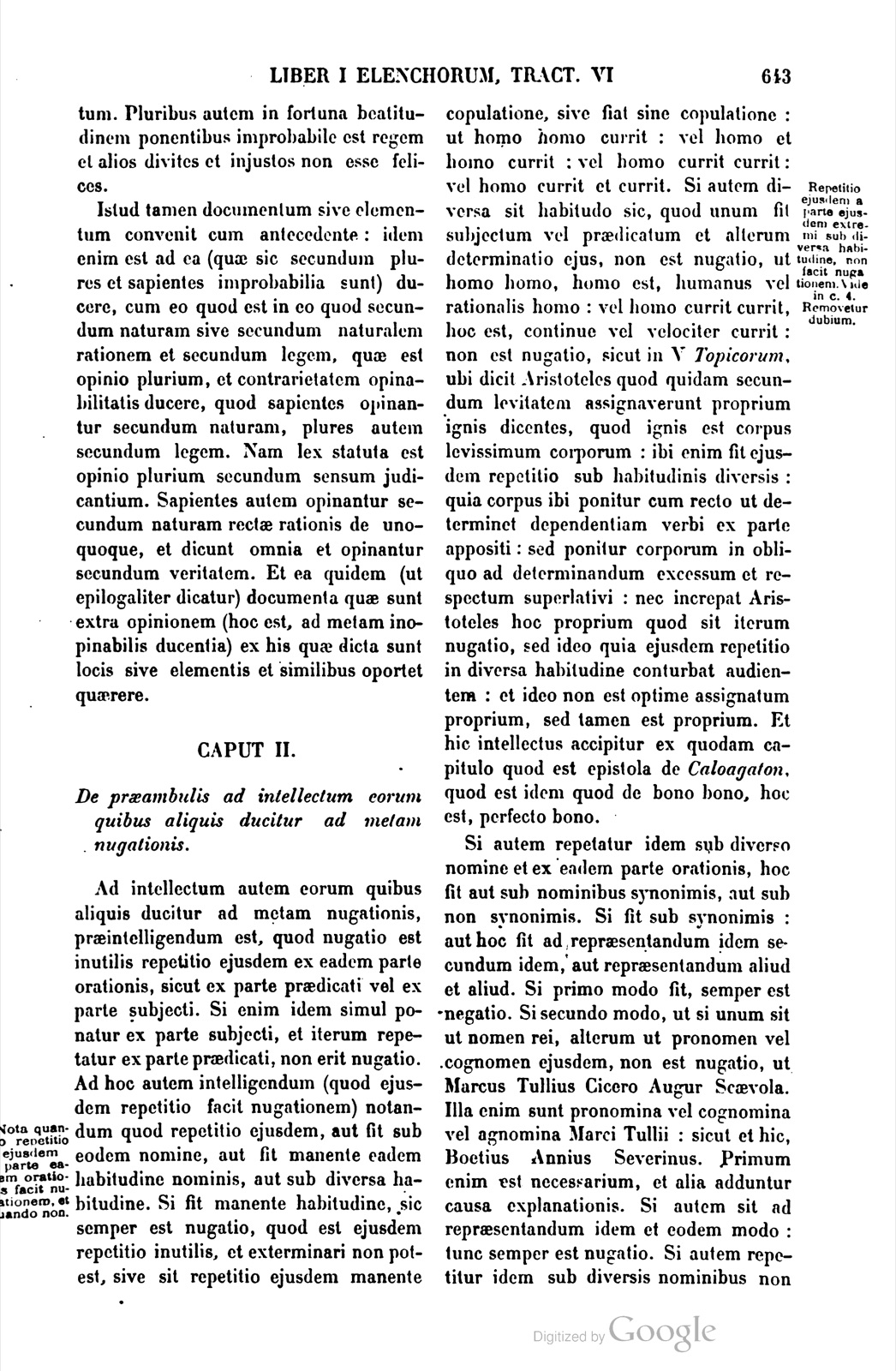
Oportet autem adhuc intendere quinto documento, et considerandum est quod ad ducendum respondentem ad inopinabile, ut ducatur ad ea quae pluribus judicantibus secundum sensum, et quae sapientibus judicantibus secundum rationem sunt contraria secundum opinionem. Nam si quis respondentium dicat aliquid quod sit opinabile secundum sapientes, ut ea quae circa rationem rectam sunt opinabilia, dicantur ad ea quae pluribus sunt opinabilia, illis ratione recta determinata sunt inopinabilia, ut solem esse multo majorem terra. Si autem dicat ad opinabilia ut plures, dicantur ad ea quae sunt opinabilia sapientibus, qui opinantur ea quae opinabilia sunt his quae sunt instituta in ratione recta: et sic semper cogetur dicere aliquid quod est contra opinionem aliorum. Dicunt enim hi qui sunt sapientes (quod etiam ex necessitate rectae rationis verum est) bonum justum esse et secundum virtutum perfectum actum. Pluribus autem in fortuna beatitudinem ponentibus improbabile est regem et alios divites et injustos non esse felices.
Istud tamen documentum sive elementum convenit cum antecedente: idem enim est ad ea (quae sic secundum plures et sapientes improbabilia sunt) ducere, cum eo quod est in eo quod secundum naturam sive secundum naturalem rationem et secundum legem, quae est opinio plurium, et contrarietatem opinabilitatis ducere, quod sapientes opinantur secundum naturam, plures autem secundum legem. Nam lex statuta est opinio plurium secundum sensum judicantium. Sapientes autem opinantur secundum naturam rectae rationis de unoquoque, et dicunt omnia et opinantur secundum veritatem. Et ea quidem (ut epilogaliter dicatur) documenta quae sunt extra opinionem (hoc est, ad metam inopinabilis ducentia) ex his quae dicta sunt locis sive elementis et similibus oportet quaerere.
But one must still attend to the fifth teaching, and it must be considered that, for leading the respondent to the improbable, he is to be led to those things which are contrary according to opinion to the things judged by many according to sense and to the things judged by wise men according to reason. For if one of the respondents says something which is opinionable according to wise men, as the things which are opinionable about right reason are said in relation to those things which are opinionable to many, those things determined by right reason are improbable to them, as that the sun is much greater than the earth. But if he says something according to opinionable things as many people do, let them be said in relation to those things which are opinionable to wise men, who opine those things which are opinionable according to things established in right reason; and thus he will always be compelled to say something which is against the opinion of others. For those who are wise say, what is also true from the necessity of right reason, that the just good is according to the perfect act of virtues. But to the many who posit beatitude in fortune, it is improbable that the king and other rich and unjust persons are not happy.
Yet that teaching or element agrees with the preceding one; for to lead to those things which in this way are improbable according to the many and according to wise men is the same as to lead with respect to that which is according to nature or according to natural reason and according to law, which is the opinion of the many, and to the contrariety of opinionability, which wise men opine according to nature, but the many according to law. For statute law is the opinion of the many judging according to sense. But wise men opine according to the nature of right reason about each thing, and say and opine all things according to truth. And indeed, to speak by way of epilogue, the teachings which are outside opinion, that is, leading to the goal of the improbable, must be sought from these places or elements which have been stated and from similar ones.
Notes
- The Philosopher also posits this precaution in Topics, chapter 14, and calls it sophistical. (Hanc cautelam ponit etiam Philosophus Topic. cap. 14, et vocat eam sophisticam.) ↩
If a page does not appear, its photograph has not been uploaded yet.