Works › Sophistical Refutations, Books I–II
Volume 2 · pp. 633–638
Tractate V. Chapter VII and Chapter VI
A marker with ≈ is an approximate page boundary, placed by measure of the text; the page photographs remain the authority. In the paired views, clicking a page marker brings that page into view.
Et hoc probatur simili exemplo: quemadmodum enim ista injuria, quae in certamine est, quamdam speciem habet secundum formam resistentiae, et secundum illam est injusta ratio quando oppugnat justo: sic in contradictione (hoc est, in disputatione et syllogismo ad contradictionem ducente) injusta contentio (quae non habet illa ex quibus ut propriis fit redargutio) litigiosa est: nam et illis in certaminibus illi qui omnino et omni modo per justa et per injusta vincere volunt, omnia et ad se pertinentia et ad se non pertinentia apprehendunt, ut ex propriis et alienis adjuventur: et similiter hi litigiosi sunt, qui communia apprehendunt, quae ad se ut propria non pertinent: finibus enim intentis et propriis distinguuntur sophisticus et litigiosus, quamvis subjecto idem sint et secundum hoc.
Ergo syllogismi et homines qui ob victoriam ipsam tales sunt, ut per communia vincant, sunt litigiosi homines, et syllogismi eorum sunt litigiosae orationes. Qui autem homines et syllogismi tales sunt propter gloriam apparentis sapientiae, quae est in divitiis sive copiositate apparentis sapientiae, sunt homines sophistici et sophisticae orationes. A principio enim hujus scientiae dictum est, quod sophista vult videri copiosus ab apparente sapientia: nam sophistica est quaedam scientia indicativa ejus qui habet eam ab apparente sapientia, sicut in ante habitis dictum est: propter quod isti sophistae appetunt eam quae est apparens demonstratio, apparentem faciens scientiam vel sapientiam: et haec est illa demonstratio sive syllogismus, qui est ex communibus circa propria. Et ideo quia non differunt litigiosi et sophistae, nisi finibus, ideo in orationibus eisdem secundum substantiam et subjectum sunt litium amatores, et sophistae: sed non sunt propter eadem, sive propter eumdem finem et litigiosi et sophistae: et ideo etiam oratio eadem subjecto erit quidem sophistica et litigiosa, sed non secundum idem, hoc est, ad eumdem finem, sed in eo quidem quod est propter victoriam apparentem (hoc est, quia quaerit apparere quod vincat) est litigiosa: in eo vero sive quod est propter apparentem sapientiam, qua copiosus vult videri, est sophistica: nam sophistica est apparens quaedam sapientia, non autem existens. Sic ergo patet qualiter syllogismus qui est ex communibus circa propria, et litigiosus est et sophisticus. Qualiter autem idem se habeat ad dialecticum syllogismum, nunc dicemus.
Litigiosus autem est talis syllogismus, qui quodammodo in materia se habet ad dialecticum, sicut falsigraphus se habet ad geometricum: et hoc est, quia in hoc quod paralogizabat ex eisdem (hoc est, ex communibus) quae sunt dialecticae: velut etiam falsigraphus paralogizabat ex eisdem (hoc est, ex propriis) quae sunt geometriae: quia si proprium est principium geometriae, ex quibus demonstrat, est etiam oppositum proprio proprium geometriae, ex quo fit falsigraphus: et dicitur falsigraphus, et non litigiosus: quia falso describit figuras, ex principiis tamen et conclusionibus propriis quae sunt sub arte et propria sunt artis. Syllogismus autem qui est ex communibus quae sunt sub dialectica, est circa alia quam circa propria quae sunt sub arte: et hoc quidem jam ante erat manifestum, quod ille erat litigiosus, ut jam dictum est de quadratura facta per lunulas, quia isti erat ex propriis, non erat litigiosa: Brissonis autem quae est per communia, dictum est quod erat litigiosa.
Adhuc autem differentia est inter istos syllogismos, quod hunc quidem qui est falsigraphus, non est monstrare nisi ad geometriam tantum: quia est ex propriis geometriae quae propria sibi soli conveniunt et non alii: et ideo ad aliam scientiam transferri non potest: quamvis enim in Posteriorum libris dictum sit, quod demonstratio aliquando est de genere in genus, si magnitudo numerus quidem est: tamen hoc non verum est, nisi de scientia subalternante ad scientiam subalternatam: subalternans autem et subalternata scientia non differunt sicut alia et alia scientia, sed sicut scientia continens et scientia contenta. Aliquando autem syllogismum qui est ex communibus circa propria, contingit transferre ad plures apud eos scientes quicumque non sciunt quid ex propriis principiis est possibile in qualibet scientia, et quid impossibile est accidere ex illis: quia illi utuntur communibus: tunc enim ille qui est ex communibus per coarctationem communium, aptabit ad id quod est in aliis scientiis, sicut principia communia coarctantur et aptantur ad propria, sicut ex communibus, et Antiphon quadravit ex communibus, sicut et Brisso, sicut superius dictum est.
And this is proved by a similar example: for just as that injustice which is in contest has a certain species according to the form of resistance, and according to that form an unjust reasoning is such when it fights against the just, so in contradiction, that is, in disputation and in a syllogism leading to contradiction, unjust contention, which does not have those things from which refutation is made as from proper things, is contentious. For also in contests those who wish to conquer altogether and in every way by just things and by unjust things take up all things, both those pertaining to them and those not pertaining to them, so that they may be helped from proper and alien things; and similarly these are contentious persons, who take up common things which do not pertain to them as proper things. For the sophistical and the contentious are distinguished by their intended and proper ends, although they are the same in subject and according to this.
Therefore syllogisms and men who are such for the sake of victory itself, so as to conquer through common things, are contentious men, and their syllogisms are contentious speeches. But those men and syllogisms which are such because of the glory of apparent wisdom, which lies in the riches or abundance of apparent wisdom, are sophistical men and sophistical speeches. For from the beginning of this science it has been said that the sophist wishes to seem abundant by apparent wisdom; for sophistic is a certain science indicative of him who has it by apparent wisdom, as was said in the preceding things. For this reason those sophists desire that which is apparent demonstration, making apparent science or wisdom; and this is that demonstration or syllogism which is from common things concerning proper things. And therefore because the contentious and sophists do not differ except by ends, therefore in speeches which are the same according to substance and subject, they are lovers of strife and sophists; but they are not contentious and sophists because of the same things, or because of the same end. And therefore the same speech in subject will indeed be sophistical and contentious, but not according to the same thing, that is, toward the same end; rather in that which is for apparent victory, that is, because it seeks to appear to conquer, it is contentious, but in that which is for apparent wisdom, by which it wishes to seem abundant, it is sophistical; for sophistic is a certain apparent wisdom, but not existing wisdom. Thus therefore it is clear how a syllogism which is from common things concerning proper things is both contentious and sophistical. But how the same thing stands in relation to the dialectical syllogism we shall now say.
But a contentious syllogism is such a syllogism as in a certain way stands in matter toward the dialectical as a falsigraph stands toward the geometrical. This is because it paralogized from the same things, that is, from common things, which belong to dialectic, just as also the falsigraph paralogized from the same things, that is, from proper things, which belong to geometry. For if the principle of geometry from which it demonstrates is proper, then the opposite to the proper principle is also proper to geometry, from which the falsigraph is made; and it is called a falsigraph and not contentious, because it describes figures falsely, yet from proper principles and conclusions which are under the art and are proper to the art. But the syllogism which is from common things that are under dialectic is concerned with things other than the proper things which are under an art. And this indeed was already manifest before, because that one was contentious, as has already been said about the squaring made through lunes: because that was from proper things, it was not contentious; but that of Brisson, which is through common things, has been said to be contentious.
There is also a further difference between these syllogisms, that the one which is a falsigraph cannot be shown except with reference to geometry alone, because it is from proper things of geometry which are proper to it alone and agree with no other science; and therefore it cannot be transferred to another science. For although in the books of the Posterior Analytics it has been said that demonstration is sometimes from genus to genus, if magnitude is indeed number, nevertheless this is not true except from a subalternating science to a subalternated science; but a subalternating and a subalternated science do not differ as one science and another science, but as containing science and contained science. But sometimes it happens to transfer a syllogism which is from common things concerning proper things to several sciences, among those knowing persons who do not know what is possible from proper principles in any science, and what is impossible to happen from them, because they use common things. For then the one which is from common things, through the narrowing of common things, will adapt to that which is in other sciences, as common principles are narrowed and adapted to proper things, as from common things; and Antiphon squared from common things, as did Brisson, as was said above.
Vel in alio exemplo, si quis dixit non esse melius vel bonum post coenam deambulare per Zenonis rationem, et dicat hoc per syllogismum ex communibus qui est non medicinalis, quia non ex propriis medicinae, eo quod communis est per communia sic: in quolibet spatio sunt infinita: infinita autem non contingit pertransire: ergo impossibile est post coenam ambulare. Impossibile autem facere non est bonum. Ergo non est bonum post coenam ambulare. Hae ergo sunt differentiae falsigraphi ad litigiosum qui est ex communibus circa propria.
Hoc autem quod diximus (quod litigiosus se habet ad dialecticum quodammodo sicut falsigraphus ad geometricum) intelligendum est quodammodo et non omni modo: si enim omnino et omni modo se haberet litigiosus ad dialecticum, sicut falsigraphus ad geometricum: tunc oporteret, quod sicut falsigraphus peccat contra geometricum et nunquam est geometricus, ita semper peccaret litigiosus qui est ex communibus circa propria contra dialecticum, et nunquam esset dialecticus: hoc autem falsum est, quia sic litigiosus nunquam esset de illis sive de numero illorum qui sunt dialectici: hoc autem falsum est, quia in superioribus hujus capituli dictum est, quod quidam de talibus syllogismis qui est ex communibus circa propria, est syllogizatus, et habet conclusionem veram: et tunc si ista conclusio sequitur ex veris, erunt praemissae verae et conclusio vera, et consequentia vera: et cum sint ex communibus quae sunt circa singula, erit talis syllogismus vere de numero syllogismorum dialecticorum.
Attendendum autem, quod non oportet ulterius determinare de alio syllogismo. Quamvis enim in Topicis dictum sit, quod quidam est syllogismus apparens qui peccat in forma: et quidam syllogizatus ex falsis, qui peccat in materia potius quam in forma, qui vocatur syllogismus apparens ex apparentibus probabilibus: quia jam determinatum est de peccante in forma et de peccante in materia, satis scitur peccans in utroque per sua componentia. De syllogismo autem ex communibus circa propria in Topicis determinari non debuit: quia illi qui in Topicis habiti sunt peccare contra syllogismum dialecticum, sunt sophistici in veritate: hic autem de quo hic loquimur, non est sophisticus nisi secundum quid, et ad quemdam non topicum syllogismum, et non simpliciter: hic autem est litigiosus et sophisticus, ut dictum est, respectu finium diversorum: et quamvis aliquando concludat verum ex veris, est tamen aliquo modo sophisticus, in quantum apparet facere scientiam ex propriis quam non facit, ut dictum est. Nec oportet hic determinare hujus syllogismi principia, cum sit dialecticus: principia autem dialectici syllogismi determinata sunt in Topicis.
Or in another example, if someone said that it is not better or good to walk after dinner by Zeno's reasoning, and says this through a syllogism from common things which is not medical, because it is not from the proper things of medicine, since it is common through common things thus: in any space there are infinite things; but it is not possible to traverse infinite things; therefore it is impossible to walk after dinner. But to do the impossible is not good. Therefore it is not good to walk after dinner. These therefore are the differences of the falsigraph in relation to the contentious syllogism which is from common things concerning proper things.
But this which we have said, that the contentious stands in a certain way toward the dialectical as the falsigraph stands toward the geometrical, must be understood in a certain way and not in every way. For if the contentious stood altogether and in every way toward the dialectical as the falsigraph stands toward the geometrical, then it would be necessary that, just as the falsigraph sins against the geometrical and is never geometrical, so the contentious syllogism which is from common things concerning proper things would always sin against the dialectical and would never be dialectical. But this is false, because thus the contentious would never be of those, or of the number of those, which are dialectical. But this is false, because in the earlier parts of this chapter it has been said that a certain one of such syllogisms, which is from common things concerning proper things, is syllogized and has a true conclusion; and then, if that conclusion follows from true things, the premises will be true and the conclusion true and the consequence true; and since they are from common things which concern singulars, such a syllogism will truly be of the number of dialectical syllogisms.
But it must be attended that one need not determine further about another syllogism. For although in the Topics it was said that there is a certain apparent syllogism which sins in form, and a certain syllogized syllogism from false things, which sins in matter rather than in form, which is called an apparent syllogism from apparently probable things, nevertheless because it has already been determined concerning the one sinning in form and the one sinning in matter, the one sinning in both is sufficiently known through its components. But concerning the syllogism from common things about proper things it ought not to have been determined in the Topics, because those which in the Topics were held to sin against the dialectical syllogism are in truth sophistical. But this one about which we are speaking here is not sophistical except qualifiedly, and in relation to a certain non-topical syllogism, and not simply. But this one is contentious and sophistical, as has been said, with respect to diverse ends; and although sometimes it concludes the true from true things, it is nevertheless in some way sophistical, insofar as it appears to make science from proper things which it does not make, as has been said. Nor is it necessary here to determine the principles of this syllogism, since it is dialectical; for the principles of the dialectical syllogism have been determined in the Topics.
Adhuc autem intelligendum est, quod iste syllogismus qui est ex communibus circa propria, peccat contra demonstrativum, in hoc quod est ex communibus, quia communia accipit ex propriis: nec tamen in illis communibus quae per se sunt, peccat, quia communia accipit vera: peccare autem in communibus est, quando pro communibus (quae deberent esse vera vel saltem probabilia) accipiuntur falsa vel improbabilia: et si ita fieret, peccaret contra dialecticum. Unde contra demonstrativum in propriis peccat falsigraphus. Per communia autem contra demonstrativum peccat ille qui est ex communibus circa propria.
Et si quis objiciat, quod omnis syllogismus sophisticus peccat contra dialecticum, et sic non est dialecticus, Dicendum quod hoc est verum de syllogismo qui simpliciter est sophisticus: hic enim peccat contra dialecticum: iste autem non est sophisticus, nisi quodammodo, et non simpliciter: et ideo contra dialecticum non peccat: non enim sophisticus est, nisi in hoc quod videtur facere scientiam, cum tamen non faciat: ex communibus enim non fit scientia, sed solum fides et opinio.
Sciendum est quod falsigraphus quamvis sit aliquo modo fallax et injustus, non tamen est litigiosus: quia esse fallacem et injustum, non est tota causa hujus, quod syllogismus sit litigiosus: sed oportet addere, quod fallax sit et injustus et circa omnia, et sic ad hoc quod aliquis syllogismus sit litigiosus, non sufficit hoc solum, quod intendat gloriam de apparenti sapientia, sed addendum est quod hoc faciat circa communia et in communibus.
Attendendum etiam, quod falsigraphus et demonstrativus sunt circa eadem principia incomplexa, sed non sunt circa eadem complexa, nisi dicantur secundum praesentiam esse principia demonstrationis, et secundum absentiam esse principia falsigraphi: sicut nauta per praesentiam est causa salutis navis, et secundum absentiam causa periculi navis.
CAPUT VI. De tentativis syllogismis.
Quia autem jam ante determinatum est de duplici litigioso et tentativo syllogismo: de uno quidem est qui ex communibus et falsis, qui est tentatio circa communia: syllogismus enim qui est circa communia et non arguit secundum rem, monstrat ignorantiam, ut in prae habitis dictum est. Et quia etiam jam paulo ante determinatum est de syllogismo litigioso, qui est ex communibus circa propria, qui est tentatio circa propria: et etiam quia jam saepe dictum est, quia tentativa est quaedam dialectica: ideo nunc determinare oportet de syllogismo tentativo (ut perficiatur doctrina de syllogismo) ex quibus scilicet et qualibus est principiis tentativis, et qualiter convenit cum syllogismo dialectico, et qualiter differt ab eo. Determinabimus igitur, quod tentativa est scientia communis omnium et non determinati generis alicujus, et tamen tentativa est dialectica quaedam.
Dicimus igitur quod non est dialecticus syllogismus necessarius circa aliquod determinatum genus subjecti, quia circa syllogismum ex probabilibus: tamen utens qui est ad omne problema accidentis et generis et proprii et diffinitionis et ejusdem et diversi determinandum, non est circa genus aliquod subjecti necessarius, sed est circa omnia in quibus sunt istae intentiones, genus, accidens, proprium, diffinitio, et idem et diversum, in quibus est habitudo medii probabilis ad inferendum conclusionem ex probabilibus: et talis syllogismus non ostensivus alicujus generis determinati. Et licet ita sit non circa genus determinatum, tamen non est talis qualis est scientiae universalis syllogismus: universalem autem scientiam quae de omnibus est, dicimus metaphysicam sive primam philosophiam. Tria igitur ostendere intendimus, scilicet quod tentativus et dialecticus non sunt alicujus generis subjecti determinati, et quod non est ostensivus alicujus passionis determinatae de aliquo: et tertio cum talis sit, quod tamen non propter hoc est sicut scientia quae theoriae universalis est, sicut prima philosophia.
Further, it must be understood that this syllogism which is from common things concerning proper things sins against the demonstrative syllogism in this, that it is from common things, because it takes common things instead of proper things; yet it does not sin in those common things which are per se, because it takes true common things. But to sin in common things is when false or improbable things are accepted instead of common things which ought to be true or at least probable; and if it were done so, it would sin against the dialectical syllogism. Hence the falsigraph sins against the demonstrative in proper things. But through common things that one which is from common things concerning proper things sins against the demonstrative.
And if someone objects that every sophistical syllogism sins against the dialectical syllogism, and thus is not dialectical, it must be said that this is true of the syllogism which is sophistical simply, for this one sins against the dialectical. But this one is not sophistical except in a certain way and not simply; and therefore it does not sin against the dialectical. For it is sophistical only in this, that it seems to make science although nevertheless it does not make it; for science is not made from common things, but only belief and opinion.
It must be known that a falsigraph, although it is in some way fallacious and unjust, nevertheless is not contentious, because to be fallacious and unjust is not the whole cause of this, that a syllogism is contentious. Rather, one must add that it is fallacious and unjust and concerning all things; and thus, in order that some syllogism be contentious, this alone does not suffice, that it intend glory from apparent wisdom, but it must be added that it does this concerning common things and in common things.
It must also be attended that the falsigraph and the demonstrative are concerned with the same incomplex principles, but are not concerned with the same complex principles, unless they are said according to presence to be principles of demonstration and according to absence to be principles of the falsigraph, just as the sailor by presence is the cause of the safety of the ship and according to absence the cause of the danger of the ship.
CHAPTER VI. Concerning tentative syllogisms.
But because it has already been determined beforehand concerning the twofold contentious and tentative syllogism, concerning one which is from common and false things, which is testing concerning common things; for a syllogism which concerns common things and does not argue according to the thing shows ignorance, as was said in the preceding things. And because it has also already a little before been determined concerning the contentious syllogism, which is from common things concerning proper things, which is testing concerning proper things; and also because it has often already been said that tentative disputation is a certain dialectic, therefore it is now necessary to determine concerning the tentative syllogism, so that the doctrine concerning syllogism may be perfected, namely from which and from what kind of tentative principles it is, and how it agrees with the dialectical syllogism, and how it differs from it. Therefore we shall determine that tentative disputation is the common science of all things and not of some determinate genus, and nevertheless tentative disputation is a certain dialectic.
Therefore we say that the dialectical syllogism is not necessary concerning some determinate genus of subject, because it is concerned with syllogism from probabilities; nevertheless the user who is for determining every problem of accident and genus and property and definition and the same and the diverse is not necessary concerning some genus of subject, but is concerned with all things in which these intentions are, genus, accident, property, definition, and the same and the diverse, in which there is the relation of a probable middle to inferring a conclusion from probabilities. And such a syllogism is not ostensive of some determinate genus. And although it is thus not concerned with a determinate genus, nevertheless it is not such as the syllogism of universal science is; but the universal science which is about all things we call metaphysics or first philosophy. Therefore we intend to show three things: namely that the tentative and the dialectical are not of some determinate genus of subject, and that it is not ostensive of some determinate passion concerning something, and third, since it is such, that nevertheless on this account it is not like the science which belongs to universal theory, as first philosophy is.
Quod autem non sit dialectica utens alicujus generis subjecti determinati, ex hoc probatur, quod dialectica talis est inquisitiva, et interrogativa est de communibus: communia autem de quibus inquirit (quae sunt accidens, et genus, proprium, et diffinitio, sicut hoc est, an insit ei aliquid ut accidens vel genus vel proprium vel diffinitio) non sunt in uno aliquo genere subjecti determinata: ergo dialectica utens dialectico syllogismo, non est circa aliquid quod sit determinatum subjectum. Adhuc si daretur, quod essent omnia sub ente sicut sub uno genere, non sequeretur adhuc, quod possibile esset omnia esse sub eisdem principiis: omnia enim quae sunt sub eisdem principiis, diffinitiones esse non possunt: eo quod nec ea quae sunt sub eodem genere, eisdem principiis determinari non possunt: sicut patet in substantiis intelligibilibus et corporalibus, et substantiis corruptibilibus et incorruptibilibus: et de his quae sunt in quantitate, patet in continuis et discretis, quae ad idem constitutivum sui esse principium reduci non possunt, sed continua fluunt a puncto sicut a suo principio, discreta autem ab unitate. Ens enim non genus constitutivum alicujus generis, prius est eo cujus est genus. Nunc autem cum dividitur ens in substantiam et accidens, ens simpliciter non est ante substantiam: quia simpliciter ens non est nisi substantia: nec ea in quae dividitur ens per differentias, coaequaeva exeunt de ente cum dividitur in substantiam et accidens: substantia quidem est ens, accidens quidem erit modus quidam entis per posterius: et idem genus esse non potest. Dialectica igitur cum sit inquisitiva intentionum et praedicatorum quae insunt omnibus, non potest esse alicujus generis subjecti determinati: nec potest esse ostensiva alicujus determinatae passionis vel praedicati de aliquo subjecto: sed circa subjectum inquirit quid insit ut genus, quid ut accidens, quid ut proprium, quid ut diffinitio. Nec tamen propter hoc est ut universalis et theorica scientia, omnibus dans subjectum particularibus scientiis et omnibus dans passiones. Dialectica enim circa subjectum est inquisitiva quid insit ut praedicatum hoc, vel quid non insit: eo quod et constructive et destructive quaerit quid insit et quid non insit. Scientia autem quae est universalis theoria (quae vocatur metaphysica) de omnium principiis est secundum veritatem et entitatem et necessitatem. Dialectica vero ex probabilibus inquirit quid insit ut praedicatum universale, neque secundum quod intentio est, generale accipit ut genus, et accidentale ut accidens, et appropriabile ut proprium: et haec omnia ex probabilibus et probabiliter inquirit.
Propter quod ex dictis sequitur, quod nulla ars vel scientia alicujus determinatae naturae in subjecto vel passione monstrativa sive ostensiva vel demonstrativa, est interrogativa consensus respondentis, vel etiam utriusque partis contradictionis: quia haec sola interrogatio quando interrogatur consensus in utramque partem contradictionis, quodcumque respondens eligit, ut in illam obviando disputet opponens: non enim est possibile in particularibus scientiis (quae de determinato subjecto determinatam monstrant passionem) utrumlibet, hoc est, utrum respondenti cuilibet partium contradictionis dare: sed unam ab ipsa re sive natura rei datam respondentem oportet dare, sive velit, sive nolit: in talibus enim determinatis scientiis non fit syllogismus ex utrisque sive ad utramque partem contradictionis. Dialectica autem circa omnia interrogativa est utriusque partis contradictionis, et per consequens et tentativa, cum sit dialectica quaedam.
But that dialectic as using is not of some determinate genus of subject is proved from this, that such dialectic is inquisitive and interrogative concerning common things. But the common things about which it inquires, which are accident and genus, property and definition, as this is, whether something belongs to it as accident or genus or property or definition, are not determined in some one genus of subject. Therefore dialectic using a dialectical syllogism is not concerned with anything that is a determinate subject. Further, if it were granted that all things were under being as under one genus, it would not yet follow that it was possible for all things to be under the same principles; for all things which are under the same principles cannot be definitions, because not even those things which are under the same genus can be determined by the same principles, as is clear in intelligible and corporeal substances and in corruptible and incorruptible substances; and concerning those things which are in quantity, it is clear in continuous and discrete things, which cannot be reduced to the same constitutive principle of their being, but continuous things flow from the point as from their principle, while discrete things flow from unity. For being is not a genus constitutive of some genus, prior to that of which it is the genus. But now, when being is divided into substance and accident, being simply is not before substance, because being simply is nothing except substance; nor do those things into which being is divided by differences go out coevally from being when it is divided into substance and accident. Substance indeed is being; accident, however, will be a certain mode of being posteriorly, and the same genus cannot be. Therefore dialectic, since it is inquisitive concerning intentions and predicates which belong to all things, cannot be of some determinate genus of subject, nor can it be ostensive of some determinate passion or predicate concerning some subject; but concerning a subject it inquires what belongs as genus, what as accident, what as property, what as definition. Nor nevertheless on this account is it as a universal and theoretical science, giving subject to all particular sciences and giving passions to all. For dialectic is inquisitive concerning a subject, what belongs as this predicate, or what does not belong, because both constructively and destructively it seeks what belongs and what does not belong. But the science which is universal theory, which is called metaphysics, is concerned with the principles of all things according to truth and entity and necessity. Dialectic, however, from probabilities inquires what belongs as a universal predicate; and not according as it is an intention does it take the general as genus, the accidental as accident, and the appropriable as property; and it inquires all these things from probabilities and probably.
For this reason from what has been said it follows that no art or science of some determinate nature in subject or passion, demonstrative or ostensive or demonstrative, is interrogative of the respondent's consent, or even of each part of the contradiction. For this alone is interrogation when consent is asked toward each part of the contradiction, whatever the respondent chooses, so that the opponent may dispute against it by resisting. For in particular sciences, which demonstrate a determinate passion of a determinate subject, it is not possible to give either, that is, either to the respondent from any of the parts of the contradiction; rather the respondent must give the one given by the thing itself or by the nature of the thing, whether he wishes or not. For in such determinate sciences a syllogism is not made from both or to each part of the contradiction. But dialectic is interrogative concerning all things of each part of contradiction, and consequently so also is tentative disputation, since it is a certain dialectic.
Si autem dialectica ostendit aliquando aliarum methodorum principia, ut in primo Topicorum dictum est, non tamen propter hoc est talis qualis prima philosophia: quia etsi ostendat aliarum methodorum principia, non tamen ostendet omnia principia, ut est id, de quolibet affirmatio vel negatio vera, et de nullo simul: et etiam propria principia sua (in quantum est docens quaedam determinati subjecti scientia, de subjecto suo determinatae passionis ostensiva) non interrogabit: quia illa requirere et supponere oportet: nam si haec principia interrogata non daret respondens, sed negaret ea universaliter, non haberet opponens dialecticus, ex quibus principiis amplius disputaret ad instantiam respondentis, sive contra respondentem: omnem enim disputationem interrogativam regulari oportet principiis primis et propriis. Et si tu dicis, quod haberet syllogismum ad impossibile sicut et metaphysicus, qui syllogismus ad impossibile probat prima principia. Dicendum quod proprium est argumenti dialectici (cum utraque pars contradictionis in dialecticis probabilis sit) ut ex neutra sit deductio ad impossibile.
Ex dictis igitur concluditur, quod dialectica non est generis determinati: et ideo neque tentativa est generis alicujus determinati. Cujus probatio est, quod tentativa non est talis, quod sit determinati generis, qualis est geometria, quae est determinati generis entis alicujus, quia est de continuo immobili: sed est talis qualis est dialectica ex communibus, quam habeat et non sciens aliquis propria alicujus generis determinati. Est enim experimentum simile etiam non scientis propria quando tentat per communia: est, dico, nesciens experimentum sumere: cum quis nescit rem ex propriis, sed ex communibus ad propria, et illa sunt communia: communia enim sequuntur ad propria, et non e converso: quia propria non sequuntur ad communia, nisi negatione communis, in quantum quaecumque talia sunt, quae scientem quidem nihil prohibet non scire aliquam artem: quia communibus scitis nihil prohibet nescire artem, sed eum qui nescit communia, necesse est ignorare artem: quia communibus non scitis non scitur ars, sed ignoratis communibus ignoratur ars.
Propter quod manifestum est, quoniam tentativa nullius est determinati generis vel passionis disciplina sive scientia: eo quod ipsa de omnibus est, ut dictum est. Et bene dico, quod est de omnibus, quia est de communibus circa propria: quia omnes artes quae sunt determinati generis, utuntur communibus quibusdam praedicatis, ut est inesse, ut accidens, ut genus, et inesse ut proprium, et inesse ut diffinitio, et non tantum artes, sed etiam omnes sine arte per studium nituntur suadere ex communibus: propter quod omnes etiam idiotae sine arte acquisita persuadentes, utuntur dialectica, secundum quod ex communibus persuadent: et utuntur tentativa naturalis industriae, secundum quod usque ad quid nititur ab alio experiri an ignoret vel non de aliquo. Omnes enim aliquid ponuntiantes conantur dijudicare illud per communia, et dijudicant communia: talia enim communia nihil minus sciunt idiotae, quamvis videantur valde extra artem dicere, eo quod nesciunt ea ordinare ad formam syllogismi sicut artem habentes. Ex quo patet quod sermocinantes arguunt ex probabilibus, et idiotae et artem habentes: nam idiotae sine arte participant per naturalem industriam illud commune, de quo artificialiter est dialectica, et arte syllogistica tali participant et dialecticus et tentativus.
But if dialectic sometimes shows the principles of other methods, as was said in the first book of the Topics, nevertheless on this account it is not such as first philosophy is, because although it shows the principles of other methods, nevertheless it will not show all principles, as that of which, concerning anything, affirmation or negation is true, and of nothing at once; and it will also not interrogate its own proper principles, insofar as it is a certain teaching science of a determinate subject, ostensive of a determinate passion concerning its subject, because those must be required and supposed. For if the respondent, when these principles were asked, did not give them, but denied them universally, the dialectical opponent would not have principles from which he would dispute further to the instance of the respondent or against the respondent; for every interrogative disputation must be ruled by first and proper principles. And if you say that he would have a syllogism to the impossible just like the metaphysician, which syllogism to the impossible proves first principles, it must be said that it is proper to a dialectical argument, since each part of contradiction in dialectical matters is probable, that from neither is there a deduction to the impossible.
Therefore from the things said it is concluded that dialectic is not of a determinate genus; and therefore neither is tentative disputation of some determinate genus. The proof of this is that tentative disputation is not such that it is of a determinate genus, as geometry is, which is of a determinate genus of some being, because it concerns immobile continuous quantity; but it is such as dialectic from common things is, which someone also has while not knowing the proper things of some determinate genus. For it is an experiment similar even of one not knowing proper things when he tests through common things; it is, I say, the ignorant man taking an experiment, when someone does not know the thing from proper things, but from common things toward proper things, and those are common. For common things follow upon proper things, and not conversely, because proper things do not follow upon common things, except by negation of the common, insofar as whatever things are such, these indeed do not prevent one knowing from not knowing some art; because when common things are known, nothing prevents not knowing the art. But he who does not know common things must be ignorant of the art, because when common things are not known, the art is not known, but when common things are unknown, the art is unknown.
For this reason it is manifest that tentative disputation is of no determinate genus or passion as a discipline or science, because it is about all things, as was said. And I rightly say that it is about all things, because it is about common things concerning proper things, because all arts which are of a determinate genus use certain common predicates, as to belong as accident, as genus, and to belong as property, and to belong as definition; and not only arts, but also all persons without art strive by study to persuade from common things. For this reason even all uneducated persons persuading without acquired art use dialectic, according as they persuade from common things, and they use the tentative disputation of natural industry, according as each strives up to a point to test from another whether he is ignorant or not concerning something. For all persons making some pronouncement try to judge it through common things, and they judge common things; for uneducated persons know such common things no less, although they seem to speak very much outside art because they do not know how to order them to the form of syllogism as those having art do. From this it is clear that those speaking argue from probabilities, both uneducated persons and those having art; for uneducated persons without art participate by natural industry in that common thing about which dialectic is concerned artificially, and in such syllogistic art both the dialectician and the tester participate.
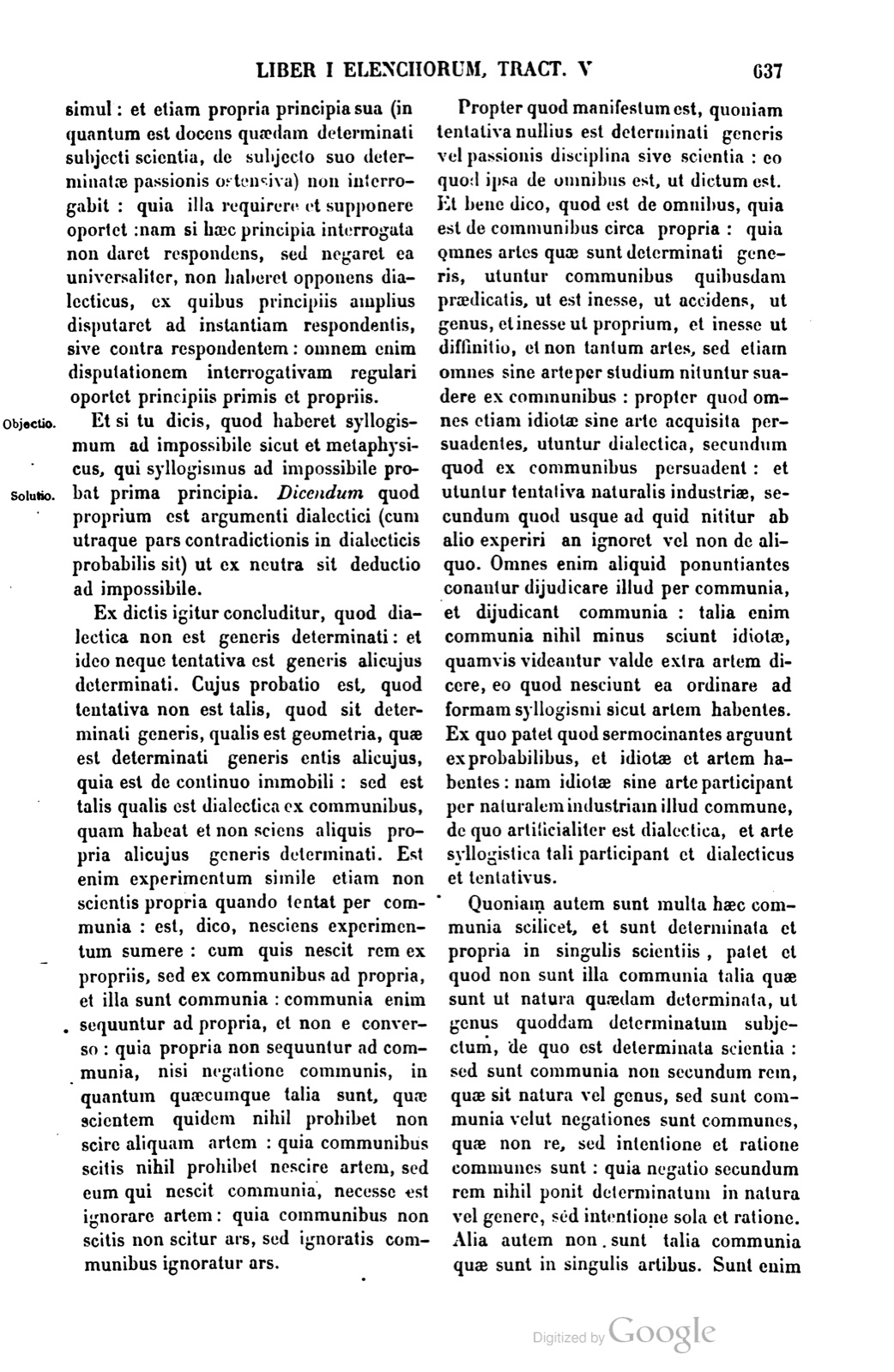
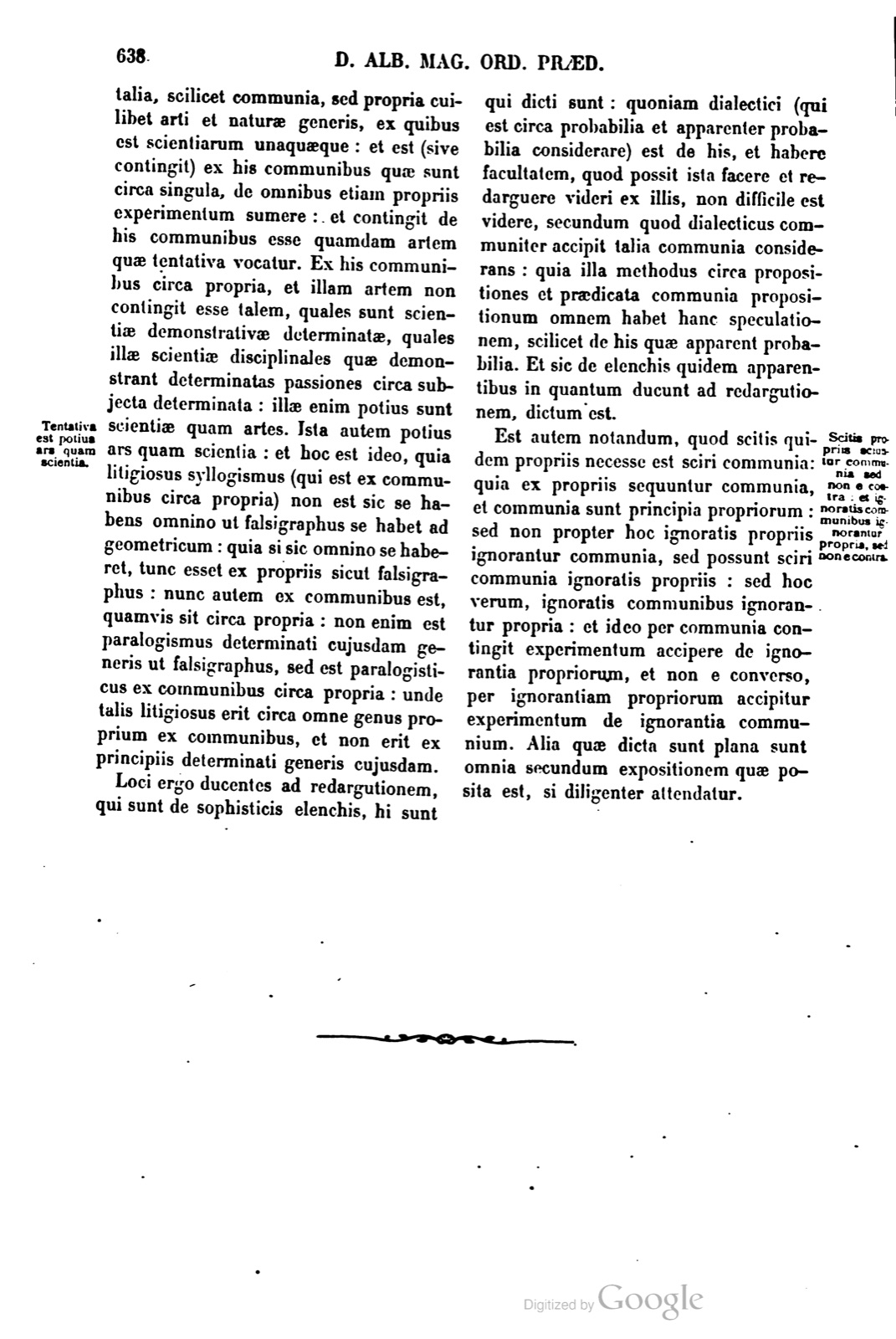
Quoniam autem sunt multa haec communia scilicet, et sunt determinata et propria in singulis scientiis, patet et quod non sunt illa communia talia quae sunt ut natura quaedam determinata, ut genus quoddam determinatum subjectum, de quo est determinata scientia: sed sunt communia non secundum rem, quae sit natura vel genus, sed sunt communia velut negationes sunt communes, quae non re, sed intentione et ratione communes sunt: quia negatio secundum rem nihil ponit determinatum in natura vel genere, sed intentione sola et ratione. Alia autem non sunt talia communia quae sunt in singulis artibus. Sunt enim talia, scilicet communia, sed propria cuilibet arti et naturae generis, ex quibus est scientiarum unaquaeque: et est (sive contingit) ex his communibus quae sunt circa singula, de omnibus etiam propriis experimentum sumere: et contingit de his communibus esse quamdam artem quae tentativa vocatur. Ex his communibus circa propria, et illam artem non contingit esse talem, quales sunt scientiae demonstrativae determinatae, quales illae scientiae disciplinales quae demonstrant determinatas passiones circa subjecta determinata: illae enim potius sunt scientiae quam artes. Ista autem potius ars quam scientia: et hoc est ideo, quia litigiosus syllogismus (qui est ex communibus circa propria) non est sic se habens omnino ut falsigraphus se habet ad geometricum: quia si sic omnino se haberet, tunc esset ex propriis sicut falsigraphus: nunc autem ex communibus est, quamvis sit circa propria: non enim est paralogismus determinati cujusdam generis ut falsigraphus, sed est paralogisticus ex communibus circa propria: unde talis litigiosus erit circa omne genus proprium ex communibus, et non erit ex principiis determinati generis cujusdam.
Loci ergo ducentes ad redargutionem, qui sunt de sophisticis elenchis, hi sunt qui dicti sunt: quoniam dialectici (qui est circa probabilia et apparenter probabilia considerare) est de his, et habere facultatem, quod possit ista facere et redarguere videri ex illis, non difficile est videre, secundum quod dialecticus communiter accipit talia communia considerans: quia illa methodus circa propositiones et praedicata communia propositionum omnem habet hanc speculationem, scilicet de his quae apparent probabilia. Et sic de elenchis quidem apparentibus in quantum ducunt ad redargutionem, dictum est.
Est autem notandum, quod scitis quidem propriis necesse est sciri communia: quia ex propriis sequuntur communia, et communia sunt principia propriorum: sed non propter hoc ignoratis propriis ignorantur communia, sed possunt sciri communia ignoratis propriis: sed hoc verum, ignoratis communibus ignorantur propria: et ideo per communia contingit experimentum accipere de ignorantia propriorum, et non e converso, per ignorantiam propriorum accipitur experimentum de ignorantia communium. Alia quae dicta sunt plana sunt omnia secundum expositionem quae posita est, si diligenter attendatur.
But since these common things are many, namely, and are determinate and proper in individual sciences, it is also clear that those common things are not such as a certain determinate nature, as a certain genus, a determinate subject about which there is a determinate science; but they are common not according to a thing which is a nature or genus, but are common as negations are common, which are common not in reality but in intention and reason, because negation according to reality posits nothing determinate in nature or genus, but only in intention and reason. But other things are not such common things as are in individual arts. For they are such, namely common, but proper to any art and to the nature of a genus, from which each one of the sciences is; and it is, or it happens, from these common things which concern singulars, to take an experiment even concerning all proper things. And it happens that concerning these common things there is a certain art which is called tentative. From these common things concerning proper things, that art cannot be such as determinate demonstrative sciences are, as those disciplinary sciences are which demonstrate determinate passions concerning determinate subjects; for those are sciences rather than arts. But this is rather art than science; and this is so because the contentious syllogism, which is from common things concerning proper things, does not stand altogether as the falsigraph stands toward the geometrical. For if it stood altogether in that way, then it would be from proper things like the falsigraph; but now it is from common things, although it is concerning proper things. For it is not a paralogism of some determinate genus as a falsigraph is, but it is paralogistic from common things concerning proper things; hence such a contentious syllogism will be concerned with every proper genus from common things, and will not be from the principles of some determinate genus.
Therefore the places leading to refutation, which are about sophistical refutations, are these which have been stated. Since it belongs to the dialectician, who considers probabilities and apparent probabilities, to be concerned with these and to have the faculty by which he can do these things and appear to refute from them, it is not difficult to see, according as the dialectician commonly accepts such common things while considering; because that method, concerning propositions and the common predicates of propositions, has all this speculation, namely concerning those things which appear probable. And thus, concerning apparent refutations insofar as they lead to refutation, it has been said.
But it must be noted that when proper things are known, common things must indeed be known, because common things follow from proper things, and common things are principles of proper things; but on this account, when proper things are unknown, common things are not unknown, but common things can be known while proper things are unknown. But this is true: when common things are unknown, proper things are unknown; and therefore through common things it happens that an experiment can be taken concerning ignorance of proper things, and not conversely, that through ignorance of proper things an experiment is taken concerning ignorance of common things. The other things which have been said are all plain according to the exposition which has been posited, if it is attended carefully.
If a page does not appear, its photograph has not been uploaded yet.