Works › Sophistical Refutations, Books I–II
Volume 2 · pp. 631–632
Tractate V. Chapter VII
A marker with ≈ is an approximate page boundary, placed by measure of the text; the page photographs remain the authority. In the paired views, clicking a page marker brings that page into view.
CAPUT VII. De syllogismo litigioso et sophistico quid et ex quibus circa propria.
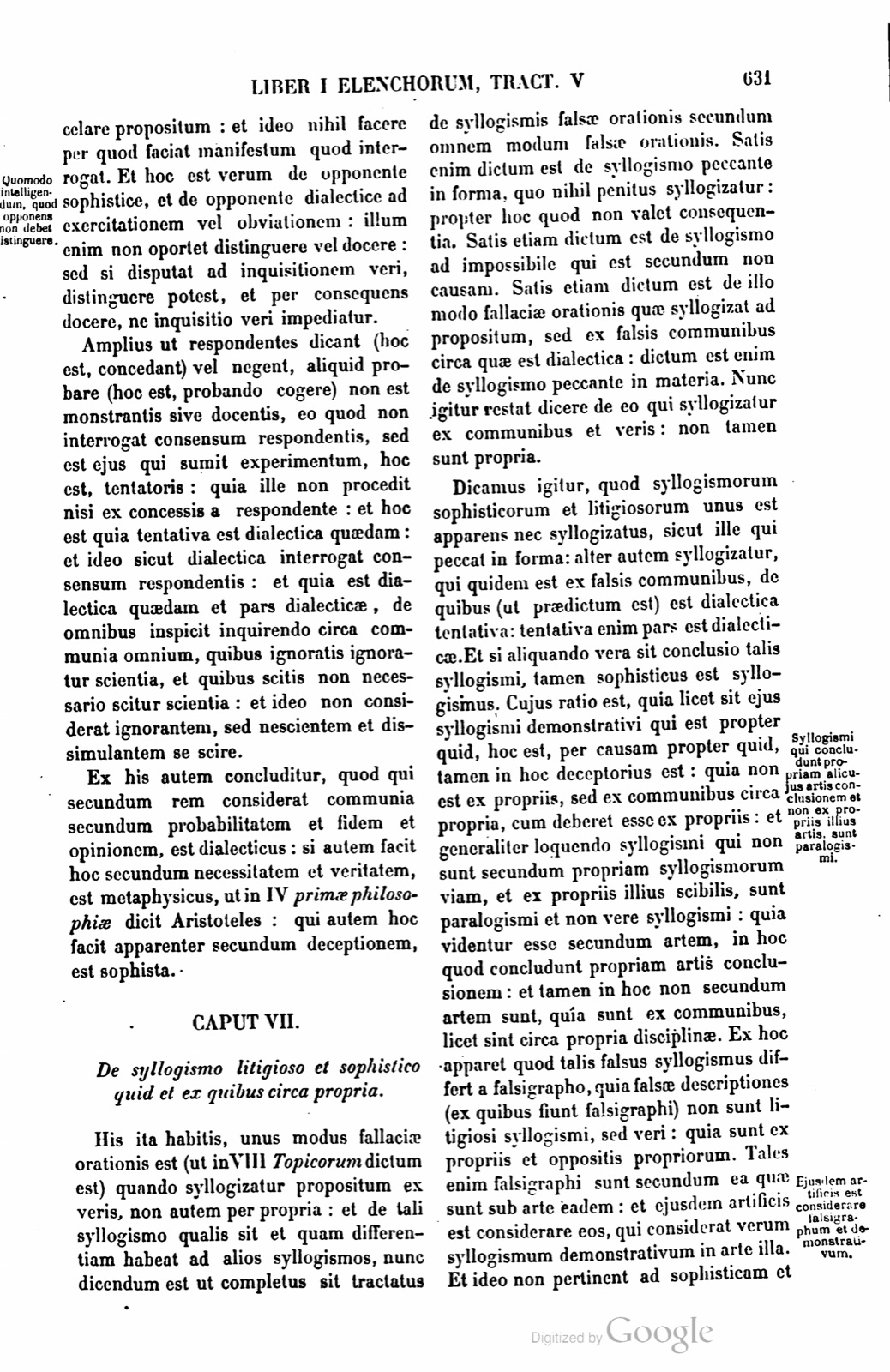
His ita habitis, unus modus fallaciae orationis est (ut in VIII Topicorum dictum est) quando syllogizatur propositum ex veris, non autem per propria: et de tali syllogismo qualis sit et quam differentiam habeat ad alios syllogismos, nunc dicendum est ut completus sit tractatus de syllogismis falsae orationis secundum omnem modum falsae orationis. Satis enim dictum est de syllogismo peccante in forma, quo nihil penitus syllogizatur: propter hoc quod non valet consequentia. Satis etiam dictum est de syllogismo ad impossibile qui est secundum non causam. Satis etiam dictum est de illo modo fallaciae orationis quae syllogizat ad propositum, sed ex falsis communibus circa quae est dialectica: dictum est enim de syllogismo peccante in materia. Nunc igitur restat dicere de eo qui syllogizatur ex communibus et veris: non tamen sunt propria.
Dicamus igitur, quod syllogismorum sophisticorum et litigiosorum unus est apparens nec syllogizatus, sicut ille qui peccat in forma: alter autem syllogizatur, qui quidem est ex falsis communibus, de quibus (ut praedictum est) est dialectica tentativa: tentativa enim pars est dialecticae. Et si aliquando vera sit conclusio talis syllogismi, tamen sophisticus est syllogismus. Cujus ratio est, quia licet sit ejus syllogismi demonstrativi qui est propter quid, hoc est, per causam propter quid, tamen in hoc deceptorius est: quia non est ex propriis, sed ex communibus circa propria, cum deberet esse ex propriis: et generaliter loquendo syllogismi qui non sunt secundum propriam syllogismorum viam, et ex propriis illius scibilis, sunt paralogismi et non vere syllogismi: quia videntur esse secundum artem, in hoc quod concludunt propriam artis conclusionem: et tamen in hoc non secundum artem sunt, quia sunt ex communibus, licet sint circa propria disciplinae. Ex hoc apparet quod talis falsus syllogismus differt a falsigrapho, quia falsae descriptiones (ex quibus fiunt falsigraphi) non sunt litigiosi syllogismi, sed veri: quia sunt ex propriis et oppositis propriorum. Tales enim falsigraphi sunt secundum ea quae sunt sub arte eadem: et ejusdem artificis est considerare eos, qui considerat verum syllogismum demonstrativum in arte illa. Et ideo non pertinent ad sophisticam et ad hanc scientiam quae de sophisticis est elenchis: unde tales paralogismi falsigraphi ad scientias pertinent disciplinales.
Neque iterum ad sophisticam pertinent si qua fallacia est descripta in disciplinalibus circa vel contra verum quod ex propriis concludit in ipsis, sicut ad sophisticam non pertinet Hippocratis quadratura, quae circulum quadravit per lunulas hoc est, circuli partitiones ad modum lunularum factas: et iste modus est in geometria, in scientia quae vocatur proportio arcus ad chordam, quando invenitur arcus aequalis chordae, secundum quod docet Ptolemaeus in Almagesto. Dicit enim Hippocrates: si inveniatur chorda aequalis arcui, sit illa chorda latus quadrati in scriptura in circulo: sic enim quatuor arcus erunt aequales quatuor quadrati lateribus, et totus circulus toti circulo: et quadravit circulum ex propriis geometriae: et ideo ad geometriam pertinet: nec est litigiosus, quamvis sit ex falsis: quia probatum est in geometria, quod figura poligonia circulo inscripta, quamvis in angulis multiplicetur in infinitum et lateribus, tamen ad capacitatem circuli non proveniet, cum tamen plus et plus in angulis multiplicata, plus et plus semper accedat ad circuli capacitatem.
CHAPTER VII. What the contentious and sophistical syllogism is, and from what things it is made concerning proper matters.
With these things thus held, one mode of the fallacy of speech is, as was said in book VIII of the Topics, when what is proposed is syllogized from true things, but not through proper things; and concerning such a syllogism, what sort it is and what difference it has in relation to other syllogisms, must now be said, so that the treatise concerning syllogisms of false speech according to every mode of false speech may be completed. For enough has been said concerning the syllogism sinning in form, by which nothing at all is syllogized, because the consequence is not valid. Enough has also been said concerning the syllogism to the impossible which is according to non-cause. Enough also has been said concerning that mode of the fallacy of speech which syllogizes to what is proposed, but from false common things, concerning which dialectic is concerned; for it has been said concerning the syllogism sinning in matter. Now therefore it remains to speak concerning that which is syllogized from common and true things; nevertheless they are not proper.
Therefore let us say that of sophistical and contentious syllogisms one is apparent and not syllogized, as that which sins in form; but another is syllogized, which indeed is from false common things, concerning which, as was said before, tentative dialectic is concerned, for tentative disputation is part of dialectic. And if at some time the conclusion of such a syllogism is true, nevertheless it is a sophistical syllogism. The reason for this is that although it belongs to the demonstrative syllogism which is propter quid, that is, through the cause on account of which, nevertheless in this it is deceptive, because it is not from proper things, but from common things concerning proper things, although it ought to be from proper things. And generally speaking, syllogisms which are not according to the proper way of syllogisms and from the proper things of that knowable thing are paralogisms and not truly syllogisms, because they seem to be according to art in this, that they conclude the proper conclusion of the art; and nevertheless in this they are not according to art, because they are from common things, although they are concerning the proper matters of the discipline. From this it appears that such a false syllogism differs from a falsigraph, because false descriptions, from which falsigraphs are made, are not contentious syllogisms but true ones, because they are from proper things and from the opposites of proper things. For such falsigraphs are according to those things which are under the same art; and it belongs to the same artisan to consider them who considers the true demonstrative syllogism in that art. And therefore they do not pertain to sophistic and to this science which is about sophistical refutations; hence such falsigraphic paralogisms pertain to disciplinary sciences.
Nor, again, do they pertain to sophistic if some fallacy has been described in disciplinary matters concerning or against the true which concludes from proper things in them, just as the squaring of Hippocrates, which squared the circle through lunes, that is, through partitions of a circle made in the manner of little moons, does not pertain to sophistic. And this mode is in geometry, in the science which is called the proportion of arc to chord, when an arc equal to a chord is found, according to what Ptolemy teaches in the Almagest. For Hippocrates says: if a chord equal to an arc is found, let that chord be the side of a square in the drawing in the circle; for thus four arcs will be equal to the four sides of the square, and the whole circle to the whole circle; and he squared the circle from the proper things of geometry; and therefore it pertains to geometry, nor is it contentious, although it is from false things, because it has been proved in geometry that a polygonal figure inscribed in a circle, although it is multiplied infinitely in angles and sides, nevertheless will not arrive at the capacity of the circle, although nevertheless, when multiplied more and more in angles, it always approaches more and more to the capacity of the circle.
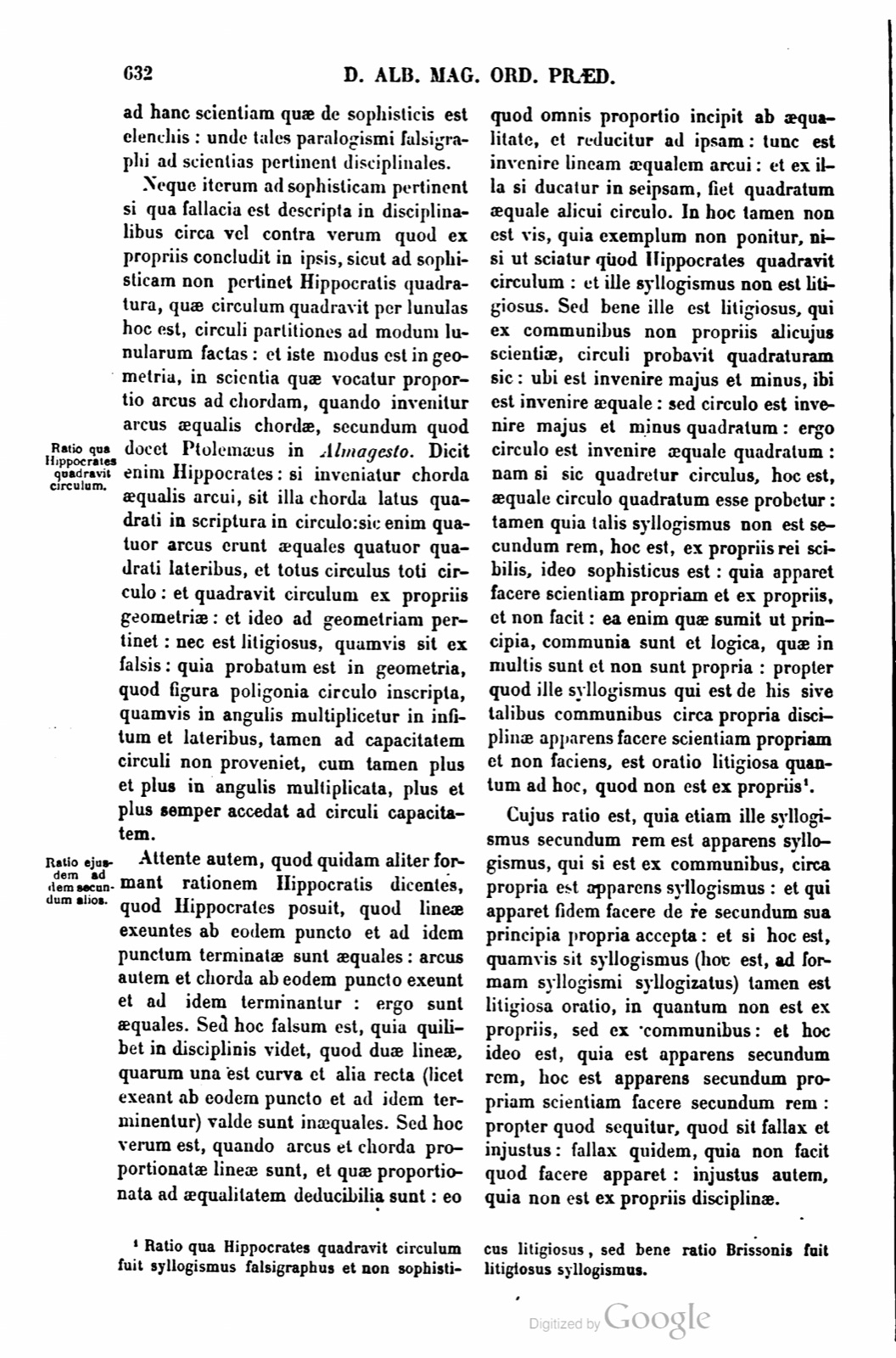
Attente autem, quod quidam aliter formant rationem Hippocratis dicentes, quod Hippocrates posuit, quod lineae exeuntes ab eodem puncto et ad idem punctum terminatae sunt aequales: arcus autem et chorda ab eodem puncto exeunt et ad idem terminantur: ergo sunt aequales. Sed hoc falsum est, quia quilibet in disciplinis videt, quod duae lineae, quarum una est curva et alia recta (licet exeant ab eodem puncto et ad idem terminentur) valde sunt inaequales. Sed hoc verum est, quando arcus et chorda proportionatae lineae sunt, et quae proportionata ad aequalitatem deducibilia sunt: eo quod omnis proportio incipit ab aequalitate, et reducitur ad ipsam: tunc est invenire lineam aequalem arcui: et ex illa si ducatur in seipsam, fiet quadratum aequale alicui circulo. In hoc tamen non est vis, quia exemplum non ponitur, nisi ut sciatur quod Hippocrates quadravit circulum: et ille syllogismus non est litigiosus. Sed bene ille est litigiosus, qui ex communibus non propriis alicujus scientiae, circuli probavit quadraturam sic: ubi est invenire majus et minus, ibi est invenire aequale: sed circulo est invenire majus et minus quadratum: ergo circulo est invenire aequale quadratum: nam si sic quadretur circulus, hoc est, aequale circulo quadratum esse probetur: tamen quia talis syllogismus non est secundum rem, hoc est, ex propriis rei scibilis, ideo sophisticus est: quia apparet facere scientiam propriam et ex propriis, et non facit: ea enim quae sumit ut principia, communia sunt et logica, quae in multis sunt et non sunt propria: propter quod ille syllogismus qui est de his sive talibus communibus circa propria disciplinae apparens facere scientiam propriam et non faciens, est oratio litigiosa quantum ad hoc, quod non est ex propriis1.
Cujus ratio est, quia etiam ille syllogismus secundum rem est apparens syllogismus, qui si est ex communibus, circa propria est apparens syllogismus: et qui apparet fidem facere de re secundum sua principia propria accepta: et si hoc est, quamvis sit syllogismus (hoc est, ad formam syllogismi syllogizatus) tamen est litigiosa oratio, in quantum non est ex propriis, sed ex communibus: et hoc ideo est, quia est apparens secundum rem, hoc est apparens secundum propriam scientiam facere secundum rem: propter quod sequitur, quod sit fallax et injustus: fallax quidem, quia non facit quod facere apparet: injustus autem, quia non est ex propriis disciplinae.
But attend carefully that some form the reasoning of Hippocrates otherwise, saying that Hippocrates posited that lines going out from the same point and terminated at the same point are equal; but an arc and a chord go out from the same point and are terminated at the same point; therefore they are equal. But this is false, because anyone in the disciplines sees that two lines, of which one is curved and the other straight, although they go out from the same point and are terminated at the same point, are greatly unequal. But this is true when the arc and chord are proportioned lines, and things proportioned are reducible to equality, because every proportion begins from equality and is reduced to it; then it is possible to find a line equal to the arc, and if from that it is drawn into itself, there will be a square equal to some circle. Yet the force is not in this, because the example is posited only so that it may be known that Hippocrates squared the circle, and that syllogism is not contentious. But that one is indeed contentious which proved the squaring of a circle from common things not proper to some science thus: where it is possible to find greater and less, there it is possible to find equal; but it is possible to find a square greater and less than the circle; therefore it is possible to find a square equal to the circle. For if the circle is squared thus, that is, if a square equal to the circle is proved to be, nevertheless because such a syllogism is not according to the thing, that is, from the proper things of the knowable thing, therefore it is sophistical, because it appears to make proper science and from proper things, and does not do so. For those things which it takes as principles are common and logical, which are in many things and are not proper. For this reason that syllogism which is about these or such common things concerning the proper matters of a discipline, appearing to make proper science and not making it, is a contentious speech with respect to this, that it is not from proper things1.
The reason for this is that even that syllogism according to the thing is an apparent syllogism, which, if it is from common things, is an apparent syllogism concerning proper things; and it appears to make belief concerning the thing according to its proper principles taken. And if this is so, although it is a syllogism, that is, syllogized according to the form of syllogism, nevertheless it is a contentious speech, insofar as it is not from proper things but from common things. And this is so because it is apparent according to the thing, that is, apparently does according to the thing according to the proper science. For this reason it follows that it is fallacious and unjust: fallacious indeed because it does not do what it appears to do; but unjust because it is not from the proper things of the discipline.
Notes
- The reasoning by which Hippocrates squared the circle was a falsigraphic syllogism and not a sophistical contentious one, but indeed the reasoning of Brisson was a contentious syllogism. (Ratio qua Hippocrates quadravit circulum fuit syllogismus falsigraphus et non sophisticus litigiosus, sed bene ratio Brissonis fuit litigiosus syllogismus.) ↩
If a page does not appear, its photograph has not been uploaded yet.