Works › Sophistical Refutations, Books I–II
Volume 2 · pp. 625–630
Tractate V. Chapters V-VI
A marker with ≈ is an approximate page boundary, placed by measure of the text; the page photographs remain the authority. In the paired views, clicking a page marker brings that page into view.
CAPUT V. De errore dividentium orationes sophisticas, quod sint quaedam ad nomen et quaedam ad intellectum.
Quia autem quidam fuerunt qui volentes orationum sophisticarum reddere principia, diviserunt orationem dicentes, quod orationum quaedam sunt ad nomen, quaedam autem ad intellectum: intendententes omnem illam orationem esse ad nomen, in qua ex aliqua causa apparentiae unus opponens vel respondens potest referre intellectum ad unum nomine significatum, et alter opponens vel respondens per defectum (qui est causa falsitatis) potest intellectum referre ad aliud quod est in re diversum ab illo quod significatur in nomine quocumque modo: et sic omnis oratio in qua est fallacia, est oratio ad nomen: et omnis in qua non est apparentia fallaciae, est oratio ad intellectum. Et quia tales orationes frequentius sunt in sophisticis, ideo ab his dicebant oriri principia paralogismorum.
Propter quod hic iste error non est probandus. Unde dicimus quod non est recta et vera differentia orationum sophisticarum in hoc quod quidam dicunt esse has quidem ad nomen, illas autem alias ad intellectum esse disputatas: haec enim divisio non est per opposita, quod inconveniens est opinari, sicut per opposita divisas alias quidem orationes esse ad nomen, alias autem oppositas his esse ad intellectum, sed non easdem dicere esse et ad nomen quantum ad unum et ad intellectum quantum ad alterum. Quid enim est non ad intellectum esse orationem, sed ad nomen, nisi hoc quod quando sive aliquando ille qui putatur interrogari, sive opponens, interrogando non utitur nomine sive significato per nomen ad illud idem quod is qui interrogatus est, sive respondens dedit sive concessit: sed respondens referens dedit, et opponens illud idem ad aliud referens, respondentem videtur redarguere hic secundum aptitudinem apparentiae et non existentiae sive defectus qui est in omni fallacia. Idem autem hoc est ad nomen commune, quando opponens utitur opposito ratione ea ad intellectum, in quo dedit sive concessit eam respondens. Unde unam et eamdem orationem contingit esse ad nomen et ad intellectum: opposita autem non sunt in eodem simul: divisio ergo haec non est per opposita.
Hoc autem probatur tam in orationibus multiplicibus quam in non multiplicibus: in multiplicibus quidem sic: si enim aliquis orationem in qua est nomen aequivocum (quod plura significat) unum putet significare, ita quod interrogans sive opponens, et interrogatus sive respondens putent illud nomen unum significare, et referunt intellectum ad idem, verbi gratia sicut forte ens et unum et caetera analoga plura significant: quia in istis magis latet aequivocatio et magis putantur unum significare, quam aequivoca casu et fortuna: sed etiam respondens sit aliquis, verbi gratia, Socrates et Zeno sit interrogans sive opponens qui unum omnia putat esse et unum significare, sicut et Socrates: et ideo ad unum idem referunt intellectum: quaestio, utrum haec oratio ad nomen aut intellectum orationis interrogatae est disputata? Constat quod est ad intellectum. Similiter autem est in aliis multiplicibus quaecumque plura in nomine vel in oratione significant. Si vero aliquis opponentium et respondentium putet illud nomen vel orationem plura significare, et in uno sensu det respondens, et in alio sensu utatur ea obviando opponens, palam est quod haec oratio non est ad intellectum disputata.
Primum inconveniens quod est contra eos qui hanc dant divisionem, est quod haec divisio maxime est circa orationes multiplices, quae sui aptitudine sunt ad nomen et ad intellectum disputabiles: orationes autem sophisticae sunt etiam circa orationes non multiplices: et sic divisio est insufficiens. Deinde aliud inconveniens est, quod haec divisio est circa quamlibet orationem: omnis enim oratio et dignitas demonstrata, et si in se unum significet, potest tamen putari plura significare: et contingit quod terminis in ea positis ad unum utitur opponens, et ad aliud utitur eis respondens, sicut patet in hoc quod dicitur, quod totum est majus parte, potest opponens uti toto et parte in uno genere totius et partis, et respondens in alio: non enim in ipsa oratione est, quando non est multiplex, quod fit ad nomen vel ad intellectum: sed est in eo sicut in causa, quod respondens se habet in usu orationis aliquo modo ad ea quae interrogantur ab opponente, scilicet quod intellectum ad idem ad quod opponens refert, non ad aliud referendo. Deinde alia ratione ducente ad inconveniens probatur idem: quia scilicet (ut probatum est) omnes orationes contingit esse ad nomen: quod ex hoc probatur, quia secundum istos nihil aliud est esse orationem ad nomen, nisi non esse orationem ad intellectum in hoc loco: et secundum istos quamlibet contingit esse non ad intellectum: ergo omnem orationem contingit esse ad nomen: aut det oppositum, scilicet quod quaedam sunt orationes quae nec sunt ad nomen, nec ad intellectum: sed hoc est inconveniens secundum istos quia hi dicunt quod omnes sunt vel ad nomen vel ad intellectum: et dividunt orationem sic per immediata dicentes, quod omnes orationes vel sunt ad nomen vel ad intellectum, et dicunt nullas alias esse orationes quae nec ad nomen sunt nec ad intellectum.
CHAPTER V. Concerning the error of those dividing sophistical speeches, namely that some are to the name and some to the intellect.
But because there were some who, wishing to give back the principles of sophistical speeches, divided speech by saying that some speeches are to the name, but some to the intellect, intending that every speech is to the name in which, from some cause of appearance, one opponent or respondent can refer the intellect to one thing signified by the name, and another opponent or respondent, through a defect which is the cause of falsity, can refer the intellect to another thing which is in reality diverse from that which is signified in the name in whatever way; and thus every speech in which there is a fallacy is a speech to the name, and every one in which there is no appearance of fallacy is a speech to the intellect. And because such speeches are more frequent in sophistical matters, therefore they said that the principles of paralogisms arise from these.
For this reason here this error must not be approved. Hence we say that it is not a correct and true difference of sophistical speeches in that some say that these are disputed to the name, but those others to the intellect. For this division is not through opposites, which it is unfitting to suppose, as if, divided through opposites, some speeches were to the name and others opposite to these were to the intellect, but not to say that the same speeches are both to the name with respect to one thing and to the intellect with respect to another. For what is it for a speech not to be to the intellect but to the name, except this, that when, or at some time, he who is thought to be questioned, or the opponent, in questioning does not use the name or the thing signified through the name for that same thing which he who has been questioned, or the respondent, gave or granted; but the respondent gave it referring it in one way, and the opponent, referring that same thing to another, seems here to refute the respondent according to an aptitude of appearance and of non-existence or defect which is in every fallacy. But this same thing is to the common name, when the opponent uses the opposite by reason of that toward the intellect in which the respondent gave or granted it. Hence it happens that one and the same speech is to the name and to the intellect. But opposites are not in the same thing at once; therefore this division is not through opposites.
But this is proved both in multiple speeches and in non-multiple speeches. In multiple speeches, indeed, thus: for if someone thinks that a speech in which there is an equivocal name, which signifies many things, signifies one thing, so that the questioner or opponent and the one questioned or respondent think that that name signifies one thing and refer the intellect to the same thing, for example as perhaps being and one and the other analogous things signify many things, because in these equivocation is more hidden and they are more thought to signify one thing than equivocal things by chance and fortune; but let the respondent also be someone, for example Socrates, and let Zeno be the questioner or opponent who thinks all things to be one and to signify one thing, as Socrates does; and therefore they refer the intellect to one and the same thing. The question is whether this speech is disputed to the name or to the intellect of the questioned speech. It is clear that it is to the intellect. Likewise it is also in other multiple speeches, whatever signify many things in name or in speech. But if one of the opponents and respondents thinks that that name or speech signifies many things, and the respondent gives it in one sense, and the opponent uses it in another sense in resisting, it is plain that this speech is not disputed to the intellect.
The first inconvenient consequence against those who give this division is that this division is especially concerned with multiple speeches, which by their aptitude are disputable to the name and to the intellect; but sophistical speeches are also concerned with non-multiple speeches, and thus the division is insufficient. Next there is another inconvenient consequence, that this division concerns any speech whatever. For every speech and demonstrated axiom, even if it signifies one thing in itself, can nevertheless be thought to signify many things; and it happens that the opponent uses the terms posited in it for one thing, and the respondent uses them for another, as is clear in this statement, that the whole is greater than the part: the opponent can use whole and part in one genus of whole and part, and the respondent in another. For it is not in the speech itself, when it is not multiple, that it becomes to the name or to the intellect, but it is in this as in a cause, that the respondent stands in some way in the use of the speech toward those things which are asked by the opponent, namely by referring the intellect to the same thing to which the opponent refers it, not by referring it to another. Next the same is proved by another reason leading to an inconvenient consequence, namely because, as has been proved, all speeches can be to the name. This is proved from this, because according to them for a speech to be to the name is nothing other than for the speech not to be to the intellect in this place; and according to them any speech can be not to the intellect; therefore every speech can be to the name. Or let him grant the opposite, namely that there are certain speeches which are neither to the name nor to the intellect. But this is unfitting according to them, because they say that all are either to the name or to the intellect, and thus they divide speech through immediate members, saying that all speeches are either to the name or to the intellect, and they say that there are no other speeches which are neither to the name nor to the intellect.
Attamen quamvis sic dicant quantum est de aptitudine orationis quicumque sunt apparentes syllogismi (in eo peccantes, quod multiplex dicitur nomen vel oratio) de numero illorum sunt qui de ipsius orationis aptitudine sunt ad nomen disputabiles. Et dico aliqui, quia in omnibus paralogismis (hoc est, qui habent actualem vel potentialem multiplicitatem) aliqui tamen de se non sic habent, ut paralogismi figurae dictionis qui non habent veram multiplicitatem: et ideo de se tantam habent aptitudinem ut disputentur ad nomen sicut alii: nam propter figuram dictionis inconvenienter dictum est, quod aequaliter de aptitudine sua sint omnes disputabiles ad nomen paralogismi, vel orationes quae sint secundum fallaciam quae est in dictione: sed sunt quidam paralogismi in dictionis multiplicitate, qui non sunt solum ad nomen, quod respondens vel opponens ad tales paralogismos sic se habeat, quod intellectum non refert aut ad idem aliquo modo: sed in eo sunt ad nomen, quod ipsa interrogatio (hoc est, interrogata propositio) quantum est de sui aptitudine habeat hoc quod ad nomen disputetur: et tales sunt qui de se plura significant, hoc est, multiplices sunt actuali vel potentiali multiplicitate. Sic igitur probatum est, quod talis divisio non est per opposita data.
Idem autem probatur, scilicet quod haec divisio quae data est, inconveniens est: quia non est per differentias essentiales parelencho. Unde omnino inconveniens est disputare de elencho, non prius de syllogismo disputando. Elenchus enim essentialiter componitur ex syllogismo et adjecta contradictione: et ideo quod necessarium syllogismi est differentia essentialis, illud nomen est differentia essentialis elencho vel parelencho: unde omnino inconveniens est disputare de elencho quantum ad differentias essentiales, ita quod non prius disputetur de syllogismo quantum ad differentias: quia syllogismus est in ratione elenchi: et hoc est omnino, quia elenchus est syllogismus: et ideo differentiae essentiales syllogismi sunt etiam differentiae essentiales elenchi: propter quod oportet de syllogismo prius quantum ad differentias essentiales disputare, quam de syllogismo elencho quantum ad differentias: quia syllogismus est in ratione elenchi. Est enim hujusmodi falsus elenchus sive sophisticus apparens syllogismus contradictionis.
Yet although they speak thus as regards the aptitude of speech, whatever apparent syllogisms there are, sinning in this, that a name or speech is called multiple, are of the number of those which by the aptitude of the speech itself are disputable to the name. And I say some, because in all paralogisms, that is, those which have actual or potential multiplicity, nevertheless some do not have themselves so of themselves, as the paralogisms of figure of diction, which do not have true multiplicity; and therefore of themselves they have so great an aptitude that they are disputed to the name just like the others. For because of figure of diction it has been unfittingly said that all paralogisms or speeches which are according to a fallacy that is in diction are equally, from their own aptitude, disputable to the name. But there are certain paralogisms in multiplicity of diction which are not only to the name because the respondent or opponent stands toward such paralogisms in such a way that he does not somehow refer the intellect to the same thing; rather they are to the name in this, that the question itself, that is, the proposition asked, as regards its own aptitude, has this, that it is disputed to the name. And such are those which of themselves signify many things, that is, they are multiple by actual or potential multiplicity. Thus therefore it has been proved that such a division is not given through opposites.
But the same is proved, namely that this division which has been given is unfitting, because it is not through essential differences of a pararefutation. Hence it is altogether unfitting to dispute about refutation without first disputing about syllogism. For refutation is essentially composed of syllogism and added contradiction; and therefore whatever necessary thing of syllogism is an essential difference, that same name is an essential difference for refutation or pararefutation. Hence it is altogether unfitting to dispute about refutation with respect to essential differences in such a way that one has not first disputed about syllogism with respect to differences, because syllogism is in the account of refutation; and this is altogether so, because refutation is a syllogism. And therefore the essential differences of syllogism are also essential differences of refutation. For this reason one must first dispute about syllogism with respect to essential differences, before disputing about refutational syllogism with respect to differences, because syllogism is in the account of refutation. For a false refutation of this kind, or a sophistical apparent syllogism, is a syllogism of contradiction.
Propter quod causa hujus divisionis quae data est, aut erit in syllogismo quantum ad essentiales differentias syllogismi, aut erit in contradictione quantum ad essentiales differentias contradictionis: in ratione enim elenchi cum ratione diffinitiva syllogismi oportet adjacere contradictionem, si debeat per omnia essentialia elenchus diffiniri. Quandoque autem per defectum qui est in utrisque, erit apparens elenchus, scilicet et in defectu syllogismi et in defectu contradictionis, et aliquando per defectum qui est in altero istorum, scilicet aut in syllogistico aut in contradictione. Quod autem est apparens elenchus per defectum in utrisque, et in syllogismo scilicet et in contradictione, probatur per exemplum. Est autem in amphibologico paralogismo, qui est de eo quod est tacentem dicere: si enim detur a respondente, quod non est vel contingit talem dicere, secundum quod accusativus, tacentem, construitur cum infinitivo, dicere, ex parte ante, sive ex parte suppositi: quia sit vera haec, non contingit tacentem dicere: et tunc ab opponente concludatur affirmative secundum quod idem accusativus cum eodem infinitivo construitur ex parte post sive ex parte appositi sic: contingit Socratem dicere: Socrates est tacens: ergo contingit tacentem dicere: non est contradictio et peccatum contra syllogismum, sed contra contradictionem: quia affirmatio et negatio non sunt secundum idem. Dico autem gratia exempli, si est paralogismus factus secundum figuram dictionis de eo quod non habet aliquis dare, sic: si aliquis dat ut conclusionem primo, iste non dat ut non habet, et arguatur contrarium sive oppositum sic: iste dat unum solum: et non habet unum solum: ergo dat quod non habet: hic est defectus tam in syllogismo quam in fallacia figurae dictionis, et non valet consequentia: et est defectus a contradictione: quia istae non sunt contradictoriae: iste non dat ut non habet, et iste dat quod non habet.
Paralogismus autem factus de eo quod est poema Homeri sive carmen esse circulum, peccabit contra syllogismum tantum: et formetur ut detur a respondente, quod nullum poema est figura, et ab opponente in oppositum arguatur sic: omnis circulus est figura: poema Homeri est circulus: ergo aliquod poema est figura. Hic enim in veritate contradicit conclusio positioni respondentis: sed syllogismus non valet, quia medium est aequivocum. Elenchus autem qui in neutro peccat, nec in contradictione scilicet, nec in syllogismo, si debitas utrique colligit differentias, verus est syllogismus.
Ex omnibus autem his colligitur, quod istae differentiae ad nomen esse vel ad intellectum esse orationem non sunt differentiae essentiales nec orationi syllogisticae nec orationi contradictionis: et ideo non sunt substantiales differentiae elenchi: nihil ergo valent ad divisionem orationis de qua fit elenchus vel parelenchus, et sic male introducuntur.
Attendendum autem, quod inconveniens secundum istos est unam orationem esse ad intellectum et non ad intellectum: quia isti ponebant has differentias esse essentiales orationi: una enim oratio non suscipit differentias plures essentiales conclusionis. Et adhuc si dicantur istae differentiae esse accidentales: tunc adhuc oratio simul et semel et secundum idem non potest esse ad intellectum et non ad intellectum, cum nihil simul et semel secundum idem suscipiat opposita. Illi autem dicebant, quod hae differentiae (esse ad intellectum et non esse ad intellectum) sunt differentiae orationis secundum id quod est oratio et non per respectum ad opponentem et respondentem: et ideo apud eos inconveniens est unam et eamdem orationem simul esse ad nomen et ad intellectum, sive ad esse intellectum et non esse ad intellectum. Si autem esse ad intellectum dicatur in oratione, non secundum ipsam orationem, sed in respectu ad opponentem et respondentem, vel generaliter loquendo per comparationem ad ipsum utentem: tunc non sunt opposita, et potest una et eadem oratio esse ad intellectum, et esse non ad intellectum, sicut unum et idem potest esse duplum et non duplum respectu diversorum, vel unus potest esse pater et non pater esse comparatus ad diversos: sed sic illi non accipiebant orationem esse ad intellectum, et non esse ad intellectum. Iste igitur est intellectus Aristotelis, et a nobis expositus est: non est in eo aliquid dignum dubitatione, de qua sit curandum.
For this reason the cause of this division which has been given will either be in syllogism with respect to the essential differences of syllogism, or it will be in contradiction with respect to the essential differences of contradiction. For in the account of refutation, together with the definitive account of syllogism, contradiction must be adjoined, if refutation ought to be defined through all its essentials. But sometimes, through a defect which is in both, there will be an apparent refutation, namely in the defect of syllogism and in the defect of contradiction; and sometimes through a defect which is in one of these, namely either in the syllogistic part or in contradiction. But that there is an apparent refutation through defect in both, namely in syllogism and in contradiction, is proved through an example. It is in an amphibological paralogism, which concerns what it is to say a silent thing. For if it is given by the respondent that such a one is not or cannot say, according as the accusative, silent, is construed with the infinitive, to say, from the part before, or from the part of the supposit, because this is true, it is not possible for a silent one to say; and then it is affirmatively concluded by the opponent according as the same accusative with the same infinitive is construed from the part after or from the part of the apposite thus: Socrates can speak; Socrates is silent; therefore it is possible to say a silent one. There is no contradiction, and there is sin against syllogism, but against contradiction, because affirmation and negation are not according to the same thing. But I say by way of example: if there is a paralogism made according to figure of diction concerning the fact that someone does not have something to give, thus: if someone gives as a first conclusion, this man does not give as not having, and the contrary or opposite is argued thus: this man gives one alone; and he does not have one alone; therefore he gives what he does not have. Here there is defect both in syllogism and in the fallacy of figure of diction, and the consequence is not valid; and there is defect from contradiction, because these are not contradictory: this man does not give as not having, and this man gives what he does not have.
But the paralogism made about the fact that Homer's poem or song is a circle will sin against syllogism only; and let it be formed so that it is given by the respondent that no poem is a figure, and the opponent argues to the opposite thus: every circle is a figure; Homer's poem is a circle; therefore some poem is a figure. For here in truth the conclusion contradicts the position of the respondent, but the syllogism is not valid, because the middle is equivocal. But the refutation which sins in neither, namely neither in contradiction nor in syllogism, if it gathers the due differences for each, is a true syllogism.
But from all these things it is gathered that these differences, for a speech to be to the name or for it to be to the intellect, are not essential differences either for syllogistic speech or for the speech of contradiction; and therefore they are not substantial differences of refutation. Therefore they have no value for the division of the speech concerning which a refutation or pararefutation is made, and thus they are introduced badly.
But it must be attended that according to these people it is unfitting for one speech to be to the intellect and not to the intellect, because they posited these differences to be essential to speech; for one speech does not receive several essential differences of conclusion. And further, if these differences are said to be accidental, then even so a speech at once and together and according to the same thing cannot be to the intellect and not to the intellect, since nothing at once and together according to the same thing receives opposites. But they said that these differences, to be to the intellect and not to be to the intellect, are differences of speech according to that which is speech and not through respect to the opponent and respondent; and therefore according to them it is unfitting that one and the same speech should at once be to the name and to the intellect, or to be intellect and not to be to the intellect. But if to be to the intellect is said in speech not according to the speech itself, but in respect to the opponent and respondent, or, generally speaking, by comparison to the user himself, then they are not opposites, and one and the same speech can be to the intellect and not be to the intellect, just as one and the same thing can be double and not double with respect to diverse things, or one man can be father and not be father as compared to diverse persons. But those men did not take a speech to be to the intellect and not to be to the intellect in this way. Therefore this is the understanding of Aristotle, and it has been expounded by us; there is nothing in it worthy of doubt, about which one should be concerned.
CAPUT VI. De destructione inductae divisionis ex hoc quod est fallacia.
Cum autem ideo inducta divisio ostensa sit esse impropria: eo quod nec est per immediata nec per proprias differentias, adhuc ex his quae hic dicemus, ostendetur esse falsa. Redeamus ergo (quia digressionem fecimus) ad id unde sermo venit prius, scilicet an haec divisio conveniens sit, quod omnis oratio sit ad nomen vel intellectum. Dicebant autem auctores hujus divisionis, quod orationes doctrinales sunt ad intellectum: orationes multiplices sunt ad nomen. Et hoc probatur esse falsum: quaeramus enim, utrum orationes (quae in disciplinis sive scientiis disciplinalibus sunt) sint ad intellectum vel non. Et si dicunt illi, quod sint ad intellectum, tunc procedendo arguatur in contrarium sic: et si cui (hoc est, alicui) respondenti plura videtur significare: triangulus enim significat triangulum compositum ex portionibus circuli sive arcubus, et ille habet tres aliquando majores tribus vel duobus rectis, et significat triangulum rectilineum, qui habet tres aequales duobus rectis, interrogatus respondens dedit sive consensit, quod triangulus habet tres aequales duobus rectis: et dedit hoc considerans triangulum, non ut hanc figuram trilateram rectilineam, de qua concludebat opponens, quoniam habet tres aequales duobus rectis, quaero utrum iste opponens vel respondens ad intellectum disputat vel non? Et constat quod non: cum non referant intellectus suos ad idem. Ex hoc autem relinquitur, quod aliqua oratio est, ad quam nusquam illi ad intellectum dicebant: et sic divisio falsa, quia unum dividentium cadit sub altero, quod in vera divisione accidere non potest.
Amplius e converso etiam accidere probabimus sic, si plura quidem significet nomen vel oratio: ille autem qui respondet, non intelligit illam multiplicitatem, neque putat illud nomen vel orationem plura significare, et dat eam in sensu in quo accipit eam opponens, quaero quomodo hoc ad intellectum disputavit? Constat eos ad intellectum (secundum illos) disputare, qui referunt intellectum ad idem: isti autem ad idem referunt intellectum. Dicebant autem isti, quod oratio multiplex est ad nomen: ergo iterum falsa est divisio cum oratio ad nomen existens cadat sub opposito membro, quod est orationem esse ad intellectum.
Si forte aliquis dicit, quod opponens et respondens semper referunt intellectum ad idem, et quoad eos est oratio ad intellectum, licet ipsa oratio multiplex in se considerata sit ad nomen, ideo oportet hic intelligi, quod (sicut dicit cavillator) nisi sic intelligatur, quod ipse opponens in omni oppositione vel interrogatione multiplicis det divisionem, hoc est, orationis multiplicis distinctionem, ut ipse respondens sit non deceptus multiplicitate, ferat intellectum suum in idem cum opponente, sive interroget aliquis opponentium. Ut gratia exempli dicamus, si est tacentem dicere vel non? quod est multiplex secundum amphibologiam: et dicat aut quod est quidem ut non in uno sensu, est autem ut sic in sensu alio. Si aliquis respondentium distinctam ab opponente orationem de uno modo, in alio sensu neget eam, et opponens disputet ad utramque partem: quaero igitur, si haec oratio non ad intellectum disputat? Constat quod sic, quia oportet quod opponens et respondens referant intellectus suos ad idem. Quamvis ergo videatur oratio de numero earum orationum (quae ad nomen sunt) esse: tamen ad intellectum est disputata: et sic eadem oratio ad nomen et ad intellectum est: non ergo est genus aliquod orationum quod sit ad intellectum, quod non possit esse ad nomen: nec e converso: et sic divisio illa falsa est. Sed secundum istos hae quidem orationes multiplices sunt ad nomen: et jam ostensum est quod non omnes hujusmodi elenchi sunt ad nomen. Dico autem elenchos conclusiones in quibus est affirmatio et negatio, sed etiam per consequens non omnes apparentes elenchi sunt ad nomen, si ad nomen est oratio quae est multiplex. Sunt enim quidem apparentes elenchi qui non sunt secundum divisionem, hoc est, secundum multiplex in dictione: quia sunt apparentes elenchi qui sunt secundum fallacias extra dictionem, ut illi qui secundum accidens, et reliqui secundum alias fallacias extra dictionem, qui non peccant secundum multiplex.
CHAPTER VI. Concerning the destruction of the division introduced from the fact that it is a fallacy.
But since the division introduced has therefore been shown to be improper, because it is neither through immediate members nor through proper differences, from these things which we shall say here it will further be shown to be false. Therefore let us return, because we have made a digression, to that whence the discourse came earlier, namely whether this division is fitting, that every speech is to the name or to the intellect. But the authors of this division said that doctrinal speeches are to the intellect, and multiple speeches are to the name. And this is proved to be false. For let us ask whether speeches which are in disciplines or disciplinary sciences are to the intellect or not. And if they say that they are to the intellect, then by proceeding let it be argued to the contrary thus: even if to some respondent it seems to signify many things. For triangle signifies a triangle composed of portions of a circle or arcs, and that sometimes has three angles greater than three or two right angles; and it signifies a rectilinear triangle, which has three equal to two right angles. The respondent, when questioned, gave or agreed that a triangle has three angles equal to two right angles, and he gave this while considering triangle not as this trilateral rectilinear figure, about which the opponent was concluding, because it has three equal to two right angles. I ask whether this opponent or respondent disputes to the intellect or not. And it is clear that he does not, since they do not refer their intellects to the same thing. But from this it is left that there is some speech to which they were nowhere saying to the intellect; and thus the division is false, because one of the dividing members falls under another, which cannot happen in a true division.
Moreover we shall also prove that the converse happens thus, if a name or speech signifies many things, but the one who responds does not understand that multiplicity, nor thinks that that name or speech signifies many things, and gives it in the sense in which the opponent takes it. I ask how this was disputed to the intellect. It is clear, according to them, that those dispute to the intellect who refer the intellect to the same thing; but these refer the intellect to the same thing. But these people were saying that a multiple speech is to the name. Therefore again the division is false, since a speech existing to the name falls under the opposite member, which is for speech to be to the intellect.
If perhaps someone says that the opponent and respondent always refer the intellect to the same thing, and with regard to them the speech is to the intellect, although the multiple speech itself considered in itself is to the name, therefore it must here be understood that, as the quibbler says, unless it is so understood that the opponent himself in every opposition or interrogation of a multiple thing gives a division, that is, a distinction of the multiple speech, so that the respondent himself is not deceived by the multiplicity, he carries his intellect into the same thing with the opponent, or some one of the opponents asks. As by way of example let us say, whether it is to say a silent thing or not? This is multiple according to amphibology; and let him say either that it is indeed as not in one sense, but that it is as so in another sense. If one of the respondents, from the speech distinguished by the opponent in one mode, denies it in another sense, and the opponent disputes toward each part, I therefore ask whether this speech is not disputed to the intellect. It is clear that it is, because the opponent and respondent must refer their intellects to the same thing. Therefore, although the speech seems to be of the number of those speeches which are to the name, nevertheless it has been disputed to the intellect; and thus the same speech is to the name and to the intellect. Therefore there is no genus of speeches which is to the intellect that cannot be to the name, nor conversely; and thus that division is false. But according to these people, these multiple speeches are to the name; and it has already been shown that not all refutations of this sort are to the name. But by refutations I mean conclusions in which there is affirmation and negation; and also, consequently, not all apparent refutations are to the name, if a speech to the name is one which is multiple. For there are indeed apparent refutations which are not according to division, that is, according to multiplicity in diction, because there are apparent refutations which are according to fallacies outside diction, as those according to accident, and the remaining ones according to other fallacies outside diction, which do not sin according to multiplicity.
Si autem aliquis probet sive approbet hoc quod dictum est, debere dividere seu distinguere opponentem ipsum multiplex, quando opponit, sicut in hoc exemplo quando dico, estne tacentem dicere? et dicere quod haec oratio sic (hoc est, uno modo) est vera: illa autem oratio sic (hoc est, alio modo) non est vera: quamvis sic dicat: tamen hoc est primum inconveniens contra illum qui sic dicit, quod hoc approbet. Quandoque enim ipsi opponenti non videtur ipsum interrogatum simpliciter significare: cum tamen sit multiplex, eo quod multiplicitas ejus latet opponentem: quia tunc improbabile est, quod ipse opponens distinguat quod nescit, vel non putat esse multiplex. Deinde secundum inconveniens est, quod secundum hoc opponens erit docens: quia distinctio cum fiat ad sciendum, opus est docentis: et sic opponens in sophisticis erit docens, quod est inconveniens: quia sic non celaret intentionem a respondente: sic enim distinguens manifestum facit ei respondenti, qui neque considerat multiplicitatem, et docet eum quomodo res se habet de qua disputatur, cum respondens neque sciat illud, neque opinetur esse multiplex, sive quoniam alicui in uno sensu et alicui in alio sensu videatur: hoc enim dicere est docentis et non celantis. Et si quis objiciat quod opponens sophista vult videri sapiens, et sic debet usurpare opus docentis in his in quibus opus illud non est contra suam intentionem quae est videri arguere respondentem. Distinguere autem est contra intentionem sophistae: quia instruit respondentem ut caveat sibi de redargutione: et ideo non est suum usurpare opus illud nisi in casu aliquo, ut in sequentibus ostendetur.
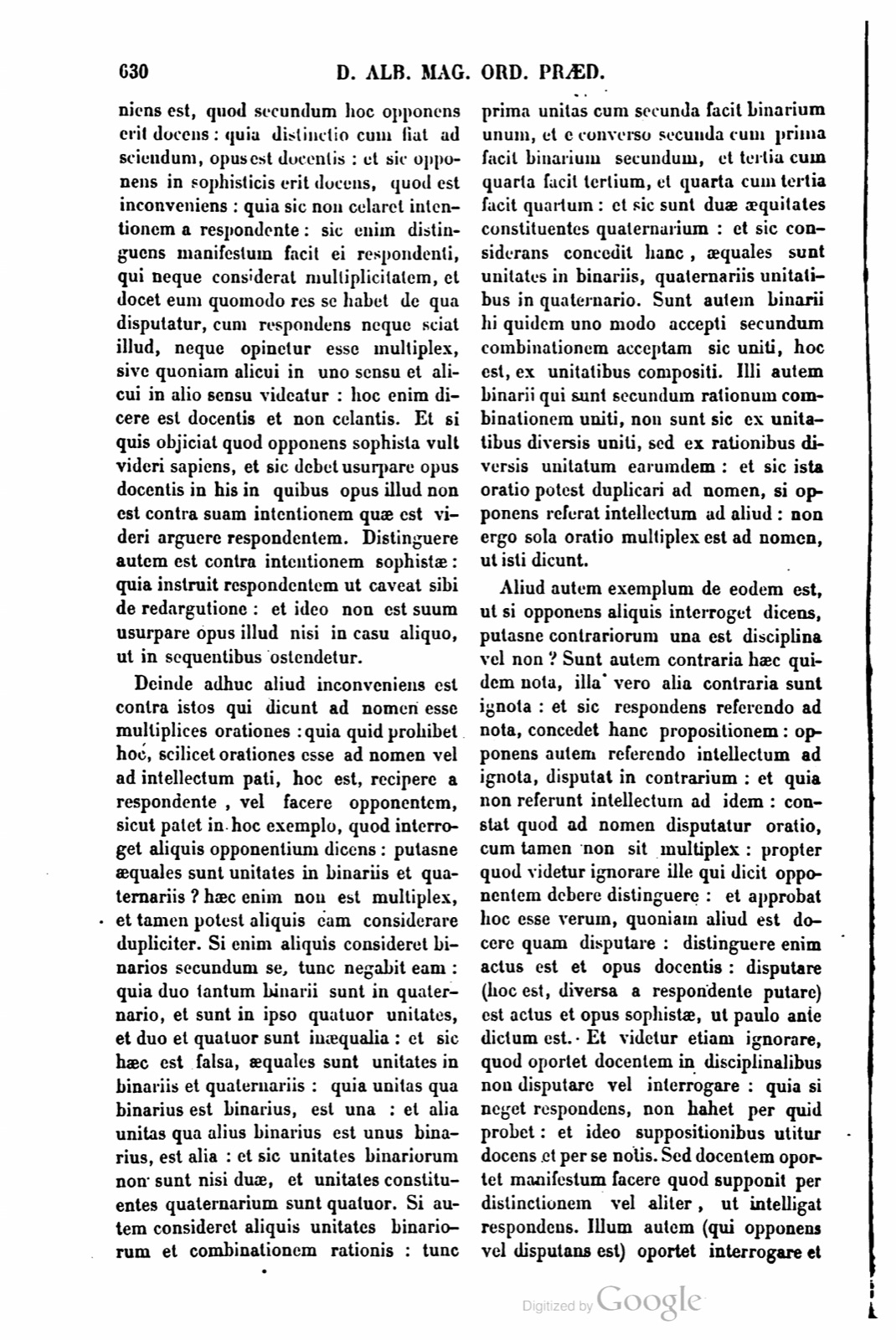
Deinde adhuc aliud inconveniens est contra istos qui dicunt ad nomen esse multiplices orationes: quia quid prohibet hoc, scilicet orationes esse ad nomen vel ad intellectum pati, hoc est, recipere a respondente, vel facere opponentem, sicut patet in hoc exemplo, quod interroget aliquis opponentium dicens: putasne aequales sunt unitates in binariis et quaternariis? Haec enim non est multiplex, et tamen potest aliquis eam considerare dupliciter. Si enim aliquis consideret binarios secundum se, tunc negabit eam: quia duo tantum binarii sunt in quaternario, et sunt in ipso quatuor unitates, et duo et quatuor sunt inaequalia: et sic haec est falsa, aequales sunt unitates in binariis et quaternariis: quia unitas qua binarius est binarius, est una: et alia unitas qua alius binarius est unus binarius, est alia: et sic unitates binariorum non sunt nisi duae, et unitates constituentes quaternarium sunt quatuor. Si autem consideret aliquis unitates binariorum et combinationem rationis: tunc prima unitas cum secunda facit binarium unum, et e converso secunda cum prima facit binarium secundum, et tertia cum quarta facit tertium, et quarta cum tertia facit quartum: et sic sunt duae aequitates constituentes quaternarium: et sic considerans concedit hanc, aequales sunt unitates in binariis, quaternariis unitatibus in quaternario. Sunt autem binarii hi quidem uno modo accepti secundum combinationem acceptam sic uniti, hoc est, ex unitatibus compositi. Illi autem binarii qui sunt secundum rationum combinationem uniti, non sunt sic ex unitatibus diversis uniti, sed ex rationibus diversis unitatum earumdem: et sic ista oratio potest duplicari ad nomen, si opponens referat intellectum ad aliud: non ergo sola oratio multiplex est ad nomen, ut isti dicunt.
But if someone proves or approves what has been said, that the opponent ought to divide or distinguish the multiple itself when he opposes, as in this example when I say, is it to say a silent thing? and to say that this speech in this way, that is, in one mode, is true, but that speech in this way, that is, in another mode, is not true; although he speaks thus, nevertheless this is the first inconvenient consequence against him who speaks thus, that he approves this. For sometimes the thing questioned does not seem to the opponent himself to signify simply, although nevertheless it is multiple, because its multiplicity is hidden from the opponent. For then it is improbable that the opponent himself should distinguish what he does not know, or does not think to be multiple. Next the second inconvenient consequence is that according to this the opponent will be teaching; because since distinction is made for knowing, it is the work of one teaching. And thus the opponent in sophistical matters will be teaching, which is unfitting, because thus he would not conceal his intention from the respondent. For by thus distinguishing he makes it manifest to that respondent, who does not consider the multiplicity, and he teaches him how the thing about which the dispute is held has itself, although the respondent neither knows that nor opines that it is multiple, or that it seems to someone in one sense and to someone in another sense. For to say this is the work of one teaching and not of one concealing. And if someone objects that the sophist opponent wishes to seem wise, and thus ought to usurp the work of one teaching in those things in which that work is not contrary to his intention, which is to seem to argue against the respondent: to distinguish, however, is contrary to the intention of the sophist, because it instructs the respondent so that he may beware of refutation. And therefore it is not his part to usurp that work except in some case, as will be shown in what follows.
Next there is still another inconvenient consequence against those who say that multiple speeches are to the name, because what prevents this, namely speeches being to the name or to the intellect, from being suffered, that is, received by the respondent, or done by the opponent, as is clear in this example, that some opponent asks, saying: do you think that the units in twos and fours are equal? For this is not multiple, and nevertheless someone can consider it in two ways. For if someone considers twos according to themselves, then he will deny it, because there are only two twos in a four, and in the four itself there are four units, and two and four are unequal; and thus this is false: the units in twos and fours are equal. For the unit by which a two is a two is one; and the other unit by which another two is one two is another; and thus the units of twos are only two, and the units constituting a four are four. But if someone considers the units of twos and the combination of reason, then the first unit with the second makes one two, and conversely the second with the first makes a second two, and the third with the fourth makes a third, and the fourth with the third makes a fourth; and thus there are two equalities constituting a four. And by thus considering he grants this: units in twos are equal to the units in a four. But these twos are taken in one way according to the combination accepted as thus united, that is, composed from units. But those twos which are united according to the combination of accounts are not thus united from diverse units, but from diverse accounts of the same units. And thus that speech can be doubled toward the name, if the opponent refers the intellect to another thing. Therefore not only a multiple speech is to the name, as these people say.
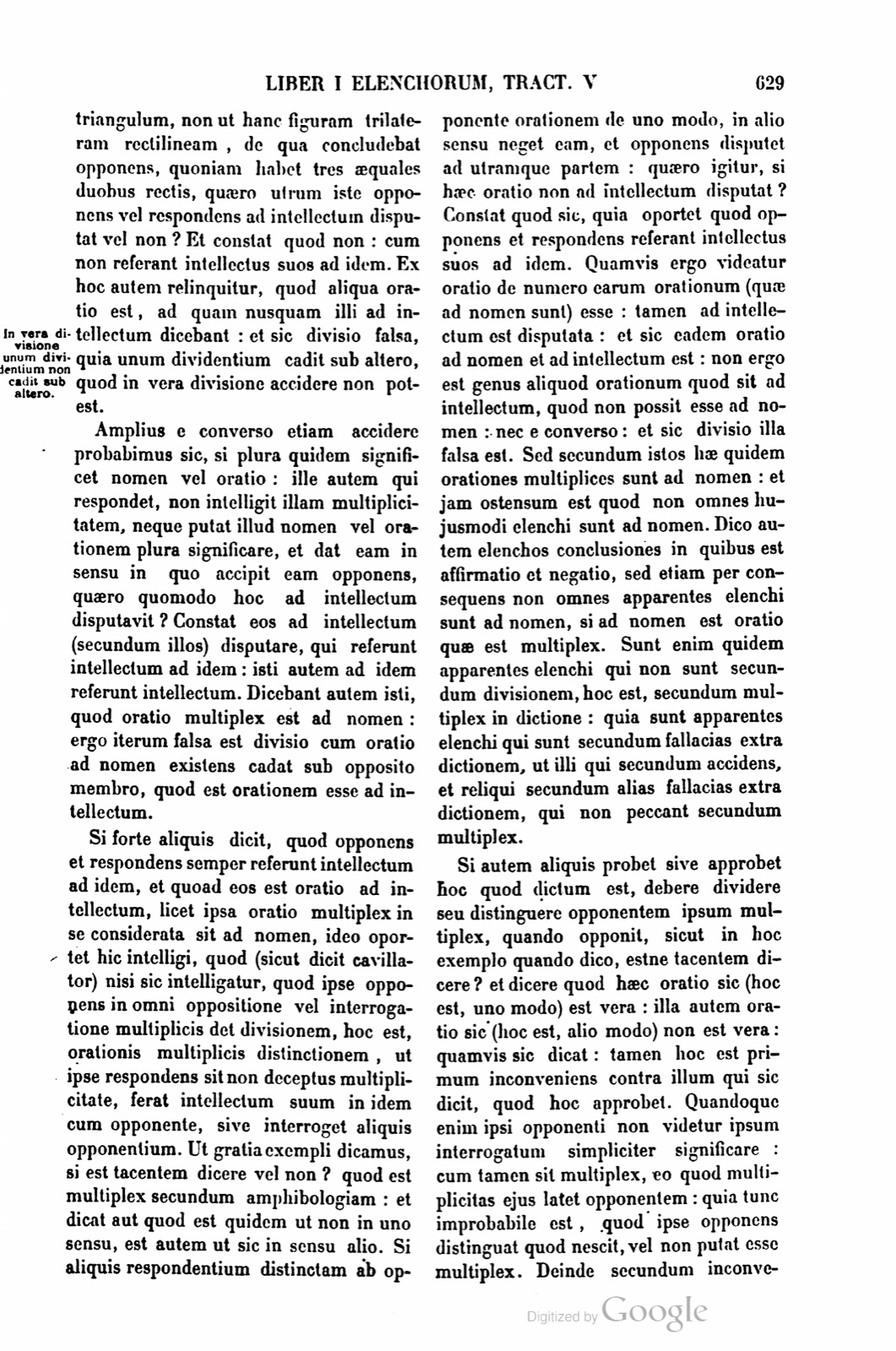
Aliud autem exemplum de eodem est, ut si opponens aliquis interroget dicens, putasne contrariorum una est disciplina vel non? Sunt autem contraria haec quidem nota, illa vero alia contraria sunt ignota: et sic respondens referendo ad nota, concedet hanc propositionem: opponens autem referendo intellectum ad ignota, disputat in contrarium: et quia non referunt intellectum ad idem: constat quod ad nomen disputatur oratio, cum tamen non sit multiplex: propter quod videtur ignorare ille qui dicit opponentem debere distinguere: et approbat hoc esse verum, quoniam aliud est docere quam disputare: distinguere enim actus est et opus docentis: disputare (hoc est, diversa a respondente putare) est actus et opus sophistae, ut paulo ante dictum est. Et videtur etiam ignorare, quod oportet docentem in disciplinalibus non disputare vel interrogare: quia si neget respondens, non habet per quid probet: et ideo suppositionibus utitur docens et per se notis. Sed docentem oportet manifestum facere quod supponit per distinctionem vel aliter, ut intelligat respondens. Illum autem (qui opponens vel disputans est) oportet interrogare et celare propositum: et ideo nihil facere per quod faciat manifestum quod interrogat. Et hoc est verum de opponente sophistice, et de opponente dialectice ad exercitationem vel obviationem: illum enim non oportet distinguere vel docere: sed si disputat ad inquisitionem veri, distinguere potest, et per consequens docere, ne inquisitio veri impediatur.
Amplius ut respondentes dicant (hoc est, concedant) vel negent, aliquid probare (hoc est, probando cogere) non est monstrantis sive docentis, eo quod non interrogat consensum respondentis, sed est ejus qui sumit experimentum, hoc est, tentatoris: quia ille non procedit nisi ex concessis a respondente: et hoc est quia tentativa est dialectica quaedam: et ideo sicut dialectica interrogat consensum respondentis: et quia est dialectica quaedam et pars dialecticae, de omnibus inspicit inquirendo circa communia omnium, quibus ignoratis ignoratur scientia, et quibus scitis non necessario scitur scientia: et ideo non considerat ignorantem, sed nescientem et dissimulantem se scire.
Ex his autem concluditur, quod qui secundum rem considerat communia secundum probabilitatem et fidem et opinionem, est dialecticus: si autem facit hoc secundum necessitatem et veritatem, est metaphysicus, ut in IV primae philosophiae dicit Aristoteles: qui autem hoc facit apparenter secundum deceptionem, est sophista.
But another example concerning the same thing is this: if some opponent asks, saying, do you think that there is one discipline of contraries or not? But of these contraries, some are known, while other contraries are unknown; and thus the respondent, by referring to known things, will grant this proposition, but the opponent, by referring the intellect to unknown things, disputes to the contrary. And because they do not refer the intellect to the same thing, it is clear that the speech is disputed to the name, although nevertheless it is not multiple. For this reason he who says that the opponent ought to distinguish seems to be ignorant; and he approves this to be true, since to teach is one thing and to dispute is another. For to distinguish is the act and work of one teaching; to dispute, that is, to think things diverse from the respondent, is the act and work of the sophist, as was said a little before. And he also seems to be ignorant that in disciplinary matters one teaching must not dispute or question, because if the respondent denies, he does not have through what he may prove; and therefore one teaching uses suppositions and things known through themselves. But one teaching must make manifest what he supposes by distinction or otherwise, so that the respondent may understand. But that man who is opposing or disputing must question and conceal what is proposed; and therefore he must do nothing by which he makes manifest what he asks. And this is true of one opposing sophistically, and of one opposing dialectically for exercise or resistance; for such a one must not distinguish or teach. But if he disputes for the inquiry of truth, he can distinguish and consequently teach, lest the inquiry of truth be impeded.
Moreover, to prove something, that is, to compel by proving, so that respondents may say, that is, grant, or deny, does not belong to one demonstrating or teaching, because he does not ask the consent of the respondent, but belongs to him who takes an experiment, that is, to the tester, because he proceeds only from things conceded by the respondent. And this is because tentative disputation is a certain dialectic; and therefore, just as dialectic asks the consent of the respondent, and because it is a certain dialectic and part of dialectic, it inspects concerning all things by inquiring about the common things of all, without which, if they are unknown, the science is unknown, and with which, if they are known, the science is not necessarily known. And therefore it does not consider an ignorant man, but one who does not know and pretends that he knows.
But from these things it is concluded that he who considers common things according to the thing according to probability and belief and opinion is a dialectician; but if he does this according to necessity and truth, he is a metaphysician, as Aristotle says in book IV of first philosophy; but he who does this apparently according to deception is a sophist.
If a page does not appear, its photograph has not been uploaded yet.