Works › Sophistical Refutations, Books I–II
Volume 2 · pp. 621–625
Tractate V. Chapters III-IV
A marker with ≈ is an approximate page boundary, placed by measure of the text; the page photographs remain the authority. In the paired views, clicking a page marker brings that page into view.
falsum ex falso, ut dictum est: et erit syllogismus ad respondentem qui est propter ignorantiam respondentis qui dat sive concedit talem orationem falsam propter ignorantiam: quia falsum videtur ei verum propter deceptionem factam in ipso per aliquem locum sophisticum. Sophistici autem elenchi peccantes in forma, etsi syllogizent contradictionem veram qua redarguatur vere respondens, tamen non faciunt manifestum aliquem respondentem, si ignorant sive ignorantes sunt: hoc enim non sumit experimentum ignorantiae: nam non solum ignorantem, sed etiam scientem, et pariter aliqui opponentes impediunt his orationibus sive syllogismis sophisticis qui peccant in forma, et videntur syllogismi, cum non sint: eo quod difficiles sint ad solvendum. Faciles autem sunt qui peccant in materia: peccantes enim in materia, statim solvuntur per interemptionem falsi vel improbabilis: sed non sic peccantes in forma: oportet enim resolvere conclusionem eorum in praemissas et comparare praemissas ad conclusionem, et ostendere quare ex praemissis non sequatur conclusio: et hoc est difficile. In quo etiam periti non solum ignorantes impediuntur: et ideo orationes non sunt apertae accipere experimentum ignorantiae.
Quoniam autem habemus syllogismos sophisticos eadem via eorumdem principiorum quibus habemus apparentes elenchos vel apparentes syllogismos, manifestum est ex inductis et ex dicendis. Ex inductis quidem, sicut praedictum est: quia falsa propositio quae pro vera accipitur in sophistico, conclusa est ut apparenter vera in syllogismo apparente. Ex dicendis autem: nam secundum eadem principia deceptionis videtur audientibus syllogismum apparentem syllogizare ille qui opponit: cum tamen non syllogizet sic et secundum eadem principia videbitur respondenti, hoc est, ei qui debet ad propositionem respondere. Sophistici syllogismi peccantes in materia, videntur syllogizare tanquam ex vera cum non sit vera: eadem enim deceptione deceptus respondens dat falsam ut veram, qui prius audiens syllogismum apparentem, dedit sequi eam quae non sequebatur in syllogismo probante ut videbatur illa quae falsa est, quam ut veram accepit in syllogismo peccante secundum materiam: propter quod erunt syllogismi falsi (hoc est, ex falsis peccantes in materia) originaliter per haec principia deceptionis omnia, aut quaedam per quae est syllogismus apparens. Dico autem omnia, aut quaedam, propter compositionem et divisionem et accentum, in quibus non nisi materialiter est vox eadem: quae vero profertur, formaliter distinguitur dividendo eam vel componendo, vel etiam in accentu prolata dictio acuitur vel gravatur: et sic in prolatione multiplicitas ejus facilius percipitur, quam in non prolata: quod enim ipse respondens non interrogatus ab opponente, apud se pertractans arbitratur dandum propter identitatem sermonis aut rei, hoc etiam per eadem principia deceptus dabit interrogatus ab opponente, et ponet ipsum tanquam verum per ea quae vera videbantur, prolatum in quibusdam orationibus, sicut quae sunt secundum compositionem et divisionem et accentum interrogare in prolatione quae deest (hoc est, quae est causa defectus) et falsum apparere in uno sensu, ut in his quae secundum dictionem sive prolationem: quia ipse distinctione dictionis in his apparet, in quo sensu falsae sunt orationes. Et hoc etiam accidit in orationibus quae ducunt ad solaecismum: hoc enim ipsa prolatione manifestatur.
the false from the false, as was said; and it will be a syllogism to the respondent, which exists because of the ignorance of the respondent who gives or grants such a false speech because of ignorance, because the false seems true to him because of the deception made in him through some sophistical place. But sophistical refutations sinning in form, although they syllogize a true contradiction by which the respondent is truly refuted, nevertheless do not make any respondent manifest, if he is ignorant or if they are ignorant; for this does not take an experiment of ignorance. For not only an ignorant man, but also one who knows, and likewise some opponents, are impeded by these sophistical speeches or syllogisms which sin in form and seem to be syllogisms when they are not, because they are difficult to solve. But those which sin in matter are easy; for those sinning in matter are at once solved by the destruction of the false or improbable thing. But those sinning in form are not so; for one must resolve their conclusion into the premises and compare the premises to the conclusion, and show why the conclusion does not follow from the premises, and this is difficult. In this even skilled persons, not only ignorant ones, are impeded; and therefore the speeches are not open for taking an experiment of ignorance.
But since we have sophistical syllogisms by the same way of the same principles by which we have apparent refutations or apparent syllogisms, this is manifest from the things brought in and from the things to be said. From the things brought in, indeed, as was said before, because the false proposition which is accepted as true in the sophistical syllogism has been concluded as apparently true in the apparent syllogism. But from the things to be said: for according to the same principles of deception the one who opposes seems to syllogize to those hearing the apparent syllogism, although nevertheless he does not so syllogize; and according to the same principles it will seem so to the respondent, that is, to him who must answer to the proposition. Sophistical syllogisms sinning in matter seem to syllogize as if from a true proposition when it is not true; for by the same deception the deceived respondent gives the false as true, who earlier, hearing an apparent syllogism, granted that that followed which did not follow in the syllogism proving, as it seemed, that which is false, which he accepted as true in the syllogism sinning according to matter. For this reason false syllogisms, that is, those sinning from false things in matter, will originally be through all or some of these principles of deception through which there is an apparent syllogism. But I say all or some because of composition and division and accent, in which the word is the same only materially; but what is uttered is formally distinguished by dividing it or composing it, or also, in accent, the uttered diction is made acute or grave; and thus in pronunciation its multiplicity is more easily perceived than when it is not pronounced. For what the respondent himself, not questioned by the opponent, considering within himself, judges should be given because of the identity of speech or of thing, this also, deceived through the same principles, he will give when questioned by the opponent, and he will posit it as true through those things which seemed true, uttered in certain speeches, as those which are according to composition and division and accent, to question in the pronunciation which is lacking, that is, which is the cause of the defect, and for the false to appear in one sense, as in those things which are according to diction or pronunciation, because by the distinction of diction in these it appears in what sense the speeches are false. And this also occurs in speeches which lead to solecism; for this is manifested by the pronunciation itself.
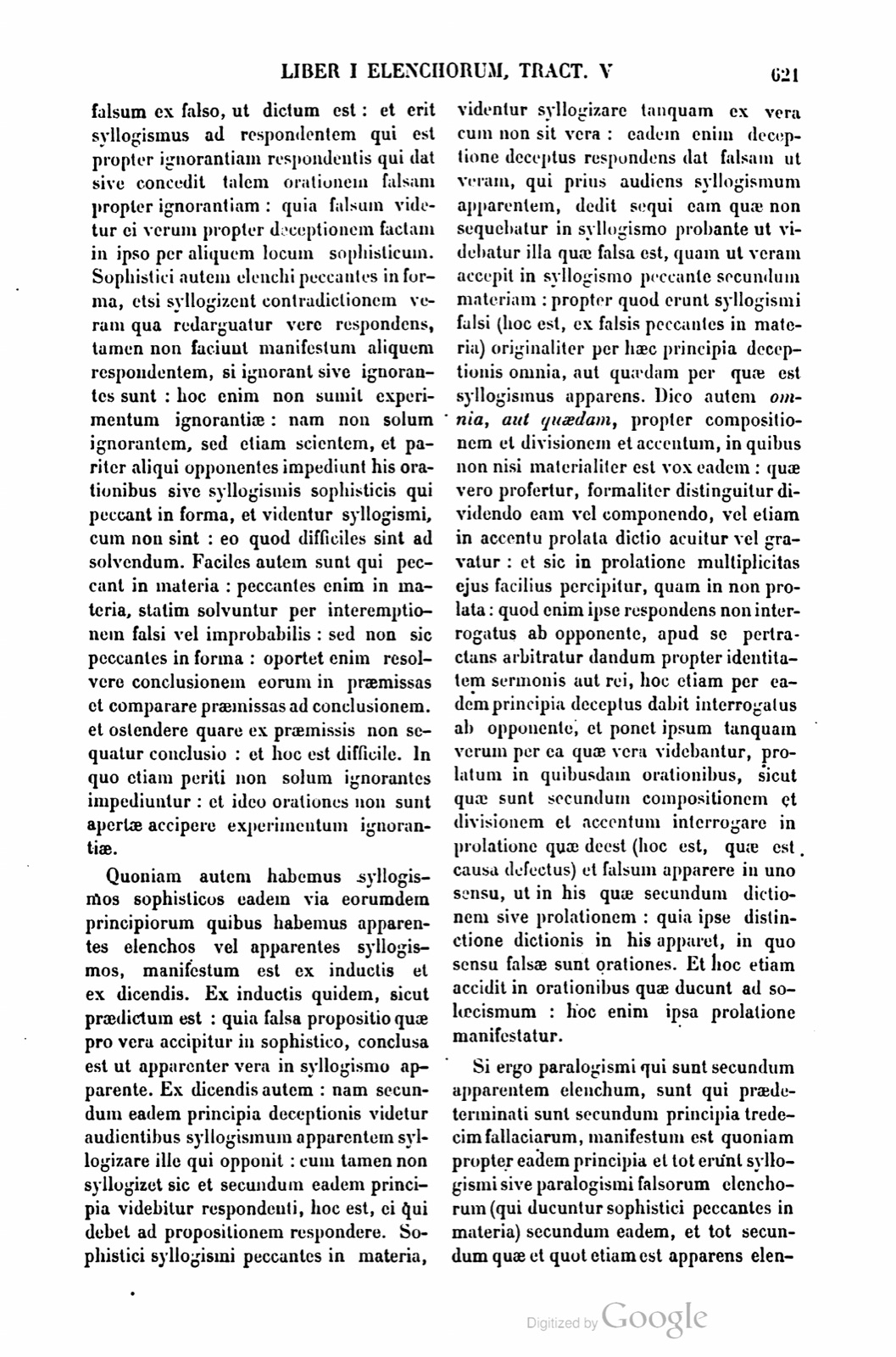
Si ergo paralogismi qui sunt secundum apparentem elenchum, sunt qui praedeterminati sunt secundum principia tredecim fallaciarum, manifestum est quoniam propter eadem principia et tot erunt syllogismi sive paralogismi falsorum elenchorum (qui ducuntur sophistici peccantes in materia) secundum eadem, et tot secundum quae et quot etiam est apparens elenchus peccans in forma. Hoc autem probatur etiam per inductionem: apparens enim elenchus peccans in forma est secundum particulas et differentias constituentes verum syllogismum, quae quando deficiunt, sunt principia apparentis elenchi: nam quando singulum de numero illarum particularum veri syllogismi deerit secundum veritatem, quamvis videatur non deesse, tunc non fit elenchus verus: sed videbitur elenchus qui fit sic per defectum rationis syllogismi, sed est apparens elenchus. Et hoc apparet inducendo in non causa ut causa in paralogismo qui fit ad impossibile: in illo enim fit non ut causa, qui deficit in eo quod est conclusionem accidere propter orationem praemissam: non enim accidit propter eam quae non causa est. Qui autem duas interrogationes ut unam fecit, deficit propter deceptionem orationis sive propositionis, quam non sumit quando non unam sumit, ut in ante habitis probatum est. Ille autem apparens elenchus qui est secundum accidens, decipit propter idem, quod ut idem assignatur rei subjectae et accidenti similiter inesse, cum hoc in syllogismo bono idem et simile esse debeat, quod non habet accidentis paralogismus: et hujus pars est paralogismus qui est secundum consequens: et ideo per defectum ejusdem particulae deficit et decipit.
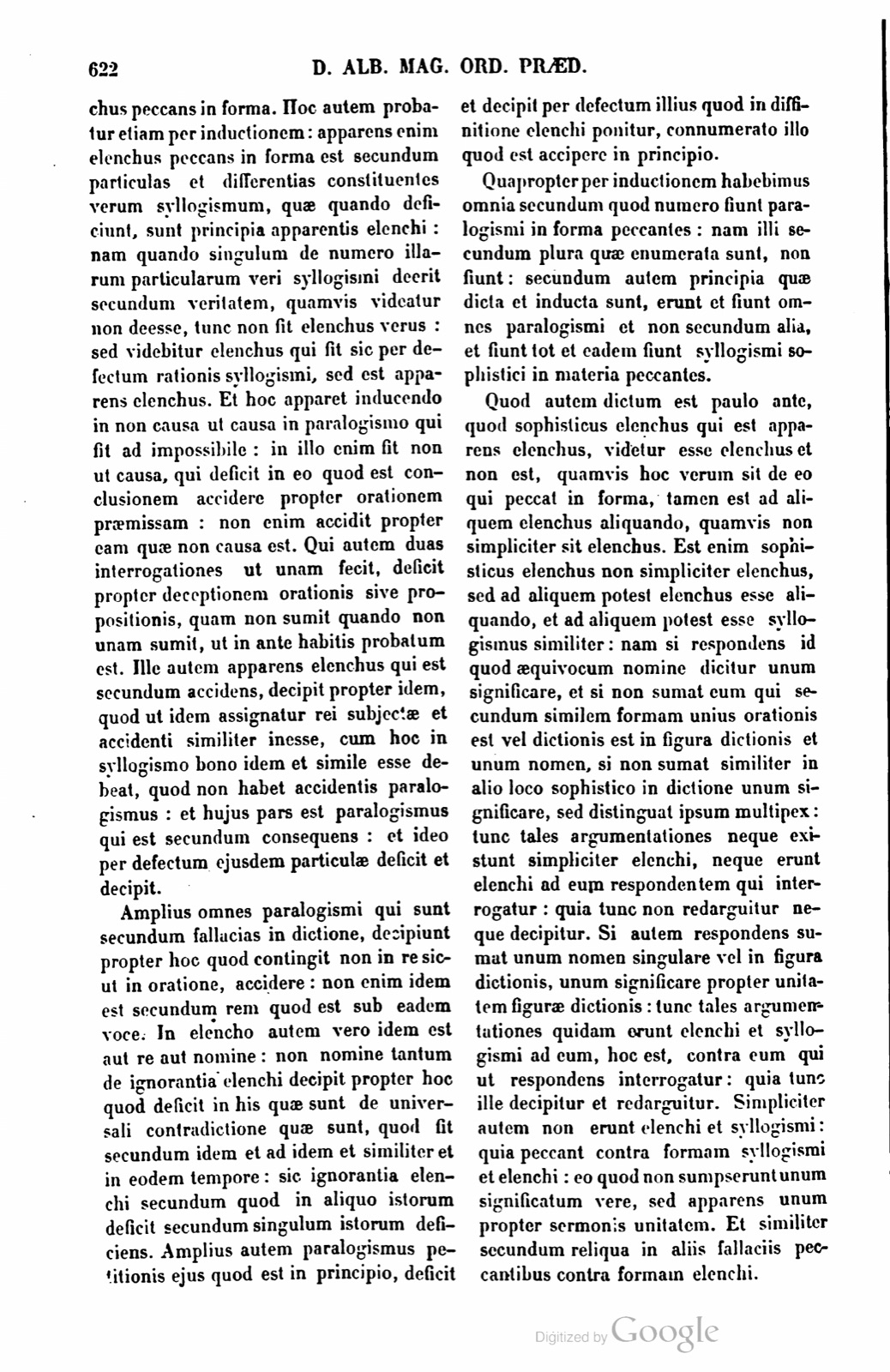
Amplius omnes paralogismi qui sunt secundum fallacias in dictione, decipiunt propter hoc quod contingit non in re sicut in oratione, accidere: non enim idem est secundum rem quod est sub eadem voce. In elencho autem vero idem est aut re aut nomine: non nomine tantum de ignorantia elenchi decipit propter hoc quod deficit in his quae sunt de universali contradictione quae sunt, quod fit secundum idem et ad idem et similiter et in eodem tempore: sic ignorantia elenchi secundum quod in aliquo istorum deficit secundum singulum istorum deficiens. Amplius autem paralogismus petitionis ejus quod est in principio, deficit et decipit per defectum illius quod in diffinitione elenchi ponitur, connumerato illo quod est accipere in principio.
Quapropter per inductionem habebimus omnia secundum quod numero fiunt paralogismi in forma peccantes: nam illi secundum plura quae enumerata sunt, non fiunt: secundum autem principia quae dicta et inducta sunt, erunt et fiunt omnes paralogismi et non secundum alia, et fiunt tot et eadem fiunt syllogismi sophistici in materia peccantes.
Quod autem dictum est paulo ante, quod sophisticus elenchus qui est apparens elenchus, videtur esse elenchus et non est, quamvis hoc verum sit de eo qui peccat in forma, tamen est ad aliquem elenchus aliquando, quamvis non simpliciter sit elenchus. Est enim sophisticus elenchus non simpliciter elenchus, sed ad aliquem potest elenchus esse aliquando, et ad aliquem potest esse syllogismus similiter: nam si respondens id quod aequivocum nomine dicitur unum significare, et si non sumat eum qui secundum similem formam unius orationis est vel dictionis est in figura dictionis et unum nomen, si non sumat similiter in alio loco sophistico in dictione unum significare, sed distinguat ipsum multiplex: tunc tales argumentationes neque existunt simpliciter elenchi, neque erunt elenchi ad eum respondentem qui interrogatur: quia tunc non redarguitur neque decipitur. Si autem respondens sumat unum nomen singulare vel in figura dictionis, unum significare propter unitatem figurae dictionis: tunc tales argumentationes quidam erunt elenchi et syllogismi ad eum, hoc est, contra eum qui ut respondens interrogatur: quia tunc ille decipitur et redarguitur. Simpliciter autem non erunt elenchi et syllogismi: quia peccant contra formam syllogismi et elenchi: eo quod non sumpserunt unum significatum vere, sed apparens unum propter sermonis unitatem. Et similiter secundum reliqua in aliis fallaciis peccantibus contra formam elenchi.
Therefore, if the paralogisms which are according to apparent refutation are those which have been predetermined according to the principles of the thirteen fallacies, it is manifest that because of the same principles and as many there will be syllogisms or paralogisms of false refutations, which are led as sophistical ones sinning in matter, according to the same things and according to as many things as there also is an apparent refutation sinning in form. But this is also proved by induction: for an apparent refutation sinning in form is according to the particles and differences constituting a true syllogism, which, when they are lacking, are principles of an apparent refutation. For when each one of the number of those particles of a true syllogism is lacking according to truth, although it seems not to be lacking, then a true refutation is not made; but a refutation will seem to be made thus through defect of the account of syllogism, but it is an apparent refutation. And this appears by inducing in non-cause as cause in the paralogism which is made to the impossible; for in that there is non-cause as cause, which is deficient in that the conclusion happens because of the premised speech; for it does not happen because of that which is not the cause. But he who made two questions as one is deficient because of the deception of the speech or proposition, which he does not take when he does not take one, as was proved in the preceding things. But that apparent refutation which is according to accident deceives because of the same thing, which as the same is assigned to the subject thing and to the accident as belonging similarly, although in a good syllogism this ought to be the same and similar, which the paralogism of accident does not have; and the paralogism which is according to the consequent is part of this; and therefore through defect of the same particle it is deficient and deceives.
Moreover, all paralogisms which are according to fallacies in diction deceive because of this, that it happens not in the thing as in the speech; for that which is under the same word is not the same according to the thing. But in a true refutation the same is either in thing or in name, not in name only. It deceives from ignorance of refutation because it is deficient in those things which belong to universal contradiction, namely, that it be made according to the same thing and in relation to the same thing and similarly and in the same time. Thus ignorance of refutation, according as it is deficient in one of these, is deficient according to each one of these. Moreover, the paralogism of begging that which is in the principle is deficient and deceives through defect of that which is posited in the definition of refutation, that which is to take in the principle being counted along with it.
Therefore through induction we shall have all the things according to which paralogisms sinning in form are made in number; for those are not made according to more things than have been enumerated. But according to the principles which have been stated and brought in, all paralogisms will be and are made, and not according to others, and sophistical syllogisms sinning in matter are made as many and the same.
But what was said a little before, that a sophistical refutation which is an apparent refutation seems to be a refutation and is not, although this is true of that which sins in form, nevertheless it is sometimes a refutation relative to someone, although it is not a refutation simply. For a sophistical refutation is not a refutation simply, but relative to someone it can sometimes be a refutation, and relative to someone it can likewise be a syllogism. For if the respondent, as to that which is said equivocally in name, does not take it to signify one thing, and if he does not take that which is according to the similar form of one speech or diction, in figure of diction, and one name, if he similarly does not take it in another sophistical place in diction to signify one thing, but distinguishes it as multiple, then such argumentations neither exist as refutations simply nor will they be refutations relative to that respondent who is questioned, because then he is neither refuted nor deceived. But if the respondent takes one singular name, or in figure of diction takes it to signify one thing because of the unity of the figure of diction, then such argumentations will indeed be refutations and syllogisms relative to him, that is, against him who is questioned as respondent, because then he is deceived and refuted. But simply they will not be refutations and syllogisms, because they sin against the form of syllogism and refutation, in that they did not take one signified thing truly, but an apparent one thing because of the unity of speech. And similarly according to the remaining things in other fallacies sinning against the form of refutation.
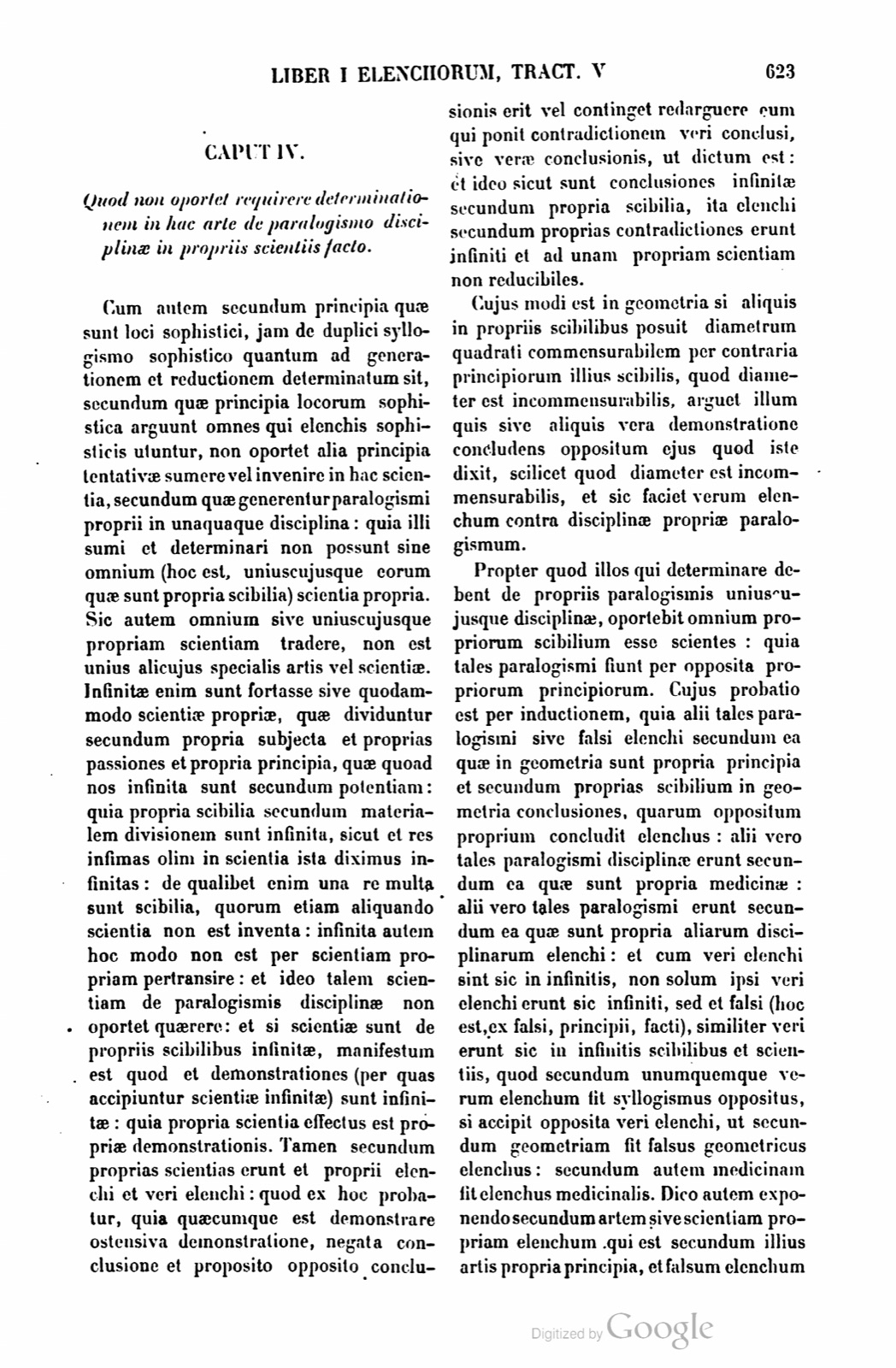
CAPUT IV. Quod non oportet requirere determinationem in hac arte de paralogismo disciplinae in propriis scientiis facto.
Cum autem secundum principia quae sunt loci sophistici, jam de duplici syllogismo sophistico quantum ad generationem et reductionem determinatum sit, secundum quae principia locorum sophistica arguunt omnes qui elenchis sophisticis utuntur, non oportet alia principia tentativae sumere vel invenire in hac scientia, secundum quae generentur paralogismi proprii in unaquaque disciplina: quia illi sumi et determinari non possunt sine omnium (hoc est, uniuscujusque eorum quae sunt propria scibilia) scientia propria. Sic autem omnium sive uniuscujusque propriam scientiam tradere, non est unius alicujus specialis artis vel scientiae. Infinitae enim sunt fortasse sive quodammodo scientiae propriae, quae dividuntur secundum propria subjecta et proprias passiones et propria principia, quae quoad nos infinita sunt secundum potentiam: quia propria scibilia secundum materialem divisionem sunt infinita, sicut et res infimas olim in scientia ista diximus infinitas: de qualibet enim una re multa sunt scibilia, quorum etiam aliquando scientia non est inventa: infinita autem hoc modo non est per scientiam propriam pertransire: et ideo talem scientiam de paralogismis disciplinae non oportet quaerere: et si scientiae sunt de propriis scibilibus infinitae, manifestum est quod et demonstrationes (per quas accipiuntur scientiae infinitae) sunt infinitae: quia propria scientia effectus est propriae demonstrationis. Tamen secundum proprias scientias erunt et proprii elenchi et veri elenchi: quod ex hoc probatur, quia quaecumque est demonstrare ostensiva demonstratione, negata conclusione et proposito opposito conclusionis erit vel continget redarguere eum qui ponit contradictionem veri conclusi, sive verae conclusionis, ut dictum est: et ideo sicut sunt conclusiones infinitae secundum propria scibilia, ita elenchi secundum proprias contradictiones erunt infiniti et ad unam propriam scientiam non reducibiles.
Cujus modi est in geometria si aliquis in propriis scibilibus posuit diametrum quadrati commensurabilem per contraria principiorum illius scibilis, quod diameter est incommensurabilis, arguet illum quis sive aliquis vera demonstratione concludens oppositum ejus quod iste dixit, scilicet quod diameter est incommensurabilis, et sic faciet verum elenchum contra disciplinae propriae paralogismum.
CHAPTER IV. That it is not necessary in this art to seek a determination concerning a disciplinary paralogism made in the proper matters of the sciences.
But since, according to the principles which are sophistical places, it has already been determined concerning the twofold sophistical syllogism with respect to generation and reduction, according to which principles of places all who use sophistical refutations argue sophistically, it is not necessary to take or discover other principles of tentative disputation in this science, according to which proper paralogisms are generated in each discipline, because those cannot be taken and determined without the proper science of all things, that is, of each one of those things which are proper knowable things. But to hand down the proper science of all or of each is not the work of one special art or science. For perhaps, or in a certain way, proper sciences are infinite, which are divided according to proper subjects and proper passions and proper principles, which with respect to us are infinite according to potency, because proper knowable things according to material division are infinite, just as we said long ago in this science that lowest things are infinite. For concerning any one thing there are many knowable things, of which also sometimes the science has not been discovered. But infinite things in this way are not to be traversed by a proper science; and therefore such a science concerning disciplinary paralogisms must not be sought. And if sciences concerning proper knowable things are infinite, it is manifest that demonstrations also, through which the sciences are received, are infinite, because proper science is the effect of proper demonstration. Nevertheless according to proper sciences there will be both proper refutations and true refutations. This is proved from this, that whatever can be demonstrated by ostensive demonstration, once the conclusion has been denied and the opposite of the conclusion proposed, it will be or will be possible to refute him who posits the contradiction of the true thing concluded, or of the true conclusion, as was said; and therefore, just as conclusions are infinite according to proper knowable things, so refutations according to proper contradictions will be infinite and not reducible to one proper science.
Of this sort it is in geometry if someone in proper knowable things has posited that the diagonal of a square is commensurable, through things contrary to the principles of that knowable thing, namely that the diagonal is incommensurable, someone will argue against him by a true demonstration concluding the opposite of what that man said, namely that the diagonal is incommensurable, and thus he will make a true refutation against the paralogism of the proper discipline.
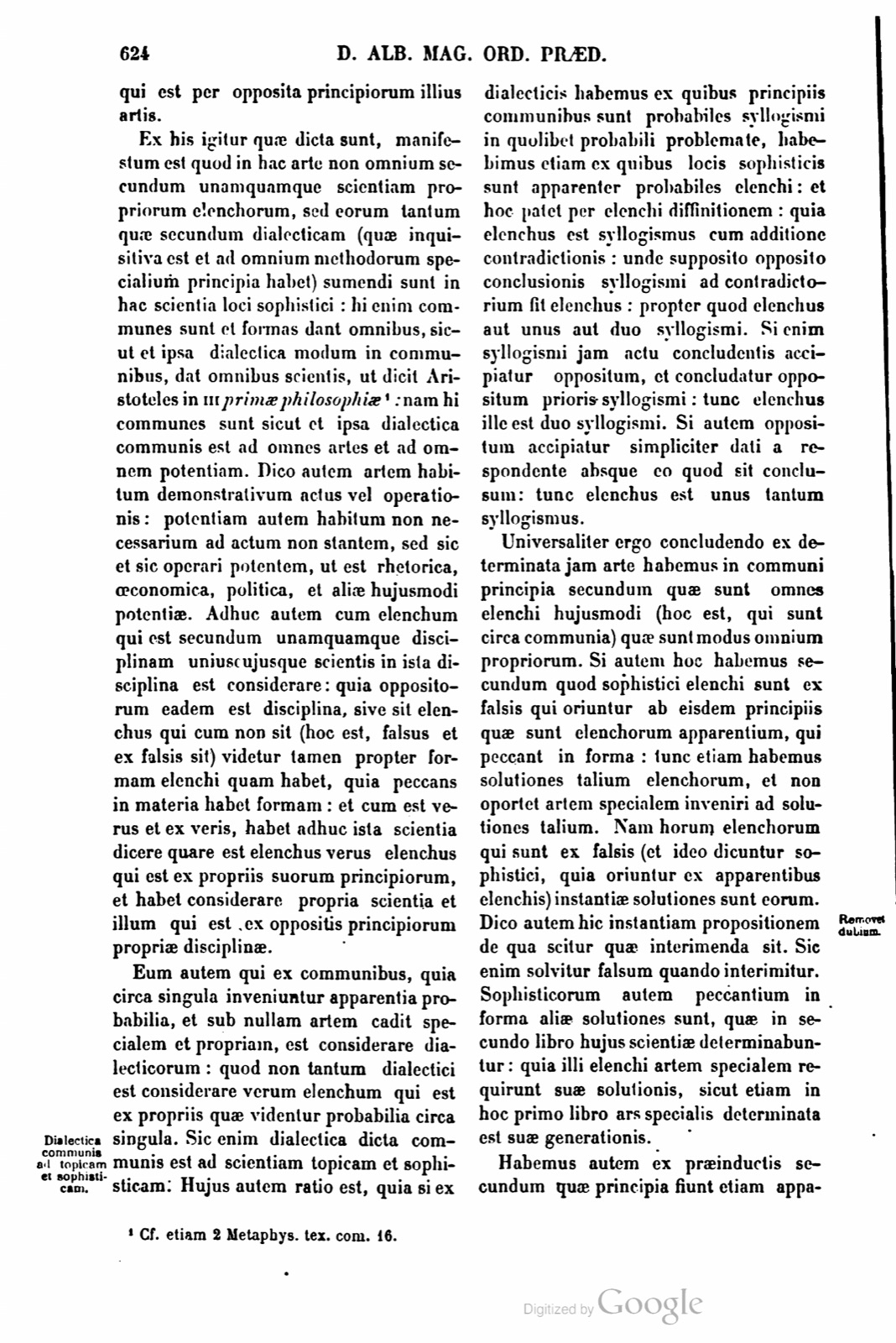
Propter quod illos qui determinare debent de propriis paralogismis uniuscujusque disciplinae, oportebit omnium propriorum scibilium esse scientes: quia tales paralogismi fiunt per opposita propriorum principiorum. Cujus probatio est per inductionem, quia alii tales paralogismi sive falsi elenchi secundum ea quae in geometria sunt propria principia et secundum proprias scibilium in geometria conclusiones, quarum oppositum proprium concludit elenchus: alii vero tales paralogismi disciplinae erunt secundum ea quae sunt propria medicinae: alii vero tales paralogismi erunt secundum ea quae sunt propria aliarum disciplinarum elenchi: et cum veri elenchi sint sic in infinitis, non solum ipsi veri elenchi erunt sic infiniti, sed et falsi (hoc est, ex falsi, principii, facti), similiter veri erunt sic in infinitis scibilibus et scientiis, quod secundum unumquemque verum elenchum fit syllogismus oppositus, si accipit opposita veri elenchi, ut secundum geometriam fit falsus geometricus elenchus: secundum autem medicinam fit elenchus medicinalis. Dico autem exponendo secundum artem sive scientiam propriam elenchum qui est secundum illius artis propria principia, et falsum elenchum qui est per opposita principiorum illius artis.
Ex his igitur quae dicta sunt, manifestum est quod in hac arte non omnium secundum unamquamque scientiam propriorum elenchorum, sed eorum tantum quae secundum dialecticam (quae inquisitiva est et ad omnium methodorum specialium principia habet) sumendi sunt in hac scientia loci sophistici: hi enim communes sunt et formas dant omnibus, sicut et ipsa dialectica modum in communibus, dat omnibus scientis, ut dicit Aristoteles in III primae philosophiae1: nam hi communes sunt sicut et ipsa dialectica communis est ad omnes artes et ad omnem potentiam. Dico autem artem habitum demonstrativum actus vel operationis: potentiam autem habitum non necessarium ad actum non stantem, sed sic et sic operari potentem, ut est rhetorica, oeconomica, politica, et aliae hujusmodi potentiae. Adhuc autem cum elenchum qui est secundum unamquamque disciplinam uniuscujusque scientis in ista disciplina est considerare: quia oppositorum eadem est disciplina, sive sit elenchus qui cum non sit (hoc est, falsus et ex falsis sit) videtur tamen propter formam elenchi quam habet, quia peccans in materia habet formam: et cum est verus et ex veris, habet adhuc ista scientia dicere quare est elenchus verus elenchus qui est ex propriis suorum principiorum, et habet considerare propria scientia et illum qui est ex oppositis principiorum propriae disciplinae.
Eum autem qui ex communibus, quia circa singula inveniuntur apparentia probabilia, et sub nullam artem cadit specialem et propriam, est considerare dialecticorum: quod non tantum dialectici est considerare verum elenchum qui est ex propriis quae videntur probabilia circa singula. Sic enim dialectica dicta communis est ad scientiam topicam et sophisticam: Hujus autem ratio est, quia si ex dialecticis habemus ex quibus principiis communibus sunt probabiles syllogismi in quolibet probabili problemate, habebimus etiam ex quibus locis sophisticis sunt apparenter probabiles elenchi: et hoc patet per elenchi diffinitionem: quia elenchus est syllogismus cum additione contradictionis: unde supposito opposito conclusionis syllogismi ad contradictorium fit elenchus: propter quod elenchus aut unus aut duo syllogismi. Si enim syllogismi jam actu concludentis accipiatur oppositum, et concludatur oppositum prioris syllogismi: tunc elenchus ille est duo syllogismi. Si autem oppositum accipiatur simpliciter dati a respondente absque eo quod sit conclusum: tunc elenchus est unus tantum syllogismus.
For this reason, those who ought to determine concerning the proper paralogisms of each discipline will have to be knowledgeable in all proper knowable things, because such paralogisms are made through the opposites of proper principles. The proof of this is by induction, because some such paralogisms or false refutations are according to those things which in geometry are proper principles and according to the proper conclusions of knowable things in geometry, the proper opposite of which the refutation concludes; but other such paralogisms of discipline will be according to those things which are proper to medicine; and still other such paralogisms will be according to the refutations which are proper to other disciplines. And since true refutations are thus among infinite things, not only will true refutations themselves thus be infinite, but also false ones, that is, ones made from a false principle; similarly true ones will thus be in infinite knowable things and sciences, because according to each true refutation an opposite syllogism is made, if it takes the opposites of the true refutation, as according to geometry a false geometrical refutation is made, but according to medicine a medical refutation is made. But I say, by way of exposition, a refutation according to a proper art or science, which is according to the proper principles of that art, and a false refutation which is through the opposites of the principles of that art.
Therefore from these things which have been said it is manifest that in this art the sophistical places must be taken not of all proper refutations according to each science, but only of those which are according to dialectic, which is inquisitive and has access to the principles of all special methods. For these are common and give forms to all, just as dialectic itself, in common matters, gives a mode to all sciences, as Aristotle says in book III of first philosophy1; for these common places are common just as dialectic itself is common to all arts and to every potency. But by art I mean a demonstrative habit of act or operation; by potency, however, a habit not necessary to an act, not standing in act, but able to operate in this way and that, as rhetoric, economics, politics, and other powers of this sort are. Further, since it belongs to each person knowing in this discipline to consider the refutation which is according to each discipline, because of opposites there is the same discipline, whether it is a refutation which, though it is not, that is, though it is false and from false things, nevertheless seems because of the form of refutation which it has, since that which sins in matter has form; and when it is true and from true things, this science still has to say why a true refutation is a true refutation, namely one that is from things proper to its principles, and the proper science has to consider also the one which is from the opposites of the principles of the proper discipline.
But to consider the one which is from common things, because apparent probable things are found concerning singulars and it falls under no special and proper art, belongs to dialecticians; and it does not belong only to the dialectician to consider a true refutation which is from proper things that seem probable concerning singulars. For in this way dialectic, called common, is common to the topical and sophistical science. But the reason of this is that, if from dialectical matters we have from what common principles probable syllogisms are in any probable problem, we shall also have from what sophistical places apparently probable refutations are. And this is clear through the definition of refutation, because a refutation is a syllogism with the addition of contradiction. Hence, once the opposite of the conclusion of a syllogism has been supposed for the contradictory, a refutation is made; for this reason a refutation is either one syllogism or two syllogisms. For if the opposite of a syllogism already actually concluding is accepted, and the opposite of the prior syllogism is concluded, then that refutation is two syllogisms. But if the opposite of what has simply been given by the respondent is accepted without its having been concluded, then the refutation is only one syllogism.
Universaliter ergo concludendo ex determinata jam arte habemus in communi principia secundum quae sunt omnes elenchi hujusmodi (hoc est, qui sunt circa communia) quae sunt modus omnium propriorum. Si autem hoc habemus secundum quod sophistici elenchi sunt ex falsis qui oriuntur ab eisdem principiis quae sunt elenchorum apparentium, qui peccant in forma: tunc etiam habemus solutiones talium elenchorum, et non oportet artem specialem inveniri ad solutiones talium. Nam horum elenchorum qui sunt ex falsis (et ideo dicuntur sophistici, quia oriuntur ex apparentibus elenchis) instantiae solutiones sunt eorum. Dico autem hic instantiam propositionem de qua scitur quae interimenda sit. Sic enim solvitur falsum quando interimitur. Sophisticorum autem peccantium in forma aliae solutiones sunt, quae in secundo libro hujus scientiae determinabuntur: quia illi elenchi artem specialem requirunt suae solutionis, sicut etiam in hoc primo libro ars specialis determinata est suae generationis.
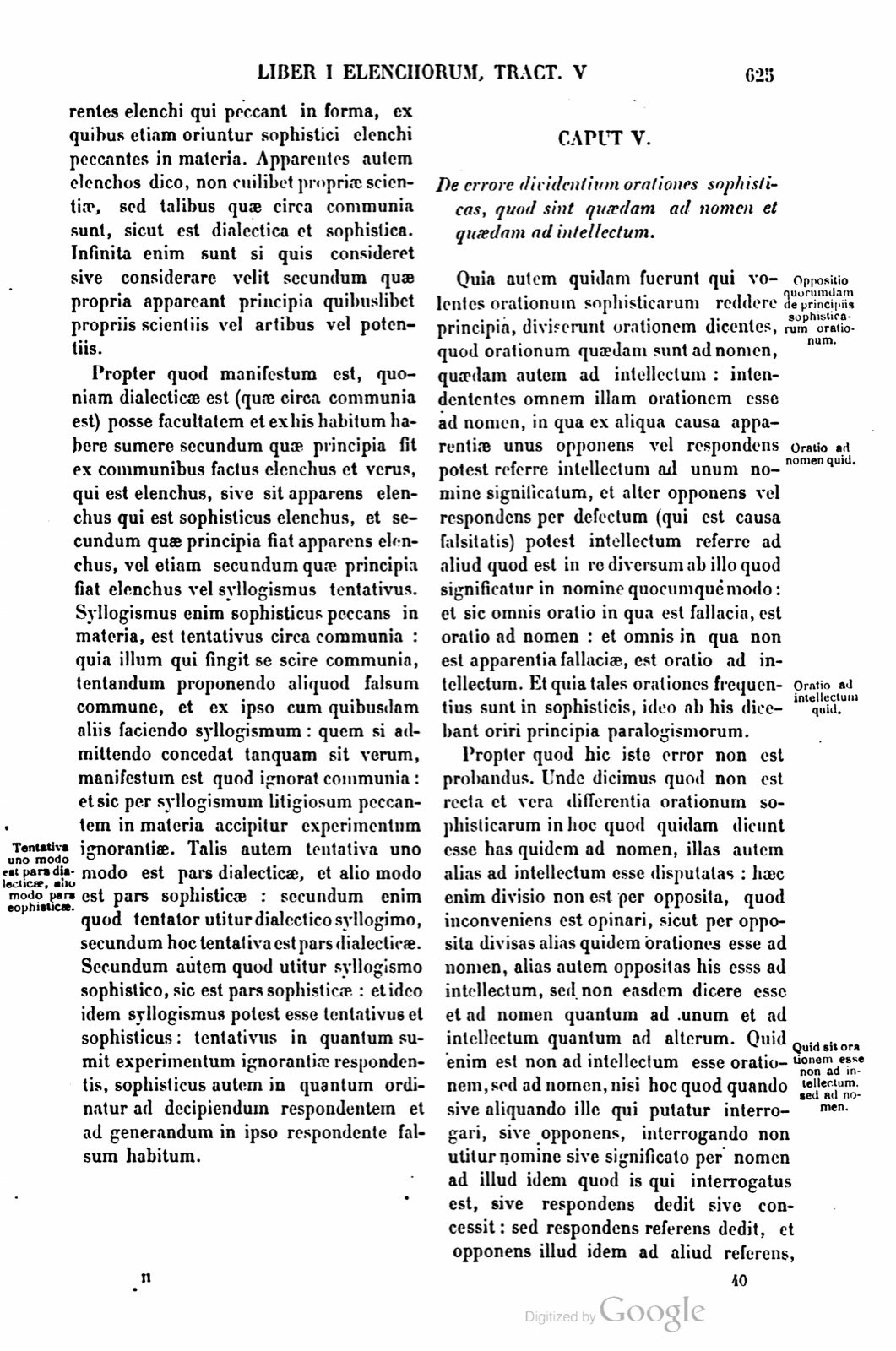
Habemus autem ex praeinductis secundum quae principia fiunt etiam apparentes elenchi qui peccant in forma, ex quibus etiam oriuntur sophistici elenchi peccantes in materia. Apparentes autem elenchos dico, non cuilibet propriae scientiae, sed talibus quae circa communia sunt, sicut est dialectica et sophistica. Infinita enim sunt si quis consideret sive considerare velit secundum quae propria appareant principia quibuslibet propriis scientiis vel artibus vel potentiis.
Propter quod manifestum est, quoniam dialecticae est (quae circa communia est) posse facultatem et ex his habitum habere sumere secundum quae principia fit ex communibus factus elenchus et verus, qui est elenchus, sive sit apparens elenchus qui est sophisticus elenchus, et secundum quae principia fiat apparens elenchus, vel etiam secundum quae principia fiat elenchus vel syllogismus tentativus. Syllogismus enim sophisticus peccans in materia, est tentativus circa communia: quia illum qui fingit se scire communia, tentandum proponendo aliquod falsum commune, et ex ipso cum quibusdam aliis faciendo syllogismum: quem si admittendo concedat tanquam sit verum, manifestum est quod ignorat communia: et sic per syllogismum litigiosum peccantem in materia accipitur experimentum ignorantiae. Talis autem tentativa uno modo est pars dialecticae, et alio modo est pars sophisticae: secundum enim quod tentator utitur dialectico syllogismo, secundum hoc tentativa est pars dialecticae. Secundum autem quod utitur syllogismo sophistico, sic est pars sophisticae: et ideo idem syllogismus potest esse tentativus et sophisticus: tentativus in quantum sumit experimentum ignorantiae respondentis, sophisticus autem in quantum ordinatur ad decipiendum respondentem et ad generandum in ipso respondente falsum habitum.
Therefore, concluding universally from the art already determined, we have in common the principles according to which all refutations of this kind are, that is, those which concern common things, which are the mode of all proper things. But if we have this according as sophistical refutations are from false things which arise from the same principles which are the principles of apparent refutations that sin in form, then we also have the solutions of such refutations, and a special art need not be discovered for the solutions of such. For of these refutations which are from false things, and therefore are called sophistical because they arise from apparent refutations, their solutions are instances. But here I call an instance a proposition about which it is known that it must be destroyed. For the false is solved in this way, when it is destroyed. But of sophistical refutations sinning in form there are other solutions, which will be determined in the second book of this science, because those refutations require a special art for their solution, just as also in this first book a special art has been determined for their generation.
But from the things brought in beforehand we have according to which principles apparent refutations too are made which sin in form, from which sophistical refutations sinning in matter also arise. But I call apparent refutations those not of any proper science, but such as concern common things, as dialectic and sophistic do. For they are infinite if someone considers, or wishes to consider, according to what proper principles they appear to any proper sciences or arts or potencies.
For this reason it is manifest that it belongs to dialectic, which concerns common things, to be able to have the faculty, and from these the habit, of taking the principles according to which a refutation made from common things and true is made, which is a refutation, or according to which an apparent refutation is made, which is a sophistical refutation, and according to which principles an apparent refutation is made, or also according to which principles a refutation or tentative syllogism is made. For a sophistical syllogism sinning in matter is tentative concerning common things, because he who feigns that he knows common things must be tested by proposing some common false thing and from it making a syllogism with certain other things; if by admitting he grants it as if true, it is manifest that he is ignorant of common things. And thus through a contentious syllogism sinning in matter an experiment of ignorance is taken. But such tentative disputation in one way is part of dialectic, and in another way is part of sophistic. For insofar as the tester uses a dialectical syllogism, in this respect tentative disputation is part of dialectic. But insofar as he uses a sophistical syllogism, in this way it is part of sophistic; and therefore the same syllogism can be tentative and sophistical: tentative insofar as it takes an experiment of the ignorance of the respondent; but sophistical insofar as it is ordered to deceiving the respondent and to generating in that respondent a false habit.
Notes
- Compare also Metaphysics 2, text commentary 16. (Cf. etiam 2 Metaphys. tex. com. 16.) ↩
If a page does not appear, its photograph has not been uploaded yet.