Works › Sophistical Refutations, Books I–II
Volume 2 · pp. 618–620
Tractate V. Chapters II-III
A marker with ≈ is an approximate page boundary, placed by measure of the text; the page photographs remain the authority. In the paired views, clicking a page marker brings that page into view.
Hoc modo praenotato dicimus, quod in his quae sunt secundum accidens deceptio fit in respondente sive fallacia: eo quod ipse respondens non potest dijudicare idem et diversum, et non potest dijudicare multa et unum: neque potest dividere quaelibet secundum quae insunt praedicationibus (hoc est, praedicatis) et rei subjectae accidere: haec enim tria in diversis paralogismis accidentis necesse est discernere eum qui non decipitur. Haec enim tria ponit Aristoteles, et possunt hic referri ad idem et ad diversum. Si ad idem intentum illa referantur, tunc sequens est determinatio quaedam praecedentis, ita quod idem diversum determinetur per multa et unum, et multa et unum determinentur per ea quae insunt praedicatis: et putantur per hoc etiam subjectis inesse: potest enim intelligi per idem et diversum identitas accidentis ad subjectum sive medii ad extrema: medium enim convenit utrique extremo: et in hac convenientia est idem: secundum tamen quod in fallacia accidentis convenit uni extremo, secundum hoc convenit ei oppositum alterius extremi, ut in prae habitis de fallacia accidentis dictum est: et in hoc consistit diversitas: qui enim habet identitatem, et hanc diversitatem considerare et discernere non valet, decipitur. Potest etiam per unum et multa intendere accidens et subjectum: subjectum enim et accidens secundum quod comparantur ad accidens quod eis similiter inest, sicut ad accidens quod sequitur subjectum et accidens, sic sunt unum: et non solum unum est idem alteri, sed in tertio sunt unum: secundum autem quod idem subjectum et accidens comparantur ad aliquid (quod eis dissimiliter inest) sunt multa, et non solum est unum diversum ab altero: et hoc specificatur per verbum sequens: eo enim ipso quod aliquis impotens est discernere quae similiter attribuuntur rei subjectae et accidenti inesse simpliciter, eo ipso impotens est discernere inter unum et multa: et sic per haec tria verba intenditur unum magis specificatum.
Possunt etiam per haec tria verba intendi diversa genera paralogismorum accidentis: per hoc enim quod dicit unum et multa, dicunt quidam intendi paralogismos accentus, qui procedit a divisis ad conjunctum: ut canis est tuus, et est pater: ergo est tuus pater. Per hoc autem quod dicitur idem et diversum, dicunt intendi paralogismos in quibus infertur aliquid modo syllogistico, ut hoc: musicum est nigrum: album est musicum: ergo album nigrum. Cum autem dicitur, neque quaelibet praedicationibus omnia haec et rei subjectae accidere, dicunt intendi paralogismos accidentis, qui communem faciunt deceptionem secundum utrumque modum. Prius tamen dictum, quod scilicet unum per alterum specificetur, est probabilius.
Similiter autem generatur fallacia sive deceptio in paralogismis secundum consequens: pars enim quaedam accidentis est consequens, ut in ante habitis de consequente dictum. Tamen sciendum, quod fallacia consequentis non peccat penes omnes praedictas conditiones quae sunt idem et diversum, et unum et multa, quaecumque insunt praedicatis et rei similiter inesse: sed peccat tantum penes duas ex illis: penes enim hanc, quod impotens est quis judicare, quod quaecumque praedicatis insunt, omnia haec similiter et rei subjectae inesse, non decipitur aliquis secundum consequens, sed penes hoc quod impotens est dijudicare inter idem et diversum, et unum et multa: eo enim decipitur quis secundum consequens, quod nescit dijudicare identitatem antecedentis ad consequens, quae consistit in hoc quod ubicumque est antecedens, ibi necesse est esse consequens: et inter divisionem antecedentis ad consequens, quae consistit in hoc, quod non est necesse esse antecedens, ubicumque fuerit consequens: et iterum quis in hoc decipitur: quia nescit discernere inter antecedentis necessitatem et consequentis. Amplius autem, sicut in ante habitis dictum est, consequens semper in pluribus esse videtur: et probatur sic, hoc est, probari videtur secundum apparentiam: si enim hoc consequens ab illo antecedente non separatur, putatur quod nec ab illo quod est consequens, separetur alterum quod est antecedens: et sic generatur deceptio: quia licet antecedens non separetur a consequente, tamen consequens semper separetur ab antecedente: eo quod in pluribus est.
With this mode having been noted beforehand, we say that in those things which are according to accident deception or fallacy is made in the respondent because that respondent himself cannot judge the same and the diverse, and cannot judge many and one; nor can he divide any things according to which they belong to predications, that is, predicates, and happen to the subject thing. For these three things must be discerned by him who is not deceived in diverse paralogisms of accident. For Aristotle posits these three, and they can here be referred to the same and to the diverse. If they are referred to the same intended thing, then the following is a certain determination of the preceding, so that the same and diverse is determined through many and one, and many and one are determined through those things which belong to predicates; and through this they are thought also to belong to subjects. For by same and diverse can be understood the identity of accident to subject, or of the middle to the extremes; for the middle agrees with each extreme, and in this agreement it is the same; nevertheless, according as in the fallacy of accident it agrees with one extreme, according to this the opposite of the other extreme agrees with it, as was said in the preceding things concerning the fallacy of accident; and diversity consists in this. For one who has identity and is not able to consider and discern this diversity is deceived. Through one and many, accident and subject can also be intended; for subject and accident, insofar as they are compared to an accident which similarly belongs to them, as to an accident which follows subject and accident, are thus one; and not only is one the same as the other, but they are one in a third thing. But insofar as the same subject and accident are compared to something which belongs to them dissimilarly, they are many, and not only is one diverse from the other; and this is specified by the following word: for by the very fact that someone is unable to discern that the things which are similarly attributed to a subject thing and to an accident belong simply, by that very fact he is unable to discern between one and many; and thus through these three words one more specified thing is intended.
Through these three words diverse genera of the paralogisms of accident can also be intended. For by the fact that he says one and many, some say that paralogisms of accent are intended, which proceed from divided things to a conjoined thing, as: the dog is yours, and is a father; therefore it is your father. But by that which is called same and diverse, they say that paralogisms are intended in which something is inferred in syllogistic mode, as this: the musical is black; the white is musical; therefore the white is black. But when it is said, nor do any things whatever that belong to predications, all these things, happen to the subject thing, they say that paralogisms of accident are intended which make common deception according to each mode. Yet what was said first, namely that one is specified through the other, is more probable.
Similarly, fallacy or deception is generated in paralogisms according to the consequent: for the consequent is a certain part of accident, as was said in the preceding things concerning the consequent. Yet it must be known that the fallacy of the consequent does not sin with respect to all the aforesaid conditions, which are the same and diverse, and one and many, and that whatever things belong to predicates belong similarly to the thing; but it sins only with respect to two of them. For with respect to this, that someone is unable to judge that whatever things belong to predicates, all these things belong similarly also to the subject thing, no one is deceived according to the consequent, but with respect to this, that he is unable to judge between the same and the diverse, and one and many. For someone is deceived according to the consequent in this, that he does not know how to judge the identity of the antecedent to the consequent, which consists in this, that wherever the antecedent is, there the consequent must be; and between the division of antecedent from consequent, which consists in this, that it is not necessary that the antecedent be wherever the consequent has been; and again someone is deceived in this, because he does not know how to discern between the necessity of the antecedent and of the consequent. Moreover, as was said in the preceding things, the consequent always seems to be in several things; and it is proved thus, that is, it seems to be proved according to appearance: for if this consequent is not separated from that antecedent, it is thought that neither is the other, which is the antecedent, separated from that which is the consequent; and thus deception is generated, because although the antecedent is not separated from the consequent, nevertheless the consequent is always separated from the antecedent, because it is in more things.
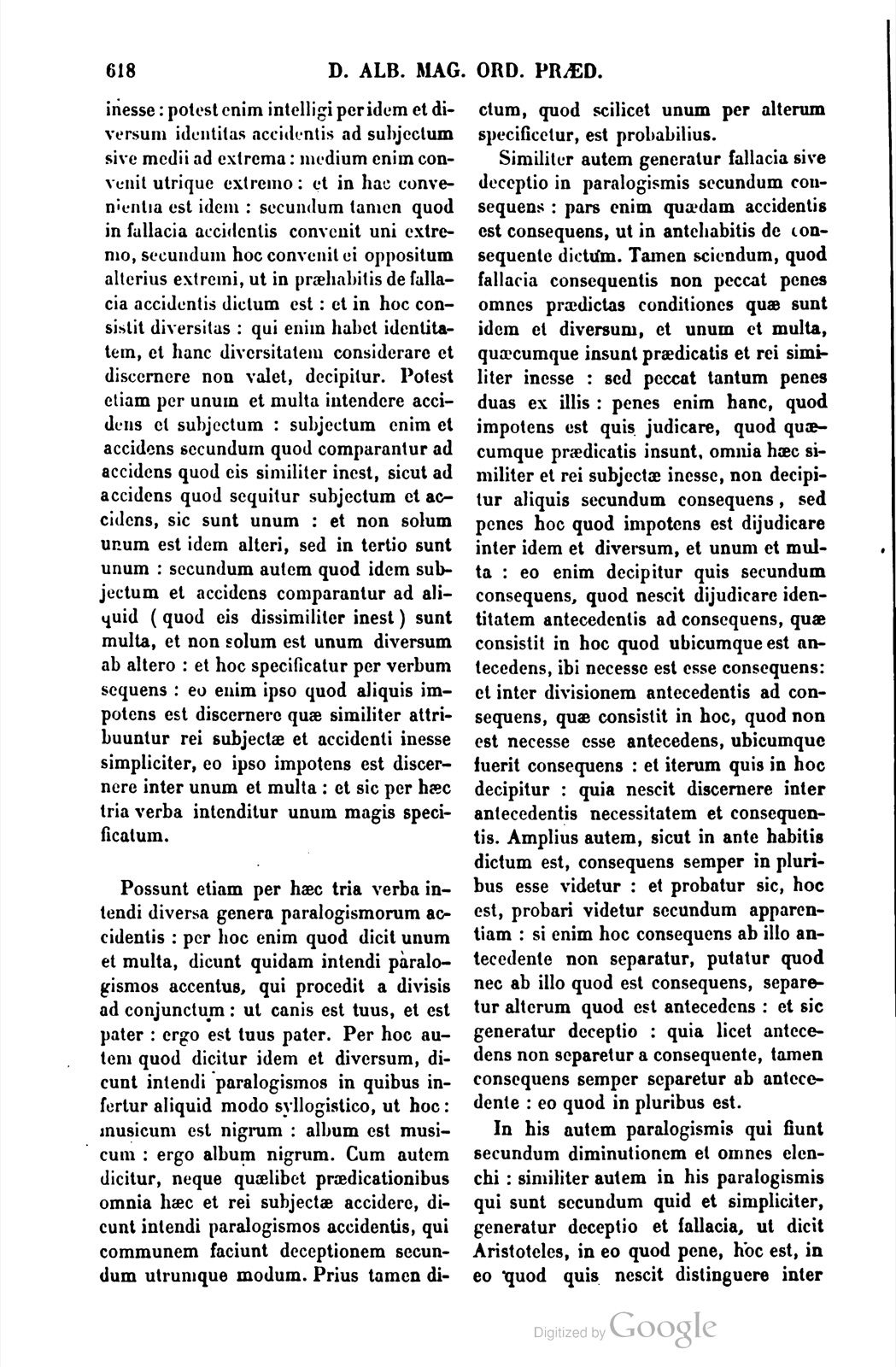
In his autem paralogismis qui fiunt secundum diminutionem et omnes elenchi: similiter autem in his paralogismis qui sunt secundum quid et simpliciter, generatur deceptio et fallacia, ut dicit Aristoteles, in eo quod pene, hoc est, in eo quod quis nescit distinguere inter identitatem simpliciter et veram identitatem partialem quae est secundum quid. Similiter autem in ignorantia elenchi deceptio fit: eo quod quis nescit determinare inter opposita sumpta simpliciter, et sumpta cum determinationibus propriis quae inferunt suum simpliciter. In fallacia enim secundum quid et simpliciter concedimus universaliter sive simpliciter conclusionem, quod nihil consignificet quid (hoc est, secundum quid) aut quomodo, aut quo loco, aut ut nunc: et ideo decipimur.
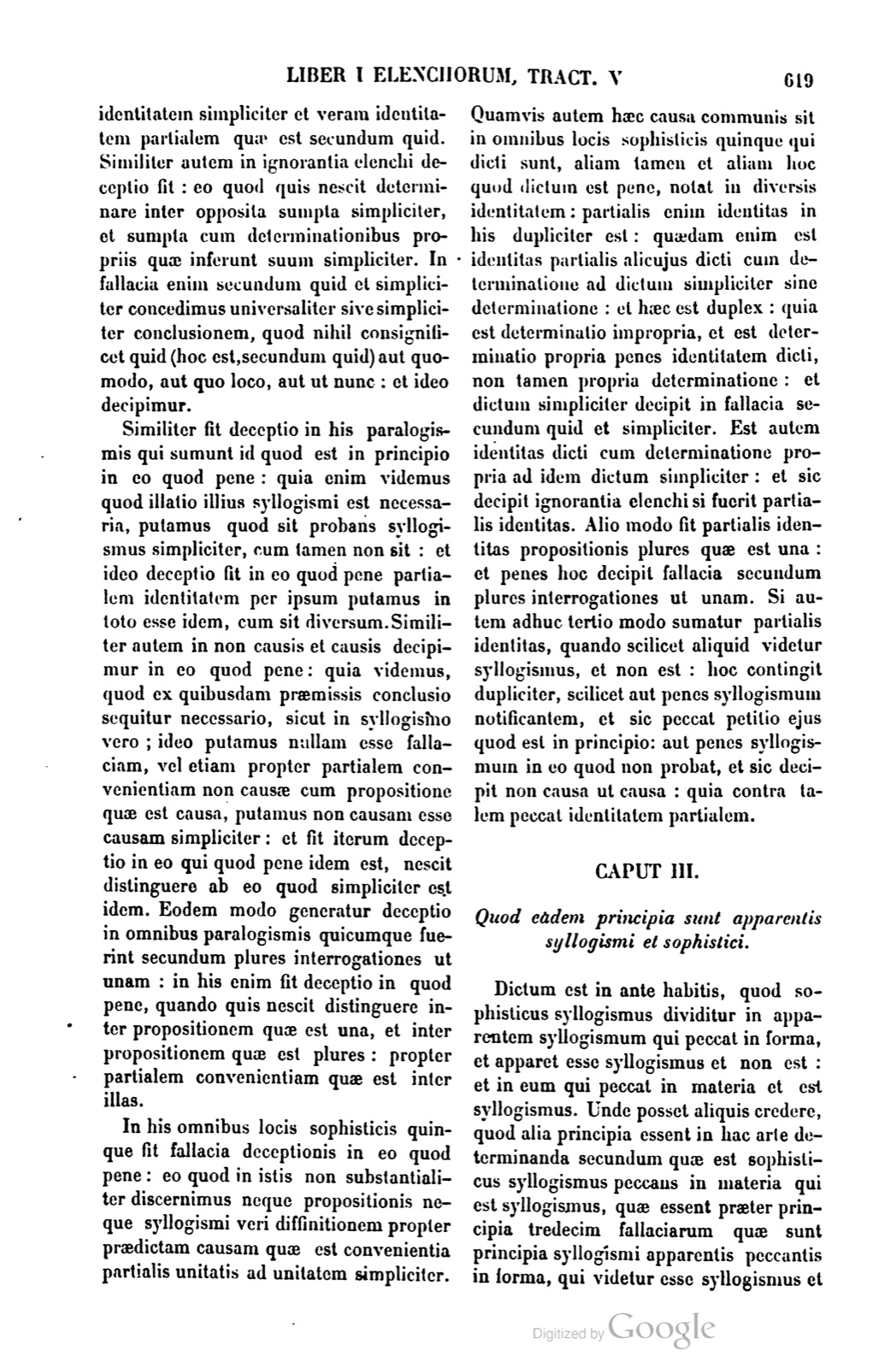
Similiter fit deceptio in his paralogismis qui sumunt id quod est in principio in eo quod pene: quia enim videmus quod illatio illius syllogismi est necessaria, putamus quod sit probans syllogismus simpliciter, cum tamen non sit: et ideo deceptio fit in eo quod pene partialem identitatem per ipsum putamus in toto esse idem, cum sit diversum. Similiter autem in non causis et causis decipimur in eo quod pene: quia videmus, quod ex quibusdam praemissis conclusio sequitur necessario, sicut in syllogismo vero; ideo putamus nullam esse fallaciam, vel etiam propter partialem convenientiam non causae cum propositione quae est causa, putamus non causam esse causam simpliciter: et fit iterum deceptio in eo qui quod pene idem est, nescit distinguere ab eo quod simpliciter est idem. Eodem modo generatur deceptio in omnibus paralogismis quicumque fuerint secundum plures interrogationes ut unam: in his enim fit deceptio in quod pene, quando quis nescit distinguere inter propositionem quae est una, et inter propositionem quae est plures: propter partialem convenientiam quae est inter illas.
In his omnibus locis sophisticis quinque fit fallacia deceptionis in eo quod pene: eo quod in istis non substantialiter discernimus neque propositionis neque syllogismi veri diffinitionem propter praedictam causam quae est convenientia partialis unitatis ad unitatem simpliciter. Quamvis autem haec causa communis sit in omnibus locis sophisticis quinque qui dicti sunt, aliam tamen et aliam hoc quod dictum est pene, notat in diversis identitatem: partialis enim identitas in his dupliciter est: quaedam enim est identitas partialis alicujus dicti cum determinatione ad dictum simpliciter sine determinatione: et haec est duplex: quia est determinatio impropria, et est determinatio propria penes identitatem dicti, non tamen propria determinatione: et dictum simpliciter decipit in fallacia secundum quid et simpliciter. Est autem identitas dicti cum determinatione propria ad idem dictum simpliciter: et sic decipit ignorantia elenchi si fuerit partialis identitas. Alio modo fit partialis identitas propositionis plures quae est una: et penes hoc decipit fallacia secundum plures interrogationes ut unam. Si autem adhuc tertio modo sumatur partialis identitas, quando scilicet aliquid videtur syllogismus, et non est: hoc contingit dupliciter, scilicet aut penes syllogismum notificatem, et sic peccat petitio ejus quod est in principio: aut penes syllogismum in eo quod non probat, et sic decipit non causa ut causa: quia contra talem peccat identitatem partialem.
CAPUT III. Quod eadem principia sunt apparentis syllogismi et sophistici.
Dictum est in ante habitis, quod sophisticus syllogismus dividitur in apparentem syllogismum qui peccat in forma, et apparet esse syllogismus et non est: et in eum qui peccat in materia et est syllogismus. Unde posset aliquis credere, quod alia principia essent in hac arte determinanda secundum quae est sophisticus syllogismus peccans in materia qui est syllogismus, quae essent praeter principia tredecim fallaciarum quae sunt principia syllogismi apparentis peccantis in forma, qui videtur esse syllogismus et non est syllogismus: ideo oportet nos hoc capitulum inducere, quod secundum eadem principia fit uterque syllogismus sophisticus peccans in materia et peccans in forma: et non oportet alia et alia requirere, secundum quae fiat peccans in forma apparens syllogismus, et alia secundum quae fiat peccans in materia qui est syllogismus. Et hujus ratio in communi est, quia quando aliquis decipitur per syllogismum peccantem in materia, hoc non fit nisi quia concedit propositionem aliquam falsam vel ad minus improbabilem, quae videtur esse vera: non autem videtur eidem vera, nisi quia videtur ei sequi ex veris vel ex vera, cum non sequatur ex illa vel ex illis: non autem videtur sequi, cum non sequatur nisi per apparentiam alicujus loci sophistici sive fallaciae: falsum ergo pro vero accipit per aliquem locum sophisticum; et sic deceptus utitur falso pro vero in syllogismo sophistico peccante in materia: et sic deceptio sive fallacia syllogismi sophistici peccantis in materia, oritur a principio syllogismi sophistici peccantis in forma: sed non oportet quod principium sophisticae deceptionis sit in eodem syllogismo qui peccat in materia, sed in syllogismo praecedente illum qui per syllogismum apparentem videtur probare propositionem falsam videri veram per locum aliquem sophisticum. Et sic patet quod eadem et tot sunt principia syllogismi sophistici peccantis in forma et peccantis in materia: sed tamen non immediate, quia mediante syllogismo peccante in forma efficiuntur etiam principia syllogismi peccantis in materia.
But in these paralogisms which are made according to diminution and all refutations, and similarly in those paralogisms which are according to qualifiedly and simply, deception and fallacy are generated, as Aristotle says, in that which is nearly, that is, in that someone does not know how to distinguish between identity simply and a true partial identity which is according to a qualification. Likewise in ignorance of refutation deception is made because someone does not know how to determine between opposites taken simply and taken with proper determinations which infer their simple form. For in the fallacy according to qualifiedly and simply we concede universally or simply the conclusion that nothing consignifies what, that is, according to a qualification, or how, or in what place, or as now; and therefore we are deceived.
Similarly deception occurs in those paralogisms which take that which is in the principle in that which is nearly; for because we see that the inference of that syllogism is necessary, we think that it is a proving syllogism simply, although nevertheless it is not. And therefore deception occurs in that which is nearly: through it we think partial identity is the same in the whole, although it is diverse. Likewise in non-causes and causes we are deceived in that which is nearly, because we see that from certain premises a conclusion follows necessarily, as in a true syllogism; therefore we think that there is no fallacy, or also, because of the partial agreement of the non-cause with the proposition which is the cause, we think the non-cause is the cause simply; and again deception is made in one who does not know how to distinguish that which is nearly the same from that which is simply the same. In the same way deception is generated in all paralogisms whatsoever that are according to several questions as one; for in these deception occurs in that which is nearly, when someone does not know how to distinguish between the proposition which is one and the proposition which is several, because of the partial agreement which is between them.
In all these five sophistical places the fallacy of deception occurs in that which is nearly, because in these we do not substantially discern either the definition of a true proposition or of a true syllogism, because of the aforesaid cause, which is the partial agreement of unity with unity simply. But although this cause is common in all five sophistical places which have been spoken of, nevertheless what has been called nearly marks one identity in one place and another in diverse places. For partial identity in these is twofold: one is the partial identity of something said with a determination in relation to the thing said simply without determination; and this is twofold, because there is an improper determination, and there is a proper determination with respect to the identity of the thing said, but nevertheless not proper in determination; and the thing said simply deceives in the fallacy according to qualifiedly and simply. But there is an identity of the thing said with a proper determination in relation to the same thing said simply; and thus ignorance of refutation deceives if there is partial identity. In another way partial identity is made of a several proposition which is one; and with respect to this the fallacy according to several questions as one deceives. But if partial identity is taken still in a third way, namely when something seems to be a syllogism and is not, this happens in two ways, namely either with respect to a syllogism that makes known, and thus begging that which is in the principle sins, or with respect to a syllogism in that it does not prove, and thus non-cause as cause deceives, because it sins against such partial identity.
CHAPTER III. That the same principles belong to the apparent syllogism and to the sophistical syllogism.
It has been said in the preceding things that the sophistical syllogism is divided into an apparent syllogism which sins in form and appears to be a syllogism and is not, and into that which sins in matter and is a syllogism. Hence someone could believe that other principles were to be determined in this art according to which there is a sophistical syllogism sinning in matter, which is a syllogism, which would be besides the principles of the thirteen fallacies which are the principles of the apparent syllogism sinning in form, which seems to be a syllogism and is not a syllogism. Therefore we must introduce this chapter: that according to the same principles each sophistical syllogism is made, the one sinning in matter and the one sinning in form; and one need not seek one set and another set, according to which the apparent syllogism sinning in form is made, and others according to which the one sinning in matter, which is a syllogism, is made. And the reason of this in common is that, when someone is deceived through a syllogism sinning in matter, this happens only because he grants some false or at least improbable proposition which seems to be true; but it does not seem true to him except because it seems to him to follow from true things or from a true thing, although it does not follow from that thing or from those things; but it does not seem to follow, when it does not follow, except through the appearance of some sophistical place or fallacy. Therefore he accepts the false as true through some sophistical place, and thus, deceived, he uses the false as true in a sophistical syllogism sinning in matter. And thus the deception or fallacy of a sophistical syllogism sinning in matter arises from a principle of a sophistical syllogism sinning in form; but it is not necessary that the principle of the sophistical deception be in the same syllogism which sins in matter, but in a syllogism preceding that one, which through an apparent syllogism seems to prove that a false proposition seems true through some sophistical place. And thus it is clear that the principles of the sophistical syllogism sinning in form and sinning in matter are the same and as many; yet nevertheless not immediately, because through the mediation of the syllogism sinning in form they are also made principles of the syllogism sinning in matter.
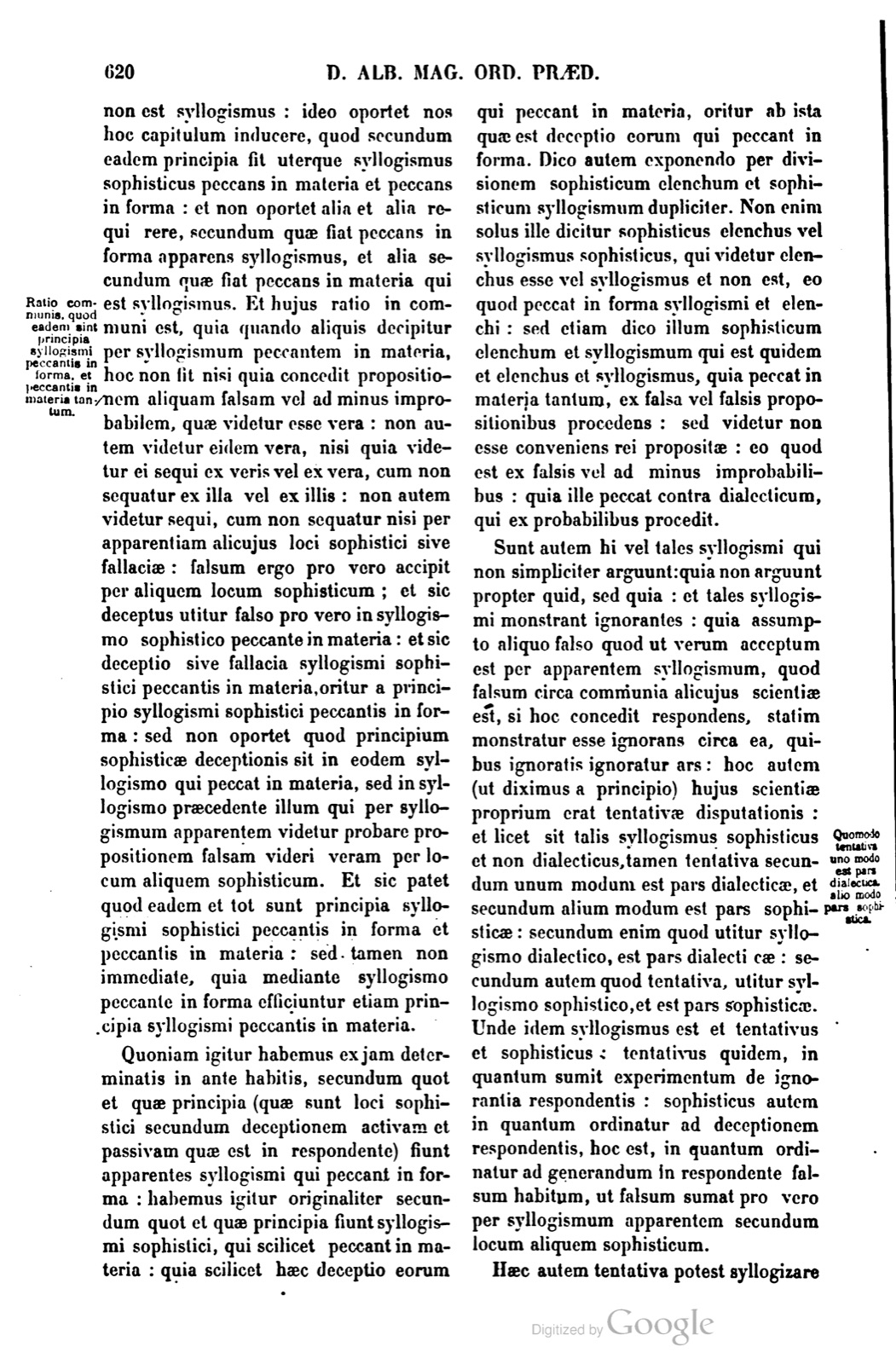
Quoniam igitur habemus ex jam determinatis in ante habitis, secundum quot et quae principia (quae sunt loci sophistici secundum deceptionem activam et passivam quae est in respondente) fiunt apparentes syllogismi qui peccant in forma: habemus igitur originaliter secundum quot et quae principia fiunt syllogismi sophistici, qui scilicet peccant in materia: quia scilicet haec deceptio eorum qui peccant in materia, oritur ab ista quae est deceptio eorum qui peccant in forma. Dico autem exponendo per divisionem sophisticum elenchum et sophisticum syllogismum dupliciter. Non enim solus ille dicitur sophisticus elenchus vel syllogismus sophisticus, qui videtur elenchus esse vel syllogismus et non est, eo quod peccat in forma syllogismi et elenchi: sed etiam dico illum sophisticum elenchum et syllogismum qui est quidem et elenchus et syllogismus, quia peccat in materia tantum, ex falsa vel falsis propositionibus procedens: sed videtur non esse conveniens rei propositae: eo quod est ex falsis vel ad minus improbabilibus: quia ille peccat contra dialecticum, qui ex probabilibus procedit.
Sunt autem hi vel tales syllogismi qui non simpliciter arguunt: quia non arguunt propter quid, sed quia: et tales syllogismi monstrant ignorantes: quia assumpto aliquo falso quod ut verum acceptum est per apparentem syllogismum, quod falsum circa communia alicujus scientiae est, si hoc concedit respondens, statim monstratur esse ignorans circa ea, quibus ignoratis ignoratur ars: hoc autem (ut diximus a principio) hujus scientiae proprium erat tentativae disputationis: et licet sit talis syllogismus sophisticus et non dialecticus, tamen tentativa secundum unum modum est pars dialecticae, et secundum alium modum est pars sophisticae: secundum enim quod utitur syllogismo dialectico, est pars dialecticae: secundum autem quod tentativa, utitur syllogismo sophistico, et est pars sophisticae. Unde idem syllogismus est et tentativus et sophisticus: tentativus quidem, in quantum sumit experimentum de ignorantia respondentis: sophisticus autem in quantum ordinatur ad deceptionem respondentis, hoc est, in quantum ordinatur ad generandum in respondente falsum habitum, ut falsum sumat pro vero per syllogismum apparentem secundum locum aliquem sophisticum.
Haec autem tentativa potest syllogizare
Therefore, since from the things already determined in the preceding matters we have according to how many and which principles, which are sophistical places according to active and passive deception that is in the respondent, apparent syllogisms which sin in form are made, therefore we have originally according to how many and which principles sophistical syllogisms, namely those which sin in matter, are made, because this deception of those which sin in matter arises from that which is the deception of those which sin in form. But I say, explaining by division, that sophistical refutation and sophistical syllogism are twofold. For not only is that called a sophistical refutation or sophistical syllogism which seems to be a refutation or syllogism and is not, because it sins in the form of syllogism and refutation; but I also call that a sophistical refutation and syllogism which indeed is both a refutation and a syllogism, because it sins in matter only, proceeding from a false proposition or false propositions. But it seems not to be suitable to the thing proposed, because it is from false or at least improbable things, because that one sins against the dialectical syllogism, which proceeds from probabilities.
But these or such syllogisms are those which do not argue simply, because they do not argue why, but that; and such syllogisms show people to be ignorant, because when some false thing has been assumed, which has been accepted as true through an apparent syllogism, and that false thing concerns the common matters of some science, if the respondent grants this, he is immediately shown to be ignorant about those things which, if they are unknown, make the art unknown. But this, as we said at the beginning, was proper to the tentative disputation of this science; and although such a syllogism is sophistical and not dialectical, nevertheless tentative disputation according to one mode is part of dialectic, and according to another mode is part of sophistic. For insofar as it uses a dialectical syllogism, it is part of dialectic; but insofar as it, as tentative, uses a sophistical syllogism, it is part of sophistic. Hence the same syllogism is both tentative and sophistical: tentative indeed insofar as it takes an experiment concerning the respondent's ignorance; but sophistical insofar as it is ordered to the deception of the respondent, that is, insofar as it is ordered to generating in the respondent a false habit, so that he takes the false as true through an apparent syllogism according to some sophistical place.
But this tentative disputation can syllogize
If a page does not appear, its photograph has not been uploaded yet.