Works › Sophistical Refutations, Books I–II
Volume 2 · pp. 615–617
Tractate V. Chapter I; Opening Of Chapter II
A marker with ≈ is an approximate page boundary, placed by measure of the text; the page photographs remain the authority. In the paired views, clicking a page marker brings that page into view.
TRACTATUS V. QUALITER EX LOCO SOPHISTICO GENERATUR DECEPTIO IN EO QUI NON POTEST DISTINGUERE.
CAPUT I. Qualiter hoc fit in locis sophisticis in distinctione.
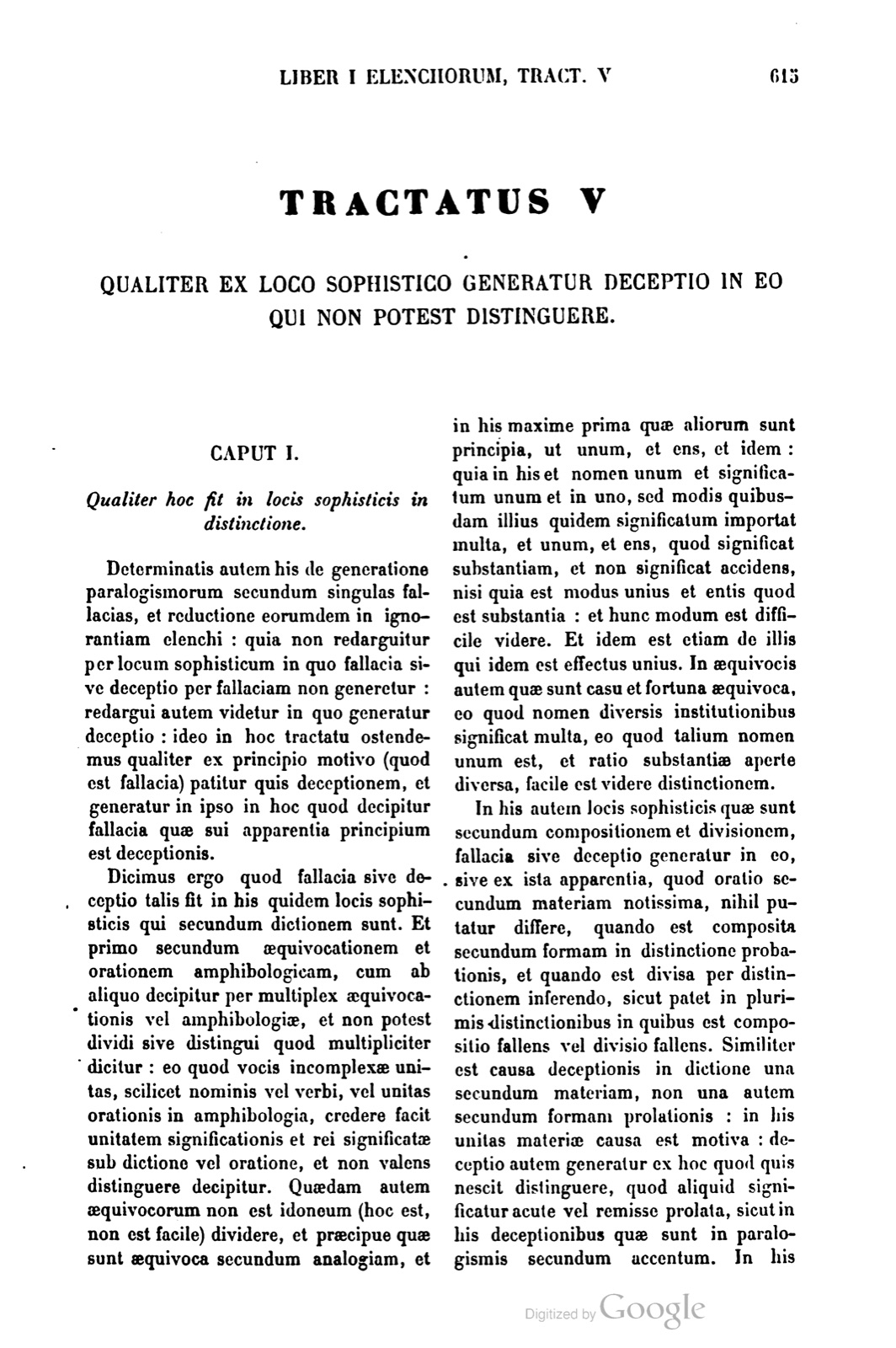
Determinatis autem his de generatione paralogismorum secundum singulas fallacias, et reductione eorumdem in ignorantiam elenchi: quia non redarguitur per locum sophisticum in quo fallacia sive deceptio per fallaciam non generetur: redargui autem videtur in quo generatur deceptio: ideo in hoc tractatu ostendemus qualiter ex principio motivo (quod est fallacia) patitur quis deceptionem, et generatur in ipso in hoc quod decipitur fallacia quae sui apparentia principium est deceptionis.
Dicimus ergo quod fallacia sive deceptio talis fit in his quidem locis sophisticis qui secundum dictionem sunt. Et primo secundum aequivocationem et orationem amphibologicam, cum ab aliquo decipitur per multiplex aequivocationis vel amphibologiae, et non potest dividi sive distingui quod multipliciter dicitur: eo quod vocis incomplexae unitas, scilicet nominis vel verbi, vel unitas orationis in amphibologia, credere facit unitatem significationis et rei significatae sub dictione vel oratione, et non valens distinguere decipitur. Quaedam autem aequivocorum non est idoneum (hoc est, non est facile) dividere, et praecipue quae sunt aequivoca secundum analogiam, et in his maxime prima quae aliorum sunt principia, ut unum, et ens, et idem: quia in his et nomen unum et significatum unum et in uno, sed modis quibusdam illius quidem significatum importat multa, et unum, et ens, quod significat substantiam, et non significat accidens, nisi quia est modus unius et entis quod est substantia: et hunc modum est difficile videre. Et idem est etiam de illis qui idem est effectus unius. In aequivocis autem quae sunt casu et fortuna aequivoca, eo quod nomen diversis institutionibus significat multa, eo quod talium nomen unum est, et ratio substantiae aperte diversa, facile est videre distinctionem.
In his autem locis sophisticis quae sunt secundum compositionem et divisionem, fallacia sive deceptio generatur in eo, sive ex ista apparentia, quod oratio secundum materiam notissima, nihil putatur differre, quando est composita secundum formam in distinctione probationis, et quando est divisa per distinctionem inferendo, sicut patet in plurimis distinctionibus in quibus est compositio fallens vel divisio fallens. Similiter est causa deceptionis in dictione una secundum materiam, non una autem secundum formam prolationis: in his unitas materiae causa est motiva: deceptio autem generatur ex hoc quod quis nescit distinguere, quod aliquid significatur acute vel remisse prolata, sicut in his deceptionibus quae sunt in paralogismis secundum accentum. In his enim propter unitatem materialem vocis non aliud videtur significare remissa gravi scilicet accentu, et intensa sive acuto accentu prolata: in nullo enim vel non in pluribus oratio (in qua talis distinctio ponitur) aliud significare videtur: diversas enim istae fallaciae deceptiones generant propter diversitatem motivorum sive apparentiarum quae sunt in ipsis.
Horum autem paralogismorum qui sunt secundum figuram dictionis, vel in terminatione, vel in significatione, vel in suppositione, difficile est alicui imperito dividere, hoc est, per distinctionem comprehendere, quae similiter vel in figura terminationis vel in modo suppositionis similiter dicuntur, et quae sunt ista quae diversae ab illis vel consignificant, licet diverse terminentur: vel quae diverse ab illis significantur, ut sic unum significetur quid, et aliud quale vel quale quid: vel quae non eodem supponuntur, ut speciem unius praedicamenti vel generis mutat in alia. Qui enim potest hoc facere, quod sic distinguat quae unam habent appellationis sive dictionis significationem, ita quod pene dividat, hoc est, quae pene in figura dictionis similia sunt, illi proprie est videre verum. Sicut gratia exempli dicimus, quod omne quod in communi praedicatur vel subjicitur, hoc opinamur hoc aliquid significare, et intelligimus ipsum gratia suppositi poni, et unum aliquid, sicut in Praedicamentis dictum est: quia substantiae nomen secundum appellationis figuram videtur hoc aliquid significare: talia enim significant formam sive materiam quae communicabilis est suppositis, et per modum concreti dicuntur secundum figuram vocis, ut homo, corpus, substantia, animal: et ideo in ipso nomine inclinationem ad substantiam suppositam significant, propter quod hoc aliquid videntur significare: aliquando tamen significant ipsam essentiam: et ideo difficile est distinguere. Qui distinguere scit ea quae pene similia sunt, cum tamen diversa sunt, maxime sciet annuere sive dare in talibus quod dandum est, et negare quod negandum est: hoc autem maxime est in transcendentibus et in generalissimis, sicut patet quod unum et substantia quae est genus, maxime videtur sequi hoc aliquid: et etiam ipsum ens maxime videtur sequi hoc aliquid: quia hoc aliquid maxime est unum, et maxime substantia, et maxime ens: unde si aliquis in talibus distinguat significatum a supposito, et maxime annuit per distinctionem quid pro nomine accipiatur, maxime potest videre verum.
TRACTATE V. HOW DECEPTION IS GENERATED FROM A SOPHISTICAL PLACE IN ONE WHO CANNOT DISTINGUISH.
CHAPTER I. How this happens in sophistical places in distinction.
But when these things have been determined concerning the generation of paralogisms according to the individual fallacies and the reduction of the same into ignorance of refutation, because one is not refuted through a sophistical place in which a fallacy or deception through fallacy is not generated, but one seems to be refuted in that in which deception is generated, therefore in this tractate we shall show how from the motive principle, which is the fallacy, someone suffers deception, and the fallacy whose appearance is the principle of deception is generated in him in this, that he is deceived.
Therefore we say that such fallacy or deception occurs in these sophistical places which are according to diction. And first, according to equivocation and amphibological speech, when someone is deceived through the manifold character of equivocation or amphibology and cannot divide or distinguish what is said in many ways; because the unity of an incomplex utterance, namely of a noun or verb, or the unity of a speech in amphibology, causes one to believe in a unity of signification and of the thing signified under the diction or speech, and one who cannot distinguish is deceived. But some equivocal things are not apt, that is, are not easy, to divide, and especially those which are equivocal according to analogy, and among these most of all the first things which are principles of others, as one, and being, and same; because in these both the name is one and the signified thing is one and in one, but in certain modes the signified of that thing imports many things, and one, and being, which signifies substance and does not signify accident except because it is a mode of one and of being which is substance; and this mode is difficult to see. And the same is also true of those for which the same is the effect of one. But in equivocal things which are equivocal by chance and fortune, because the name by diverse impositions signifies many things, since the name of such things is one and the account of the substance openly diverse, it is easy to see the distinction.
But in these sophistical places which are according to composition and division, fallacy or deception is generated in this, or from this appearance, that a speech very well known according to matter is thought to differ in nothing when it is composed according to form in the distinction of proof and when it is divided by distinction in inferring, as is clear in very many distinctions in which there is deceiving composition or deceiving division. The cause of deception is similar in a diction one according to matter but not one according to the form of utterance; in these the unity of matter is the motive cause. But deception is generated from this, that someone does not know how to distinguish that something is signified when uttered acutely or weakly, as in those deceptions which are in paralogisms according to accent. For in these, because of the material unity of the word, what is uttered weakly, namely with a grave accent, and what is uttered intensely or with an acute accent, does not seem to signify another thing; for in no speech, or not in many speeches, in which such a distinction is posited, does it seem to signify another thing; for these fallacies generate diverse deceptions because of the diversity of motives or appearances which are in them.
But in the case of those paralogisms which are according to figure of diction, whether in termination, or in signification, or in supposition, it is difficult for an unskilled person to divide, that is, to comprehend by distinction, which things are said similarly either in the figure of termination or similarly in the mode of supposition, and which are those things which, although they are terminated diversely, differently from those either consignify; or which things are signified differently from those, so that one is signified as a what and another as a quale or a qualified what; or which are not supposed in the same way, as when he changes the species of one predicament or genus into others. For he who can do this, namely distinguish in this way things which have one signification of appellation or diction, so that he almost divides, that is, things which in figure of diction are almost similar, to him it properly belongs to see the true. As by way of example we say that whatever is predicated or subjected in common, we opine that this signifies a this-something, and we understand it to be posited for the sake of a supposit and as one something, as was said in the Categories, because the name of substance according to the figure of appellation seems to signify a this-something. For such things signify form or matter which is communicable to supposits, and are said by way of the concrete according to the figure of the word, as man, body, substance, animal; and therefore in the name itself they signify an inclination to a supposed substance, on account of which they seem to signify a this-something; nevertheless they sometimes signify the essence itself, and therefore it is difficult to distinguish. He who knows how to distinguish those things which are almost similar, although they are diverse, will most of all know how to assent or grant in such matters what must be granted, and to deny what must be denied. But this occurs most of all in transcendentals and in the most general things, as is clear because one and substance which is a genus most of all seem to follow this-something; and also being itself most of all seems to follow this-something; because this-something is most of all one, and most of all substance, and most of all being. Hence if someone in such matters distinguishes the signified from the supposit, and most of all assents by distinction to what is taken for the name, he can most of all see the true.
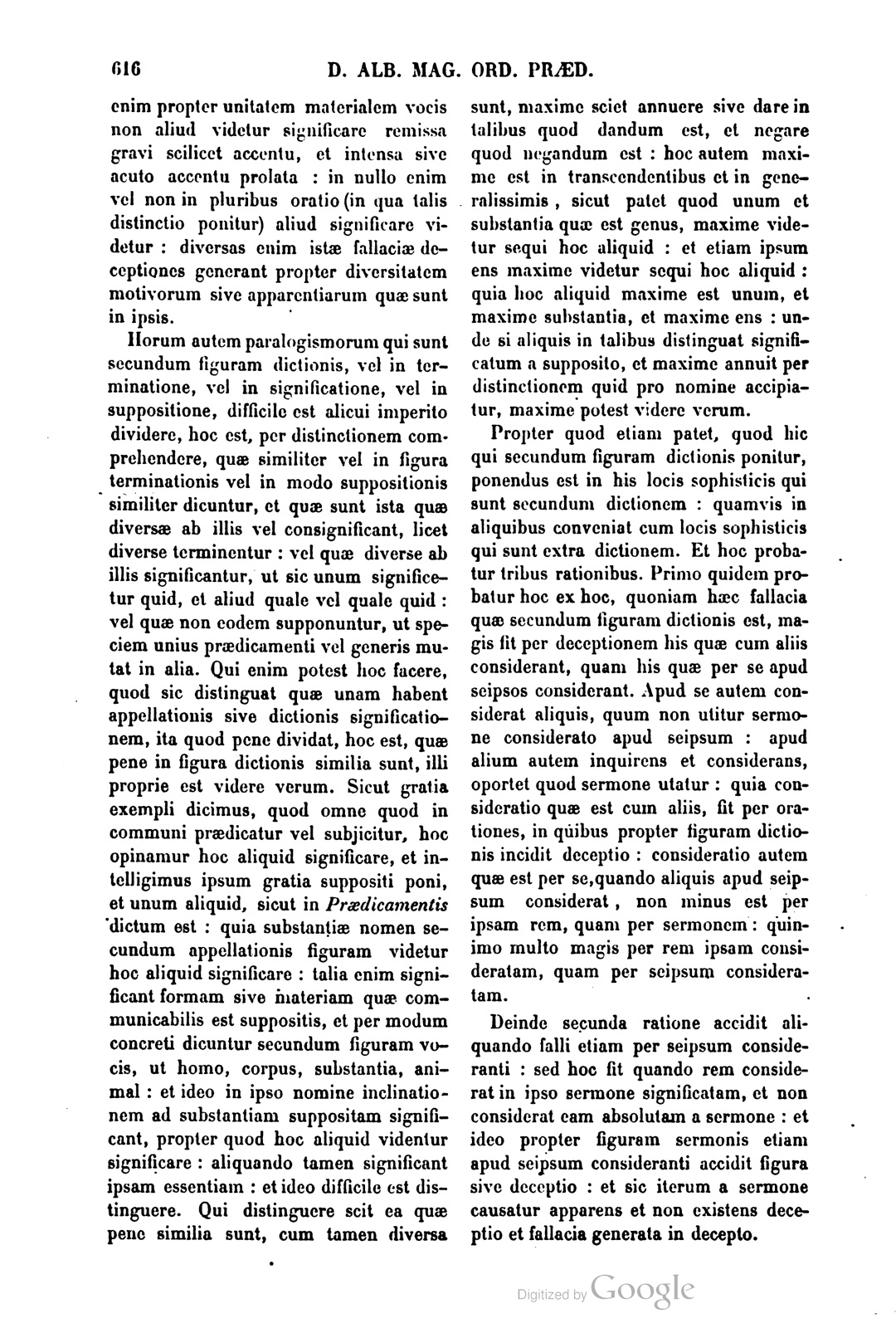
Propter quod etiam patet, quod hic qui secundum figuram dictionis ponitur, ponendus est in his locis sophisticis qui sunt secundum dictionem: quamvis in aliquibus conveniat cum locis sophisticis qui sunt extra dictionem. Et hoc probatur tribus rationibus. Primo quidem probatur hoc ex hoc, quoniam haec fallacia quae secundum figuram dictionis est, magis fit per deceptionem his quae cum aliis considerant, quam his quae per se apud seipsos considerant. Apud se autem considerat aliquis, quum non utitur sermone considerato apud seipsum: apud alium autem inquirens et considerans, oportet quod sermone utatur: quia consideratio quae est cum aliis, fit per orationes, in quibus propter figuram dictionis incidit deceptio: consideratio autem quae est per se, quando aliquis apud seipsum considerat, non minus est per ipsam rem, quam per sermonem: quinimo multo magis per rem ipsam consideratam, quam per seipsum consideratam.
Deinde secunda ratione accidit aliquando falli etiam per seipsum consideranti: sed hoc fit quando rem considerat in ipso sermone significatam, et non considerat eam absolutam a sermone: et ideo propter figuram sermonis etiam apud seipsum consideranti accidit figura sive deceptio: et sic iterum a sermone causatur apparens et non existens deceptio et fallacia generata in decepto.
On account of this it is also clear that this one which is placed according to figure of diction must be placed among those sophistical places which are according to diction, although in some things it agrees with sophistical places which are outside diction. And this is proved by three reasons. First, indeed, this is proved from this, that this fallacy which is according to figure of diction is made more through deception for those who consider with others than for those who consider by themselves among themselves. But someone considers among himself when he does not use speech considered among himself; but inquiring and considering with another, he must use speech, because consideration which is with others occurs through speeches, in which, because of figure of diction, deception occurs; but consideration which is by itself, when someone considers among himself, is no less through the thing itself than through speech; rather, much more through the thing itself considered than through himself considered.
Next, by a second reason, it happens sometimes that one considering by himself is also deceived; but this happens when he considers the thing signified in the speech itself and does not consider it absolved from speech; and therefore because of the figure of speech, figure or deception happens even to one considering among himself; and thus again an apparent and non-existent deception and a fallacy generated in the one deceived are caused by speech.
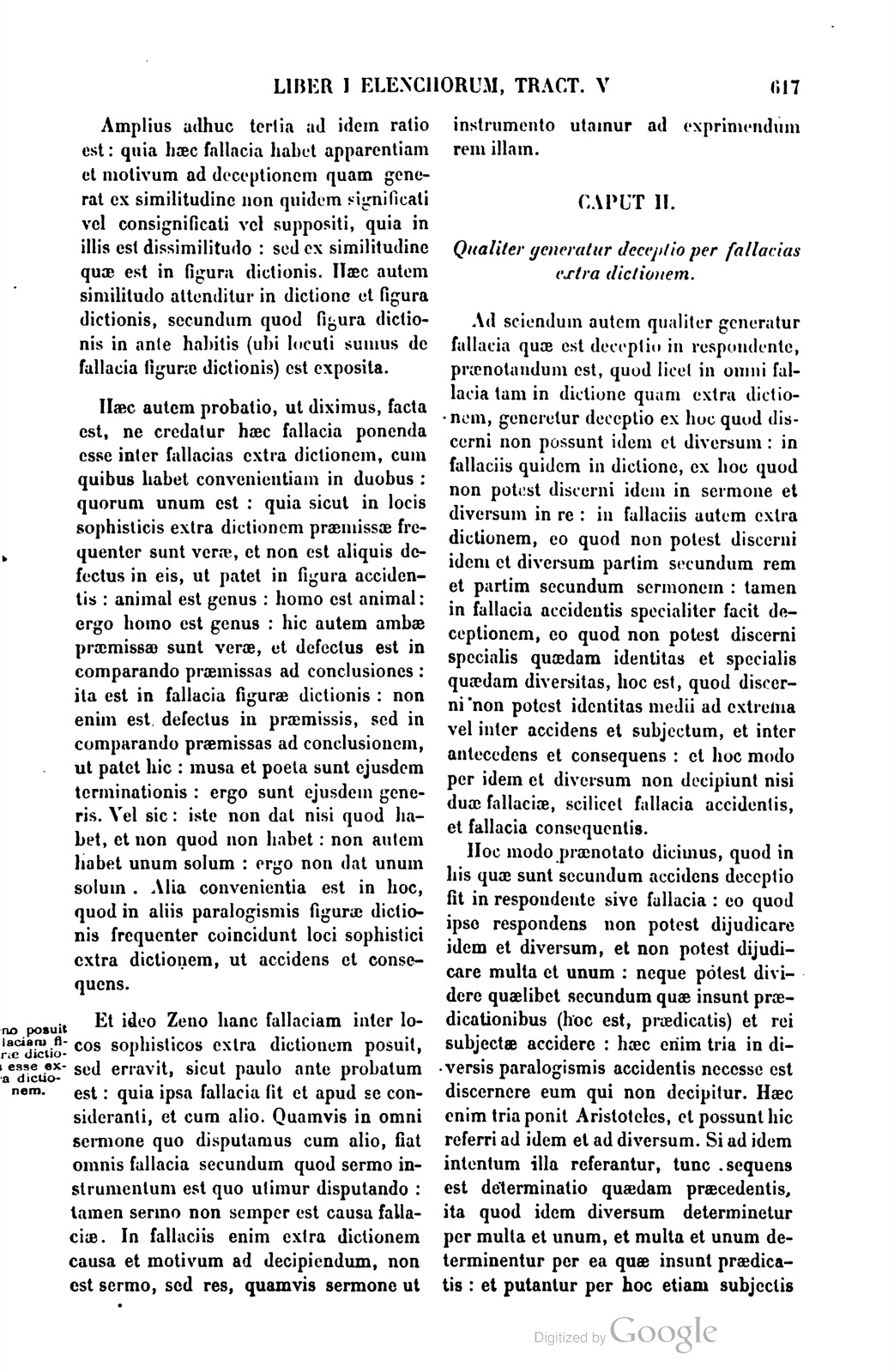
Amplius adhuc tertia ad idem ratio est: quia haec fallacia habet apparentiam et motivum ad deceptionem quam generat ex similitudine non quidem significati vel consignificati vel suppositi, quia in illis est dissimilitudo: sed ex similitudine quae est in figura dictionis. Haec autem similitudo attenditur in dictione et figura dictionis, secundum quod figura dictionis in ante habitis (ubi locuti sumus de fallacia figurae dictionis) est exposita.
Haec autem probatio, ut diximus, facta est, ne credatur haec fallacia ponenda esse inter fallacias extra dictionem, cum quibus habet convenientiam in duobus: quorum unum est: quia sicut in locis sophisticis extra dictionem praemissae frequenter sunt verae, et non est aliquis defectus in eis, ut patet in figura accidentis: animal est genus: homo est animal: ergo homo est genus: hic autem ambae praemissae sunt verae, et defectus est in comparando praemissas ad conclusiones: ita est in fallacia figurae dictionis: non enim est defectus in praemissis, sed in comparando praemissas ad conclusionem, ut patet hic: musa et poeta sunt ejusdem terminationis: ergo sunt ejusdem generis. Vel sic: iste non dat nisi quod habet, et non quod non habet: non autem habet unum solum: ergo non dat unum solum. Alia convenientia est in hoc, quod in aliis paralogismis figurae dictionis frequenter coincidunt loci sophistici extra dictionem, ut accidens et consequens.
Et ideo Zeno hanc fallaciam inter locos sophisticos extra dictionem posuit, sed erravit, sicut paulo ante probatum est: quia ipsa fallacia fit et apud se consideranti, et cum alio. Quamvis in omni sermone quo disputamus cum alio, fiat omnis fallacia secundum quod sermo instrumentum est quo utimur disputando: tamen sermo non semper est causa fallaciae. In fallaciis enim extra dictionem causa et motivum ad decipiendum, non est sermo, sed res, quamvis sermone ut instrumento utamur ad exprimendum rem illam.
CAPUT II. Qualiter generatur deceptio per fallacias extra dictionem.
Ad sciendum autem qualiter generatur fallacia quae est deceptio in respondente, praenotandum est, quod licet in omni fallacia tam in dictione quam extra dictionem, generetur deceptio ex hoc quod discerni non possunt idem et diversum: in fallaciis quidem in dictione, ex hoc quod non potest discerni idem in sermone et diversum in re: in fallaciis autem extra dictionem, eo quod non potest discerni idem et diversum partim secundum rem et partim secundum sermonem: tamen in fallacia accidentis specialiter facit deceptionem, eo quod non potest discerni specialis quaedam identitas et specialis quaedam diversitas, hoc est, quod discerni non potest identitas medii ad extrema vel inter accidens et subjectum, et inter antecedens et consequens: et hoc modo per idem et diversum non decipiunt nisi duae fallaciae, scilicet fallacia accidentis, et fallacia consequentis.
Furthermore, a third reason to the same point is this: because this fallacy has the appearance and motive toward the deception which it generates from likeness, not indeed of the signified or consignified or supposit, because in those there is unlikeness, but from the likeness which is in the figure of diction. But this likeness is attended to in diction and the figure of diction, according as figure of diction has been explained in the preceding things, where we spoke about the fallacy of figure of diction.
But this proof, as we have said, has been made so that this fallacy not be believed to have to be placed among the fallacies outside diction, with which it has agreement in two things. One of these is that, just as in sophistical places outside diction the premises are frequently true and there is no defect in them, as is clear in the figure of accident: animal is a genus; man is animal; therefore man is a genus; here both premises are true, and the defect is in comparing the premises to the conclusions. So it is in the fallacy of figure of diction; for there is no defect in the premises, but in comparing the premises to the conclusion, as is clear here: muse and poet are of the same termination; therefore they are of the same gender. Or thus: this person gives only what he has, and not what he does not have; but he does not have one alone; therefore he does not give one alone. The other agreement is in this, that in other paralogisms of figure of diction sophistical places outside diction frequently coincide, as accident and consequent.
And therefore Zeno placed this fallacy among the sophistical places outside diction, but he erred, as was proved a little before, because this fallacy occurs both for one considering among himself and with another. Although in every speech by which we dispute with another every fallacy occurs insofar as speech is the instrument which we use in disputing, nevertheless speech is not always the cause of fallacy. For in fallacies outside diction the cause and motive for deceiving is not speech, but the thing, although we use speech as an instrument for expressing that thing.
CHAPTER II. How deception is generated through fallacies outside diction.
But for knowing how the fallacy which is deception in the respondent is generated, it must be noted beforehand that, although in every fallacy, both in diction and outside diction, deception is generated from this, that the same and the diverse cannot be discerned, in fallacies in diction indeed from this, that the same in speech and the diverse in reality cannot be discerned, but in fallacies outside diction because the same and the diverse cannot be discerned partly according to the thing and partly according to speech, nevertheless in the fallacy of accident it specially makes deception because a certain special identity and a certain special diversity cannot be discerned, that is, because the identity of the middle to the extremes, or between accident and subject, and between antecedent and consequent, cannot be discerned; and in this way only two fallacies deceive through the same and the diverse, namely the fallacy of accident and the fallacy of the consequent.
If a page does not appear, its photograph has not been uploaded yet.