Works › Sophistical Refutations, Books I–II
Volume 2 · pp. 609–614
Tractate IV. Chapters V-VII
A marker with ≈ is an approximate page boundary, placed by measure of the text; the page photographs remain the authority. In the paired views, clicking a page marker brings that page into view.
principio, reductioni fallaciae consequentis praeordinamus.
CAPUT V. De reductione fallaciae accidentis in ignorantiam elenchi.
Paralogismi autem qui sunt secundum consequens, per hoc reducuntur in ignorantiam elenchi, qui sunt partes accidentis, non quidem verae partes subjectivae vel integrales, sed sunt partes quasi subjectivae in hoc quod aliquam habent similitudinem cum partibus subjectivis: posita enim parte ponitur totum, et non e converso, toto posito ponitur pars: ita est in antecedente et consequente, quod ubicumque consequens est, ibi est antecedens: et non convertitur, quod ubicumque sit antecedens, ibi sit consequens. Nam consequens accidit semper, hoc est, ubicumque est consequens, ibi est antecedens: sed non convertitur, quod si antecedens sit, consequens semper sit: et haec quidem videtur esse intentio Aristotelis. Aliter autem dixerunt quidam antiquiores quod, sicut dictum est supra in generatione paralogismorum consequentis, uno modo antecedens accidit consequenti, et alio modo e converso consequens accidit antecedenti: tertio modo unum convertibilium accidit reliquo: propter quod accidens commune est ei quod antecedit, et ei quod sequitur et ei quod convertitur: et ideo necesse est consequens sive id quod sequitur, partem esse accidentis: cum accidens commune sit ad haec tria. Et quod haec sit intentio Aristotelis quando dicit consequens esse partem antecedentis, patet ex hoc quod unus locus sophisticus non potest esse pars alterius quantum ad habitudinem inferendi: quia si hoc modo esset pars alterius quantum ad habitudinem inferendi, et non faceret numerum cum ipso, idem sequeretur si esset pars integralis ejus: unde oportet quod consequens sit accidentis a parte terminorum in quibus habent fieri accidens et consequens, et non a parte ipsarum habitudinum: sicut locus a specie non est pars loci a genere: quamvis ea quorum sunt istae habitudines, sic se habeant, quod unum est pars alterius subjectiva: et hoc consequens est pars subjectiva alterius. Et sic consequens est pars accidentis a parte terminorum, in quibus fiunt accidens et consequens, et non a parte habitudinum ipsarum quae sunt consequentis ad inferendum. Habitudinum autem dico sophisticarum: omne enim consequens accidit, sed non convertitur: eodem enim modo verum est quod antecedens accidit, ut quod consequens accidit, et quod convertibile accidit, ut in prae habitis in generatione paralogismorum accidentis dictum est. Sic ergo patet qualiter consequens est, quasi subjectiva pars accidentis.
Ne autem aliquis credat propter hoc quod consequens est pars antecedentis, quod non faciat numerum cum eo instituendo locum sophisticum specialem, ideo assignanda est differentia dicendo, quod differt ab accidente consequens: quia accidens quidem est in uno solo sumere, consequens autem semper in pluribus. Et hoc est dictum Aristotelis quod tripliciter exponitur, et semper bene et satis convenienter. Uno quidem modo, quod accidens semper est in una consequentia: quoniam accidens est subjecti, et accidens consequens ad subjectum, et accidens relatum ad utrumque, ut in ante habitis de accidente determinatum est. Consequens autem est in duabus vel pluribus consequentiis, sive a positione consequentis, sive a destructione antecedentis procedatur. Alio autem modo quia accidens est in uno solo medio, quod extranee et accidentaliter se habet ad extrema: consequens autem in pluribus: quia illatio consequentis est semper ab eo quod est in pluribus: et ideo non de necessitate ponit et infert consequens. Alii autem exponendo dicunt, quod accidens est in uno, hoc est, in terminis convertibilibus qui sunt unum in subjecto. Cujus exemplum est, ut si idem (hoc est, convertibilia secundum subjectum) ponantur esse rubeum humidum et mel, sic quod omne rubeum humidum sit mel: sicut e converso, omne mel est rubeum humidum. Et si idem in subjecto per convertibilitatem ponantur esse albus et cygnus, ita quod omne album sit cygnus: sicut e converso, omnis cygnus est albus. Adhuc enim incidit in talibus fallacia accidentis sic: idem est mel et rubeum: tu cognoscis rubeum: ergo tu cognoscis mel. Vel sic: idem est album et cygnus: tu cognoscis album: ergo tu cognoscis cygnum.
at the beginning, we set in order beforehand for the reduction of the fallacy of the consequent.
CHAPTER V. On the reduction of the fallacy of accident into ignorance of refutation.
But the paralogisms which are according to the consequent are reduced into ignorance of refutation through this, that they are parts of accident, not indeed true subjective or integral parts, but they are, as it were, subjective parts in this, that they have some likeness with subjective parts: for when the part is posited, the whole is posited, and not conversely; when the whole is posited, the part is posited. So it is in antecedent and consequent, that wherever the consequent is, there is the antecedent; and it is not converted, that wherever the antecedent is, there is the consequent. For the consequent always happens, that is, wherever there is the consequent, there is the antecedent; but it is not converted, that if the antecedent is, the consequent always is; and this indeed seems to be Aristotle's intention. But certain more ancient men spoke otherwise, that, as was said above in the generation of the paralogisms of the consequent, in one way the antecedent happens to the consequent, and in another way, conversely, the consequent happens to the antecedent; in a third way one of the convertibles happens to the remaining one; on account of which accident is common to that which precedes, and to that which follows, and to that which is converted; and therefore it is necessary that the consequent, or that which follows, be a part of accident, since accident is common to these three. And that this is Aristotle's intention when he says the consequent is part of the antecedent is clear from this, that one sophistical place cannot be part of another with respect to the relation of inferring; because if in this way it were part of another with respect to the relation of inferring, and did not make a number with it, the same would follow if it were an integral part of it; whence the consequent must belong to accident on the part of the terms in which accident and consequent have to occur, and not on the part of those relations themselves, just as the place from species is not part of the place from genus, although those things of which these are relations so have themselves that one is a subjective part of the other; and this consequent is a subjective part of another. And thus the consequent is part of accident on the part of the terms in which accident and consequent occur, and not on the part of the relations themselves which belong to the consequent for inferring. But I mean sophistical relations; for every consequent happens, but it is not converted; for in the same way it is true that the antecedent happens, as that the consequent happens, and that the convertible happens, as was said in the preceding things on the generation of paralogisms of accident. Thus therefore it is clear how the consequent is, as it were, a subjective part of accident.
But lest someone believe, because the consequent is part of the antecedent, that it does not make a number with it in establishing a special sophistical place, therefore the difference must be assigned by saying that the consequent differs from accident: because accident indeed is to be taken in one alone, but the consequent always in several. And this saying of Aristotle is explained in three ways, and always well and sufficiently suitably. In one way, because accident is always in one consequence, since accident belongs to a subject, and accident follows upon a subject, and accident is related to both, as was determined in the preceding things concerning accident. But the consequent is in two or more consequences, whether the procedure be from the position of the consequent or from the destruction of the antecedent. In another way, because accident is in one middle alone, which has itself toward the extremes externally and accidentally; but the consequent is in several, because the inference of the consequent is always from that which is in several things, and therefore it does not of necessity posit and infer the consequent. But others, explaining it, say that accident is in one, that is, in convertible terms which are one in subject. An example of this is if the same things, that is, things convertible according to subject, are posited to be red moist and honey, so that every red moist thing is honey, just as conversely every honey is red moist; and if things the same in subject through convertibility are posited to be white and swan, so that every white thing is a swan, just as conversely every swan is white. For still in such things the fallacy of accident occurs thus: the same thing is honey and red; you know red; therefore you know honey. Or thus: the same thing is white and swan; you know white; therefore you know swan.
Et cum dicitur, quod consequens semper in pluribus est (hoc est, in terminis non convertibilibus) quia a non convertibili, sed ab eo quod est in pluribus, accipit inferentiam consequens: nam in consequente quae uni et eidem sunt eadem, illa probamus per paralogismum consequentis sibi invicem esse eadem. Ex tali enim et propter talem apparentiam et defectum fit secundum consequens apparens elenchus. In consequentis enim fallacia medium est in plus utroque terminorum: quia quando aliquid est idem alteri, illud alterum sequitur ad ipsum: et si duo quae non sunt sibi invicem eadem esse dicantur in tertio, sicut homo et asinus in animali, illud tertium erit consequens ad utrumque illorum: et si tertium illud fuit medium ad inferendum unum istorum de alio, tunc erit medium inferens in plus et illatum in minus: et ita semper erit fallacia consequentis: ut homo est animal: et asinus est animal: ergo homo est asinus. Et est a positione consequentis: eo quod medium in fallacia consequentis semper erit consequens non convertibile. Non enim generaliter verum est, quod quaecumque uni et eidem sunt eadem, quod ipsa sunt eadem: sive quae in uno et eodem sunt eadem, quod ipsa sunt eadem: non enim generaliter hoc verum est, si sint eadem in uno secundum accidens, et non ita, quod unum participet illud per alterum et aliud per se. Hoc patet, quia nix et cygnus sunt in alio idem, ita quod utrumque per accidens et non unum per aliud respicit albi praedicationem: et tamen nix et cygnus non sunt idem: sed homo et animal sunt in substantia idem, et unum est per aliud et non per accidens: et ideo homo est animal. Et sic formatur paralogismus: nix est alba: cygnus est albus: ergo nix est cygnus.
Aut rursum in alio exemplo, sicut in Melissi ratione, ipse Melissus haec duo idem esse accepit, scilicet quod factum est et principium habet, in eo quod est terminatum sive finitum esse. Et formatur sic paralogismus: quod factum est, terminatum est: quod habet principium, terminatur sive finitum est: ergo omne factum habet principium. Idem enim sequitur factum, existens idem cum eo quod habet principium, propter id quod idem esse ponuntur in eo quod est esse terminatum sive finitum: et sic fit paralogismus consequentis ex affirmativis in secunda figura. Non solum autem fit hoc modo paralogismus consequentis, sed etiam quando convertitur consequentia quae conversionem non habet, sicut patet in hoc paralogismo: quae aequalia sunt, eamdem magnitudinem accipiunt: ergo quae eamdem magnitudinem accipiunt, aequalia sunt. Duo et tria eamdem magnitudinem accipiunt, si utrique duo addantur. Ergo duo cum duobus et tria cum duobus sunt aequalia, quod falsum est: quia duo cum duobus sunt quatuor, et tria cum duobus sunt quinque. Melissus enim sumit quia quod factum est, habet principium, quod etiam e converso sit, quod omne quod principium habet, sit factum. Melissus enim in hac ratione probat sive probare videtur id quod principium habet, factum esse, et quod factum est, principium habere, in eo quod sunt idem vel eadem in hoc quod est terminatum sive finitum esse: et ab illo sumit inferentiam, quod sint eadem ex affirmativis in secunda figura.
And when it is said that the consequent is always in several, that is, in non-convertible terms, because the consequent takes its inference not from a convertible, but from that which is in several things: for in the consequent, the things which are the same as one and the same thing, we prove through the paralogism of the consequent to be the same as one another. For from such a thing, and on account of such appearance and defect, an apparent refutation comes to be according to the consequent. For in the fallacy of the consequent the middle is in more than either term, because when something is the same as another, that other follows upon it; and if two things which are not the same as one another are said to be in a third, as man and ass in animal, that third will be consequent upon each of them; and if that third was the middle for inferring one of these of the other, then it will be a middle inferring in more and an inferred thing in less; and so there will always be the fallacy of the consequent, as: man is animal, and ass is animal; therefore man is ass. And it is from the position of the consequent, because the middle in the fallacy of the consequent will always be a non-convertible consequent. For it is not generally true that whatever things are the same as one and the same thing are themselves the same, or that the things which are the same in one and the same thing are themselves the same; for this is not generally true if they are the same in one thing according to accident, and not in such a way that one participates in that through the other and the other through itself. This is clear, because snow and swan are the same in another thing, so that each with respect to the predication of white does so by accident and not one through the other; and yet snow and swan are not the same. But man and animal are the same in substance, and one is through the other and not by accident; and therefore man is animal. And thus the paralogism is formed: snow is white; swan is white; therefore snow is swan.
Or again in another example, as in the reasoning of Melissus, Melissus himself took these two things to be the same, namely that which has been made and that which has a beginning, in that which is to be bounded or finite. And the paralogism is formed thus: what has been made is bounded; what has a beginning is bounded or finite; therefore everything made has a beginning. For the same thing follows the made thing, existing as the same with that which has a beginning, because they are posited to be the same in that which is to be bounded or finite; and thus a paralogism of the consequent is made from affirmatives in the second figure. But a paralogism of the consequent is made not only in this way, but also when a consequence which does not have conversion is converted, as is clear in this paralogism: things which are equal take the same magnitude; therefore things which take the same magnitude are equal. Two and three take the same magnitude, if two are added to each. Therefore two with two and three with two are equal, which is false, because two with two are four, and three with two are five. For Melissus takes that because what has been made has a beginning, the converse also is so, that everything which has a beginning has been made. For in this reasoning Melissus proves, or seems to prove, that what has a beginning has been made, and that what has been made has a beginning, in that they are the same or identical in this, that they are bounded or finite; and from that he takes the inference that they are the same from affirmatives in the second figure.
Similiter ergo arguit, ac si sic arguat in his: si aliqua aequalia facta sunt, quod non sequitur: quia eamdem magnitudinem accipiunt: ergo quae unam sumunt magnitudinem, aequalia facta sunt, quod non sequitur. Quare patet quod sumit consequens et arguit a positione consequentis. Sic ergo patet qualiter consequens est pars accidentis: et quoniam accidentis fallacia in ignorantiam elenchi reducta est, manifestum est quoniam et iste paralogismus qui secundum consequens est, reductus est in ignorantiam elenchi ut pars ejus: et iste communis modus est cum accidente reductionis consequentis in ignorantiam elenchi. Reductio tamen paralogismi consequentis etiam aliter speciali modo perspicienda est: et quia specialiter ignorat elenchum secundum illud diffinitivum in elenchi diffinitione positum, quod est, quod syllogismus est oratio in qua quibusdam positis aliud accidit ex necessitate: contra hoc enim peccat paralogismus consequentis: quia non habet debitam terminorum positionem: eo quod consequens ponit pro antecedente, et e converso: cum tamen consequens non necessario ponat antecedens, quamvis antecedens ponat consequens. Haec est sententia Aristotelis de reductione consequentis in ignorantiam elenchi a nobis secundum duos Commentatores fideliter exposita: et sunt in ea adhuc dubitationes plurimae.
CAPUT VI. De solutione dubiorum quae sunt circa ea quae dicta sunt.
Est autem dubitatio primum de hoc quod si consequens pars accidentis est, sive integralis, sive subjectiva, non deberet consequens cum accidente facere numerum: quia pars cum toto non facit numerum: consequens ergo cum accidente non facit nisi unum locum sophisticum. Adhuc autem videntur opposita et non simul posse stare, quod accidens in uno solo aliquando, consequens autem semper in pluribus, et quod tamen consequens sit pars accidentis: quia plura non sunt pars unius, sed potius e converso unum est pars eorum quae sunt plura.
Sed ad hoc dicendum est, quod sicut ante dictum est, non dicitur consequens pars accidentis, quod sit vere pars vel integralis vel subjectiva, sed quia quamdam similitudinem habet partis subjectivae: quia ubicumque est consequens, ibi est accidens: sed non convertitur: cujus ratio in communi est, quod in fallacia accidentis medium sive inhaerens est in plus quam extrema illata: et ideo accidit, quod id quod est in plus, accidit ei quod est in minus, et e converso. Cum ergo in fallacia consequentis semper prius attribuatur ei quod est in plus, et aliud idem postea attribuatur ei quod est in minus, semper attribuitur aliquid rei subjectae, et postea accidenti, et hoc facit paralogismum accidentis. Patet ergo quod in omni paralogismo consequentis coincidit et est paralogismus accidentis: quandocumque enim dissimiliter attribuitur rei subjectae et accidenti, fit fallacia accidentis. Ubicumque igitur est consequens, ibi est accidens: sed non convertitur, quod ubicumque sit accidens, ibi sit consequens: quia sicut in ante habitis de accidente dictum est, accidens in multis terminis est et convertibilibus et non convertibilibus.
Therefore he argues similarly, as if he argued thus in these things: if certain equal things have been made, which does not follow, because they take the same magnitude; therefore things which take one magnitude have been made equal, which does not follow. Wherefore it is clear that he takes the consequent and argues from the position of the consequent. Thus therefore it is clear how the consequent is a part of accident; and since the fallacy of accident has been reduced into ignorance of refutation, it is manifest that this paralogism also, which is according to the consequent, has been reduced into ignorance of refutation as its part; and this mode of reduction of the consequent into ignorance of refutation is common with accident. Yet the reduction of the paralogism of the consequent must also be considered otherwise in a special way, and because it specially ignores refutation according to that definitive item placed in the definition of refutation, which is that a syllogism is a speech in which, certain things having been posited, another thing follows of necessity. For the paralogism of the consequent sins against this, because it does not have the due position of terms, in that it posits the consequent for the antecedent, and conversely, although the consequent does not necessarily posit the antecedent, even though the antecedent posits the consequent. This is Aristotle's opinion concerning the reduction of the consequent into ignorance of refutation, faithfully explained by us according to the two Commentators; and in it there are still very many doubts.
CHAPTER VI. On the solution of the doubts which concern the things that have been said.
But the first doubt concerns this, that if the consequent is part of accident, whether integral or subjective, then the consequent ought not to make a number with accident, because a part does not make a number with the whole; therefore the consequent with accident makes only one sophistical place. Moreover opposites seem not able to stand at the same time, namely that accident is sometimes in one alone, but the consequent is always in several, and that nevertheless the consequent is part of accident, because several things are not part of one, but rather conversely one is part of those which are several.
But to this one must say that, as was said before, the consequent is not called part of accident because it is truly an integral or subjective part, but because it has a certain likeness of a subjective part: because wherever there is the consequent, there is accident; but it is not converted. The common reason of this is that in the fallacy of accident the middle, or the inhering thing, is in more than the inferred extremes; and therefore it happens that that which is in more happens to that which is in less, and conversely. Therefore, since in the fallacy of the consequent there is always first attributed to that which is in more, and afterward another same thing is attributed to that which is in less, something is always attributed to the subject thing, and afterward to the accident, and this makes the paralogism of accident. Therefore it is clear that in every paralogism of the consequent there coincides, and there is, a paralogism of accident; for whenever something is attributed dissimilarly to the subject thing and to the accident, the fallacy of accident occurs. Therefore wherever there is the consequent, there is accident; but it is not converted, that wherever there is accident, there is the consequent; because, as was said in the preceding things concerning accident, accident is in many terms, both convertible and non-convertible.
In terminis autem convertibilibus, ut cum dicitur: homo est risibile: risibile est proprium: ergo homo est proprium. Et patet quod hoc est accidens, et non consequens: quia secundum consequentiam terminorum naturalem non convertitur. Est etiam accidens in terminis non convertibilibus, et hoc modo in terminis se habentibus ut excedentia et excessa: album currit: musicum album: ergo musicum currit. Et est accidens hic et non consequens: quia consequentia naturalis non est e converso: et sic iterum est sine consequente. Est etiam in terminis non convertibilibus quae se habent ut in plus et in minus: et hoc dupliciter, scilicet ita quod termini sint diversorum generum vel unius et ejusdem generis, ut superius et inferius. In terminis diversorum generum: ut hic: omne aes naturale: statua aes: ergo statua est naturalis. Hic iterum est accidens sine consequente: quia naturalis consequentia terminorum non est e converso.
In terminis autem non convertibilibus ejusdem generis non in debita figura et modo dispositis dupliciter: quia medium comparatur ad utrumque extremorum, ut ad unum ut ad suppositum, et ad alterum ut essentia simplex. Dico autem non debito modo in figura: quia si in talibus terminis debita figura et debitus modus sumitur, nulla incidit fallacia, sed fit verus et bonus syllogismus. Dico autem figuram indebitam et modum, quando in prima figura aut major est particularis, aut minor negativa, aut in secunda figura ambae sunt affirmativae ex quibus procedit. Si ergo medium comparetur ad unum ratione suppositi, et ad alterum ratione essentiae, fit fallacia accidentis sic: animal est genus: homo est animal: ergo homo est genus. Hic etiam est accidens et non consequens: quia consequentia non convertitur. Si autem comparetur medium ad utrumque extremorum in ratione suppositi, et non sit in debita figura et materia, sic fit fallacia accidentis et coincidit cum ipsa fallacia consequentis semper in tali casu: ut quando arguitur ex majori particulari vel minori negativa in prima figura, vel ex utraque negativa in secunda figura in terminis in eodem genere se habentibus ut superius et inferius. Ut omnis homo est animal: omnis asinus est animal: ergo omnis asinus est homo. E converso non sequitur: et sic patet quod ubicumque est consequens, ibi est accidens: sed non e converso ubicumque est accidens, ibi etiam est consequens: et sic consequens dicitur quasi pars accidentis. Et hoc etiam modo dici potest, quod consequens est in uno, accidens autem in pluribus modis terminorum. Cum autem non fit nisi in uno terminorum, sed non convertibilium, in eodem genere se ut inferius et superius habentium, non in debitis figura et modo dispositis: et sic ratione terminorum quibus accidens fit, consequens est pars accidentis: et sic accidens est in una sola consequentia, et consequens in consequentiis pluribus: vel accidens est in uno solo convertibili, et consequens semper in pluribus, quia infert a consequente: et semper est in pluribus: quia id quod in plus est, semper consequens est: quod autem in minus, est accidens.
Et quocumque modo dicatur, semper erit verum quod dictum est, quod scilicet consequens est pars accidentis: et tamen accidens in uno solo, consequens autem in pluribus semper: quia licet accidens in pluribus generibus sit terminorum, tamen accidens est aliquando in uno solo, quando scilicet est in convertibilibus. Hoc autem modo consequens est nunquam in uno solo: quia inter consequentia convertibilia, consequentia semper est bona: et patet quod hoc modo ut pars subjectiva consequens est accidentis dupliciter, ratione scilicet terminorum in quibus sunt et accidens et consequens: et quia semper ubi est consequens, semper ibi est accidens: sed non convertitur, quod semper ibi sit consequens, ubi est accidens. Et quia non est vera pars, nec ratione habitudinum inferentium est pars, ideo non sequitur quod non debeat facere numerum cum ista fallacia quae est secundum accidens.
In convertible terms, as when it is said: man is capable of laughter; what is capable of laughter is a property; therefore man is a property. And it is clear that this is accident and not consequent, because it is not converted according to the natural consequence of the terms. There is also accident in non-convertible terms, and in this way in terms having themselves as exceeding and exceeded: white runs; the musical is white; therefore the musical runs. And here there is accident and not consequent, because the natural consequence is not conversely; and so again it is without the consequent. There is also in non-convertible terms which have themselves as in more and in less, and this in two ways, namely so that the terms are of diverse genera, or of one and the same genus, as superior and inferior. In terms of diverse genera, as here: every bronze is natural; a statue is bronze; therefore a statue is natural. Here again there is accident without the consequent, because the natural consequence of the terms is not conversely.
But in non-convertible terms of the same genus, not disposed in due figure and mode, there are two ways, because the middle is compared to each extreme, to one as to a supposit, and to the other as simple essence. But I say not in due mode in figure, because if in such terms the due figure and due mode is taken, no fallacy occurs, but a true and good syllogism is made. But I call a figure and mode undue when, in the first figure, either the major is particular or the minor negative, or in the second figure both premises from which it proceeds are affirmative. Therefore, if the middle is compared to one through the account of a supposit and to the other through the account of essence, the fallacy of accident is made thus: animal is a genus; man is animal; therefore man is a genus. Here also there is accident and not consequent, because the consequence is not converted. But if the middle is compared to each extreme in the account of a supposit, and is not in due figure and matter, thus the fallacy of accident occurs and coincides with the fallacy itself of the consequent always in such a case, as when one argues from a particular major or a negative minor in the first figure, or from both negatives in the second figure in terms in the same genus having themselves as superior and inferior. As: every man is animal; every ass is animal; therefore every ass is man. Conversely it does not follow; and thus it is clear that wherever there is the consequent, there is accident, but not conversely, that wherever there is accident, there also is the consequent; and thus the consequent is called, as it were, part of accident. And in this way also it can be said that the consequent is in one, but accident in several modes of terms. But since it occurs only in one class of terms, namely non-convertibles in the same genus having themselves as inferior and superior, not disposed in due figure and mode, thus by reason of the terms in which accident occurs, the consequent is part of accident; and thus accident is in one consequence alone, and the consequent in several consequences; or accident is in one convertible alone, and the consequent always in several, because it infers from the consequent, and it is always in several, because that which is in more is always the consequent, but that which is in less is the accident.
And in whatever way it is said, what has been said will always be true, namely that the consequent is part of accident; and nevertheless accident is in one alone, but the consequent always in several, because although accident is in several genera of terms, nevertheless accident is sometimes in one alone, namely when it is in convertibles. But in this way the consequent is never in one alone, because among convertible consequents the consequence is always good; and it is clear that in this way, as a subjective part, the consequent belongs to accident in two ways: namely by reason of the terms in which both accident and consequent are, and because wherever the consequent is, there accident always is; but it is not converted, that the consequent is always there where accident is. And because it is not a true part, nor is it a part by reason of the inferring relations, therefore it does not follow that it ought not to make a number with that fallacy which is according to accident.
Secundum consequens ergo decipimur, ut dictum est paulo ante, quando ea probabamus esse eadem sibi invicem, quaecumque uni et eidem sunt eadem secundum accidens et non per se: nec ita, quod unum per aliud sit idem illi: quia tunc credimus quod quaecumque sunt eadem consequenti, putamus eadem esse antecedenti: ideo quod videmus quod quae sunt eadem antecedenti, sunt eadem consequenti: quando enim unum est de duobus, fit dispositio secundae figurae ex affirmativis; ut cygnus est albus: nix est alba: ergo cygnus est nix. Et sic est in Melissi ratione, quod principium habere et factum esse unum sunt in eo quod est terminatum esse: et ideo creditur quod sicut omne factum habet principium creationis, sic omne quod habet principium, sit factum: et hoc non est verum secundum consequentiam, ut in ante habitis dictum est. Similiter autem in alio paralogismo: quae enim aequalia facta sunt, eamdem magnitudinem accipiunt: ideo putamus e converso quae eamdem magnitudinem accipiunt, aequalia esse facta, cum hoc non sit verum frequenter, ut in prae habitis dictum est. Sic ergo intelligendum est quod in prae habitis de consequente dictum est.
CAPUT VII. De reductione fallaciae secundum plures interrogationes ut unam in ignorantiam elenchi.
Paralogismi autem qui fiunt in eo quod aliqui plures interrogationes ut unam faciunt, in eo reducuntur in ignorantiam elenchi, quod in paralogismis illis non enodamus, id est, manifestamus propositionis (quae elenchi est proprium) diffinitionem: nam propositio quae substantialis est syllogismi et elenchi, propositio est secundum diffinitionem veram, qua unum praedicatum de uno subjecto est. Quod ex hoc probatur, quod eadem diffinitio est unius solius rei et simpliciter sine discretione vel nota discretionis posita: eo quod unum non addit ad rem cui opponitur rem aliquam vel formam rei alicujus, sed modum discretionis tantum, qui modus totus in negatione consistit: et hoc patet quod unum est indivisum in se et ab aliis divisum: indivisum autem in se negatio est, ad quam consequitur divisum esse ab aliis: et sic realiter non addit unum super rem quae una dicitur esse: et ideo modo discretionis differt una res a re, et non rem aliquam addit. Una igitur et eadem est diffinitio unius rei et simpliciter rei, ut hominis, et unius tantum hominis non singularis, sed unius per discretionis notam indivisi. Similiter autem est etiam in aliis. Si ergo una tantum propositio est, quae unum praedicatum de uno subjecto assignat, tunc etiam simpliciter propositio erit illa, quae talis est interrogatio. Quoniam autem syllogismus ex propositionibus est, quae simpliciter propositiones sunt, et omnis elenchus est syllogismus, sequitur quod elenchus ex necessariis erit propositionibus. Si autem propositio est unum de uno, manifestum est quod qui hoc ignorat et omittit, incidit in ignorantiam elenchi quoad omissionem hujus particulae, quod propositio elenchi non est una de uno: quia fiunt interrogationes plures ut unam vel in unam.
Therefore we are deceived according to the consequent, as was said a little before, when we were proving to be the same as one another whatever things are the same as one and the same thing according to accident and not through themselves, nor in such a way that one through the other is the same as that thing, because then, when we believe that whatever things are the same as the consequent, we think they are the same as the antecedent, since we see that the things which are the same as the antecedent are the same as the consequent. For when one thing is predicated of two, the disposition of the second figure from affirmatives is made, as: swan is white; snow is white; therefore swan is snow. And so it is in the reasoning of Melissus, that to have a beginning and to have been made are one in that which is to be bounded; and therefore it is believed that, just as everything made has a beginning of creation, so everything which has a beginning has been made; and this is not true according to consequence, as was said in the preceding things. Likewise also in another paralogism: for things which have been made equal take the same magnitude; therefore conversely we think that things which take the same magnitude have been made equal, although this is frequently not true, as was said in the preceding things. Thus therefore what was said in the preceding things about the consequent is to be understood.
CHAPTER VII. On the reduction of the fallacy according to several questions as one into ignorance of refutation.
But the paralogisms which occur in that some people make several questions as one are reduced into ignorance of refutation in this, that in those paralogisms we do not untie, that is, manifest, the definition of the proposition, which is proper to refutation; for the proposition which is substantial to syllogism and refutation is a proposition according to the true definition by which one predicate is of one subject. This is proved from the fact that the same definition belongs to one sole thing and to a thing simply, without discretion or a mark of discretion being posited; because one does not add to the thing to which it is opposed some thing or form of some thing, but only a mode of discretion, and this mode consists wholly in negation. And this is clear, that one is undivided in itself and divided from others; but undivided in itself is a negation, upon which to be divided from others follows; and thus one really adds nothing above the thing which is said to be one, and therefore one thing differs from a thing by a mode of discretion, and does not add some thing. Therefore the definition of one thing and of a thing simply, as of man, and of one man only, not singular but one through the mark of discretion of being undivided, is one and the same. So also it is in other things. Therefore, if only one proposition is one which assigns one predicate of one subject, then also the proposition simply will be that which is such an interrogation. But because a syllogism is from propositions which are simply propositions, and every refutation is a syllogism, it follows that a refutation will be from necessary propositions. But if a proposition is one thing of one thing, it is manifest that he who ignores and omits this falls into ignorance of refutation with respect to the omission of this little part, that the proposition of a refutation is not one thing of one thing, because several questions are made as one or into one.
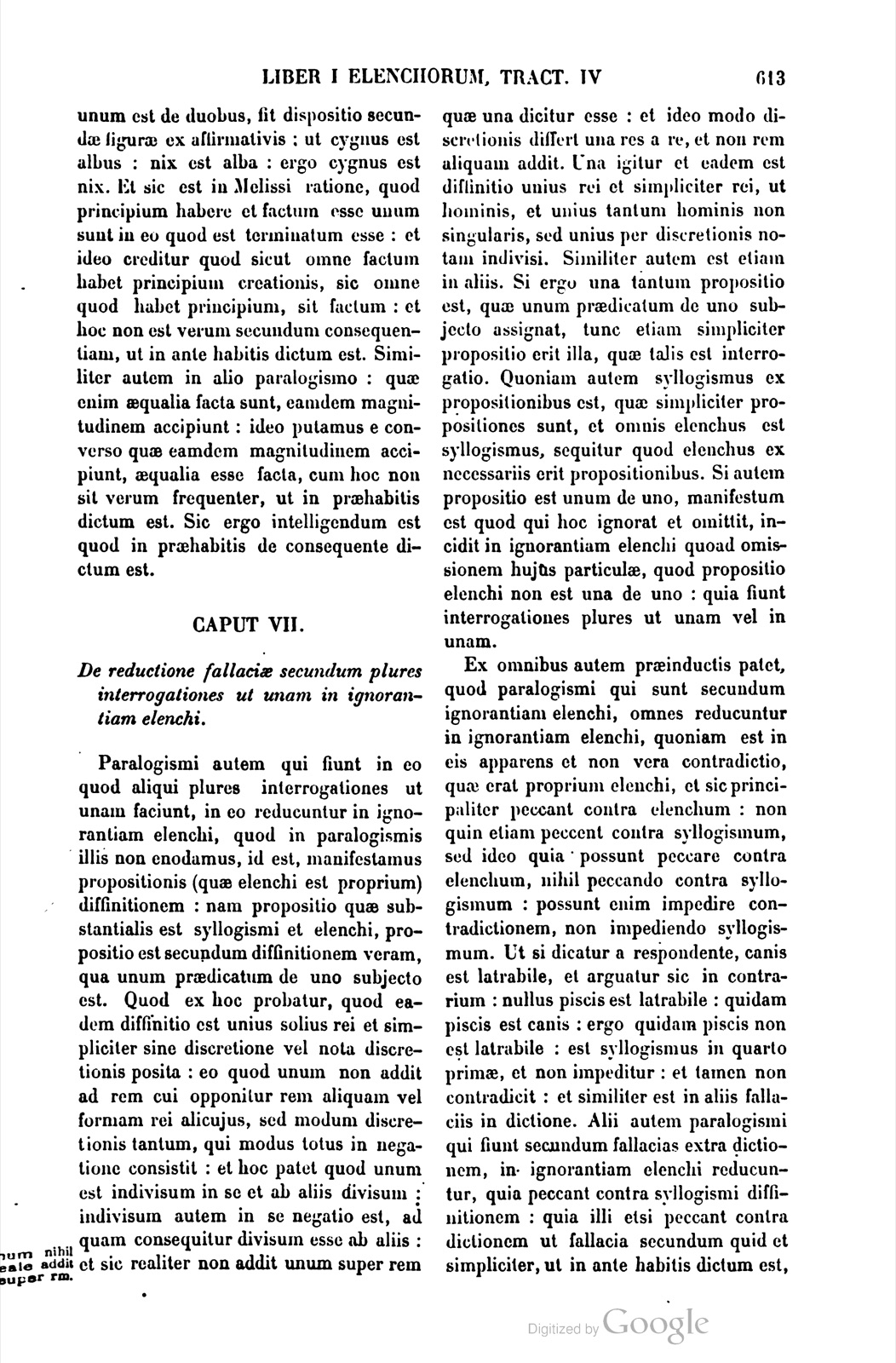
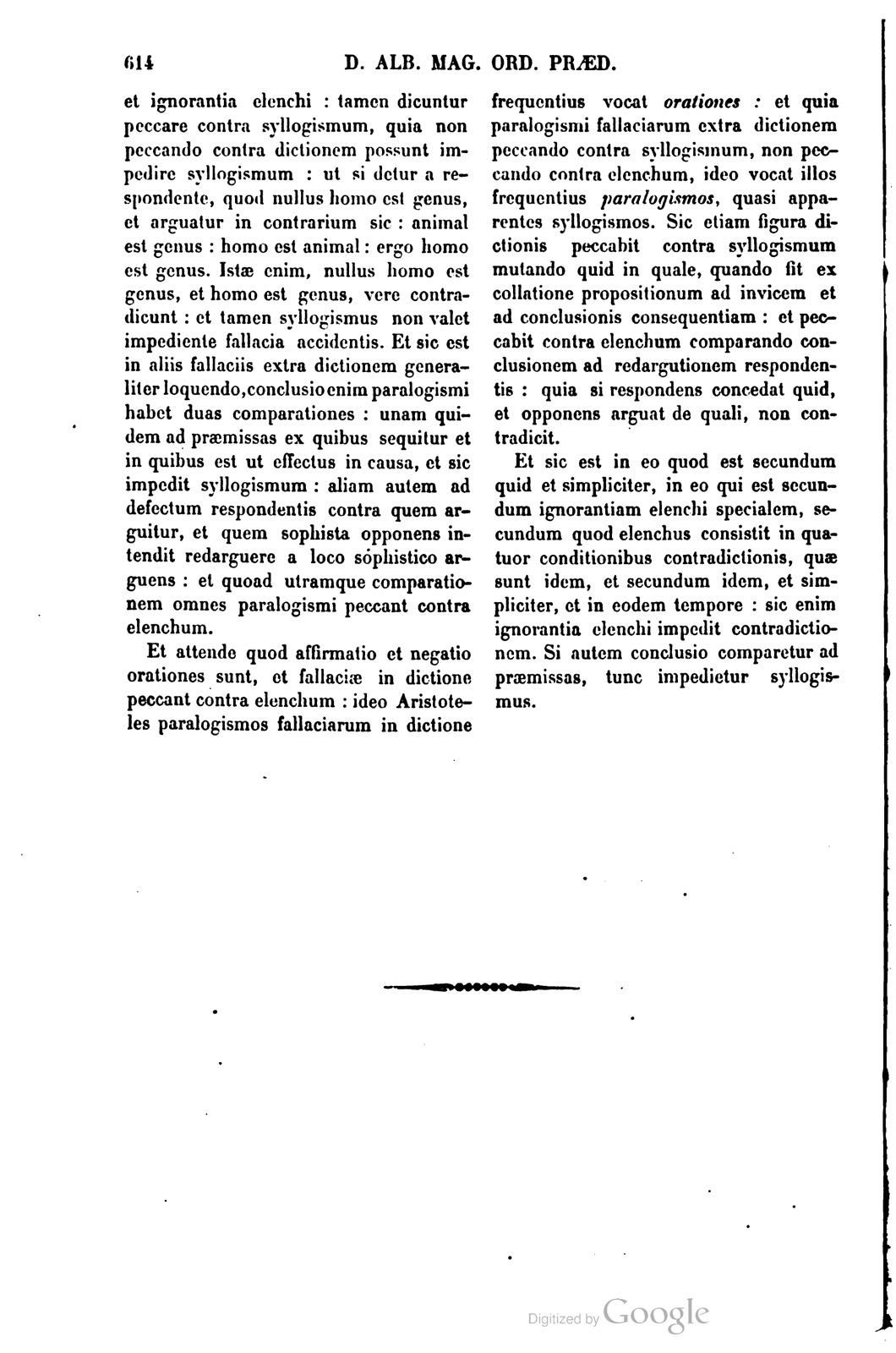
Ex omnibus autem praeinductis patet, quod paralogismi qui sunt secundum ignorantiam elenchi, omnes reducuntur in ignorantiam elenchi, quoniam est in eis apparens et non vera contradictio, quae erat proprium elenchi, et sic principaliter peccant contra elenchum: non quin etiam peccent contra syllogismum, sed ideo quia possunt peccare contra elenchum, nihil peccando contra syllogismum: possunt enim impedire contradictionem, non impediendo syllogismum. Ut si dicatur a respondente, canis est latrabile, et arguatur sic in contrarium: nullus piscis est latrabile: quidam piscis est canis: ergo quidam piscis non est latrabile: est syllogismus in quarto primae, et non impeditur: et tamen non contradicit: et similiter est in aliis fallaciis in dictione. Alii autem paralogismi qui fiunt secundum fallacias extra dictionem, in ignorantiam elenchi reducuntur, quia peccant contra syllogismi diffinitionem: quia illi etsi peccant contra dictionem ut fallacia secundum quid et simpliciter, ut in ante habitis dictum est, et ignorantia elenchi: tamen dicuntur peccare contra syllogismum, quia non peccando contra dictionem possunt impedire syllogismum: ut si detur a respondente, quod nullus homo est genus, et arguatur in contrarium sic: animal est genus: homo est animal: ergo homo est genus. Istae enim, nullus homo est genus, et homo est genus, vere contradicunt: et tamen syllogismus non valet impediente fallacia accidentis. Et sic est in aliis fallaciis extra dictionem generaliter loquendo, conclusio enim paralogismi habet duas comparationes: unam quidem ad praemissas ex quibus sequitur et in quibus est ut effectus in causa, et sic impedit syllogismum: aliam autem ad defectum respondentis contra quem arguitur, et quem sophista opponens intendit redarguere a loco sophistico arguens: et quoad utramque comparationem omnes paralogismi peccant contra elenchum.
Et attende quod affirmatio et negatio orationes sunt, et fallaciae in dictione peccant contra elenchum: ideo Aristoteles paralogismos fallaciarum in dictione frequentius vocat orationes: et quia paralogismi fallaciarum extra dictionem peccando contra syllogismum, non peccando contra elenchum, ideo vocat illos frequentius paralogismos, quasi apparentes syllogismos. Sic etiam figura dictionis peccabit contra syllogismum mutando quid in quale, quando fit ex collatione propositionum ad invicem et ad conclusionis consequentiam: et peccabit contra elenchum comparando conclusionem ad redargutionem respondentis: quia si respondens concedat quid, et opponens arguat de quali, non contradicit.
Et sic est in eo quod est secundum quid et simpliciter, in eo qui est secundum ignorantiam elenchi specialem, secundum quod elenchus consistit in quatuor conditionibus contradictionis, quae sunt idem, et secundum idem, et simpliciter, et in eodem tempore: sic enim ignorantia elenchi impedit contradictionem. Si autem conclusio comparetur ad praemissas, tunc impedietur syllogismus.
But from all the things brought in beforehand it is clear that the paralogisms which are according to ignorance of refutation are all reduced into ignorance of refutation, since in them there is an apparent and not true contradiction, which was proper to refutation, and thus they principally sin against refutation, not that they do not also sin against syllogism, but because they can sin against refutation while sinning not at all against syllogism: for they can impede contradiction without impeding syllogism. For example, if it is said by the respondent, dog is barkable, and it is argued thus to the contrary: no fish is barkable; a certain fish is dog; therefore a certain fish is not barkable; it is a syllogism in the fourth mode of the first figure and is not impeded, and yet it does not contradict. And similarly it is in the other fallacies in diction. But the other paralogisms which occur according to fallacies outside diction are reduced into ignorance of refutation because they sin against the definition of syllogism: because although those sin against diction, as the fallacy according to qualifiedly and simply, as was said in the preceding things, and ignorance of refutation, nevertheless they are said to sin against syllogism, because by not sinning against diction they can impede syllogism; as if it is granted by the respondent that no man is a genus, and it is argued to the contrary thus: animal is a genus; man is animal; therefore man is a genus. For these, no man is a genus and man is a genus, truly contradict; and yet the syllogism is not valid, with the fallacy of accident impeding it. And so it is in the other fallacies outside diction, speaking generally; for the conclusion of a paralogism has two comparisons: one to the premises from which it follows and in which it is as an effect in a cause, and thus it impedes syllogism; but the other to the defect of the respondent against whom it is argued, and whom the sophist as opponent intends to refute by arguing from a sophistical place; and with respect to each comparison all paralogisms sin against refutation.
And attend that affirmation and negation are speeches, and fallacies in diction sin against refutation; therefore Aristotle more frequently calls the paralogisms of fallacies in diction speeches. And because the paralogisms of fallacies outside diction sin against syllogism, by not sinning against refutation, therefore he more frequently calls those paralogisms, as if apparent syllogisms. Thus also figure of diction will sin against syllogism by changing a what into a qualified thing, when it occurs from the collation of propositions with one another and with the consequence of the conclusion; and it will sin against refutation by comparing the conclusion to the refutation of the respondent, because if the respondent grants a what, and the opponent argues about a qualified thing, he does not contradict.
And so it is in that which is according to qualifiedly and simply, in that which is according to special ignorance of refutation, insofar as refutation consists in four conditions of contradiction, which are the same thing, and according to the same thing, and simply, and at the same time. For thus ignorance of refutation impedes contradiction. But if the conclusion is compared to the premises, then the syllogism will be impeded.
If a page does not appear, its photograph has not been uploaded yet.