Works › Sophistical Refutations, Books I–II
Volume 2 · pp. 557–560
Tractate III. On Fallacies Outside Diction. Chapters I-III
A marker with ≈ is an approximate page boundary, placed by measure of the text; the page photographs remain the authority. In the paired views, clicking a page marker brings that page into view.
TRACTATUS III. DE FALLACIIS EXTRA DICTIONEM.
CAPUT I. De his quae in communi praemittenda sunt.
Antequam de fallaciis extra dictionem specialiter secundum singulas fallacias determinetur, in communi de omnibus praenotandum est, quod non est in fallaciis extra dictionem aliquod unum univoce participatum ab omnibus, penes cujus diversam participationem possit sumi determinatio numeri fallaciarum extra dictionem, sicut est unum commune quod est sermonis identitas, vel in parte vel in toto, quae diversimode participata determinat numerum fallaciarum in dictione. Et hoc ideo, quia hoc quod est causa apparentiae in fallaciis in dictione, non potest esse causa apparentiae in fallaciis extra dictionem: et ideo cum unitas vocis tam in materia quam in forma sit causa apparentiae in aequivocatione et amphibologia et figura dictionis fallaciis, et in eis sit causa non existentiae diversitas rei significatae: non potest fieri quod unitas vocis in materia et forma, et diversitas rei significatae sit causa apparentiae et non existentiae in aliqua fallaciarum extra dictionem. Nec iterum potest fieri e converso, scilicet quod diversitas in voce sit causa non existentiae, et unitas in re sit causa apparentiae: quia talis complexio nullam habet similitudinem cum syllogismo et elencho: sicut si dicam, omnis gladius incidit vel quidam, unicus est sensus: ex hac enim complexione nihil infertur: quia caret et medio et extremis in dispositione syllogismi et elenchi positis. Nec iterum fieri potest, quod identitas vocis in parte vocis (hoc est, secundum materiam) et diversitas in parte altera vocis sit causa apparentiae et non existentiae: quum haec sit causa in tribus aliis fallaciis in dictione, compositione, et divisione, et accentu. Et sic relinquitur quod causa apparentiae in fallaciis extra dictionem sit unitas rei secundum unam partem, et diversitas rei secundum alteram partem sit causa non existentiae.
Penes ergo hujusmodi unitatem sic potest sumi numerus fallaciarum extra dictionem penes tria quae faciunt unitatem sive identitatem: aut enim ista est unitas substantiae, et facit idem: aut unitas quantitatis, et facit aequale: aut unitas qualitatis, et facit simile. Si est penes unitatem qualitatis quae facit simile, haec erit altero duorum modorum: aut enim erit similitudo in ipso significato, aut in modo significandi. Si est in ipso significato, eo quod communicant in significato aliquo: tunc est fallacia secundum non causam ut causam: in illa enim propositio quae non est causa, apparet causa conclusionis: quia communicat et similis est cum propositione quae est causa ejusdem conclusionis in significato termini alicujus. Si autem sit similitudo in modo significandi, sic unitas similitudinis est causa apparentiae in fallacia secundum plures interrogationes ut unam: in hac enim propositione, plures apparet esse una, quia communicat cum uno in modo significandi, eo quod interrogatio facta ex affirmatione et negatione proprie non una est, ut haec, estne homo animal, vel non? et ideo quando proponuntur duae interrogationes diversae, propter modum significandi similem putatur, quod illa sit una interrogatio, et sic interrogatio composita ex affirmatione et negatione putatur una, et sic quod plures interrogationes sint una. Si autem fiat apparentia penes unitatem rei quae est aequalitas, sic unitas est causa apparentiae in fallacia petitionis principii: ibi enim convertibilitas medii cum altero extremorum facit apparere, quod medium cum extremis ordinatur sicut notius ut faciat cognoscere conclusionem, cum sit aeque ignotum vel minus notum conclusione. Si autem fiat penes causam unitatis quae est identitas: tunc non potest esse causa apparentiae idem in genere, specie, et numero: et quia quandoque apparet aliqua istarum identitatum esse causa apparentiae, tunc semper contingit fallacia accidentis et non alia.
TRACTATE III. ON FALLACIES OUTSIDE DICTION.
CHAPTER I. On those things which must be premised in common.
Before there is determination concerning fallacies outside diction specially according to the individual fallacies, it must be prenoted in common concerning all of them that in fallacies outside diction there is not some one thing univocally participated by all, according to whose diverse participation the determination of the number of fallacies outside diction could be taken, as there is one common thing which is identity of speech, either in part or in whole, which, when participated in diverse ways, determines the number of fallacies in diction. And this is because that which is the cause of appearance in fallacies in diction cannot be the cause of appearance in fallacies outside diction. And therefore, since unity of word both in matter and in form is the cause of appearance in equivocation and amphibology and the fallacies of figure of diction, and in them diversity of the signified thing is the cause of non-existence, it cannot happen that unity of word in matter and form, and diversity of the signified thing, should be the cause of appearance and non-existence in any of the fallacies outside diction. Nor again can the converse occur, namely that diversity in word should be the cause of non-existence and unity in the thing the cause of appearance, because such a complex has no likeness to syllogism and elench; as if I say, every sword cuts or some one, the sense is single; for from this complex nothing is inferred, because it lacks both middle and extremes placed in the disposition of syllogism and elench. Nor again can it happen that identity of word in part of the word, that is, according to matter, and diversity in another part of the word should be the cause of appearance and non-existence, since this is the cause in three other fallacies in diction, composition, division, and accent. And thus it remains that the cause of appearance in fallacies outside diction is unity of the thing according to one part, and diversity of the thing according to another part is the cause of non-existence.
According to this kind of unity, therefore, the number of fallacies outside diction can be taken according to three things which make unity or identity: for either that is unity of substance, and it makes the same; or unity of quantity, and it makes equal; or unity of quality, and it makes similar. If it is according to unity of quality, which makes similar, this will be in one of two ways: for either there will be likeness in the signified thing itself, or in the mode of signifying. If it is in the signified thing itself, because they communicate in some signified thing, then there is the fallacy according to non-cause as cause. For in that the proposition which is not a cause appears to be the cause of the conclusion, because it communicates and is similar with the proposition which is the cause of the same conclusion in the signified of some term. But if there is likeness in the mode of signifying, thus unity of likeness is the cause of appearance in the fallacy according to many questions as one; for in this, a proposition that is many appears to be one, because it communicates with one in the mode of signifying, because a question made from affirmation and negation is not properly one, as this, is a man an animal, or not? And therefore when two diverse questions are proposed, because of a similar mode of signifying it is thought that it is one question, and thus a question composed from affirmation and negation is thought to be one, and so that many questions are one. But if the appearance occurs according to the unity of the thing which is equality, thus unity is the cause of appearance in the fallacy of petition of the principle; for there the convertibility of the middle with one of the extremes makes it appear that the middle is ordered with the extremes as something better known so that it makes the conclusion known, although it is equally unknown or less known than the conclusion. But if it occurs according to the cause of unity which is identity, then the same in genus, species, and number cannot be the cause of appearance; and because sometimes some one of those identities appears to be the cause of appearance, then the fallacy of accident always occurs and no other.
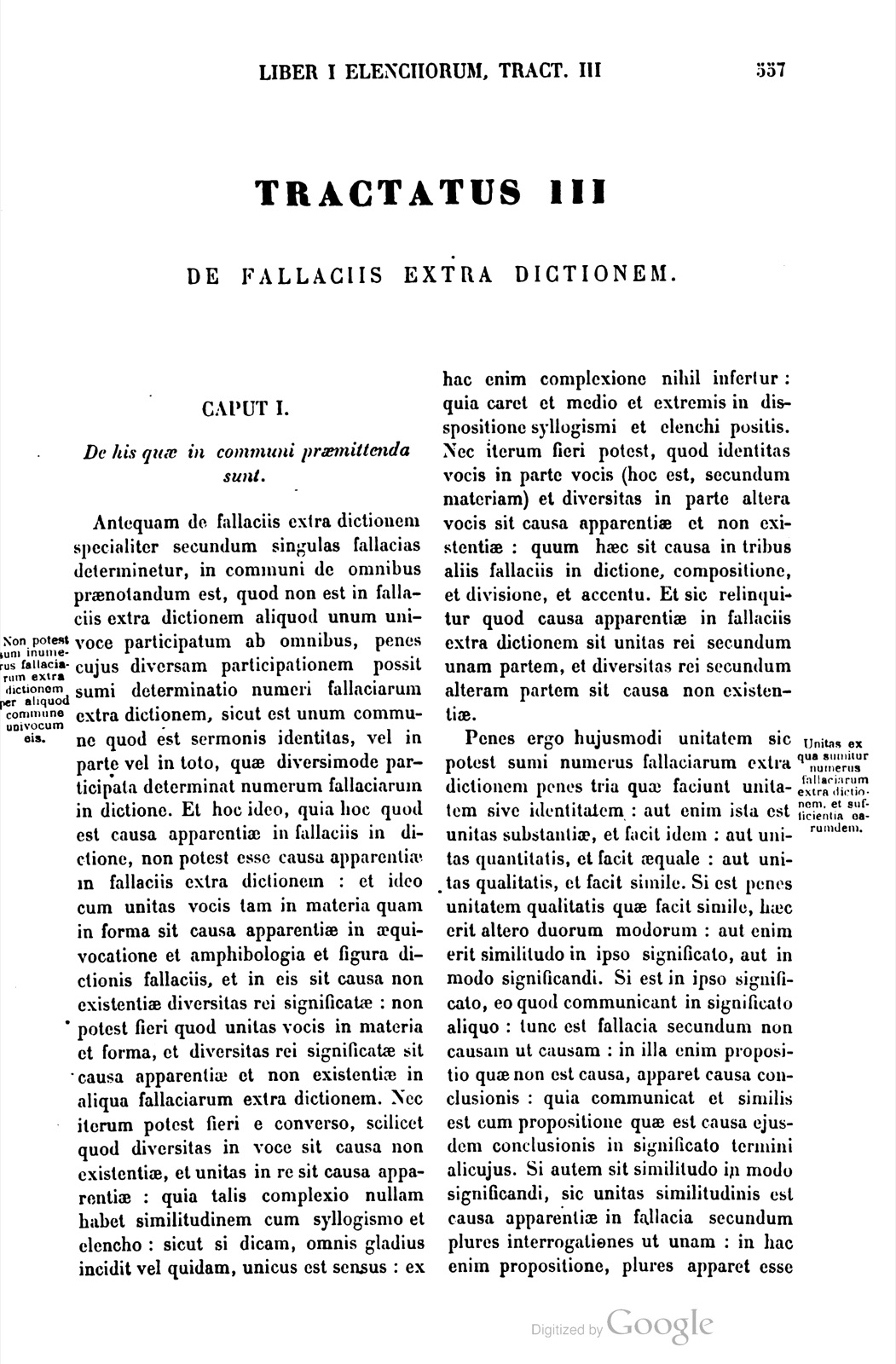
Et ideo sic dicendum est: Idem aut est idem accidentis ad subjectum, aut antecedentis ad consequens, aut absoluti et simpliciter dicti ad eamdem dictionem cum determinatione. Et primo quidem horum trium modorum est fallacia accidentis. Secundo vero modo identitas est causa apparentiae in fallacia consequentis. Si vero identitas tertio modo dicta est causa apparentiae, hoc contingit duobus modis: quia aut est determinatio quae infert simpliciter, et haec determinatio vocatur proprii: aut quae non infert. Si primo modo unitas absoluti et determinati sit causa apparentiae, sic fit fallacia secundum ignorantiam elenchi: identitas enim talis absolute dicti et determinati facit apparere, quod quidquid stat cum uno, possit stare cum alio: identitas autem determinationis non inferentis suum absolutum est causa apparentiae in fallacia secundum quid et simpliciter: quia illa identitas facit credere, quod de quocumque dicitur secundum quid, dicatur et de eodem simpliciter.
Alio modo consuevit dici, quod accipitur numerus fallaciarum extra dictionem secundum ea quae faciunt causam non existendi: diversitas enim rei aliqua est non existenti per quam diversitatem deficit a syllogismo et elencho. Si enim sit defectus ille ex parte materiae, sic est fallacia secundum plures interrogationes ut unam facere: quia in illa accipitur propositio plures, cum in syllogismo et elencho propositio simpliciter una sit accipienda. Si autem deficiat ex parte formae, hoc erit dupliciter: aut enim deficit ab elencho, aut a syllogismo. Si ab elencho, tunc est ignorantia elenchi quae infert ex veris et vera, sed non infert conclusionem. Si vero deficit a syllogismo, hoc contingit dupliciter: aut enim deficit a syllogismo per impossibile, aut a syllogismo ostensivo. Si ab eo qui est per impossibile, sic est non causa ut causa: quia in non causa ut causa non vere interimitur hypothesis, quamvis interimi videatur. Si vero deficit ab ostensivo, hoc contingit tripliciter: medium enim aut est penitus diversum, aut partim idem et partim diversum. Si penitus idem, sic est petitio principii. Si autem penitus diversum, tunc nulla est causa apparentiae: et ideo nulla fallacia. Si autem partim sit idem et partim differens, tunc identitas quam habet cum extremo, aut est essentialis, aut accidentalis. Dico autem essentialiter ambo esse eadem, quando unum de altero praedicatur, ut albus dentes, et albus. Si medium habet cum extremo identitatem essentialem, ita quod unum de altero praedicatur, hoc contingit tripliciter: medium enim aut erit antecedens ad conclusionem, aut est consequens ad eamdem sive illatum ex conclusione. Si est antecedens: aut erit argumentum affirmativum, et sic illa non est fallacia: quia antecedens affirmatum infert consequens: aut est negativum, et sic est fallacia consequentis a destructione antecedentis. Si autem sit consequens ad id quod infertur ex ipso: tunc iterum aut est argumentum affirmativum, et sic est fallacia consequentis a positione consequentis: aut negativum, et sic non est fallacia: quia consequens negatum infert antecedens negatum. Si autem identitas medii cum extremo sit accidentalis: aut ergo illa identitas provenit ex additione determinationis, et sic est fallacia secundum quid et simpliciter: aut provenit ex comparatione mutua extremorum ad invicem et ad tertium, et sic est fallacia accidentis, in qua medium cum uno extremorum non habet nisi accidentalem identitatem: et hoc provenit ex comparatione medii ad extrema.
And therefore it must be said thus: the same is either the same of accident to subject, or of antecedent to consequent, or of what is absolute and said simply to the same diction with determination. And of the first of these three modes there is the fallacy of accident. But in the second way identity is the cause of appearance in the fallacy of the consequent. But if identity said in the third way is the cause of appearance, this happens in two ways, because either it is a determination which infers simply, and this determination is called of the property, or it is one which does not infer. If in the first way the unity of the absolute and the determined is the cause of appearance, thus the fallacy according to ignorance of elench occurs; for the identity of such a thing said absolutely and determined makes it appear that whatever stands with one can stand with the other. But identity of a determination that does not infer its absolute is the cause of appearance in the fallacy according to qualifiedly and simply, because that identity makes one believe that of whatever something is said qualifiedly, it is said of the same simply.
In another way it is customarily said that the number of fallacies outside diction is taken according to the things that make the cause of non-existing: for some diversity of thing belongs to non-existence through which diversity it falls short of syllogism and elench. For if that defect is on the part of matter, thus there is the fallacy according to making many questions as one, because in it a proposition that is many is taken, whereas in syllogism and elench a proposition simply one must be taken. But if it falls short on the part of form, this will be in two ways: for it falls short either from elench or from syllogism. If from elench, then it is ignorance of elench, which infers from true things and true things, but does not infer the conclusion. But if it falls short from syllogism, this happens in two ways: either it falls short from syllogism through the impossible, or from ostensive syllogism. If from that which is through the impossible, thus it is non-cause as cause, because in non-cause as cause the hypothesis is not truly destroyed, although it seems to be destroyed. But if it falls short from the ostensive, this happens in three ways: for the middle is either entirely diverse, or partly the same and partly diverse. If entirely the same, thus it is petition of the principle. But if entirely diverse, then there is no cause of appearance, and therefore no fallacy. But if it is partly the same and partly different, then the identity which it has with the extreme is either essential or accidental. But I call both essentially the same when one is predicated of the other, as white teeth, and white. If the middle has essential identity with the extreme, so that one is predicated of the other, this happens in three ways: for the middle will either be antecedent to the conclusion, or it is consequent to the same, or what is inferred from the conclusion. If it is antecedent, either the argument will be affirmative, and thus that is not a fallacy, because the antecedent affirmed infers the consequent, or it is negative, and thus it is the fallacy of the consequent from destruction of the antecedent. But if it is consequent to that which is inferred from it, then again either the argument is affirmative, and thus it is the fallacy of the consequent from position of the consequent, or negative, and thus it is not a fallacy, because the consequent denied infers the antecedent denied. But if the identity of the middle with the extreme is accidental, then either that identity arises from the addition of a determination, and thus it is the fallacy according to qualifiedly and simply, or it arises from the mutual comparison of the extremes to one another and to a third, and thus it is the fallacy of accident, in which the middle with one of the extremes has only accidental identity; and this arises from the comparison of the middle to the extremes.
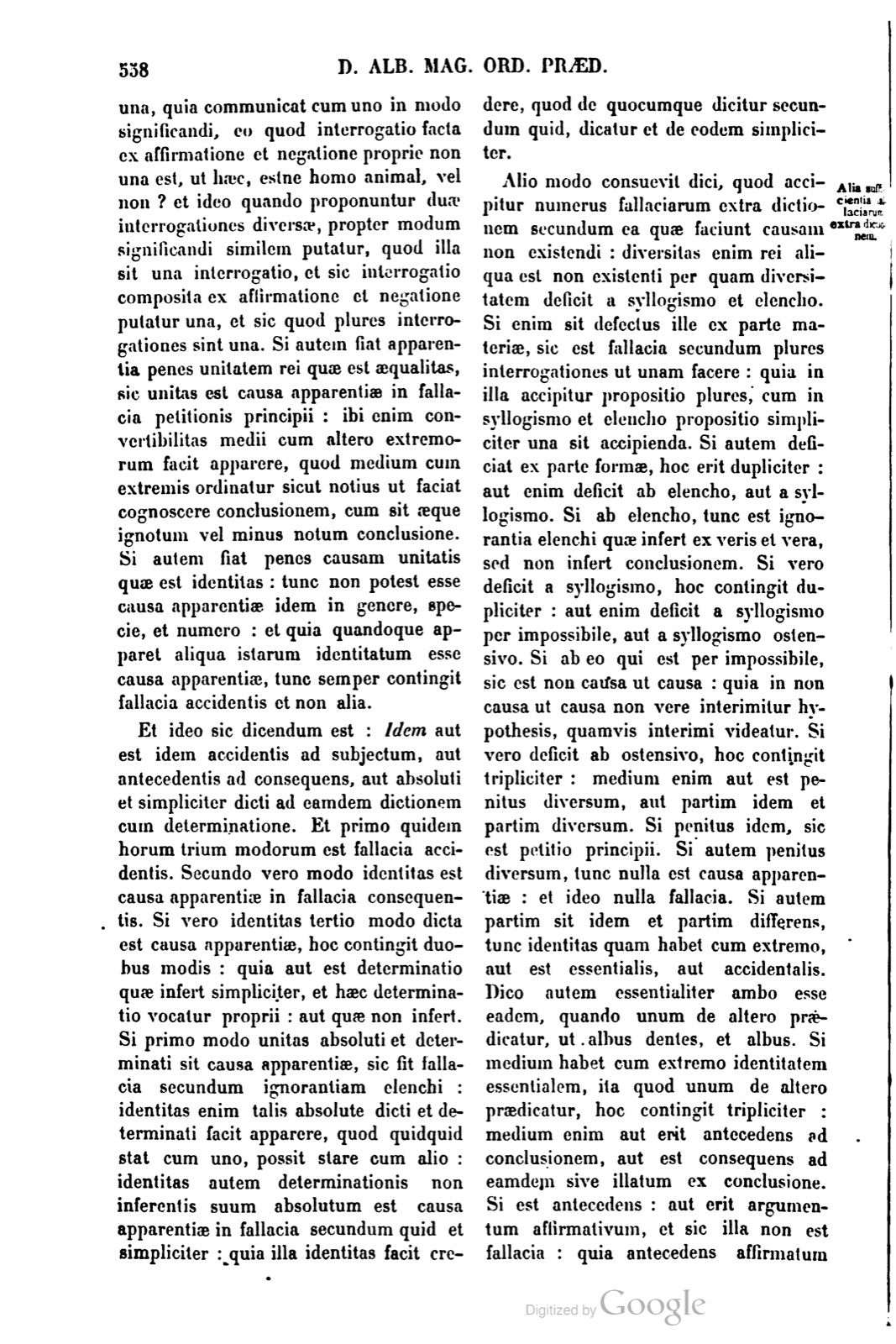
Alfarabius levius innuit numerum fallaciarum extra dictionem sic: fallacia extra dictionem peccat contra syllogismum et elenchum, aut in materia, et sic est fallacia secundum plures interrogationes ut unam, ut dictum est: aut in forma quae est in ordine propositionum vel terminorum. Si in propositione, aut secundum quod propositio causa est conclusionis, et sic est non causa ut causa: aut secundum quod principium notius est quam conclusio, et contra hoc peccat petitio principii. Si autem in ordine terminorum, sic est peccans contra hoc fallacia accidentis: si autem non peccat contra propositionis formam vel terminorum, et tamen peccat contra formam syllogisticam: tunc oportet quod peccet contra consequentiam ipsam secundum quod unum sequitur ex altero, et hoc est aut contra id quod unum perfecte sequitur ex altero, et sic contra hoc peccat fallacia consequentis: aut secundum quod inferens imperfecte infert consequens, et sic est fallacia secundum quid et simpliciter. Si autem peccat contra elenchum, et sic est ignorantia elenchi. Et haec acceptio plana est et vera.
CAPUT II. Quae sunt fallaciae extra dictionem et quis ordo.
His ita praemissis, patet quod eorum locorum sophisticorum quae sunt extra dictionem sive paralogismorum, species sunt septem. Una quidem species est et prima, quae dicitur fallacia secundum accidens. Secunda vero in eo quod aliquid dicitur simpliciter et absolute et sine determinatione, et non simpliciter, sed dicitur quo, et hoc dico propter conditionem determinationis quae id quod simpliciter dicitur, contrahit ad partem subjectivam, aut ubi quantum ad conditionem ad partem in loco, aut quando quantum ad conditionem et partem ad partem in tempore, aut ad aliquid dicitur quantum ad conditionem ad aliquem respectum. Tertia autem species est fallacia secundum ignorantiam elenchi. Quarta vero species est secundum consequens. Quinta vero est fallacia secundum quod in principio sumere. Sexta vero species est secundum quod est non causam ut causam ponere. Septima vero est secundum quod est plures interrogationes ut unam facere.
Ordinari autem possunt dupliciter. Uno quidem modo sic quod priores sunt quae peccant contra principium syllogismi, vel elenchi formam, quam illae quae peccant in materia: et inter peccantes contra principium quod est medium jungens extrema, et sic primus locus est fallacia accidentis: aut peccant contra principium secundum quod est inferens, aut contra principium quod est probans. Si contra principium secundum quod est inferens: aut perfecte, aut imperfecte. Minus peccando recedit qui peccat contra inferens imperfecte: et sic secundum est secundum quid et simpliciter. Peccans autem contra elenchum est tertia, quia minus recedit a consequentia: non enim peccat contra consequentiam, sed contra illatum quod non est vera contradictio. Quarta autem fallacia consequentis quae totam pervertit consequentiam: et sic quarta est consequentis fallacia. Si autem peccat contra principium probans, tunc manifestum est magis contractum: et sic peccat in hoc quod est esse causam conclusionis: et sic sexta est non causa ut causa. Ultima est plures interrogationes ut unam facere, quae peccat contra dispositionem materiae syllogismi.
Alfarabius more lightly indicates the number of fallacies outside diction thus: a fallacy outside diction sins against syllogism and elench either in matter, and thus it is the fallacy according to many questions as one, as has been said, or in form, which is in the order of propositions or of terms. If in the proposition, either according as a proposition is the cause of the conclusion, and thus it is non-cause as cause, or according as the principle is better known than the conclusion, and petition of the principle sins against this. But if in the order of terms, then the fallacy of accident is what sins against this; but if it does not sin against the form of the proposition or of the terms, and nevertheless sins against syllogistic form, then it must sin against the consequence itself according as one thing follows from another, and this is either against that by which one thing follows perfectly from another, and against this the fallacy of the consequent sins, or according as what infers imperfectly infers the consequent, and thus there is the fallacy according to qualifiedly and simply. But if it sins against elench, then it is ignorance of elench. And this acceptance is plain and true.
CHAPTER II. What the fallacies outside diction are and what the order is.
With these things thus premised, it is clear that of those sophistical places which are outside diction, or of paralogisms, there are seven species. One species indeed, and the first, is that which is called the fallacy according to accident. But the second is in this, that something is said simply and absolutely and without determination, and not simply, but is said in a certain respect; and I say this because of the condition of the determination which contracts that which is said simply to a subjective part, or where according to condition to a part in place, or when according to condition and part to part in time, or it is said toward something according to condition to some respect. But the third species is the fallacy according to ignorance of elench. But the fourth species is according to the consequent. But the fifth is the fallacy according to taking in the beginning. But the sixth species is according to positing non-cause as cause. But the seventh is according to making many questions as one.
But they can be ordered in two ways. In one way thus, that those are prior which sin against the principle of the syllogism, or the form of the elench, than those which sin in matter; and among those sinning against the principle which is the middle joining the extremes, and thus the first place is the fallacy of accident, or they sin against the principle according as it is inferring, or against the principle which is proving. If against the principle according as it is inferring: either perfectly or imperfectly. The one who sins against what infers imperfectly recedes by sinning less, and thus the second is according to qualifiedly and simply. But the one sinning against elench is third, because he recedes less from consequence; for he does not sin against consequence, but against what is inferred, which is not a true contradiction. But the fourth is the fallacy of the consequent, which wholly perverts consequence, and thus the fourth is the fallacy of the consequent. But if it sins against the principle proving, then the manifest thing is more contracted; and thus it sins in this, that it is the cause of the conclusion, and thus the sixth is non-cause as cause. The last is making many questions as one, which sins against the disposition of the matter of the syllogism.
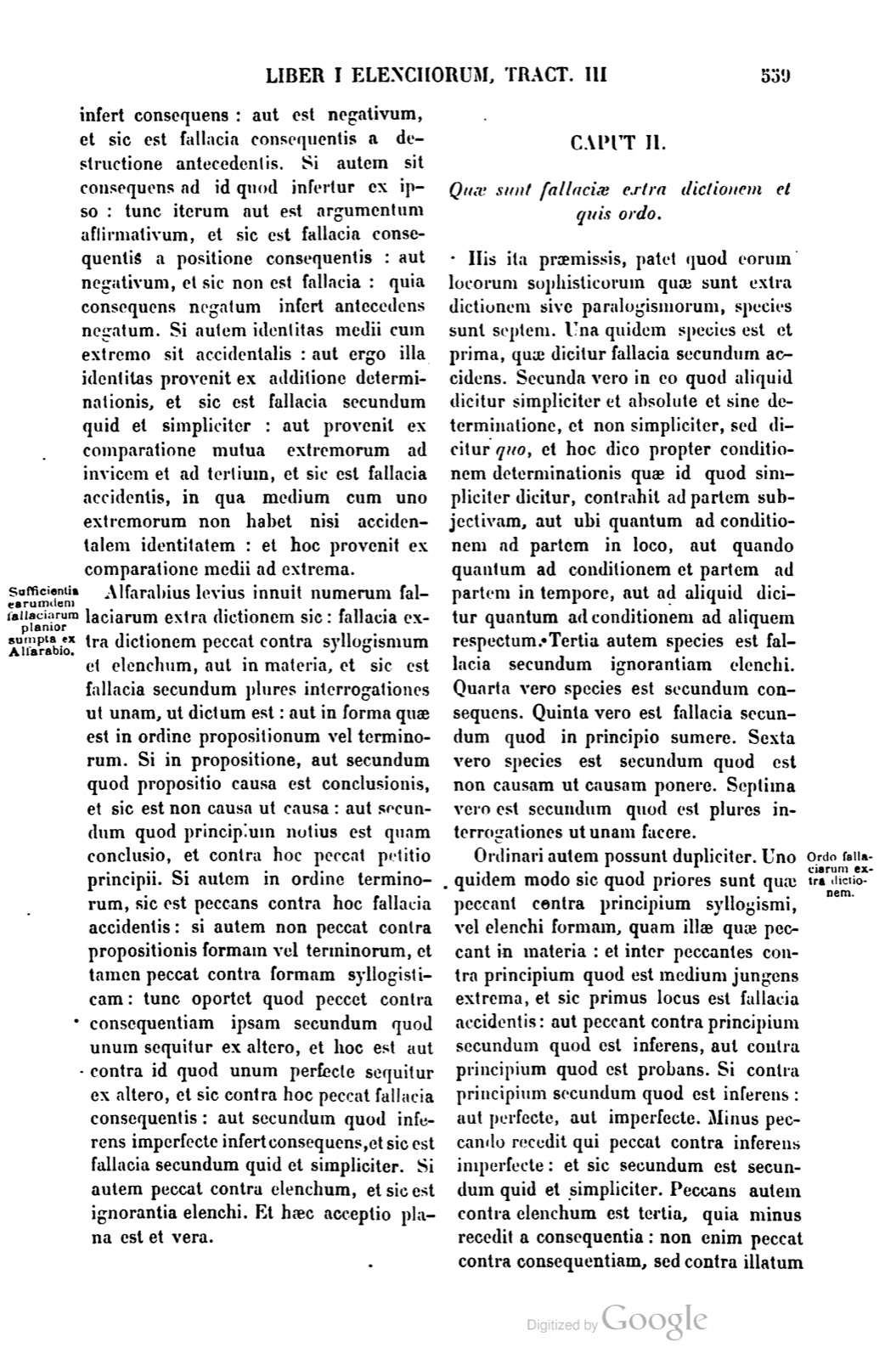
Potest etiam aliter sumi ordo fallaciarum extra dictionem secundum quosdam sic, quod scilicet illae sint priores, in quibus major est unitas causa apparentiae, et illae posteriores in quibus est minor unitas causa apparentiae omnibus. Ergo posteriores sunt non causa ut causa, et plures interrogationes ut una: quia in illis (ut superius habitum est) causa unitatis non est nisi similitudo: et sic est non causa ut causa prior quam plures interrogationes ut una: quia major est convenientia similitudinis in participando in significato, quam sit convenientia in participando in modo significandi. Fallacia autem accidentis omnibus prior est in ordine fallaciarum ut fallaciae sunt, quia plus habet de virtute decipiendi. Secundo autem secundum quid et simpliciter propter identitatem inferentis imperfecte ad illatum, quod est quasi identitas partis ad totum. Et tertia secundum ignorantiam elenchi propter causam dictam. Et quarta est secundum consequens propter identitatem antecedentis ad consequens quae substantialis est. Quinta autem petitio principii, quia ibi est identitas aequalitatis sive quantitatis in convertibilitate.
CAPUT III. De his quae dicenda sunt de fallacia accidentis.
Inter fallacias ergo extra dictionem primo occurrit determinare de fallacia accidentis. Primum autem videndum est, quae sit differentia inter fallaciam accidentis et figuram dictionis: cum in omni paralogismo figurae dictionis inveniatur etiam fallacia accidentis, quamvis non sit verum e converso, quod in omni paralogismo accidentis sit etiam fallacia figurae dictionis.
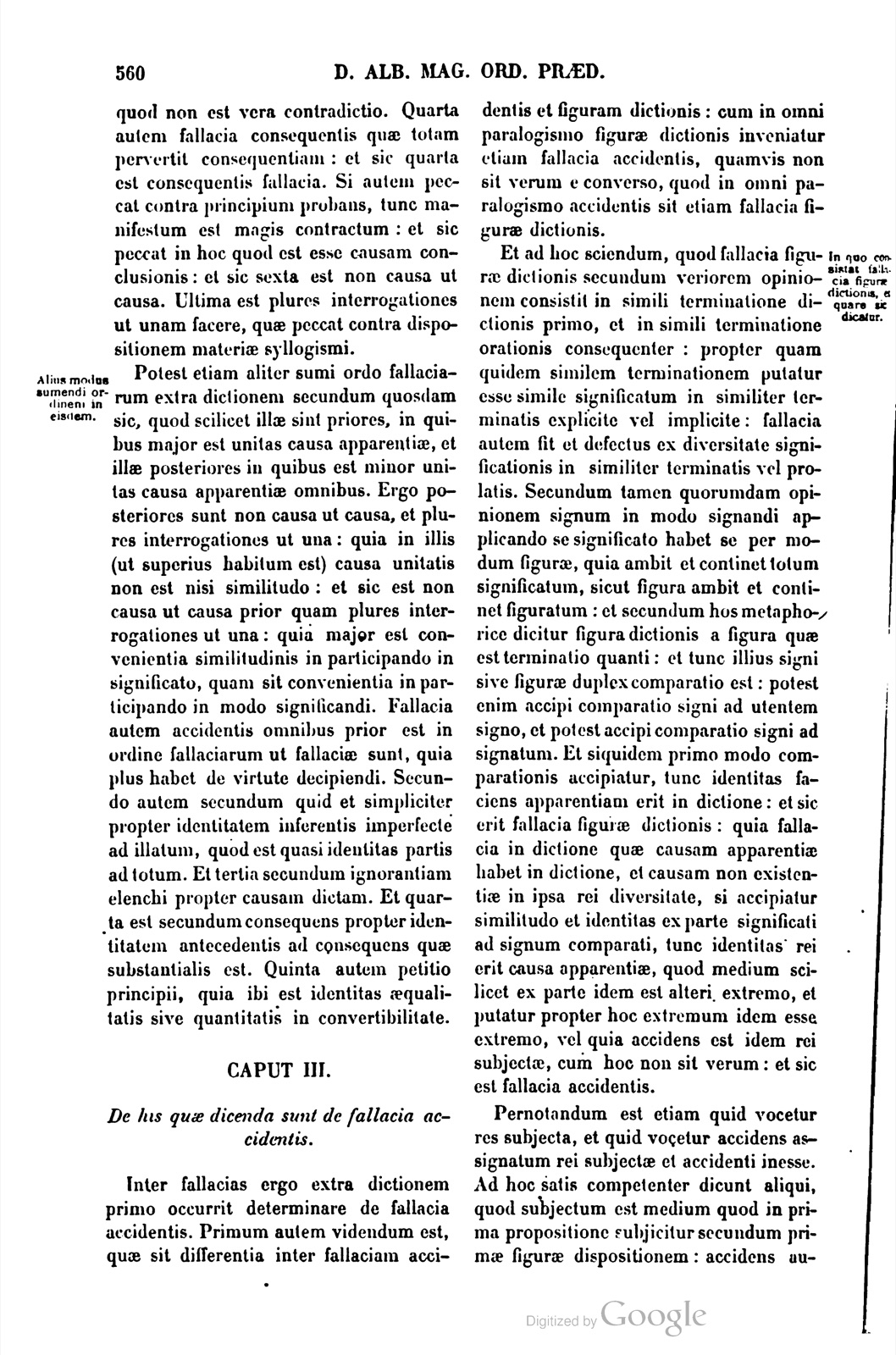
Et ad hoc sciendum, quod fallacia figurae dictionis secundum veriorem opinionem consistit in simili terminatione dictionis primo, et in simili terminatione orationis consequenter: propter quam quidem similem terminationem putatur esse simile significatum in similiter terminatis explicite vel implicite: fallacia autem fit et defectus ex diversitate significationis in similiter terminatis vel prolatis. Secundum tamen quorumdam opinionem signum in modo signandi applicando se significato habet se per modum figurae, quia ambit et continet totum significatum, sicut figura ambit et continet figuratum: et secundum hos metaphorice dicitur figura dictionis a figura quae est terminatio quanti: et tunc illius signi sive figurae duplex comparatio est: potest enim accipi comparatio signi ad utentem signo, et potest accipi comparatio signi ad signatum. Et siquidem primo modo comparationis accipiatur, tunc identitas faciens apparentiam erit in dictione: et sic erit fallacia figurae dictionis: quia fallacia in dictione quae causam apparentiae habet in dictione, et causam non existentiae in ipsa rei diversitate, si accipiatur similitudo et identitas ex parte significati ad signum comparati, tunc identitas rei erit causa apparentiae, quod medium scilicet ex parte idem est alteri, extremo, et putatur propter hoc extremum idem esse extremo, vel quia accidens est idem rei subjectae, cum hoc non sit verum: et sic est fallacia accidentis.
Pernotandum est etiam quid vocetur res subjecta, et quid vocetur accidens assignatum rei subjectae et accidenti inesse. Ad hoc satis competenter dicunt aliqui, quod subjectum est medium quod in prima propositione subjicitur secundum primae figurae dispositionem: accidens autem.
The order of fallacies outside diction can also be taken otherwise according to certain people, namely thus, that those are prior in which there is a greater unity as cause of appearance, and those are posterior in which there is less unity as cause of appearance than in all. Therefore the posterior ones are non-cause as cause and many questions as one, because in those, as was had above, the cause of unity is only likeness; and thus non-cause as cause is prior to many questions as one, because there is greater agreement of likeness in participating in the signified thing than there is agreement in participating in the mode of signifying. But the fallacy of accident is prior to all in the order of fallacies as they are fallacies, because it has more of the power of deceiving. But second is according to qualifiedly and simply, because of the identity of what infers imperfectly to what is inferred, which is as it were the identity of part to whole. And third is according to ignorance of elench because of the cause stated. And fourth is according to the consequent because of the identity of antecedent to consequent, which is substantial. But fifth is petition of the principle, because there is identity of equality or of quantity in convertibility.
CHAPTER III. On the things that must be said concerning the fallacy of accident.
Therefore among fallacies outside diction it first occurs to determine concerning the fallacy of accident. But first one must see what the difference is between the fallacy of accident and figure of diction, since in every paralogism of figure of diction there is also found the fallacy of accident, although the converse is not true, that in every paralogism of accident there is also the fallacy of figure of diction.
And for this one must know that the fallacy of figure of diction according to the truer opinion consists first in a similar termination of diction, and consequently in a similar termination of speech; because of this similar termination it is thought that there is a similar signified thing in things similarly terminated, explicitly or implicitly. But the fallacy occurs and the defect arises from diversity of signification in things similarly terminated or uttered. Nevertheless, according to the opinion of certain people, a sign in the mode of signifying, applying itself to the signified, has itself in the manner of a figure, because it surrounds and contains the whole signified, as a figure surrounds and contains the figured thing. And according to these, figure of diction is said metaphorically from figure, which is the termination of quantity; and then of that sign or figure there is a twofold comparison: for the comparison of sign to the one using the sign can be taken, and the comparison of sign to the signified can be taken. And if it is taken in the first way of comparison, then the identity making appearance will be in diction, and thus it will be the fallacy of figure of diction, because a fallacy in diction which has the cause of appearance in diction and the cause of non-existence in the very diversity of the thing, if likeness and identity are taken on the part of the signified compared to the sign, then identity of thing will be the cause of appearance, namely that the middle in part is the same as the other extreme, and because of this the extreme is thought to be the same as the extreme, or because the accident is the same as the subject thing, although this is not true; and thus it is the fallacy of accident.
One must also carefully note what is called the subject thing, and what is called the accident assigned to belong to the subject thing and to the accident. For this certain people say rather competently that the subject is the middle which in the first proposition is subjected according to the disposition of the first figure; but the accident.
If a page does not appear, its photograph has not been uploaded yet.