Works › Sophistical Refutations, Books I–II
Volume 2 · pp. 549–556
Tractate II. Chapters IX-XI
A marker with ≈ is an approximate page boundary, placed by measure of the text; the page photographs remain the authority. In the paired views, clicking a page marker brings that page into view.
considerandum est si illa determinabilia sic se habent ad invicem, quod unum sit pars alterius, aut non. Et si unum est pars alterius, tunc non contingit ibi duplex compositio et duplex divisio. Si autem non se habent ad invicem ut totum, sive quod unum sit pars alterius, sed sunt diversa vel disparata, tunc accidit multiplicitas ex praepositione vel postpositione determinationis. Ex praepositione sic, non unum hominem sedere sequitur ad istum hominem sedere: hic enim est multiplicitas ex hoc, quod negatio potest referri ad totum vel ad partem. Ex postpositione autem determinationis accidit multiplicitas, ut hic, omne aliud quam animal quod et Socrates sunt duo, differt a Socrate: quia haec determinatio, quod, potest determinare hoc totum, aliud quam animal, vel partem ejus, scilicet animal.
Generaliter ergo loquendo quando una est determinatio et duo determinabilia, quorum unum se habet ut totum, reliquum ut pars: tunc dicendum, quod oratio dicitur composita ex compositione determinationis cum illo determinabili quod se habet ut totum, et ex divisione ejusdem ab illo dicitur omnino divisa: et secundum quod dividitur ab illo, non componitur cum aliquo alio, ut hic, non unum hominem esse, sequitur ad omnem hominem esse, ita quod punctum suspensivum statim ponatur post negationem sic, non, unum hominem esse, sequitur ad omnem hominem esse: hoc enim modo est oratio divisa, secundum quod est prolatio discontinua inter illud totum et negationem praecedentem. Si autem continue pronuntietur, sic est composita. Similiter autem quod subsequitur determinatio, ut hic, omne aliud quam animal (quod et Socrates sunt duo) differt a Socrate: secundum enim quod haec determinatio, quod, hic est pars totius relati, continue profertur cum toto hoc, aliud quam animal, sic est composita sub hoc sensu: omne aliud quam animal, quod et Socrates sunt duo, differt a Socrate: secundum autem quod pars ejus ad quod refertur, continue profertur cum relatione et non ut totum, sic est oratio divisa, secundum quod fit quaedam pausatio parva inter hoc quod dico, aliud, et hoc quod dico, quam, sic, omne aliud, quam animal quod et Socrates sunt duo, differt a Socrate.
Si vero sint duo determinabilia et sic se habeant, quod neutrum sit ut totum respectu alterius, sicut si sint duo substantiva, vel duo verba ad quae determinatio referri possit: tunc semper accidit multiplicitas ex interpositione determinationis, ut hic, quidquid vivit semper est: tunc enim non esset oratio multiplex, si praeponeretur vel postponeretur determinatio sic, semper quidquid vivit, est: vel sic, quidquid vivit, est semper. Quando ergo sic est, quod determinatio ponitur inter determinabilia: tunc considerandum est utrum illa determinabilia se habent in oratione secundum aeque, ita quod neutrum sit principalius in oratione, aut unum est principalius alio. Si autem unum est principalius alio, tunc determinatione composita cum principaliori dicitur oratio composita, et ad divisionem ejusdem determinationis ab illo debet dici divisa. Et hujus causa est, quia determinatio de natura sua antecedens et dependens est ad alterum, et principalius magis natum est suscipere suam dependentiam, quam quod minus est principale. Si vero ita se habeant, quod neutrum sit magis principale, ut hic, posui te servum entem liberum: tunc considerandum est quod illorum magis habebit naturam determinabilis, et hoc semper erit praecedens determinationem: natura enim determinabilis est semper praecedere determinationem suam ut subjectum praecedit formam: et tunc ex compositione determinationis cum magis determinabili dicitur oratio composita, et a divisione ejusdem ab eodem dicitur divisa.
one must consider whether those determinables are so related to one another that one is part of the other, or not. And if one is part of the other, then there does not occur there a double composition and a double division. But if they are not related to one another as a whole, or so that one is part of the other, but are diverse or disparate, then multiplicity occurs from the preposition or postposition of the determination. From preposition thus: not one man to sit follows upon this man to sit; for here there is multiplicity from this, that the negation can be referred to the whole or to the part. But from postposition of the determination multiplicity occurs, as here: every other thing than an animal which and Socrates are two differs from Socrates; because this determination, which, can determine this whole, other than animal, or a part of it, namely animal.
Therefore, speaking generally, when there is one determination and two determinables, of which one is related as a whole, the remaining one as a part, then it must be said that the speech is called composed from the composition of the determination with that determinable which is related as a whole, and from the division of the same from that it is called wholly divided; and according as it is divided from that, it is not composed with anything else, as here: not one man to be follows upon every man to be, so that the suspensive point is placed immediately after the negation thus, not, one man to be follows upon every man to be; for in this way the speech is divided, according as there is a discontinuous utterance between that whole and the preceding negation. But if it is pronounced continuously, thus it is composed. Similarly also when a determination follows, as here: every other thing than animal (which and Socrates are two) differs from Socrates; for according as this determination, which, here is part of the whole relative expression, it is uttered continuously with this whole, other than animal, and thus it is composed under this sense: every other thing than animal, which and Socrates are two, differs from Socrates. But according as a part of that to which it is referred is uttered continuously with the relation and not as the whole, thus the speech is divided, according as a certain small pause is made between what I say, other, and what I say, than, thus: every other thing, than an animal which and Socrates are two, differs from Socrates.
But if there are two determinables and they are so related that neither is as a whole with respect to the other, as if there are two substantives or two verbs to which the determination can be referred, then multiplicity always occurs from the interposition of the determination, as here: whatever lives always is. For then the speech would not be multiple if the determination were placed before or after, thus: always whatever lives, is; or thus: whatever lives, is always. Therefore when it is so, that the determination is placed between determinables, then one must consider whether those determinables are related in the speech according to equality, so that neither is more principal in the speech, or whether one is more principal than the other. But if one is more principal than the other, then when the determination is composed with the more principal one, the speech is called composed, and from the division of the same determination from that it ought to be called divided. And the cause of this is that a determination by its own nature is antecedent and dependent upon another, and the more principal is more naturally fitted to receive its dependence than what is less principal. But if they are so related that neither is more principal, as here, I have posited you as a slave being free, then one must consider which of them will more have the nature of a determinable, and this will always be the one preceding the determination. For the nature of a determinable is always to precede its determination, as a subject precedes form; and then from the composition of the determination with the more determinable one the speech is called composed, and from the division of the same from the same it is called divided.
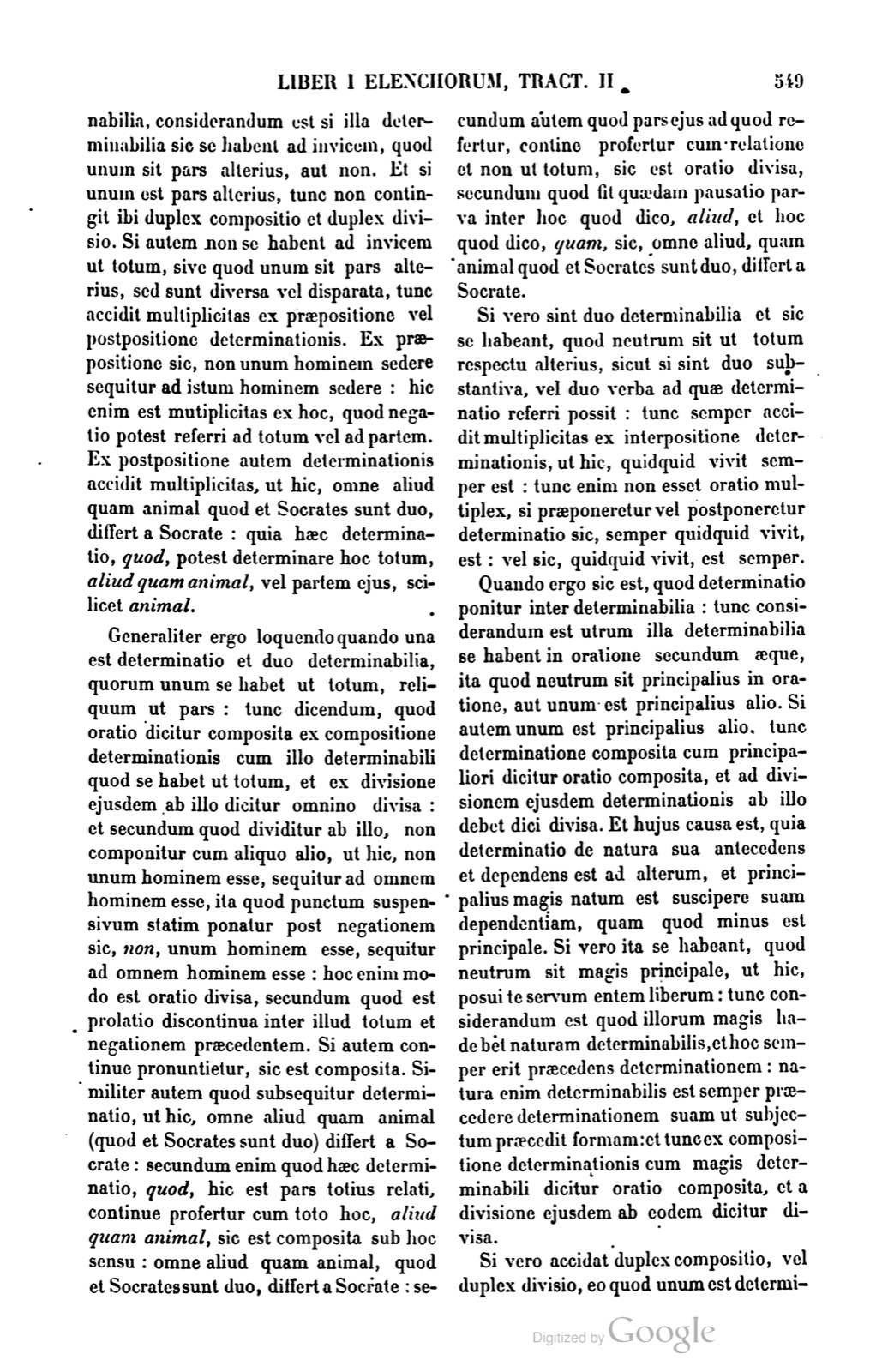
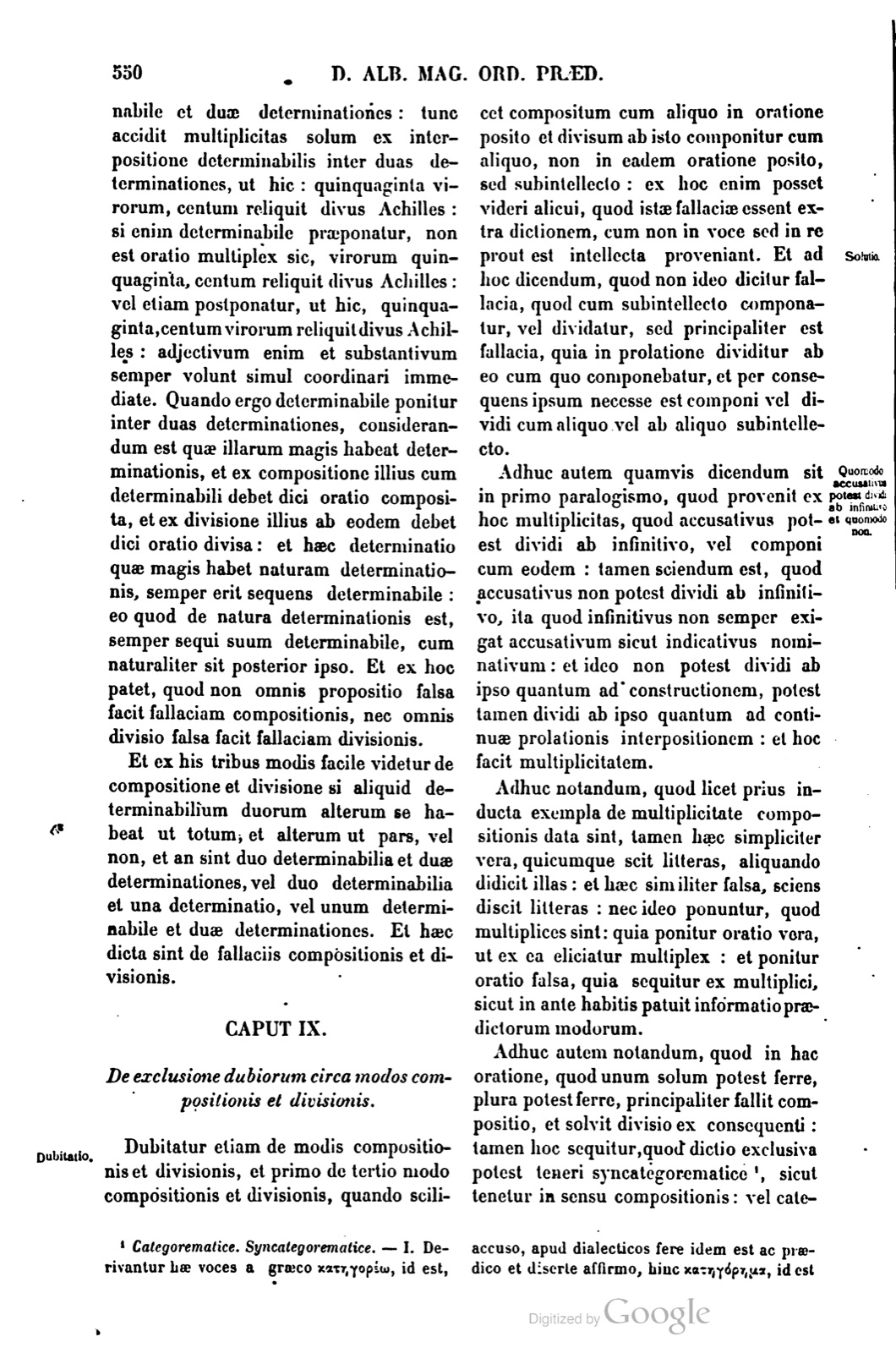
Si vero accidat duplex compositio, vel duplex divisio, eo quod unum est determinabile et duae determinationes: tunc accidit multiplicitas solum ex interpositione determinabilis inter duas determinationes, ut hic: quinquaginta virorum, centum reliquit divus Achilles: si enim determinabile praeponatur, non est oratio multiplex sic, virorum quinquaginta, centum reliquit divus Achilles: vel etiam postponatur, ut hic, quinquaginta, centum virorum reliquit divus Achilles: adjectivum enim et substantivum semper volunt simul coordinari immediate. Quando ergo determinabile ponitur inter duas determinationes, considerandum est quae illarum magis habeat determinationis, et ex compositione illius cum determinabili debet dici oratio composita, et ex divisione illius ab eodem debet dici oratio divisa: et haec determinatio quae magis habet naturam determinationis, semper erit sequens determinabile: eo quod de natura determinationis est, semper sequi suum determinabile, cum naturaliter sit posterior ipso. Et ex hoc patet, quod non omnis propositio falsa facit fallaciam compositionis, nec omnis divisio falsa facit fallaciam divisionis.
Et ex his tribus modis facile videtur de compositione et divisione si aliquid determinabilium duorum alterum se habeat ut totum, et alterum ut pars, vel non, et an sint duo determinabilia et duae determinationes, vel duo determinabilia et una determinatio, vel unum determinabile et duae determinationes. Et haec dicta sint de fallaciis compositionis et divisionis.
CAPUT IX. De exclusione dubiorum circa modos compositionis et divisionis.
Dubitatur etiam de modis compositionis et divisionis, et primo de tertio modo compositionis et divisionis, quando scilicet compositum cum aliquo in oratione posito et divisum ab isto componitur cum aliquo, non in eadem oratione posito, sed subintellecto: ex hoc enim posset videri alicui, quod istae fallaciae essent extra dictionem, cum non in voce sed in re prout est intellecta proveniant. Et ad hoc dicendum, quod non ideo dicitur fallacia, quod cum subintellecto componatur, vel dividatur, sed principaliter est fallacia, quia in prolatione dividitur ab eo cum quo componebatur, et per consequens ipsum necesse est componi vel dividi cum aliquo vel ab aliquo subintellecto.
Adhuc autem quamvis dicendum sit in primo paralogismo, quod provenit ex hoc multiplicitas, quod accusativus potest dividi ab infinitivo, vel componi cum eodem: tamen sciendum est, quod accusativus non potest dividi ab infinitivo, ita quod infinitivus non semper exigat accusativum sicut indicativus nominativum: et ideo non potest dividi ab ipso quantum ad constructionem, potest tamen dividi ab ipso quantum ad continuae prolationis interpositionem: et hoc facit multiplicitatem.
But if a double composition or a double division occurs, because there is one determinable and two determinations, then multiplicity occurs only from the interposition of the determinable between two determinations, as here: fifty of men, divine Achilles left a hundred. For if the determinable is placed first, the speech is not multiple thus: of men fifty, divine Achilles left a hundred; or also if it is placed after, as here: fifty, he left a hundred men, divine Achilles. For adjective and substantive always wish to be coordinated together immediately. Therefore when the determinable is placed between two determinations, one must consider which of them has more of determination, and from the composition of that with the determinable the speech ought to be called composed, and from the division of that from the same it ought to be called divided; and this determination which has more the nature of determination will always follow the determinable, because it belongs to the nature of determination always to follow its determinable, since naturally it is posterior to it. And from this it is clear that not every false proposition makes the fallacy of composition, nor does every false division make the fallacy of division.
And from these three modes it is easily seen concerning composition and division whether one of two determinables is related as a whole and the other as a part, or not, and whether there are two determinables and two determinations, or two determinables and one determination, or one determinable and two determinations. And let these things have been said concerning the fallacies of composition and division.
CHAPTER IX. On the exclusion of doubts concerning the modes of composition and division.
There is also doubt concerning the modes of composition and division, and first concerning the third mode of composition and division, namely when what is composed with something posited in a speech and divided from that is composed with something not posited in the same speech but understood. For from this it could seem to someone that these fallacies were outside diction, since they arise not in the word but in the thing according as it is understood. And to this one must say that it is not called a fallacy for this reason, that it is composed with what is understood or divided from it, but it is principally a fallacy because in utterance it is divided from that with which it was being composed, and consequently it is necessary for it to be composed with something or divided from something understood.
Further, although in the first paralogism one must say that the multiplicity arises from this, that the accusative can be divided from the infinitive or composed with the same, nevertheless one must know that the accusative cannot be divided from the infinitive in such a way that the infinitive does not always require an accusative just as an indicative requires a nominative; and therefore it cannot be divided from it as to construction, yet it can be divided from it as to the interposition of continuous utterance, and this makes the multiplicity.
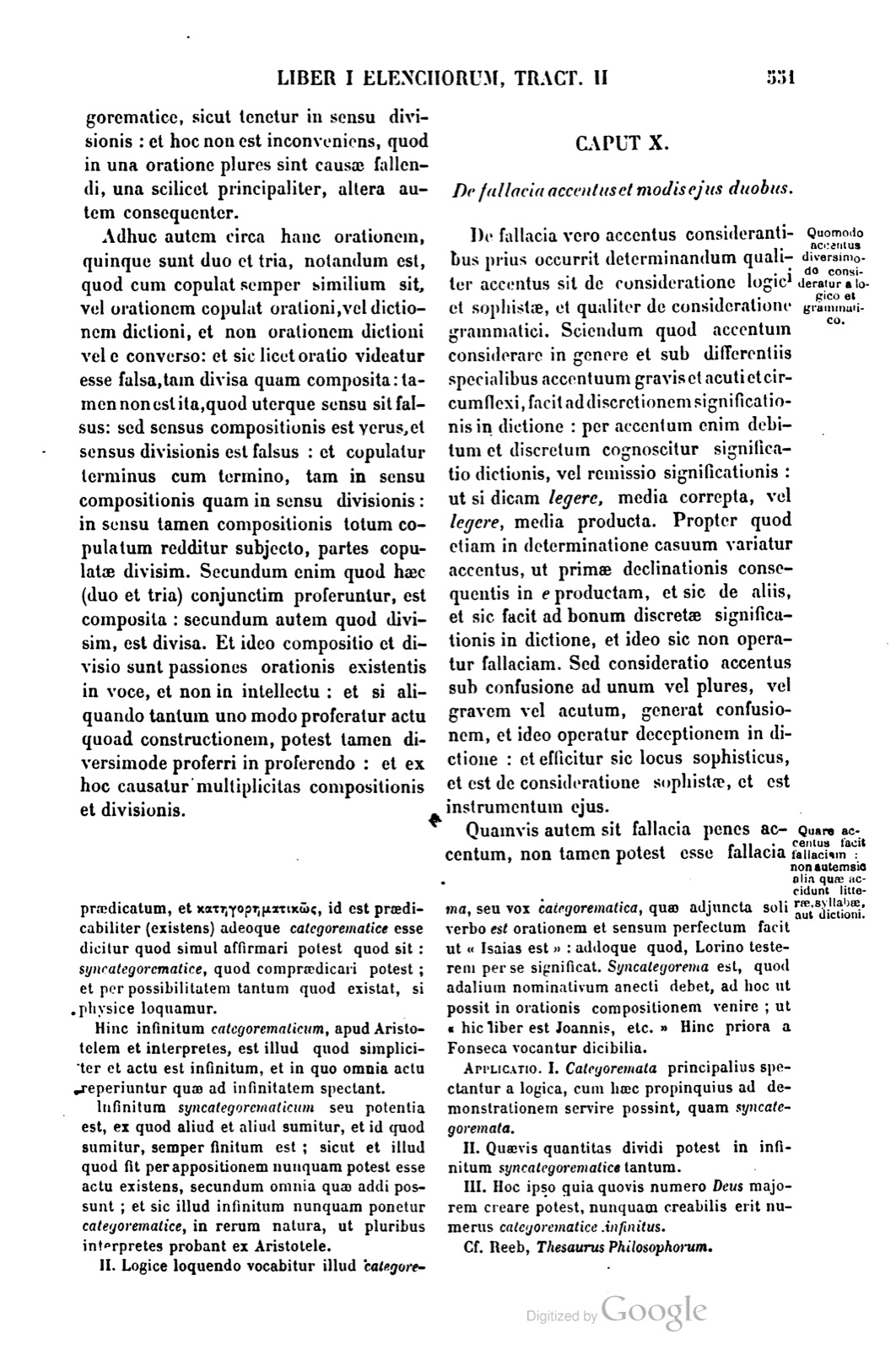
Adhuc notandum, quod licet prius inducta exempla de multiplicitate compositionis data sint, tamen haec simpliciter vera, quicumque scit litteras, aliquando didicit illas: et haec similiter falsa, sciens discit litteras: nec ideo ponuntur, quod multiplices sint: quia ponitur oratio vera, ut ex ea eliciatur multiplex: et ponitur oratio falsa, quia sequitur ex multiplici, sicut in ante habitis patuit informatio praedictorum modorum.
Adhuc autem notandum, quod in hac oratione, quod unum solum potest ferre, plura potest ferre, principaliter fallit compositio, et solvit divisio ex consequenti: tamen hoc sequitur, quod dictio exclusiva potest teneri syncategorematice 1, sicut tenetur in sensu compositionis: vel categorematice, sicut tenetur in sensu divisionis: et hoc non est inconveniens, quod in una oratione plures sint causae fallendi, una scilicet principaliter, altera autem consequenter.
Adhuc autem circa hanc orationem, quinque sunt duo et tria, notandum est, quod cum copulat semper similium sit, vel orationem copulat orationi, vel dictionem dictioni, et non orationem dictioni vel e converso: et sic licet oratio videatur esse falsa, tam divisa quam composita: tamen non est ita, quod utroque sensu sit falsus: sed sensus compositionis est verus, et sensus divisionis est falsus: et copulatur terminus cum termino, tam in sensu compositionis quam in sensu divisionis: in sensu tamen compositionis totum copulatum redditur subjecto, partes copulatae divisim. Secundum enim quod haec (duo et tria) conjunctim proferuntur, est composita: secundum autem quod divisim, est divisa. Et ideo compositio et divisio sunt passiones orationis existentis in voce, et non in intellectu: et si aliquando tantum uno modo proferatur actu quoad constructionem, potest tamen diversimode proferri in proferendo: et ex hoc causatur multiplicitas compositionis et divisionis.
CAPUT X. De fallacia accentus et modis ejus duobus.
De fallacia vero accentus considerantibus prius occurrit determinandum qualiter accentus sit de consideratione logici et sophistae, et qualiter de consideratione grammatici. Sciendum quod accentum considerare in genere et sub differentiis specialibus accentuum gravis et acuti et circumflexi, facit ad discretionem significationis in dictione: per accentum enim debitum et discretum cognoscitur significatio dictionis, vel remissio significationis: ut si dicam legere, media correpta, vel legere, media producta. Propter quod etiam in determinatione casuum variatur accentus, ut primae declinationis consequentis in e productam, et sic de aliis, et sic facit ad bonum discretae significationis in dictione, et ideo sic non operatur fallaciam. Sed consideratio accentus sub confusione ad unum vel plures, vel gravem vel acutum, generat confusionem, et ideo operatur deceptionem in dictione: et efficitur sic locus sophisticus, et est de consideratione sophistae, et est instrumentum ejus.
Further one must note that although the examples previously introduced were given concerning the multiplicity of composition, nevertheless this one is simply true, whoever knows letters at some time learned them; and this one is similarly false, one knowing learns letters; nor are they posited for this reason, that they are multiple, because a true speech is posited so that a multiple one may be elicited from it, and a false speech is posited because it follows from a multiple one, as in the foregoing the formation of the aforesaid modes was clear.
Further one must note that in this speech, what can carry one only can carry many, composition principally deceives and division solves consequently; nevertheless this follows, that the exclusive diction can be held syncategorematically 1, as it is held in the sense of composition, or categorematically, as it is held in the sense of division; and this is not inappropriate, that in one speech there should be several causes of deceiving, one namely principally, but another consequently.
Further, concerning this speech, five are two and three, one must note that since and always couples like things, it couples either speech to speech or diction to diction, and not speech to diction or conversely; and thus although the speech seems to be false both divided and composed, nevertheless it is not so, that it is false in both senses, but the sense of composition is true and the sense of division is false; and term is coupled with term, both in the sense of composition and in the sense of division. Yet in the sense of composition the whole coupled thing is rendered to the subject, while the coupled parts are rendered dividedly. For according as these, two and three, are uttered conjointly, it is composed; but according as they are uttered dividedly, it is divided. And therefore composition and division are passions of speech existing in the voice, and not in the intellect; and if sometimes it is uttered actually in only one way as to construction, nevertheless it can be uttered in diverse ways in pronouncing, and from this the multiplicity of composition and division is caused.
CHAPTER X. On the fallacy of accent and its two modes.
For those considering the fallacy of accent, it first occurs that one must determine in what way accent belongs to the consideration of the logician and the sophist, and in what way to the consideration of the grammarian. One must know that to consider accent in general and under the special differences of accents, grave, acute, and circumflex, makes for the discretion of signification in a diction; for through due and discrete accent the signification of a diction is known, or the slackening of signification, as if I say legere with the middle syllable shortened, or legere with the middle syllable lengthened. On account of this also in the determination of cases the accent is varied, as of the first declension consequent in a lengthened e, and so concerning others; and thus it makes for the good of discrete signification in diction, and therefore in this way it does not produce a fallacy. But consideration of accent under confusion toward one or many, or toward grave or acute, generates confusion, and therefore produces deception in diction; and thus a sophistical place is effected, and it belongs to the consideration of the sophist, and is his instrument.
Quamvis autem sit fallacia penes accentum, non tamen potest esse fallacia penes alia quae accidunt syllabae, vel litterae, vel dictioni: penes accentus enim differentiam dictio manet eadem secundum materiam, quamvis non secundum formam, et sic potest habere convenientiam cum syllogismo et elencho, et ex illa convenientia accipere potest causam apparentiae: variata autem in litteris vel numero litterarum, tunc amittit convenientiam illam, et per consequens causam apparentiae.
In tempore autem variata syllaba vel dictio retinet eamdem materiam, et est eadem quantum ad pronuntiationem: et ideo sensum non variat, nec facit multiplicitatem potentialem: ut si dicam caput, prima longa vel brevi: vel si aliquid variat, hoc erit aequivocatio et non accentus: quia accentus vult habere eamdem materiam et diversum modum proferendi. Similiter autem et spiritus qui accidit dictioni, neque diversificat dictionem secundum materiam, neque secundum modum proferendi: ut si dicam hominem cum aspiratione, et ominem sine aspiratione: in utraque enim est eadem prolatio sicut idem modus proferendi: quando autem nomen est idem secundum materiam et secundum prolationem, et diversa significata, tunc est aequivocatio. Numerus autem litterarum si aliquam causabit fallaciam, illa est fallacia figurae dictionis. Spiritus autem et tempus diversum causabunt aequivocationem.
Tamen Antiquorum quidam dixerunt, quod deceptio causata a spiritu et tempore, reducuntur ad fallaciam accentus, sicut haec: bonum est viros justos pendere: sed pendere est pati poenam: ergo bonum est justos viros pati poenam. Et hoc dictum non est inconveniens. Alii tamen dixerunt, quod quando productio et correptio temporum causant diversum accentum, quod tunc causant aequivocationem potius quam accentum: quia sic neque diversificant dictionem quantum ad materiam, nec quantum ad formam sive modum proferendi.
Attendendum autem, quod licet diversi casus causent aequivocationem, ut in prae habitis dictum est: tamen diversus accentus non potest causare aequivocationem: quia in diverso accentu diversa est prolatio: nec potest esse aequivocatio, quia nomen variatur. In diversis autem numeris et casibus idem manet nomen secundum prolationem, licet varietur significatum quoad modum significandi: et hoc causat aequivocationem. His habitis ponendi sunt modi decipiendi secundum accentum in dialectis.
Qui sunt sine scriptura poematum, non est idoneum facere sophisticam orationem: quia statim accentus dictionis manifestatur diversitas. In scripturis autem Auctorum et maxime in poematibus, in quibus diversitas pronuntiationis non est adeo manifesta, magis est idoneum sophisticam facere orationem. Et dabimus de hoc duos modos in poeticis. Primo quando sub uno accentu pronuntiantur duae dictiones quae divisos habent accentus; ut, metuo longas pereunte noctes Lydia dormis. Est enim multiplicitas ex hoc quod metuo prout est una dictio, uno pronuntiatur accentu: prout autem oratio me tuo, duobus accentibus habet pronuntiari. Aliud autem exemplum est: Heu! qui nam tanti cinxerunt aethera nimbi: et de diversitate acuti accentus et gravis in una voce: si enim hoc ipsum quod dicitur, quinam, acuto accentu in fine pronuntietur, tunc valet tantum quantum cur, et est una dictio, et est ac si dicatur: Heu! quinam tanti cinxerunt aethera nimbi: si autem gravi pronuntietur, tantum valet quantum quia, vel quantum valet nam, et habet aliam significationem.
But although there is a fallacy according to accent, nevertheless there cannot be a fallacy according to other things that happen to a syllable, or letter, or diction; for according to difference of accent the diction remains the same according to matter, although not according to form, and thus it can have agreement with syllogism and elench, and from that agreement it can receive the cause of appearance. But when there is variation in letters or in the number of letters, then it loses that agreement and consequently the cause of appearance.
But when a syllable or diction is varied in time, it retains the same matter and is the same as to pronunciation, and therefore it does not vary the sense nor make potential multiplicity, as if I say caput with the first syllable long or short; or if it varies anything, this will be equivocation and not accent, because accent wishes to have the same matter and a diverse mode of uttering. Similarly also breathing, which happens to diction, diversifies diction neither according to matter nor according to the mode of uttering, as if I say hominem with aspiration and ominem without aspiration; for in both there is the same utterance, as the same mode of uttering. But when the name is the same according to matter and according to utterance, and the significates are diverse, then there is equivocation. But if the number of letters causes any fallacy, that is the fallacy of figure of diction. But breathing and diverse time will cause equivocation.
Nevertheless certain of the ancients said that deception caused by breathing and time is reduced to the fallacy of accent, as this: it is good to weigh just men; but to hang is to suffer punishment; therefore it is good for just men to suffer punishment. And this saying is not inappropriate. Others, however, said that when lengthening and shortening of times cause a diverse accent, then they cause equivocation rather than accent, because in this way they diversify diction neither as to matter nor as to form or mode of uttering.
But one must attend that although diverse cases cause equivocation, as was said in the foregoing, nevertheless diverse accent cannot cause equivocation, because in diverse accent there is diverse utterance; nor can there be equivocation, because the name is varied. But in diverse numbers and cases the same name remains according to utterance, although the significate is varied as to the mode of signifying; and this causes equivocation. With these things had, the modes of deceiving according to accent in dialectical matters must be posited.
Those which are without the writing of poems are not suitable for making a sophistical speech, because immediately the diversity of the accent of the diction is manifested. But in the writings of authors, and especially in poems, in which diversity of pronunciation is not so manifest, it is more suitable to make a sophistical speech. And we shall give two modes of this in poetic matters. First, when under one accent two dictions are pronounced which have divided accents, as, metuo longas pereunte noctes Lydia dormis. For there is multiplicity from this, that metuo, according as it is one diction, is pronounced with one accent; but according as it is the speech me tuo, it has to be pronounced with two accents. But another example is: Alas! what such clouds have girded the ether? and concerning the diversity of acute accent and grave in one word: for if this very thing which is said, quinam, is pronounced with an acute accent at the end, then it is worth as much as why, and it is one diction, and it is as if it were said: Alas! why have such clouds girded the ether? But if it is pronounced with a grave accent, it is worth as much as because, or as much as for, and it has another signification.
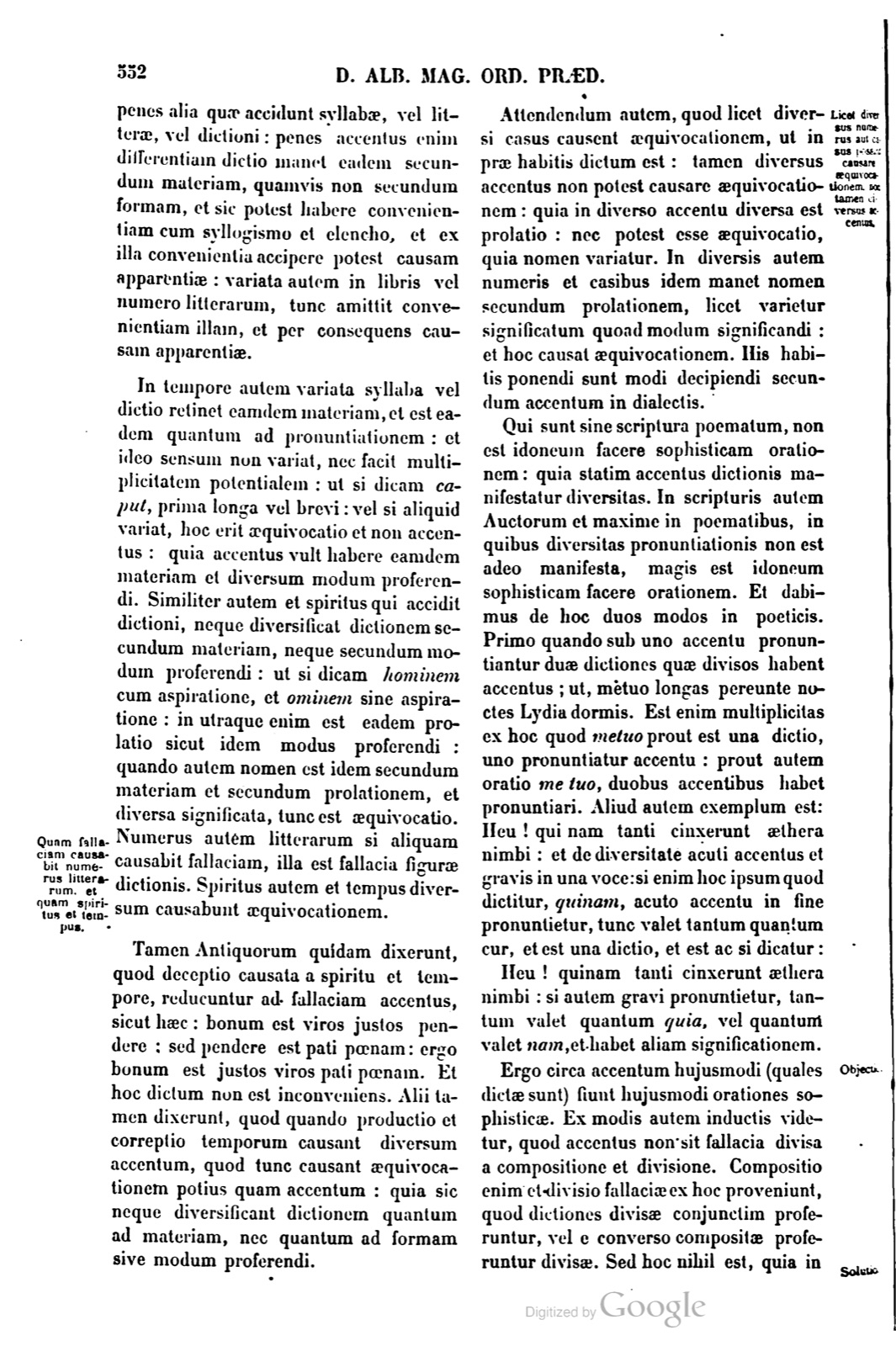
Ergo circa accentum hujusmodi (quales dictae sunt) fiunt hujusmodi orationes sophisticae. Ex modis autem inductis videtur, quod accentus non sit fallacia divisa a compositione et divisione. Compositio enim et divisio fallaciae ex hoc proveniunt, quod dictiones divisae conjunctim proferuntur, vel e converso compositae proferuntur divisae. Sed hoc nihil est, quia in accentu duae proferuntur, vel una ut duae. In compositione autem semper manent dictiones distinctae, sive compositae, sive divisae proferantur.
Ulterius notandum in illis modis, quod licet in speciali in duobus modis inductis duae diversae sint causae apparentiae: in speciali tamen non sunt duae fallaciae: quia est unum commune univocum ambobus, quod est communis causa apparentiae, a quo causatur una tantum fallacia: et hoc est apparentia unius significati propter unitatem dictionis secundum materiam: et ideo non sunt duae fallaciae, sed una.
Notandum etiam, quod licet diversae fallaciae coincidant in unam, tamen multiplicitas unius non est multiplicitas alterius, et causa multiplicitatis unius non est causa multiplicitatis alterius, sicut patet in compositione, et divisione, et amphibologia: possunt enim coincidere in eamdem orationem, sed tunc habent ordinem ad invicem, tunc enim per prius accidit in oratione compositio et divisio, et per posterius amphibologia, ut ex hoc sophismate: omne quod est verum sciri a te est verum: hoc enim est multiplex secundum compositionem et divisionem, et est divisa secundum quod discontinua est prolatio inter haec duo, a te scilicet, et omne quod est verum, sub hoc sensu: omne quod est verum: et fiat pausatio: et inferatur illud residuum, a te sciri est verum; et sic est falsa. Composita autem est secundum quod est continua prolatio unius cum altero sic: omne quod est verum sciri a te, est verum: et sic est vera. Et sic posterius accidit multiplicitas secundum amphibologiam: eo quod hoc nomen, omne, potest construi cum hoc verbo, sciri, et sic est falsa, et est sensus: omne sciri a te quod est verum, est verum: vel potest construi cum hoc verbo, est, et sic est vera, et est sensus: omne illud est verum, quod est verum sciri a te.
Similiter est de aequivocatione et accentu, quod coincidunt in unam orationem, non tamen modus fallendi unius est modus fallendi alterius secundum ordinem hunc: ita quod prius est in tali oratione fallacia accentus, et postea per distinctionem accentus accidit aequivocatio: ex eo quod potest esse nomen vel adverbium: et sic est in multis.
Therefore concerning an accent of this kind, such as those that have been stated, sophistical speeches of this kind are made. But from the modes introduced it seems that accent is not a fallacy divided from composition and division. For the fallacies of composition and division arise from this, that divided dictions are uttered conjointly, or conversely composed dictions are uttered dividedly. But this is nothing, because in accent two are uttered as one, or one as two. But in composition the dictions always remain distinct, whether they are uttered composed or divided.
Further, in those modes one must note that although in particular in the two introduced modes there are two diverse causes of appearance, nevertheless in particular there are not two fallacies, because there is one univocal common thing for both, which is the common cause of appearance, from which only one fallacy is caused; and this is the appearance of one significate because of the unity of diction according to matter, and therefore they are not two fallacies, but one.
One must also note that although diverse fallacies coincide in one speech, nevertheless the multiplicity of one is not the multiplicity of another, and the cause of the multiplicity of one is not the cause of the multiplicity of another, as is clear in composition, division, and amphibology. For they can coincide in the same speech, but then they have an order toward one another; for then composition and division occur in the speech first, and amphibology afterward, as from this sophism: everything that is true to be known by you is true. For this is multiple according to composition and division, and it is divided according as there is discontinuous utterance between these two, by you namely, and everything that is true, under this sense: everything that is true; and let a pause be made; and let that residue be inferred, to be known by you is true; and thus it is false. But it is composed according as there is continuous utterance of one with the other thus: everything that is true to be known by you, is true; and thus it is true. And thus multiplicity according to amphibology occurs afterward, because this name, every, can be construed with this verb, to be known, and thus it is false, and the sense is: every thing to be known by you that is true, is true; or it can be construed with this verb, is, and thus it is true, and the sense is: every that thing is true, which is true to be known by you.
Similarly it is concerning equivocation and accent, that they coincide in one speech; nevertheless the mode of deceiving of one is not the mode of deceiving of the other according to this order, so that in such a speech the fallacy of accent is first, and afterward by the distinction of accent equivocation occurs, from the fact that it can be a noun or an adverb; and thus it is in many cases.
Patet ergo quod diversae fallaciae coincidant in unam orationem: non tamen ita quod causa et modus fallendi in una, sit causa et modus fallendi in alia. Duo autem modi qui positi sunt de fallacia accentus, sumuntur penes duas accentus variationes: potest enim variari unus in plures, vel e converso, et sic est modus primus, ut hic: quidquid Deus fecit invite, fecit invitus: sed vinum fecit in vite: ergo vinum fecit invitus. Potest etiam variari a differentia accentus ad differentiam aliam, et sic est secundus modus. Et unitas vocis secundum materiam quam aliquis credit unitatem debere esse accentus, est causa apparentiae: diversitas autem significationis sub accentu causa est non existentiae. Et haec de accentu dicta sint.
CAPUT XI. De fallacia figurae dictionis et de modis ejusdem.
Circa fallaciam figurae dictionis primo notandum, quod figura dictionis est in similitudine terminationis: propter quod principaliter est in dictione, et per dictionem posterius et per accidens in oratione: et quia per se est in dictione, ideo dicitur figura dictionis et non figura orationis. Ideo etiam licet aliae multiplicitates diversas fallacias causent in dictione et oratione, haec tamen multiplicitas et in dictione et in oratione non operatur nisi fallaciam unicam. Causa autem apparentiae in hac fallacia est similitudo figurae dictionis: et causa non existentiae est, quod non idem est in significatione, ut idem interpretamur in dictione propter terminationis similitudinem. Et ideo duas habet differentias ad alias fallacias in dictione. Una quarum est, quia in aliis idem secundum vocem ut idem secundum rem interpretamur: hic autem non idem sed simile secundum vocem ut idem interpretamur. Alia vero, quia in aliis fallaciis in dictione, in voce significatur aliquid quod non creditur significari: in ista autem et simili figura vocis non significatur quod creditur significari.
Dicamus igitur quod orationes quae fiunt secundum figuram dictionis, accidunt quando aliquid non idem in significando similiter (hoc est, propter similem vocis significationem) similiter significare cum alio interpretatur, et hoc fit duobus modis. Uno quidem modo in generibus consignificatis, formam naturae et essentiae significantibus, ut si interpretatur masculinum esse foemininum, vel e converso foemininum masculinum, propter terminationis similitudinem, ut musa et Catilina: vel genus quod est inter haec (quod est neutrum) interpretatur ut alterum illorum, ut scamnum et dominium, vel scamna et foemina vel vir. Sive et secundo modo in generibus significativis praedicamentorum propter similitudinem terminationis interpretatur quantum in quale, vel e converso, aut interpretatur dispositum ad passiones ut faciens, et similiter de generibus aliis, ut prius in Praedicamentis est determinatum. Contingit enim id quod non est facere (hoc est, quod non est in genere actionis sive factionis) significare dictione (hoc est, figura vel similitudine terminationis in dictione) velut (hoc est, similiter) quia sit eorum (hoc est, de numero eorum) quae sunt facere, hoc est, in genere factionis. Cujus exemplum est, ut vigere secundum figuram dictionis in terminatione, similiter dicitur ei quod est secare: et propter id videtur alicui, quod sit ejusdem generis praedicamenti sicut et aedificare et operari: quamvis non ita sit: quia hoc quidem quod est vigere, quale quid dicit et affectum secundum actum vitae et passionem dicit, illud vero quod est secare, dicit simpliciter facere, et non quale vel affectum passionis secundum actum aliquem. Eodem autem modo est in aliis quando permutatur genus in genus, vel species in species praedicamenti.
Therefore it is clear that diverse fallacies coincide in one speech; nevertheless not in such a way that the cause and mode of deceiving in one is the cause and mode of deceiving in another. But the two modes that have been posited concerning the fallacy of accent are taken according to two variations of accent: for one can be varied into many, or conversely, and thus is the first mode, as here: whatever God made in the vine, he made unwilling; but he made wine in the vine; therefore he made wine unwilling. It can also be varied from one difference of accent to another difference, and thus is the second mode. And the unity of the word according to matter, which someone believes ought to be unity of accent, is the cause of appearance; but the diversity of signification under accent is the cause of non-existence. And let these things have been said concerning accent.
CHAPTER XI. On the fallacy of figure of diction and on the modes of the same.
Concerning the fallacy of figure of diction one must first note that the figure of diction is in likeness of termination; on account of which it is principally in diction, and through diction afterward and accidentally in speech. And because it is per se in diction, therefore it is called figure of diction and not figure of speech. For this reason also, although other multiplicities cause diverse fallacies in diction and speech, this multiplicity both in diction and in speech produces only a single fallacy. But the cause of appearance in this fallacy is likeness of the figure of diction; and the cause of non-existence is that there is not the same thing in signification, while we interpret it as the same in diction because of likeness of termination. And therefore it has two differences from the other fallacies in diction. One of these is that in the others we interpret the same according to word as the same according to thing; but here we interpret not the same but similar according to word as the same. The other is that in the other fallacies in diction, something is signified in the word which is not believed to be signified; but in this one and in the similar figure of the word, what is believed to be signified is not signified.
Let us say, therefore, that speeches which are made according to figure of diction occur when something not the same in signifying similarly, that is, because of a similar signification of the word, is interpreted to signify similarly with another, and this happens in two ways. In one way, in consignified genera signifying the form of nature and essence, as if the masculine is interpreted to be feminine, or conversely the feminine masculine, because of likeness of termination, as musa and Catilina; or the genus which is between these, which is neuter, is interpreted as one of those, as scamnum and dominium, or scamna and woman or man. Or also in the second way, in the signifying genera of the predicaments, because of likeness of termination, quantity is interpreted as quality, or conversely, or what is disposed to passions is interpreted as doing, and similarly concerning other genera, as was previously determined in the Categories. For it happens that that which is not doing, that is, which is not in the genus of action or making, signifies by diction, that is, by figure or likeness of termination in diction, as if, that is, similarly, it were of those, that is, of the number of those things, which are doing, that is, in the genus of making. An example of this is that to thrive according to figure of diction in termination is said similarly to that which is to cut; and because of this it seems to someone that it is of the same predicamental genus as also to build and to work, although it is not so; because this, to thrive, says a certain quality and says one affected according to the act of life and a passion, but that which is to cut says simply to do, and not a quality or something affected by passion according to some act. But it is in the same way in other cases when genus is changed into genus, or species into species of a predicament.
Attendendum tamen est, quod quamvis similitudo in figura vocis sit pro certo causa apparentiae in fallacia figurae dictionis, et quamvis forte in tali oratione nomen sit idem: ut quidquid vidisti heri, vides hodie: heri vidisti album: ergo hodie vides album: tamen est figura dictionis: quando enim dicitur similitudo figurae vocis esse causa apparentiae, non accipitur vera semper, sed per similitudinem quae creditur et apparet in verbo vel nomine phantastice: quia fallacia multiplicitatem phantasticam operatur: apparet autem, quod quid significet ut quale, et sic fieri fallacia figurae dictionis.
Adhuc notandum, quod licet similis figura dictionis maxime sit penes similitudinem in fine dictionis, tamen etiam potest esse in medio et principio et in tota dictione, ut haec: cujuslibet hominis asinus currit: ergo asinus cujuslibet hominis currit, quod potest esse falsum: et haec, omnium oppositorum eadem est disciplina: ergo eadem disciplina est omnium oppositorum. Et variatur haec, quod similitudo vocis est principium fallendi in fine, vel in principio, vel in medio, vel etiam in tota dictione. Paralogismi autem juxta primum modum figurae dictionis ex commutatione generis consignificati provenientes, sic habent formam. Uno quidem modo quando duo genera similes habent terminationes: quia secundum grammaticam genera per terminabiles litteras et syllabas distinguuntur, ut si dicam, musa est foeminini generis, ergo et poeta. Vel sic: secari est passivi generis: ergo et operari et loqui est passivi generis: quod falsum est. Alia modo formari possunt ut in eumdem modum sic, quod ponatur genus commune accidentale in oratione in principio, et sub isto accipiatur aliud genus tanquam utrumque significet, et alterum ex duobus inferatur: ut quemcumque diligis, ille est amicus tuus: puellam diligis: ergo puella est amicus tuus.
Juxta secundum autem modum sic possunt formari. Uno quidem modo, ut dictum est, quando duae dictiones ejusdem terminationis ponuntur in oratione, et propter illam similem terminationem arguitur illa esse ejusdem generis praedicamenti: ut amari est pati: ergo et operari. Secundo autem modo potest formari quando nomen unius generis praedicamenti ponitur universaliter, et sub illo sumitur res alterius praedicamenti ac si sit ejusdem generis: ut quidquid vidisti heri, hodie vides: heri vidisti album: ergo hodie vides album. Tertio modo potest formari ita quod primo ponatur nomen significans rem alicujus generis sine universalitate, et inferatur nomen rei alterius generis: ut iste dat unum solum denarium: et non habet unum solum: ergo dat quod non habet. Solum enim significat relationem: quod autem significat solum quod quidam dicunt praetermittere universalem in qua sit causa apparentiae sic: quaecumque sunt ejusdem determinationis, sunt ejusdem generis: secare et vigere sunt ejusdem determinationis: ergo sunt ejusdem generis. Iste enim modus in aliis fallaciis in dictione non observatur.
Nevertheless one must attend that although likeness in the figure of the word is certainly the cause of appearance in the fallacy of figure of diction, and although perhaps in such a speech the name is the same, as: whatever you saw yesterday, you see today; yesterday you saw white; therefore today you see white; nevertheless it is figure of diction. For when likeness of the figure of the word is said to be the cause of appearance, it is not always taken as true, but through a likeness that is believed and appears in verb or noun phantastically, because the fallacy produces phantastical multiplicity; but it appears that what signifies as what signifies quality, and thus the fallacy of figure of diction is produced.
Further one must note that although similar figure of diction is especially according to likeness at the end of a diction, nevertheless it can also be in the middle and beginning and in the whole diction, as this: the ass of any man runs; therefore the ass of any man runs, which can be false; and this: of all opposites there is the same discipline; therefore the same discipline is of all opposites. And this is varied, that likeness of word is a principle of deceiving at the end, or at the beginning, or in the middle, or even in the whole diction. But paralogisms alongside the first mode of figure of diction arising from change of a consignified genus have form thus. In one way, when two genera have similar terminations, because according to grammar genera are distinguished through terminal letters and syllables, as if I say: musa is of feminine gender, therefore also poeta. Or thus: to be cut is of passive gender, therefore also to work and to speak is of passive gender, which is false. They can be formed in another way as toward the same mode thus, that the common accidental genus is posited in the speech at the beginning, and under it another genus is taken as though it signifies both, and one of the two is inferred, as: whomever you love, he is your friend; you love a girl; therefore a girl is your friend.
But alongside the second mode they can be formed thus. In one way, as has been said, when two dictions of the same termination are posited in a speech, and because of that similar termination it is argued that they are of the same predicamental genus, as: to be loved is to suffer; therefore also to work. But in a second way it can be formed when the name of one predicamental genus is posited universally, and under it a thing of another predicament is taken as if it were of the same genus, as: whatever you saw yesterday, today you see; yesterday you saw white; therefore today you see white. In a third way it can be formed such that first a name signifying a thing of some genus is posited without universality, and the name of a thing of another genus is inferred, as: this man gives one coin only; and he does not have one only; therefore he gives what he does not have. For only signifies relation; but what only signifies, which certain people say, omits the universal in which the cause of appearance would be thus: whatever things are of the same determination are of the same genus; to cut and to thrive are of the same determination; therefore they are of the same genus. For this mode is not observed in the other fallacies in diction.
Ex omnibus autem his patet, quod causa apparentiae in figura dictionis est similis figuratio vel ejusdem dictionis ad seipsam, vel unius dictionis ad alteram. Ejusdem ad seipsam ut haec, omnium oppositorum est eadem disciplina: ergo eadem disciplina est omnium oppositorum. In qua haec dictio, eadem, stans confuse est similis ad seipsam stantem determinate pro una disciplina. Ad aliam autem, ut Catilina et musa sunt ejusdem terminationis: ergo ejusdem generis.
Scias autem, quod ista similis figuratio dupliciter fit. Uno quidem modo, quod dictiones similis figurae in terminatione exprimuntur in oratione, ut secare et vigere, et musa et scamnum et poeta et nauta et hujusmodi. Alio autem modo quando non exprimuntur, sed continentur similiter figurata in aliquo genere posito, ex alio sicut partes inferuntur: et hoc dupliciter, scilicet quod figurata intelliguntur secundum genus consignatum vel secundum genus praedicamenti prioris. Exemplum est, ut quemcumque vides, est amicus tuus: puellam vides: ergo puella est amicus tuus. Sub hoc enim signo, quemcumque, multa continentur in a desinentia quae sunt masculini generis, ut nauta, poeta, pincerna, et hujusmodi, per quae aliquis credit, quod propter similem terminationem etiam puella sub eodem contineatur. Aliquando autem est secundum commutationem praedicamenti praedicabilis: ut quidquid vidisti heri, vides hodie: heri vidisti album: ergo hodie vides album. Multa enim neutrorum habentia eamdem terminationem, continentur sub hoc signo, quidquid, ut scamnum, pomum, vinum, acetum, et hujusmodi, propter quorum configurationem potest credi etiam album contineri sub ipso, et inferri ab ipso.
Talis etiam fallacia figurae dictionis ex commutata specie quantitatis in aliam fit: ut quandocumque sedisti, fuisti homo. Probatio: heri cum sedisti, fuisti homo, et ante heri, et pridie, et perendie, et sic de aliis, et quandocumque. Contra: quandocumque sedisti, fuisti homo: ergo multoties fuisti homo: quandocumque enim dicit tempus sub continuitate: et sic partes ejus sunt heri et pridie et perendie, et haec commutantur in quotiescumque quod dicit numerum: et similis figura in quotiescumque et quandocumque, causa est deceptionis.
Sic etiam fit mutatio singularis in plurale secundum unam speciem discretae quantitatis mutatam in aliam sic: quodcumque novit aliquis, novit inveniendo: et plura novit aliquis vel nulla novit aliquis: ergo novit inveniendo: et penes hujusmodi figuram dictionis accipiuntur modi tres figurae dictionis qui superius dicti sunt.
From all these things, however, it is clear that the cause of appearance in figure of diction is similar figuration either of the same diction to itself, or of one diction to another. Of the same to itself, as this: of all opposites there is the same discipline; therefore the same discipline is of all opposites. In this, this diction same, standing confusedly, is similar to itself standing determinately for one discipline. But to another, as: Catilina and musa are of the same termination; therefore of the same genus.
But you should know that this similar figuration happens in two ways. In one way, when dictions of similar figure in termination are expressed in the speech, as to cut and to thrive, and musa and scamnum and poeta and nauta and things of this kind. But in another way, when they are not expressed, but similarly figured things are contained in some posited genus, and from another they are inferred as parts; and this in two ways, namely because the figured things are understood according to the consignified genus or according to the genus of the prior predicament. An example is: whomever you see is your friend; you see a girl; therefore a girl is your friend. For under this sign, whomever, many things ending in a are contained which are of masculine gender, as nauta, poeta, pincerna, and things of this kind; through these someone believes that because of the similar termination even girl is contained under the same. But sometimes it is according to a change of the predicament of a predicable, as: whatever you saw yesterday, you see today; yesterday you saw white; therefore today you see white. For many neuters having the same termination are contained under this sign, whatever, as scamnum, apple, wine, vinegar, and things of this kind; because of their configuration it can be believed that white also is contained under it and is inferred from it.
Such a fallacy of figure of diction also occurs from a species of quantity changed into another, as: whenever you sat, you were a man. Proof: yesterday when you sat, you were a man, and the day before yesterday, and the day before, and the day after tomorrow, and so concerning others, and whenever. To the contrary: whenever you sat, you were a man; therefore many times you were a man. For whenever says time under continuity, and thus its parts are yesterday and the day before and the day after tomorrow, and these are changed into as often as, which says number; and the similar figure in as often as and whenever is the cause of deception.
Thus also a change of singular into plural occurs according to one species of discrete quantity changed into another thus: whatever anyone knows, he knows by finding; and someone knows many things or someone knows nothing; therefore he knows by finding; and according to figure of diction of this kind the three modes of figure of diction are taken which were stated above.
Notes
- Categorematically. Syncategorematically. - I. These words are derived from the Greek κατηγορέω, that is, I accuse, which among dialecticians is almost the same as I predicate and expressly affirm; hence κατηγόρημα, that is, predicate, and κατηγορηματικῶς, that is, predicably existing; and therefore that is said to be categorematically which can at the same time be affirmed to be; syncategorematically, that which can be co-predicated, and only through possibility that it exists, if we speak physically. Hence a categorematic infinite, according to Aristotle and the interpreters, is that which simply and actually is infinite, and in which all things that pertain to infinity are actually found. A syncategorematic infinite, or an infinite in potency, is that from which one thing and another is taken, and what is taken is always finite, just as also that which comes to be by apposition can never be actually existing according to all things that can be added; and thus that infinite will never be posited categorematically in the nature of things, as many interpreters prove from Aristotle. II. Logically speaking, that will be called a categorem, or a categorematic word, which, joined to a verb alone, makes a speech and a perfect sense, as 'Isaiah is'; and I add that, with Lorinus as witness, it signifies a thing per se. A syncategorem is that which must be attached to another nominative so that it can come into the composition of a speech, as 'this book is John's, etc.' Hence the former are called dicibles by Fonseca. APPLICATION. I. Categorems are considered more principally by logic, since they can serve more closely for demonstration than syncategorems. II. Any quantity can be divided into infinity only syncategorematically. III. By this very fact, because God can create a number greater than any number, a categorematically infinite number will never be creatable. Cf. Reeb, Thesaurus Philosophorum. (Categorematice. Syncategorematice. - I. Derivantur hae voces a graeco κατηγορέω, id est, accuso, apud dialecticos fere idem est ac praedico et diserte affirmo, hinc κατηγόρημα, id est praedicatum, et κατηγορηματικῶς, id est praedicabiliter (existens) adeoque categorematice esse dicitur quod simul affirmari potest quod sit: syncategorematice, quod compraedicari potest; et per possibilitatem tantum quod existat, si physice loquamur. Hinc infinitum categorematicum, apud Aristotelem et interpretes, est illud quod simpliciter et actu est infinitum, et in quo omnia actu reperiuntur quae ad infinitatem spectant. Infinitum syncategorematicum seu potentia est, ex quo aliud et aliud sumitur, et id quod sumitur, semper finitum est; sicut et illud quod fit per appositionem nunquam potest esse actu existens, secundum omnia quae addi possunt; et sic illud infinitum nunquam ponetur categorematice, in rerum natura, ut pluribus interpretes probant ex Aristotele. II. Logice loquendo vocabitur illud categorema, seu vox categorematica, quae adjuncta soli verbo est orationem et sensum perfectum facit ut «Isaias est»: addoque quod, Lorino teste, rem per se significat. Syncategorema est, quod ad alium nominativum annecti debet, ad hoc ut possit in orationis compositionem venire; ut «hic liber est Joannis, etc.» Hinc priora a Fonseca vocantur dicibilia. APPLICATIO. I. Categoremata principalius spectantur a logica, cum haec propinquius ad demonstrationem servire possint, quam syncategoremata. II. Quaevis quantitas dividi potest in infinitum syncategorematice tantum. III. Hoc ipso quia quovis numero Deus majorem creare potest, nunquam creabilis erit numerus categorematice infinitus. Cf. Reeb, Thesaurus Philosophorum.) ↩
If a page does not appear, its photograph has not been uploaded yet.