Works › Sophistical Refutations, Books I–II
Volume 2 · pp. 537–548
Tractate II. On fallacy in diction. Chapters I-VIII
A marker with ≈ is an approximate page boundary, placed by measure of the text; the page photographs remain the authority. In the paired views, clicking a page marker brings that page into view.
TRACTATUS II. DE FALLACIA IN DICTIONE. CAPUT I. De paralogismis aequivocationis.
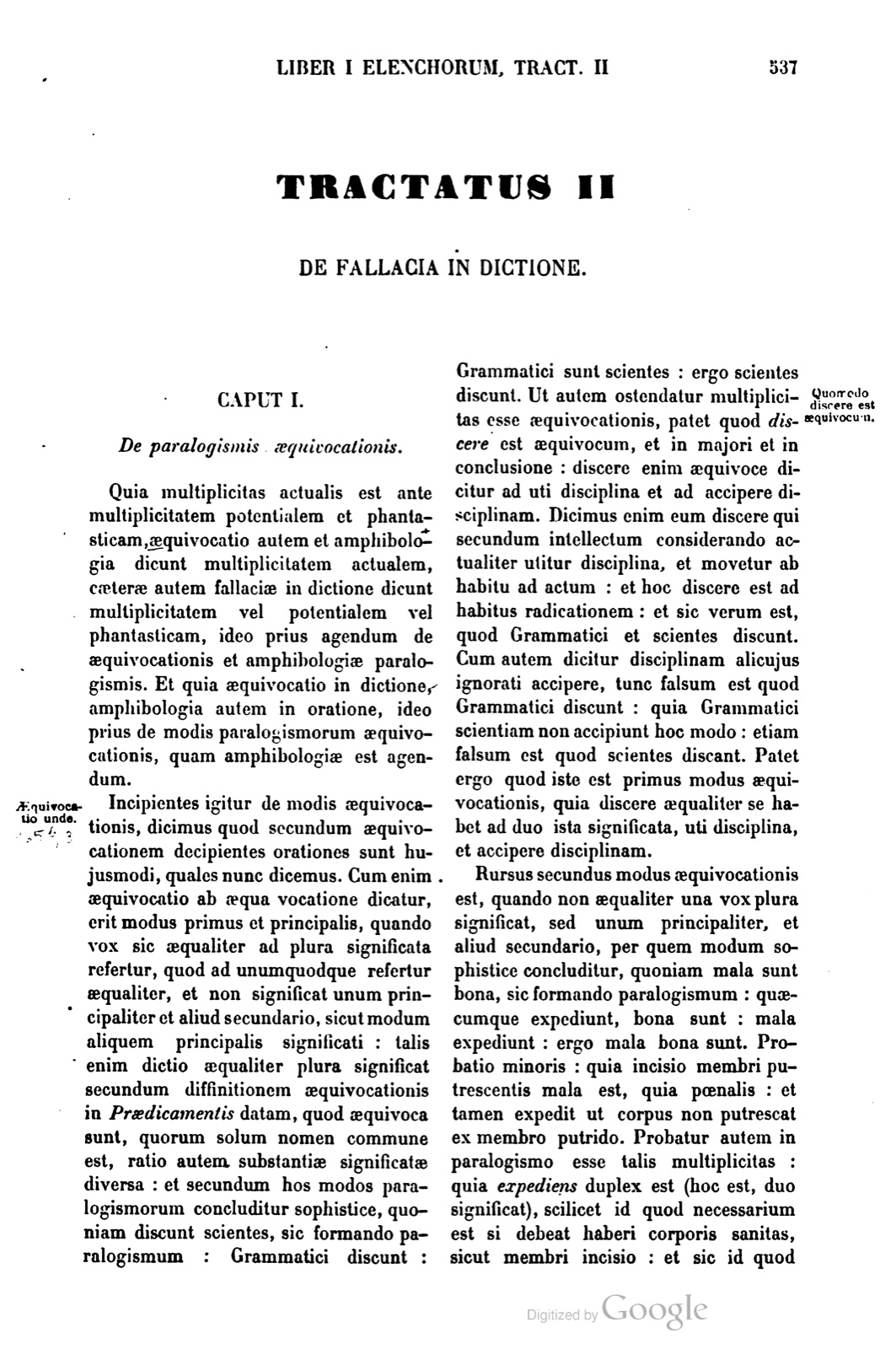
Quia multiplicitas actualis est ante multiplicitatem potentialem et phantasticam, aequivocatio autem et amphibologia dicunt multiplicitatem actualem, caeterae autem fallaciae in dictione dicunt multiplicitatem vel potentialem vel phantasticam, ideo prius agendum de aequivocationis et amphibologiae paralogismis. Et quia aequivocatio in dictione, amphibologia autem in oratione, ideo prius de modis paralogismorum aequivocationis, quam amphibologiae est agendum.
Incipientes igitur de modis aequivocationis, dicimus quod secundum aequivocationem decipientes orationes sunt hujusmodi, quales nunc dicemus. Cum enim aequivocatio ab aequa vocatione dicatur, erit modus primus et principalis, quando vox sic aequaliter ad plura significata refertur, quod ad unumquodque refertur aequaliter, et non significat unum principaliter et aliud secundario, sicut modum aliquem principalis significati: talis enim dictio aequaliter plura significat secundum diffinitionem aequivocationis in Praedicamentis datam, quod aequivoca sunt, quorum solum nomen commune est, ratio autem substantiae significatae diversa: et secundum hos modos paralogismorum concluditur sophistice, quoniam discunt scientes, sic formando paralogismum: Grammatici discunt: Grammatici sunt scientes: ergo scientes discunt. Ut autem ostendatur multiplicitas esse aequivocationis, patet quod discere est aequivocum, et in majori et in conclusione: discere enim aequivoce dicitur ad uti disciplina et ad accipere disciplinam. Dicimus enim eum discere qui secundum intellectum considerando actualiter utitur disciplina, et movetur ab habitu ad actum: et hoc discere est ad habitus radicationem: et sic verum est, quod Grammatici et scientes discunt. Cum autem dicitur disciplinam alicujus ignorati accipere, tunc falsum est quod Grammatici discunt: quia Grammatici scientiam non accipiunt hoc modo: etiam falsum est quod scientes discant. Patet ergo quod iste est primus modus aequivocationis, quia discere aequaliter se habet ad duo ista significata, uti disciplina, et accipere disciplinam.
Rursus secundus modus aequivocationis est, quando non aequaliter una vox plura significat, sed unum principaliter, et aliud secundario, per quem modum sophistice concluditur, quoniam mala sunt bona, sic formando paralogismum: quaecumque expediunt, bona sunt: mala expediunt: ergo mala bona sunt. Probatio minoris: quia incisio membri putrescentis mala est, quia poenalis: et tamen expedit ut corpus non putrescat ex membro putrido. Probatur autem in paralogismo esse talis multiplicitas: quia expediens duplex est, hoc est, duo significat, scilicet id quod necessarium est si debeat haberi corporis sanitas, sicut membri incisio: et sic id quod est malum, expediens est frequenter: plerumque enim in malis accidit aliquid expediens esse. Et secundo modo principaliter in his quae in se bona sunt, dicemus esse expediens, sicut expedit virtuti studere et ditari et philosophari, et hujusmodi: tamen expediens dicitur principaliter in bonis, et secundario in malis quibusdam, eo quod conferunt aliquando mala secundum aliquid.
Amplius tertius modus est, ex eo quod dictio aliqua secundum se sumpta, significat unum solum et modo uno significandi, sed conjuncta cum alia dictione in oratione eadem, modos significandi accipit plures, et secundum hoc sophistice concludetur eumdem sedere et stare, et eumdem laborare infirmitate et sanum esse, sic formando paralogismum primum: quicumque surgebat, stat: sedens surgebat: ergo sedens stat. Secundus autem sic formatur: quicumque sanabatur, sanus est: laborans sanabatur: ergo laborans sanus est. Quod autem in orationibus multiplicitas aequivocationis sit, sic ostenditur. Fiat enim vis in hoc quod dicitur, surgebat et sanabatur: haec enim quia sunt praeteriti imperfecti temporis, includunt in se praesens tempus, et sic in se duo habent tempora, praeteritum in parte, et praesens: unde si ponatur praeteritum quod in se non includat praesens, et dicatur, quicumque surrexit, stat, falsa est locutio. Similiter si dicitur sic: quicumque sanatus fuit, sanus est, falsa est propositio. Quando autem praeteritum imperfectum ponitur, tunc sunt verae in uno sensu: quia praeteritum imperfectum dicit actum incompletum includentem in se praesens ad quod continuatur actus. Quod autem in talibus sit multiplicitas aequivocationis, patet ex hoc quod laborantem, quod formatur a praeterito imperfecto, quodlibet facere aut pati, hoc est, adjunctum verbo activae vel passivae significationis, de praeterito non significat unum, sed plura: sed ratione duorum temporum quae in se claudit, aliquando significat praesens quod nunc instat, ut dicat eum qui nunc laborat, et sic falsa est, qui laborat sanus est: quia sequeretur quod nunc laborat, et nunc sanus est. Quandoque autem significat praeteritum, ut cum dicitur, qui laborabat prius sanus est nunc, et haec vera est. Et sic est etiam de ista, qui sedebat, stat. Et sic patet quod est hic multiplicitas aequivocationis in dictione quidem una, sed ex conjunctione dictionis ad aliam, quae si per se poneretur, non esset aequivoca: unde sanabatur laborans et non laborans secundum diversos sensus, et sanus est non laborans in hoc sensu, quod sanus est laborans, non nunc in praesenti in quo sanus est, sed laborans prius in praeterito in quo non sanus fuit.
TRACTATE II. ON FALLACY IN DICTION. CHAPTER I. On paralogisms of equivocation.
Because actual multiplicity is before potential and phantastic multiplicity, and equivocation and amphibology indicate actual multiplicity, while the other fallacies in diction indicate multiplicity either potential or phantastic, therefore one must first deal with the paralogisms of equivocation and amphibology. And because equivocation is in diction, but amphibology is in speech, therefore one must first deal with the modes of paralogisms of equivocation rather than of amphibology.
Therefore, beginning with the modes of equivocation, we say that the speeches deceiving according to equivocation are of this kind, such as we shall now state. For since equivocation is named from equal vocation, the first and principal mode will be when a word is referred so equally to several significates that it is referred equally to each one, and does not signify one principally and another secondarily, as some mode of the principal significate. For such a diction signifies several things equally according to the definition of equivocation given in the Categories, that equivocal things are those of which only the name is common, but the account of the signified substance is diverse. And according to these modes of paralogisms it is concluded sophistically that those who know learn, by forming the paralogism thus: Grammarians learn; grammarians are knowers; therefore knowers learn. But so that it may be shown that there is multiplicity of equivocation, it is clear that to learn is equivocal, both in the major and in the conclusion; for to learn is said equivocally with respect to using a discipline and receiving a discipline. For we say that he learns who, by considering according to intellect, actually uses a discipline and is moved from habit to act; and this learning is toward the rooting of the habit, and thus it is true that grammarians and knowers learn. But when it is said to receive a discipline of some unknown thing, then it is false that grammarians learn, because grammarians do not receive science in this mode; it is also false that knowers learn. Therefore it is clear that this is the first mode of equivocation, because to learn is related equally to those two significates, to use a discipline and to receive a discipline.
Again, the second mode of equivocation is when one word does not signify several things equally, but one principally and another secondarily; by this mode it is concluded sophistically that evils are goods, by forming the paralogism thus: whatever is expedient is good; evils are expedient; therefore evils are goods. The proof of the minor is that the cutting away of a putrid member is evil, because it is penal, and nevertheless it is expedient so that the body not putrefy from the putrid member. But it is proved that such multiplicity exists in the paralogism because expedient is double, that is, it signifies two things, namely what is necessary if the health of the body is to be had, as the cutting away of a member; and in this way what is evil is frequently expedient, for often in evils something happens to be expedient. And in the second mode we shall principally say that expedient exists in those things which are good in themselves, as it is expedient to study virtue, to become rich, to philosophize, and things of this sort; nevertheless expedient is said principally in goods and secondarily in certain evils, because evils sometimes contribute in some respect.
Moreover, the third mode is from the fact that some diction taken according to itself signifies only one thing and in one mode of signifying, but, joined with another diction in the same speech, receives several modes of signifying; and according to this it will be concluded sophistically that the same one sits and stands, and that the same one labors with infirmity and is healthy, by forming the first paralogism thus: whoever was rising, stands; the one sitting was rising; therefore the one sitting stands. But the second is formed thus: whoever was being healed is healthy; the one laboring was being healed; therefore the one laboring is healthy. But that in speeches there is multiplicity of equivocation is shown thus. Let force be placed in what is said, was rising and was being healed; for because these are of the imperfect past tense, they include in themselves the present time, and thus in themselves have two times, the past in part and the present. Hence if a past is posited which does not include the present in itself, and it is said, whoever rose stands, the locution is false. Similarly, if it is said thus, whoever was healed is healthy, the proposition is false. But when the imperfect past is posited, then they are true in one sense, because the imperfect past indicates an incomplete act including in itself the present to which the act is continued. But that in such things there is multiplicity of equivocation is clear from this, that laboring, which is formed from the imperfect past, whatever making or undergoing it is, that is, when joined to a verb of active or passive signification, does not signify one thing concerning the past, but several. But by reason of the two times which it encloses in itself, sometimes it signifies the present which now stands, so that it speaks of him who now labors; and thus it is false that he who labors is healthy, because it would follow that he now labors and now is healthy. But sometimes it signifies the past, as when it is said, he who formerly labored is healthy now, and this is true. And so it is also with this, he who was sitting stands. And thus it is clear that here there is multiplicity of equivocation in one diction indeed, but from the conjunction of the diction with another, which, if it were posited by itself, would not be equivocal. Hence the one being healed was laboring and was not laboring according to diverse senses, and the healthy one is not laboring in this sense, that the healthy one is laboring not now in the present in which he is healthy, but was laboring before in the past in which he was not healthy.
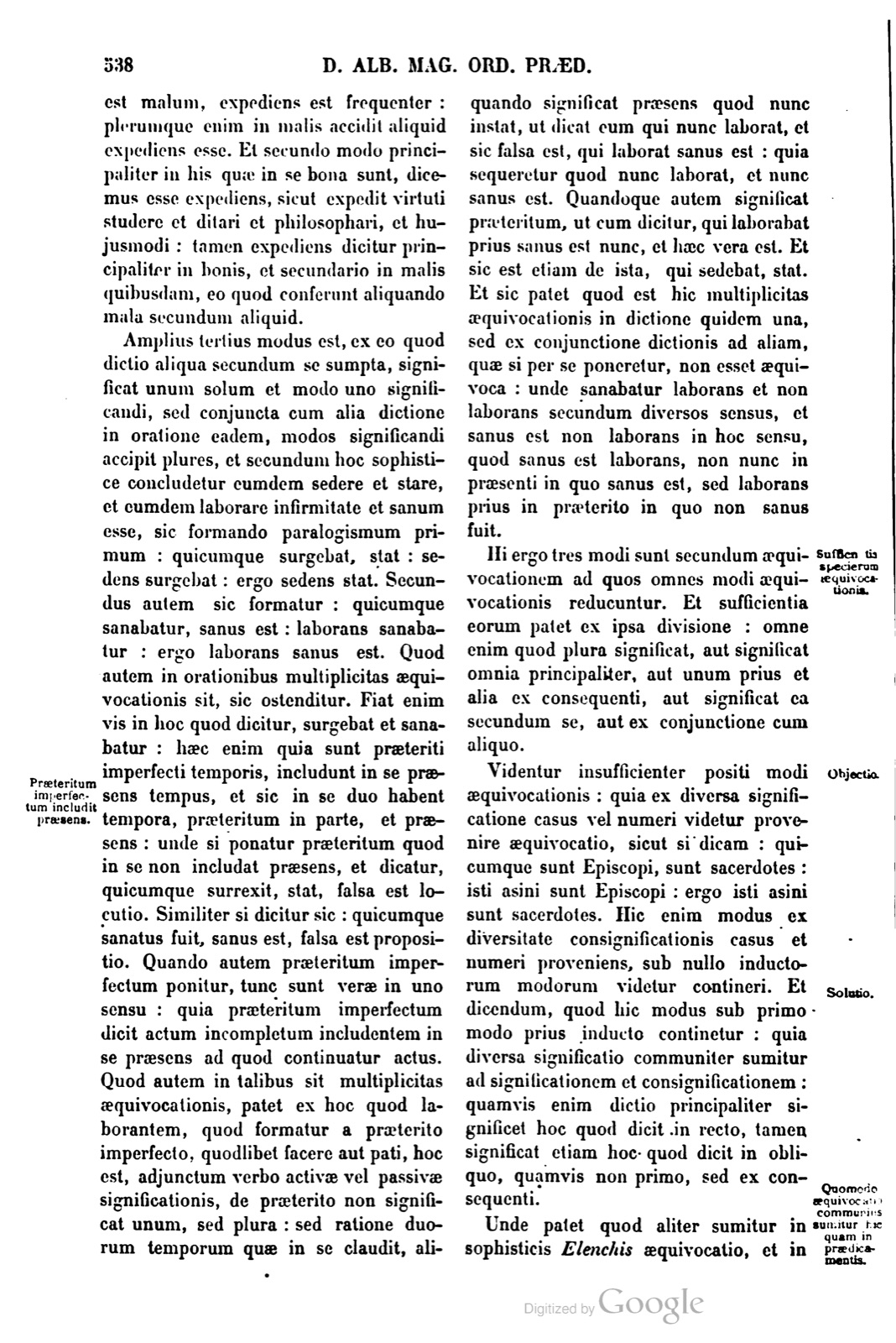
Hi ergo tres modi sunt secundum aequivocationem ad quos omnes modi aequivocationis reducuntur. Et sufficientia eorum patet ex ipsa divisione: omne enim quod plura significat, aut significat omnia principaliter, aut unum prius et alia ex consequenti, aut significat ea secundum se, aut ex conjunctione cum aliquo.
Videntur insufficienter positi modi aequivocationis: quia ex diversa significatione casus vel numeri videtur provenire aequivocatio, sicut si dicam: quicumque sunt Episcopi, sunt sacerdotes: isti asini sunt Episcopi: ergo isti asini sunt sacerdotes. Hic enim modus ex diversitate consignificationis casus et numeri proveniens, sub nullo inductorum modorum videtur contineri. Et dicendum, quod hic modus sub primo modo prius inducto continetur: quia diversa significatio communiter sumitur ad significationem et consignificationem: quamvis enim dictio principaliter significet hoc quod dicit in recto, tamen significat etiam hoc quod dicit in obliquo, quamvis non primo, sed ex consequenti. Unde patet quod aliter sumitur in sophisticis Elenchis aequivocatio, et in Praedicamentis. In Praedicamentis enim sumitur prout impedit aliquid poni in genere uno praedicamenti, et hoc non facit nisi ex diversa principali significatione in re significata: hic autem sumitur prout est principium decipiendi, et hoc facit ex diverso modo consignificandi, et ex diversa significatione principali aequaliter: et ideo magis large sumitur hic aequivocatio quam ibi.
CAPUT II. De solutione dubiorum quae sunt circa aequivocationem.
Dubitationes autem quae sunt circa dicta de aequivocatione, sunt plures: sed de quibus curandum est, sunt quinque. Quarum prima est, an una dictio possit plura significare? Secunda, si plura significat, qualiter illa significat? Tertia, an una dictione semel posita contingat unum et eumdem uti aequivoce? Quarta de distributione quae adjungitur dictioni aequivocae. Quinta, quae sit causa apparentiae in dictione aequivoca?
Therefore these are the three modes according to equivocation to which all modes of equivocation are reduced. And their sufficiency is clear from the division itself: for everything that signifies several things either signifies all principally, or one first and the others consequently, or signifies them according to itself, or from conjunction with something.
The modes of equivocation seem to have been posited insufficiently, because equivocation seems to arise from diverse signification of case or number, as if I say: whoever are Bishops are priests; these asses are Bishops; therefore these asses are priests. For this mode, arising from the diversity of consignification of case and number, seems to be contained under none of the modes introduced. And one must say that this mode is contained under the first mode introduced earlier, because diverse signification is commonly taken for signification and consignification; for although a diction principally signifies what it says in the direct case, nevertheless it also signifies what it says in an oblique case, although not first, but consequently. Hence it is clear that equivocation is taken differently in the Sophistical Refutations and in the Categories. For in the Categories it is taken insofar as it prevents something from being placed in one genus of a category, and this happens only from diverse principal signification in the thing signified. But here it is taken insofar as it is a principle of deceiving, and this it does from a diverse mode of consignifying and from a diverse principal signification equally; and therefore equivocation is taken more broadly here than there.
CHAPTER II. On the solution of doubts that concern equivocation.
But the doubts that concern the things said about equivocation are many, yet there are five about which one must be concerned. The first of these is whether one diction can signify several things. The second, if it signifies several things, how it signifies them. The third, whether when one diction has once been posited it happens that one and the same person uses it equivocally. The fourth concerns the distribution which is joined to an equivocal diction. The fifth is what the cause of appearance is in an equivocal diction.
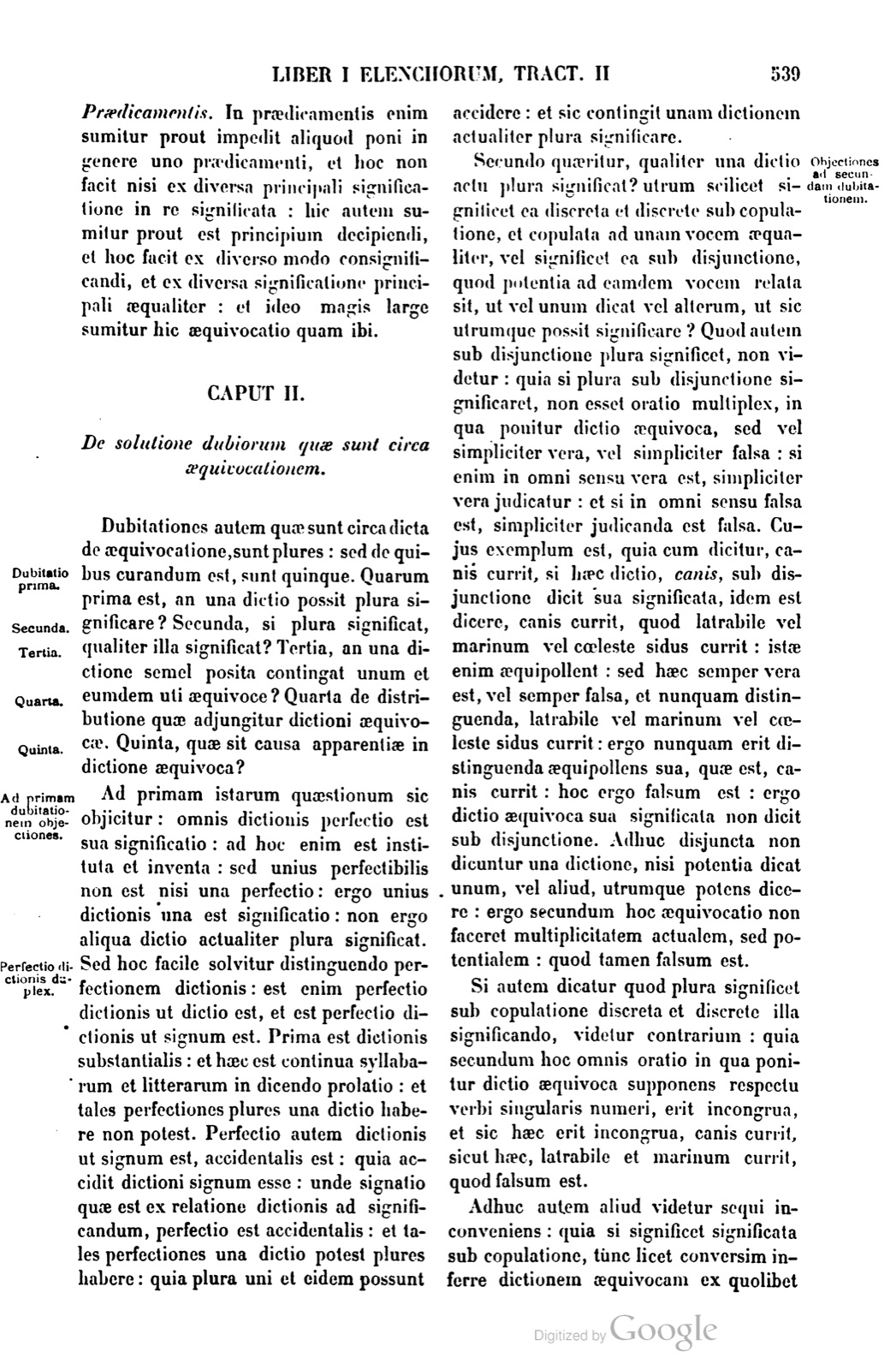
Ad primam istarum quaestionum sic objicitur: omnis dictionis perfectio est sua significatio: ad hoc enim est instituta et inventa: sed unius perfectibilis non est nisi una perfectio: ergo unius dictionis una est significatio: non ergo aliqua dictio actualiter plura significat. Sed hoc facile solvitur distinguendo perfectionem dictionis: est enim perfectio dictionis ut dictio est, et est perfectio dictionis ut signum est. Prima est dictionis substantialis: et haec est continua syllabarum et litterarum in dicendo prolatio: et tales perfectiones plures una dictio habere non potest. Perfectio autem dictionis ut signum est, accidentalis est: quia accidit dictioni signum esse: unde signatio quae est ex relatione dictionis ad significandum, perfectio est accidentalis: et tales perfectiones una dictio potest plures habere: quia plura uni et eidem possunt accidere: et sic contingit unam dictionem actualiter plura significare.
Secundo quaeritur, qualiter una dictio actu plura significat? utrum scilicet significet ea discreta et discrete sub copulatione, et copulata ad unam vocem aequaliter, vel significet ea sub disjunctione, quod potentia ad eamdem vocem relata sit, ut vel unum dicat vel alterum, ut sic utrumque possit significare? Quod autem sub disjunctione plura significet, non videtur: quia si plura sub disjunctione significaret, non esset oratio multiplex, in qua ponitur dictio aequivoca, sed vel simpliciter vera, vel simpliciter falsa: si enim in omni sensu vera est, simpliciter vera judicatur: et si in omni sensu falsa est, simpliciter judicanda est falsa. Cujus exemplum est, quia cum dicitur, canis currit, si haec dictio, canis, sub disjunctione dicit sua significata, idem est dicere, canis currit, quod latrabile vel marinum vel coeleste sidus currit: istae enim aequipollent: sed haec semper vera est, vel semper falsa, et nunquam distinguenda, latrabile vel marinum vel coeleste sidus currit: ergo nunquam erit distinguenda aequipollens sua, quae est, canis currit: hoc ergo falsum est: ergo dictio aequivoca sua significata non dicit sub disjunctione. Adhuc disjuncta non dicuntur una dictione, nisi potentia dicat unum vel aliud, utrumque potens dicere: ergo secundum hoc aequivocatio non faceret multiplicitatem actualem, sed potentialem: quod tamen falsum est.
Si autem dicatur quod plura significet sub copulatione discreta et discrete illa significando, videtur contrarium: quia secundum hoc omnis oratio in qua ponitur dictio aequivoca supponens respectu verbi singularis numeri, erit incongrua, et sic haec erit incongrua, canis currit, sicut haec, latrabile et marinum currit, quod falsum est. Adhuc autem aliud videtur sequi inconveniens: quia si significet significata sub copulatione, tunc licet conversim inferre dictionem aequivocam ex quolibet suo significato, et e converso quodlibet significatum ex dictione aequivoca, sicut infertur pars copulationis ex tota copulatione: et sit sicut sequitur, Socrates et Plato currunt, ergo Socrates currit: ita sequitur, canis currit, ergo latrabile currit, quod falsum est: ergo aequivocum non dicit significata discreta per modum copulationis copulata in una voce importata. Adhuc autem idem sequitur inconveniens quod superius dictum est, scilicet nulla oratio in qua ponitur terminus aequivocus est distinguenda, sed vel simpliciter vera, vel simpliciter falsa: quia si pars copulationis est falsa, copulativa similiter est falsa. Et similiter si oratio in qua ponitur dictio aequivoca, pro parte significationis est falsa, tota est falsa: hoc autem falsum est: ergo dictio aequivoca non significat sua significata per modum copulationis.
To the first of these questions objection is made thus: every perfection of a diction is its signification, for it has been instituted and invented for this; but there is only one perfection of one perfectible thing; therefore there is one signification of one diction; therefore no diction actually signifies several things. But this is easily solved by distinguishing the perfection of diction. For there is a perfection of diction as it is diction, and there is a perfection of diction as it is a sign. The first is substantial to diction, and this is the continuous utterance of syllables and letters in speaking; and one diction cannot have several such perfections. But the perfection of diction as it is a sign is accidental, because it happens to diction to be a sign. Hence signification, which is from the relation of diction to signifying, is an accidental perfection; and one diction can have several such perfections, because several things can happen to one and the same thing; and thus it happens that one diction actually signifies several things.
Second, it is asked how one diction actually signifies several things: whether, namely, it signifies them as discrete and discretely under copulation, and as coupled equally to one word, or whether it signifies them under disjunction, so that what is referred potentially to the same word is either to say one thing or the other, so that in this way it can signify each. But it does not seem that it signifies several things under disjunction, because if it signified several things under disjunction, the speech in which an equivocal diction is posited would not be multiple, but either simply true or simply false. For if it is true in every sense, it is judged simply true; and if it is false in every sense, it must be judged simply false. An example of this is that when it is said, a dog runs, if this diction, dog, says its significates under disjunction, saying a dog runs is the same as saying the barkable thing or the marine thing or the heavenly star runs. For these are equipollent; but this is always true or always false, and is never to be distinguished, the barkable thing or the marine thing or the heavenly star runs. Therefore its equipollent, which is a dog runs, will never have to be distinguished. Therefore this is false; therefore an equivocal diction does not say its significates under disjunction. Moreover, things disjoined are not said by one diction unless it potentially says one or another, able to say either; therefore according to this equivocation would not make actual multiplicity but potential multiplicity, which nevertheless is false.
But if it is said that it signifies several things under copulation, as discrete and by signifying them discretely, the contrary seems to follow, because according to this every speech in which an equivocal diction is posited as supposing with respect to a verb of singular number will be incongruous, and thus this will be incongruous, a dog runs, just as this is, a barkable thing and a marine thing runs, which is false. Moreover, another unsuitable thing seems to follow, because if it signifies the significates under copulation, then it is permitted conversely to infer the equivocal diction from any one of its significates, and conversely any significate from the equivocal diction, just as a part of a copulation is inferred from the whole copulation; and it would be as follows: Socrates and Plato run; therefore Socrates runs. So it follows: a dog runs; therefore a barkable thing runs, which is false. Therefore the equivocal term does not say its significates as discrete, copulated by the mode of copulation in one imported word. Moreover, the same unsuitable thing follows which was stated above, namely that no speech in which an equivocal term is posited has to be distinguished, but is either simply true or simply false; because if part of a copulation is false, the copulative is likewise false. And similarly, if a speech in which an equivocal diction is posited is false for part of the signification, the whole is false. But this is false; therefore an equivocal diction does not signify its significates by the mode of copulation.
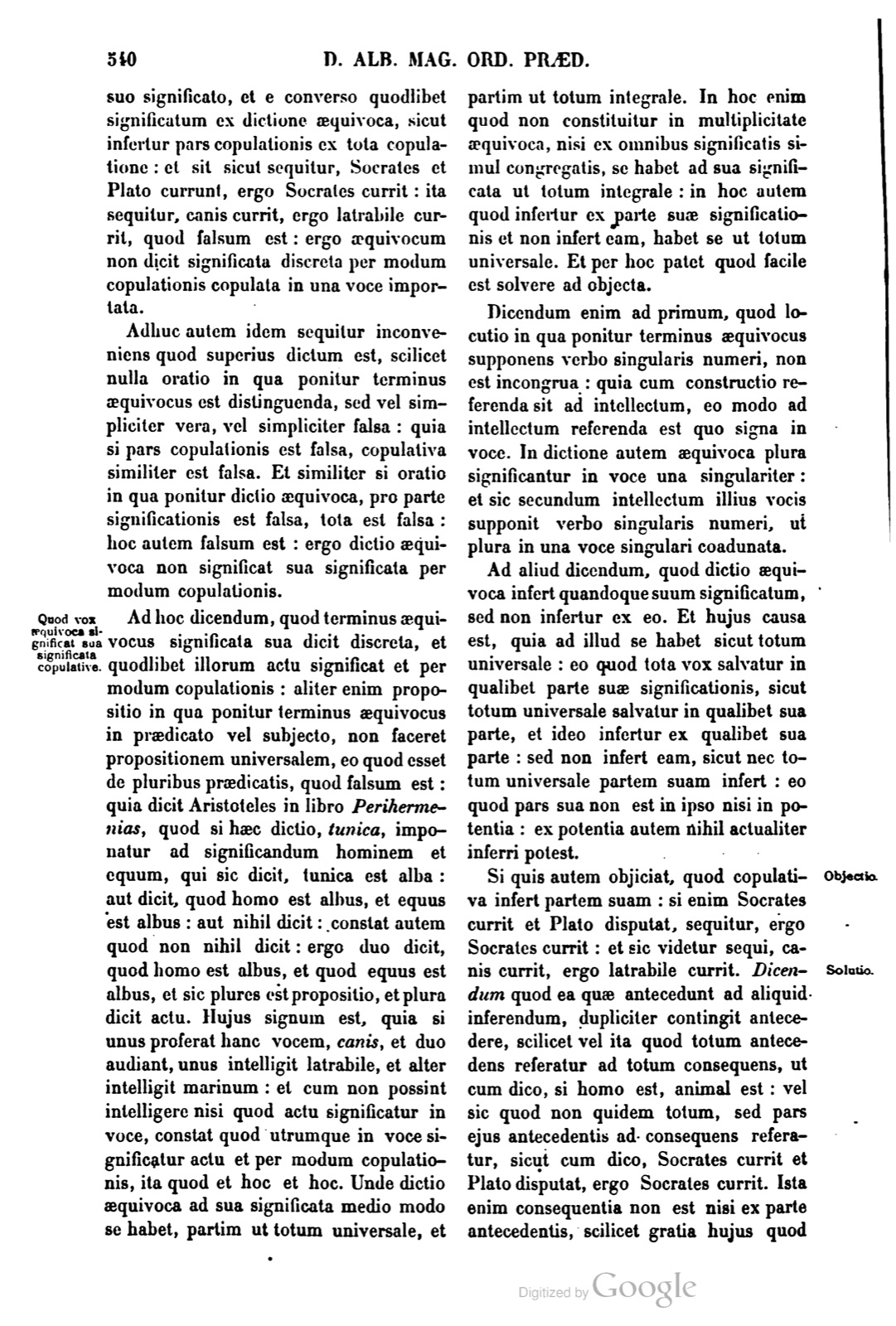
Ad hoc dicendum, quod terminus aequivocus significata sua dicit discreta, et quodlibet illorum actu significat et per modum copulationis: aliter enim propositio in qua ponitur terminus aequivocus in praedicato vel subjecto, non faceret propositionem universalem, eo quod esset de pluribus praedicatis, quod falsum est: quia dicit Aristoteles in libro Perihermenias, quod si haec dictio, tunica, imponatur ad significandum hominem et equum, qui sic dicit, tunica est alba: aut dicit, quod homo est albus, et equus est albus: aut nihil dicit: constat autem quod non nihil dicit: ergo duo dicit, quod homo est albus, et quod equus est albus, et sic plures est propositio, et plura dicit actu. Hujus signum est, quia si unus proferat hanc vocem, canis, et duo audiant, unus intelligit latrabile, et alter intelligit marinum: et cum non possint intelligere nisi quod actu significatur in voce, constat quod utrumque in voce significatur actu et per modum copulationis, ita quod et hoc et hoc. Unde dictio aequivoca ad sua significata medio modo se habet, partim ut totum universale, et partim ut totum integrale. In hoc enim quod non constituitur in multiplicitate aequivoca, nisi ex omnibus significatis simul congregatis, se habet ad sua significata ut totum integrale: in hoc autem quod infertur ex parte suae significationis et non infert eam, habet se ut totum universale. Et per hoc patet quod facile est solvere ad objecta.
Dicendum enim ad primum, quod locutio in qua ponitur terminus aequivocus supponens verbo singularis numeri, non est incongrua: quia cum constructio referenda sit ad intellectum, eo modo ad intellectum referenda est quo signa in voce. In dictione autem aequivoca plura significantur in voce una singulariter: et sic secundum intellectum illius vocis supponit verbo singularis numeri, ut plura in una voce singulari coadunata. Ad aliud dicendum, quod dictio aequivoca infert quandoque suum significatum, sed non infertur ex eo. Et hujus causa est, quia ad illud se habet sicut totum universale: eo quod tota vox salvatur in qualibet parte suae significationis, sicut totum universale salvatur in qualibet sua parte, et ideo infertur ex qualibet sua parte: sed non infert eam, sicut nec totum universale partem suam infert: eo quod pars sua non est in ipso nisi in potentia: ex potentia autem nihil actualiter inferri potest.
Si quis autem objiciat, quod copulativa infert partem suam: si enim Socrates currit et Plato disputat, sequitur, ergo Socrates currit: et sic videtur sequi, canis currit, ergo latrabile currit. Dicendum quod ea quae antecedunt ad aliquid inferendum, dupliciter contingit antecedere, scilicet vel ita quod totum antecedens referatur ad totum consequens, ut cum dico, si homo est, animal est: vel sic quod non quidem totum, sed pars ejus antecedentis ad consequens referatur, sicut cum dico, Socrates currit et Plato disputat, ergo Socrates currit. Ista enim consequentia non est nisi ex parte antecedentis, scilicet gratia hujus quod est, Socrates currit: et alia pars est ad consequens non causa, et non facit ad consequentiam: et ideo ex parte non potest inferri copulativa. Et quod ex parte significationis infertur tota vox aequivoca, hoc est, ideo quia habet in hoc naturam ipsius universalis, quod tota vox refertur ad quamlibet partem significationis: et ideo sequitur, latrabile currit, ergo canis currit: licet non sequatur, Socrates currit, ergo Socrates currit et Plato disputat: quamvis e converso sequatur, Socrates currit et Plato disputat, ergo Socrates currit.
To this one must say that an equivocal term says its significates as discrete, and actually signifies each of them and by the mode of copulation. For otherwise the proposition in which an equivocal term is posited in the predicate or subject would not make a universal proposition, because it would be about several predicates, which is false; because Aristotle says in the book Perihermenias that if this diction, tunic, is imposed to signify man and horse, one who says thus, the tunic is white, either says that the man is white and the horse is white, or says nothing. But it is evident that he does not say nothing; therefore he says two things, that the man is white and that the horse is white, and thus the proposition is several and says several things actually. The sign of this is that if one person utters this word, dog, and two hear it, one understands the barkable thing and the other understands the marine thing; and since they cannot understand except what is actually signified in the word, it is evident that each is actually signified in the word and by the mode of copulation, so that both this and this are signified. Hence equivocal diction is related to its significates in a middle mode, partly as a universal whole and partly as an integral whole. For in that it is not constituted in equivocal multiplicity except from all the significates gathered together at once, it is related to its significates as an integral whole; but in that it is inferred from a part of its signification and does not infer it, it is related as a universal whole. And through this it is clear that it is easy to solve the objections.
For one must say to the first that a locution in which an equivocal term is posited as supposing for a verb of singular number is not incongruous, because, since construction must be referred to the intellect, it must be referred to the intellect in the mode in which signs are in the voice. But in an equivocal diction several things are signified in one singular word; and thus according to the intellect of that word it supposes for a verb of singular number, as several things gathered together in one singular word. To the other one must say that equivocal diction sometimes infers its significate, but is not inferred from it. And the cause of this is that it is related to it as a universal whole, because the whole word is preserved in any part of its signification, just as a universal whole is preserved in any of its parts, and therefore it is inferred from any of its parts. But it does not infer that part, just as neither does a universal whole infer its part, because its part is not in it except in potency; but nothing is actually inferred from potency.
But if someone objects that the copulative infers its part, for if Socrates runs and Plato disputes, it follows, therefore Socrates runs, and thus it seems to follow, a dog runs, therefore a barkable thing runs. One must say that the things which antecede for inferring something can antecede in two ways, namely either so that the whole antecedent is referred to the whole consequent, as when I say, if a man is, an animal is; or so that not indeed the whole, but a part of its antecedent, is referred to the consequent, as when I say, Socrates runs and Plato disputes, therefore Socrates runs. For that consequence is only from part of the antecedent, namely by reason of this, that Socrates runs; and the other part is not a cause with respect to the consequent, and does not contribute to the consequence; and therefore the copulative cannot be inferred from a part. And the reason that the whole equivocal word is inferred from part of the signification is this, that it has in this the nature of the universal, namely that the whole word is referred to any part of the signification; and therefore it follows, the barkable thing runs, therefore a dog runs, although it does not follow, Socrates runs, therefore Socrates runs and Plato disputes; although conversely it follows, Socrates runs and Plato disputes, therefore Socrates runs.
Si quis autem objiciat dicens, quod si pars copulativae est falsa, tota est falsa. Dicendum quod si intelligatur ratione copulationis, verum est: si autem intelligatur ratione copulatorum, est falsum: dictio autem aequivoca plura significat ut copulata, et non ratione formalis copulationis: et ideo cum in una significatione est falsa, non est in toto falsa: et ideo ratione ex ea pars infertur, et ratione partis vera esse videtur pro parte et non pro toto. Et per hoc patet solutio ad omnia quaesita.
Tertio quaeritur, an una dictione semel posita contingit uti aequivoce? Videtur autem quod sic: ex quo enim dictio aequivoca plura significat actu et discreta sub copulatione, ita quod hoc et hoc, tunc videtur quod proferens eam in omni sensu suo potest uti ea, et sic utitur aequivoce. Adhuc si aliquis dictionem aequivocam proferat, eam diversi audientes prolationem, accipiunt in diversis significatis; non autem sic accipiunt eam pro diversis significatis, nisi proferens eam uteretur pro diversis proferendo: ergo utitur dictione semel prolata et semel posita aequivoce. In contrarium autem hujus est quod dicit Boetius, quod termino semel posito non contingit uti aequivoce. Ad hoc dicendum, quod uti dictione semel posita dicitur dupliciter, scilicet secundum intellectum referentem vocem ad plura significata, et secundum prolationem solam sine intellectuali relatione vocis ad significata. Et primo quidem modo non contingit una dictione semel posita uti aequivoce: quia dicit Aristoteles quod scire quidem plura possumus, intelligere autem minime: et ideo per unum et eumdem actum intelligendi non contingit dictionem semel acceptam referri ad plura distincte significata. Secundo autem modo contingit unica prolatione termino semel prolato uti aequivoce a diversis audientibus, ut dictum est: contingit etiam ab uno et eodem bis utente secundum duplicem actum intelligendi uti uno termino aequivoce. Et sic patet hujus quaestionis solutio.
Quarta quaestio est de distributione termini aequivoci: quaerit enim si adveniat ei signum distributivum, utrum distribuatur pro omnibus suis significatis, vel pro uno tantum? Videtur quod pro omnibus, ex quo continet in se omnia sua significata per medium copulationis, qua ratione distribuetur pro uno, eadem ratione distribuetur pro quolibet: ergo pro omnibus distribuetur. Adhuc ut totum universale se habet ad sua significata: sed totum universale pro omnibus contentis sub uno distribuitur: ergo et vox aequivoca pro omnibus significatis suis, quae in ea continentur ut partes subjectivae, distribuetur. In contrarium hujus est, quod unius distributi tantum una est distributio: plura autem forma et ratione sunt in termino aequivoco: ergo pluribus et non una distributione distribuetur. Ad hoc dicendum, quod terminus aequivocus dupliciter potest determinari a signo distributivo: potest enim determinari ratione partium significatarum in unitate et communitate vocis: et sic una distributione pro omni sua distribuitur significatione. Si autem ratione significatorum respiciatur a distributione, non posset una distributione distribui pro partibus cujuslibet significati. Et per hoc patet solutio quaesiti.
If someone objects by saying that if a part of the copulative is false, the whole is false, one must say that if it is understood by reason of copulation, it is true; but if it is understood by reason of the things copulated, it is false. But equivocal diction signifies several things as copulated, and not by reason of formal copulation; and therefore, when it is false in one signification, it is not false in the whole, and therefore by reason of it a part is inferred from it, and by reason of the part it seems true for the part and not for the whole. And by this the solution to all the things asked is clear.
Third, it is asked whether, when one diction has once been posited, it happens that it is used equivocally. But it seems that it does, because since an equivocal diction actually signifies several things and discrete things under copulation, so that it signifies this and this, then it seems that one uttering it can use it in every sense of it, and thus he uses it equivocally. Moreover, if someone utters an equivocal diction, diverse hearers receive its utterance in diverse significates; but they do not thus receive it for diverse significates unless the one uttering it were using it for diverse things by uttering it; therefore he uses a diction once uttered and once posited equivocally. But to the contrary of this is what Boethius says, that once a term has been posited, it does not happen that it is used equivocally. To this one must say that to use a diction once posited is said in two ways: namely according to an intellect referring the word to several significates, and according to utterance alone without an intellectual relation of the word to the significates. And in the first way, indeed, it does not happen that one uses one diction once posited equivocally, because Aristotle says that we can indeed know several things, but by no means understand several things; and therefore by one and the same act of understanding it does not happen that a diction once accepted is referred to several distinct significates. But in the second way it happens that by a single utterance, when the term has once been uttered, it is used equivocally by diverse hearers, as was said; it also happens that by one and the same person using it twice according to a double act of understanding one term is used equivocally. And thus the solution of this question is clear.
The fourth question concerns the distribution of an equivocal term; for it asks whether, if a distributive sign comes to it, it is distributed for all its significates or for one only. It seems that it is distributed for all, since it contains all its significates in itself through the middle of copulation; by whatever reason it will be distributed for one, by the same reason it will be distributed for any; therefore it will be distributed for all. Moreover, as a universal whole is related to its significates, so also the whole universal is distributed for all things contained under one; therefore also the equivocal word will be distributed for all its significates, which are contained in it as subjective parts. To the contrary of this is that there is only one distribution of one distributed thing; but in an equivocal term there are several things in form and account; therefore it will be distributed by several distributions and not by one. To this one must say that an equivocal term can be determined in two ways by a distributive sign. For it can be determined by reason of the signified parts in the unity and community of the word, and thus by one distribution it is distributed for every signification of its own. But if it is regarded by the distribution by reason of the significates, it could not be distributed by one distribution for the parts of each significate. And by this the solution of the question is clear.
Quinto quaeritur, quae sit causa apparentiae in dictione aequivoca? Videtur enim nulla esse, quia ex quo plura actu significat, videtur illa distincte significare, et non unum in alio. In contrarium autem est, quod si causam apparentiae non haberet, non deciperet: decipit autem aliquem: ergo habet causam apparentiae. Ad hoc autem dicendum, quod causam apparentiae habet unitatem vocis secundum materiam et formam substantialem quae est dictionis ut est dictio: ex hoc enim credit aliquis, quod significata sint unum: causam autem non existentiae habet diversitatem significatorum. Et attende quod ad terminum aequivocum non debet addi signum universale ad hoc ut sit paralogismus, sed ad hoc ut paralogismus videatur esse syllogismus: et ut sic sub figura syllogismi decipiat, debet addi signum universale: quia sine signo universali non fit syllogismus.
CAPUT III. De modis amphibologiae.
Quia amphibologia multiplicitatem facit actualem in oratione ex diversa constructione: et ideo post aequivocationem modos ponemus amphibologiae. Et sequentes Aristotelem quinque modos simul ponemus. Quorum primus est multiplex, ex eo quod oratio principaliter plura sive multa significat, quorum primus modus est: Vellem accipere pugnantes: et debet sic formari paralogismus: quoscumque vellem me accipere, vellem quod me acciperent: pugnantes vellem me accipere: ergo vellem quod pugnantes me acciperent, quod falsum est. Haec enim multiplicitas est secundum amphibologiam ex eo quod iste accusativus, me, potest construi cum infinitivo ex parte ante, et potest construi cum eodem ex parte post: et in primo sensu vera est, in secundo autem falsa.
Secunda ratio est: Putas quod quis scit, hoc scit? quae oratio exemplum est secundi modi amphibologiae, scilicet quia oratio per se significat unum solum, et adjuncta aliquando plura significat. Et paralogismus sic est formandus: quod quis scit, hoc scit: grammaticam scit aliquis: ergo grammatica scit. Nam in tali oratione et scientem et scitum contingit ut scientem significari: quia hoc pronomen, hoc, potest haec significare: quia hoc pronomen, hoc, potest significare scientem, et tunc construitur cum verbo ex parte suppositi, et ante verbum ponitur: et sic est oratio falsa. Potest etiam significare scitum, et tunc construitur ex parte appositi: et tunc est vera.
Tertius modus est, ut: Putasne quod quis videt, hoc videt? columnam aliquis videt: ergo columna videt. Formatur autem paralogismus, sicut jam habitum est: et patet multiplicitas ipsius ex hoc quod hoc pronomen, hoc, potest construi cum hoc verbo, videt, ex supposito: et sic est nominativi casus, et construitur ex vi suppositi. Vel potest construi cum verbo eodem ex parte appositi, et est accusativi casus, et construitur ex vi transitionis: et sic patet multiplicitas.
Quartus est: Putasne quod tu dicis esse, hoc tu dicis esse? dicis autem lapidem esse: ergo tu lapis dicis esse. Et patet multiplicitas istius ex eo quod hoc pronomen, hoc, potest esse nominativi casus, et construi cum supposito verbi quasi determinantis suppositum sub hoc sensu, putas quod tu existens dicis esse? Vel potest esse accusativi casus et construi cum dicis ex parte post ex vi transitionis, et sic columnam vel aliud dicis esse. Facile autem est in omnibus talibus multiplicitatem invenire ex diversa constructione.
Quintus modus est in oratione syllogismi primae orationis: ex eo quod in primo non est distincta multiplicitas ut in ista distincta intelligatur et esse in prima: et haec est oratio: Putas est, sive contingit, tacentem dicere? Et potest sic formari paralogismus: contingit Socratem dicere: Socrates est tacens: ergo contingit tacentem dicere. Duplex est hujus oratio, quia significat tacentem dicere, et hunc tacentem: haec enim oratio potest significare haec duo, hoc scilicet, tacens dicit: et sic construitur hoc participium, tacens, cum verbo dicere infinitivo ex parte ante ex vi suppositi. Potest etiam significare hoc, tacens dicitur: et sic construitur cum eodem verbo ex parte post: quia hoc, quod est tacentem dicere, dicitur ut quoddam de numero dicibilium. Illi igitur sunt modi amphibologiae, ad quos omnes modi deceptionum, qui proveniunt ex diversa constructione dictionis cum dictione in eadem oratione, reducuntur. Et causa apparentiae in eis est identitas orationis secundum formam et materiam: causa autem non existentiae est significationis actualis diversitas.
Fifth, it is asked what is the cause of appearance in an equivocal diction. For there seems to be none, because since it actually signifies several things, it seems to signify them distinctly and not one in another. But to the contrary, if it did not have a cause of appearance, it would not deceive; yet it deceives someone; therefore it has a cause of appearance. To this one must say that it has as cause of appearance the unity of the word according to the matter and substantial form which belongs to diction as it is diction. For from this someone believes that the significates are one. But it has as cause of non-existence the diversity of the significates. And attend that a universal sign ought not to be added to an equivocal term so that it may be a paralogism, but so that the paralogism may seem to be a syllogism; and so that, under the figure of a syllogism, it may deceive, a universal sign must be added, because without a universal sign there is no syllogism.
CHAPTER III. On the modes of amphibology.
Because amphibology makes actual multiplicity in speech from diverse construction, therefore after equivocation we shall posit the modes of amphibology. And following Aristotle we shall posit five modes together. The first of these is multiple from the fact that the speech principally signifies several or many things, of which the first mode is: I would wish to receive fighters. And the paralogism must be formed thus: whomsoever I would wish to receive me, I would wish that they receive me; I would wish fighters to receive me; therefore I would wish that fighters receive me, which is false. For this multiplicity is according to amphibology from the fact that this accusative, me, can be constructed with the infinitive from the part before, and can be constructed with the same infinitive from the part after; and in the first sense it is true, but in the second false.
The second account is: Do you think that what someone knows, he knows? This speech is an example of the second mode of amphibology, namely because a speech by itself signifies one thing only, and when joined sometimes signifies several things. And the paralogism is to be formed thus: what someone knows, he knows; someone knows grammar; therefore grammar knows. For in such speech it happens that both the knower and the known thing are signified as knower, because this pronoun, this, can signify these things; because this pronoun, this, can signify the knower, and then it is constructed with the verb from the side of the supposit, and is placed before the verb; and thus the speech is false. It can also signify the known thing, and then it is constructed from the side of the apposite; and then it is true.
The third mode is as follows: Do you think that what someone sees, this sees? Someone sees a column; therefore a column sees. But the paralogism is formed as has already been held, and its multiplicity is clear from this, that this pronoun, this, can be constructed with this verb, sees, from the supposit, and thus it is of the nominative case and is constructed from the force of the supposit. Or it can be constructed with the same verb from the side of the apposite, and is of the accusative case and is constructed from the force of transition; and thus the multiplicity is clear.
The fourth is: Do you think that what you say to be, you say this to be? But you say a stone to be; therefore you say that you are a stone. And the multiplicity of this is clear from the fact that this pronoun, this, can be of the nominative case and be constructed with the supposit of the verb as though determining the supposit under this sense: do you think that you, existing, say to be? Or it can be of the accusative case and be constructed with you say from the part after by force of transition, and thus you say that a column or something else exists. But in all such cases it is easy to discover multiplicity from diverse construction.
The fifth mode is in the speech of a syllogism of the first speech, from the fact that in the first the multiplicity is not distinct so that it may be understood distinctly in that and to be in the first; and this is the speech: Do you think that it is, or happens, for one silent to speak? And the paralogism can be formed thus: it happens that Socrates speaks; Socrates is silent; therefore it happens that one silent speaks. This speech is double, because it signifies one silent speaking and this silent one; for this speech can signify these two things, namely this, the silent one speaks; and thus this participle, silent, is constructed with the infinitive verb to speak from the part before, from the force of the supposit. It can also signify this, the silent one is said, and thus it is constructed with the same verb from the part after, because this, which is one silent speaking, is said as one of the number of sayable things. Therefore these are the modes of amphibology, to which all modes of deceptions that arise from diverse construction of diction with diction in the same speech are reduced. And the cause of appearance in them is the identity of the speech according to form and matter; but the cause of non-existence is the diversity of actual signification.
CAPUT IV. De solutione dubiorum quae sunt circa modos amphibologiae.
Est autem primo notandum, quod quamvis in aequivocatione et amphibologia identitas vocis secundum formam et materiam sit causa apparentiae, et diversitas significationis sit causa non existentiae, et sic unam et eamdem causam videantur habere causam apparentiae et non existentiae, et per consequens una videtur esse fallacia: tamen una non est fallacia: tum quia una est in dictione, et altera in oratione: tum etiam, quia una est in diversa sententia, et alia in diversa significatione. Sententia proprie dictionis non est, sed orationis. Et ideo convenientia quam habent in causa apparentiae et in causa non existentiae, est convenientia in genere et non in specie, et non facit convenire aequivocationem cum amphibologia, nisi in hoc quod utraque causat multiplicitatem actualem, et non in modo fallendi speciali.
Adhuc autem secundum notandum, quod quamvis in omni fallacia in dictione sit ambiguitas substantiae, et sic amphibologia videatur generalis ad omnes fallacias in dictione, tamen quia ambiguitas amphibologiae est una et eadem ratione ex diversa construendi habitudine, et talis ambiguitas in nulla alia fallacia in dictione est, quia accentus et figura dictionis et aequivocatio sunt in dictione, et non in oratione, compositio autem et divisio non sunt in una oratione secundum materiam, ideo amphibologia est specialis et non generalis fallacia.
Adhuc tertio notandum, quod licet in talibus modis, quod aliquis scit, hoc scit, sit multiplicitas ex consignificatione diversi casus nominativi et accusativi, ex quo in prae habitis diximus provenire aequivocationem: tamen principaliter et primo sunt istae orationes secundum amphibologiam: quia in talibus quaelibet oratio significat unum solum, et conjuncta una cum alia ex diversa significatione efficitur dubia sententia: unum significat haec oratio, omne quod quis scit, et unum solum significat haec, hoc scit: conjuncta autem ex diversa habitudine constructionis pronominis cum verbo, fit dubia sententia: et quod est ibi aequivocatio, est ex consequenti.
Quarto notandum est hic, quod quamvis amphibologia dicatur provenire ex diversa habitudine principaliter, tamen etiam provenit ex ambiguitate sententiae quae provenit ex proprio et transumptione sumpto: ut quidquid ridet, habet os: pratum ridet: ergo pratum habet os. Quamvis enim idem modus in genere sit construendi transumptum et proprium, tamen pro utroque est ambiguitas sententiae, secundum quod sententia ad intellectum refertur: et hoc sufficit ad amphibologiam: quia dubiam in oratione una secundum formam et materiam facit sententiam. Sed tamen non ponitur ab Aristotele iste modus, quia usitatus est et manifestus: quia fere omnes utuntur parabolis. Adhuc notandum quod ponens dubiam sententiam, aut intendit decipere per eam, aut tantum exemplificare. De multiplici primo modo oportet quod proponentes eam forment in modo et figura: quia aliter non deciperet. Secundo autem modo distinguendum est: quia aut est manifesta multiplicitas, et tunc non oportet nisi proponere. Secundo autem modo debet deducere ut manifesta fiat ejus multiplicitas.
CHAPTER IV. On the solution of doubts that concern the modes of amphibology.
First, then, it must be noted that although in equivocation and amphibology identity of the word according to form and matter is the cause of appearance, and diversity of signification is the cause of non-existence, and thus they seem to have one and the same cause of appearance and of non-existence, and consequently to be one fallacy, nevertheless they are not one fallacy. This is both because one is in diction and the other in speech, and also because one is in diverse sense and the other in diverse signification. Sense properly belongs not to diction, but to speech. And therefore the agreement which they have in the cause of appearance and in the cause of non-existence is an agreement in genus and not in species, and does not make equivocation agree with amphibology except in this, that each causes actual multiplicity, and not in the special mode of deceiving.
Moreover, second, one must note that although in every fallacy in diction there is ambiguity of substance, and thus amphibology seems general to all fallacies in diction, nevertheless, because the ambiguity of amphibology is one and the same in account from a diverse habit of constructing, and such ambiguity is in no other fallacy in diction, because accent and figure of diction and equivocation are in diction and not in speech, while composition and division are not in one speech according to matter, therefore amphibology is a special fallacy and not a general one.
Moreover, third, one must note that although in such modes, what someone knows, he knows, there is multiplicity from the consignification of diverse nominative and accusative case, from which we said in the foregoing that equivocation arises, nevertheless principally and first those speeches are according to amphibology, because in such cases each speech signifies one thing only, and when joined one with another from a diverse signification it becomes a doubtful sense. This speech, everything that someone knows, signifies one thing, and this, he knows, signifies one thing only; but when they are joined from the diverse habit of construction of the pronoun with the verb, a doubtful sense is made; and what is equivocation there is consequent.
Fourth, it must be noted here that although amphibology is said principally to arise from diverse relation, nevertheless it also arises from ambiguity of sense which comes from taking the proper and the transferred meaning: as, whatever laughs has a mouth; the meadow laughs; therefore the meadow has a mouth. For although the same mode in genus belongs to constructing the transferred and the proper, nevertheless for each there is ambiguity of sense, according as sense is referred to the intellect; and this suffices for amphibology, because it makes the sense doubtful in one speech according to form and matter. But this mode is not posited by Aristotle, because it is customary and manifest, since nearly everyone uses parables. Moreover, one must note that one who posits a doubtful sense either intends to deceive through it or only to exemplify. In the first multiple mode it is necessary that those proposing it form it in mode and figure, because otherwise it would not deceive. But in the second mode it must be distinguished, because either the multiplicity is manifest, and then nothing is needed except to propose it; or in the second mode one must lead it out so that its multiplicity becomes manifest.
CAPUT V. De tribus modis in quibus conveniunt aequivocatio et amphibologia.
Sed quia aequivocatio et amphibologia operantur multiplicitatem actualem, modi earum in multis conveniunt, quod non est in aliis fallaciis, nisi in compositione et divisione: sed in his per omnes modos manifestum est: quia si compositio fallit, divisio solvit, et e converso: et ideo in illis convenientiam et differentiam non oportet assignare, sed in aequivocatione et amphibologia assignata jam differentia modorum aequivocationis et amphibologiae, consequens est assignare in quo conveniunt.
Dicamus igitur quod tres sunt modi secundum aequivocationem in dictione, et juxta illos tres sunt modi in oratione secundum amphibologiam. Unus quorum et primus est, quando dictio secundum aequivocationem, vel oratio secundum amphibologiam, principaliter significat plura. Et hujus exemplum in aequivocatione, ut piscis aequivocum ad piscem verum, et ad piscem pictum: et canis aequivocum ad latrabile, et marinum. Et hujus exemplum in amphibologia supra positum est in hac oratione, vellem me accipere pugnantes, sicut patuit per antedicta: et ideo hoc repetere non oportet.
Alius autem est quando soliti sumus per similitudinem translationis in dictione vel oratione sic dicere, quod una dictio vel oratio significat proprie, aliud autem per similitudinem translationis secundario et improprie, de quo exemplificare non oportet: quia multae et notae sunt parabolae et in dictione et oratione.
Tertius vero modus est, quando dictio vel oratio compositae aliae dictioni vel orationi plura significant: separatae vero dictio et oratio significant simpliciter, hoc est, unum et non plura. Et hujus exemplum est in amphibologia, ut haec oratio, scit saeculum, per se significat unum: conjuncta vero alii orationi, ut huic, quodcumque scit aliquis, hoc scit, plura significabit: eo quod iste terminus, saeculum, in nominativo conjunctus verbo ex parte suppositi unum generat sensum, et in accusativo constructus cum eodem verbo ex parte post, alium sensum generabit, sicut supra patet de hac oratione, quodcumque scit aliquis, hoc scit: grammaticam scit aliquis; ergo grammatica scit: quae isti orationi per omnia similis est. Nam horum sive harum orationum utrumque si contingit, unum significat. Dico autem si contingit: quia potest adjungi orationi et unum significanti et plura significanti, et accipere ex ipsa adjunctione multiplicitatem: ambo autem sive orationes simul junctae significant plura. Et hoc, scilicet quodcumque scit aliquis, hoc scit: hoc enim non est multiplex: quando autem in paralogismo additur, saeculum scit aliquis, statim est multiplicitas ex adjuncto: quia ex adjunctione accipit, quod verbo sciendi potest construi ante vel post, quod sine hujus conjunctione non habet: significat enim aut saeculum ipsum scientiam habere, si ex parte suppositi cum verbo construatur: aut significat alium scientiam habere saeculi sive de saeculo, si iste terminus, saeculum, sit accusativi casus et cum verbo sciendi ex parte appositi construatur.
CHAPTER V. On the three modes in which equivocation and amphibology agree.
But because equivocation and amphibology produce actual multiplicity, their modes agree in many things, which does not happen in the other fallacies except in composition and division; but in these it is manifest through all the modes, because if composition deceives, division solves, and conversely. And therefore in those one need not assign agreement and difference; but, since the difference of the modes of equivocation and amphibology has already been assigned, it follows that one must assign in what they agree.
Therefore let us say that there are three modes according to equivocation in diction, and alongside those there are three modes in speech according to amphibology. One of them, and the first, is when diction according to equivocation, or speech according to amphibology, principally signifies several things. And an example of this in equivocation is fish, equivocal with respect to a true fish and a painted fish, and dog, equivocal with respect to the barkable and the marine. And its example in amphibology was posited above in this speech, I would wish to receive fighters, as was clear through the things already said; and therefore it is not necessary to repeat it.
But another is when we are accustomed by likeness of transference to speak in diction or speech in such a way that one diction or speech signifies one thing properly, but another secondarily and improperly by likeness of transference; there is no need to give an example of this, because parables both in diction and in speech are many and known.
But the third mode is when dictions or speeches, when composed with another diction or speech, signify several things, but separately the diction and speech signify simply, that is, one thing and not several. And an example of this is in amphibology, as this speech, knows the age, by itself signifies one thing; but joined to another speech, as to this, whatever someone knows, this he knows, it will signify several things, because this term, age, joined in the nominative to the verb from the side of the supposit, generates one sense, and constructed in the accusative with the same verb from the part after, will generate another sense, as is clear above concerning this speech, whatever someone knows, this he knows; someone knows grammar; therefore grammar knows, which is similar in all things to that speech. For each of these or of those speeches, if it happens, signifies one thing. But I say if it happens, because it can be joined both to a speech signifying one thing and to a speech signifying several things, and receive multiplicity from that very joining; but both or the speeches joined together signify several things. And this, namely whatever someone knows, this he knows, is not multiple. But when in the paralogism there is added, someone knows the age, at once there is multiplicity from the thing joined, because from the joining it receives that it can be constructed before or after the verb of knowing, which without this joining it does not have. For it signifies either that the age itself has knowledge, if it is constructed from the side of the supposit with the verb, or it signifies that someone else has knowledge of the age or concerning the age, if this term, age, is of the accusative case and is constructed with the verb of knowing from the side of the apposite.
Epilogaliter ergo dicendo, amphibologia et aequivocatio communiter circa hos tres sunt modos. Quod autem quidam dicunt et scire et saeculum multipliciter dici, et ex hoc causare multiplicitatem, falsum est, nisi scire cum adjuncto sibi in hac oratione, saeculum scit, intelligatur: quia aliter non esset ad propositum.
Si forte hac oratione secundum se sumpta quaeratur, utrum sit multiplicitas vel non, etiam si alii non adjungat? Dicendum quod non est multiplex. Si autem quis objiciat, quod adhuc in oratione illa, saeculum potest construi cum verbo ex parte suppositi, vel ex parte appositi. Dicendum quod hoc falsum est, quia si construatur ex parte appositi, nihil est quod supponitur verbo, cum omne verbum tertiae personae exigat suppositum vel finitum vel infinitum, constat quod cum nullum habeat suppositum quando iste terminus, saeculum, construitur cum eo ex parte appositi, oratio erit incongrua: et sic in hoc sensu nec vera nec falsa est: et sic perit multiplicitas ejus. Non enim potest excusari quin exigat, nec est exceptae actionis: et hoc scitur esse verum. Et si objicitur, quod sic se habet infinitivus ad accusativum exigendo ipsum ex parte ante, sicut indicativus tertiae personae ad nominativum. Hoc patet esse falsum, quia infinitivus non necessario ante se exigit accusativum, ut patet in pluribus, ut scio metere, volo currere. Indicativus autem de necessitate exigit nominativum ante se pro supposito, et nisi habeat eum certum et determinatum, non est oratio perfecta ad verum vel falsum significandum, et talis imperfecta oratio non potest esse multiplex. Propter quod patet quod ista oratio, scit saeculum, ex seipsa non est multiplex, nisi alii adjungatur. Sic ergo de amphibologia et modis communibus amphibologiae et aequivocationis determinatum sit.
CAPUT VI. De tribus modis compositionis.
De potentiali multiplicitate post actualem multiplicitatem determinandum est, quae licet sit in compositione et in divisione et accentu, et compositio et divisio sint in oratione, accentus autem in dictione: tamen de compositione prius est agendum, quia in accentu, in diversis pronuntiationibus acuti et gravis et circumflexi accentus, non remanet eadem forma dictionis secundum quod prolatio forma dictionis est: et ideo magis refertur ad diversitatem. In oratione autem sive composita sive divisa dictiones secundum formam et materiam remanent eaedem, et ideo magis respiciunt unitatem: et sic compositio ordinanda est ante accentum, et compositio ante divisionem, sicut habitus ante privationem.
Et ideo in hac multiplicitate primo damus modos compositionis, qui sunt tres. Quorum primus provenit, quia aliqua dictio in oratione est composita cum aliquo, et tamen non dividitur id quod est in oratione: et tales sunt hae duae orationes, ut posse sedentem ambulare, et posse non scribentem scribere. Si quis enim dicat istas orationes, componens accusativum cum infinitivo, et dicat eas dividens eumdem accusativum cum eodem infinitivo, non idem significabit, sed multiplex secundum compositionem et divisionem: si enim componit accusativum cum infinitivo, tunc significat idem quod haec oratio, quod habet aliquis possibilitatem ut non scribens scribat, et est falsa. Si quis autem non componat accusativum cum verbo, tunc significat quod qui nunc non scribit, habet possibilitatem ut scribat: et haec est vera. Composita ergo est falsa, divisa vera. Divisa sic pronuntianda est, verum est, non scribentem, scribere posse, ita quod punctum suspensivum ponatur ad scribentem, et subinferatur scribere posse. Composita autem oratio sic pronuntiatur, verum est non scribentem scribere posse, ita quod suspensio ponatur ad scribere, et sic falsa est 1.
Therefore, speaking by way of epilogue, amphibology and equivocation are commonly about these three modes. But what certain people say, that both to know and age are said multiply and cause multiplicity from this, is false, unless to know is understood with what is joined to it in this speech, he knows the age, because otherwise it would not belong to the matter proposed.
If perhaps, when this speech is taken according to itself, it is asked whether there is multiplicity or not, even if it is not joined to another, one must say that it is not multiple. But if someone objects that still in that speech, age can be constructed with the verb from the side of the supposit or from the side of the apposite, one must say that this is false, because if it is constructed from the side of the apposite, there is nothing that is supposed to the verb, since every verb of the third person requires a supposit either finite or infinite; it is evident that, since it has no supposit when this term, age, is constructed with it from the side of the apposite, the speech will be incongruous. And thus in this sense it is neither true nor false, and thus its multiplicity perishes. For it cannot be excused from requiring one, nor is it of an excepted action; and this is known to be true. And if it is objected that the infinitive is related to the accusative by requiring it from the part before, just as the indicative of the third person is related to the nominative, this is clearly false, because the infinitive does not necessarily require an accusative before itself, as is clear in many cases, as I know how to reap, I wish to run. But the indicative necessarily requires a nominative before itself for the supposit, and unless it has it certain and determinate, it is not a perfect speech for signifying true or false, and such an imperfect speech cannot be multiple. Because of this it is clear that that speech, knows the age, is not multiple from itself unless it is joined to another. Thus, therefore, let the determination concerning amphibology and the common modes of amphibology and equivocation have been made.
CHAPTER VI. On the three modes of composition.
After actual multiplicity one must determine concerning potential multiplicity, which, although it is in composition and in division and accent, and composition and division are in speech while accent is in diction, nevertheless one must deal first with composition, because in accent, in the diverse pronunciations of acute, grave, and circumflex accent, the same form of diction does not remain according as utterance is the form of diction; and therefore it is referred more to diversity. But in speech, whether composed or divided, the dictions remain the same according to form and matter, and therefore they look more to unity; and thus composition must be ordered before accent, and composition before division, as habit before privation.
And therefore in this multiplicity we first give the modes of composition, which are three. The first of these arises because some diction in a speech is composed with something, and nevertheless that which is in the speech is not divided; and such are these two speeches, as to be able, while sitting, to walk, and to be able, while not writing, to write. For if someone says these speeches by composing the accusative with the infinitive, and says them by dividing the same accusative from the same infinitive, he will not signify the same thing, but a multiple thing according to composition and division. For if he composes the accusative with the infinitive, then it signifies the same as this speech, that someone has the possibility that, while not writing, he writes, and it is false. But if someone does not compose the accusative with the verb, then it signifies that one who now is not writing has the possibility of writing, and this is true. Therefore the composed speech is false, the divided true. It must be pronounced as divided thus: it is true, not writing, to be able to write, so that the suspensive point is placed at not writing, and to be able to write is subinferred. But the composed speech is pronounced thus: it is true that one not writing is able to write, so that the suspension is placed at to write, and thus it is false 1.
Secundus modus provenit ex hoc quod aliquid componitur cum aliquo in oratione eadem posito, et dividitur etiam ab aliquo posito in eadem oratione: et hujus exemplum est, discere nunc litteras, siquidem didicit quas scit, et formatur sic paralogismus: proponatur ista, quicumque scit litteras, didicit illas, ex hac enim elicitur ista quae est multiplex, quicumque scit litteras nunc didicit illas. Si enim componatur hoc adverbium nunc, cum hoc verbo didicit, et dividatur ab hoc verbo scit, sic est falsa. Si autem componatur cum hoc verbo, scit, et dividatur ab hoc verbo, didicit, vera est oratio: et sic composita fallit, et divisa solvit, quicumque scit litteras, aliquando didicit illas, et in praeterito tempore usque nunc didicit illas: et quicumque scit litteras, didicit illas: sed iste scit litteras: ergo nunc didicit illas.
Tertius modus est, quando componit cum aliquo in oratione posito, sed sub intellectu in eadem oratione: et hujus exemplum est quod dicitur, quod unum solum potest ferre, plura potest ferre: sensus enim compositionis est secundum quod continua et composita est prolatio inter haec duo, unum solum, cum hoc verbo infinitivo, ferre, sic, quod potest ferre unum solum, ita quod nihil amplius plura potest ferre: sic enim composita est et falsa: et sic dictio exclusiva respicit infinitivum ferre: quia quod sic unum solum potest ferre, et nihil amplius, non potest ferre plura: quia sic dictio exclusiva ponit formam suam circa hunc terminum, unum, et excludit id quod est oppositum uni ab infinitivo super quod ponitur posse vel possibile: et ideo quod sic unum solum potest ferre, non potest plura ferre. Si autem discontinua et divisa sit prolatio inter haec duo, unum solum, tunc dictio exclusiva excluditur ab isto termino, unum, et conjungitur cum participio subintellecto quod est ens vel existens solum, potest ferre: et hoc est verum: et ideo divisa est vera, composita falsa.
Sunt autem qui exemplum istius tertii modi aliter distinguunt ex compositione: dicunt enim quod haec oratio, quod unum solum potest ferre, plura potest ferre, potest reddi subjecto conjunctim vel divisim. Si reddatur ei conjunctim, tunc falsa est sub hoc sensu: illud enim quod potest ferre unum solum, non potest conjunctim cum hoc ferre plura. Si autem divisim reddatur ei, oratio est vera sub hoc sensu: quia illud quod potest ferre unum solum divisim, non potest conjunctim vel cum hoc ferre plura.
Dicunt adhuc alii, quod haec oratio, quod unum solum potest ferre, plura potest ferre, non est multiplex, sed simpliciter falsa: nec ponitur ideo quod sit multiplex, sed quia sequitur ex multiplici sic, quod unum et aliud potest ferre, unum solum potest ferre: ergo quod unum solum potest ferre, plura potest ferre. Pluribus etiam modis haec oratio potest distingui ex compositione et divisione: sed primus modus rationabilior videtur.
CAPUT VII. De tribus modis divisionis.
Secundum divisionem vero sive fallaciam divisionis dabimus tres paralogismos juxta tres modos compositionis secundum eumdem ordinem. Primus ergo modus erit, quando aliquid dividitur ab aliquo in oratione posito, et cum nullo componitur in eadem oratione posito: et de hoc duo sunt exempla sic, quinque sunt duo, et tria: et formatur sic: quaecumque sunt duo et tria, sunt quinque: duo et tria sunt duo et tria: ergo duo sunt quinque, et tria sunt quinque, quod falsum est. Adhuc alia oratio: quaecumque sunt duo et tria, sunt paria et imparia: quinque sunt tria et duo: ergo quinque sunt paria et imparia. Adhuc autem penes eumdem modum accipitur et haec oratio, quae est majus esse aequale et formatur sic: quod est majus, est tantumdem et amplius: sed quod est tantumdem, est aequale: et quod est amplius, est inaequale: ergo quod est tantumdem, est aequale et inaequale.
The second mode arises from this, that something is composed with something posited in the same speech, and is also divided from something posited in the same speech. An example of this is to learn letters now, if indeed he learned those which he knows; and the paralogism is formed thus: let this be proposed, whoever knows letters has learned them; from this is elicited this, which is multiple: whoever knows letters now has learned them. For if this adverb now is composed with this verb, learned, and divided from this verb, knows, thus it is false. But if it is composed with this verb, knows, and divided from this verb, learned, the speech is true; and thus the composed deceives and the divided solves: whoever knows letters at some time learned them, and in the past time up to now learned them; and whoever knows letters learned them; but this person knows letters; therefore he now learned them.
The third mode is when it composes with something posited in the speech, but under an understanding in the same speech. And an example of this is what is said, what can carry one only can carry many. For the sense of composition is according as there is a continuous and composed utterance between these two, one only, and this infinitive verb, to carry, thus: what can carry one only, so that nothing further, can carry many; for thus it is composed and false; and thus the exclusive diction regards the infinitive to carry, because what thus can carry one only and nothing more cannot carry many. For thus the exclusive diction posits its form around this term, one, and excludes what is opposite to one from the infinitive over which can or possible is posited; and therefore what thus can carry one only cannot carry many. But if the utterance between these two, one only, is discontinuous and divided, then the exclusive diction is excluded from that term, one, and is joined with the participle understood, which is being or existing only, can carry; and this is true. And therefore the divided is true and the composed false.
But there are some who distinguish the example of this third mode otherwise from composition. For they say that this speech, what can carry one only can carry many, can be rendered to the subject jointly or dividedly. If it is rendered to it jointly, then it is false under this sense: for that which can carry one only cannot jointly with this carry many. But if it is rendered to it dividedly, the speech is true under this sense: because that which can carry one only dividedly cannot jointly or with this carry many.
Others also say that this speech, what can carry one only can carry many, is not multiple but simply false, nor is it posited for the reason that it is multiple, but because it follows from a multiple one thus: what can carry one and another can carry one only; therefore what can carry one only can carry many. This speech can also be distinguished in several ways from composition and division, but the first mode seems more reasonable.
CHAPTER VII. On the three modes of division.
But according to division, or the fallacy of division, we shall give three paralogisms alongside the three modes of composition according to the same order. The first mode, therefore, will be when something is divided from something posited in a speech and is composed with nothing posited in the same speech; and concerning this there are two examples thus: five are two and three; and it is formed thus: whatever are two and three are five; two and three are two and three; therefore two are five, and three are five, which is false. Moreover another speech: whatever are two and three are even and odd; five are three and two; therefore five are even and odd. Moreover, according to the same mode this speech is also received, which is for the greater to be equal, and it is formed thus: what is greater is so much and more; but what is so much is equal, and what is more is unequal; therefore what is so much is equal and unequal.
Cum autem in his orationibus sit multiplicitas in hoc quod eadem oratio secundum materiam in omnibus his divisa et composita non eadem significat, sed aliud, in omnibus his significat divisa et composita. Exemplum autem quod est quando aliquid in eadem oratione componitur cum aliquo, et divisum ab isto componitur cum aliquo in eadem oratione posito, ut ego te posui servum entem liberum: et est in hac oratione multiplicitas, ex eo quod hoc participium, entem, potest componi cum hoc nomine, servum, et sic est oratio composita et vera: vel dividi ab illo et componi cum hoc nomine, liberum, et sic est divisa et falsa: et hoc juxta secundum modum compositionis.
Exemplum autem ejus quod est tertius modus compositionis, scilicet quod divisum ab aliquo in oratione posito componitur cum aliquo non in eadem oratione posito, sed sub subjecto intellecto, est hoc: quadraginta virorum, centum reliquit divus Achilles: et est haec multiplicitas ex eo quod haec dictio, centum, potest componi cum isto termino, virorum, et tunc est adjectivum ejus et est casus genitivi: et sic oratio est composita et vera sub hoc sensu, centum virorum reliquit divus Achilles quadraginta. Vel iste terminus, centum, potest addi ad hunc terminum, reliquit: et tunc componitur cum hoc termino subintellecto quod est virorum: et sic est divisa et falsa sub hoc sensu, quod de numero quadraginta virorum, centum reliquit divus Achilles, quod est impossibile. Isti ergo sunt modi compositionis et divisionis.
CAPUT VIII. De exclusione dubiorum quae sunt circa fallacias compositionis et divisionis.
Attendendum est autem quoad solutionem dubiorum quae sunt circa has duas fallacias, quod multiplicitas potentialis in oratione, non facit nisi unam fallaciam, quae est accentus: et quamvis eadem videatur causa apparentiae in compositione et divisione, quae est identitas orationis secundum materiam in composita oratione et divisa, tamen compositio et divisio sunt fallaciae distinctae: et hoc est propter duas causas, scilicet quia non eadem causa apparentiae, sed diversa. Alia autem est, quia non est aliquid commune in uno cum quo illae duae fallaciae nominari possint. Unde quantum ad constitutionem unius loci sophistici non est simile de multiplicitate potentiali et actuali in oratione: oratio enim in qua multiplicitas est actualis, non habet nisi unam causam apparentiae: oratio autem in qua est multiplicitas potentialis, duas habet causas apparentiae: et hoc patebit in sequentibus.
Adhuc notandum, quod non est simile de multiplicitate potentiali in dictione et oratione: quia in dictione per accentum non est nisi una causa apparentiae: in oratione autem multiplici duae sunt causae apparentiae, et ideo duae fallaciae. Adhuc autem notandum, quod licet semper simul sint compositio et divisio in oratione quantum ad hoc quod si compositio fallit, divisio solvit, et e converso: tamen non ita sunt simul, quod generaliter sit quod hoc quod componitur cum uno, dividatur ab alio in eadem oratione posito, sicut patet in modis tribus compositionis, et in tribus modis divisionis in ante habitis paulo ante positis: nec etiam omnis compositio falsa facit fallaciam compositionis, sicut patebit in sequentibus.
But since in these speeches there is multiplicity in this, that the same speech according to matter in all these, divided and composed, does not signify the same thing but another, in all these it signifies divided and composed. But the example which exists when something in the same speech is composed with something, and, divided from that, is composed with something posited in the same speech, is: I have posited you as a slave being free. And there is multiplicity in this speech from the fact that this participle, being, can be composed with this name, slave, and thus the speech is composed and true; or it can be divided from it and composed with this name, free, and thus it is divided and false. And this is alongside the second mode of composition.
But the example of that which is the third mode of composition, namely that what is divided from something posited in the speech is composed with something not posited in the same speech but understood under the subject, is this: forty men, divine Achilles left a hundred. And this is multiplicity from the fact that this diction, hundred, can be composed with this term, men, and then it is its adjective and is of the genitive case; and thus the speech is composed and true under this sense: divine Achilles left forty of a hundred men. Or this term, hundred, can be added to this term, left, and then it is composed with this term understood, which is men; and thus it is divided and false under this sense, that of the number of forty men divine Achilles left a hundred, which is impossible. Therefore these are the modes of composition and division.
CHAPTER VIII. On the exclusion of doubts that concern the fallacies of composition and division.
But with regard to the solution of doubts that concern these two fallacies, one must attend that potential multiplicity in speech makes only one fallacy, which is accent; and although the cause of appearance in composition and division seems to be the same, namely the identity of speech according to matter in composed and divided speech, nevertheless composition and division are distinct fallacies. And this is on account of two causes: namely, because there is not the same cause of appearance, but a diverse one. The other is because there is not something common in one thing by which those two fallacies could be named. Hence, as to the constitution of one sophistical place, it is not similar concerning potential and actual multiplicity in speech. For speech in which there is actual multiplicity has only one cause of appearance; but speech in which there is potential multiplicity has two causes of appearance, and this will be clear in what follows.
Moreover, one must note that it is not similar concerning potential multiplicity in diction and in speech, because in diction through accent there is only one cause of appearance; but in multiple speech there are two causes of appearance, and therefore two fallacies. Moreover, one must note that although composition and division are always together in speech as to this, that if composition deceives, division solves, and conversely, nevertheless they are not together in such a way that generally what is composed with one thing is divided from another posited in the same speech, as is clear in the three modes of composition and in the three modes of division posited a little before in the foregoing; nor does every false composition make the fallacy of composition, as will be clear in what follows.
Si autem quis quaerat, quae sit propria causa apparentiae compositionis, et quae propria causa divisionis, et quae propria causa non existentiae compositionis, et quae divisionis? Dicendum quod propria causa apparentiae compositionis est identitas orationis materialis divisae ad compositam, et e converso identitas materialis compositae ad divisam est causa apparentiae specialis in divisione. Causa autem non existentiae est diversitas in formali oratione et divisa et composita, sicut patet per antedicta.
Si autem quaeritur penes quid accipiantur modi compositionis et divisionis? Satis patet per praedicta: quia divisum ab aliquo in oratione posito: aut non componitur cum aliquo in eadem posito, et sic est primus modus: aut componitur cum aliquo: et si componitur, aut componitur cum aliquo in oratione posito, aut non posito, sed subintellecto. Et primo modo est secundus modus, altero autem modo tertius tam in compositione quam in divisione.
Sunt tamen qui dicunt, quod nihil componitur cum aliquo vel dividitur ab illo, nisi adjectivum verbi vel nominis: et hoc divisum a suo substantivo sua dependentia exigit ut cum altero componatur: quia per se stare non potest. Sed ad hoc dicendum, quod licet non possit esse per se, nisi componatur cum alio secundum constructionem: potest tamen esse per se et dividi secundum prolationem. Disjunctio autem in prolatione facit divisionem, sicut et continua prolatio facit compositionem secundum quod hic intenditur de compositione et divisione.
Adhuc specialiter circa primum modum compositionis notandum est: illius enim modi exemplum est posse non scribentem scribere: et haec vera esse videtur et in sensu compositionis et in sensu divisionis. In sensu enim divisionis, secundum quod dividitur accusativus ab infinitivo, significatur quod ille qui nunc non scribit, potest scribere: et hoc est verum. In sensu vero compositionis, secundum quod accusativus componitur cum infinitivo eodem, nihil aliud significatur, nisi quod praedicatum dicti possit inesse subjecto: et hoc est non scribentem scribere posse: et hoc iterum verum est. Adhuc eadem extrema manent, hoc est, idem praedicatum et idem subjectum in sensu compositionis et in sensu divisionis: et manentibus eisdem extremis semper manet eadem falsitas et eadem veritas.
Sed ad hoc dicendum, quod diversus est sensus in compositione et divisione orationis primi modi compositionis: et non est verum quod in sensu compositionis non significet aliud quam quod praedicatum dicti possit inesse subjecto: significatur enim quod praedicatum dicti actualiter insit subjecto, quod est non scribentem: et hoc est possibile. Est enim sensus compositionis, non scribentem scribere est possibile, hoc est, dictum istius propositionis, non scribens scribit, est possibile, quod esse non potest, cum propositio sit impossibilis: et ideo dictum oportet esse impossibile. Nec etiam sunt eadem extrema, quae sunt praedicatum et subjectum. In sensu enim compositionis subjicitur tantum accusativus, non scribentem, et praedicatur hoc totum, scribere est possibile: et sic diversa sunt extrema compositae orationis et divisae.
Adhuc ulterius quaeritur in secundo modo in quo divisum ab uno componitur cum alio. In hoc enim videtur esse duplex compositio, et duplex divisio ex duarum causarum altera oportet quod proveniat, aut scilicet quod sint in oratione una determinatio et duo determinabilia.
But if someone asks what is the proper cause of appearance of composition, and what is the proper cause of division, and what is the proper cause of non-existence of composition, and what of division, one must say that the proper cause of appearance of composition is the identity of the material speech divided to the composed, and conversely the material identity of the composed to the divided is the special cause of appearance in division. But the cause of non-existence is the diversity in the formal speech, both divided and composed, as is clear through what has been said before.
But if it is asked according to what the modes of composition and division are received, it is sufficiently clear through the foregoing, because what is divided from something posited in speech either is not composed with something posited in the same speech, and thus it is the first mode, or is composed with something; and if it is composed, it is composed either with something posited in the speech or with something not posited but understood. And in the first way it is the second mode, but in the other way the third, both in composition and in division.
There are nevertheless some who say that nothing is composed with something or divided from it unless it is an adjective of a verb or of a noun; and this, divided from its substantive, requires by its dependence that it be composed with another, because it cannot stand by itself. But to this one must say that although it cannot exist by itself unless it is composed with another according to construction, nevertheless it can exist by itself and be divided according to utterance. But disjunction in utterance makes division, just as continuous utterance makes composition, according as composition and division are understood here.
Moreover, concerning the first mode of composition especially, one must note that the example of that mode is to be able, while not writing, to write; and this seems to be true both in the sense of composition and in the sense of division. For in the sense of division, according as the accusative is divided from the infinitive, it is signified that the one who now does not write can write, and this is true. But in the sense of composition, according as the accusative is composed with the same infinitive, nothing else is signified except that the predicate of the dictum can belong to the subject, and this is that one not writing can write; and this again is true. Moreover, the same extremes remain, that is, the same predicate and the same subject in the sense of composition and in the sense of division; and when the same extremes remain, the same falsity and the same truth always remain.
But to this one must say that the sense in composition and division of the speech of the first mode of composition is diverse; and it is not true that in the sense of composition it signifies nothing other than that the predicate of the dictum can belong to the subject. For it is signified that the predicate of the dictum actually belongs to the subject, which is the one not writing, and this is possible. For the sense of composition is, that one not writing is able to write, that is, the dictum of this proposition, a non-writing one writes, is possible, which cannot be, since the proposition is impossible; and therefore the dictum must be impossible. Nor also are the extremes the same, which are predicate and subject. For in the sense of composition only the accusative, not writing, is subjected, and this whole, to write is possible, is predicated; and thus the extremes of the composed and divided speech are diverse.
Further still, inquiry is made in the second mode, in which what is divided from one is composed with another. For in this there seems to be double composition and double division from one of two causes from which it must arise: either, namely, that in the speech there is one determination and two determinables.
Notes
- And thus it is clear how propositions of composed sense and propositions of divided sense are to be pronounced differently. (Et sic patet quomodo differenter sunt pronuntiandae propositiones de sensu composito, et propositiones de sensu diviso.) ↩
If a page does not appear, its photograph has not been uploaded yet.