Works › Sophistical Refutations, Books I–II
Volume 2 · pp. 535–536
Chapter VI. On the modes of arguing toward reduction, which are fallacies in common
A marker with ≈ is an approximate page boundary, placed by measure of the text; the page photographs remain the authority. In the paired views, clicking a page marker brings that page into view.
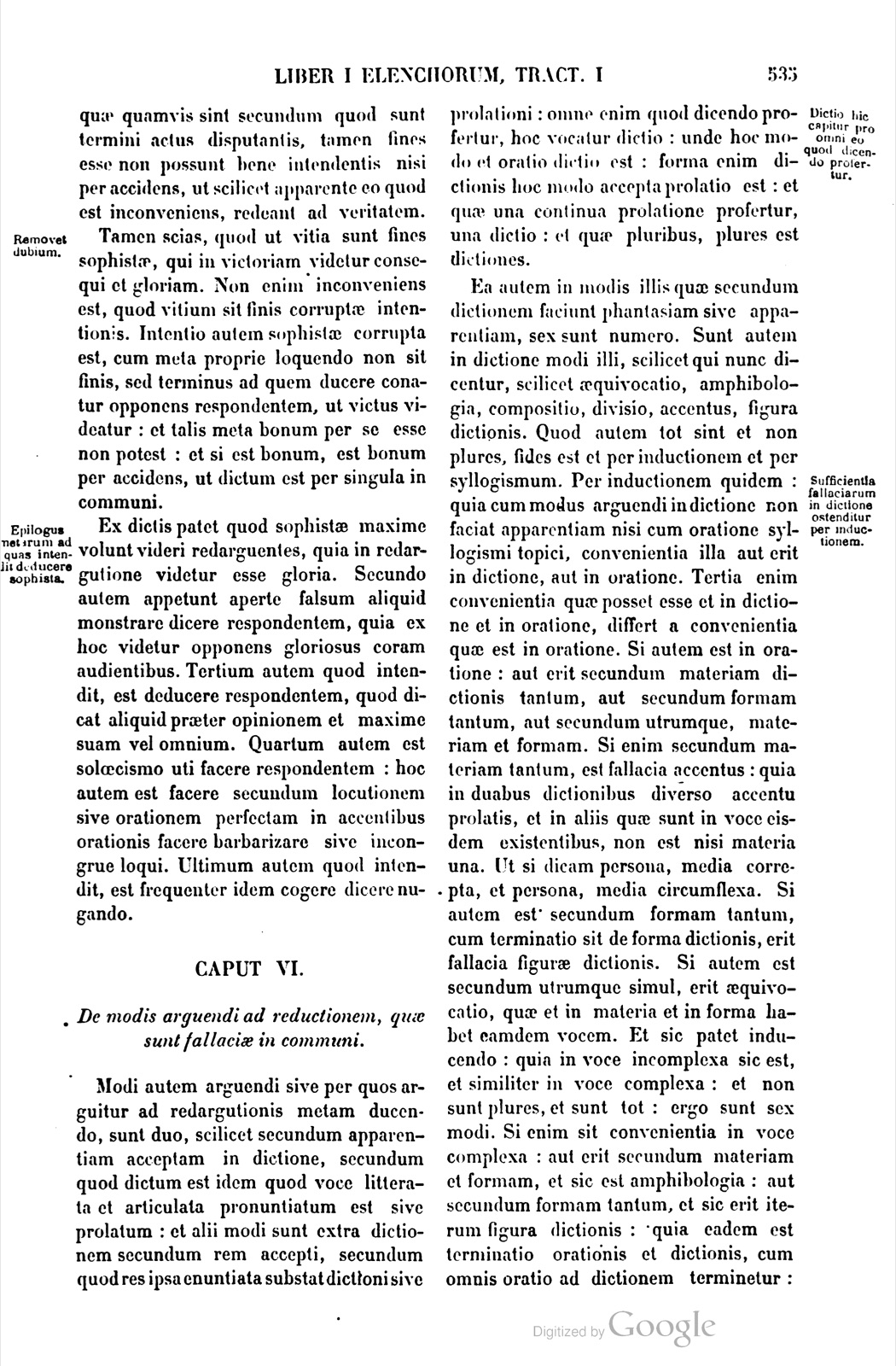
CAPUT VI. De modis arguendi ad reductionem, quae sunt fallaciae in communi.
Modi autem arguendi sive per quos arguitur ad redargutionis metam ducendo, sunt duo, scilicet secundum apparentiam acceptam in dictione, secundum quod dictum est idem quod voce litterata et articulata pronuntiatum est sive prolatum: et alii modi sunt extra dictionem secundum rem accepti, secundum quod res ipsa enuntiata substat dictioni sive prolationi: omne enim quod dicendo profertur, hoc vocatur dictio: unde hoc modo et oratio dictio est: forma enim dictionis hoc modo accepta prolatio est: et quae una continua prolatione profertur, una dictio: et quae pluribus, plures est dictiones.
Ea autem in modis illis quae secundum dictionem faciunt phantasiam sive apparentiam, sex sunt numero. Sunt autem in dictione modi illi, scilicet qui nunc dicentur, scilicet aequivocatio, amphibologia, compositio, divisio, accentus, figura dictionis. Quod autem tot sint et non plures, fides est et per inductionem et per syllogismum. Per inductionem quidem: quia cum modus arguendi in dictione non faciat apparentiam nisi cum oratione syllogismi topici, convenientia illa aut erit in dictione, aut in oratione. Tertia enim convenientia quae posset esse et in dictione et in oratione, differt a convenientia quae est in oratione. Si autem est in oratione: aut erit secundum materiam dictionis tantum, aut secundum formam tantum, aut secundum utrumque, materiam et formam. Si enim secundum materiam tantum, est fallacia accentus: quia in duabus dictionibus diverso accentu prolatis, et in aliis quae sunt in voce eisdem existentibus, non est nisi materia una. Ut si dicam persona, media corrupta, et persona, media circumflexa. Si autem est secundum formam tantum, cum terminatio sit de forma dictionis, erit fallacia figurae dictionis. Si autem est secundum utrumque simul, erit aequivocatio, quae et in materia et in forma habet eamdem vocem. Et sic patet inducendo: quia in voce incomplexa sic est, et similiter in voce complexa: et non sunt plures, et sunt tot: ergo sunt sex modi. Si enim sit convenientia in voce complexa: aut erit secundum materiam et formam, et sic est amphibologia: aut secundum formam tantum, et sic erit iterum figura dictionis: quia eadem est terminatio orationis et dictionis, cum omnis oratio ad dictionem terminetur: aut in materia tantum, et sic compositio et divisio: si enim una continua prolatione pronuntietur, erit composita: et si diversis prolationibus pronuntietur, erit divisa: nec conveniunt nisi in materia tantum oratio composita et divisa.
CHAPTER VI. On the modes of arguing toward reduction, which are fallacies in common.
But the modes of arguing, or those through which argument is made by leading to the goal of refutation, are two: namely, according to appearance taken in diction, according as diction is said to be the same as what has been pronounced or uttered by literate and articulate voice; and other modes are outside diction, taken according to the thing, according as the enunciated thing itself underlies diction or utterance. For everything that is brought forth by speaking is called diction; hence in this mode speech also is diction. For the form of diction taken in this way is utterance; and what is brought forth by one continuous utterance is one diction, and what is brought forth by several utterances is several dictions.
But those things in those modes which according to diction make phantasy or appearance are six in number. And those modes in diction are those which will now be stated: equivocation, amphibology, composition, division, accent, and figure of diction. But that there are so many and not more, the proof is both by induction and by syllogism. By induction indeed: because, since a mode of arguing in diction does not make appearance except with the speech of a topical syllogism, that agreement will be either in diction or in speech. For a third agreement which could be both in diction and in speech differs from the agreement which is in speech. But if it is in speech, it will be either according to the matter of diction only, or according to form only, or according to both, matter and form. For if it is according to matter only, it is the fallacy of accent, because in two dictions uttered with different accent, while other things which are in the voice remain the same, there is only one matter. As if I say persona, with the middle syllable corrupted, and persona, with the middle syllable circumflexed. But if it is according to form only, since termination belongs to the form of diction, it will be the fallacy of figure of diction. But if it is according to both together, it will be equivocation, which has the same word both in matter and in form. And thus it is clear by inducing, because it is so in the incomplex voice and similarly in complex voice; and there are not more, and there are so many; therefore there are six modes. For if there is agreement in complex voice, it will be either according to matter and form, and thus it is amphibology; or according to form only, and thus it will again be figure of diction, because the termination of speech and diction is the same, since every speech is terminated at diction; or in matter only, and thus composition and division. For if it is pronounced in one continuous utterance, it will be composed; and if it is pronounced in diverse utterances, it will be divided; and composed and divided speech agree only in matter.
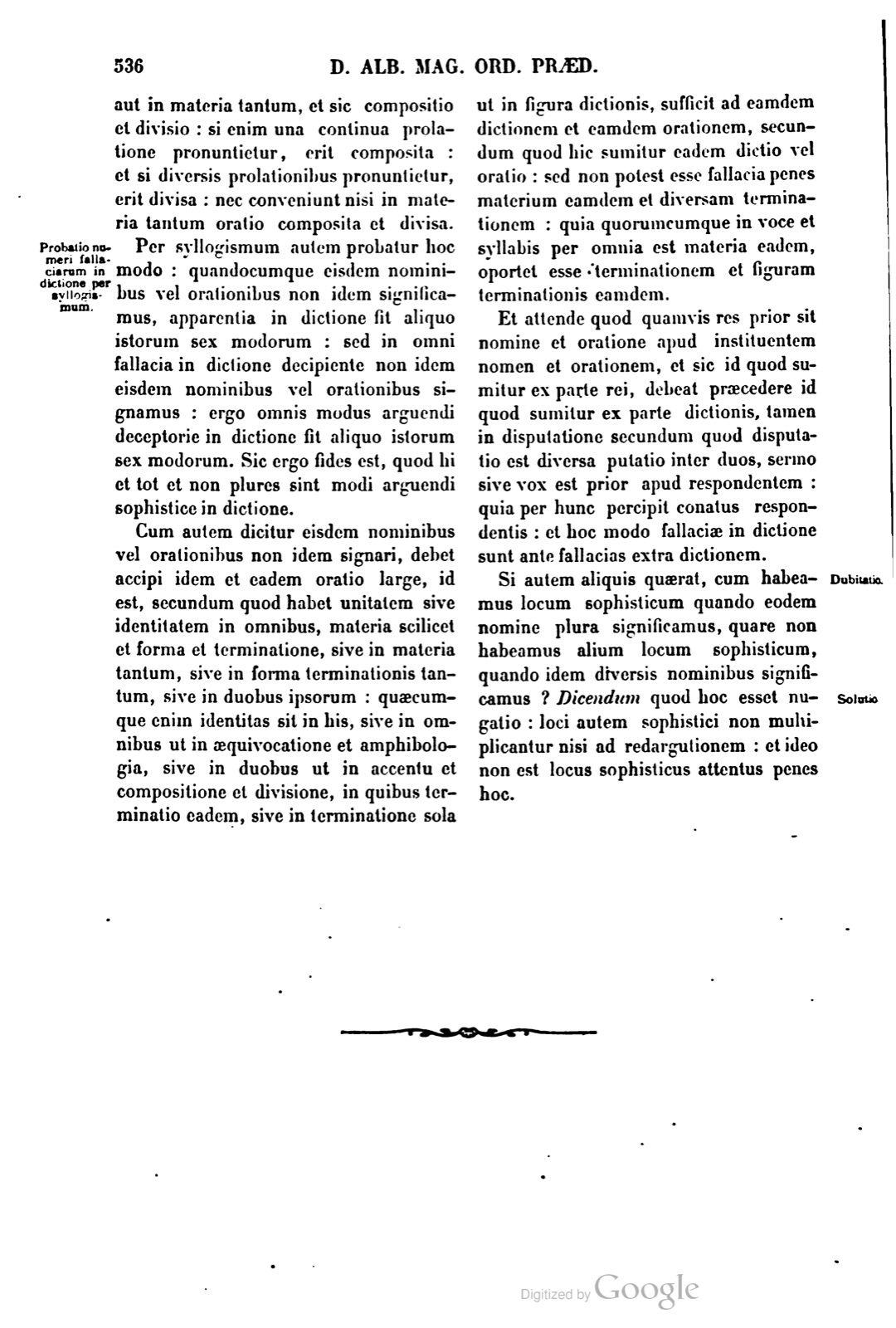
Per syllogismum autem probatur hoc modo: quandocumque eisdem nominibus vel orationibus non idem significamus, apparentia in dictione fit aliquo istorum sex modorum: sed in omni fallacia in dictione decipiente non idem eisdem nominibus vel orationibus signamus: ergo omnis modus arguendi deceptorie in dictione fit aliquo istorum sex modorum. Sic ergo fides est, quod hi et tot et non plures sint modi arguendi sophistice in dictione.
Cum autem dicitur eisdem nominibus vel orationibus non idem signari, debet accipi idem et eadem oratio large, id est, secundum quod habet unitatem sive identitatem in omnibus, materia scilicet et forma et terminatione, sive in materia tantum, sive in forma terminationis tantum, sive in duobus ipsorum: quaecumque enim identitas sit in his, sive in omnibus ut in aequivocatione et amphibologia, sive in duobus ut in accentu et compositione et divisione, in quibus terminatio eadem, sive in terminatione sola ut in figura dictionis, sufficit ad eamdem dictionem et eamdem orationem, secundum quod hic sumitur eadem dictio vel oratio: sed non potest esse fallacia penes materiam eamdem et diversam terminationem: quia quorumcumque in voce et syllabis per omnia est materia eadem, oportet esse terminationem et figuram terminationis eamdem.
Et attende quod quamvis res prior sit nomine et oratione apud instituentem nomen et orationem, et sic id quod sumitur ex parte rei, debeat praecedere id quod sumitur ex parte dictionis, tamen in disputatione secundum quod disputatio est diversa putatio inter duos, sermo sive vox est prior apud respondentem: quia per hunc percipit conatus respondentis: et hoc modo fallaciae in dictione sunt ante fallacias extra dictionem.
Si autem aliquis quaerat, cum habeamus locum sophisticum quando eodem nomine plura significamus, quare non habeamus alium locum sophisticum, quando idem diversis nominibus significamus? Dicendum quod hoc esset nugatio: loci autem sophistici non multiplicantur nisi ad redargutionem: et ideo non est locus sophisticus attentus penes hoc.
But by syllogism this is proved in this way: whenever by the same names or speeches we do not signify the same thing, appearance in diction is made by one of those six modes; but in every deceiving fallacy in diction we do not signify the same thing by the same names or speeches; therefore every deceptive mode of arguing in diction is made by one of those six modes. Thus therefore the proof is that these, and so many, and not more, are the modes of arguing sophistically in diction.
But when it is said that the same thing is not signified by the same names or speeches, the same and the same speech must be taken broadly, that is, according as it has unity or identity in all things, namely matter and form and termination, or in matter only, or in the form of termination only, or in two of these. For whatever identity there is in these, whether in all, as in equivocation and amphibology, or in two, as in accent and composition and division, in which the termination is the same, or in termination alone, as in figure of diction, suffices for the same diction and the same speech, according as the same diction or speech is taken here. But there cannot be a fallacy with respect to the same matter and a different termination, because of whatever things in voice and syllables the matter is wholly the same, the termination and the figure of termination must be the same.
And attend that, although the thing is prior to the name and speech for the one instituting the name and speech, and thus what is taken from the side of the thing ought to precede what is taken from the side of diction, nevertheless in disputation, according as disputation is a diverse thinking between two persons, speech or voice is prior for the respondent, because through it he perceives the attempts of the respondent; and in this way fallacies in diction are before fallacies outside diction.
But if someone asks, since we have a sophistical place when by the same name we signify many things, why do we not have another sophistical place when we signify the same thing by diverse names? One must say that this would be babbling; but sophistical places are not multiplied except for refutation, and therefore no sophistical place is attended to with respect to this.
If a page does not appear, its photograph has not been uploaded yet.