Works › Sophistical Refutations, Books I–II
Volume 2 · pp. 533–535
Chapter V. On the five goals
A marker with ≈ is an approximate page boundary, placed by measure of the text; the page photographs remain the authority. In the paired views, clicking a page marker brings that page into view.
CAPUT V. De quinque metis.
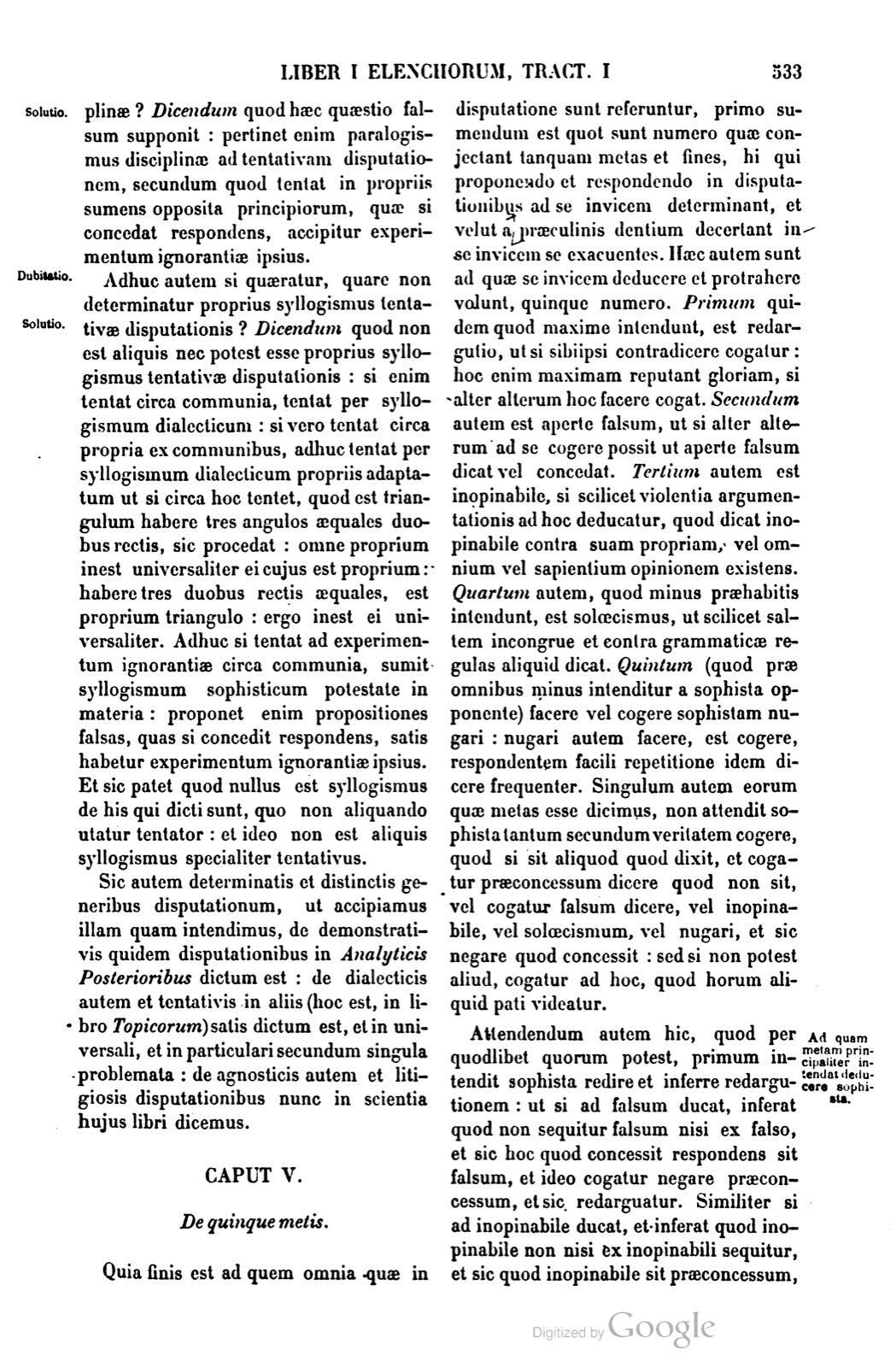
Quia finis est ad quem omnia quae in disputatione sunt referuntur, primo sumendum est quot sunt numero quae conjectant tanquam metas et fines, hi qui proponendo et respondendo in disputationibus ad se invicem determinant, et velut ac praecultis dentium decertant in se invicem se exacuentes. Haec autem sunt ad quae se invicem deducere et protrahere volunt, quinque numero. Primum quidem quod maxime intendunt, est redargutio, ut si sibi ipsi contradicere cogatur: hoc enim maximam reputant gloriam, si alter alterum hoc facere cogat. Secundum autem est aperte falsum, ut si alter alterum ad se cogere possit ut aperte falsum dicat vel concedat. Tertium autem est inopinabile, si scilicet violentia argumentationis ad hoc deducatur, quod dicat inopinabile contra suam propriam, vel omnium vel sapientium opinionem existens. Quartum autem, quod minus prae habitis intendunt, est solaecismus, ut scilicet saltem incongrue et contra grammaticae regulas aliquid dicat. Quintum, quod prae omnibus minus intenditur a sophista opponente, facere vel cogere sophistam nugari: nugari autem facere, est cogere respondentem facili repetitione idem dicere frequenter. Singulum autem eorum quae metas esse dicimus, non attendit sophista tantum secundum veritatem cogere, quod si sit aliquod quod dixit, et cogatur praeconcessum dicere quod non sit, vel cogatur falsum dicere, vel inopinabile, vel solaecismum, vel nugari, et sic negare quod concessit: sed si non potest aliud, cogatur ad hoc, quod horum aliquid pati videatur.
Attendendum autem hic, quod per quodlibet quorum potest, primum intendit sophista redire et inferre redargutionem: ut si ad falsum ducat, inferat quod non sequitur falsum nisi ex falso, et sic hoc quod concessit respondens sit falsum, et ideo cogatur negare praeconcessum, et sic redarguatur. Similiter si ad inopinabile ducat, et inferat quod inopinabile non nisi ex inopinabili sequitur, et sic quod inopinabile sit praeconcessum, et sic idem negare cogatur quod praeconcessit. Similiter si ad solaecismum ducit, intendit quod nihil signaverit in praeconcesso, et sic quod praeconcessit negare cogatur. Et idem est in nugari, quia per hoc improbare vult quod praeconcessit: quia inutile fuit, et sic praeconcessum sit negandum. Ex quo patet, quod in omnibus aliis intendit primum: ipsum autem primum intendit principaliter: et ideo loci sophistici qui sunt fallaciae, non ponuntur nisi ad redargutionem. Ad alias autem metas aliae viae ponuntur, et non fallaciae.
CHAPTER V. On the five goals.
Because the end is that to which all things that are in disputation are referred, one must first take how many in number are the things which those who, by proposing and responding in disputations, determine themselves to one another, and, as though with the sharpened front of the teeth, contend with one another while sharpening themselves against one another, aim at as goals and ends. But these things to which they wish to lead and drag one another are five in number. The first, indeed, which they chiefly intend, is refutation, as when someone is compelled to contradict himself; for they count this the greatest glory, if one compels the other to do this. The second is the openly false, as if one can compel the other to himself so that he openly says or concedes something false. The third is the improbable, namely if by the violence of argumentation he is led to this, that he says something improbable existing against his own opinion, or the opinion of all, or of the wise. The fourth, which they intend less than the preceding, is solecism, namely that at least he say something incongruously and contrary to the rules of grammar. The fifth, which before all is less intended by the sophist objecting, is to make or compel the sophist to babble; but to make one babble is to compel the respondent by easy repetition to say the same thing frequently. The sophist does not attend to each of the things which we say are goals only according to compelling in truth, that if there is something which he said, he is compelled to say that what was preconceded is not, or is compelled to say something false, or improbable, or a solecism, or to babble, and thus to deny what he conceded; but if he cannot do anything else, he is compelled to this, that he seem to suffer one of these things.
But here one must attend that, through whichever of these he can, the sophist first intends to return to and infer refutation: as if he leads to the false, he infers that the false does not follow except from the false, and thus that what the respondent conceded is false, and therefore he is compelled to deny the preconceded, and thus he is refuted. Similarly, if he leads to the improbable and infers that the improbable follows only from the improbable, then that the improbable was preconceded, and thus he is compelled to deny the same thing which he preconceded. Similarly, if he leads to solecism, he intends that he signified nothing in the preconceded, and thus that he be compelled to deny what he preconceded. And it is the same in babbling, because through this he wishes to disprove what he preconceded, because it was useless, and thus the preconceded is to be denied. From this it is clear that in all the other things he intends the first; but he intends the first itself principally; and therefore the sophistical places which are fallacies are posited only for refutation. But for the other goals other ways are posited, and not fallacies.
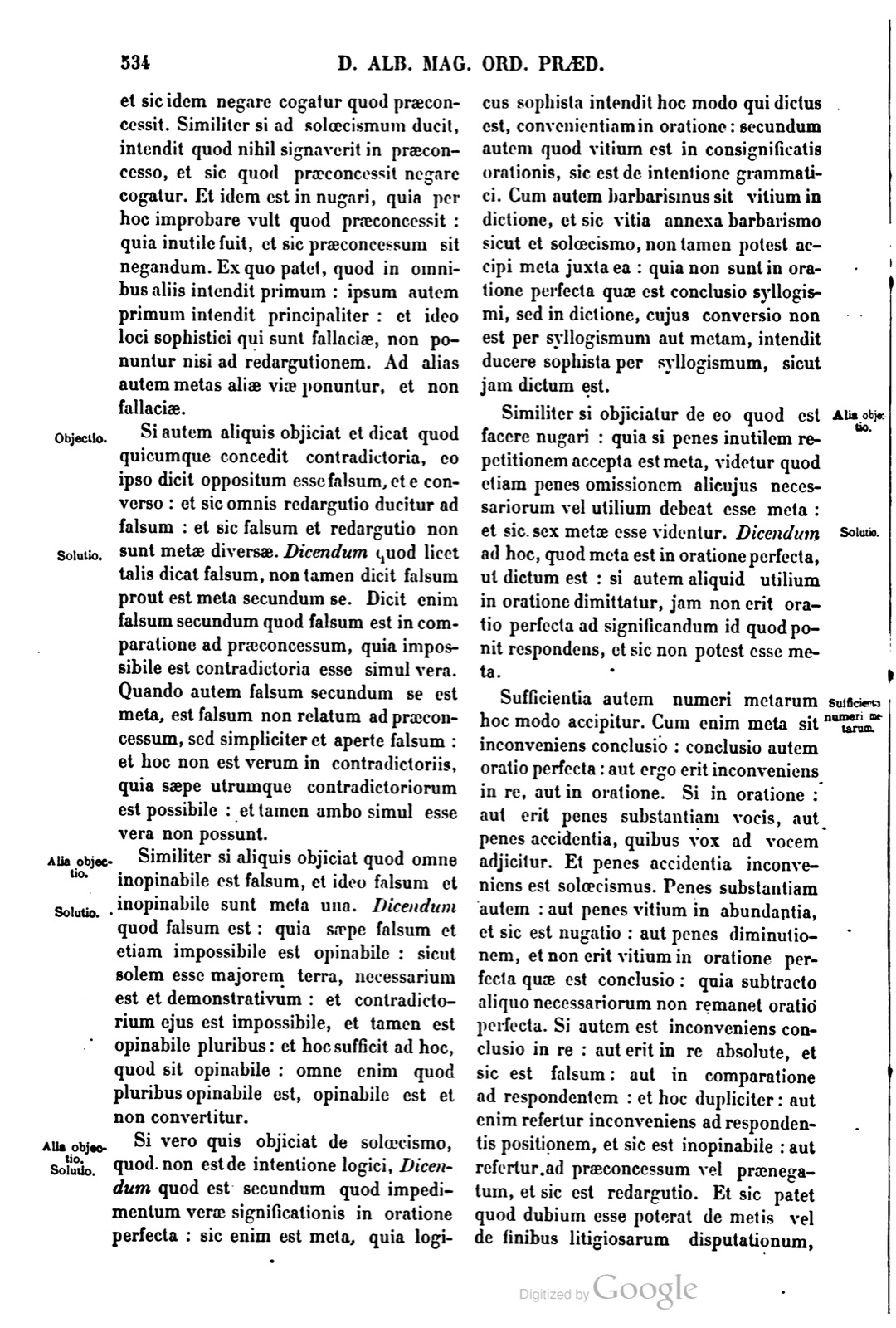
Si autem aliquis objiciat et dicat quod quicumque concedit contradictoria, eo ipso dicit oppositum esse falsum, et e converso: et sic omnis redargutio ducitur ad falsum: et sic falsum et redargutio non sunt metae diversae. Dicendum quod licet talis dicat falsum, non tamen dicit falsum prout est meta secundum se. Dicit enim falsum secundum quod falsum est in comparatione ad praeconcessum, quia impossibile est contradictoria esse simul vera. Quando autem falsum secundum se est meta, est falsum non relatum ad praeconcessum, sed simpliciter et aperte falsum: et hoc non est verum in contradictoriis, quia saepe utrumque contradictoriorum est possibile: et tamen ambo simul esse vera non possunt.
Similiter si aliquis objiciat quod omne inopinabile est falsum, et ideo falsum et inopinabile sunt meta una. Dicendum quod falsum est: quia saepe falsum et etiam impossibile est opinabile: sicut solem esse majorem terra, necessarium est et demonstrativum: et contradictorium ejus est impossibile, et tamen est opinabile pluribus: et hoc sufficit ad hoc, quod sit opinabile: omne enim quod pluribus opinabile est, opinabile est et non convertitur.
Si vero quis objiciat de solaecismo, quod non est de intentione logici, dicendum quod est secundum quod impedit mentum verae significationis in oratione perfecta: sic enim est meta, quia logicus sophista intendit hoc modo qui dictus est, convenientiam in oratione: secundum autem quod vitium est in consignificatis orationis, sic est de intentione grammatici. Cum autem barbarismus sit vitium in dictione, et sic vitia annexa barbarismo sicut et solaecismo, non tamen potest accipi meta juxta ea: quia non sunt in oratione perfecta quae est conclusio syllogismi, sed in dictione, cujus conversio non est per syllogismum aut metam, intendit ducere sophista per syllogismum, sicut jam dictum est.
Similiter si objiciatur de eo quod est facere nugari: quia si penes inutilem repetitionem accepta est meta, videtur quod etiam penes omissionem alicujus necessariorum vel utilium debeat esse meta: et sic sex metae esse videntur. Dicendum ad hoc, quod meta est in oratione perfecta, ut dictum est: si autem aliquid utilium in oratione dimittatur, jam non erit oratio perfecta ad significandum id quod ponit respondens, et sic non potest esse meta.
But if someone objects and says that whoever concedes contradictories, by that very fact says that the opposite is false, and conversely, and thus every refutation is led back to the false, and so the false and refutation are not different goals: one must say that although such a person says something false, nevertheless he does not say the false insofar as it is a goal according to itself. For he says the false according as the false is in comparison to the preconceded, because it is impossible for contradictories to be true simultaneously. But when the false according to itself is a goal, it is the false not related to the preconceded, but simply and openly false; and this is not true in contradictories, because often each of the contradictories is possible, and nevertheless both cannot be true simultaneously.
Similarly, if someone objects that everything improbable is false, and therefore the false and the improbable are one goal, one must say that this is false, because often the false and even the impossible is opinable; as that the sun is greater than the earth is necessary and demonstrative, and its contradictory is impossible, and yet it is opinable to many. And this suffices for this, that it be opinable; for everything that is opinable to many is opinable, and it is not converted.
But if someone objects concerning solecism, that it is not of the intention of the logician, one must say that it is according as it impedes the true signification in a perfect speech; for thus it is a goal, because the sophistical logician intends in the mode which has been stated agreement in speech. But according as the fault is in the consignified things of speech, thus it belongs to the intention of the grammarian. But since barbarism is a fault in diction, and thus faults attached to barbarism as also to solecism, nevertheless a goal cannot be taken according to them, because they are not in the perfect speech which is the conclusion of syllogism, but in diction, whose turning the sophist does not intend to lead by syllogism or goal, but he intends to lead by syllogism, as has already been said.
Similarly, if objection is made concerning what it is to make one babble: because if a goal has been received according to useless repetition, it seems that there also ought to be a goal according to the omission of something necessary or useful, and thus there seem to be six goals. To this one must say that a goal is in perfect speech, as has been said; but if something useful is omitted in speech, it will no longer be a perfect speech for signifying what the respondent posits, and thus it cannot be a goal.
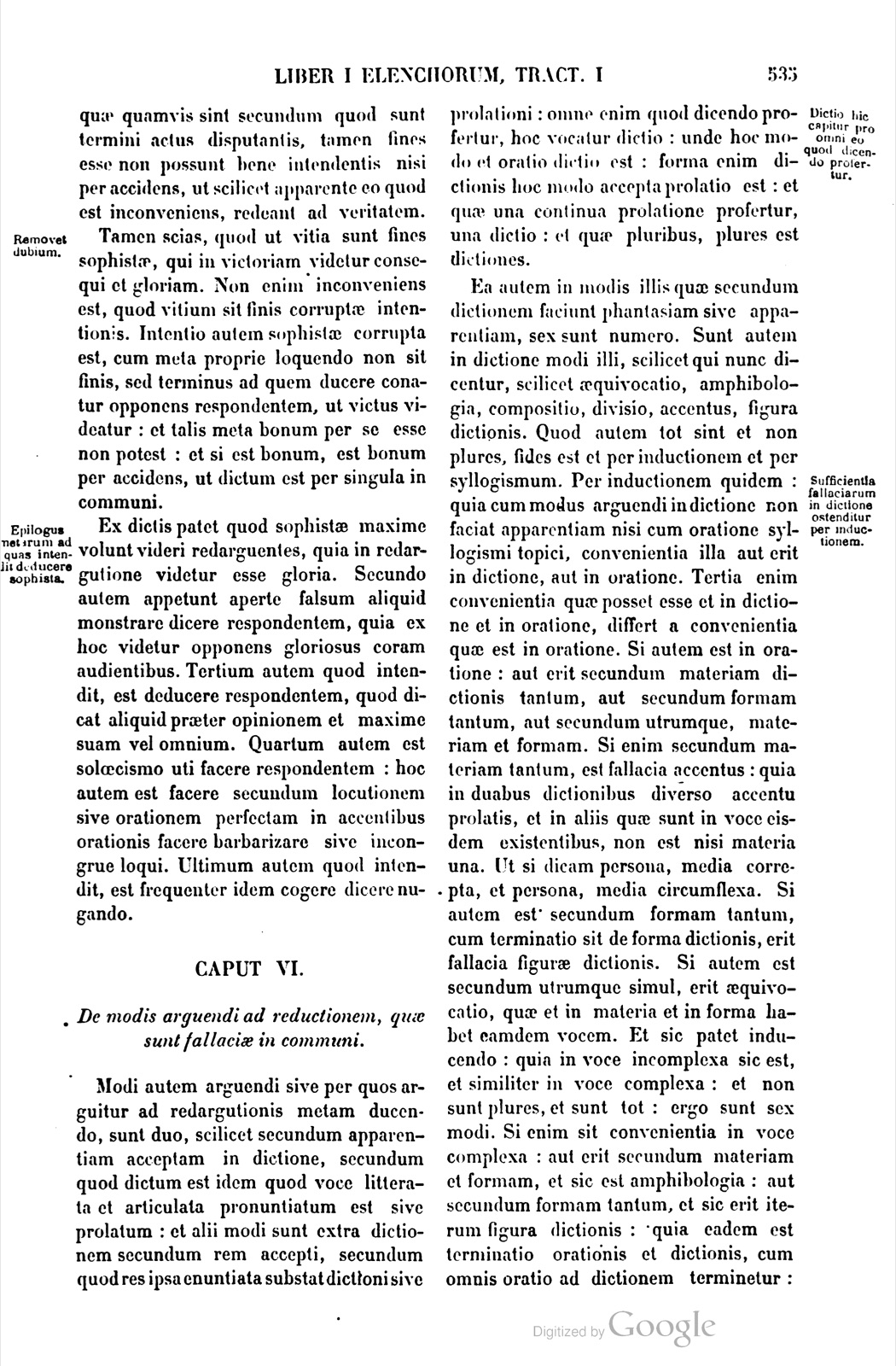
Sufficientia autem numeri metarum hoc modo accipitur. Cum enim meta sit inconveniens conclusio: conclusio autem oratio perfecta: aut ergo erit inconveniens in re, aut in oratione. Si in oratione: aut erit penes substantiam vocis, aut penes accidentia, quibus vox ad vocem adjicitur. Et penes accidentia inconveniens est solaecismus. Penes substantiam autem: aut penes vitium in abundantia, et sic est nugatio: aut penes diminutionem, et non erit vitium in oratione perfecta quae est conclusio: quia subtracto aliquo necessariorum non remanet oratio perfecta. Si autem est inconveniens conclusio in re: aut erit in re absolute, et sic est falsum: aut in comparatione ad respondentem: et hoc dupliciter: aut enim refertur inconveniens ad respondentis positionem, et sic est inopinabile: aut refertur ad praeconcessum vel praenegatum, et sic est redargutio. Et sic patet quod dubium esse poterat de metis vel de finibus litigiosarum disputationum, quae quamvis sint secundum quod sunt termini actus disputantis, tamen fines esse non possunt bene intendentis nisi per accidens, ut scilicet apparente eo quod est inconveniens, redeant ad veritatem.
Tamen scias, quod ut vitia sunt fines sophistae, qui in victoriam videtur consequi et gloriam. Non enim inconveniens est, quod vitium sit finis corruptae intentionis. Intentio autem sophistae corrupta est, cum meta proprie loquendo non sit finis, sed terminus ad quem ducere conatur opponens respondentem, ut victus videatur: et talis meta bonum per se esse non potest: et si est bonum, est bonum per accidens, ut dictum est per singula in communi.
Ex dictis patet quod sophistae maxime volunt videri redarguentes, quia in redargutione videtur esse gloria. Secundo autem appetunt aperte falsum aliquid monstrare dicere respondentem, quia ex hoc videtur opponens gloriosus coram audientibus. Tertium autem quod intendit, est deducere respondentem, quod dicat aliquid praeter opinionem et maxime suam vel omnium. Quartum autem est solaecismo uti facere respondentem: hoc autem est facere secundum locutionem sive orationem perfectam in accentibus orationis facere barbarizare sive incongrue loqui. Ultimum autem quod intendit, est frequenter idem cogere dicere nugando.
But the sufficiency of the number of goals is taken in this way. Since a goal is an unsuitable conclusion, and a conclusion is a perfect speech, therefore it will be unsuitable either in the thing or in the speech. If in the speech, it will be either with respect to the substance of the voice or with respect to accidents by which voice is added to voice. And with respect to accidents the unsuitable thing is solecism. But with respect to substance, it is either by reason of a fault in abundance, and thus it is babbling; or by reason of diminution, and then there will not be a fault in the perfect speech which is the conclusion, because when something necessary has been subtracted a perfect speech does not remain. But if it is an unsuitable conclusion in the thing, either it is so in the thing absolutely, and thus it is the false; or in comparison to the respondent, and this in two ways: for either the unsuitable thing is referred to the respondent's position, and thus it is the improbable; or it is referred to what was preconceded or predenied, and thus it is refutation. And thus it is clear what doubt there could be concerning the goals or ends of contentious disputations, which, although they are terms of the act of the disputant, nevertheless cannot be ends of one intending well except accidentally, namely so that, with that which is unsuitable appearing, they return to truth.
Yet know that they are ends of the sophist as faults, since he seems to pursue victory and glory. For it is not unsuitable that fault should be the end of a corrupt intention. But the intention of the sophist is corrupt, since a goal, properly speaking, is not an end, but the term to which the objector endeavors to lead the respondent, so that he may seem conquered; and such a goal cannot be a good in itself, and if it is a good, it is a good accidentally, as has been said in common through the individual cases.
From the things said it is clear that sophists most of all wish to seem refuting, because glory seems to exist in refutation. Second, they desire to show that the respondent says something openly false, because from this the objector seems glorious before the hearers. Third, what he intends is to lead the respondent to say something beyond opinion, and especially beyond his own or everyone's opinion. Fourth is to make the respondent use solecism; but this is, according to locution or perfect speech, to make him barbarize or speak incongruously in the accents of speech. But the last thing which he intends is frequently to compel him to say the same thing by babbling.
If a page does not appear, its photograph has not been uploaded yet.