Works › Sophistical Refutations, Books I–II
Volume 2 · pp. 531–533
Chapter IV. On the kinds of disputations
A marker with ≈ is an approximate page boundary, placed by measure of the text; the page photographs remain the authority. In the paired views, clicking a page marker brings that page into view.
CAPUT IV. De generibus disputationum.
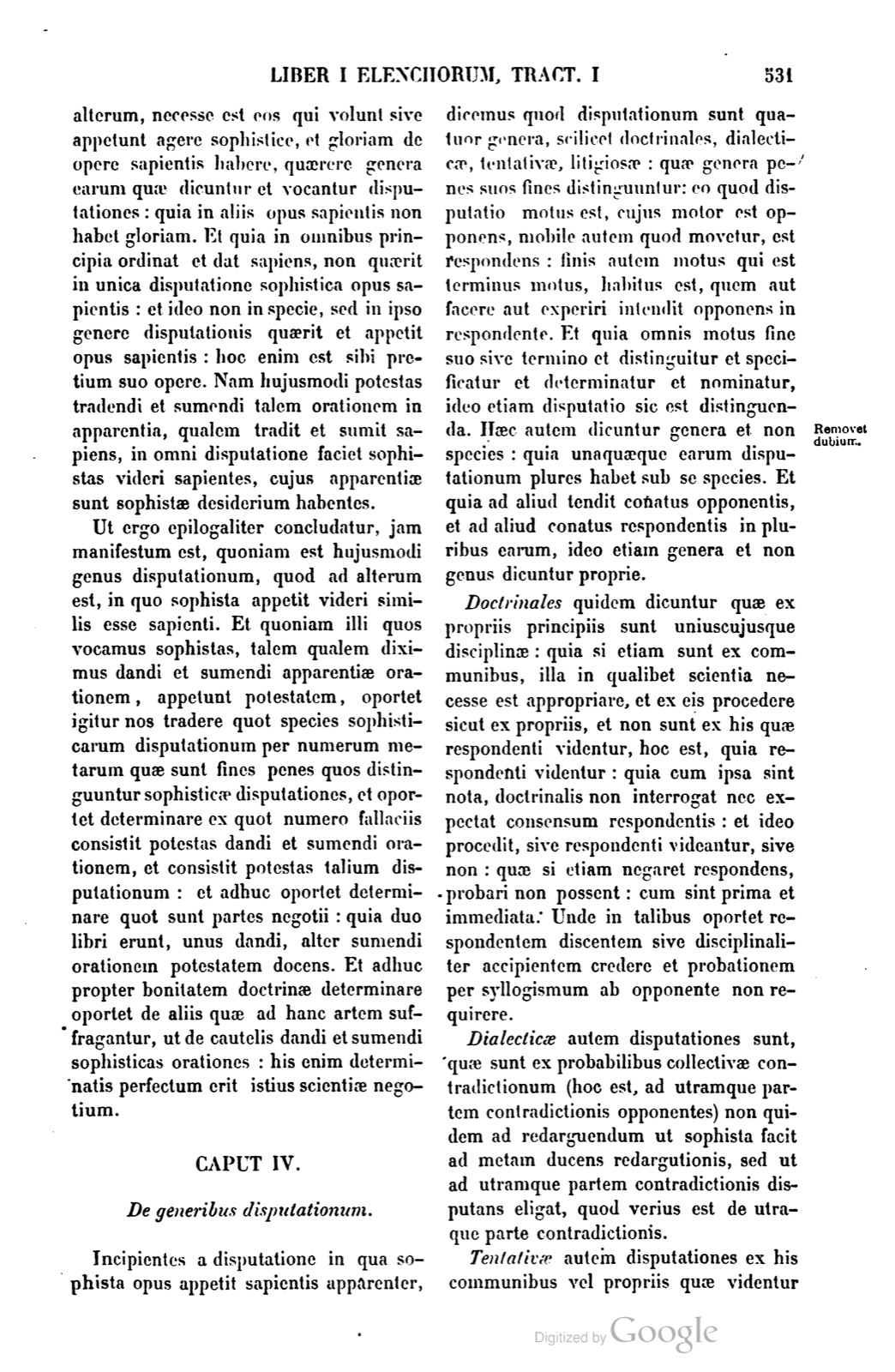
Incipientes a disputatione in qua sophista opus appetit sapientis apparenter, dicemus quod disputationum sunt quatuor genera, scilicet doctrinales, dialecticae, tentativae, litigiosae: quae genera penes suos fines distinguuntur: eo quod disputatio motus est, cujus motor est opponens, mobile autem quod movetur, est respondens: finis autem motus qui est terminus motus, habitus est, quem aut facere aut experiri intendit opponens in respondente. Et quia omnis motus fine suo sive termino et distinguitur et specificatur et determinatur et nominatur, ideo etiam disputatio sic est distinguenda. Haec autem dicuntur genera et non species: quia unaquaeque earum disputationum plures habet sub se species. Et quia ad aliud tendit conatus opponentis, et ad aliud conatus respondentis in pluribus earum, ideo etiam genera et non genus dicuntur proprie.
Doctrinales quidem dicuntur quae ex propriis principiis sunt uniuscujusque disciplinae: quia si etiam sunt ex communibus, illa in qualibet scientia necesse est appropriare, et ex eis procedere sicut ex propriis, et non sunt ex his quae respondenti videntur, hoc est, quia respondenti videntur: quia cum ipsa sint nota, doctrinalis non interrogat nec expectat consensum respondentis: et ideo procedit, sive respondenti videantur, sive non: quae si etiam negaret respondens, probari non possent: cum sint prima et immediata: Unde in talibus oportet respondentem discentem sive disciplinaliter accipientem credere et probationem per syllogismum ab opponente non requirere.
Dialecticae autem disputationes sunt, quae sunt ex probabilibus collectivae contradictionum, hoc est, ad utramque partem contradictionis opponentes, non quidem ad redarguendum ut sophista facit ad metam ducens redargutionis, sed ut ad utramque partem contradictionis disputans eligat, quod verius est de utraque parte contradictionis.
Tentativae autem disputationes ex his communibus vel propriis quae videntur respondenti, et quae necessarium est scire eum qui simulat vel dicit se habere scientiam, hoc est, quibus nescitis pro certo accipitur experimentum ignorantiae, et quibus scitis non propter hoc habetur experimentum scientiae: et haec sunt communia: quia illis nescitis ignoratur ars sive scientia, et illis scitis non sequitur quod propter hoc sciatur ars vel scientia. Quomodo autem tentativa sit circa talia, determinatum est in aliis quae de Topicis jam habita sunt: si tamen circa propria tentat aliquando demonstrator et singula propria, tunc acciperet experimentum scientiae, quae si nescirentur, nesciretur ars, et quibus scitis etiam ipsa consequenter scitur ars.
CHAPTER IV. On the kinds of disputations.
Beginning from the disputation in which the sophist apparently desires the work of the wise man, we shall say that there are four kinds of disputations, namely doctrinal, dialectical, tentative, and contentious; and these kinds are distinguished according to their ends, because disputation is a motion, whose mover is the one objecting, while the movable thing that is moved is the respondent. But the end of the motion, which is the term of the motion, is a habit, which the objector intends either to produce or to test in the respondent. And because every motion is distinguished, specified, determined, and named by its end or term, therefore disputation also is to be distinguished in this way. But these are called kinds and not species, because each of these disputations has many species under itself. And because the effort of the objector tends to one thing, and the effort of the respondent to another in several of them, therefore they are also properly called kinds and not a genus.
Those are called doctrinal which are from the proper principles of each discipline, because even if they are from common principles, these must be appropriated in any science and one must proceed from them as from proper principles; and they are not from those things which seem so to the respondent, that is, because they seem so to the respondent. For since they themselves are known, the doctrinal disputation does not interrogate nor wait for the consent of the respondent; and therefore it proceeds whether they seem so to the respondent or not. If the respondent even denied them, they could not be proved, since they are first and immediate. Hence in such things the respondent who is learning or receiving disciplinarily must believe and not require proof through syllogism from the objector.
Dialectical disputations are those which are collective of contradictions from probable things, that is, objecting to each part of a contradiction, not indeed for refuting as the sophist does by leading to the goal of refutation, but so that, disputing toward each part of the contradiction, he may choose what is truer concerning each part of the contradiction.
Tentative disputations are from those common or proper things which seem so to the respondent, and which it is necessary for the one who pretends or says that he has science to know, that is, by ignorance of which an experiment of ignorance is received with certainty, and by knowledge of which, for this reason, an experiment of science is not had. And these are common, because if they are not known the art or science is unknown, and if they are known it does not follow on account of this that the art or science is known. But how the tentative disputation is about such things has been determined in the other things already had concerning the Topics; yet if the demonstrator sometimes tests about proper things and individual proper things, then he would receive an experiment of science, which, if they were not known, the art would be unknown, and by knowledge of which the art itself is consequently known.
Litigiosae autem disputationes, quae sunt ex his quae videntur probabilia per locum sophisticum, non sunt autem vere et secundum esse probabilia: syllogizant enim ad minus syllogismum verum factum secundum formam et materiam, quam syllogismus quaerit in oratione: procedunt enim ex duabus propositionibus secundum vocem communicantibus in termino uno, quod est medium duorum terminorum, in quibus a se invicem differunt propositiones: et haec est vera quantum ad vocem forma et materia syllogismi, quando in qualitate et quantitate debitis ad modum alicujus figurae combinantur: et ideo syllogizant vere hac veritate syllogismi sophistici, quamvis non veritate probantis syllogizent.
Istarum autem disputationum sufficientia penes terminos et fines accipitur: quia disputans movendo respondentem, aut intendit facere habitum, aut experiri si vere inest sibi habitus quem dicit esse factum. Si autem intendit facere habitum, tunc ille habitus aut est necessarius et immobilis, et sic est doctrinalis: aut est vincens cum ex probabilibus per necessariam consequentiam, et tunc est dialectica deficiens a necessitate consequentis quae est in doctrinali, et retinens necessitatem consequentiae: aut intendit facere habitum qui videtur et non est, qui quidem generatur ex his quae sequuntur in voce, et ideo in re sequi videntur et non sequuntur: et tunc est disputatio litigiosa. Si autem intendat experiri habitum qui factus dicitur esse, erit disputatio tentativa.
Et notandum, quod penes idem videtur esse divisio syllogismi et divisio disputationis quantum ad materiam: et tamen syllogismus dividitur in Topicis, et disputatio dividitur hic: quia cum syllogismus et maxime syllogismus probans, per prius et posterius dicatur de demonstrativo et dialectico et litigioso, syllogismus dialecticus medius est ut mutans quantum materia permittit demonstrativum: cum autem mutatur litigiosus: et sicut medium refertur ad utrumque, et sic in consideratione ipsius omnes differentiae syllogismi considerantur. Propter quod in scientia de syllogismo dialectico conveniens fuit syllogismum in suas dividere differentias: quia aliter nesciretur cum quibus ut extremis syllogismus dialecticus communicat. Disputatio etiam dicitur per prius et posterius de generibus disputationum, sed per prius dicitur de disputatione litigiosa. In his autem quae per prius et posterius dicuntur, commune quidem est in uno, et in aliis est secundum proportionem ad illud: nec sciri possunt modi secundorum, nisi cum principali: et ideo hic conveniens fuit distinguere modos disputationum.
But contentious disputations, which are from those things which seem probable through a sophistical place, are not truly and according to being probable; for they syllogize at least a true syllogism made according to form and matter, which the syllogism seeks in speech. For they proceed from two propositions communicating according to speech in one term, which is the middle of two terms, in which the propositions differ from one another; and this is the true form and matter of a syllogism as to speech, when they are combined in the due quality and quantity according to the mode of some figure. And therefore they syllogize truly with this truth of a sophistical syllogism, although they do not syllogize with the truth of a proving syllogism.
The sufficiency of these disputations is taken according to terms and ends, because the disputant, in moving the respondent, either intends to make a habit or to test whether the habit which he says has been made is truly present to him. But if he intends to make a habit, then that habit is either necessary and immovable, and thus it is doctrinal; or it is persuasive, since from probable things it proceeds through necessary consequence, and then it is dialectical, deficient from the necessity of the consequent which is in the doctrinal disputation and retaining the necessity of consequence; or he intends to make a habit which seems to exist and does not, and this is generated from those things which follow in speech, and therefore seem to follow in reality and do not follow: and then it is contentious disputation. But if he intends to test a habit which is said to have been made, it will be tentative disputation.
And one must note that the division of syllogism and the division of disputation seem to be with respect to the same thing as to matter, and nevertheless the syllogism is divided in the Topics and disputation is divided here; because, since syllogism, and especially proving syllogism, is said by prior and posterior of demonstrative, dialectical, and contentious syllogism, the dialectical syllogism is a middle as changing into the demonstrative so far as matter permits, while the contentious is also changed; and as the middle is referred to each, so in the consideration of it all the differences of syllogism are considered. For this reason in the science concerning dialectical syllogism it was fitting to divide syllogism into its differences, because otherwise it would not be known with which extremes the dialectical syllogism communicates. Disputation also is said by prior and posterior of the kinds of disputations, but by priority it is said of contentious disputation. In those things which are said by prior and posterior, the common is in one, and in the others according to proportion to it; nor can the modes of the secondary things be known except with the principal one, and therefore here it was fitting to distinguish the modes of disputations.
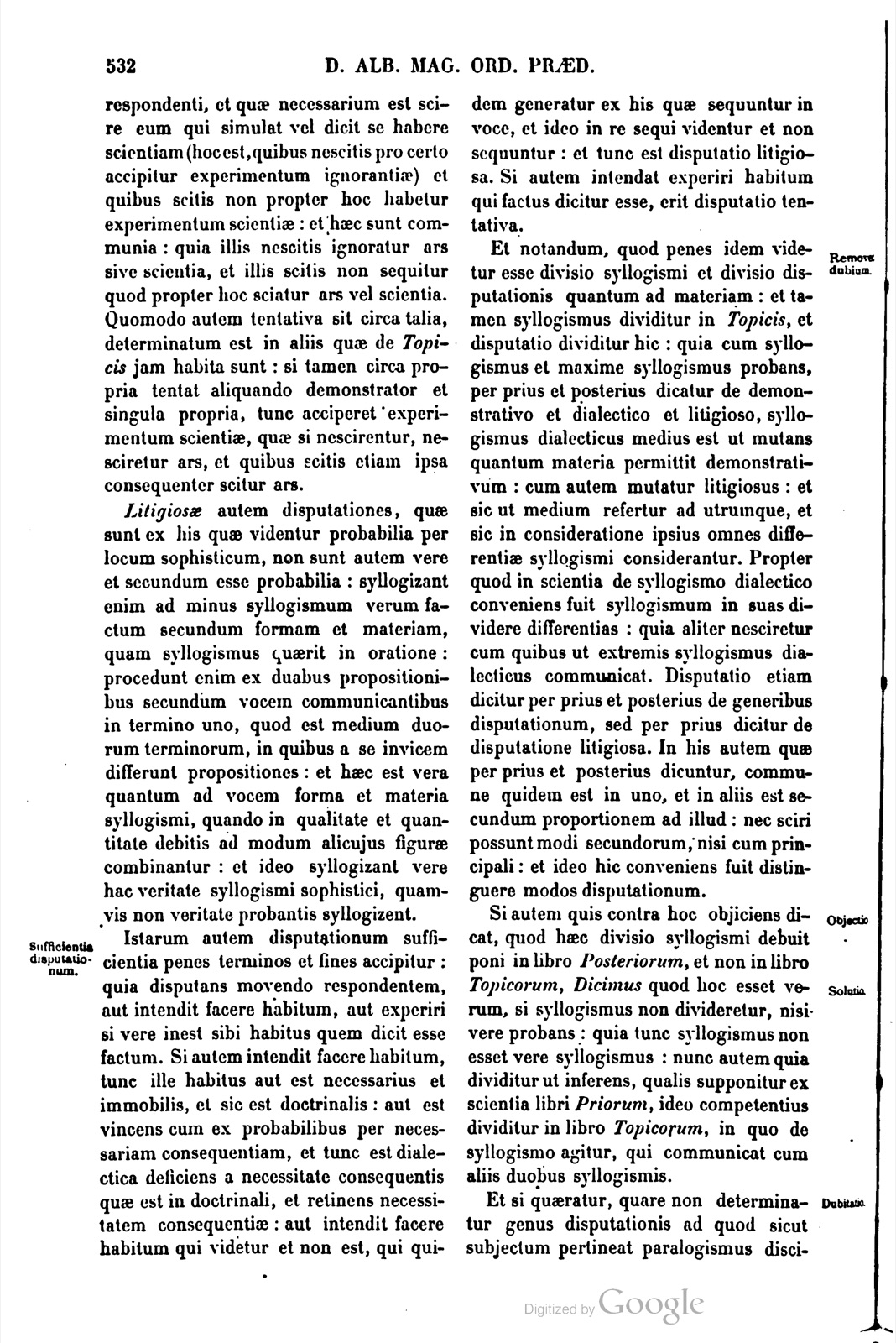
Si autem quis contra hoc objiciens dicat, quod haec divisio syllogismi debuit poni in libro Posteriorum, et non in libro Topicorum, dicimus quod hoc esset verum, si syllogismus non divideretur, nisi vere probans: quia tunc syllogismus non esset vere syllogismus: nunc autem quia dividitur ut inferens, qualis supponitur ex scientia libri Priorum, ideo competentius dividitur in libro Topicorum, in quo de syllogismo agitur, qui communicat cum aliis duobus syllogismis.
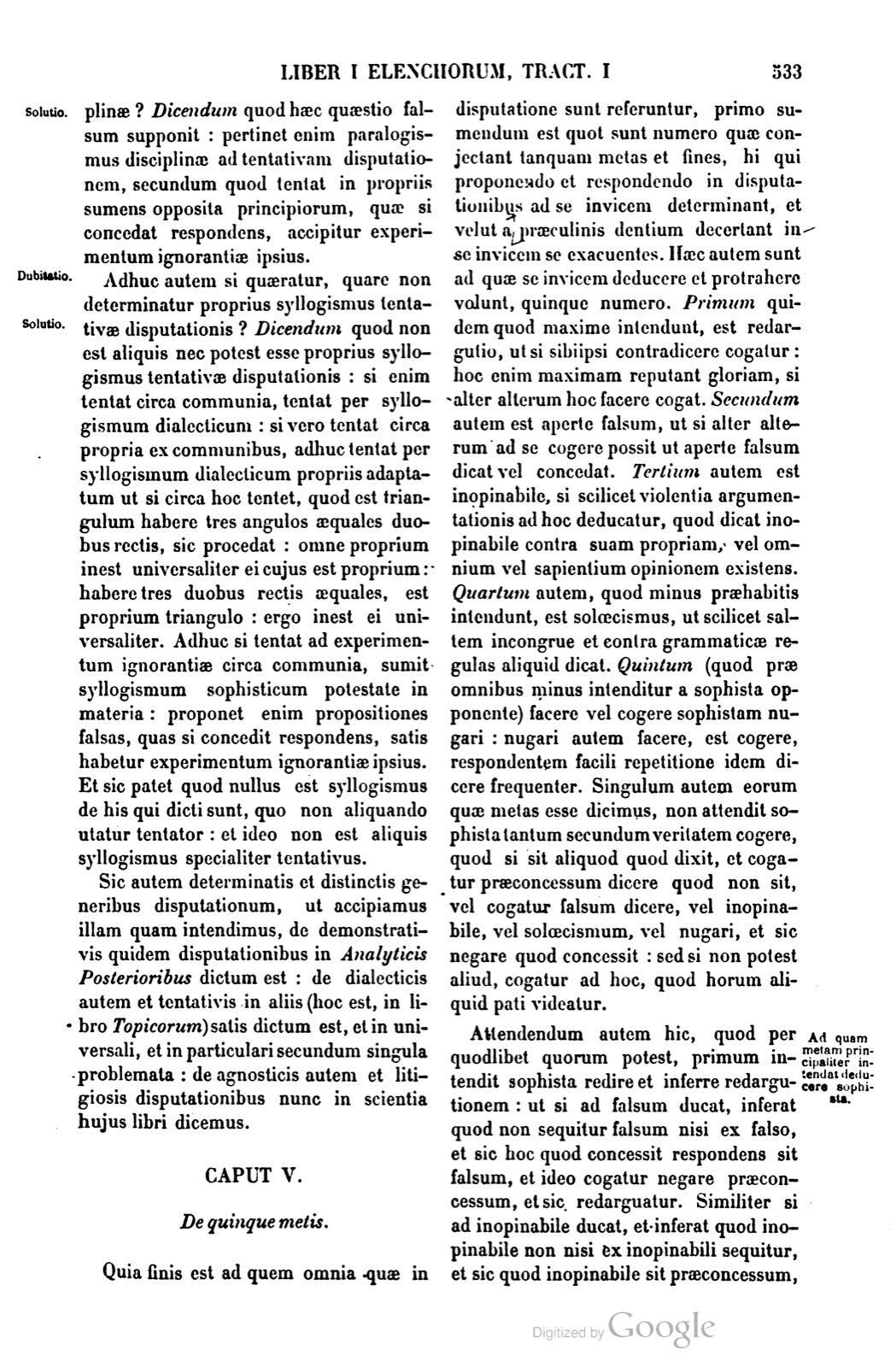
Et si quaeratur, quare non determinatur genus disputationis ad quod sicut subjectum pertineat paralogismus disciplinae? Dicendum quod haec quaestio falsum supponit: pertinet enim paralogismus disciplinae ad tentativam disputationem, secundum quod tentat in propriis sumens opposita principiorum, quae si concedat respondens, accipitur experimentum ignorantiae ipsius.
Adhuc autem si quaeratur, quare non determinatur proprius syllogismus tentativae disputationis? Dicendum quod non est aliquis nec potest esse proprius syllogismus tentativae disputationis: si enim tentat circa communia, tentat per syllogismum dialecticum: si vero tentat circa propria ex communibus, adhuc tentat per syllogismum dialecticum propriis adaptatum, ut si circa hoc tentet, quod est triangulum habere tres angulos aequales duobus rectis, sic procedat: omne proprium inest universaliter ei cujus est proprium: habere tres duobus rectis aequales, est proprium triangulo: ergo inest ei universaliter. Adhuc si tentat ad experimentum ignorantiae circa communia, sumit syllogismum sophisticum potestate in materia: proponet enim propositiones falsas, quas si concedit respondens, satis habetur experimentum ignorantiae ipsius. Et sic patet quod nullus est syllogismus de his qui dicti sunt, quo non aliquando utatur tentator: et ideo non est aliquis syllogismus specialiter tentativus.
Sic autem determinatis et distinctis generibus disputationum, ut accipiamus illam quam intendimus, de demonstrativis quidem disputationibus in Analyticis Posterioribus dictum est: de dialecticis autem et tentativis in aliis, hoc est, in libro Topicorum, satis dictum est, et in universali, et in particulari secundum singula problemata: de agnosticis autem et litigiosis disputationibus nunc in scientia hujus libri dicemus.
But if someone objecting against this says that this division of syllogism ought to have been placed in the book of the Posterior Analytics and not in the book of the Topics, we say that this would be true if syllogism were divided only as truly proving, because then syllogism would not be truly syllogism; but now, because it is divided as inferring, such as is supposed from the science of the book of the Prior Analytics, therefore it is more fittingly divided in the book of the Topics, in which syllogism is treated, which communicates with the other two syllogisms.
And if it is asked why the kind of disputation is not determined to which the disciplinary paralogism belongs as to a subject, one must say that this question supposes something false; for the disciplinary paralogism belongs to tentative disputation, according as it tests in proper things by taking opposites of principles, which, if the respondent concedes them, an experiment of his ignorance is received.
Moreover, if it is asked why a proper syllogism of tentative disputation is not determined, one must say that there is not any nor can there be a proper syllogism of tentative disputation. For if it tests concerning common things, it tests through a dialectical syllogism; but if it tests concerning proper things from common things, it still tests through a dialectical syllogism adapted to proper things, as if it were to test concerning this, that a triangle has three angles equal to two right angles, it proceeds thus: every proper attribute belongs universally to that of which it is proper; to have three equal to two right angles is proper to the triangle; therefore it belongs to it universally. Moreover, if it tests for an experiment of ignorance concerning common things, it takes a sophistical syllogism in power in matter; for it will propose false propositions which, if the respondent concedes them, an experiment of his ignorance is sufficiently had. And thus it is clear that there is no syllogism among those that have been named which the tester does not sometimes use; and therefore there is no syllogism specially tentative.
But with the kinds of disputations thus determined and distinguished, so that we may receive the one which we intend, concerning demonstrative disputations it has indeed been said in the Posterior Analytics; but concerning dialectical and tentative disputations enough has been said in the other things, that is, in the book of the Topics, both universally and particularly according to individual problems. But concerning agnostic and contentious disputations we shall now speak in the science of this book.
If a page does not appear, its photograph has not been uploaded yet.