Works › Sophistical Refutations, Books I–II
Volume 2 · pp. 527–530
Chapter II. On the things that must be treated and how many sophistical refutations there are
A marker with ≈ is an approximate page boundary, placed by measure of the text; the page photographs remain the authority. In the paired views, clicking a page marker brings that page into view.
CAPUT II. De quibus tractandum est et quot sunt sophistici elenchi.
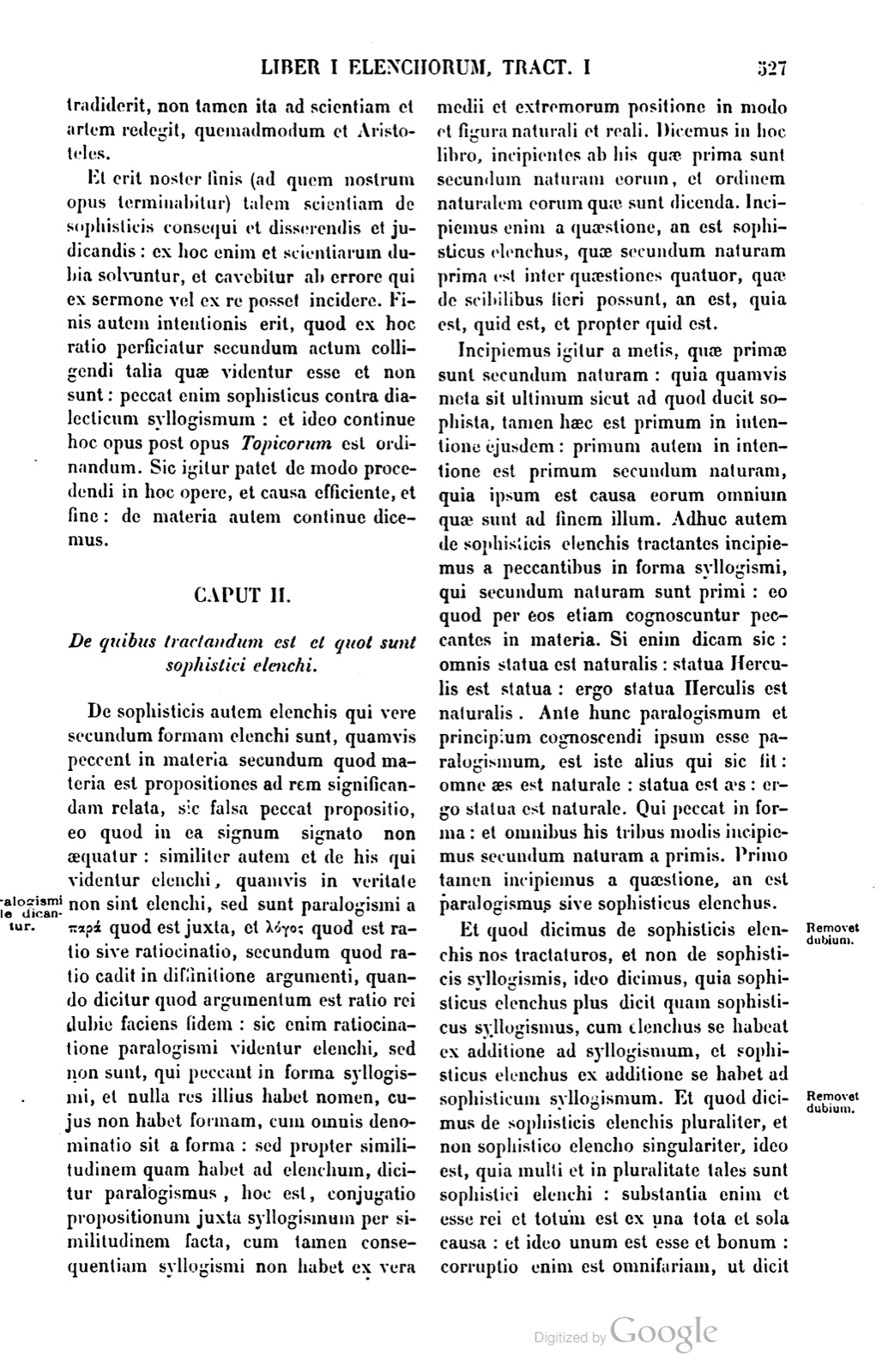
De sophisticis autem elenchis qui vere secundum formam elenchi sunt, quamvis peccent in materia secundum quod materia est propositiones ad rem significandam relata, sic falsa peccat propositio, eo quod in ea signum signato non aequatur: similiter autem et de his qui videntur elenchi, quamvis in veritate non sint elenchi, sed sunt paralogismi a παρά quod est juxta, et λόγος quod est ratio sive ratiocinatio, secundum quod ratio cadit in diffinitione argumenti, quando dicitur quod argumentum est ratio rei dubiae faciens fidem: sic enim ratiocinatione paralogismi videntur elenchi, sed non sunt, qui peccant in forma syllogismi, et nulla res illius habet nomen, cujus non habet formam, cum omnis denominatio sit a forma: sed propter similitudinem quam habet ad elenchum, dicitur paralogismus, hoc est, conjugatio propositionum juxta syllogismum per similitudinem facta, cum tamen consequentiam syllogismi non habet ex vera medii et extremorum positione in modo et figura naturali et reali. Dicemus in hoc libro, incipientes ab his quae prima sunt secundum naturam eorum, et ordinem naturalem eorum quae sunt dicenda. Incipiemus enim a quaestione, an est sophisticus elenchus, quae secundum naturam prima est inter quaestiones quatuor, quae de scibilibus fieri possunt, an est, quia est, quid est, et propter quid est.
Incipiemus igitur a metis, quae primae sunt secundum naturam: quia quamvis meta sit ultimum sicut ad quod ducit sophista, tamen haec est primum in intentione ejusdem: primum autem in intentione est primum secundum naturam, quia ipsum est causa eorum omnium quae sunt ad finem illum. Adhuc autem de sophisticis elenchis tractantes incipiemus a peccantibus in forma syllogismi, qui secundum naturam sunt primi: eo quod per eos etiam cognoscuntur peccantes in materia. Si enim dicam sic: omnis statua est naturalis: statua Herculis est statua: ergo statua Herculis est naturalis. Ante hunc paralogismum et principium cognoscendi ipsum esse paralogismum, est iste alius qui sic fit: omne aes est naturale: statua est aes: ergo statua est naturale. Qui peccat in forma: et omnibus his tribus modis incipiemus secundum naturam a primis. Primo tamen incipiemus a quaestione, an est paralogismus sive sophisticus elenchus.
Et quod dicimus de sophisticis elenchis nos tractaturos, et non de sophisticis syllogismis, ideo dicimus, quia sophisticus elenchus plus dicit quam sophisticus syllogismus, cum elenchus se habeat ex additione ad syllogismum, et sophisticus elenchus ex additione se habet ad sophisticum syllogismum. Et quod dicimus de sophisticis elenchis pluraliter, et non sophistico elencho singulariter, ideo est, quia multi et in pluralitate tales sunt sophistici elenchi: substantia enim et esse rei et totum est ex una tota et sola causa: et ideo unum est esse et bonum: corruptio enim est omnifariam, ut dicit Aristoteles: et ideo melius in plurali dicitur de sophisticis elenchis, quam de sophistico elencho: corruptio enim elenchi in uno modo non consistit, sed in multis et partitis ad unum modum non reducibilibus. Quod autem diximus sophisticum elenchum peccare in materia, intelligendum est quod dictum est de materia secundum vocem scilicet et rei naturam et conjugationem naturalem rerum significatarum in oratione: et materiam quidem secundum vocem habet paralogismus peccans in materia: et sic syllogismus est verus proximam et essentialem materiam habens syllogismi: realiter autem secundum quod ea quae sunt in voce, sunt ad rem significandam, non habet materiam: et ideo non est syllogismus, cum materiam non habens, per consequens et forma reali sit necesse carere: vocaliter igitur syllogismus est, et non realiter: significatio enim sermonis adjacet falso, sicut figura hominis adjacet mortuo: nam statim cadunt vel corrumpuntur a figura quae cadunt ab esse: quamvis figura comitetur et consequens sit esse, sicut dicit Aristoteles in quarto Meteororum.
CHAPTER II. On the things that must be treated and how many sophistical refutations there are.
But concerning sophistical refutations which truly are refutations according to the form of a refutation, although they sin in matter according as matter is propositions referred to signifying the thing, in the way in which a false proposition sins, because in it the sign is not equated to the signified; and similarly concerning those which seem to be refutations, although in truth they are not refutations, but are paralogisms from παρά, which is beside, and λόγος, which is reason or reasoning, according as reason falls in the definition of argument, when it is said that an argument is a reason making faith concerning a doubtful thing. For thus by reasoning paralogisms seem to be refutations, but are not, since they sin in the form of syllogism; and no thing has the name of that whose form it does not have, since every denomination is from form. But because of the likeness which it has to a refutation, it is called a paralogism, that is, a conjunction of propositions made beside the syllogism by likeness, although it does not have the consequence of syllogism from the true position of the middle and extremes in a natural and real mode and figure. In this book we shall speak, beginning from those things which are first according to their nature and the natural order of the things which must be said. For we shall begin from the question whether there is a sophistical refutation, which according to nature is first among the four questions that can be asked about knowable things: whether it is, because it is, what it is, and on account of what it is.
Therefore we shall begin from the goals, which are first according to nature, because although the goal is last as that to which the sophist leads, nevertheless this is first in his intention; but what is first in intention is first according to nature, because it is the cause of all those things which are for that end. Moreover, treating of sophistical refutations, we shall begin from those that sin in the form of syllogism, which according to nature are first, because through them those that sin in matter are also known. For if I say thus: every statue is natural; the statue of Hercules is a statue; therefore the statue of Hercules is natural. Before this paralogism and the principle of knowing it to be a paralogism, there is that other which is made thus: every bronze is natural; a statue is bronze; therefore a statue is natural. This one sins in form, and in all these three modes we shall begin according to nature from the first things. Yet first we shall begin from the question whether there is a paralogism or sophistical refutation.
And when we say that we are going to treat of sophistical refutations, and not of sophistical syllogisms, we say this because a sophistical refutation says more than a sophistical syllogism, since a refutation stands by addition to a syllogism, and a sophistical refutation stands by addition to a sophistical syllogism. And when we speak of sophistical refutations in the plural, and not of a sophistical refutation in the singular, the reason is that many such sophistical refutations exist and in plurality; for the substance and being of a thing and the whole are from one whole and sole cause, and therefore being and good are one; but corruption is in every way, as Aristotle says, and therefore it is better to speak in the plural of sophistical refutations than in the singular of a sophistical refutation. For the corruption of a refutation does not consist in one mode, but in many modes, divided and not reducible to one mode. But what we said, that a sophistical refutation sins in matter, must be understood as was said concerning matter according to speech, namely also the nature of the thing and the natural conjunction of the things signified in speech. And indeed a paralogism sinning in matter has matter according to speech, and thus it is a true syllogism having the proximate and essential matter of a syllogism; but really, according as the things which are in speech are for signifying the thing, it does not have matter; and therefore it is not a syllogism, since, not having matter, consequently it necessarily lacks real form. Therefore it is a syllogism vocally and not really; for the signification of speech lies next to the false, just as the figure of a man lies next to a dead man; for things which fall from being at once fall or are corrupted from figure, although figure accompanies and is consequent upon being, as Aristotle says in the fourth book of the Meteorology.
De his igitur dicemus incipientes a quaestione an est talis sophisticus elenchus, sicut diximus. Quod enim sit, sic probatur. Quoniam ergo alii quidem sunt veri syllogismi veram materiam et veram formam realiter habentes secundum naturalem et realem medii positionem, alii autem cum non sint veri syllogismi, videntur tamen esse syllogismi per aliquam causam apparentiae et similitudinis ad veros syllogismos, manifestum est ex nunc dicendis: hoc enim fit in omnibus rebus et animatis et inanimatis: unde quemadmodum hoc fit in aliis a syllogismis, quod aliquid videtur esse et non est, ita fit et in orationibus syllogisticis. In hominibus enim alii quidem habent bene habitum unde laudentur, ut nobiles et pulchri, sicut sunt secundum veritatem: alii autem in veritate quidem non habent talem habitum, videntur etenim per compositionem exteriorem habere tribualiter hoc quod non habent sibi apparenter tribuentes et inflando se per extensionem ad magna quae non habent, procedentes et fingentes se exterius ut videantur esse quod non sunt. Et sic pulchri sunt, alii quidem propter decorem quem habent in veritate, alii autem cum non sint in veritate decori, videntur tamen esse decori, componentes se exterius, ut videantur esse quod non sunt. Et hoc non tantum est in animatis, sed etiam inanimatis similiter est: nam horum quae sunt inanimata, haec quidem sunt argentea vere secundum formam et materiam argenti: illa vero sunt aurea vere. Illa autem non sunt vere argentea vel aurea, sed secundum sensum apparenter, ut lithargyria quidem, hoc est, de spuma et faece argenti facta, et stannea videntur in sensu in superficie argentea: aurichalchea vero felle croceo canino tincta, videntur in superficie quantum ad primum intuitum esse aurea.
Therefore concerning these things we shall speak, beginning from the question whether there is such a sophistical refutation, as we said. That it is, is proved thus. Since therefore some are true syllogisms, really having true matter and true form according to the natural and real position of the middle, and others, though they are not true syllogisms, nevertheless seem to be syllogisms through some cause of appearance and likeness to true syllogisms, this is manifest from the things now to be said. For this happens in all things, both animate and inanimate; hence, just as this happens in things other than syllogisms, that something seems to be and is not, so it happens also in syllogistic speeches. For among men some have a good disposition for which they are praised, as noble and beautiful men, just as they are according to truth; but others, though in truth they do not have such a disposition, nevertheless seem to have outwardly, by external composition, that which they do not have, assigning things apparently to themselves and puffing themselves up by extension to great things which they do not have, proceeding and fashioning themselves outwardly so that they may seem to be what they are not. And thus some are beautiful, indeed some because of the beauty which they have in truth, but others, although in truth they are not beautiful, nevertheless seem to be beautiful, composing themselves outwardly so that they may seem to be what they are not. And this is not only in animate things, but similarly also in inanimate things: for of those things which are inanimate, some are truly silver according to the form and matter of silver, and others are truly gold. But those things are not truly silver or gold, but apparently according to sense, as lithargyries, that is, things made from the foam and dregs of silver, and tin things seem to the sense on the surface to be silver; but brass things dyed with saffron-colored dog-gall seem on the surface, as to the first glance, to be gold.
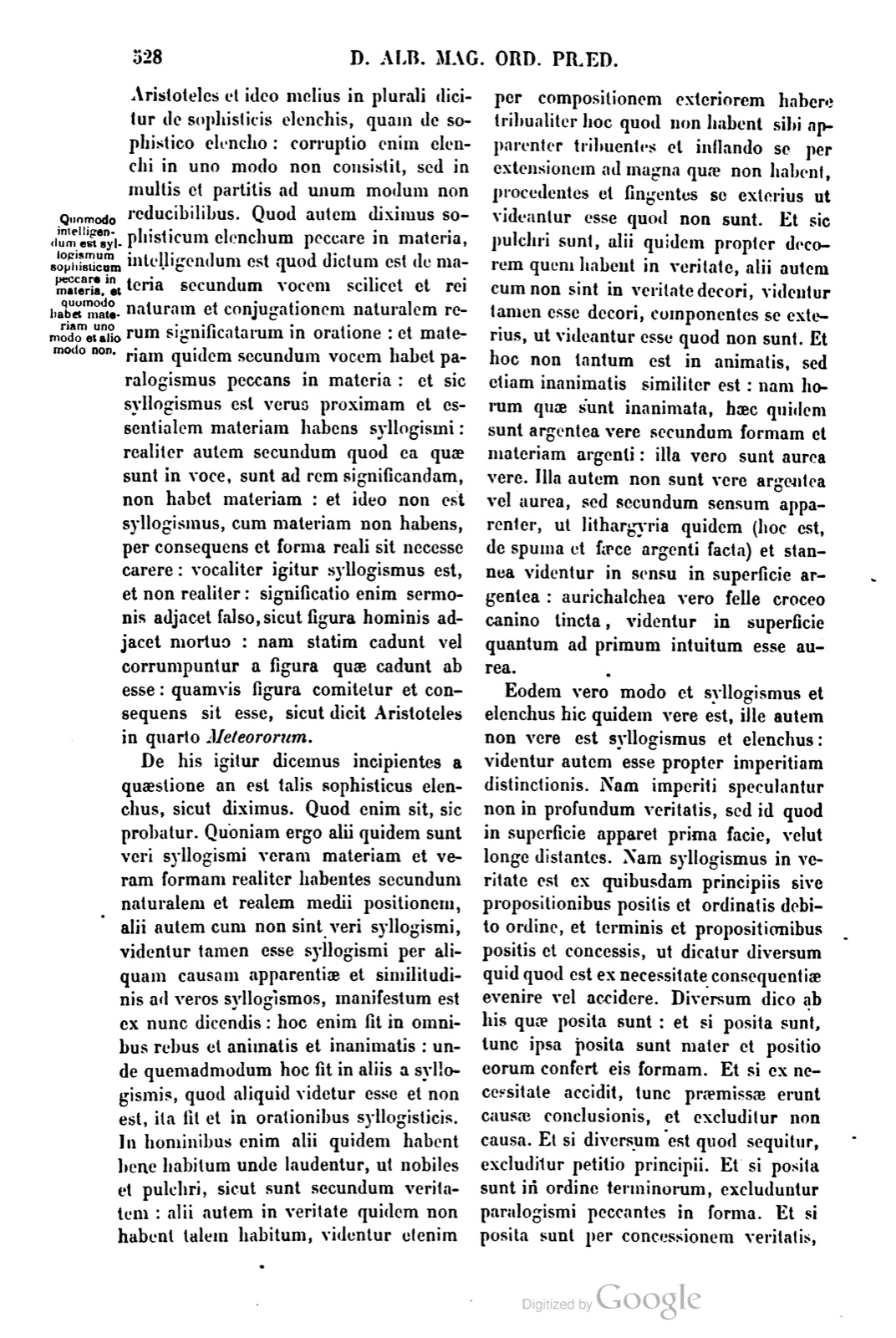
Eodem vero modo et syllogismus et elenchus hic quidem vere est, ille autem non vere est syllogismus et elenchus: videntur autem esse propter imperitiam distinctionis. Nam imperiti speculantur non in profundum veritatis, sed id quod in superficie apparet prima facie, velut longe distantes. Nam syllogismus in veritate est ex quibusdam principiis sive propositionibus positis et ordinatis debito ordine, et terminis et propositionibus positis et concessis, ut dicatur diversum quid quod est ex necessitate consequentiae evenire vel accidere. Diversum dico ab his quae posita sunt: et si posita sunt, tunc ipsa posita sunt mater et positio eorum confert eis formam. Et si ex necessitate accidit, tunc praemissae erunt causae conclusionis, et excluditur non causa. Et si diversum est quod sequitur, excluditur petitio principii. Et si posita sunt in ordine terminorum, excluduntur paralogismi peccantes in forma. Et si posita sunt per concessionem veritatis, excluduntur peccantes in materia. Elenchus autem verus est syllogismus cum contradictione conclusionis. Et sic uterque tam syllogismus, quam elenchus, vere concludit: quod non facit sophisticus: ergo sophisticus videtur esse syllogismus et elenchus, non autem est in veritate.
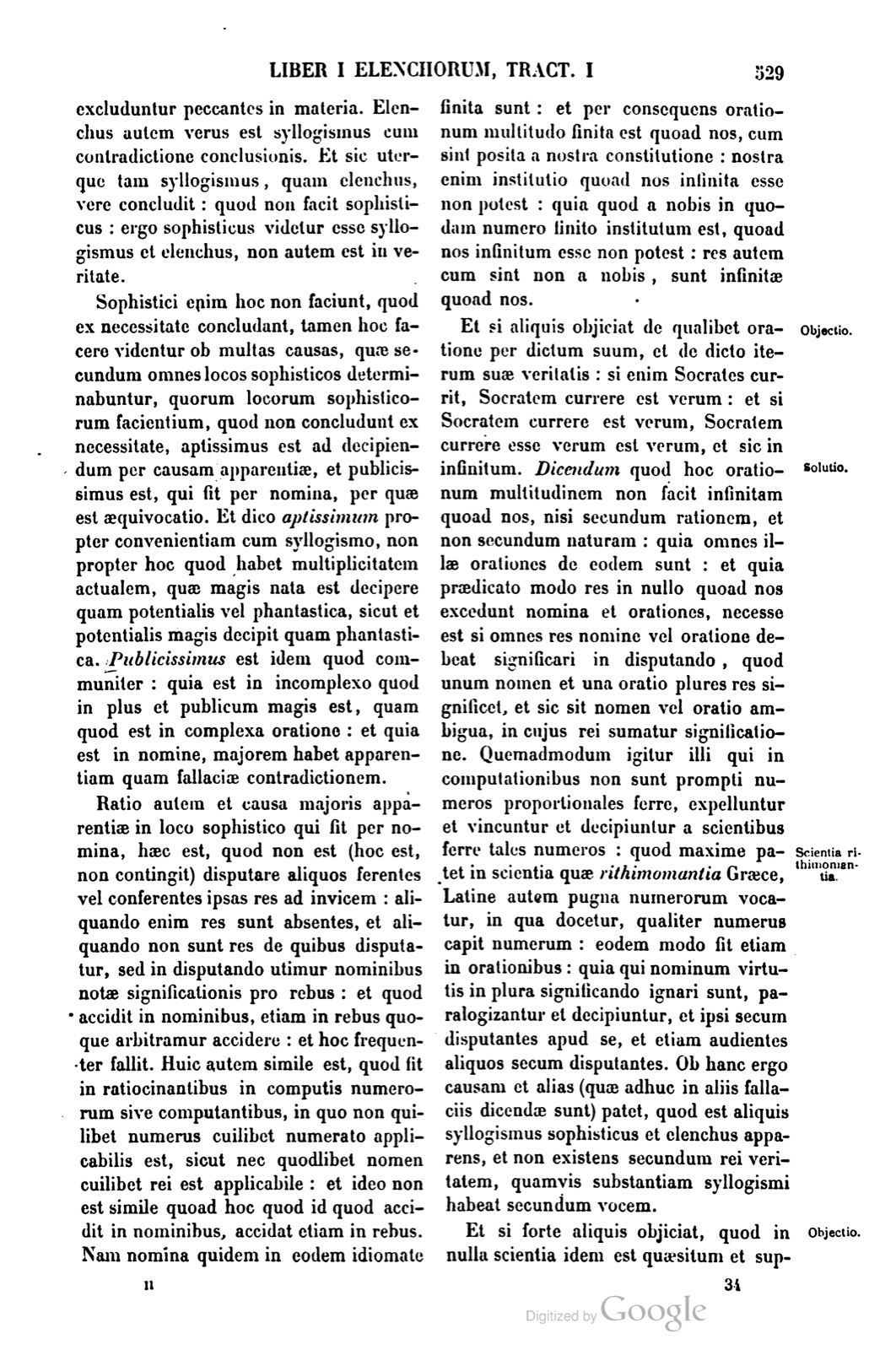
Sophistici enim hoc non faciunt, quod ex necessitate concludant, tamen hoc facere videntur ob multas causas, quae secundum omnes locos sophisticos determinabuntur, quorum locorum sophisticorum facientium, quod non concludunt ex necessitate, aptissimus est ad decipiendum per causam apparentiae, et publicissimus est, qui fit per nomina, per quae est aequivocatio. Et dico aptissimum propter convenientiam cum syllogismo, non propter hoc quod habet multiplicitatem actualem, quae magis nata est decipere quam potentialis vel phantastica, sicut et potentialis magis decipit quam phantastica. Publicissimus est idem quod communiter: quia est in incomplexo quod in plus et publicum magis est, quam quod est in complexa oratione: et quia est in nomine, majorem habet apparentiam quam fallaciae contradictionem.
Ratio autem et causa majoris apparentiae in loco sophistico qui fit per nomina, haec est, quod non est, hoc est, non contingit, disputare aliquos ferentes vel conferentes ipsas res ad invicem: aliquando enim res sunt absentes, et aliquando non sunt res de quibus disputatur, sed in disputando utimur nominibus notae significationis pro rebus: et quod accidit in nominibus, etiam in rebus quoque arbitramur accidere: et hoc frequenter fallit. Huic autem simile est, quod fit in ratiocinantibus in computis numerorum sive computantibus, in quo non quilibet numerus cuilibet numerato applicabilis est, sicut nec quodlibet nomen cuilibet rei est applicabile: et ideo non est simile quoad hoc quod id quod accidit in nominibus, accidat etiam in rebus. Nam nomina quidem in eodem idiomate finita sunt: et per consequens orationum multitudo finita est quoad nos, cum sint posita a nostra constitutione: nostra enim institutio quoad nos infinita esse non potest: quia quod a nobis in quodam numero finito institutum est, quoad nos infinitum esse non potest: res autem cum sint non a nobis, sunt infinitae quoad nos.
In the same way also one syllogism and refutation is truly this, while another is not truly a syllogism and refutation, yet they seem to be because of lack of skill in distinguishing. For the unskilled do not look into the depth of truth, but at what appears on the surface at first sight, like those standing far away. For a syllogism in truth is from certain principles or propositions posited and ordered in due order, and from terms and propositions posited and conceded, so that something different is said to come about or occur from the necessity of consequence. I say different from those things which have been posited; and if they have been posited, then those very posited things are the mother, and their position gives them form. And if it occurs from necessity, then the premises will be the causes of the conclusion, and non-cause is excluded. And if what follows is different, begging the principle is excluded. And if they are posited in the order of terms, paralogisms sinning in form are excluded. And if they are posited through concession of truth, those sinning in matter are excluded. But a true refutation is a syllogism with contradiction of the conclusion. And thus each, both syllogism and refutation, truly concludes; the sophistical one does not do this. Therefore the sophistical one seems to be a syllogism and refutation, but is not in truth.
For sophistical arguments do not do this, namely conclude from necessity; nevertheless they seem to do this on account of many causes, which will be determined according to all the sophistical places. Of these sophistical places that bring about that they do not conclude from necessity, the one that is made through names, through which there is equivocation, is most apt for deceiving through a cause of appearance, and is most public. And I say most apt because of its agreement with syllogism, not because it has actual multiplicity, which is more naturally suited to deceive than potential or phantastic multiplicity, just as potential multiplicity deceives more than phantastic. Most public is the same as more common, because it is in the incomplex, which is more extensive and more public than what is in complex speech; and because it is in a name, it has greater appearance than the fallacy of contradiction.
But the reason and cause of the greater appearance in the sophistical place that is made through names is this, that it is not possible, that is, it does not happen, for people disputing to carry or compare the things themselves to one another; for sometimes the things are absent, and sometimes the things about which there is dispute do not exist, but in disputing we use names of known signification in place of things. And what happens in names we also think happens in things, and this frequently deceives. Something like this happens among those reasoning in computations of numbers or calculating, in which not every number is applicable to every numbered thing, just as not every name is applicable to every thing. And therefore it is not similar in this respect, that what happens in names would also happen in things. For names in the same idiom are finite, and consequently the multitude of speeches is finite for us, since they are posited by our institution. For our institution cannot be infinite for us, because what has been instituted by us in a certain finite number cannot be infinite for us; but things, since they are not from us, are infinite for us.
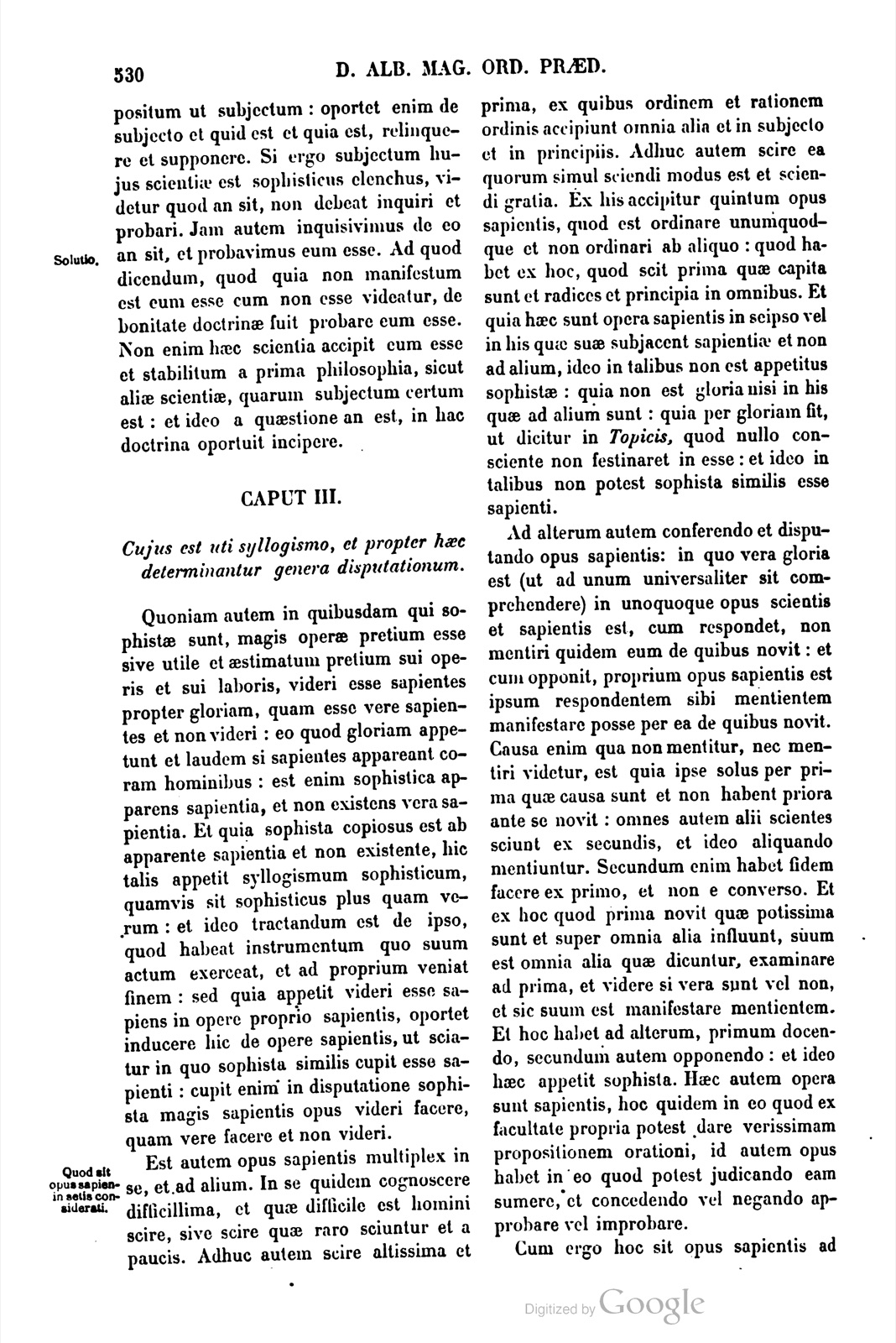
Et si aliquis objiciat de qualibet oratione per dictum suum, et de dicto iterum suae veritatis: si enim Socrates currit, Socratem currere est verum: et si Socratem currere est verum, Socratem currere esse verum est verum, et sic in infinitum. Dicendum quod hoc orationum multitudinem non facit infinitam quoad nos, nisi secundum rationem, et non secundum naturam: quia omnes illae orationes de eodem sunt: et quia praedicato modo res in nullo quoad nos excedunt nomina et orationes, necesse est si omnes res nomine vel oratione debeant significari in disputando, quod unum nomen et una oratio plures res significet, et sic sit nomen vel oratio ambigua, in cujus rei sumatur significatione. Quemadmodum igitur illi qui in computationibus non sunt prompti numeros proportionales ferre, expelluntur et vincuntur et decipiuntur a scientibus ferre tales numeros: quod maxime patet in scientia quae rithimomantia Graece, Latine autem pugna numerorum vocatur, in qua docetur, qualiter numerus capit numerum: eodem modo fit etiam in orationibus: quia qui nominum virtutis in plura significando ignari sunt, paralogizantur et decipiuntur, et ipsi secum disputantes apud se, et etiam audientes aliquos secum disputantes. Ob hanc ergo causam et alias, quae adhuc in aliis fallaciis dicendae sunt, patet, quod est aliquis syllogismus sophisticus et elenchus apparens, et non existens secundum rei veritatem, quamvis substantiam syllogismi habeat secundum vocem.
Et si forte aliquis objiciat, quod in nulla scientia idem est quaesitum et suppositum ut subjectum: oportet enim de subjecto et quid est et quia est, relinquere et supponere. Si ergo subjectum hujus scientiae est sophisticus elenchus, videtur quod an sit, non debeat inquiri et probari. Jam autem inquisivimus de eo an sit, et probavimus eum esse. Ad quod dicendum, quod quia non manifestum est eum esse cum non esse videatur, de bonitate doctrinae fuit probare eum esse. Non enim haec scientia accipit cum esse et stabilitum a prima philosophia, sicut aliae scientiae, quarum subjectum certum est: et ideo a quaestione an est, in hac doctrina oportuit incipere.
And if someone objects concerning any speech by its saying, and again concerning the saying of its truth: for if Socrates runs, that Socrates runs is true; and if that Socrates runs is true, that Socrates runs is true is true, and so on to infinity. One must say that this does not make the multitude of speeches infinite for us except according to reason and not according to nature, because all those speeches are about the same thing. And because, in the aforesaid mode, things in no way exceed names and speeches for us, if all things must be signified by a name or speech in disputing, it is necessary that one name and one speech signify many things, and thus that the name or speech be ambiguous as to the signification of which thing is taken. Therefore, just as those who in calculations are not ready to carry proportional numbers are driven out, overcome, and deceived by those who know how to carry such numbers, which is especially evident in the science which is called rithimomantia in Greek and the battle of numbers in Latin, in which it is taught how a number captures a number, so also it happens in speeches: because those who are ignorant of the power of names in signifying many things are paralogized and deceived, both when disputing with themselves within themselves and also when hearing others disputing with them. Therefore because of this cause and others, which still must be spoken of in the other fallacies, it is clear that there is some apparent sophistical syllogism and refutation, and one not existing according to the truth of the thing, although it has the substance of syllogism according to speech.
And if perhaps someone objects that in no science is the same thing both what is sought and what is supposed as subject, for one must leave and suppose concerning the subject both what it is and that it is. Therefore if the subject of this science is the sophistical refutation, it seems that whether it exists should not be investigated and proved. But we have now inquired about it, whether it exists, and have proved that it exists. To this one must say that because it is not manifest that it exists, since it seems not to exist, it belonged to the goodness of teaching to prove that it exists. For this science does not receive it with being and established from first philosophy, as do other sciences whose subject is certain; and therefore it was necessary in this doctrine to begin from the question whether it is.
If a page does not appear, its photograph has not been uploaded yet.