Works › Sophistical Refutations, Books I–II
Volume 2 · pp. 525–527
Book I of the Refutations. Tractate I. On the things to be set forth first. Chapter I. On what is to be treated in this book
A marker with ≈ is an approximate page boundary, placed by measure of the text; the page photographs remain the authority. In the paired views, clicking a page marker brings that page into view.
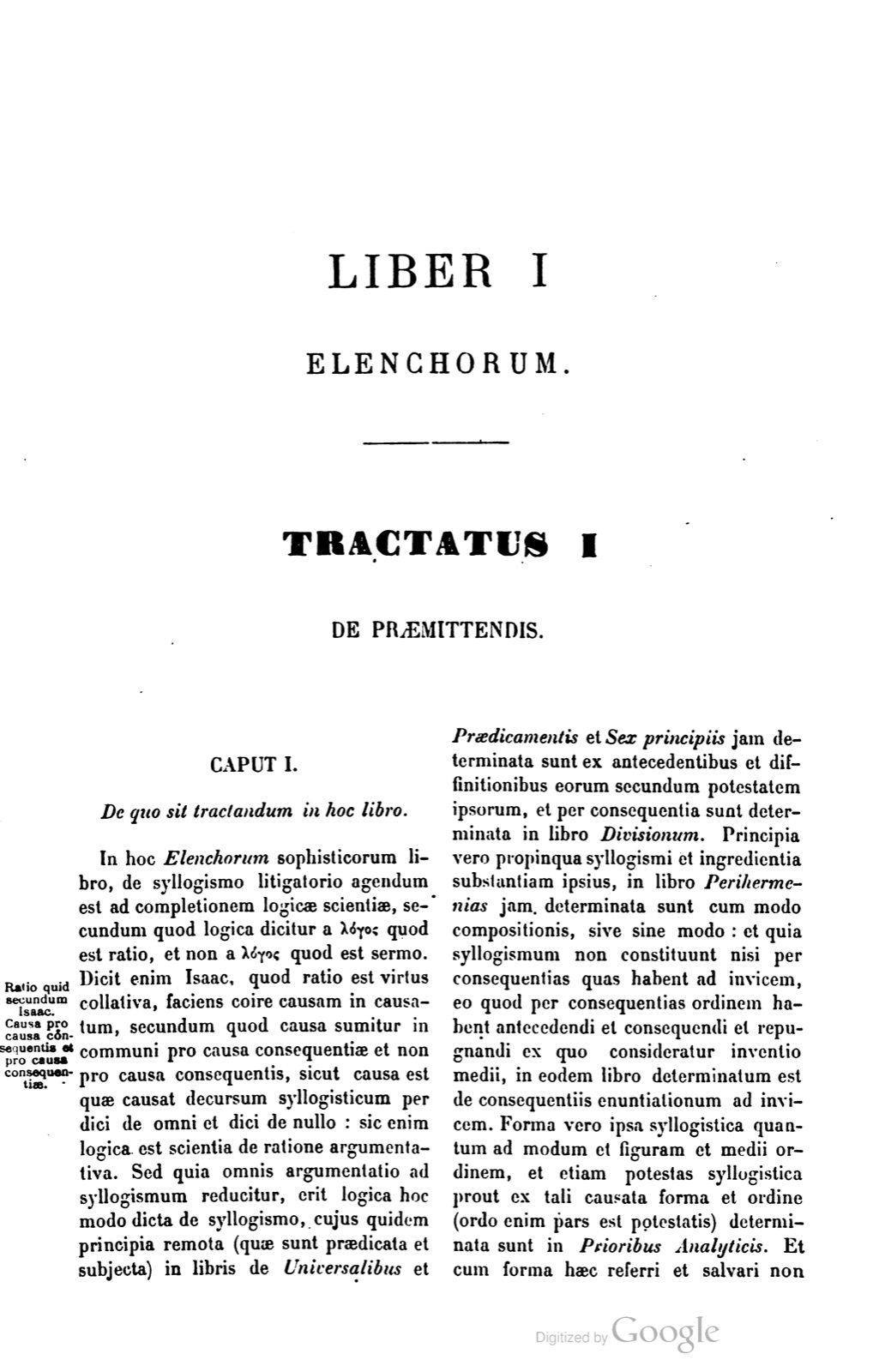
LIBER I. ELENCHORUM. TRACTATUS I. DE PRAEMITTENDIS. CAPUT I. De quo sit tractandum in hoc libro.
In hoc Elenchorum sophisticorum libro, de syllogismo litigatorio agendum est ad completionem logicae scientiae, secundum quod logica dicitur a λόγος quod est ratio, et non a λόγος quod est sermo. Dicit enim Isaac, quod ratio est virtus collativa, faciens coire causam in causatum, secundum quod causa sumitur in communi pro causa consequentiae et non pro causa consequentis, sicut causa est quae causat decursum syllogisticum per dici de omni et dici de nullo: sic enim logica est scientia de ratione argumentativa. Sed quia omnis argumentatio ad syllogismum reducitur, erit logica hoc modo dicta de syllogismo, cujus quidem principia remota, quae sunt praedicata et subjecta, in libris de Universalibus et Praedicamentis et Sex principiis jam determinata sunt ex antecedentibus et diffinitionibus eorum secundum potestatem ipsorum, et per consequentia sunt determinata in libro Divisionum. Principia vero propinqua syllogismi et ingredientia substantiam ipsius, in libro Perihermenias jam determinata sunt cum modo compositionis, sive sine modo: et quia syllogismum non constituunt nisi per consequentias quas habent ad invicem, eo quod per consequentias ordinem habent antecedendi et consequendi et repugnandi ex quo consideratur inventio medii, in eodem libro determinatum est de consequentiis enuntiationum ad invicem. Forma vero ipsa syllogistica quantum ad modum et figuram et medii ordinem, et etiam potestas syllogistica prout ex tali causata forma et ordine, ordo enim pars est potestatis, determinata sunt in Prioribus Analyticis. Et cum forma haec referri et salvari non possit, nisi vel in materia necessaria, quae causam consequentiae et consequentis continet intra se, vel in materia probabili quae intra se habet causam consequentiae ex habitudine locali quae locus dicitur, et quid de consequente per communia in omnibus vel in pluribus inventa, vel in materia quae videtur habere causam consequentiae et consequentis, et non habet vel non sufficienter habet: et cum de ipsa prout primo modo refertur ad materiam, in Posterioribus Analyticis jam determinatum sit, in Topicis autem etiam dictum sit de ea prout secundo modo refertur ad materiam: restat nunc determinare de ipsa prout refertur ad materiam quae apparet esse: haec enim proxima materia syllogismi est prout est in voce: hanc enim habet syllogismus sophisticus, quamvis non sit, sed appareat, prout ipsa materia, quae est propositiones, refertur ad figuram. Quia igitur quantum ad vocem propositiones habet in quibus salvatur forma syllogismi, oportet ostendere qualiter forma syllogismi ad hanc refertur materiam: et tunc quoad relationem formae syllogisticae ad materiam consummatum erit negotium logicum sive syllogisticum.
BOOK I. OF THE REFUTATIONS. TRACTATE I. ON THE THINGS TO BE SET FORTH FIRST. CHAPTER I. On what is to be treated in this book.
In this book of the Sophistical Refutations, one must deal with the contentious syllogism for the completion of the science of logic, according as logic is said from λόγος, which is reason, and not from λόγος, which is speech. For Isaac says that reason is a collative power, making the cause come together into the thing caused, according as cause is taken in common for the cause of consequence and not for the cause of the consequent, just as a cause is that which causes the syllogistic course through being said of every and being said of none. For thus logic is the science concerning argumentative reason. But because every argumentation is reduced to syllogism, logic, said in this way, will be about syllogism, whose remote principles, namely predicates and subjects, have already been determined in the books On Universals and On the Categories and Six Principles from their antecedents and definitions according to their own power, and by consequents they have been determined in the book of Divisions. But the proximate principles of the syllogism and those entering into its substance have already been determined in the book Perihermenias, with mode of composition or without mode; and because they do not constitute the syllogism except through the consequences which they have to one another, in that through consequences they have the order of anteceding and following and of repugnance, from which the discovery of the middle is considered, in the same book determination has been made concerning the consequences of enunciations to one another. But the syllogistic form itself as to mode and figure and the order of the middle, and also the syllogistic power insofar as it is caused by such form and order, for order is a part of power, have been determined in the Prior Analytics. And since this form cannot be referred and preserved except either in necessary matter, which contains within itself the cause of consequence and of the consequent, or in probable matter, which has within itself the cause of consequence from the local relation which is called a place, and something concerning the consequent through common things found in all things or in many things, or in matter which seems to have the cause of consequence and of the consequent and does not have it or does not sufficiently have it; and since concerning it insofar as in the first mode it is referred to matter, determination has already been made in the Posterior Analytics, and in the Topics it has also been spoken of insofar as in the second mode it is referred to matter, it now remains to determine concerning it insofar as it is referred to matter which appears to be: for this is the proximate matter of the syllogism insofar as it is in speech. For the sophistical syllogism has this, although it is not, but appears, insofar as that matter, which is propositions, is referred to figure. Therefore, because as to speech it has propositions in which the form of syllogism is preserved, one must show how the form of syllogism is referred to this matter; and then, with respect to the relation of syllogistic form to matter, the logical or syllogistic business will be completed.
Adhuc autem cum logica praedicto modo dicta dividatur in scientiam differendi sive inveniendi, et scientiam judicandi, sicut in partes objectivas: et tradita sit in Topicis ut scientia differendi, in Prioribus autem tradita est sicut scientia judicandi: apparens autem nec perfecte sit scientia differendi, nec perfecte scientia judicandi, etsi imitetur utramque 1: ideo oportet hanc scientiam tradi in differendo primo, et judicando secundo, sive primo per formam compositionis, secundo autem per formam resolutionis ejus quod compositum est. Et ideo duos libros in hac scientia necesse est introduci, quorum primus sit de dissertivis per formam, secundus autem resolutivus et per formam resolutionis ad dijudicandum quod videbatur esse ad formam syllogismi compositam.
Adhuc autem cum omne quod traditur, si incomplexum est, per priora necesse est illud notificare per divisionem: si autem potestas ejus determinari debet, cum omnis potestas superioris sit, eo quod in tot vel tot potest partes, oportet quod sic determinetur per divisionem. Si autem complexum determinari debeat, oportet quod in omne unum alteri determinetur, quod fieri non potest, nisi colligendo unum cum altero, ut antecedens, vel consequens, vel subjectum et praedicatum de illo: oportet enim in hoc uti colligendi arte et conferendi: quia in omni arte syllogistica necessarium est, in qua major extremitas probatur inesse minori. Hac igitur necessitate modus noster erit diffinitivus et divisivus et collectivus: qui modus in omni arte logicae praedicto modo dictae necessarius est, quia de his tribus tanquam integrantibus consistit logicum negotium.
Moreover, since logic, said in the aforesaid way, is divided into the science of arguing or discovering and the science of judging, as into objective parts, and in the Topics it has been handed down as the science of arguing, but in the Prior Analytics it has been handed down as the science of judging, while the apparent is neither perfectly the science of arguing nor perfectly the science of judging, although it imitates both 1, therefore this science must be handed down first by arguing and second by judging, or first through the form of composition and then through the form of resolution of that which has been composed. And therefore it is necessary that two books be introduced in this science, of which the first is about the disputative things through form, and the second is resolutive and through the form of resolution for judging what seemed to belong to the composed form of syllogism.
Moreover, since everything that is handed down, if it is incomplex, must be made known through prior things by division; but if its power must be determined, since every power belongs to a superior by the fact that it can have so many or so many parts, it must be determined in this way by division. But if something complex must be determined, each thing must be determined in relation to another, which cannot be done except by collecting one thing with another, as antecedent or consequent, or subject and predicate concerning it; for in this one must use the art of collecting and comparing, because it is necessary in every syllogistic art in which the greater extreme is proved to belong to the lesser. Therefore by this necessity our mode will be definitive and divisive and collective; and this mode is necessary in every art of logic said in the aforesaid way, because the logical business consists of these three as integrating it.
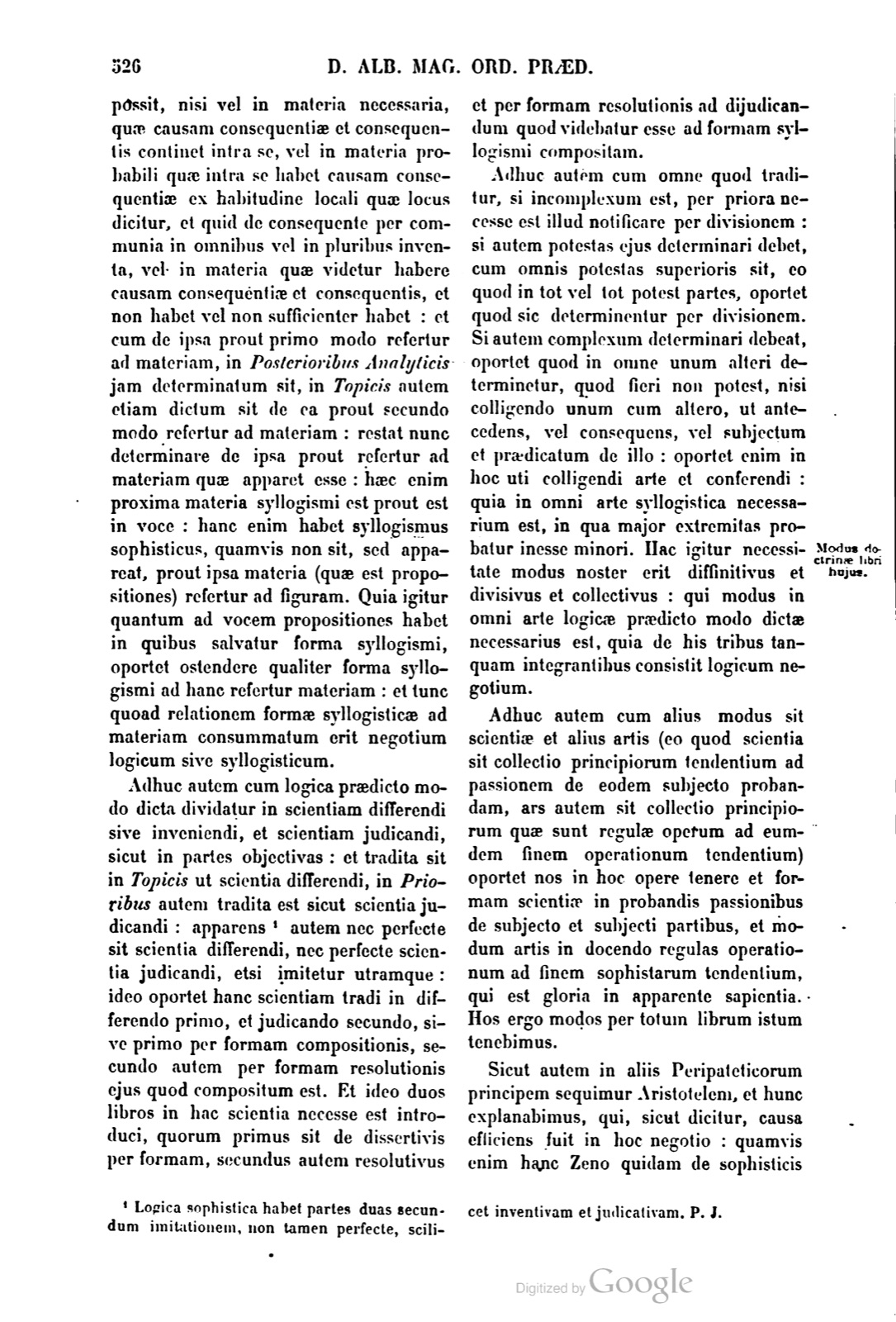
Adhuc autem cum alius modus sit scientiae et alius artis, eo quod scientia sit collectio principiorum tendentium ad passionem de eodem subjecto probandam, ars autem sit collectio principiorum quae sunt regulae operum ad eumdem finem operationum tendentium, oportet nos in hoc opere tenere et formam scientiae in probandis passionibus de subjecto et subjecti partibus, et modum artis in docendo regulas operationum ad finem sophistarum tendentium, qui est gloria in apparente sapientia. Hos ergo modos per totum librum istum tenebimus.
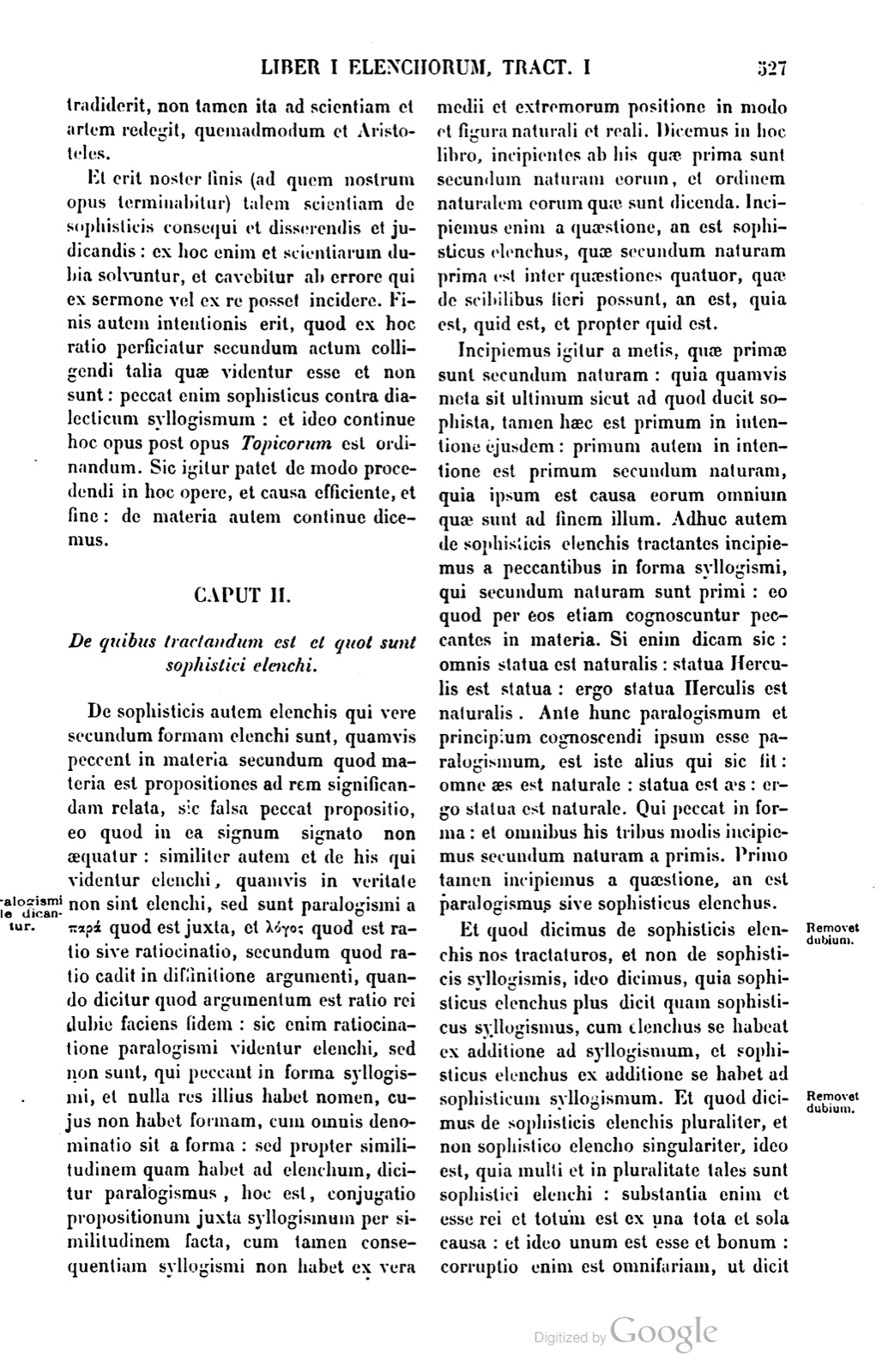
Sicut autem in aliis Peripateticorum principem sequimur Aristotelem, et hunc explanabimus, qui, sicut dicitur, causa efficiens fuit in hoc negotio: quamvis enim hanc Zeno quidam de sophisticis tradiderit, non tamen ita ad scientiam et artem redegit, quemadmodum et Aristoteles.
Et erit noster finis, ad quem nostrum opus terminabitur, talem scientiam de sophisticis consequi et disserendis et judicandis: ex hoc enim et scientiarum dubia solvuntur, et cavebitur ab errore qui ex sermone vel ex re posset incidere. Finis autem intentionis erit, quod ex hoc ratio perficiatur secundum actum colligendi talia quae videntur esse et non sunt: peccat enim sophisticus contra dialecticum syllogismum: et ideo continue hoc opus post opus Topicorum est ordinandum. Sic igitur patet de modo procedendi in hoc opere, et causa efficiente, et fine: de materia autem continue dicemus.
Moreover, since one mode belongs to science and another to art, because science is a collection of principles tending to a passion to be proved of the same subject, but art is a collection of principles which are rules of works tending to the same end of operations, we must in this work keep both the form of science in proving passions concerning the subject and the parts of the subject, and the mode of art in teaching rules of operations tending to the end of sophists, which is glory in apparent wisdom. Therefore we shall keep these modes throughout this whole book.
But as in other matters we follow Aristotle, the prince of the Peripatetics, so we shall explain him here, who, as is said, was the efficient cause in this business; for although a certain Zeno handed down this material concerning sophistical things, nevertheless he did not reduce it to science and art in the way Aristotle did.
And our end, at which our work will be terminated, will be to acquire such science concerning sophistical things, both in arguing and in judging them. For from this both the doubts of the sciences are solved, and one will be guarded against error which could arise from speech or from the thing. But the end of the intention will be that from this reason may be perfected according to the act of collecting such things as seem to be and are not. For the sophist sins against the dialectical syllogism, and therefore this work is to be ordered immediately after the work of the Topics. Thus, therefore, the mode of proceeding in this work is clear, and the efficient cause, and the end; but concerning the matter we shall speak immediately.
Notes
- Sophistical logic has two parts according to imitation, yet not perfectly, namely the inventive and the judicative. P. J. (Logica sophistica habet partes duas secundum imitationem, non tamen perfecte, scilicet inventivam et judicativam. P. J.) ↩
If a page does not appear, its photograph has not been uploaded yet.