Works › Prior Analytics, Books I–II
Volume 1 · pp. 803–806
Treatise VII, Chapter IX
A marker with ≈ is an approximate page boundary, placed by measure of the text; the page photographs remain the authority. In the paired views, clicking a page marker brings that page into view.
CAPUT IX.
De enthymemate, quid sit, et quibus modis fiat, et qualiter ad syllogismum reducitur.
Ex diffinitione autem icotis et signi, diffinitio concluditur enthymematis, dicendo quod enthymema est syllogismus procedens ex icotibus et signis. Quamvis enim diversae argumentationes sint syllogismus et enthymema, tamen substantialiter enthymema est syllogismus: quamvis enim non nisi una propositio ponatur in enthymemate, duae autem in syllogismo secundum vocem: tamen in enthymemate una secundum vocem posita, altera subintelligitur secundum rem et decursum rationis: et sic secundum rem et decursum rationis enthymema substantialiter dicitur esse syllogismus ex icotibus in secunda et tertia figuris, et signis sive prodigiis in prima figura.
Modi autem quibus fiunt enthymemata, ex hoc inveniuntur, quod signum (quod est quasi medium enthymematis) tripliciter secundum positionem et ordinem terminorum accipitur: quoties enim medium secundum diversitatem positionis accipitur in figuris: aut enim positio signi accipitur ut in prima figura accipitur medium, quod positione et ordine terminorum est medium, ut pars unius et totum alterius: aut accipitur sicut medium accipitur in figura secunda, in qua medium est extra extrema ut unum commune praedicatum de pluribus: aut accipitur sicut accipitur medium in tertia, ut unum commune subjectum substans pluribus praedicatis. Cujus exemplum est, ut si velimus ostendere primam figuram, hoc est, per enthymema, cujus signum medii habet virtutem secundum modum medii primae figurae, arguimus sic, haec mulier habet lac in mamillis; ergo peperit: reducitur enim ad syllogismum primae figurae, ita quod medium quod est lac habere sit B, A autem quod est major extremitas sit parientem esse: in mamillis autem habere, minor extremitas sit C, et resultabit forma syllogismi in prima figura, sic, omne B est A, quia omnis mulier lac habens in mamillis pariens est: quoddam C est B, quia haec mulier lac habet in mamillis: ergo quoddam C est A, quia haec mulier peperit: est enim syllogismus in tertio primae. Lac autem habere signum est, et non causa: quia si etiam ea quae non peperit fricet mamillas urtica et sale, lac habebit in mamillis, sed non ubertim fundent illud mamillae ipsius. Sic ergo fit enthymema in prima figura ex signo convertibili tacita majori propositione: eo quod illa reputatur manifesta.
In tertia figura quae in multis convenit cum prima, accipitur signum quod est in minus: ut si concludere velimus, quoniam studiosi sunt sapientes sic: est studiosus: ergo sapiens: accipiemus quod Pittacus studiosus, et ex hoc sapiens. Pittacus autem erat quidam Pythagoricus Pythagorae discipulus, et a Pythagora sic denominatur. Reducitur autem in syllogismum tertiae sic: sit enim in quo A studiosum esse: id autem in quo B sit esse sapiens: id autem in quo C, sit Pittacus studiosus: sic enim iterum erit A studiosum, et de B et de C praedicari: quia et sapientes sunt studiosi, et Pittacus est studiosus: et tunc arguitur sic, Pittacus est studiosus: Pittacus est sapiens: ergo sapiens studiosus. Sed hoc (quod est major propositio) non dicunt vocali expressione, scilicet quod omnis sapiens studiosus: eo quod reputatur hoc palam esse. Illud vero quod est minor propositio, sumunt et ex illo arguunt vocaliter expresso: majori tamen subintellecta, quia sine illa nullus esset decursus rationis.
CHAPTER IX.
On Enthymeme, What It Is, And By Which Modes It Is Made, And In What Way It Is Reduced To Syllogism.
But from the definition of ikos and sign, the definition of enthymeme is concluded, by saying that an enthymeme is a syllogism proceeding from ikoi and signs. For although syllogism and enthymeme are diverse argumentations, nevertheless substantially the enthymeme is a syllogism; for although only one proposition is posited in an enthymeme, but two in a syllogism according to voice, nevertheless in an enthymeme, when one is posited according to voice, the other is understood according to the thing and the course of reason. And thus, according to the thing and the course of reason, an enthymeme is substantially said to be a syllogism from ikoi in the second and third figures, and from signs or prodigies in the first figure.
But the modes by which enthymemes are made are found from this, that a sign, which is as it were the middle of the enthymeme, is taken in three ways according to the position and order of the terms; for as often as the middle is taken according to diversity of position in the figures, either the position of the sign is taken as the middle is taken in the first figure, which by position and order of the terms is middle, as part of one and whole of the other, or it is taken as the middle is taken in the second figure, in which the middle is outside the extremes as one common predicate of many, or it is taken as the middle is taken in the third, as one common subject standing under many predicates. An example of this is that, if we wish to show the first figure, that is, through an enthymeme whose sign of the middle has power according to the mode of the middle of the first figure, we argue thus: this woman has milk in her breasts; therefore she has given birth. For it is reduced to a syllogism of the first figure, so that the middle, which is to have milk, is B, but A, which is the major extreme, is to be giving birth; but to have in the breasts, let it be the minor extreme C, and the form of a syllogism in the first figure will result, thus: every B is A, because every woman having milk in her breasts is one giving birth; a certain C is B, because this woman has milk in her breasts; therefore a certain C is A, because this woman has given birth. For it is a syllogism in the third mode of the first figure. But to have milk is a sign and not a cause, because if even she who has not given birth rubs her breasts with nettle and salt, she will have milk in the breasts, but her breasts will not pour it forth abundantly. Thus therefore an enthymeme is made in the first figure from a convertible sign, with the major proposition left tacit, because it is reckoned manifest.
In the third figure, which agrees with the first in many things, a sign is taken which is in fewer things, as if we wish to conclude that the studious are wise thus: he is studious; therefore wise; we will accept that Pittacus is studious, and from this wise. But Pittacus was a certain Pythagorean, a disciple of Pythagoras, and is so named from Pythagoras. But it is reduced into a syllogism of the third figure thus: let that in which A is be to be studious; but let that in which B is be to be wise; but let that in which C is be Pittacus studious. For thus again A will be studious and will be predicated of B and of C, because both wise persons are studious and Pittacus is studious. And then it is argued thus: Pittacus is studious; Pittacus is wise; therefore the wise person is studious. But this, which is the major proposition, they do not say with vocal expression, namely that every wise person is studious, because this is reckoned to be obvious. But that which is the minor proposition they take and from it they argue with it vocally expressed, with the major nevertheless understood, because without it there would be no course of reason.
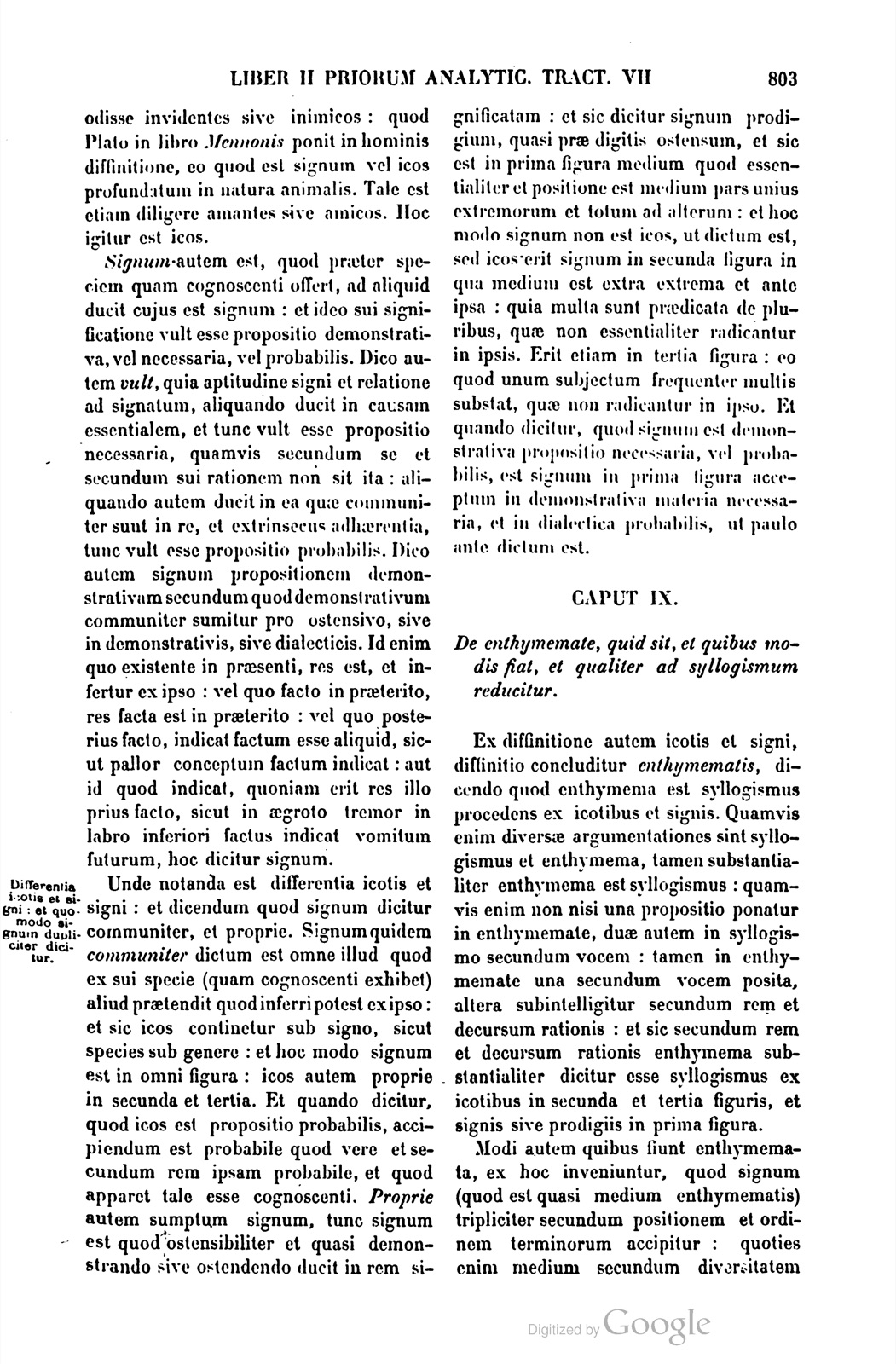
In secunda autem figura fit enthymema accipiendo signum quod est plus sicut est medium in secunda figura: sicut enthymemate arguimus aliquam peperisse ex hoc, quoniam est pallida: hoc enim enthymema reductum ad syllogismum vult (quantum ad terminorum ordinem et dispositionem) esse per mediam figuram secundum quod apparet, quamvis in veritate non sit: quia sic arguitur affirmative, et in secunda figura nihil affirmative concluditur: propter quod in ante habitis dictum est, quod in secunda figura non est signum: quoniam enim parientes plerumque sequitur pallor: sequitur autem et hanc: arbitrantur ostensam esse per conclusionem, quoniam peperit haec, et arguunt sic, quaecumque peperit, est pallida: haec est pallida: ergo peperit. Et in terminis transcendentibus sic, quod pallor sit in quo A, parere autem (quod est major extremitas) sit in quo B, mulier autem haec quae est minor extremitas sit in quo est C, sic, omne B est A, quoddam vel hoc C est A, ergo hoc vel quoddam C est B. Et est affirmativus syllogismus in secunda figura: et talis syllogizatio praecedit verum syllogismum: iste autem syllogismus supponitur ab eo qui enthymemate sic arguit: est pallida: ergo peperit.
Est autem differentia enthymematis ad syllogismum: quia enthymema ex una procedit propositione, syllogismus autem ex duabus: quia si una quidem tantum dicatur vel exprimatur vocaliter propositio, tunc signum fit ex quo sumitur enthymema. Si autem cum illa et altera sumatur universalis propositio et vocaliter exprimatur, tunc syllogismus in forma perfectus secundum figuram et modum et materiam proximam, quae est duae propositiones ex tribus terminis formatae. Hoc autem ostenditur per exemplum tam in prima figura, quam in tertia. In prima quidem figura sic, ut quando volumus probare quod ambitiosus liberalis: tunc enim sic arguimus. Omnis ambitiosus liberalis: Pittacus est ambitiosus: ergo Pittacus est liberalis. Aut rursus in tertia figura concludentes, quoniam sapientes sunt boni vel studiosi: sic arguentes: Pittacus est sapiens: Pittacus est bonus, ergo boni sapientes.
But in the second figure an enthymeme is made by accepting a sign which is in more things, just as it is the middle in the second figure; as by enthymeme we argue that someone has given birth from this, that she is pale. For this enthymeme reduced to a syllogism wants, as much as concerns the order and disposition of the terms, to be through the middle figure according as it appears, although in truth it is not, because it is argued affirmatively in this way, and in the second figure nothing is concluded affirmatively. On account of this it was said in the things already had that in the second figure there is no sign. For since paleness for the most part follows those giving birth, and it also follows this woman, they judge that this has been shown through the conclusion, namely that this woman has given birth, and they argue thus: whoever has given birth is pale; this woman is pale; therefore she has given birth. And in transcendent terms in this way, that paleness is that in which A is, but to give birth, which is the major extreme, is that in which B is, but this woman, who is the minor extreme, is that in which C is, thus: every B is A; a certain or this C is A; therefore this or a certain C is B. And it is an affirmative syllogism in the second figure, and such syllogizing precedes a true syllogism; but that syllogism is presupposed by him who argues thus by enthymeme: she is pale; therefore she has given birth.
But there is a difference of enthymeme from syllogism, because enthymeme proceeds from one proposition, but syllogism from two; because if indeed only one proposition is said or expressed vocally, then a sign is made from which the enthymeme is taken. But if with that one the other universal proposition also is taken and vocally expressed, then there is a syllogism perfect in form according to figure and mode and proximate matter, which is two propositions formed from three terms. But this is shown through example both in the first figure and in the third. In the first figure indeed thus, as when we wish to prove that the ambitious person is liberal; then we argue thus: every ambitious person is liberal; Pittacus is ambitious; therefore Pittacus is liberal. Or again in the third figure, concluding that the wise are good or studious, arguing thus: Pittacus is wise; Pittacus is good; therefore the good are wise.
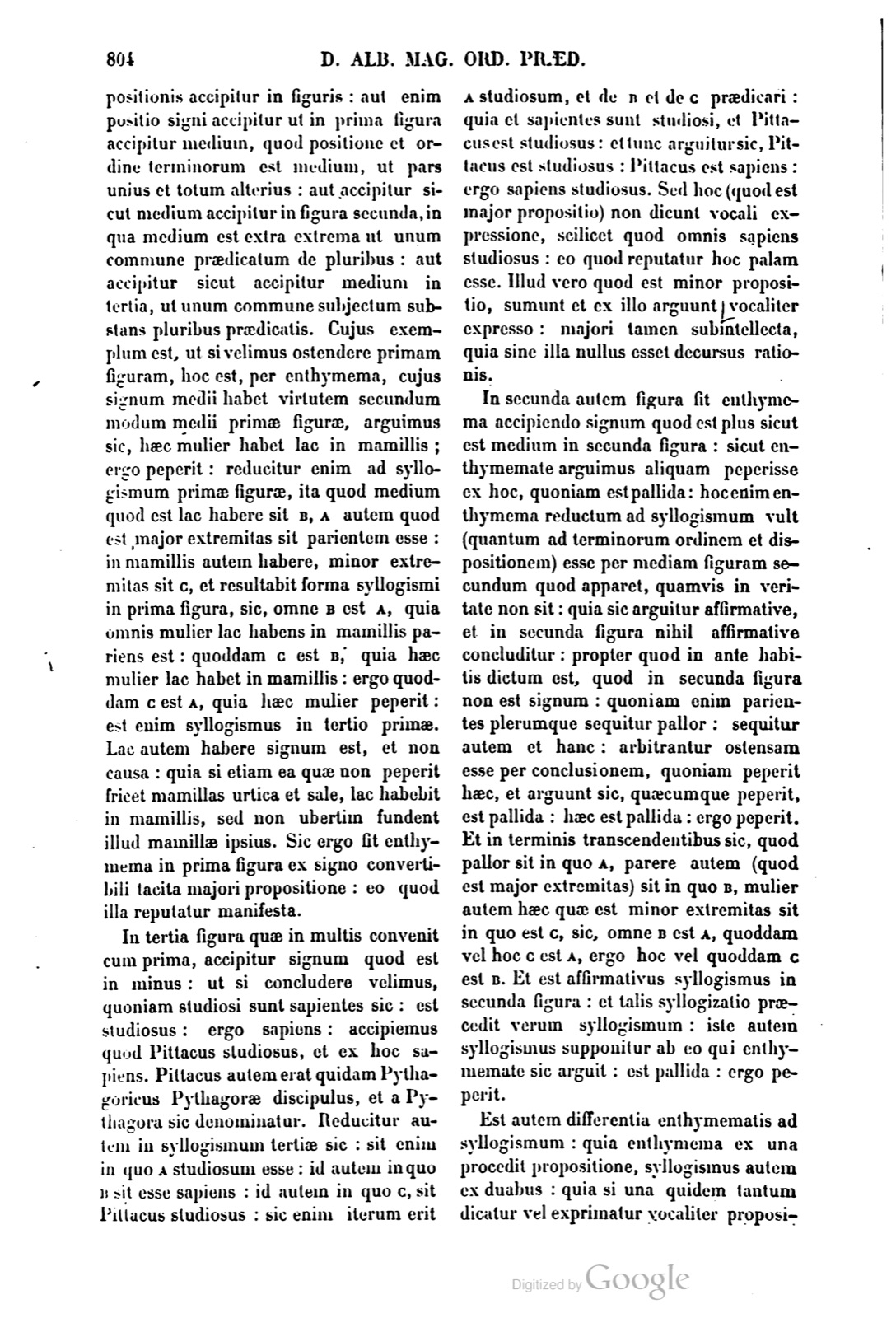
Sic ergo per omnes figuras enthymematis fiunt syllogismi. Sed in hoc differunt enthymemata primae figurae ab enthymematibus secundae et tertiae figurae: quia syllogismi enthymematis quod fit per primam figuram sunt insolubiles et perfecti, non soluti a forma syllogismi: quia fundantur super propositionem universalem, penes quam perfectus est syllogismi decursus. Et hoc dico quando verus est syllogismus in forma, et verum et vere concludens. Et hoc ideo est, ut diximus: quia universalis est in ipso propositio per quam arguitur. Syllogismus autem enthymematis quod fit per tertiam, est solubilis non habens formam, quamvis verus sit, ita quod verum concludat: quia est ex singularibus sive particularibus et non ex universali: ex qua forma nihil sequitur syllogistice. Universalis autem propositio non est in tertia figura, ex qua sit virtus inferendi. Adhuc tamen talis syllogismus in tertia figura factus, non est ad rem: quia non concludit extremitatem de extremitate, cum non utatur universali propositione: non enim si Pittacus est studiosus et sapiens, propter hoc necesse est alios sapientes studiosos, vel bonos esse, sive assumatur universalis propositio, quod omnes sapientes sunt studiosi. Syllogismus vero qui fit per mediam figuram ex secundae figurae enthymemate, semper et omnino sive universaliter est solubilis sive solutus et imperfectus et sophisticus, sive assumatur universalis, sive non: quia semper est affirmativus: quia nunquam sic se habentibus terminis fit syllogismus in secunda figura: non enim sequitur per virtutem syllogismi secundae figurae, quod si quaecumque parit pallida est (pallida autem est et haec) quod hanc parere sit necesse: sed est fallacia consequentis. Verum quidem igitur per syllogismum enthymematis concluditur in omnibus figuris: sed etiam syllogismi differentias habent quae jam dictae sunt, et etiam enthymemata differunt hoc modo.
Marginal label (printed page 805): Differentia inter signum et prodigium.
Sic ergo, ut dictum est, dividendum est signum quod medii habet rationem in enthymemate. Horum autem signorum id quod vere et positione medium est (sicut signum in prima figura) prodigii habet rationem: nam hoc signum Philosophi dicunt esse prodigium, quod facit scire sicut facit medium in prima figura: quod vere medii habet rationem: quia tale est maxime medium secundum medii rationem vel secundum naturam. Sed quae signa sunt sumpta in extremitatibus, et sunt extremitates secundum naturam, licet sint loco mediorum accepta, sicut in figura secunda et tertia: in secunda enim signum est primum, et in tertia est postremum: in neutra autem positione est medium: et ideo illa dicenda sunt signa tantum et non prodigia. Quod autem signum sumitur ex medio quod vere est medium positione, aut et natura, illud est prodigium: probabilissimum enim est maxime verum, quod conclusum est per primam figuram: cujus ratio jam saepius dicta est.
Thus therefore through all figures syllogisms of enthymeme are made. But in this enthymemes of the first figure differ from enthymemes of the second and third figure, because syllogisms of the enthymeme which is made through the first figure are insoluble and perfect, not loosened from the form of syllogism, because they are founded upon a universal proposition, according to which the course of the syllogism is perfect. And I say this when the syllogism is true in form, and true and truly concluding. And this is so, as we have said, because the proposition through which it is argued is universal in it. But the syllogism of an enthymeme which is made through the third figure is soluble, not having form, although it is true, so that it concludes what is true, because it is from singulars or particulars and not from a universal; from such a form nothing follows syllogistically. But a universal proposition is not in the third figure from which there may be a power of inferring. Again, nevertheless, such a syllogism made in the third figure is not to the matter, because it does not conclude an extreme of an extreme, since it does not use a universal proposition. For if Pittacus is studious and wise, on account of this it is not necessary that other wise persons are studious or good, even if the universal proposition is assumed that all wise persons are studious. But the syllogism which is made through the middle figure from an enthymeme of the second figure is always and altogether or universally soluble, or loosened, and imperfect and sophistical, whether a universal is assumed or not, because it is always affirmative; because with the terms having themselves thus, a syllogism is never made in the second figure. For it does not follow by the power of a syllogism of the second figure that, if whoever gives birth is pale, but this woman also is pale, it is necessary that this woman give birth; rather it is a fallacy of the consequent. Therefore the true indeed is concluded through the syllogism of the enthymeme in all figures; but syllogisms also have the differences which have now been stated, and enthymemes also differ in this way.
Marginal label (printed page 805): Difference between sign and prodigy.
Thus therefore, as has been said, the sign which has the account of a middle in an enthymeme must be divided. But of these signs, that which truly and by position is the middle, as the sign in the first figure, has the account of a prodigy. For the philosophers say that this sign is a prodigy, which makes one know as the middle in the first figure makes one know; and it truly has the account of the middle, because such a thing is most of all the middle according to the account of the middle or according to nature. But the signs which are taken in the extremes, and are extremes according to nature, although they are accepted in the place of middles, as in the second and third figure, for in the second the sign is first, and in the third it is last, in neither position is it the middle. And therefore those must be called signs only and not prodigies. But the sign which is taken from a middle which truly is a middle by position, or even by nature, that is a prodigy. For the most probable is most true, which has been concluded through the first figure; the account of this has now been given often.
Marginal label (printed page 805): Ars generalis reducendi omne enthymema in syllogismum.
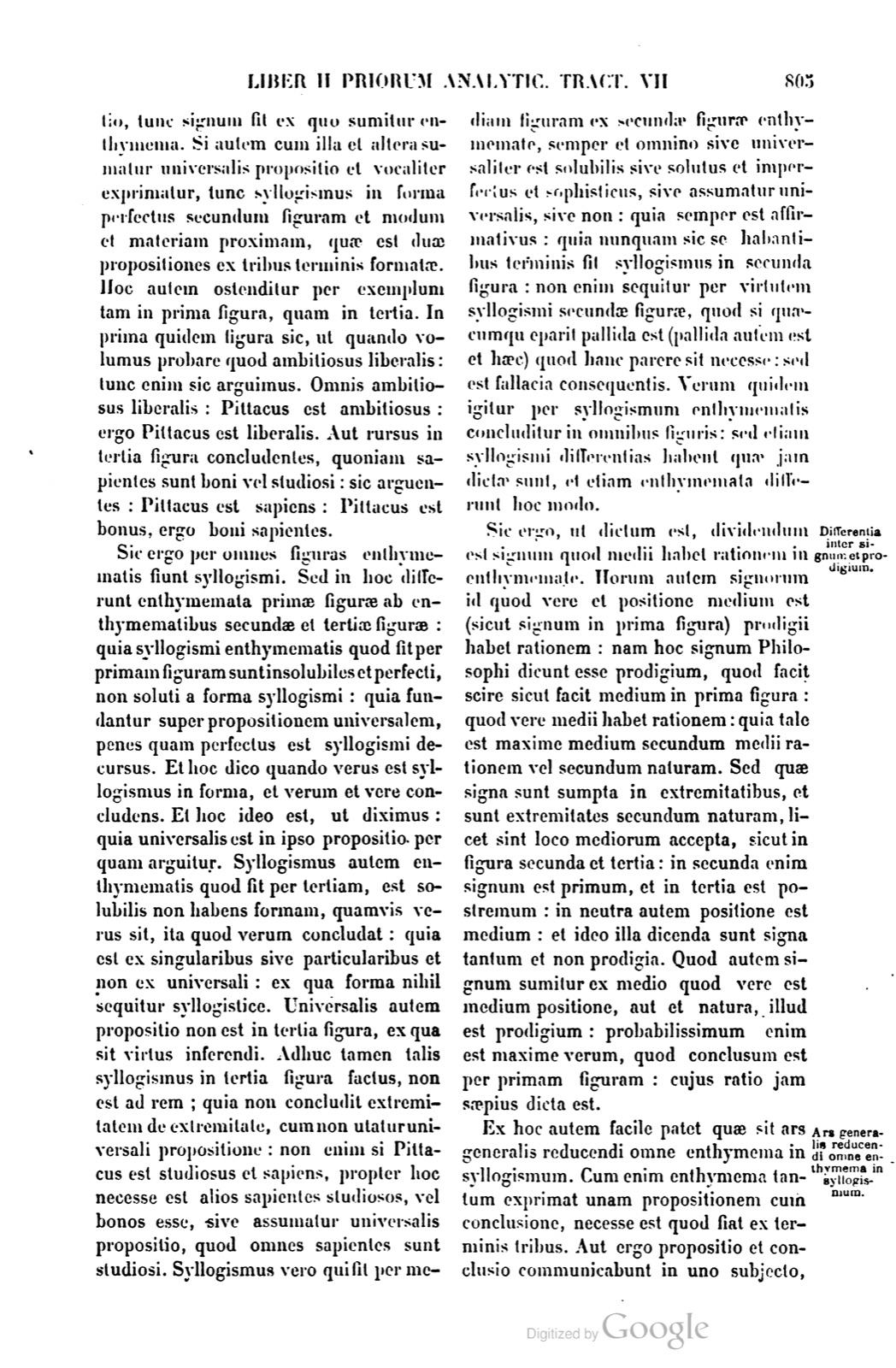
Ex hoc autem facile patet quae sit ars generalis reducendi omne enthymema in syllogismum. Cum enim enthymema tantum exprimat unam propositionem cum conclusione, necesse est quod fiat ex terminis tribus. Aut ergo propositio et conclusio communicabunt in uno subjecto, aut in uno praedicato: aut quod subjicitur in una, praedicatur in altera. Et si quidem communicant in uno praedicato: tunc illud enthymema vel fit in prima figura, vel in tertia, et fit ex majori et conclusione: et addita minori fit syllogismus. In quam autem harum figurarum reducitur, patet ex naturali positione terminorum secundum quam ordinatur in syllogismum primae vel tertiae figurae. Si autem communicant in subjecto, erit enthymema vel primae vel tertiae figurae, et fit ex minori et conclusione: et fiet syllogismus per additionem majoris, quae addi debet secundum terminorum possibilitatem et inhaerentiam. Si autem quod subjicitur in una, praedicatur in alia: aut ergo quod subjicitur in praemissa, praedicatur in conclusione, aut e converso. Si primo modo, erit syllogismus in secunda figura et ex majori et conclusione: et fiet syllogismus addendo minorem. Si autem secundo modo, erit enthymema in tertia figura ex minori et conclusione: et fiet syllogismus addendo majorem.
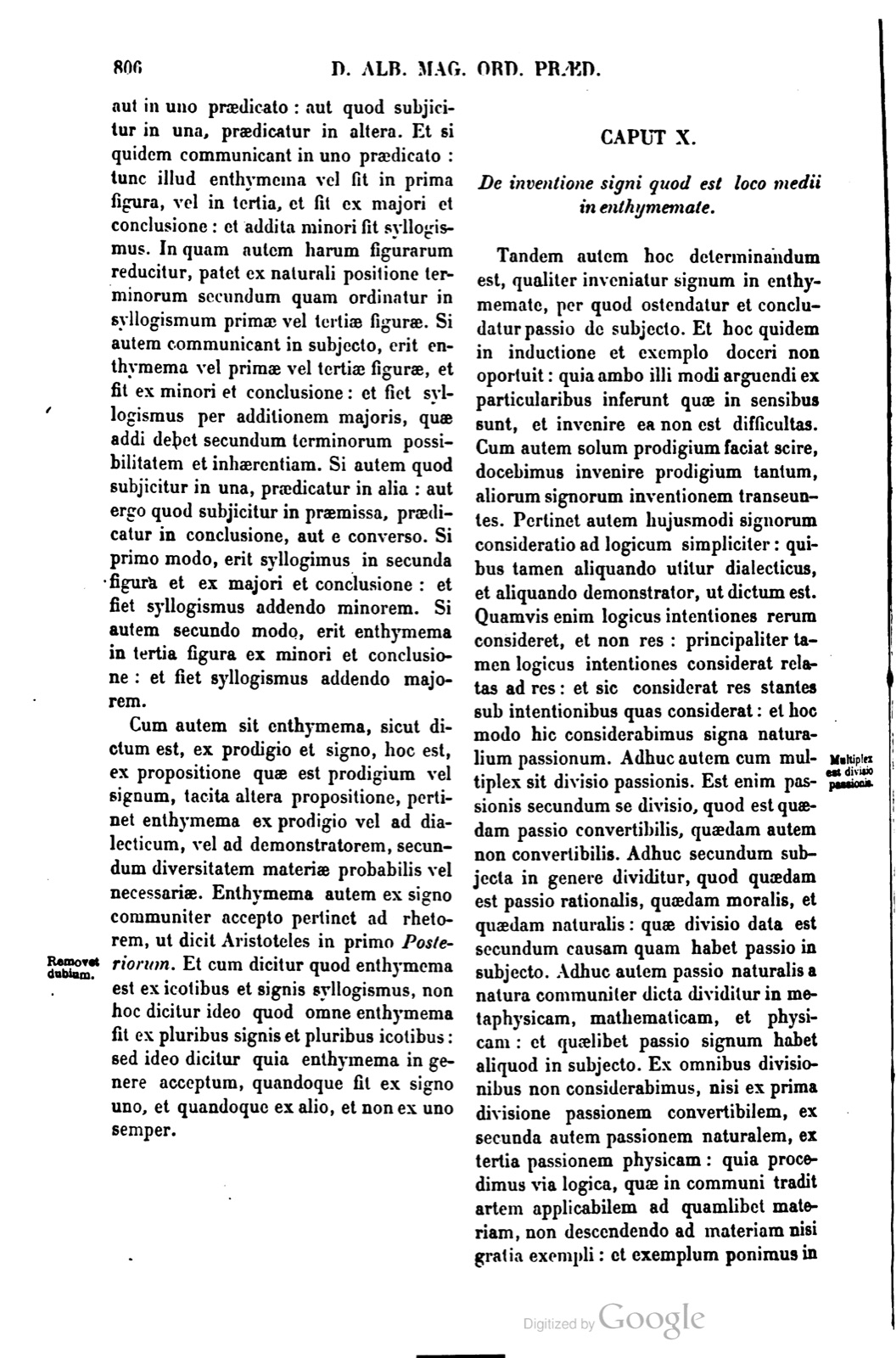
Cum autem sit enthymema, sicut dictum est, ex prodigio et signo, hoc est, ex propositione quae est prodigium vel signum, tacita altera propositione, pertinet enthymema ex prodigio vel ad dialecticum, vel ad demonstratorem, secundum diversitatem materiae probabilis vel necessariae. Enthymema autem ex signo communiter accepto pertinet ad rhetorem, ut dicit Aristoteles in primo Posteriorum.
Marginal label (printed page 806): Removet dubium.
Et cum dicitur quod enthymema est ex icotibus et signis syllogismus, non hoc dicitur ideo quod omne enthymema fit ex pluribus signis et pluribus icotibus: sed ideo dicitur quia enthymema in genere acceptum, quandoque fit ex signo uno, et quandoque ex alio, et non ex uno semper.
Marginal label (printed page 805): General art of reducing every enthymeme into syllogism.
But from this it is easily plain what the general art is of reducing every enthymeme into syllogism. For since an enthymeme expresses only one proposition with the conclusion, it must be made from three terms. Therefore either the proposition and conclusion will communicate in one subject, or in one predicate, or what is subjected in one is predicated in the other. And if indeed they communicate in one predicate, then that enthymeme either is made in the first figure or in the third, and it is made from the major and the conclusion; and when the minor has been added, a syllogism is made. But into which of these figures it is reduced is plain from the natural position of the terms according to which it is ordered into a syllogism of the first or third figure. But if they communicate in subject, it will be an enthymeme either of the first or third figure, and is made from the minor and conclusion; and a syllogism will be made by the addition of the major, which must be added according to the possibility and inherence of the terms. But if what is subjected in one is predicated in another, then either what is subjected in the premise is predicated in the conclusion, or conversely. If in the first mode, there will be a syllogism in the second figure and from the major and conclusion, and a syllogism will be made by adding the minor. But if in the second mode, there will be an enthymeme in the third figure from the minor and conclusion, and a syllogism will be made by adding the major.
But since an enthymeme is, as has been said, from a prodigy and sign, that is, from a proposition which is a prodigy or sign, with the other proposition left tacit, an enthymeme from a prodigy pertains either to the dialectician or to the demonstrator according to the diversity of probable or necessary matter. But an enthymeme from a sign commonly accepted pertains to the rhetorician, as Aristotle says in the first book of the Posterior Analytics.
Marginal label (printed page 806): He removes a doubt.
And when it is said that an enthymeme is a syllogism from ikoi and signs, this is not said for this reason, that every enthymeme is made from several signs and several ikoi, but it is said for this reason, that an enthymeme accepted in genus is sometimes made from one sign and sometimes from another, and not always from one.
If a page does not appear, its photograph has not been uploaded yet.