Works › Prior Analytics, Books I–II
Volume 1 · pp. 806–809
Treatise VII, Chapter X
A marker with ≈ is an approximate page boundary, placed by measure of the text; the page photographs remain the authority. In the paired views, clicking a page marker brings that page into view.
CAPUT X.
De inventione signi quod est loco medii in enthymemate.
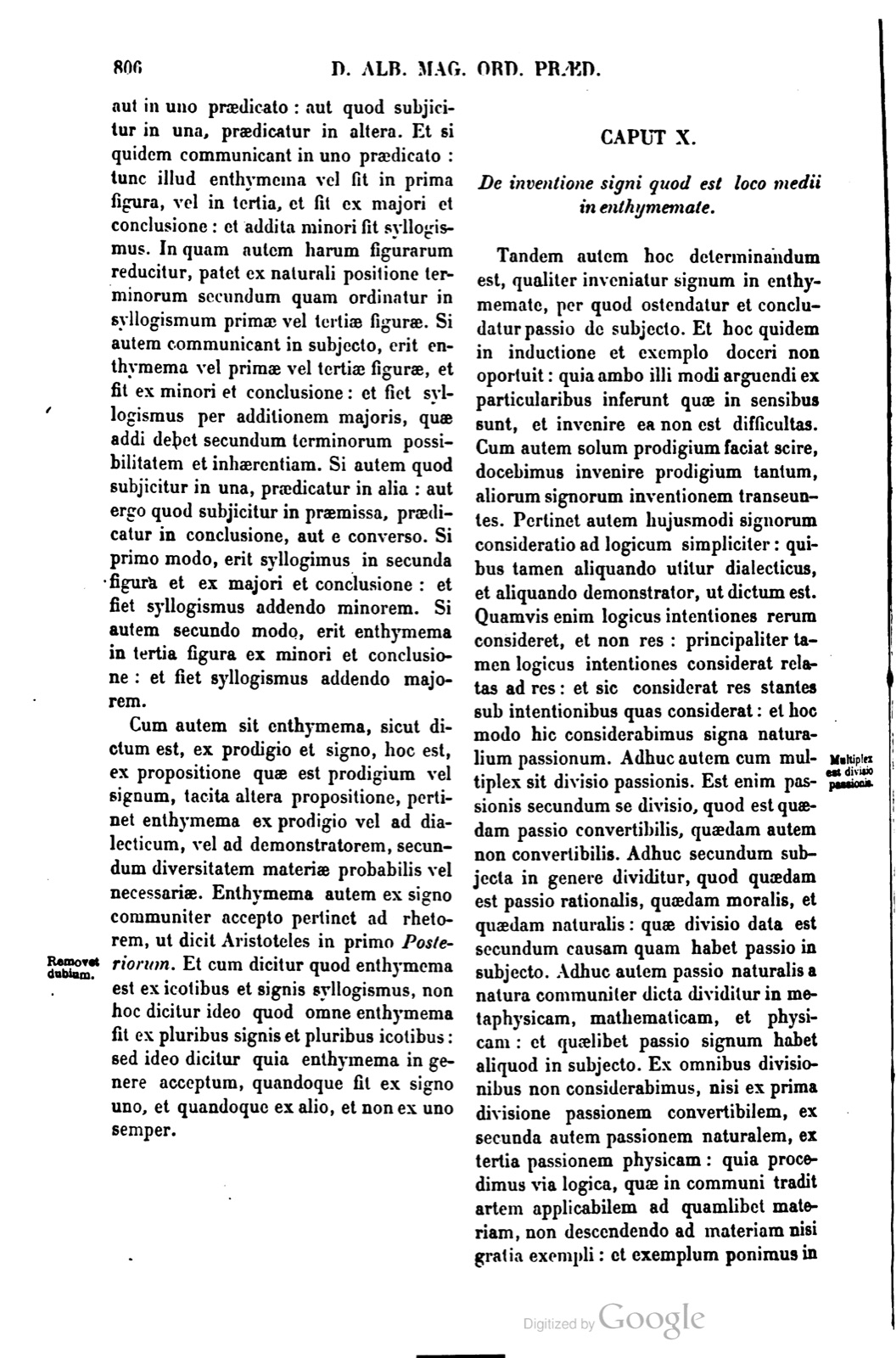
Tandem autem hoc determinandum est, qualiter inveniatur signum in enthymemate, per quod ostendatur et concludatur passio de subjecto. Et hoc quidem in inductione et exemplo doceri non oportuit: quia ambo illi modi arguendi ex particularibus inferunt quae in sensibus sunt, et invenire ea non est difficultas. Cum autem solum prodigium faciat scire, docebimus invenire prodigium tantum, aliorum signorum inventionem transeuntes. Pertinet autem hujusmodi signorum consideratio ad logicum simpliciter: quibus tamen aliquando utitur dialecticus, et aliquando demonstrator, ut dictum est. Quamvis enim logicus intentiones rerum consideret, et non res: principaliter tamen logicus intentiones considerat relatas ad res: et sic considerat res stantes sub intentionibus quas considerat: et hoc modo hic considerabimus signa naturalium passionum.
Marginal label (printed page 806): Multiplex est divisio passionis.
Adhuc autem cum multiplex sit divisio passionis. Est enim passionis secundum se divisio, quod est quaedam passio convertibilis, quaedam autem non convertibilis. Adhuc secundum subjecta in genere dividitur, quod quaedam est passio rationalis, quaedam moralis, et quaedam naturalis: quae divisio data est secundum causam quam habet passio in subjecto. Adhuc autem passio naturalis a natura communiter dicta dividitur in metaphysicam, mathematicam, et physicam: et quaelibet passio signum habet aliquod in subjecto. Ex omnibus divisionibus non considerabimus, nisi ex prima divisione passionem convertibilem, ex secunda autem passionem naturalem, ex tertia passionem physicam: quia procedimus via logica, quae in communi tradit artem applicabilem ad quamlibet materiam, non descendendo ad materiam nisi gratia exempli: et exemplum ponimus in materia magis manifesta, ut similiter intelligatur in aliis.
Ad signi igitur talis (quod prodigium est) inventionem, dicamus quod naturas (hoc est, naturales passiones) cognoscere possibile est per signa quae sunt in enthymematibus loco mediorum, tali suppositione praehabita, si quis concedat simul corpus et animam (hoc est, totum conjunctum ex corpore et anima) mutari (hoc est, transmutari) a passionibus talibus quaecumque sunt naturales passiones conjuncti totius: ita ut passiones mutent corpus et animam, ita quod in eis sit signum passionis naturalis. Si autem aliquis patitur passione non naturali, sed accidentali, tunc hoc non erit necessarium. Discens enim aliquis fortasse musicam, secundum aliquid passionis alicujus animalis et intellectualis mutavit in animam, et mutatus est in anima, et non oportet hujus passionis esse signum in conjuncto: quia naturalis non est talis passio: sed passiones naturales sunt, ut irae naturales et concupiscentiae quae sunt passiones et passibiles dictae passiones: sunt enim illae naturalium motuum quibus movent conjunctum.
Secundum autem supponendum est, quod det et concedat aliquis unum commune in natura communi, unius passionis communis in illa natura esse signum, ita quod hoc signum comitetur totam illam naturam cujus est illa passio: tunc per talia signa arguendo per enthymema poterimus sumere concludendo uniuscujusque generis, quod illam passionem communicat propriam et convertibilem passionem, et signum illius passionis in natura illa: et sic poterimus illam naturam cognoscere secundum quod illi subjecta est passioni.
CHAPTER X.
On The Discovery Of The Sign Which Is In Place Of The Middle In An Enthymeme.
But at last this must be determined, how the sign is found in an enthymeme, through which an affection is shown and concluded of a subject. And this indeed did not have to be taught in induction and example, because both those modes of arguing infer from particulars which are in the senses, and to find them is not a difficulty. But since only the prodigy makes one know, we will teach how to find the prodigy only, passing over the discovery of the other signs. But the consideration of signs of this sort pertains to the logician simply, although sometimes the dialectician uses them, and sometimes the demonstrator, as has been said. For although the logician considers intentions of things and not things, nevertheless principally the logician considers intentions related to things; and thus he considers things standing under the intentions which he considers; and in this way here we will consider signs of natural affections.
Marginal label (printed page 806): The division of affection is manifold.
Again, since the division of affection is manifold. For there is the division of affection according to itself, namely that one affection is convertible, but another not convertible. Again, according to subjects in a genus it is divided, namely that one affection is rational, another moral, and another natural; this division is given according to the cause which the affection has in the subject. Again, natural affection from nature commonly said is divided into metaphysical, mathematical, and physical; and any affection has some sign in the subject. From all the divisions we will consider only, from the first division, the convertible affection; but from the second, the natural affection; from the third, the physical affection, because we proceed by a logical way, which in common hands down an art applicable to any matter, not descending to matter except for the sake of example; and we posit the example in more manifest matter, so that it may be understood similarly in the others.
Therefore for the discovery of such a sign, which is a prodigy, let us say that to know natures, that is, natural affections, is possible through signs which are in enthymemes in the place of middles, with such a supposition previously had: if someone grants that body and soul together, that is, the whole composite from body and soul, is changed, that is, transmuted, by such affections, whatever are natural affections of the whole composite, so that affections change body and soul, so that in them there is a sign of a natural affection. But if someone suffers by a non-natural affection, but an accidental one, then this will not be necessary. For someone perhaps learning music has changed in the soul according to something of some animal and intellectual affection, and he has been changed in the soul, and a sign of this affection need not be in the composite, because such an affection is not natural. But natural affections are, as natural angers and concupiscences, which are affections and passible affections, as they are called; for they are of the natural motions by which they move the composite.
But the second thing to be supposed is that someone gives and grants that one common thing in a common nature is the sign of one common affection in that nature, so that this sign accompanies that whole nature of which that affection is; then by arguing through such signs through an enthymeme, we will be able to take, by concluding, of each genus which communicates that affection, its proper and convertible affection, and the sign of that affection in that nature; and thus we will be able to know that nature according as it is subjected to that affection.
Sic autem procedemus, et tali modo considerabimus. Si enim est aliqua passio propria specialiter alicui generi individuato ad speciem sive in specie determinato conveniens, sicut fortitudo sive animositas convenit leonibus secundum suam speciem determinatis; tunc cum concessum sit quod passio naturalis transmutat conjunctum, necesse est in tota specie leonum hujus passionis esse signum aliquod positum, et compati sibi invicem in corpore et anima conjunctum in tali passione: ut si dicamus quod hoc hujus passionis signum in leone sit, magnas habere summitates: considerabimus ergo hoc signum in aliis animalibus fortibus quibus haec passio non universaliter in totis suis generibus vel speciebus contingit, sicut in hominibus fortibus et animosis per naturam et non per habitum acquisitum. Signum enim per quod talem de subjecto concludimus passionem, sic vocamus proprium: quia totius illius generis est hoc modo propria passio, quo dicimus proprium quod convenit omni generi et non soli. Hoc enim modo saepe solemus proprium dicere. Erit ergo et in alio genere proprium hoc scilicet non universaliter, ut in hominibus fortibus per naturam: et erit hoc modo per naturam fortis homo, et aliud forte quodlibet sive omne animal quod per naturam est forte: et cum illud animal vel homo cum leone naturaliter communicet passionem illam, sequitur quod habebit idem fortitudinis signum per primam suppositionem. Dictum enim est in secunda suppositione, quod unum commune unius communis passionis fuit signum in omnibus in quibus est illa passio. Si ergo haec vera sunt quae dicta sunt, tunc nos ex arte ista poterimus talia talium passionum signa colligere in his animalibus, quae tantum unam secundum totum genus vel speciem habent illam passionem et communem: unumquodque enim habet signum illius passionis secundum totam illius speciei multitudinem: necesse enim per secundam suppositionem, quod suae passionis quae est speciei suae propria, tamen commune habet signum: tunc ex hoc signo poterimus naturas propriarum passionum cognoscere: considerabimus enim in homine forti vel alio animali, quod quodlibet forte per naturam habet magnas summitates: et considerantes hoc signum in leone generaliter arguimus sic: leo generaliter habet magnas summitates: ergo leo generaliter est fortis.
Si vero aliqua natura una in genere uno vel specie duo habet propria universaliter sibi convenientia secundum totum genus suum, sicut leo fortitudinem habet et liberalitatem: est enim et per naturam forte animal animosum, et est praedae communicativum etiam per naturam: tunc dubium est quomodo cognoscimus, utrum hoc signum determinatum sic unius illarum passionum, sit signum vel alterius quae ambo sive ambae passiones specialiter, hoc est, totam sequuntur speciem: hoc enim scire non poterimus, nisi concederemus quod et alii speciei non generaliter toti universaliter, sed particulariter, nec ambae passiones, sed altera inest. Et considerabimus tunc in his in quibus non totis inest illa passio naturalis: et considerabimus in quibus non utrumque nec totis inest: quando hoc quidem signum habet, quod ejusdem passionis signum est in leone, ut habere magnas summitates. Illud vero alterius passionis signum non habet, sicut et ipsa passione caret. Si enim homo est fortis cum leone per naturam, habet autem duorum signorum hoc quod est fortitudinis signum: palam ex conclusione enthymematis, quoniam etiam in leone hoc fuit signum fortitudinis, et non liberalitatis.
But we will proceed in this way, and in such a mode we will consider. For if there is some proper affection agreeing especially with some genus individuated to a species or determined in a species, as fortitude or spiritedness agrees with lions according to their determined species, then, since it has been granted that a natural affection transmutates the composite, there must be some sign of this affection posited in the whole species of lions, and the composite in body and soul must suffer together mutually with itself in such an affection. For example, if we say that this sign of this affection in the lion is to have large extremities, we will therefore consider this sign in other strong animals to which this affection does not universally happen in all their genera or species, as in strong and spirited human beings by nature and not through an acquired habit. For the sign through which we conclude such an affection of a subject we call proper in this way, because it is a proper affection of that whole genus in this mode in which we call proper what belongs to every genus and not only to it. For in this way we are often accustomed to call something proper. Therefore this proper thing will also be in another genus, namely not universally, as in human beings strong by nature; and in this way a human being will be strong by nature, and any other strong thing or every animal which by nature is strong. And since that animal or human being naturally communicates that affection with the lion, it follows that it will have the same sign of fortitude through the first supposition. For it was said in the second supposition that one common thing was the sign of one common affection in all things in which that affection is. Therefore if these things which have been said are true, then from this art we will be able to gather such signs of such affections in those animals which have only one according to the whole genus or species, that affection and common affection. For each thing has the sign of that affection according to the whole multitude of that species; for it is necessary through the second supposition that it has a common sign of its affection which is proper to its species. Then from this sign we will be able to know the natures of proper affections; for we will consider in a strong human being or another animal, that anything strong by nature has large extremities; and considering this sign in the lion generally we argue thus: the lion generally has large extremities; therefore the lion generally is strong.
But if one nature in one genus or species has two proper things universally agreeing with it according to its whole genus, as the lion has fortitude and liberality, for it is both a strong spirited animal by nature, and is communicative of prey also by nature, then it is doubtful how we know whether this determinate sign in this way of one of those affections is the sign of it or of the other, which both, or both affections, especially, that is, follow the whole species. For we will not be able to know this unless we were to grant that also to another species, not generally to the whole universally, but particularly, not both affections, but the one, belongs. And then we will consider in those in which that natural affection does not belong to all; and we will consider in which not both nor to all it belongs, when it indeed has this sign, which is the sign of the same affection in the lion, as to have large extremities. But it does not have that sign of the other affection, just as it also lacks that affection itself. For if man is strong with the lion by nature, but of the two signs has this one which is the sign of fortitude, it is clear from the conclusion of the enthymeme that also in the lion this was the sign of fortitude, and not of liberality.
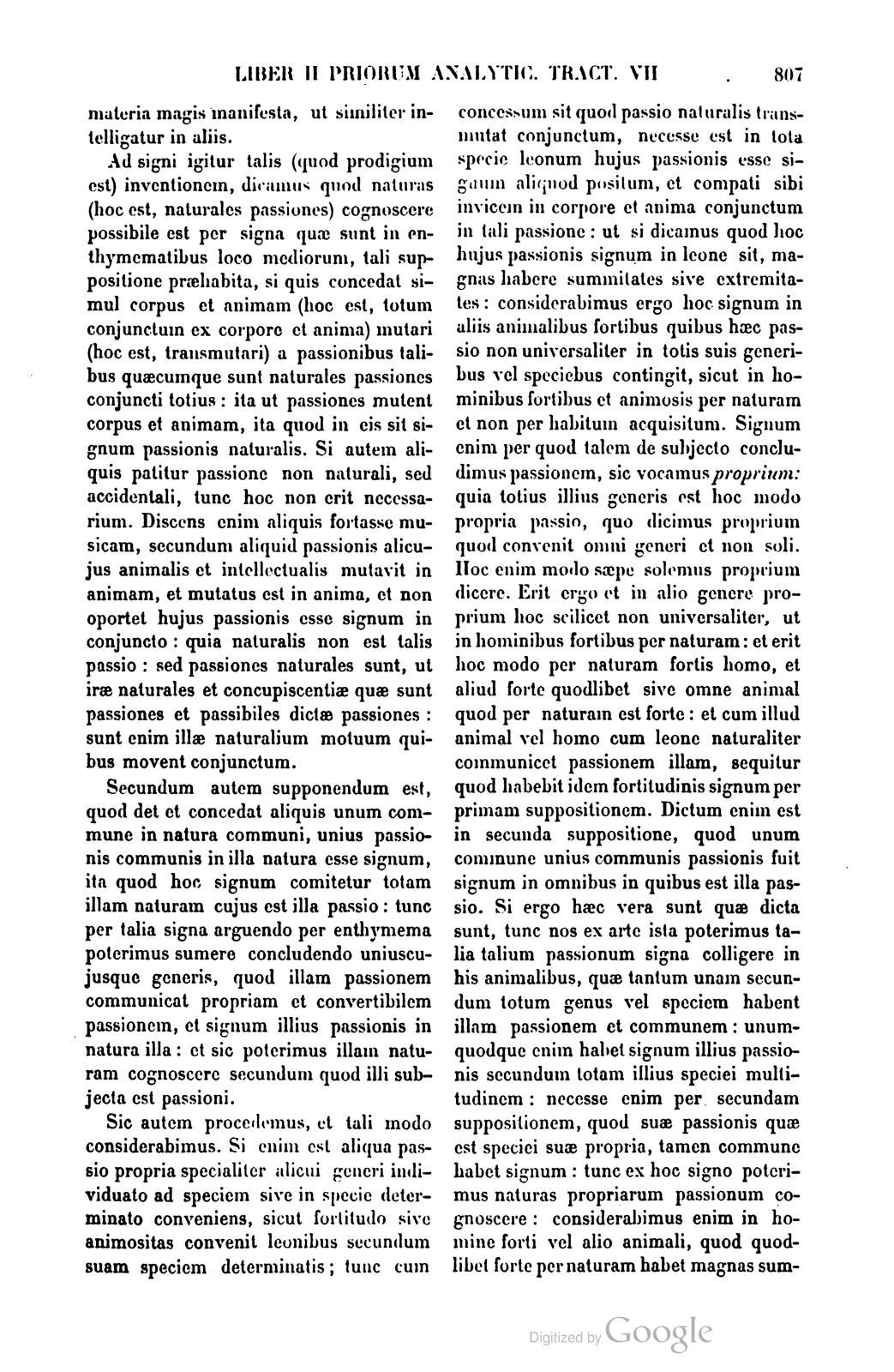
Ostendamus igitur per hunc modum concludere vel ostendere passionem de subjecto. Dicamus quod est naturas sive passiones naturales de quolibet subjecto cognoscere in prima quidem figura, supponendo medium converti cum priori sive majori extremitate, sicut esse forte et habere magnas summitates convertuntur. Medium autem in plus esse quam minorem extremitatem: esse enim forte in plus est quam leo. In tertia autem oportet minorem extremitatem transcendere et non converti, sicut patet in exemplis, si sit fortitudo vel forte esse A, quae est prima extremitas: summitates vero magnas habere sit in quo B quod convertitur cum A, C autem tertia extremitas post medium sit leo; quod minus est, quam forte esse. Patet enim sic dispositis terminis, quod omni C inest B, quia omnis leo magnas habet summitates: sed hoc non inest soli leoni, sed et aliis animalibus inest particulariter: cui autem B inest, omni illi inest A, quia omne habens magnas summitates, est forte: et non inest pluribus, quia convertitur cum ipso. Si autem dicatur sic non esse ut dictum est, sequitur inconveniens contra secundam hypothesim: quia sequitur quod non erit unum commune unius passionis communis signum. Hujus autem probatio patet per quartam consequentiam in ante habitis determinatam, in capitulo ubi dictum est quod quando convertuntur extremitates, necesse est et medium converti: si enim A dicitur de solo B, et A et B de omni C, tunc A et B convertuntur: et sic patet inventio medii in prima figura, in qua signum est prodigium.
Quando autem per habere magnas summitates ostenditur leo esse fortis, hoc sumitur et non probatur: quia hoc constat in leone signum esse per hoc quod in aliis talis passionis est signum. Non autem sic potest ostendi hoc esse signum fortitudinis in alio animali per hoc quod est signum talis passionis in leone, quia leoni inest universaliter, aliis autem non: et ideo per differentias eorum qui non habent magnas extremitates, ostenditur hoc fortitudinis esse signum in leone.
Marginal label (printed page 808): Objectio.
Si quis autem objiciat et dicat hanc artem nullam esse, quia probat idem per seipsum: ostendit enim passionem per signum, et e converso signum per passionem, et sic idem per seipsum.
Marginal label (printed page 808): Solutio.
Dicendum quod passio ostenditur per signum, et e converso, sed non eodem modo; ostendit enim signum per passionem in subjecto non proprio passionis, ostendit passionem per signum in subjecto proprio passionis: et hoc non est inconveniens. Adhuc signum ostenditur per passionem
Therefore let us show through this mode how to conclude or show an affection of a subject. Let us say that it is to know natures or natural affections of any subject in the first figure indeed, by supposing the middle to be converted with the prior or major extreme, as to be strong and to have large extremities are converted. But the middle is in more things than the minor extreme; for to be strong is in more things than lion. But in the third it is necessary for the minor extreme to transcend and not to be converted, as is plain in examples, if fortitude or being strong is A, which is the first extreme; but having large extremities is that in which B is, which is converted with A; but let C, the third extreme after the middle, be lion, which is less than to be strong. For with the terms disposed in this way, it is plain that B belongs to every C, because every lion has large extremities; but this does not belong only to the lion, but also belongs particularly to other animals; but to whatever B belongs, to all that A belongs, because everything having large extremities is strong; and it does not belong to more things, because it is converted with it. But if it is said not to be so as has been said, an unacceptable consequence follows against the second hypothesis, because it follows that there will not be one common sign of one common affection. But the proof of this is plain through the fourth consequence determined in the things already had, in the chapter where it was said that when the extremes are converted, the middle also must be converted. For if A is said of B alone, and A and B of every C, then A and B are converted; and thus the discovery of the middle is plain in the first figure, in which the sign is a prodigy.
But when through having large extremities the lion is shown to be strong, this is taken and not proved, because this is established to be a sign in the lion through the fact that in others it is a sign of such an affection. But this cannot be shown in this way, that this is a sign of fortitude in another animal through the fact that it is a sign of such an affection in the lion, because it belongs to the lion universally, but not to the others; and therefore through the differences of those who do not have large extremities, this is shown to be the sign of fortitude in the lion.
Marginal label (printed page 808): Objection.
But if someone objects and says that this art is nothing, because it proves the same thing through itself, for it shows the affection through the sign, and conversely the sign through the affection, and thus the same thing through itself.
Marginal label (printed page 808): Solution.
It must be said that the affection is shown through the sign, and conversely, but not in the same mode; for it shows the sign through the affection in a subject not proper to the affection, and it shows the affection through the sign in the proper subject of the affection; and this is not unacceptable. Again, the sign is shown through the affection
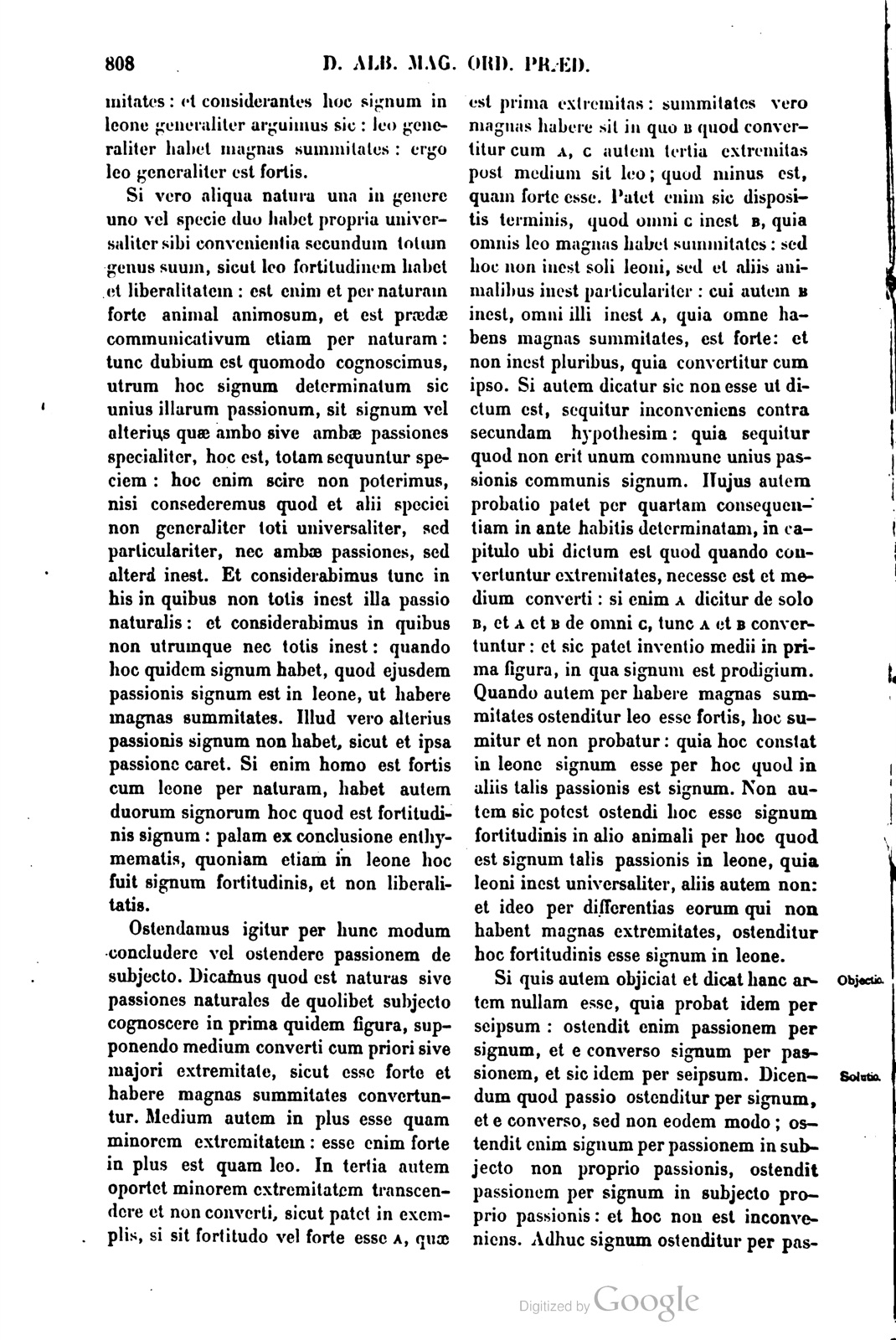
per viam sensus, passio autem per signum per viam syllogismi et rationis. Scias autem quod tota scientia quae dicitur physiognomia super hanc artem fundata est.
FINIS TOMI PRIMI
through the way of sense, but the affection through the sign, through the way of syllogism and reason. But you should know that the whole science which is called physiognomy is founded upon this art.
END OF THE FIRST VOLUME.
If a page does not appear, its photograph has not been uploaded yet.