Works › Prior Analytics, Books I–II
Volume 1 · pp. 802–803
Treatise VII, Chapter VIII
A marker with ≈ is an approximate page boundary, placed by measure of the text; the page photographs remain the authority. In the paired views, clicking a page marker brings that page into view.
CAPUT VIII.
De icote et signo ex quibus fit enthymema.
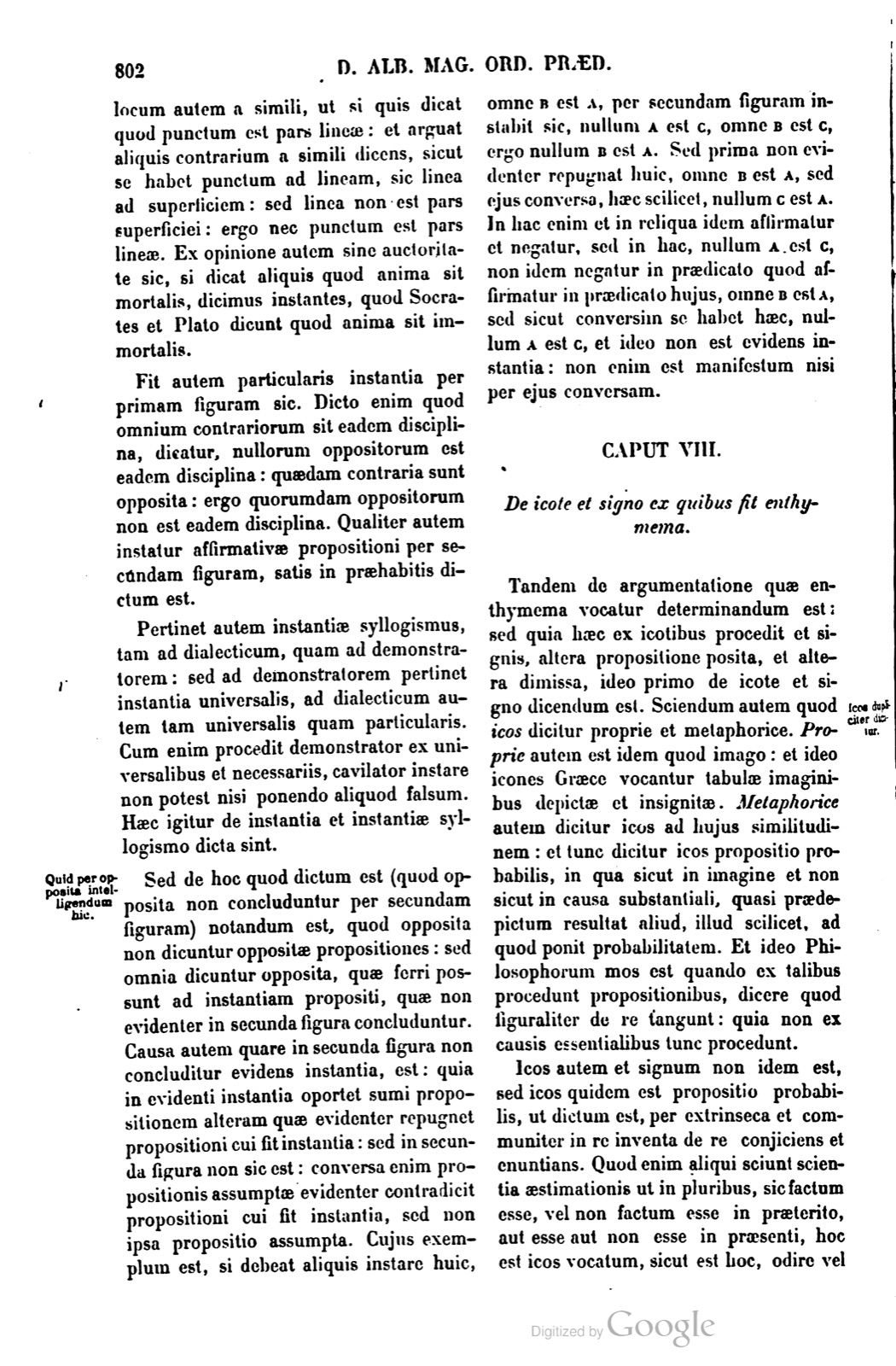
Tandem de argumentatione quae enthymema vocatur determinandum est: sed quia haec ex icotibus procedit et signis, altera propositione posita, et altera dimissa, ideo primo de icote et signo dicendum est.
Marginal label (printed page 802): Icos dupliciter dicitur.
Sciendum autem quod icos dicitur proprie et metaphorice. Proprie autem est idem quod imago: et ideo icones Graece vocantur tabulae imaginibus depictae et insignitae. Metaphorice autem dicitur icos ad hujus similitudinem: et tunc dicitur icos propositio probabilis, in qua sicut in imagine et non sicut in causa substantiali, quasi praedepictum resultat aliud, illud scilicet, ad quod ponit probabilitatem. Et ideo Philosophorum mos est quando ex talibus procedunt propositionibus, dicere quod figuraliter de re tangunt: quia non ex causis essentialibus tunc procedunt.
Icos autem et signum non idem est, sed icos quidem est propositio probabilis, ut dictum est, per extrinseca et communiter in re inventa de re conjiciens et enuntians. Quod enim aliqui sciunt scientia aestimationis ut in pluribus, sic factum esse, vel non factum esse in praeterito, aut esse aut non esse in praesenti, hoc est icos vocatum, sicut est hoc, odire vel odisse invidentes sive inimicos: quod Plato in libro Mennonis ponit in hominis diffinitione, eo quod est signum vel icos profundatum in natura animalis. Tale est etiam diligere amantes sive amicos. Hoc igitur est icos.
Signum autem est, quod praeter speciem quam cognoscenti offert, ad aliquid ducit cujus est signum: et ideo sui significatione vult esse propositio demonstrativa, vel necessaria, vel probabilis. Dico autem vult, quia aptitudine signi et relatione ad signatum, aliquando ducit in causam essentialem, et tunc vult esse propositio necessaria, quamvis secundum se et secundum sui rationem non sit ita: aliquando autem ducit in ea quae communiter sunt in re, et extrinsecus adhaerentia, tunc vult esse propositio probabilis. Dico autem signum propositionem demonstrativam secundum quod demonstrativum communiter sumitur pro ostensivo, sive in demonstrativis, sive dialecticis. Id enim quo existente in praesenti, res est, et infertur ex ipso: vel quo facto in praeterito, res facta est in praeterito: vel quo posterius facto, indicat factum esse aliquid, sicut pallor conceptum factum indicat: aut id quod indicat, quoniam erit res illo prius facto, sicut in aegroto tremor in labro inferiori factus indicat vomitum futurum, hoc dicitur signum.
CHAPTER VIII.
On Ikos And Sign, From Which Enthymeme Is Made.
At last one must determine about the argumentation which is called enthymeme; but because this proceeds from ikoi and signs, with one proposition posited and the other omitted, therefore first one must speak about ikos and sign.
Marginal label (printed page 802): Ikos is said in two ways.
But one must know that ikos is said properly and metaphorically. Properly, however, it is the same as image; and therefore icons in Greek are called tablets depicted and marked with images. But metaphorically ikos is said according to a likeness of this; and then ikos is called a probable proposition in which, as in an image and not as in a substantial cause, another thing results as though pre-depicted, namely that toward which it posits probability. And therefore the custom of the philosophers is, when they proceed from such propositions, to say that they touch upon the matter figuratively, because then they do not proceed from essential causes.
But ikos and sign are not the same; rather ikos indeed is a probable proposition, as has been said, conjecturing and enunciating about a thing through extrinsic things and things commonly found in the thing. For what some know by knowledge of estimation as in the majority of cases, that it has been done thus, or has not been done in the past, or is or is not in the present, this is called ikos, as is this: to hate or have hated the envious or enemies; this Plato posits in the definition of man in the book of the Meno, because it is a sign or ikos grounded in the nature of animal. Such also is to love lovers or friends. This therefore is ikos.
But a sign is that which, beyond the species which it offers to the knower, leads to something of which it is the sign; and therefore by its signification it wants to be a demonstrative, or necessary, or probable proposition. But I say wants, because by the aptitude of the sign and relation to the thing signified, sometimes it leads into an essential cause, and then it wants to be a necessary proposition, although according to itself and according to its own account it is not so; but sometimes it leads into those things which are commonly in the thing and adhering extrinsically, and then it wants to be a probable proposition. But I call a sign a demonstrative proposition according as demonstrative is commonly taken for ostensive, whether in demonstratives or dialecticals. For that by whose existing in the present the thing is, and is inferred from it; or that by whose having been done in the past the thing has been done in the past; or that which, having been done later, indicates that something has been done, as paleness indicates that conception has been made; or that which indicates that the thing will be when that has first been done, as a tremor made in the lower lip in a sick person indicates future vomiting: this is called a sign.
Marginal label (printed page 803): Differentia icotis et signi: et quomodo signum dupliciter dicitur.
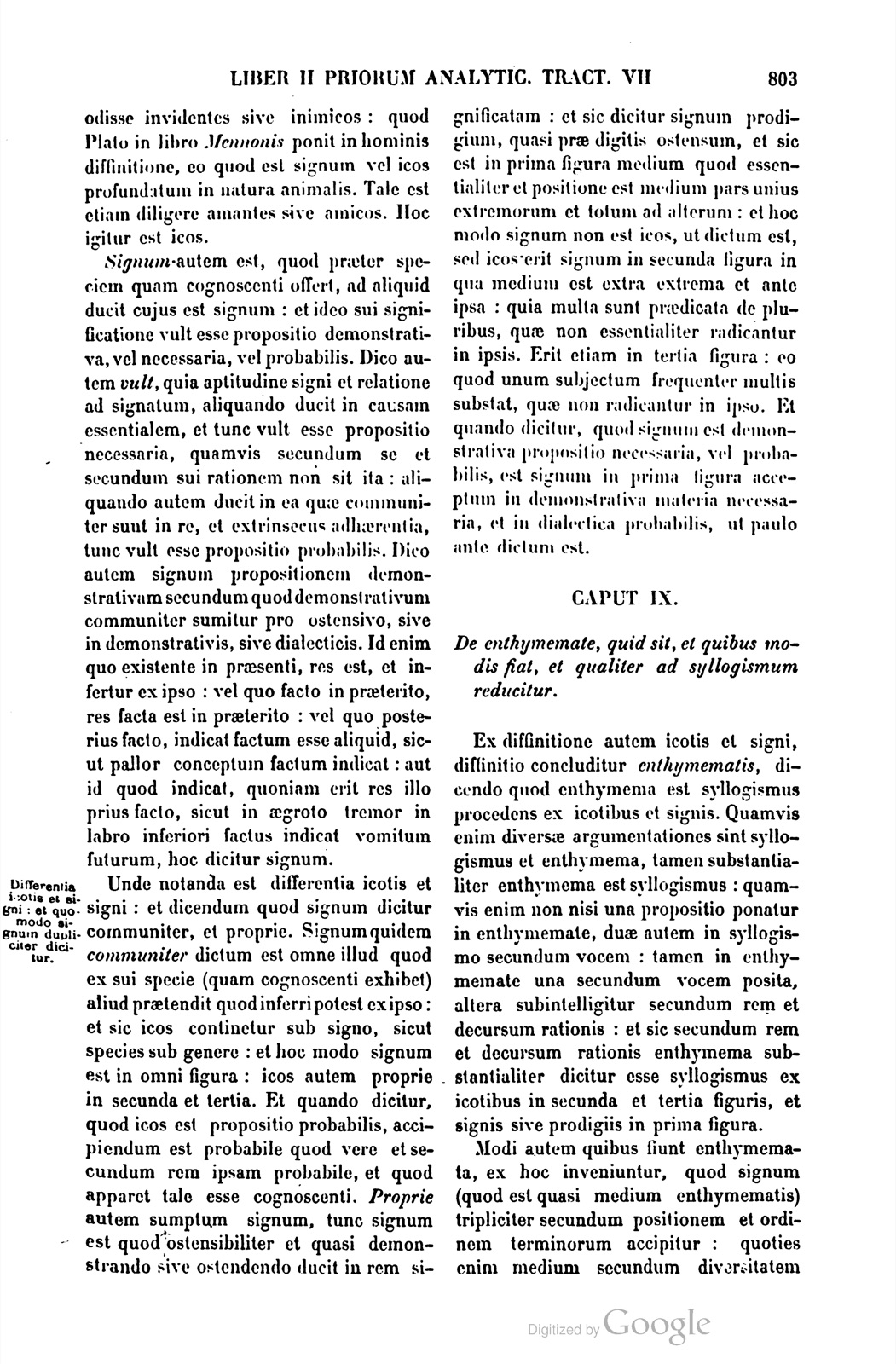
Unde notanda est differentia icotis et signi: et dicendum quod signum dicitur communiter, et proprie. Signum quidem communiter dictum est omne illud quod ex sui specie (quam cognoscenti exhibet) aliud praetendit quod inferri potest ex ipso: et sic icos continetur sub signo, sicut species sub genere: et hoc modo signum est in omni figura: icos autem proprie in secunda et tertia. Et quando dicitur, quod icos est propositio probabilis, accipiendum est probabile quod vere et secundum rem ipsam probabile, et quod apparet tale esse cognoscenti. Proprie autem sumptum signum, tunc signum est quod ostensibiliter et quasi demonstrando sive ostendendo ducit in rem significatam: et sic dicitur signum prodigium, quasi prae digitis ostensum, et sic est in prima figura medium quod essentialiter et positione est medium pars unius extremorum et totum ad alterum: et hoc modo signum non est icos, ut dictum est, sed icos erit signum in secunda figura in qua medium est extra extrema et ante ipsa: quia multa sunt praedicata de pluribus, quae non essentialiter radicantur in ipsis. Erit etiam in tertia figura: eo quod unum subjectum frequenter multis substat, quae non radicantur in ipso. Et quando dicitur, quod signum est demonstrativa propositio necessaria, vel probabilis, est signum in prima figura acceptum in demonstrativa materia necessaria, et in dialectica probabilis, ut paulo ante dictum est.
Marginal label (printed page 803): Difference of ikos and sign, and in what way sign is said in two ways.
Whence the difference of ikos and sign must be noted; and it must be said that sign is said commonly and properly. A sign said commonly is everything which from its species, which it displays to the knower, holds forth something else which can be inferred from it; and thus ikos is contained under sign, as species under genus; and in this way sign is in every figure, but ikos properly is in the second and third. And when it is said that ikos is a probable proposition, the probable must be taken as that which is truly and according to the thing itself probable, and which appears to the knower to be such. But sign taken properly is then a sign when it leads into the signified thing ostensively and as though by demonstrating or showing; and thus a sign is called a prodigy, as though shown before the fingers, and thus in the first figure it is a middle which essentially and by position is the middle, part of one extreme and whole to the other. And in this way sign is not ikos, as has been said; but ikos will be a sign in the second figure, in which the middle is outside the extremes and before them, because many things are predicates of many things which are not essentially rooted in them. It will also be in the third figure, because one subject frequently stands under many things which are not rooted in it. And when it is said that a sign is a demonstrative necessary or probable proposition, it is a sign accepted in the first figure in necessary demonstrative matter, and in dialectic matter it is probable, as was said a little before.
If a page does not appear, its photograph has not been uploaded yet.