Works › Prior Analytics, Books I–II
Volume 1 · pp. 799–802
Treatise VII, Chapter VII
A marker with ≈ is an approximate page boundary, placed by measure of the text; the page photographs remain the authority. In the paired views, clicking a page marker brings that page into view.
CAPUT VII.
De instantia sive instantivo syllogismo, quid sit et per quas fiat figuras.
Marginal label (printed page 799): Quare hic determinandum de instantia.
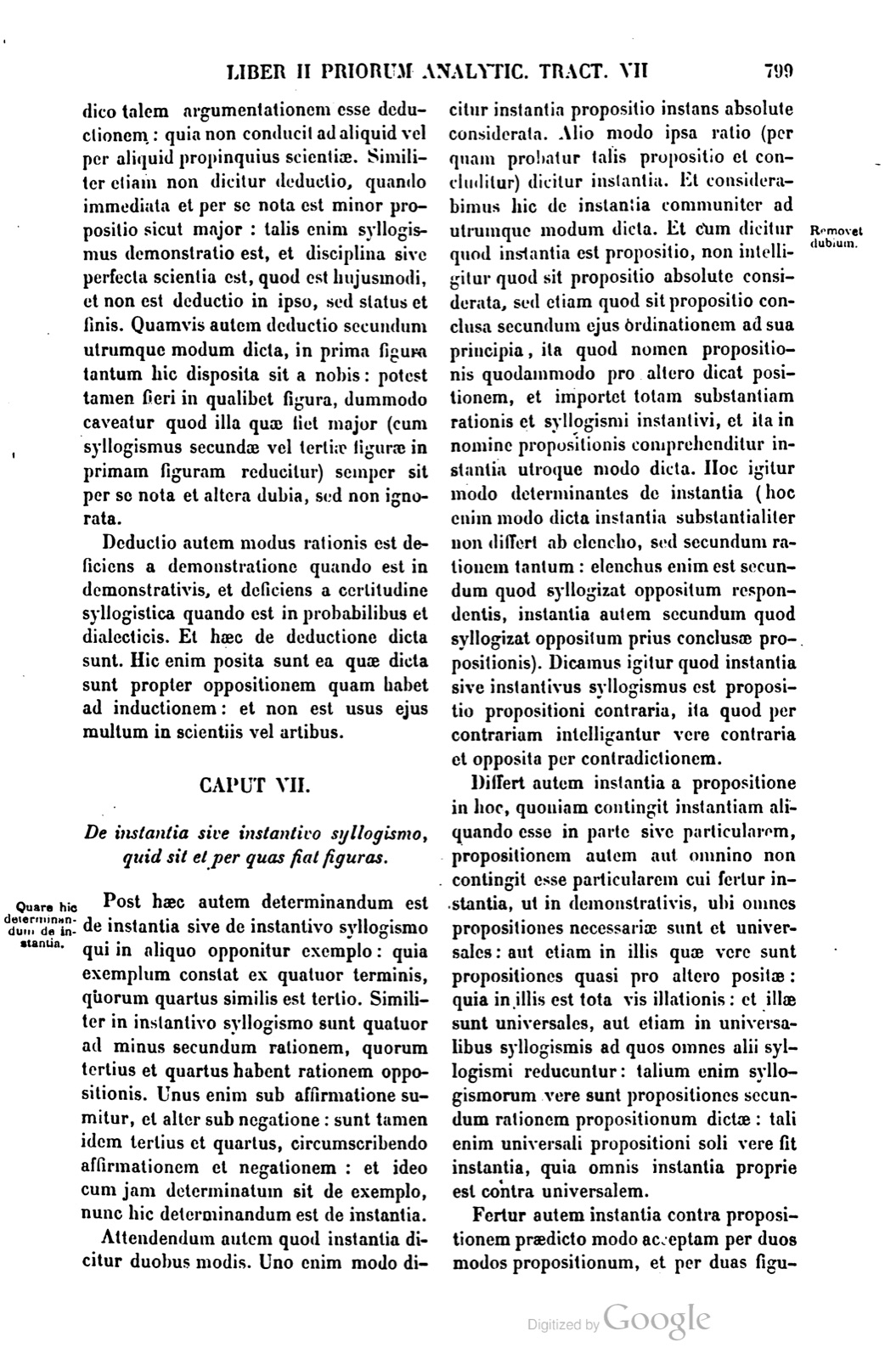
Post haec autem determinandum est de instantia sive de instantivo syllogismo qui in aliquo opponitur exemplo: quia exemplum constat ex quatuor terminis, quorum quartus similis est tertio. Similiter in instantivo syllogismo sunt quatuor ad minus secundum rationem, quorum tertius et quartus habent rationem oppositionis. Unus enim sub affirmatione sumitur, et alter sub negatione: sunt tamen idem tertius et quartus, circumscribendo affirmationem et negationem: et ideo cum jam determinatum sit de exemplo, nunc hic determinandum est de instantia.
Attendendum autem quod instantia dicitur duobus modis. Uno enim modo dicitur instantia propositio instans absolute vel considerata. Alio modo ipsa ratio (per quam probatur talis propositio et concluditur) dicitur instantia. Et considerabimus hic de instantia communiter ad utrumque modum dicta.
Marginal label (printed page 799): Removet dubium.
Et cum dicitur quod instantia est propositio, non intelligitur quod sit propositio absolute considerata, sed etiam quod sit propositio conclusa secundum ejus ordinationem ad sua principia, ita quod nomen propositionis quodammodo pro altero dicat positionem, et importet totam substantiam rationis et syllogismi instantivi, et ita in nomine propositionis comprehenditur instantia utroque modo dicta. Hoc igitur modo determinantes de instantia (hoc enim modo dicta instantia substantialiter non differt ab elencho, sed secundum rationem tantum: elenchus enim est secundum quod syllogizat oppositum respondentis, instantia autem secundum quod syllogizat oppositum prius conclusae propositionis). Dicamus igitur quod instantia sive instantivus syllogismus est propositio propositioni contraria, ita quod per contrariam intelligantur vere contraria et opposita per contradictionem.
Differt autem instantia a propositione in hoc, quoniam contingit instantiam aliquando esse in parte sive particularem, propositionem autem aut omnino non contingit esse particularem cui fertur instantia, ut in demonstrativis, ubi omnes propositiones necessariae sunt et universales: aut etiam in illis quae vere sunt propositiones quasi pro altero positae: quia in illis est tota vis illationis: et illae sunt universales, aut etiam in universalibus syllogismis ad quos omnes alii syllogismi reducuntur: talium enim syllogismorum vere sunt propositiones secundum rationem propositionum dictae: tali enim universali propositioni soli vere fit instantia, quia omnis instantia proprie est contra universalem.
Fertur autem instantia contra propositionem praedicto modo acceptam per duos modos propositionum, et per duas figuras, si instantia sit contra propositum syllogizata propositio. Dico autem duobus modis fieri instantiam quantum ad quantitatem duplicem propositionis instantis: est enim omnis instantiva propositio, aut universalis, aut particularis. Dico autem ex duabus figuris: quia instantiae opposito modo feruntur propositioni illi quae vere est propositio: et illa est, sine qua non est syllogismus universalis, scilicet affirmativa: opposita autem tali propositioni, non concluditur nisi in prima et tertia figura tantum, sicut patebit per sequentia. Quod autem per primam fiat instantia, patet ex hoc: quia si adversarius concludat omni inesse minori extremitati majorem: tunc instamus dicentes contrariam, quoniam nulli inest: aut ferentes condictoriam dicentes, quoniam alicui non inest. Horum autem duorum per quae instamus, nulli quidem minori majorem extremitatem inesse concludimus per primam figuram in secundo primae: alicui autem non inesse eidem subjecto quod est, concludimus per tertiam.
CHAPTER VII.
On Instance Or The Instantiative Syllogism, What It Is And Through Which Figures It Is Made.
Marginal label (printed page 799): Why one must determine here about instance.
But after these things one must determine about instance or about the instantiative syllogism, which in some respect is opposed to example, because example consists of four terms, of which the fourth is similar to the third. Similarly in an instantiative syllogism there are at least four according to reason, of which the third and fourth have the account of opposition. For one is taken under affirmation, and the other under negation; nevertheless the third and fourth are the same, if affirmation and negation are set aside. And therefore, since there has now been a determination about example, now here there must be a determination about instance.
But it must be attended that instance is said in two ways. For in one way the proposition instancing absolutely, or considered, is called an instance. In another way the very reasoning, through which such a proposition is proved and concluded, is called an instance. And here we will consider instance said commonly according to each mode.
Marginal label (printed page 799): He removes a doubt.
And when it is said that an instance is a proposition, it is not understood that it is a proposition considered absolutely, but also that it is a proposition concluded according to its ordering to its principles, so that the name of proposition in a certain way says a position for another, and imports the whole substance of the reasoning and of the instantiative syllogism; and thus under the name of proposition is comprehended instance said in each mode. Therefore, determining about instance in this way, for instance said in this way does not differ substantially from an elenchus, but only according to reason, since an elenchus is according as it syllogizes the opposite of the respondent, but an instance according as it syllogizes the opposite of a previously concluded proposition, let us say therefore that an instance or instantiative syllogism is a proposition contrary to a proposition, so that by contrary are understood things truly contrary and opposed through contradiction.
But instance differs from proposition in this, since it happens that an instance is sometimes in part or particular, but the proposition to which the instance is brought either cannot be particular at all, as in demonstratives, where all propositions are necessary and universal, or also in those which are truly propositions as it were posited for another, because in them is the whole force of inference, and they are universal, or also in universal syllogisms to which all other syllogisms are reduced. For propositions of such syllogisms are truly said according to the account of propositions; for an instance is truly made only against such a universal proposition, because every instance properly is against a universal.
But instance is brought against a proposition accepted in the aforesaid mode through two modes of propositions and through two figures, if the instance is a proposition syllogized against the proposed thing. But I say that instance is made in two modes with respect to the double quantity of the instancing proposition; for every instantiative proposition is either universal or particular. But I say from two figures because instances are brought in an opposite mode to that proposition which is truly a proposition; and that proposition is the one without which there is not a universal syllogism, namely the affirmative. But the opposite to such a proposition is concluded only in the first and third figures, as will be plain through what follows. But that an instance is made through the first is plain from this: because if the adversary concludes that the major belongs to every minor extreme, then we instance by saying the contrary, that it belongs to none, or by bringing the contradictory, saying that it does not belong to some. But of these two through which we instance, we conclude that the major extreme belongs to no minor through the first figure in the second mode of the first figure; but we conclude that it does not belong to some same subject which is, through the third.
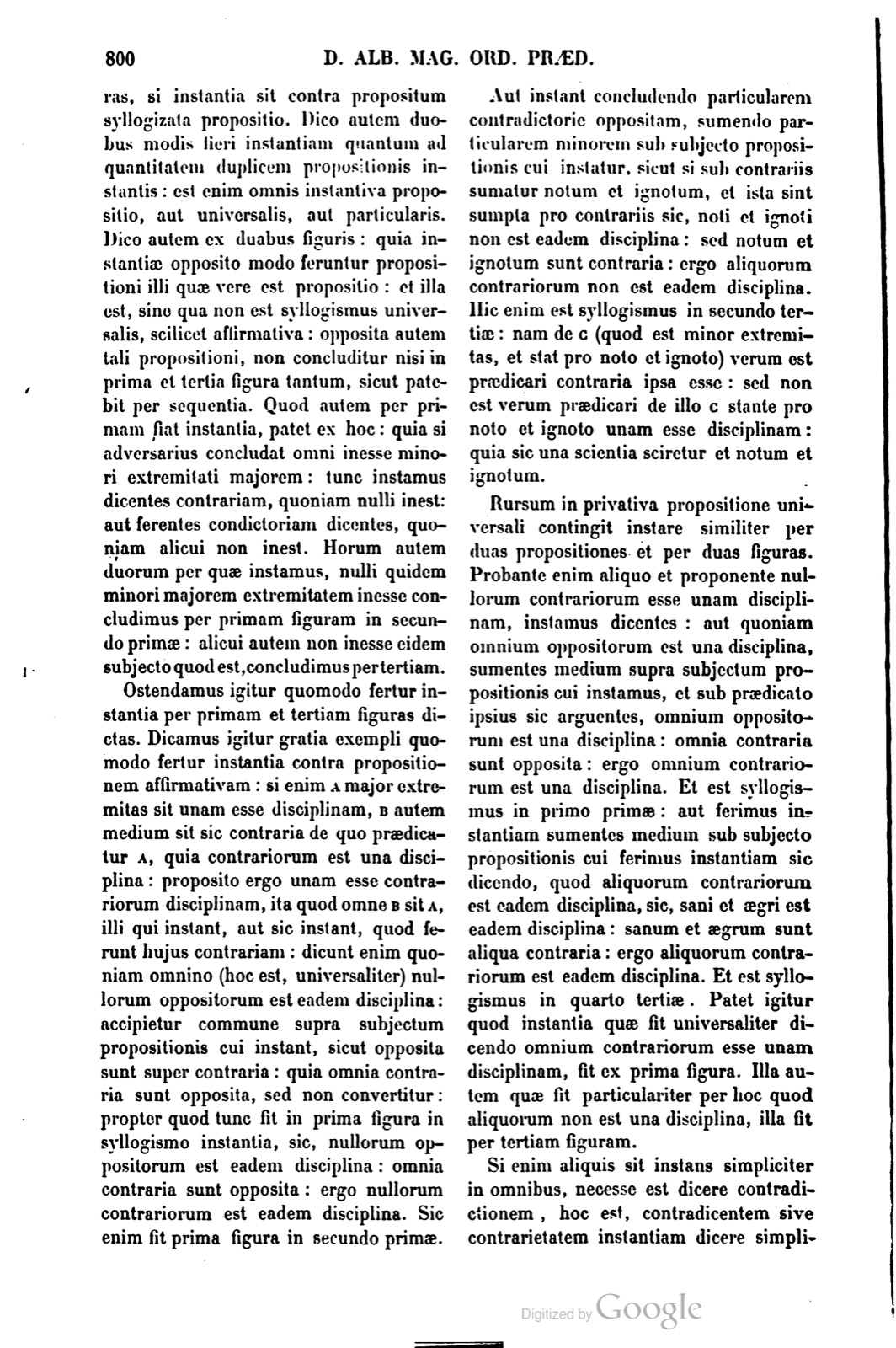
Ostendamus igitur quomodo fertur instantia per primam et tertiam figuras dictas. Dicamus igitur gratia exempli quomodo fertur instantia contra propositionem affirmativam: si enim A major extremitas sit unam esse disciplinam, B autem medium sit sic contraria de quo praedicatur A, quia contrariorum est una disciplina: proposito ergo unam esse contrariorum disciplinam, ita quod omne B sit A, illi qui instant, aut sic instant, quod ferunt hujus contrariam: dicunt enim quoniam omnino (hoc est, universaliter) nullorum oppositorum est eadem disciplina: accipietur commune supra subjectum propositionis cui instant, sicut opposita sunt super contraria: quia omnia contraria sunt opposita, sed non convertitur: propter quod tunc fit in prima figura in syllogismo instantia, sic, nullorum oppositorum est eadem disciplina: omnia contraria sunt opposita: ergo nullorum contrariorum est eadem disciplina. Sic enim fit prima figura in secundo primae.
Aut instant concludendo particularem contradictorie oppositam, sumendo particularem minorem sub subjecto propositionis cui instatur, sicut si sub contrariis sumatur notum et ignotum, et ista sint sumpta pro contrariis sic, noti et ignoti non est eadem disciplina: sed notum et ignotum sunt contraria: ergo aliquorum contrariorum non est eadem disciplina. Hic enim est syllogismus in secundo tertiae: nam de C (quod est minor extremitas, et stat pro noto et ignoto) verum est praedicari contraria ipsa esse: sed non est verum praedicari de illo C stante pro noto et ignoto unam esse disciplinam: quia sic una scientia sciretur et notum et ignotum.
Rursum in privativa propositione universali contingit instare similiter per duas propositiones et per duas figuras. Probante enim aliquo et proponente nullorum contrariorum esse unam disciplinam, instamus dicentes: aut quoniam omnium oppositorum est una disciplina, sumentes medium supra subjectum propositionis cui instamus, et sub praedicato ipsius sic arguentes, omnium oppositorum est una disciplina: omnia contraria sunt opposita: ergo omnium contrariorum est una disciplina. Et est syllogismus in primo primae: aut ferimus instantiam sumentes medium sub subjecto propositionis cui ferimus instantiam sic dicendo, quod aliquorum contrariorum est eadem disciplina, sic, sani et aegri est eadem disciplina: sanum et aegrum sunt aliqua contraria: ergo aliquorum contrariorum est eadem disciplina. Et est syllogismus in quarto tertiae. Patet igitur quod instantia quae fit universaliter dicendo omnium contrariorum esse unam disciplinam, fit ex prima figura. Illa autem quae fit particulariter per hoc quod aliquorum non est una disciplina, illa fit per tertiam figuram.
Therefore let us show how instance is brought through the first and third figures mentioned. Therefore let us say, for the sake of example, how instance is brought against an affirmative proposition: for if A, the major extreme, is that there is one discipline, but B, the middle, is contraries in this way, of which A is predicated, because there is one discipline of contraries, therefore, with one discipline of contraries proposed, so that every B is A, those who instance either instance in this way, that they bring the contrary of this, for they say that absolutely, that is universally, there is not the same discipline of any opposites; the common is taken above the subject of the proposition against which they instance, as opposites are above contraries, because all contraries are opposites, but it is not converted. On account of this, then in the first figure an instance is made in a syllogism, thus: there is the same discipline of no opposites; all contraries are opposites; therefore there is the same discipline of no contraries. For thus the first figure is made in the second mode of the first figure.
Or they instance by concluding a particular contradictorily opposed proposition, taking a particular minor under the subject of the proposition against which the instance is made, as if under contraries the known and the unknown are taken, and these are taken for contraries thus: of the known and the unknown there is not the same discipline; but the known and the unknown are contraries; therefore of some contraries there is not the same discipline. For here there is a syllogism in the second mode of the third figure; for of C, which is the minor extreme and stands for the known and the unknown, it is true to predicate that they are contraries themselves, but it is not true to predicate of that C standing for the known and the unknown that there is one discipline, because in that way by one knowledge both the known and the unknown would be known.
Again, in a universal privative proposition it happens to instance similarly through two propositions and through two figures. For when someone proves and proposes that there is not one discipline of any contraries, we instance by saying either that there is one discipline of all opposites, taking the middle above the subject of the proposition against which we instance, and under its predicate arguing thus: of all opposites there is one discipline; all contraries are opposites; therefore of all contraries there is one discipline. And it is a syllogism in the first mode of the first figure. Or we bring an instance by taking the middle under the subject of the proposition to which we bring the instance, by saying thus, that of some contraries there is the same discipline, thus: of the healthy and the sick there is the same discipline; the healthy and the sick are some contraries; therefore of some contraries there is the same discipline. And it is a syllogism in the fourth mode of the third figure. Therefore it is plain that the instance which is made universally by saying that there is one discipline of all contraries is made from the first figure. But that which is made particularly through this, that of some there is not one discipline, is made through the third figure.
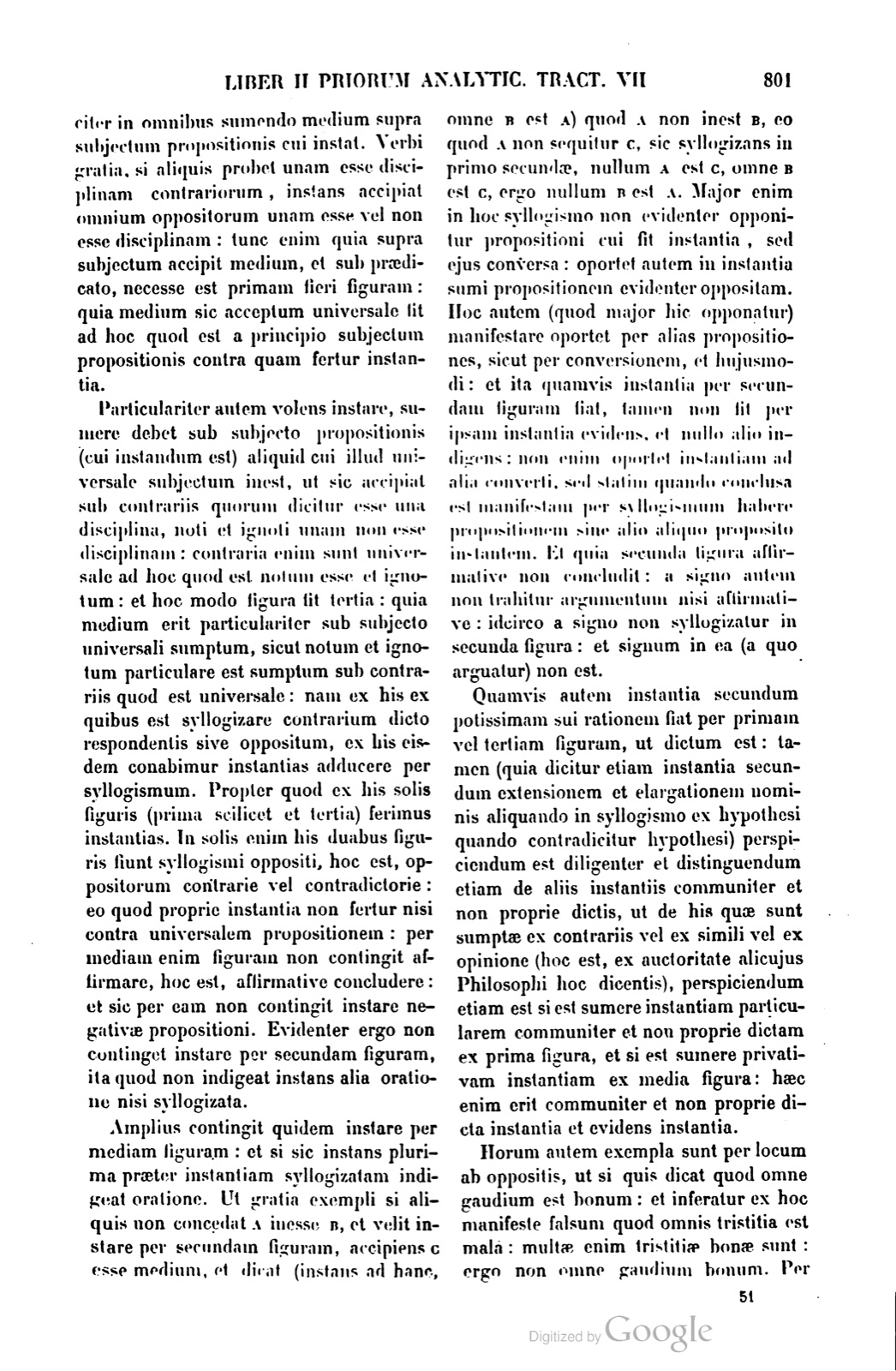
Si enim aliquis sit instans simpliciter in omnibus, necesse est dicere contradictionem, hoc est, contradicentem sive contrarietatem instantiam dicere simpliciter in omnibus sumendo medium supra subjectum propositionis cui instat. Verbi gratia, si aliquis probet unam esse disciplinam contrariorum, instans accipiat omnium oppositorum unam esse vel non esse disciplinam: tunc enim quia supra subjectum accipit medium, et sub praedicato, necesse est primam fieri figuram: quia medium sic acceptum universale fit ad hoc quod est a principio subjectum propositionis contra quam fertur instantia.
Particulariter autem volens instare, sumere debet sub subjecto propositionis (cui instandum est) aliquid cui illud universale subjectum inest, ut sic accipiat sub contrariis quorum dicitur esse una disciplina, noti et ignoti unam non esse disciplinam: contraria enim sunt universale ad hoc quod est notum esse et ignotum: et hoc modo figura fit tertia: quia medium erit particulariter sub subjecto universali sumptum, sicut notum et ignotum particulare est sumptum sub contrariis quod est universale: nam ex his ex quibus est syllogizare contrarium dicto respondentis sive oppositum, ex his eisdem conabimur instantias adducere per syllogismum. Propter quod ex his solis figuris (prima scilicet et tertia) ferimus instantias. In solis enim his duabus figuris fiunt syllogismi oppositi, hoc est, oppositorum contrarie vel contradictorie: eo quod proprie instantia non fertur nisi contra universalem propositionem: per mediam enim figuram non contingit affirmare, hoc est, affirmative concludere: et sic per eam non contingit instare negativae propositioni. Evidenter ergo non continget instare per secundam figuram, ita quod non indigeat instans alia oratione nisi syllogizata.
Amplius contingit quidem instare per mediam figuram: et si sic instans plurima praeter instantiam syllogizatam indigeat oratione. Ut gratia exempli si aliquis non concedat A inesse B, et velit instare per secundam figuram, accipiens C esse medium, et dicat (instans ad hanc, omne B est A) quod A non inest B, eo quod A non sequitur C, sic syllogizans in primo secundae, nullum A est C, omne B est C, ergo nullum B est A. Major enim in hoc syllogismo non evidenter opponitur propositioni cui fit instantia, sed ejus conversa: oportet autem in instantia sumi propositionem evidenter oppositam. Hoc autem (quod major hic opponatur) manifestare oportet per alias propositiones, sicut per conversionem, et hujusmodi: et ita quamvis instantia per secundam figuram fiat, tamen non fit per ipsam instantia evidens, et nullo alio indigens: non enim oportet instantiam ad alia converti, sed statim quando conclusa est manifestam per syllogismum habere propositionem sine alio aliquo proposito instantem. Et quia secunda figura affirmative non concludit: a signo autem non trahitur argumentum nisi affirmative: idcirco a signo non syllogizatur in secunda figura: et signum in ea (a quo arguatur) non est.
Quamvis autem instantia secundum potissimam sui rationem fiat per primam vel tertiam figuram, ut dictum est: tamen (quia dicitur etiam instantia secundum extensionem et elargationem nominis aliquando in syllogismo ex hypothesi quando contradicitur hypothesi) perspiciendum est diligenter et distinguendum etiam de aliis instantiis communiter et non proprie dictis, ut de his quae sunt sumptae ex contrariis vel ex simili vel ex opinione (hoc est, ex auctoritate alicujus Philosophi hoc dicentis), perspiciendum etiam est si est sumere instantiam particularem communiter et non proprie dictam ex prima figura, et si est sumere privativam instantiam ex media figura: haec enim erit communiter et non proprie dicta instantia et evidens instantia.
For if someone is instancing simply in all things, he must say a contradiction, that is, a contradicting instance or contrariety simply in all things by taking the middle above the subject of the proposition against which he instances. For example, if someone proves that there is one discipline of contraries, let the one instancing accept that there is one discipline or not one discipline of all opposites; for then, because he accepts the middle above the subject and under the predicate, the first figure must be made, because the middle so accepted becomes universal to that which from the beginning is the subject of the proposition against which the instance is brought.
But one wishing to instance particularly ought to take under the subject of the proposition, against which the instance is to be made, something to which that universal subject belongs, so that in this way under contraries, of which it is said that there is one discipline, he accepts that of the known and the unknown there is not one discipline; for contraries are universal with respect to this, which is to be known and unknown. And in this mode the figure becomes the third, because the middle will be taken particularly under the universal subject, as the known and the unknown is a particular taken under contraries, which is the universal. For from those things from which there is syllogizing the contrary or opposite to the saying of the respondent, from those same things we will try to bring instances through syllogism. On account of this, from these figures alone, namely the first and the third, we bring instances. For in these two figures alone are syllogisms of the opposite, that is, of things opposed contrarily or contradictorily, because properly an instance is not brought except against a universal proposition; for through the middle figure it does not happen to affirm, that is, to conclude affirmatively, and thus through it it does not happen to instance against a negative proposition. Therefore evidently it will not happen to instance through the second figure in such a way that the one instancing needs no other discourse except the one syllogized.
Moreover, it indeed happens to instance through the middle figure, even if the one so instancing needs very many discourses besides the syllogized instance. As for the sake of example, if someone does not grant that A belongs to B, and wishes to instance through the second figure, taking C to be the middle, and says, instancing against this, every B is A, that A does not belong to B because A does not follow C, syllogizing thus in the first mode of the second figure: no A is C; every B is C; therefore no B is A. For the major in this syllogism is not evidently opposed to the proposition against which the instance is made, but to its converse; but in an instance one must take a proposition evidently opposed. But this, that the major here is opposed, must be manifested through other propositions, as through conversion and things of this kind. And thus, although an instance is made through the second figure, nevertheless an evident instance, needing nothing else, is not made through it. For an instance ought not to be converted to other things, but immediately when it has been concluded through syllogism, it ought to have a manifest proposition instancing without some other thing proposed. And because the second figure does not conclude affirmatively, but an argument is not drawn from a sign except affirmatively, therefore from a sign there is no syllogizing in the second figure; and a sign, from which it is argued, does not exist in it.
But although instance according to its most powerful account is made through the first or third figure, as has been said, nevertheless, because instance is also said according to an extension and broadening of the name sometimes in a syllogism from hypothesis when the hypothesis is contradicted, one must look carefully and also distinguish concerning other instances commonly and not properly so called, as concerning those which are taken from contraries or from a similar thing or from opinion, that is, from the authority of some philosopher saying this; it must also be looked into whether it is possible to take a particular instance, commonly and not properly so called, from the first figure, and whether it is possible to take a privative instance from the middle figure. For this will be an instance commonly and not properly so called, and an evident instance.
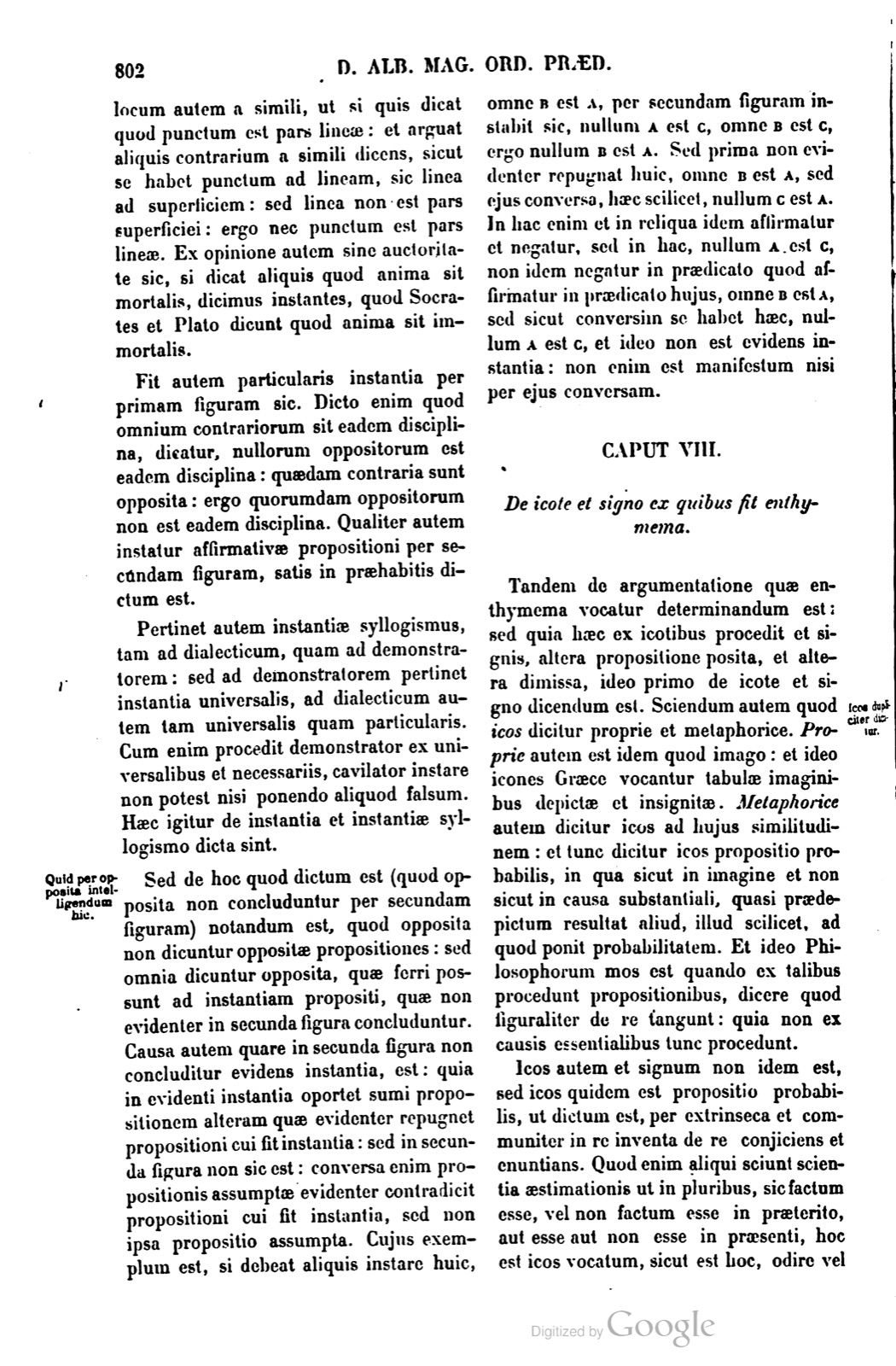
Horum autem exempla sunt per locum ab oppositis, ut si quis dicat quod omne gaudium est bonum: et inferatur ex hoc manifeste falsum quod omnis tristitia est mala: multae enim tristitiae bonae sunt: ergo non omne gaudium bonum. Per locum autem a simili, ut si quis dicat quod punctum est pars lineae: et arguat aliquis contrarium a simili dicens, sicut se habet punctum ad lineam, sic linea ad superficiem: sed linea non est pars superficiei: ergo nec punctum est pars lineae. Ex opinione autem sine auctoritate sic, si dicat aliquis quod anima sit mortalis, dicimus instantes, quod Socrates et Plato dicunt quod anima sit immortalis.
Fit autem particularis instantia per primam figuram sic. Dicto enim quod omnium contrariorum sit eadem disciplina, dicatur, nullorum oppositorum est eadem disciplina: quaedam contraria sunt opposita: ergo quorumdam oppositorum non est eadem disciplina. Qualiter autem instatur affirmativae propositioni per secundam figuram, satis in praehabitis dictum est.
Pertinet autem instantiae syllogismus, tam ad dialecticum, quam ad demonstratorem: sed ad demonstratorem pertinet instantia universalis, ad dialecticum autem tam universalis quam particularis. Cum enim procedit demonstrator ex universalibus et necessariis, cavilator instare non potest nisi ponendo aliquod falsum. Haec igitur de instantia et instantiae syllogismo dicta sint.
Marginal label (printed page 802): Quid per opposita intelligendum hic.
Sed de hoc quod dictum est (quod opposita non concluduntur per secundam figuram) notandum est, quod opposita non dicuntur oppositae propositiones: sed omnia dicuntur opposita, quae ferri possunt ad instantiam propositi, quae non evidenter in secunda figura concluduntur. Causa autem quare in secunda figura non concluditur evidens instantia, est: quia in evidenti instantia oportet sumi propositionem alteram quae evidenter repugnet propositioni cui fit instantia: sed in secunda figura non sic est: conversa enim propositionis assumptae evidenter contradicit propositioni cui fit instantia, sed non ipsa propositio assumpta. Cujus exemplum est, si debeat aliquis instare huic, omne B est A, per secundam figuram instabit sic, nullum A est C, omne B est C, ergo nullum B est A. Sed prima non evidenter repugnat huic, omne B est A, sed ejus conversa, haec scilicet, nullum C est A. In hac enim et in reliqua idem affirmatur et negatur, sed in hac, nullum A est C, non idem negatur in praedicato quod affirmatur in praedicato hujus, omne B est A, sed sicut conversim se habet haec, nullum A est C, et ideo non est evidens instantia: non enim est manifestum nisi per ejus conversam.
But examples of these are through the place from opposites, as if someone says that every joy is good, and from this the manifestly false thing is inferred, that every sadness is evil; for many sadnesses are good; therefore not every joy is good. But through the place from a similar thing, as if someone says that a point is a part of a line, and someone argues the contrary from a similar thing, saying: as the point has itself to the line, so the line to the surface; but the line is not a part of the surface; therefore neither is the point a part of the line. But from opinion without authority, in this way: if someone says that the soul is mortal, we say, instancing, that Socrates and Plato say that the soul is immortal.
But a particular instance is made through the first figure in this way. When it has been said that there is the same discipline of all contraries, let it be said: there is the same discipline of no opposites; certain contraries are opposites; therefore of certain opposites there is not the same discipline. But in what way an affirmative proposition is instanced against through the second figure has sufficiently been said in the preceding things.
But the syllogism of instance pertains both to the dialectician and to the demonstrator; but universal instance pertains to the demonstrator, while both universal and particular instance pertain to the dialectician. For when the demonstrator proceeds from universals and necessary things, the quibbler cannot instance except by positing something false. Therefore let these things have been said about instance and the syllogism of instance.
Marginal label (printed page 802): What must be understood here by opposites.
But about this which has been said, that opposites are not concluded through the second figure, it must be noted that opposite propositions are not called opposites; rather all things which can be brought to the instance of the proposed thing are called opposites, which are not evidently concluded in the second figure. But the cause why an evident instance is not concluded in the second figure is this: because in an evident instance one must take another proposition which evidently conflicts with the proposition against which the instance is made; but in the second figure it is not so. For the converse of the proposition assumed evidently contradicts the proposition against which the instance is made, but not the assumed proposition itself. An example of this is if someone should instance against this, every B is A; through the second figure he will instance thus: no A is C; every B is C; therefore no B is A. But the first does not evidently conflict with this, every B is A, but its converse does, namely this: no C is A. For in this and in the other the same thing is affirmed and denied; but in this, no A is C, the same thing is not denied in the predicate which is affirmed in the predicate of this, every B is A, but this, no A is C, has itself as conversely; and therefore it is not an evident instance, for it is not manifest except through its converse.
If a page does not appear, its photograph has not been uploaded yet.