Works › Prior Analytics, Books I–II
Volume 1 · pp. 797–799
Treatise VII, Chapter VI
A marker with ≈ is an approximate page boundary, placed by measure of the text; the page photographs remain the authority. In the paired views, clicking a page marker brings that page into view.
CAPUT VI.
De deductione, quid et quot modis fiat.
Deductio autem (quia opponitur per aliquem modum inductioni) post haec ordinanda: habet enim deductio medium magis notum secundum naturam conclusione, et propinquius scientiae quam inductio quae secundum naturam rei habet minus notum et remotius a scientia secundum naturam: infert enim universale ex singularibus, quae secundum naturam minus nota sunt, et magis remota a scientia quam universale.
Est igitur deductio, quando ipsi medio palam est inesse primum extremum sive majus extremum in majori propositione, in qua majus extremum praedicatur de medio: sic enim se habentibus terminis, primo scilicet, et medio, propositio major efficitur per se nota. Sed dubium est an postremo quod est minor extremitas, insit medium in minori propositione, in qua medium praedicatur de minori extremitate secundum dispositionem primae figurae: et quamvis dubium sit hoc, tamen vel similiter vel aequaliter debet esse credibilis, aut etiam magis credibilis quam conclusio sive conclusione: tunc enim quia non est certa minor, perfectam scientiam facere non potest: et quia aliquid habet credulitatis aliquo modo disposita in formam syllogismi, deducit et vicinat ad scientiam, quamvis non attingat perfecte usque ad scientiam. Iste est igitur unus et prior modus deductionis.
Amplius autem secundus modus deductionis est, si quidem minor mediata sit propositio, sicut et conclusio: tamen pauciora sunt media ad probandam minorem, quam ad probandam conclusionem: tunc enim omnino accidit minorem (eo quod pauciora habet media quam conclusio) propinquiorem esse scientiae: quamvis enim medium sit causa scientiae, tamen quod plura habet media, incertius est et longius a scientia, quam id quod pauciora, quia longinquius est a primis principiis per se notis et immediatis1. Isti igitur duo modi sunt deductionis. Penes diversitatem enim majoris deductio sumi non potest: quia in ipsa est tota virtus inferendi in syllogismo: et conclusio est pars ipsius: et ideo si ipsa esset dubia, nulla oratio fieret deductio ad scientiae vicinitatem.
CHAPTER VI.
On Deduction, What It Is And In How Many Modes It Is Made.
But deduction, because it is opposed in some mode to induction, must be ordered after these things; for deduction has a middle more known according to nature than the conclusion, and nearer to knowledge than induction, which according to the nature of the thing has what is less known and more remote from knowledge according to nature. For it infers a universal from singulars, which according to nature are less known and more remote from knowledge than the universal.
Therefore deduction is when it is clear that the first extreme or greater extreme belongs to the middle itself in the major proposition, in which the greater extreme is predicated of the middle; for with the terms having themselves thus, namely the first and the middle, the major proposition is made known through itself. But it is doubtful whether the middle belongs to the last, which is the minor extreme, in the minor proposition, in which the middle is predicated of the minor extreme according to the disposition of the first figure; and although this is doubtful, nevertheless it ought to be credible either similarly or equally, or even more credible than the conclusion. For then, because the minor is not certain, it cannot make perfect knowledge; and because it has something of credibility disposed in some mode into the form of a syllogism, it deduces and brings near to knowledge, although it does not attain perfectly all the way to knowledge. Therefore this is one and the prior mode of deduction.
Moreover, the second mode of deduction is if indeed the minor is a mediate proposition, just as the conclusion is, but there are fewer middles for proving the minor than for proving the conclusion. For then it altogether happens that the minor, because it has fewer middles than the conclusion, is nearer to knowledge; for although the middle is the cause of knowledge, nevertheless what has more middles is more uncertain and farther from knowledge than that which has fewer, because it is more distant from the first principles known through themselves and immediate1. Therefore these are the two modes of deduction. For deduction cannot be taken according to the diversity of the major, because in it is the whole power of inferring in the syllogism, and the conclusion is a part of it; and therefore, if it were doubtful, no discourse would become a deduction toward nearness to knowledge.
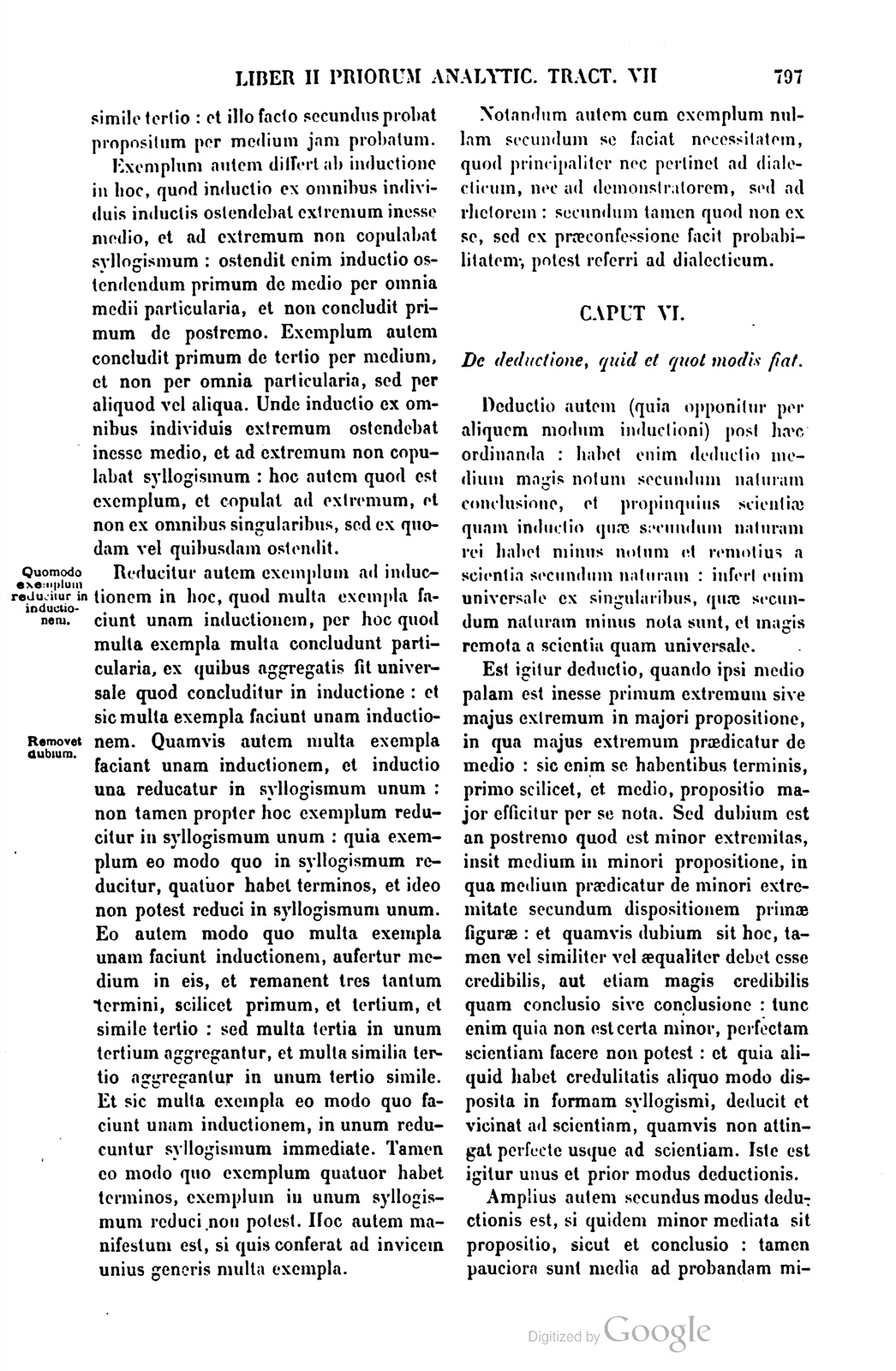
Explanatio autem primi modi deductionis est in terminis A B C transcendentibus: qui tamen ad materiam determinantur in exemplo Platonis posito in libro qui dicitur Mennonis, ubi quaeritur, utrum virtus sit disciplinabile vel assuescibile bonum, vel donum a diis donatum? Sit enim A docibile, quod est major extremitas. Id autem in quo est B medium, sit disciplina, C autem minor extremitas sit justitia generalis, quae est virtus in genere. Tali autem dispositione terminorum facta, manifestum est per se, quod omnis disciplina docibilis est, et incrementum accipit experimento et doctrina. Quod autem justitia generalis sive virtus sit disciplina (quamvis hoc dixit Socrates) dubium est. Si ergo in tali syllogismo similiter sive aequaliter vel magis credibilis sit propositio minor (quae est B C) quam conclusio quae est A C propositio: tunc talis syllogismus deductio vocatur. Cujus ratio est: quia propinquius est scientiae: eo quod sic syllogizantes assumpserint A C conclusionem talem esse, cujus prius nullam habuerint disciplinam sive scientiam, B C autem propositionem sumpserunt quidem dubiam, sed non penitus ignoratam.
Marginal label (printed page 798): Objectio.
Si quis autem objiciat dicens quod ubi minor propositio est dubia, ibi petitur id quod est in principio.
Marginal label (printed page 798): Solutio.
Dicendum quod hoc non est verum ubi minor penitus sit ignorata. Adhuc autem cum minor sit dubia, si debeat esse petitio principii, oportet converti terminos majoris propositionis: hic autem non est sic. Sic ergo explanatus est modus primus deductionis: et arguitur sic in primo primae, omnis disciplina docibilis: omnis virtus disciplina: ergo omnis virtus docibilis.
Aut rursus in modo secundo talis fit explanatio, et per terminos transcendentes, et per terminos in materia speciali sumptos. Secundus enim modus est, si pauciora sunt media ad hoc quod C sit B (quod dixit minor propositio) quam ad conclusionem: nam et sic minor est aliquid propinquius scientiae quam penitus ignorata conclusio, ut si D sit quadrangulari vel quadrari, et sit major extremitas; id autem in quo est E sit recta linea, quae est medium; in quo autem est F minor extremitas, sit circulus. Si ergo ejus quae est minor E F propositio, sit unum solum medium, hoc scilicet, per lunares figuras sive portiones aequales sumere lineas curvas rectae lineae quae est quadrati radix, et sic circulum aequalem fieri rectae lineae quadrati: ad conclusionem autem plura habeantur media, quam hoc quod dictum est: tunc iste est secundus modus deductionis: quia tunc iterum minor propinquior est scientiae, quam conclusio: et syllogizatur sic, omnis linea recta quadratur per lunares figuras; per conum circuli est accipere lineas curvas lineis rectis aequales: ergo per lunares figuras contingit quadrari circulum.
But the explanation of the first mode of deduction is in transcendent terms A B C, which nevertheless are determined to matter in the example of Plato posited in the book which is called Meno, where it is asked whether virtue is a teachable or habituable good, or a gift given by the gods. For let A be teachable, which is the major extreme. But let that in which B, the middle, is be discipline; and let C, the minor extreme, be general justice, which is virtue in the genus. But with such a disposition of terms made, it is manifest through itself that every discipline is teachable, and takes increase by experience and teaching. But that general justice or virtue is discipline, although Socrates said this, is doubtful. Therefore if in such a syllogism the minor proposition, which is B C, is similarly or equally or more credible than the conclusion which is the A C proposition, then such a syllogism is called deduction. The reason for this is that it is nearer to knowledge, because those syllogizing in this way will have assumed that the A C conclusion is such a thing of which previously they had no discipline or knowledge, but they took the B C proposition as doubtful indeed, but not wholly unknown.
Marginal label (printed page 798): Objection.
But if someone objects, saying that where the minor proposition is doubtful, there that which is in the beginning is begged.
Marginal label (printed page 798): Solution.
It must be said that this is not true where the minor is wholly unknown. Again, when the minor is doubtful, if there ought to be petition of the principle, the terms of the major proposition must be converted; but here it is not so. Thus, therefore, the first mode of deduction has been explained; and it is argued thus in the first mode of the first figure: every discipline is teachable; every virtue is discipline; therefore every virtue is teachable.
Or again, in the second mode, such an explanation is made both through transcendent terms and through terms taken in special matter. For the second mode is if there are fewer middles for this, that C is B, which the minor proposition said, than for the conclusion; for thus also the minor is something nearer to knowledge than the conclusion that is wholly unknown, as if D is to be made quadrangular or to be squared, and is the major extreme; but that in which E is, let it be a straight line, which is the middle; but that in which F, the minor extreme, is, let it be the circle. Therefore, if there is only one middle of that which is the minor E F proposition, namely this, through lunar figures or equal portions to take curved lines equal to the straight line which is the root of the square, and thus for the circle to become equal to the straight line of the square, but more middles are had for the conclusion than this which has been said, then this is the second mode of deduction, because then again the minor is nearer to knowledge than the conclusion; and it is syllogized thus: every straight line is squared through lunar figures; through the cone of the circle it is possible to receive curved lines equal to straight lines; therefore through lunar figures it happens that the circle is squared.
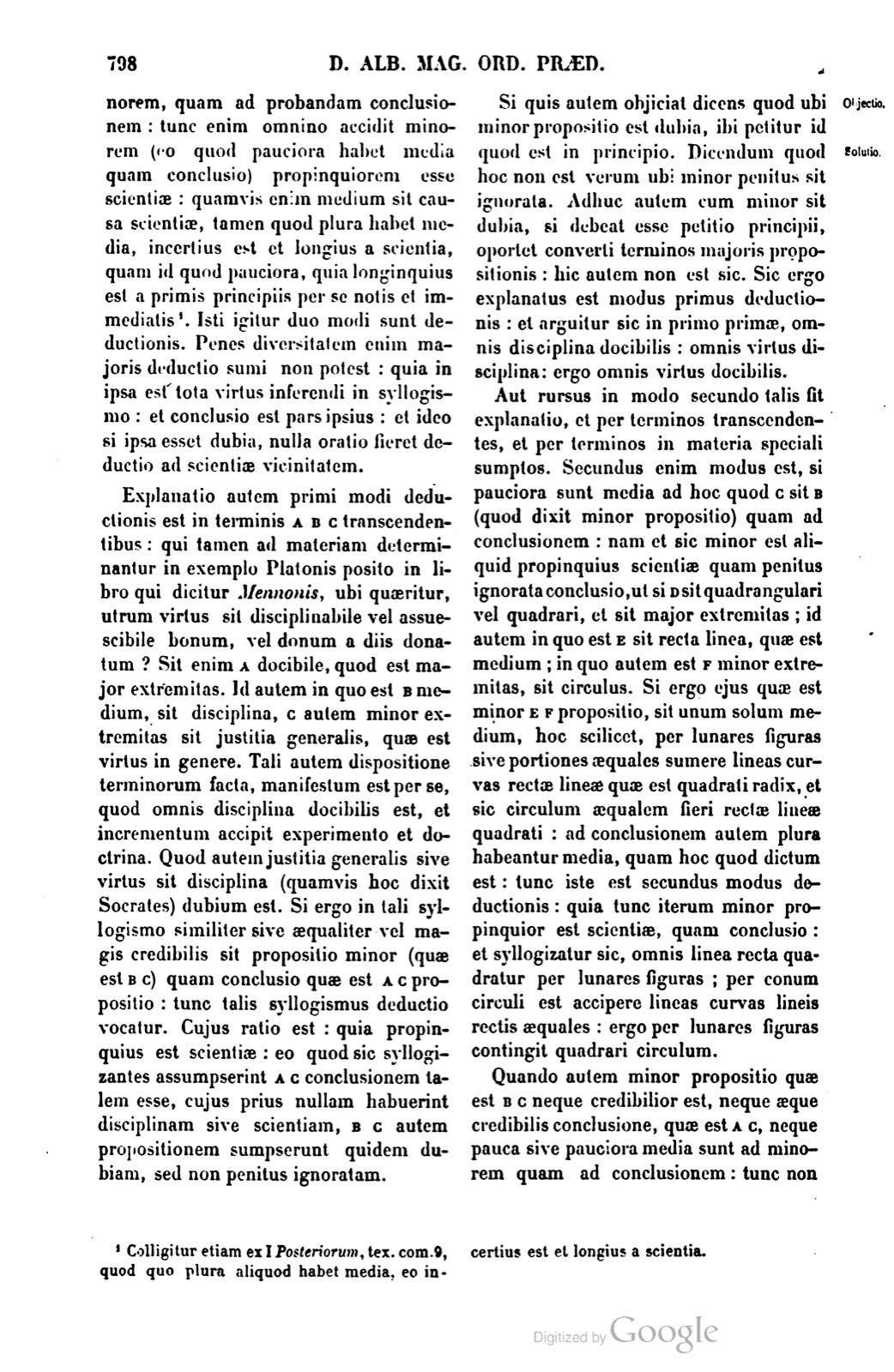
Quando autem minor propositio quae est B C neque credibilior est, neque aeque credibilis conclusione, quae est A C, neque pauca sive pauciora media sunt ad minorem quam ad conclusionem: tunc non dico talem argumentationem esse deductionem: quia non conducit ad aliquid vel per aliquid propinquius scientiae. Similiter etiam non dicitur deductio, quando immediata et per se nota est minor propositio sicut major: talis enim syllogismus demonstratio est, et disciplina sive perfecta scientia est, quod est hujusmodi, et non est deductio in ipso, sed status et finis. Quamvis autem deductio secundum utrumque modum dicta, in prima figura tantum hic disposita sit a nobis: potest tamen fieri in qualibet figura, dummodo caveatur quod illa quae fiet major (cum syllogismus secundae vel tertiae figurae in primam figuram reducitur) semper sit per se nota et altera dubia, sed non ignorata.
Deductio autem modus rationis est deficiens a demonstratione quando est in demonstrativis, et deficiens a certitudine syllogistica quando est in probabilibus et dialecticis. Et haec de deductione dicta sunt. Hic enim posita sunt ea quae dicta sunt propter oppositionem quam habet ad inductionem: et non est usus ejus multum in scientiis vel artibus.
But when the minor proposition, which is B C, is neither more credible, nor equally credible with the conclusion, which is A C, nor are there few or fewer middles for the minor than for the conclusion, then I do not say that such an argumentation is deduction, because it does not lead to something or through something nearer to knowledge. Likewise it is also not called deduction when the minor proposition is immediate and known through itself just like the major; for such a syllogism is demonstration, and discipline or perfect knowledge, which is of this kind, and deduction is not in it, but a standing-point and end. But although deduction said according to each mode has here been disposed by us only in the first figure, nevertheless it can be made in any figure, provided that care is taken that that which will become the major, when a syllogism of the second or third figure is reduced into the first figure, is always known through itself and the other is doubtful, but not unknown.
But deduction is a mode of reason deficient from demonstration when it is in demonstratives, and deficient from syllogistic certainty when it is in probabilities and dialecticals. And these things have been said about deduction. For here those things which have been said have been posited on account of the opposition which it has to induction; and its use is not great in sciences or arts.
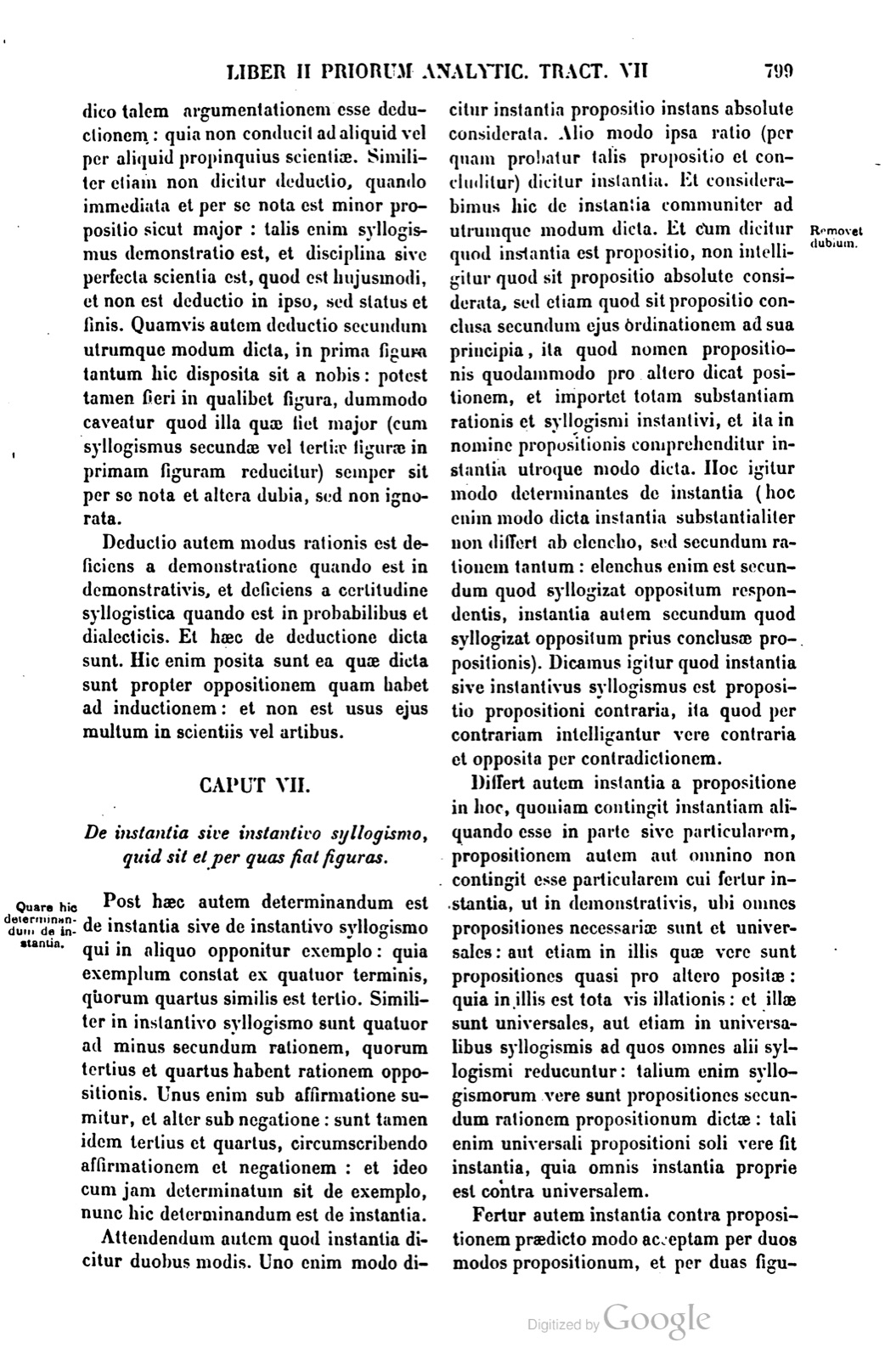
Notes
- It is also gathered from Posterior Analytics I, text/commentary 9, that the more middles something has, the more uncertain it is and the farther from knowledge. (Colligitur etiam ex I Posteriorum, tex. com. 9, quod quo plura aliquod habet media, eo incertius est et longius a scientia.) ↩
If a page does not appear, its photograph has not been uploaded yet.